AI trading isn’t a futuristic buzzword reserved for hedge funds and institutional quants; it’s a method of using artificial intelligence and machine learning to analyze market data, identify patterns that human traders might miss, and execute trades automatically. Rather than relying on human intuition alone, AI trading systems monitor price movements, volume, sentiment, and other signals in real time, enabling faster, more data-driven decisions that adapt to shifting market conditions. Essentially, AI trading brings automation and adaptive learning to financial markets in a way humans simply cannot match at scale.
In my experience researching and explaining advanced AI workflows, whether looking at automated decision systems in operations (like in our deep dive on AIOps explained), or voice automation tools like Murf AI, the common thread is this: AI excels where complexity exceeds human processing limits. When applied to markets, it means analyzing tens of thousands of data points per second to identify subtle correlations and signals that inform trade decisions. In this article, we’ll break down how AI trading works, the key strategies behind it, the benefits and risks, and how it compares to traditional trading approaches.
What Is AI Trading?
At its core, AI trading uses artificial intelligence (AI), machine learning (ML), and advanced algorithms to analyze market data and make trading decisions, often automatically. Unlike purely manual or discretionary trading, where you place trades based on research or gut instinct, AI trading systems operate by learning from historical and real-time data to generate insights and execute orders on your behalf.
AI trading can encompass a range of techniques. It may include machine learning models that adapt to patterns, neural networks that detect nonlinear relationships, and reinforcement learning systems that improve strategy performance over time. These systems are designed to monitor enormous volumes of data, from price actions and order book changes to news sentiment and macroeconomic indicators, all in milliseconds.
How AI Trading Works

Understanding AI trading means looking at the step-by-step process that turns raw data into execution decisions:
1. Data Collection and Integration
AI trading systems ingest massive streams of data: prices, volume, technical indicators, news feeds, social sentiment, economic reports, and more. This data forms the basis of pattern recognition and prediction.
2. Preprocessing and Feature Engineering
Before analysis, raw data is cleaned, normalized, and transformed into features (e.g., moving averages, momentum indicators). This helps machine learning models focus on meaningful signals rather than noise.
3. Model Training and Learning
Machine learning models, including deep neural networks or reinforcement learning algorithms, learn from historical data. They build predictive models that link input features to outcomes such as price direction or volatility. Over time, these models can update themselves with new data.
4. Backtesting and Validation
Before live deployment, strategies are backtested on historical market data to assess their performance. This step helps reduce overfitting, in which a model performs well on historical data but fails in live markets.
5. Signal Generation and Execution
Once validated, the AI system continuously analyzes new data, generates signals (buy/sell/hold), and automatically executes trades based on predefined rules or thresholds.
6. Monitoring and Adaptation
AI trading systems monitor performance and adapt to changing market conditions, improving models as new data arrives. This continuous learning is what separates AI trading from static algorithmic setups.
Types of AI Trading Strategies
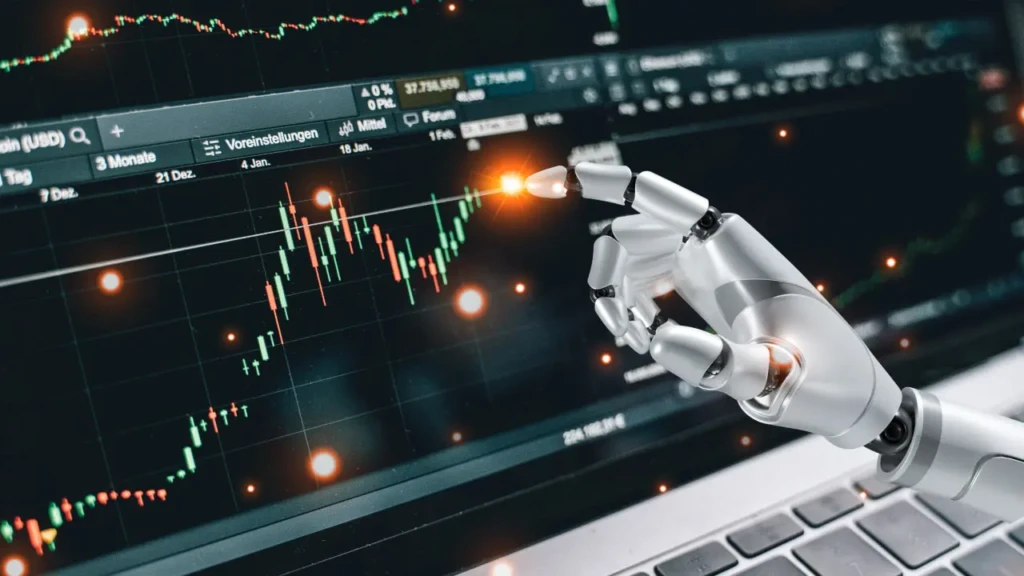
AI trading isn’t one-size-fits-all; it includes several strategic approaches:
Trend Following
AI models detect and exploit ongoing price trends, entering or exiting positions based on learned directional behavior.
Mean Reversion
This strategy assumes prices will return to their historical average and that AI systems will identify assets that deviate from typical patterns.
Statistical Arbitrage
AI can find temporary price inefficiencies across correlated assets and execute high-speed trades to capture small profits repetitively.
Sentiment and News-Driven Trading
Using natural language processing (similar to tools discussed in our DeepSeek vs ChatGPT comparison), AI systems analyze news and social media sentiment to anticipate market swings.
Reinforcement Learning Strategies
These systems learn optimal trade execution by trial and adaptation, adjusting tactics based on past successes and failures.
Benefits of AI Trading
Adopting AI in trading offers several clear advantages:
- Speed and Scalability: AI systems can process data and execute trades in milliseconds, far faster than any human.
- Emotion-Free Decisions: Unlike humans, AI models don’t experience fear or greed, helping reduce impulsive trading.
- Data-Driven Precision: AI can analyze large datasets and uncover patterns that are not obvious to human traders.
- 24/7 Operations: Markets like crypto never sleep, and AI trading bots can monitor and act continuously.
These strengths explain why AI is increasingly integrated into tools used not just by institutional traders but by retail investors seeking systematic advantages. However, automation’s presence doesn’t guarantee profits and doesn’t mean you should trade without understanding the risks.
Risks and Limitations of AI Trading
While AI trading offers many benefits, it’s important to balance them against real limitations:
- Overfitting and Model Bias: Models trained too closely on past data may perform poorly in new market conditions.
- Market Regime Shifts: Sudden events (economic shocks, policy changes) can render previously learned patterns ineffective.
- Operational Risk: Algorithm or connectivity failures can lead to unintended trades or losses.
- Regulation and Compliance: Automated strategies must operate within regulatory frameworks that vary by market and region.
Without careful oversight and risk management, even sophisticated AI trading systems can incur losses.
AI Trading vs Traditional Trading
AI trading and traditional (human) trading differ in execution, speed, and decision methodology. The following table highlights these contrasts:
Aspect | AI Trading | Traditional Trading |
Decision Logic | Data-driven, automated | Human judgment, discretionary |
Speed | Milliseconds | Seconds to minutes |
Emotion Influence | None | Significant |
Scalability | High (multi-market) | Limited by human capacity |
Adaptation | Continuous learning | Manual strategy updates |
This shows how AI trading systems prioritize consistency and speed, whereas traditional trading relies on experience and intuition.
Who Should Consider AI Trading?
AI trading isn’t just for professionals. It appeals to:
- Retail Traders looking to automate strategies without constant screen time
- Professional Traders seeking data-driven edge
- Investors with Technical Skills comfortable with backtesting and risk controls
- Beginners who want to explore systematic trading with proper education and risk limits
Whatever your background, AI trading should start with clear learning and risk management before moving into live capital commitment.
How to Get Started With AI Trading
If you’re considering AI trading, here’s a practical roadmap:
- Learn Market Fundamentals: Understand basic trading and risk concepts before automation.
- Choose a Trading Platform: Consider platforms that support AI trading models or bots.
- Backtest Strategies: Validate your approach with historical data before going live.
- Start Small: Use paper trading or small capital to test real-world performance.
- Monitor and Adjust: Continuously evaluate model performance and adapt to market changes.
Approaching AI trading with disciplined steps reduces risk and improves long-term viability.
Conclusion
AI trading represents a major evolution in how trades are analyzed and executed, combining machine intelligence with market data at speeds and scales human traders can’t match. It brings systematic discipline, emotion-free execution, and analytical depth to trading, making it compelling for a range of market participants. However, AI trading isn’t a magic formula for profit; it requires careful model validation, risk controls, and ongoing oversight to be effective.
From my perspective, the most successful use of AI trading comes when you balance its technical power with human judgment and risk awareness. Treat AI as a tool that amplifies your strategy, not as a replacement for your understanding. By learning fundamentals, rigorously testing strategies, and applying disciplined risk controls, you can explore AI trading in a way that supports sustainable decision-making and long-term growth.
Frequently Asked Questions (FAQs)
AI trading has potential but does not guarantee profits; results depend on model quality, strategy, and market conditions.
Yes, AI trading is legal in most markets, though strategies must comply with financial regulations.
Yes, but beginners should start with education and backtesting before deploying real capital.
No. Like all trading, returns are uncertain and depend on many factors, including risk management.
At Your Tech Compass, we publish detailed tech guides, reviews, and comparisons to help users choose the right devices and tools.