I want to take you back to a specific moment first, because it provides the context that makes this comparison genuinely interesting rather than just another AI tool review. In January 2025, DeepSeek released a model called R1, and within days, it had displaced ChatGPT at the top of global app store charts while Nvidia’s stock dropped by hundreds of billions in a single trading session. The shock wasn’t that DeepSeek built a good AI; it was that a relatively unknown Chinese lab built a genuinely frontier-competitive model at a reported fraction of OpenAI’s training cost, and then released the weights for free. That moment rewrote the industry’s assumptions about the relationship between compute spending and AI capability, and it set the terms of every serious AI comparison that has followed.
Fast forward to today, and the comparison has gotten both more interesting and more nuanced. On April 23, 2026, OpenAI released GPT-5.5, and DeepSeek countered the very next day with V4 Pro and V4 Flash. Two flagship models, launched within 48 hours of each other, both supporting 1-million-token context windows, both claiming frontier coding performance, at price points that are orders of magnitude apart. That’s the current state of this comparison, and it’s where this guide actually starts, not with R1, not with V3, not with GPT-4o, but with where both products genuinely stand in June 2026. By the end, you’ll have the benchmark data, the real pricing numbers, the privacy trade-offs that actually matter, and a clear-eyed answer to which tool belongs in your workflow.
A note before we begin: every YTC score is earned, never negotiated. If you want to understand exactly how we evaluate apps & tools and how we handle affiliate relationships, our Review Methodology lays it all out.
DeepSeek vs ChatGPT: Quick Comparison
Feature | DeepSeek V4 | ChatGPT (GPT-5.5) |
Latest Model | V4 Pro / V4 Flash (April 24, 2026) | GPT-5.5 (April 23, 2026) |
Context Window | 1M tokens (default, both variants) | 1M tokens |
SWE-bench Verified (coding) | ~91.2% (V4 Pro) | Strong (leads on Terminal-Bench 2.0 – 82.7%) |
Open Weights | ✅ MIT license, Hugging Face | ❌ Closed source |
Self-Hosting | ✅ Yes | ❌ No |
Free Tier | ✅ Fully free, no subscription tiers | ✅ Limited free tier (GPT-5.5 access) |
API Output Cost (Per Mtok) | $0.28 (Flash) / $3.48 (Pro) | $30 (standard) / $180 (Pro) |
Multimodal (Images, Voice) | ⚠️ Limited (V4 primarily text/code) | ✅ Full (DALL-E 3, voice, camera) |
Native Desktop App | ❌ No | ✅ Mac and Windows |
Privacy / Regulatory Concerns | ⚠️ Active, documented scrutiny | Stable |
Best For | Cost-sensitive production, coding, and self-hosting | General use, multimodal, ecosystem breadth |
What Is ChatGPT?
ChatGPT is OpenAI’s conversational AI platform, the product that put AI assistants on the mainstream map and still commands the world’s largest active AI user base. GPT-5.5, released April 23, 2026, is the current default model for Plus, Pro, Business, and Enterprise subscribers. OpenAI describes it as faster, more token-efficient, and better at coding and research than its predecessor, with a notable jump in long-context reasoning: MRCR v2 at 1 million tokens went from 36.6% on GPT-5.4 to 74.0% on GPT-5.5, nearly doubling performance on extended context tasks in a single generation.
Beyond raw model capability, ChatGPT’s defining advantage is its product completeness. Voice conversations, real-time image analysis, DALL-E 3 image generation, web search, a Canvas editor for collaborative code review, native desktop apps for Mac and Windows, a browser extension, and more than 6,000 available plugins and workflow integrations, all accessible from a single interface. The $20/month Plus subscription bundles all of this together, making ChatGPT a genuinely comprehensive AI workspace rather than just a chat interface.
What ChatGPT Doesn’t Offer: Open weights, self-hosting, or pricing that makes high-volume production workloads financially straightforward. Those are exactly the trade-offs where DeepSeek fills the gap.
What Is DeepSeek?
DeepSeek is an AI research company based in Hangzhou, China, with roots in quantitative trading research that shaped its early focus on computational efficiency, building models that achieve frontier-level capabilities without frontier-level training budgets. DeepSeek V4, released April 24, 2026, represents the current generation of that philosophy taken as far as it’s ever gone.
V4 ships as two distinct models.
- V4 Pro (1.6 trillion total parameters, 49 billion active per token) is the flagship reasoning and coding model, built for deep agentic workflows and competitive programming-grade problem-solving.
- V4 Flash (284 billion total parameters, 13 billion active) is the cost-optimized default, delivering strong performance at pricing that undercuts every closed-source competitor by a wide margin. Both support a 1-million-token context window with a 384K maximum output, are released under the MIT license, have weights publicly available on Hugging Face, and are explicitly optimized for compatibility with Claude Code and similar agent tooling.
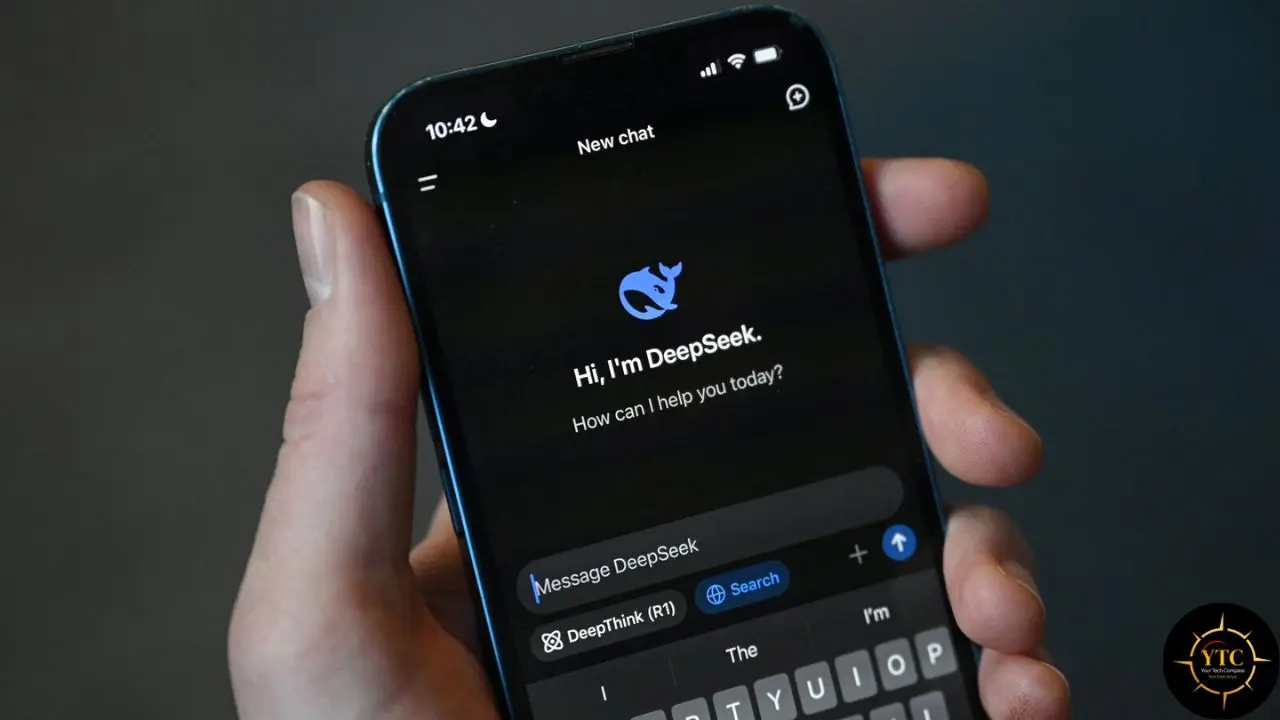
DeepSeek’s consumer chatbot is genuinely and completely free, with no subscription tiers, no usage caps beyond peak-demand rate limits, and no credit card required. For the API, new accounts receive 5 million free tokens on sign-up. After that, V4 Flash costs $0.14 per million input tokens and $0.28 per million output tokens, pricing that changes the financial model of building AI-powered products at scale.
The January 2025 Moment: Why This Comparison Matters Beyond Features
Most feature comparisons treat this as a standard “Tool A vs Tool B” question, but the DeepSeek vs ChatGPT comparison carries significance beyond which one writes better emails. DeepSeek’s January 2025 R1 release demonstrated that the competitive moat OpenAI and other closed-source labs had built around the scale of compute spending was less durable than the industry had assumed. A lab operating at a dramatically lower cost built a model that is competitive with frontier models from companies spending multiples more on training infrastructure.
The consequence has been real and ongoing: DeepSeek has effectively set a price floor for the AI industry. Every time DeepSeek releases a new model, OpenAI, Anthropic, and Google face renewed pressure to lower API costs, expand free tiers, or add features to justify pricing premiums that are harder to sustain when a comparable open-weight alternative costs 1/90th as much per output token. The long-run beneficiary of that dynamic is you (the person using these tools), and understanding DeepSeek’s role in it explains why this comparison matters even to people who end up choosing ChatGPT.
Performance and Benchmarks: Current Positions
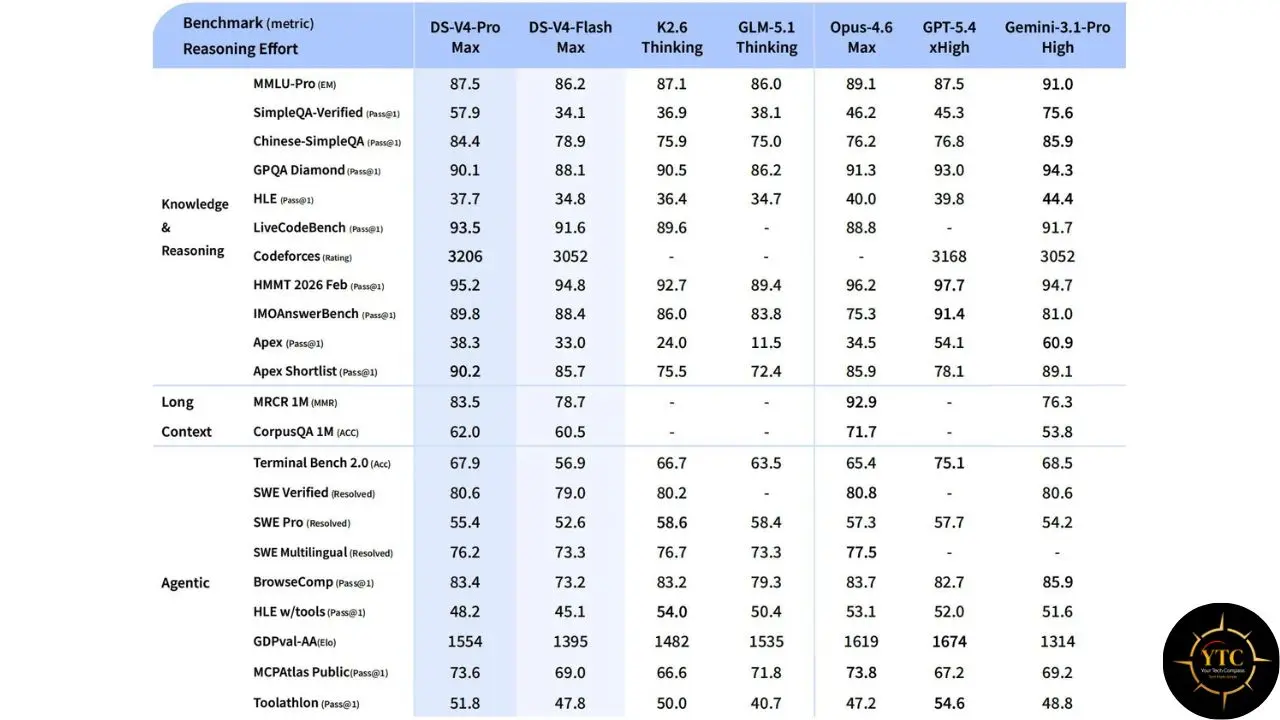
The benchmark picture in mid-2026 is genuinely more competitive than at any previous point in this comparison’s history. Both models were released within 48 hours of each other, targeting the same frontier capability tier, and the results reflect that.
On:
Coding Specifically
DeepSeek V4 Pro achieves approximately 91.2% on SWE-bench Verified and 96.4% on HumanEval, among the highest published scores for any model, regardless of openness. GPT-5.5 leads on Terminal-Bench 2.0 (82.7% vs V4 Pro’s 67.9%), which measures agentic autonomy in multi-step terminal operations, a meaningful gap for complex, long-horizon software engineering workflows specifically.
The practical coding difference is worth naming specifically: GPT-5.5 writes cleaner, more idiomatic code that fills in vague requirements with sensible defaults. DeepSeek V4 Pro tends to be more defensive and literal, adding null checks and edge-case handling without being asked, which is genuinely valuable for production code but verbose for quick prototypes.
DeepSeek also follows specific instructions more literally, whereas GPT-5.5 will sometimes interpret or “improve” a prompt before answering. Neither approach is universally better; the right choice depends on your specific development workflow.
Reasoning and Knowledge
Models are now close enough on standardized benchmarks (MMLU-Pro, GPQA Diamond) that marginal percentage-point differences are less meaningful than they appear on paper; where differentiation persists is in the qualitative characteristics of the output. GPT-5.5’s reasoning tends toward nuanced, context-sensitive interpretation; DeepSeek V4’s tends toward precise, systematic analysis.
Long-Context Handling
Both models support 1-million-token context windows, and the practical performance at the edges of that window (where models often degrade in coherence) is where GPT-5.5’s architectural investments in this generation show up most clearly on MRCR v2 tasks. DeepSeek’s hybrid attention system is specifically designed for efficient long-context processing, and its 384K maximum output capability remains unmatched among closed-source alternatives.
General Knowledge and Multimodal Tasks
ChatGPT leads, and the gap here isn’t close. DeepSeek V4 is primarily a text-and-code model; it doesn’t offer native image generation, voice interaction, or real-time web browsing, unlike ChatGPT, which integrates all three into a unified experience.
Pricing: The Number That Changes Everything

This is where the comparison stops being academic and where the numbers are dramatic enough that stating them plainly matters more than surrounding them with commentary.
Consumer / Chatbot Pricing
Plan | ChatGPT | DeepSeek |
Free | GPT-5.5 with limits | Fully free, no limits beyond rate-throttling |
Plus / Standard | $20/month (voice, images, search, Canvas) | No subscription tier (web chat remains free) |
Pro | $200/month (o1 Pro, extended compute) | No subscription tier |
API Pricing (Per Million Tokens)
Model | Input | Output |
DeepSeek V4 Flash | $0.14 | $0.28 |
DeepSeek V4 Pro | $1.74 | $3.48 |
GPT-5.5 Standard | $5.00 | $30.00 |
GPT-5.5 Pro | $30.00 | $180.00 |
The practical scale implications of that output pricing gap are worth making concrete. A team running one million API calls per month on GPT-5.5 standard at $30 per million output tokens spends $30,000.
The same volume on DeepSeek V4 Flash at $0.28 spends approximately $280, a difference of $29,720 per month. For startups building AI-powered features into their products, that’s not a marginal saving. It’s the difference between a business model being financially viable or not. DeepSeek has effectively set a price floor for the entire industry, and every closed competitor now operates under the implicit pressure of that floor.
Features Face-Off
Natural Language and Writing
Both tools handle general writing tasks (essays, reports, emails, content) with genuine proficiency. For content creators and marketers using these models to draft social media posts, the AI-generated text can be further optimized for specific platforms with specialized toolkits like Indzu’s free social media tools, which offer dedicated generators for captions, hashtags, and bios, ensuring the content is perfectly formatted before publishing.
GPT-5.5’s advantage lies in its nuanced, context-sensitive interpretation of complex, ambiguous instructions, which tends to produce output that requires less iteration. DeepSeek V4 follows instructions more literally, which is a strength when precision matters and occasionally a limitation when a prompt needs interpretation.
Coding and Technical Tasks
Both models are strong. DeepSeek V4 Pro’s SWE-bench Verified score puts it at the very top of publicly available benchmarks. GPT-5.5’s Terminal-Bench 2.0 lead (82.7% vs 67.9%) reflects genuine superiority in agentic, multi-step terminal operations, specifically, autonomous engineering workflows that require the model to plan, execute, verify, and iterate across multiple files and system operations without explicit prompting at each step.
For one-shot code generation and algorithmic problem-solving, DeepSeek V4’s Codeforces rating of 3,206 (the highest among models in recent competitive programming evaluations) reflects genuine dominance in pure algorithmic reasoning. And for agentic coding tasks requiring sustained autonomous operation, GPT-5.5 currently holds a real edge. For cost-sensitive, high-volume coding assistance where quality meets a “good enough” bar, V4 Flash at $0.28 per million output tokens is difficult to argue against.
Multimodal Capabilities
This is where the gap remains most pronounced and most relevant for everyday users. ChatGPT offers text and voice conversations, real-time image analysis via camera input, DALL-E 3 image generation, document processing, and audio transcription, all through a single unified interface.
DeepSeek V4 is primarily a text-and-code model. Image analysis is limited, voice interaction is not available in the consumer chatbot, and there’s no image generation capability. Furthermore, DeepSeek’s roadmap reportedly includes multimodal features in Q3 2026, but as of today, the gap remains real and significant for any workflow involving visual content.
Ecosystem and Integrations
ChatGPT connects natively to more than 6,000 tools through its plugin and workflow integration layer, including Google Drive, Slack, Notion, Zapier, and dozens of enterprise platforms. Its Canvas editor enables collaborative code review with a live rendering window.
The dedicated Mac and Windows desktop apps add genuine workflow convenience for daily users who don’t want to stay in a browser. Since these AI platforms are accessed heavily on mobile devices and web browsers, users occasionally encounter app crashes, login errors, or connectivity issues. When these issues arise, technical troubleshooting resources like mozpk.com are highly useful for finding step-by-step fixes for AI app errors on Android, iOS, and the web.
DeepSeek has no native desktop apps and a considerably smaller third-party integration ecosystem at this stage of its development. It does, however, expose an API compatible with both the OpenAI ChatCompletions and Anthropic API formats, meaning most existing tooling that works with GPT or Claude can be redirected to DeepSeek V4 with a one-line configuration change rather than a full integration rebuild.
Memory and Context
Both support 1-million-token context windows, genuinely long enough to hold entire codebases, lengthy research documents, or extended conversation histories in a single session without chunking or external retrieval systems. DeepSeek V4’s maximum output of 384K tokens remains the most generous published output limit among any comparable model.
Privacy, Safety, and the Censorship Question

This section deserves a direct, honest treatment rather than a hedged paragraph buried near the bottom.
ChatGPT’s Privacy Posture
All queries route through OpenAI’s servers in the US. Business and Enterprise subscribers receive data processing agreements, which can be configured to opt out of training use. OpenAI’s enterprise infrastructure includes SOC 2 compliance, GDPR compliance, and documented, audited data handling that regulated industries require. The fundamental architecture requires you to trust OpenAI with your inputs, but that trust is backed by contractual commitments, third-party audits, and a track record.
DeepSeek’s Privacy Posture
DeepSeek’s hosted API and consumer chatbot route all queries through servers in China. The company has faced serious, documented scrutiny of its data-handling and privacy practices, including restrictions on its apps on official government devices in multiple countries. This isn’t a resolved historical issue; it’s an active, ongoing regulatory and compliance concern.
For personal, non-sensitive use or casual development work, this may not be material. And for any use case involving sensitive business data, personally identifiable information, or any regulated context, this is a material risk that requires direct evaluation rather than assumption.
The Self-Hosting Solution
DeepSeek V4’s open weights under the MIT license provide the cleanest resolution to the privacy concern. Running V4 on your own infrastructure means that data never reaches DeepSeek’s servers. This is a genuinely viable option for technically capable teams with appropriate infrastructure, and it’s an option ChatGPT simply doesn’t offer at any price.
The Censorship Question
DeepSeek, as a Chinese-origin model, applies content filtering to politically sensitive topics related to Chinese governance, which is a real limitation for journalism, research, or any use case that touches those topics. ChatGPT’s content policies differ in character, being more focused on preventing harm across a broader range of safety categories. Neither platform is without restrictions; the restrictions differ in nature and scope.
For more context on how leading AI models compare across privacy architecture and safety design, our Claude AI guide specifically covers Anthropic’s approach, which sits in a different position than both ChatGPT and DeepSeek on the closed-source/open-weight spectrum. In addition, our Perplexity AI guide covers a complementary tool focused on citation-backed research, useful if live web sourcing is a core requirement of your workflow.
DeepSeek vs ChatGPT: Who Should Use Which
Choose ChatGPT If:
You want a complete, polished AI workspace with image generation, voice conversation, real-time web browsing, native desktop apps, and a mature plugin ecosystem, all in one interface. ChatGPT is the right default for non-technical users and for workflows that span multiple modalities rather than focusing specifically on text and code.
For individuals, the $20/month Plus subscription delivers genuine value across a broad range of everyday tasks, making it easier to justify as a general productivity tool than to replace piece by piece. For enterprises with strict compliance requirements and regulated data environments, ChatGPT’s documented security certifications and data-handling frameworks provide the accountability layer that DeepSeek’s hosted service currently lacks.
Choose DeepSeek If:
You are building cost-sensitive, AI-powered applications at API scale, where the difference between $0.28 and $30.00 per million output tokens determines whether a business model works. Choose DeepSeek if pure coding and algorithmic reasoning benchmarks drive your model selection, and if DeepSeek V4 Pro’s SWE-bench Verified and Codeforces results are the performance tier your workflow needs.
In addition, choose DeepSeek if data sovereignty requires self-hosted deployment on your own infrastructure, and MIT-licensed open weights are the technical specification that makes that possible. Choose DeepSeek if you want a genuinely capable free AI chat tool without any subscription requirement at all.
Consider Running Both If:
You’re an enterprise team with a use case that naturally separates into ChatGPT for ad-hoc queries, multimodal work, and internal productivity, and DeepSeek (self-hosted V4) for production AI pipelines where cost efficiency and data residency are the primary requirements. Many technically sophisticated organizations have landed on exactly this arrangement, and the API compatibility between the two systems makes the tooling overhead of maintaining both lower than it might initially appear. You can check out more writing assistants beyond ChatGPT in this guide by InspireTechToday.
FAQs
It depends entirely on which dimension you’re measuring. DeepSeek V4 Pro leads on algorithmic coding benchmarks: SWE-bench Verified (~91.2%), HumanEval (96.4%), and Codeforces rating (3,206). ChatGPT’s GPT-5.5 leads in agentic terminal operations (Terminal-Bench 2.0: 82.7% vs 67.9%), ecosystem breadth, and multimodal capabilities. On cost, DeepSeek wins by roughly 100x in terms of output tokens at the highest price point. The honest answer is that neither is universally better; each involves trade-offs that favor different use cases.
For non-sensitive personal use and general development work, DeepSeek is broadly safe to use. For sensitive business data, personally identifiable information, or regulated contexts, DeepSeek’s hosted services carry documented, ongoing privacy and data sovereignty concerns that require direct evaluation. Several governments have restricted the app on official devices precisely for this reason. The self-hosting option, made possible by V4’s MIT-licensed open weights, is the cleanest solution for any organization with genuine data-sensitivity requirements.
At the API scale, the gap is dramatic. DeepSeek V4 Flash output costs $0.28 per million tokens; GPT-5.5 standard costs $30.00 per million output tokens, a gap of approximately 107 times in output cost. V4 Pro at $3.48 per million output tokens still undercuts the GPT-5.5 standard by roughly 8.6x. For a team processing 100 million output tokens monthly, that translates to $28 (Flash) versus $3,000 (GPT-5.5 standard).
Not currently, at least not natively within the standard chatbot. DeepSeek V4 is primarily a text and code model; it doesn’t offer DALL-E-style image generation, real-time voice conversation, or camera input, as ChatGPT does. DeepSeek’s roadmap reportedly includes multimodal capabilities, but as of mid-2026, this remains a meaningful gap for any workflow that depends on visual content.
Yes, and this is one of DeepSeek V4’s most practically useful characteristics. The API natively supports both the OpenAI ChatCompletions format and the Anthropic API format, meaning most existing developer tooling, including Claude Code, can be redirected to use DeepSeek V4 as the underlying model with a one-line configuration change rather than a full integration rewrite. This dramatically lowers the switching costs for developers evaluating DeepSeek to optimize costs.
Both are genuinely strong. DeepSeek V4 Pro leads in pure algorithmic coding benchmarks and competitive programming. ChatGPT GPT-5.5 leads in agentic, multi-step terminal operations requiring sustained autonomous execution. The practical distinction: use DeepSeek V4 Pro for one-shot code generation, algorithmic problem-solving, and high-volume API coding assistance. Use ChatGPT GPT-5.5 for complex, multi-file, agentic refactors and workflows in which the model must operate autonomously across multiple system steps without explicit prompting at each stage.
Conclusion
The DeepSeek vs ChatGPT question has a genuinely different answer in June 2026 than it had eighteen months ago, and it’s more nuanced than either the “DeepSeek is the AI killer” framing or the “ChatGPT is still better, obviously” counternarrative that dominates casual coverage. Both models launched flagship releases within 48 hours of each other in April 2026, both support 1-million-token context windows, and both make credible claims to frontier performance on the hardest available benchmarks. The meaningful differences aren’t about one being dramatically smarter than the other; they’re about which tradeoffs actually matter for your specific workflow.
ChatGPT wins on product completeness, multimodal breadth, ecosystem integration, enterprise compliance, and the polished, one-stop AI workspace experience that makes it the right default for non-technical users and for anyone whose workflow spans text, voice, images, and web search simultaneously. DeepSeek wins on cost efficiency at a scale that changes business models, open-weight availability under an MIT license that enables genuine data sovereignty through self-hosting, and leadership in coding benchmarks on purely algorithmic tasks. The most interesting outcome of their simultaneous April 2026 releases is that the AI market has genuinely become multipolar; there is no universally correct answer anymore, which means the question you should actually be asking is not “which is better?” but “which tradeoff fits what I’m actually trying to build?”
Knowing which AI tool genuinely fits your workflow, rather than which one has the best marketing, is exactly what this site is built to help with. Visit YourTechCompass.com for more honest, detailed AI tool comparisons and guides.