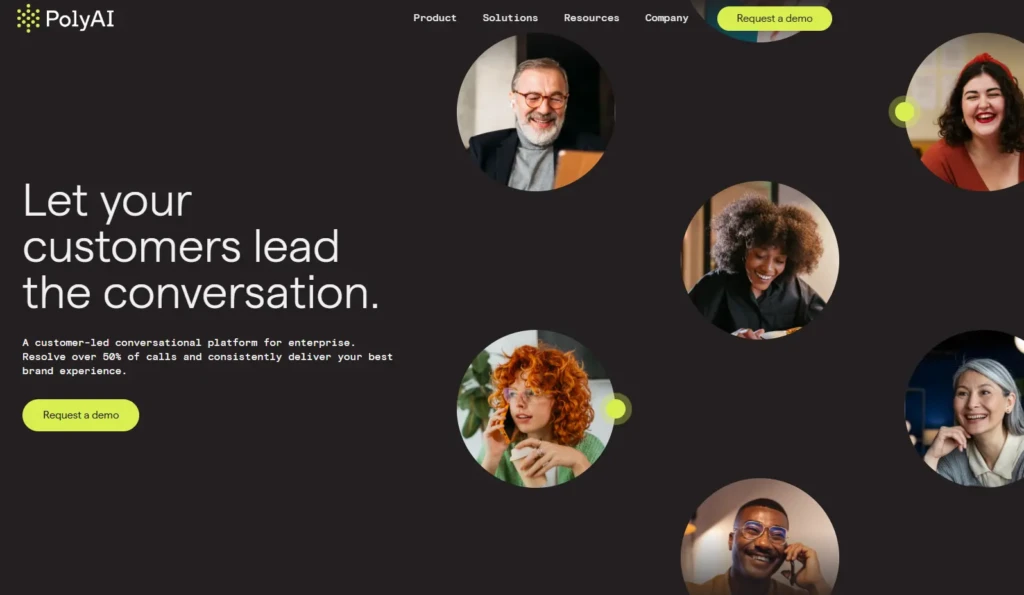
If you’ve ever called a hotel, airline, or bank and spoken to what sounded like a human agent, only to realise partway through that you couldn’t quite place anything distinctly human about it, there’s a reasonable chance you were talking to PolyAI. The company builds voice AI agents for enterprise customer service: systems that handle inbound phone calls end-to-end, without a hold queue, a script tree, or a transfer to a person for anything the AI can resolve on its own.
PolyAI is not a consumer product. You won’t download, sign up for, or use it directly. It’s a B2B platform deployed by companies like FedEx, Marriott, and Caesars Entertainment to handle the volume of customer calls that would otherwise require large human call centre teams. Understanding what PolyAI is means understanding why voice AI at the enterprise level is a fundamentally different problem than the chatbot on a website, and why solving it well is harder than it looks.
What PolyAI Is (and Isn’t)
PolyAI is a London-based AI company founded in 2017 by researchers from the Cambridge Dialogue Systems Group. It builds what it calls “voice assistants,” though the more accurate term is “voice agents,” because the system doesn’t just assist a human through a call; it handles the call. A PolyAI deployment takes inbound calls on behalf of a business, conducts the full conversation, resolves the customer’s issue where possible, and escalates only when the issue genuinely requires a human agent.
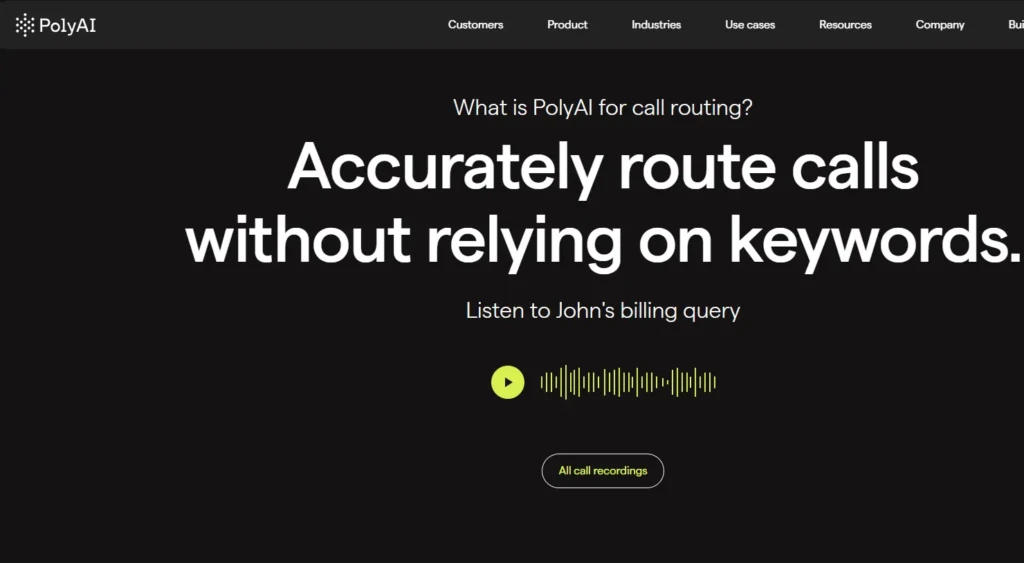
This is meaningfully different from a traditional phone bot. Traditional IVR (Interactive Voice Response) systems route calls through menus, for instance, “press 1 for billing, press 2 for technical support.” They follow decision trees. PolyAI conducts open-ended natural-language conversations, understands what customers are asking, regardless of how they phrase it, and responds the way a trained human agent would, with appropriate tone, context retention, and the ability to handle interruptions, corrections, and topic changes mid-call.
It’s also worth distinguishing PolyAI from consumer character chatbots like Janitor AI, which let individuals chat with AI personas for entertainment or creative purposes. PolyAI operates entirely in the enterprise customer service space; the technical and operational requirements are different, the stakes around accuracy are higher, and the product is sold to businesses, not individuals.
How PolyAI Works
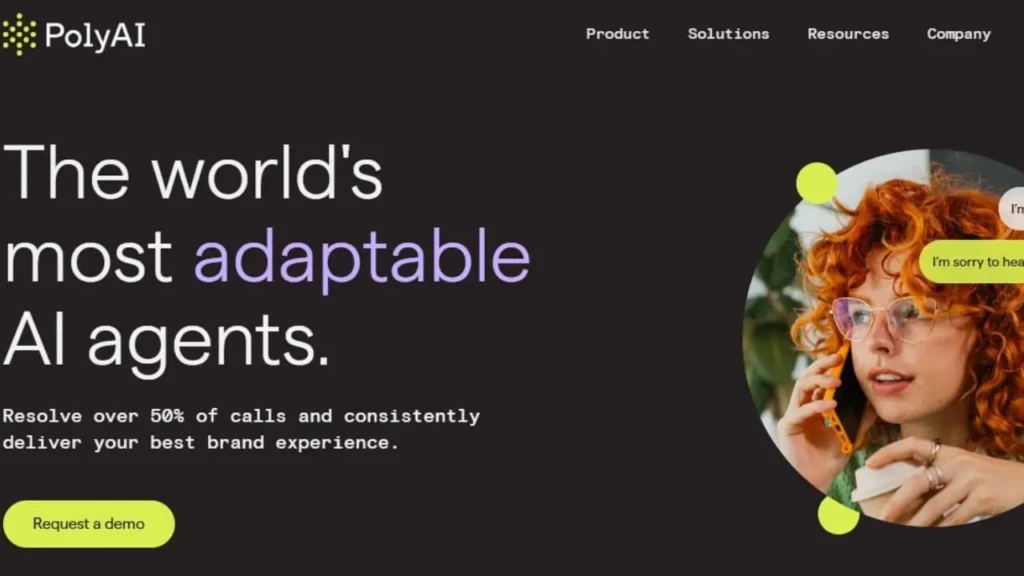
A PolyAI deployment involves three integrated components: speech recognition, natural language understanding, and speech synthesis, running in sequence fast enough to maintain the natural rhythm of a conversation.
- Speech recognition (ASR) converts the customer’s spoken words into text in real time. PolyAI uses models trained specifically on call centre audio, which is acoustically different from clean studio speech, with background noise, varied accents, telephone compression, and customers who don’t speak in complete sentences. This domain-specific training is part of what separates enterprise voice AI from general-purpose speech recognition.
- Natural language understanding (NLU) analyses the transcribed text to determine what the customer is trying to accomplish, not just what words they used, but the underlying intent. A customer who says “I need to move my reservation” and one who says “Can I change when I’m checking in” are expressing the same intent, just in different phrasing. PolyAI’s NLU layer maps to the same resolution path. It also tracks conversation context, so the system understands that “yes, that one” refers to an option mentioned two turns earlier.
- Speech synthesis (TTS) converts the AI’s generated response back into voice. PolyAI uses neural speech synthesis to produce natural-sounding output with appropriate intonation, pacing, and pauses, rather than the flat, mechanical cadence of older text-to-speech systems. The goal is a voice that customers don’t instinctively resist or find frustrating to speak with.
All three components run in sequence within a few hundred milliseconds per exchange, maintaining response timing close enough to natural conversation that most callers don’t perceive a processing lag.
Key Features
Natural Conversation Handling
PolyAI is built for open-ended calls rather than menu navigation. Customers can state their issue in plain language, change their mind mid-call, ask follow-up questions, and correct misunderstandings; the system handles all of this without losing context or forcing the conversation back to a fixed script.
Multilingual Support
The platform supports multiple languages, allowing international enterprises to deploy the same voice agent framework across different markets without building entirely separate systems. Tone and formality conventions are calibrated to each language and region rather than being directly translated.
Context Retention Within a Call
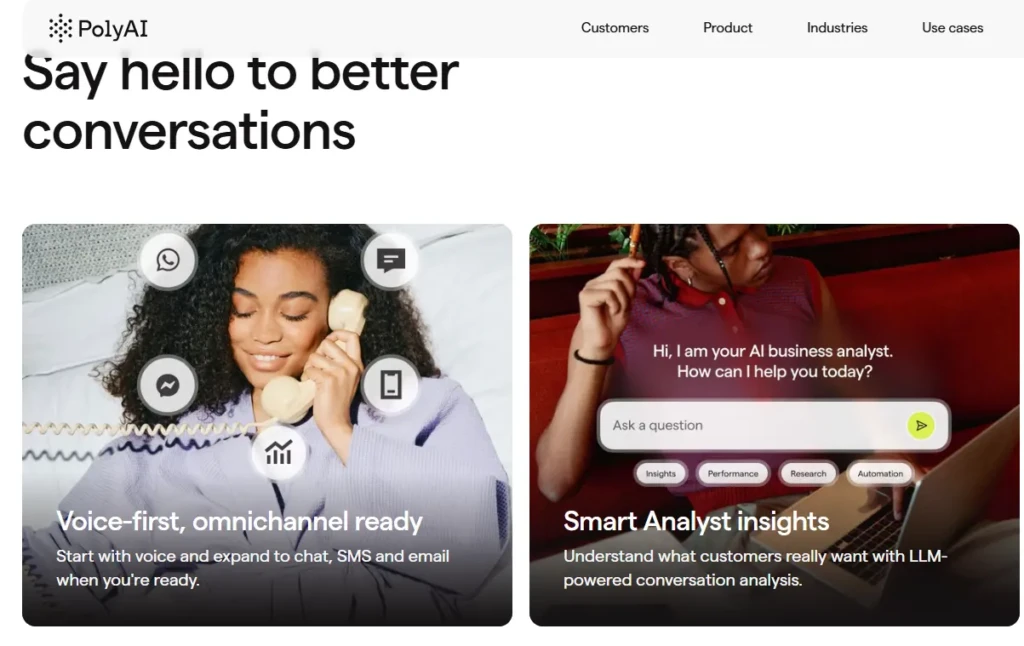
Unlike legacy systems that treat each customer utterance as independent, PolyAI maintains the full conversation context throughout the call. This enables references to earlier parts of the conversation and coherent multi-step resolution flows; a customer changing a reservation, for example, involves multiple back-and-forth exchanges rather than a single query-and-response.
CRM and Telephony Integration
PolyAI integrates with existing enterprise infrastructure, including CRM platforms, booking systems, account databases, and telephony providers, such as Twilio and Genesys. This means the AI agent can look up account details, confirm bookings, process changes, and take actions in backend systems during the call, not just provide information.
Analytics and Performance Monitoring
Businesses access dashboards showing call resolution rates, escalation rates, common failure points, and customer sentiment signals. This data drives iterative improvement to the voice agent’s performance over time.
Escalation Handling
When a call exceeds what the AI can resolve, for instance, a complex complaint, an unusual situation, or an emotionally distressed caller, the system transfers to a human agent with a summary of the conversation so the agent doesn’t require the customer to repeat themselves.
PolyAI vs Traditional IVR Systems
The comparison between PolyAI and legacy IVR is the clearest way to understand why enterprise voice AI is generating significant investment from customer-service-heavy industries.
Feature | PolyAI | Traditional IVR |
Conversation Style | Open-ended natural language | Scripted menu-driven prompts |
Context Awareness | Retains full call context | Resets with each utterance |
Handles Interruptions | Yes (customers can redirect mid-call) | No (interruptions cause errors or restart) |
Backend System Access | Yes (CRM, booking systems, databases) | Limited (typically routing only) |
Scalability | Handles simultaneous calls without degradation | Limited by infrastructure and menu complexity |
Customer Experience | Conversational, adaptive | Often frustrating; high abandonment rates |
Implementation | Significant upfront deployment | Lower upfront, high ongoing maintenance |
The fundamental limitation of IVR is that it requires customers to adapt their communication to the system’s structure. PolyAI inverts this; the system adapts to how the customer communicates. That difference is the core value proposition, and it’s why industries with high inbound call volume and predictable resolution categories (reservations, billing, order tracking, account queries) are the early adopters.
Real-World Use Cases
Hospitality
Hotels and hotel chains use PolyAI to handle reservation calls, check availability, confirm bookings, process modifications, and answer property questions. These calls are high-volume, follow predictable patterns, and are well-suited to AI resolution. A human agent is rarely needed unless the situation involves an unusual request or a customer complaint requiring genuine discretion.
Financial Services
Banks and financial institutions deploy voice agents for balance inquiries, transaction queries, fraud alert responses, and basic account management. Security protocols, such as identity verification before account access, are handled by the AI through established verification flows integrated with the institution’s authentication systems.
Retail and e-Commerce
Order tracking, return processing, and delivery inquiries are among the highest-volume call categories for retailers, and among the most straightforwardly resolvable by AI. PolyAI deployments in retail typically handle these calls end-to-end with minimal escalation rates.
Telecommunications
Network troubleshooting, billing inquiries, and plan change requests are common use cases in telecom. The conversational nature of troubleshooting, where the resolution path depends on the customer’s responses, benefits significantly from AI that can follow branching dialogue rather than a fixed decision tree.
Casinos and Entertainment
Caesars Entertainment is among the publicly disclosed clients of PolyAI. High-volume reservation and loyalty programme calls, handling millions of annual inbound calls across multiple properties, are a natural fit for voice AI at scale.
Limitations and Honest Caveats
PolyAI handles structured, resolvable conversations well. It is less suited to calls involving significant emotional complexity, such as a distressed customer, a serious complaint, or a situation requiring genuine human judgment and empathy. The escalation to a human agent exists specifically to cover these cases, but the quality of that escalation depends on how well the handoff is designed, and a poorly handled transfer can compound frustration rather than resolve it.
Deployment is not a plug-in process. Implementing PolyAI for a specific business requires training the system on that organisation’s products, policies, systems, and resolution flows. The initial deployment timeline and cost are significant, which is why the platform is enterprise-focused rather than available to small businesses. Ongoing performance improvement requires continued investment in the analytics and iteration cycle.
Voice data handling raises real privacy considerations. Calls handled by PolyAI involve voice recordings and, in many cases, identity verification and account data. Businesses deploying the platform are responsible for ensuring their PolyAI implementation complies with applicable data protection regulations, such as the GDPR in the UK and EU, CCPA in California, and sector-specific requirements in financial services and healthcare. PolyAI holds relevant compliance certifications, but enterprise buyers conduct their own due diligence rather than relying on vendor claims.
Accent and dialect handling has improved substantially in recent years, but remains an area where voice AI systems, including PolyAI, can underperform for callers whose speech patterns are underrepresented in training data. This is an industry-wide limitation, not unique to PolyAI, but worth acknowledging as part of an honest picture of where the technology currently sits.
PolyAI and the Broader Voice AI Landscape
PolyAI competes in a growing enterprise voice AI market that includes players like Nuance (now part of Microsoft), Google CCAI (Contact Center AI), Amazon Connect, and a range of specialist providers. The competitive differentiators it emphasises are the naturalness of its conversational models, its call centre-specific training data, and the depth of its integration capabilities.
What makes PolyAI worth watching as a broader AI story is what it represents about where AI is creating durable commercial value. The most defensible applications of AI in enterprise settings aren’t the ones replacing creative or knowledge work; they’re the ones handling high-volume, structured, but genuinely conversational tasks at a quality level that customers accept. Call centre automation at scale is one of those applications, and PolyAI is among the most advanced implementations currently deployed at enterprise scale.
FAQs
No, these are entirely different products that share a confusingly similar name. PolyAI (poly.ai) is the enterprise voice AI company described in this article. There is also a consumer character chatbot platform at a similar domain that is unrelated. If you were looking for the character chatbot, the Janitor AI guide covers that category of consumer AI roleplay platforms.
Not directly. PolyAI is an enterprise platform sold to large organisations with significant inbound call volumes. The deployment process requires integration with existing systems, custom training on the business’s specific products and policies, and ongoing investment in maintenance. It’s not a self-serve product.
Callers who explicitly ask for a human agent are transferred. PolyAI’s escalation flows are designed to hand off to a human agent with a conversation summary, so the customer doesn’t need to re-explain their situation. How smoothly this works in practice depends on the configuration of the individual enterprise deployment.
Hospitality, financial services, retail, telecommunications, and entertainment are the primary sectors. These industries share characteristics that make voice AI deployments commercially viable: high inbound call volume, a significant proportion of calls with predictable resolution patterns, and meaningful costs associated with human-agent capacity at scale.
Final Thoughts

PolyAI represents one of the more mature and commercially validated applications of conversational AI currently in production, not because voice AI is new, but because making it work well enough that customers don’t resent it is genuinely hard, and PolyAI has invested years of domain-specific research into solving that problem at scale. Enterprise deployments with major hotel chains, financial institutions, and logistics companies provide evidence that the technology has crossed a practical threshold.
Whether that threshold is “good enough” in every case is a reasonable question, and the limitations section above reflects that it isn’t always. But for high-volume, structured customer service calls, the AI category PolyAI represents is already reshaping how enterprise customer service is staffed and operated, and the trajectory is toward greater deployment, not less.
Found this helpful? Browse more in-depth tech guides, honest reviews, and step-by-step tutorials at YourTechCompass; your go-to resource for making smarter tech decisions.