Enterprise and developer interest in machine learning and artificial intelligence continues to grow, but practical implementation often remains complex and resource-intensive. Traditional workflows for training, deploying, and managing AI models typically require stitching together data processing, model development, infrastructure provisioning, and monitoring using disparate tools and services. Vertex AI is designed to address this challenge by providing a unified, managed platform that brings these activities into a single environment, helping teams streamline the entire artificial intelligence lifecycle.
This article explains what Vertex AI is, how it works, its core features, real-world use cases, and how it compares with other AI platforms. Additionally, this guide highlights factors to consider when deciding whether Vertex AI suits your organization’s goals. By the end, you should have a clear, practical understanding of where Vertex AI fits in the machine learning ecosystem and when it can add value to your AI projects, and I’ll draw on real workflow insights to make that distinction clear.
What Is Vertex AI
At its core, Vertex AI is a fully managed machine learning and artificial intelligence platform offered by Google Cloud that consolidates data handling, model training, deployment, and monitoring into a unified environment. Rather than requiring separate tools for each phase of the machine learning lifecycle, Vertex AI integrates these capabilities, enabling teams to build and scale AI applications more efficiently.
By combining a variety of machine learning tools, such as AutoML, custom model training, and deployment pipelines, Vertex AI enables developers and data scientists to work within a centralized interface, reducing complexity and operational overhead.
What Vertex AI Does
Vertex AI provides a range of services that support the end-to-end process of developing, deploying, and managing machine learning models:
- Data Ingestion and Preparation: Tools for cleaning, transforming, and managing datasets in preparation for training.
- Model Training: Managed environments for training both custom models and models using AutoML, which automates aspects of the training process.
- Deployment and Serving: Infrastructure to deploy models as scalable, low-latency endpoints.
- Monitoring and Governance: Built-in tools for tracking model performance, detecting drift, and managing versions.
- Model Evaluation and Tuning: Features that help compare model versions and optimize hyperparameters.
Together, these capabilities support workflows ranging from rapid experimentation to robust production deployment, without requiring teams to manually build and maintain every step.
How Vertex AI Works
Vertex AI organizes the machine learning lifecycle into coordinated stages that align with key project milestones:
- Data Management: Teams bring data into Vertex AI using cloud storage or direct integrations, then prepare it for training.
- Model Creation: Users can choose between automated model generation (AutoML) and coding custom models with frameworks such as TensorFlow or PyTorch.
- Training and Validation: Models are trained on managed compute resources and validated using built-in evaluation tools.
- Deployment: Trained models are deployed as scalable services, accessible via APIs.
- Monitoring: Vertex AI tracks performance metrics, logs, and usage patterns to inform maintenance and retraining decisions.
This structured workflow helps teams standardize their processes and reduce the fragmentation that typically arises from using multiple separate tools.
Key Features of Vertex AI
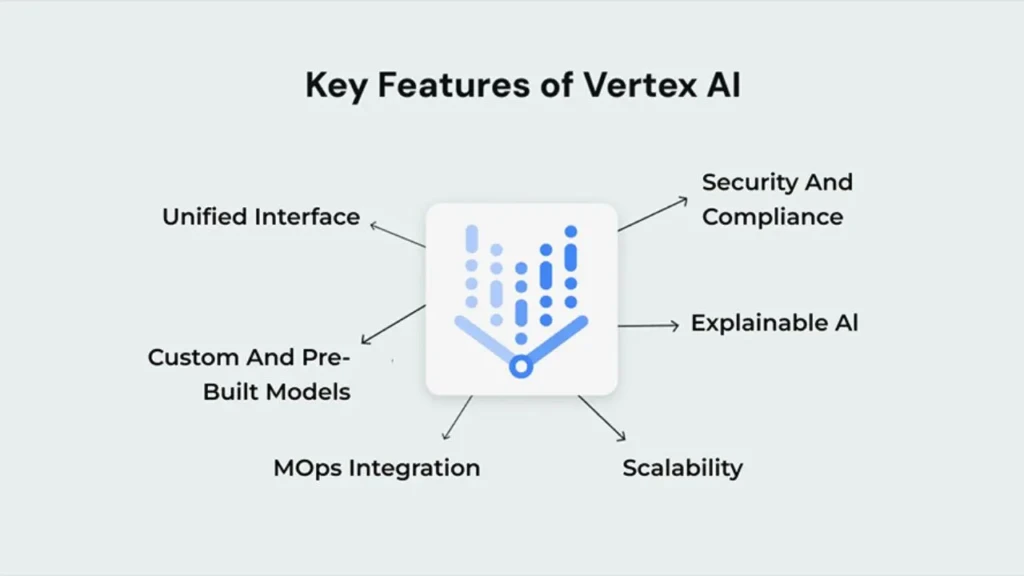
Vertex AI’s design emphasizes several core capabilities that support modern AI development:
- Unified Platform: Combines data management, training, deployment, and monitoring in one place.
- AutoML Integration: Automates model building and tuning to reduce the need for deep machine learning expertise.
- Custom Model Support: Allows developers to bring their own models and training pipelines.
- Scalability: Leverages Google Cloud infrastructure for elastic scaling of training and serving workloads.
- Governance and Security: Integrates managed services that support enterprise compliance and access control.
These features make Vertex AI suitable for teams ranging from those just experimenting with generative AI to those deploying large-scale, production-level machine learning systems.
Vertex AI Use Cases
Vertex AI supports a broad range of applications, including:
- Predictive Analytics: Forecasting trends based on historical data.
- Natural Language Processing: Building text classification, sentiment analysis, or generative capabilities.
- Computer Vision: Training models that interpret images or video streams.
- Recommendation Systems: Delivering personalized user experiences in web and mobile applications.
These use cases apply across industries such as finance, retail, healthcare, and logistics, where robust ML models contribute directly to business outcomes.
Vertex AI vs Other AI Platforms
To contextualize Vertex AI, it helps to compare it with other managed machine learning services. The most relevant comparison is between Vertex AI’s unified workflow and platforms that require more manual assembly of components:
Feature | Vertex AI | Traditional AI Platforms |
Unified Lifecycle Management | Yes | Varies |
AutoML Capabilities | Built-in | Typically separate |
Custom Model Support | Yes | Yes |
Monitoring and Governance | Integrated | Often manual |
Scalability | Elastic on cloud infra | Depends on setup |
Ease of Use for Teams | High | Medium to low |
Vertex AI’s strength lies in providing a cohesive development environment with built-in automation and management features that reduce friction at both the development and operational stages.
Who Should Use Vertex AI
Vertex AI is most valuable for teams that need:
- End-to-end machine learning workflows without stitching together disparate tools.
- Scalable infrastructure that can grow with model complexity and usage.
- Advanced automation tools such as AutoML.
- Enterprise governance and integration with existing cloud services.
Organizations ranging from large enterprises to data-intensive startups can benefit from prioritizing scalability, repeatability, and integrated lifecycle management.
Limitations and Challenges
Despite its advantages, Vertex AI also presents certain challenges:
- Complexity: A comprehensive platform can have a steeper learning curve for beginners compared to simpler, task-specific tools.
- Cost: Strong integration and managed services may result in higher costs for some workloads versus DIY solutions.
- Vendor Lock-in: Deep integration with Google Cloud services may make switching platforms more difficult over time.
These considerations are important when evaluating whether Vertex AI’s benefits justify its use in a given organization.
Is Vertex AI Suitable for Beginners
Vertex AI’s automation features, such as AutoML, make it accessible for teams with limited machine learning expertise, but the platform’s depth and breadth are best realized with some foundational knowledge of ML principles and cloud architectures. For those new to machine learning or who have lightweight requirements, task-specific tools or simpler platforms might provide a more straightforward starting point.
Conclusion
Vertex AI represents a comprehensive evolution of managed machine learning platforms by unifying the AI development lifecycle into a single, scalable environment. Its combination of data integration, model training, deployment tools, and monitoring features makes it a strong choice for organizations looking to accelerate AI initiatives while retaining control over their workflows. At the same time, its depth and integration with cloud infrastructure mean it is most appropriate for teams with defined AI goals and the resources to leverage its full capabilities.
Understanding where Vertex AI fits relative to other tools, such as the generative workflows in the Chat GPT 4 guide, automated data infrastructure platforms like Scale AI, and comparative analyses like the DeepSeek AI explained article, clarifies that it is not simply another AI service but a platform designed for end-to-end lifecycle management. Based on this analysis, I see Vertex AI as a strategic choice for enterprises and advanced teams who need a unified, scalable machine learning environment that supports both experimentation and production deployment.
FAQs About Vertex AI
No. Its AutoML features lower the barrier to entry, though advanced usage benefits from ML knowledge.
It replaces many separate components by integrating them, but foundational ML understanding and data strategy remain essential.
Yes. It supports generative AI models and workflows, including integration with foundation models.