When GPT-4 launched in March 2023, it felt like a step change. The improvement over GPT-3.5 was immediately apparent, with longer context, better reasoning, more coherent multi-step thinking, and a level of fluency that made earlier AI responses feel blunt by comparison. Millions of people signed up for ChatGPT Plus to access it. Developers rebuilt their products around it. Businesses adopted it faster than they’d adopted any enterprise software in the previous decade. GPT-4 established the benchmark against which every subsequent AI model was measured for the better part of two years. Understanding it properly (what it is, how it actually works, what it does well, and where it genuinely falls short) remains one of the most useful things you can do before deciding which AI tool to use for any serious task.
This review gives you the complete, honest picture of GPT-4: its architecture, its capabilities in real-world use cases, its pricing across all plan tiers, and an accurate 2026 context showing where it fits in OpenAI’s current model lineup. Because the landscape has evolved significantly since GPT-4’s launch, I’ll also explain how GPT-4o, GPT-4.1, and the GPT-5 family relate to it, so you understand not just what GPT-4 is, but also how it connects to what OpenAI has built since then.
A note before we begin: every YTC score is earned, never negotiated. If you want to understand exactly how we evaluate apps & tools and how we handle affiliate relationships, our Review Methodology lays it all out.
What Is GPT-4 and Why Does It Matter?
GPT-4 is the fourth generation of OpenAI’s Generative Pre-trained Transformer, a large language model trained on an enormous corpus of text data and fine-tuned for conversational and task-based use through Reinforcement Learning from Human Feedback (RLHF). The model was publicly released on March 14, 2023, and became the engine behind ChatGPT Plus, OpenAI’s subscription service.
The reason GPT-4 matters, even in 2026, is that it set the architecture and design philosophy that every subsequent OpenAI model has built on. GPT-4o extended it with multimodal capabilities. GPT-4.1 improved the context window to 1 million tokens. The GPT-5 family extended its reasoning architecture. Understanding GPT-4 provides the conceptual foundation for understanding all of these successors, because every capability they’ve added improves upon what GPT-4 established as the baseline.
In practical terms, GPT-4 introduced three things that its predecessors couldn’t reliably do:
- Longer Context: GPT-4 could handle significantly more text in a single conversation than GPT-3.5, making it useful for analyzing long documents, maintaining continuity in extended projects, and multi-step reasoning tasks.
- Stronger Reasoning: GPT-4 performs meaningfully better on logical reasoning, coding, and multi-step problems. OpenAI’s original technical report showed it scoring in the top 10% of bar exam takers, whereas GPT-3.5 scored around the bottom 10%.
- Better Instruction Following: GPT-4 is more reliable at executing complex, multi-part instructions without drifting from the original request.
How GPT-4 Actually Works
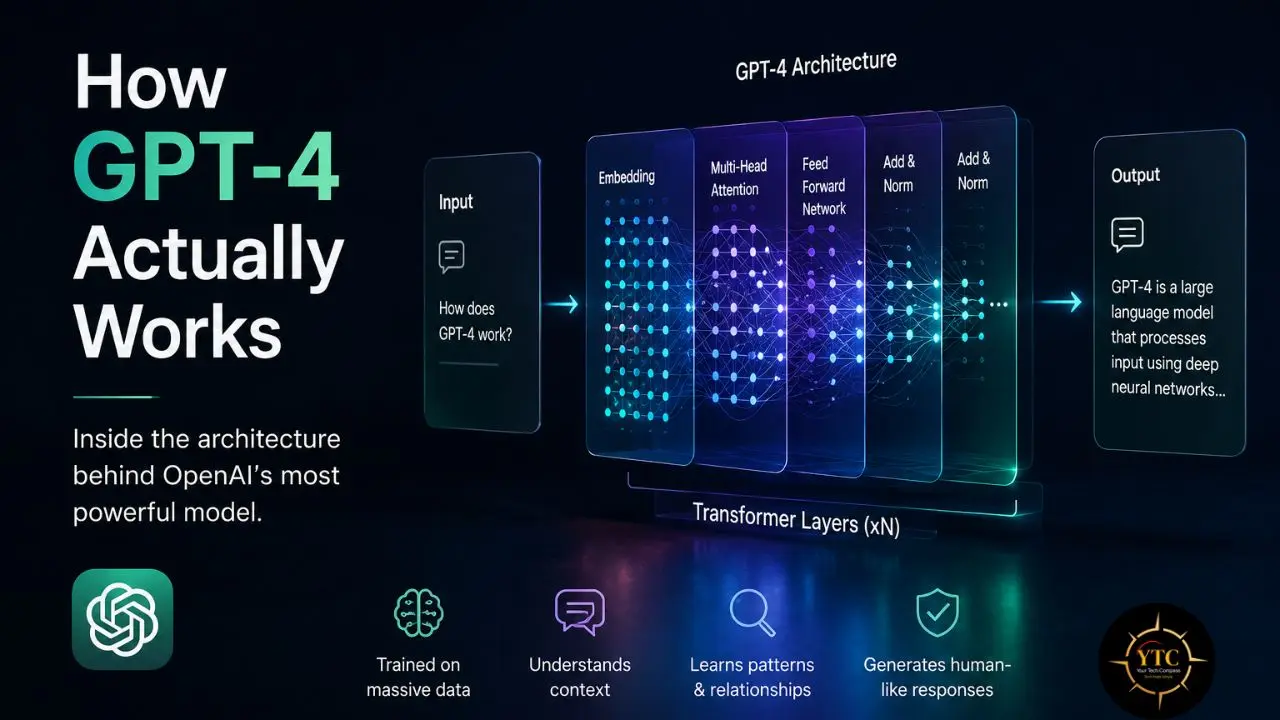
Understanding the architecture clarifies the capabilities and limitations. Here’s a plain-English explanation of what’s actually happening when GPT-4 generates a response.
Transformer Architecture
GPT-4 is built on the transformer architecture, which processes text not sequentially (word by word, left to right) but in parallel, analyzing all the relationships between tokens simultaneously. The “attention mechanism” at the core of the transformer enables the model to learn which parts of the input text are most relevant to one another while generating a response. This is what allows GPT-4 to maintain coherence over a long conversation; it continuously references relationships across the full context window, not just the last few sentences.
Tokens, Not Words
GPT-4 processes text as tokens, chunks that are roughly three-quarters of a word in English. The phrase “artificial intelligence” is two tokens.
“Photosynthesis” might be two or three. This matters practically: when you see pricing expressed in tokens, you’re looking at a unit slightly smaller than a word. It also explains the context window (the maximum amount of text the model can consider at once, measured in tokens rather than words or pages).
Training and RLHF
GPT-4 was trained on a large dataset of text from the internet, books, and other sources, learning statistical patterns about which words and phrases tend to follow which others in human-generated text. After this pre-training phase, OpenAI used Reinforcement Learning from Human Feedback to fine-tune the model’s responses: human raters evaluated and ranked outputs, and these preferences were used to adjust the model toward responses that humans found more helpful, accurate, and appropriate.
This is also why GPT-4 fails in a specific and important way: it always predicts the most statistically probable next token rather than retrieving stored facts. When the model confidently produces an incorrect statement, it’s because that statement had a high probability given the patterns in the training data, not because the model looked something up and found a wrong answer.
The model doesn’t “know” facts the way humans do. It has learned patterns about what tends to follow what.
Context Window and Memory
GPT-4’s original context window was 8,192 tokens. Extended versions provided 32,768 tokens. GPT-4 Turbo (a later variant) extended this to 128,000 tokens. This is meaningfully shorter than what successor models offer; GPT-4.1 has a 1-million-token context window, and the GPT-5.4 family matches that.
Within a conversation, GPT-4 can reference everything in the current context window. It does not retain memory between separate conversations unless memory features are explicitly enabled in the ChatGPT interface.
Key Features and Capabilities
Natural Language Understanding
GPT-4’s primary strength is its ability to understand complex, nuanced language and generate contextually appropriate, fluent responses. It handles ambiguous prompts better than earlier models, interprets instructions with more precision, and maintains coherence across longer documents and conversations. This makes it effective for tasks that require genuine comprehension rather than simple keyword matching: summarizing a 50-page contract, explaining a technical concept at different levels of complexity, or synthesizing information from multiple sources into a structured analysis.
Writing and Content Generation
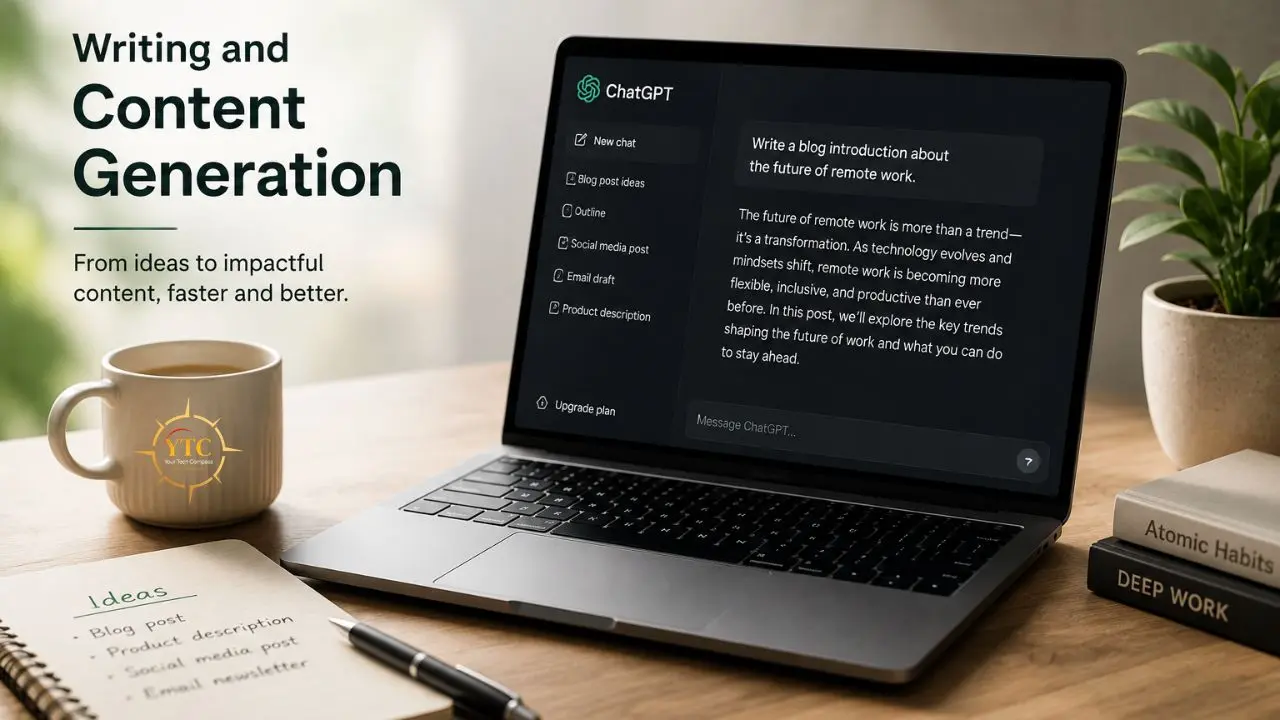
GPT-4 produces text that requires significantly less revision than earlier AI-generated content. For professional writing tasks (emails, reports, marketing copy, technical documentation), the output is often close to publication-ready when given specific, detailed prompts.
The fluency extends across different styles and registers: formal and informal, technical and accessible, narrative and analytical. Writers who use it effectively treat it as a skilled first drafter rather than a replacement for their own voice and judgment.
Coding and Technical Assistance
GPT-4 performs well across a wide range of programming tasks. It can write functional code in dozens of languages, explain what existing code does, identify bugs and suggest fixes, and help design software architecture.
For common patterns and well-documented languages, the output is often correct. However, for less-common edge cases, the code may require testing and verification.
Developers typically find GPT-4 most useful for reducing time spent on boilerplate, scaffolding, and documentation rather than as an autonomous coding agent. For developer-specific tooling built around AI code assistance, our GitHub Copilot guide covers that focused alternative in detail.
Summarization and Analysis
GPT-4 is particularly effective at reducing information. Given a long document, it can extract key points, produce structured summaries, and identify the most relevant information for a specific question. This makes it genuinely useful for research preparation, legal document review, financial report analysis, and any context where the bottleneck is processing large volumes of text quickly.
The Caveat: If the source document contains incorrect information, GPT-4 will summarize it accurately, but it doesn’t fact-check against external sources by default.
Multilingual Capability
GPT-4 supports dozens of languages with varying levels of proficiency. English performance is highest, followed by other high-resource languages with substantial representation in training data.
For common tasks in Spanish, French, German, Portuguese, Japanese, and Chinese, the quality is generally high. However, for lower-resource languages, accuracy and fluency decline, a pattern consistent across all major language models.
Multimodal Input (GPT-4V/GPT-4o)
The base GPT-4 model is text-only. GPT-4V and subsequently GPT-4o added image understanding, the ability to analyze photographs, diagrams, charts, and other visual content alongside text. In ChatGPT’s current interface, you typically access GPT-4o or later models when image capabilities are available, rather than the original text-only GPT-4. It’s worth understanding this distinction when evaluating capabilities.
The GPT-4 Family: Where It Sits in 2026
The original article described GPT-4 in isolation, without the model context that anyone deciding which version to use in 2026 needs. Here’s the accurate picture:
OpenAI’s model lineup in 2026 includes 14+ distinct GPT variants accessible via the API, each with different pricing, context windows, specialization, and quality tiers. Here’s the relevant GPT-4 family context:
📊 ChatGPT / GPT-4 Family: Model Comparison

Model | Context Window | Key Strengths | API Status (2026) | Relative Cost |
GPT-4 (Original) | 8K tokens | First strong reasoning model | ⚠️ Deprecated | High |
GPT-4 Turbo | 128K tokens | Longer context, improved instruction following | ⚠️ Being phased out | High |
GPT-4o | 128K tokens | Multimodal (text + images), faster, cheaper than Turbo | ✅ Active | Moderate |
GPT-4o Mini | 128K tokens | Lightweight, very fast, low cost | ✅ Active | Low |
GPT-4.1 | 1M tokens | Largest context window, strong coding | ✅ Active | Moderate-High |
GPT-4.1 Mini | 1M tokens | Budget option with 1M context | ✅ Active | Low |
GPT-5 (and Variants) | 272K–1M+ tokens | Reasoning, agent tasks, current frontier | ✅ Flagship | Highest |
If you are building something new in 2026 and considering the “GPT-4 family” vs. “GPT-5 family” question, for most new projects, the GPT-5.4 family is the recommended choice. GPT-4o and GPT-4.1 remain active and well-supported for existing integrations and specific use cases, but the cost-performance argument for using the original GPT-4 specifically has largely been surpassed.
ChatGPT Pricing: The Complete Picture
One of the most significant omissions in the original article was the lack of pricing. Here’s the current, verified pricing across all ChatGPT subscription tiers.
💳 ChatGPT Subscription Plans (Consumer/Professional)
ChatGPT by OpenAI costs $0–$200/user/month as of 2026, with a free tier and seven paid plans. Paid subscriptions start at $8/month for the Go plan and rise to $200/month for the top-tier Pro plan. The most popular plan, Plus, is $20/user/month and includes advanced reasoning models, deep research, agent mode, and expanded usage limits.
Plan | Monthly Cost | Best For | Key Access |
Free | $0 | Casual users | Limited GPT-5.4 Mini access, limited messages |
Go | $8/month | Light users wanting more than free | More capacity, basic model access |
Plus | $20/month | Power users | Advanced reasoning, deep research, and agent mode |
Pro ($100) | $100/month | Professionals | 5× Plus quotas, 50 deep research sessions/month |
Pro ($200) | $200/month | Researchers/heavy users | Maximum limits, unlimited GPT-4o, priority Codex |
Business (Annual) | $20/user/month | Teams | Secure workspace, SSO, no training on data |
Business (Monthly) | $25/user/month | Teams (flexible) | Same as Business annual, month-to-month |
Enterprise | Custom pricing | Large organizations | Expanded context, SCIM, data residency, 24/7 support |
For API access specifically, OpenAI APIs are billed separately from ChatGPT Plus, Business, Enterprise, and Edu. ChatGPT subscription pricing differs from API pricing. The API uses a per-token consumption model, with rates varying from $0.05/million tokens (GPT-5.4 Nano) to $30/million tokens (GPT-5.5 Pro) depending on the model tier.
What ChatGPT 4 Is Genuinely Good At
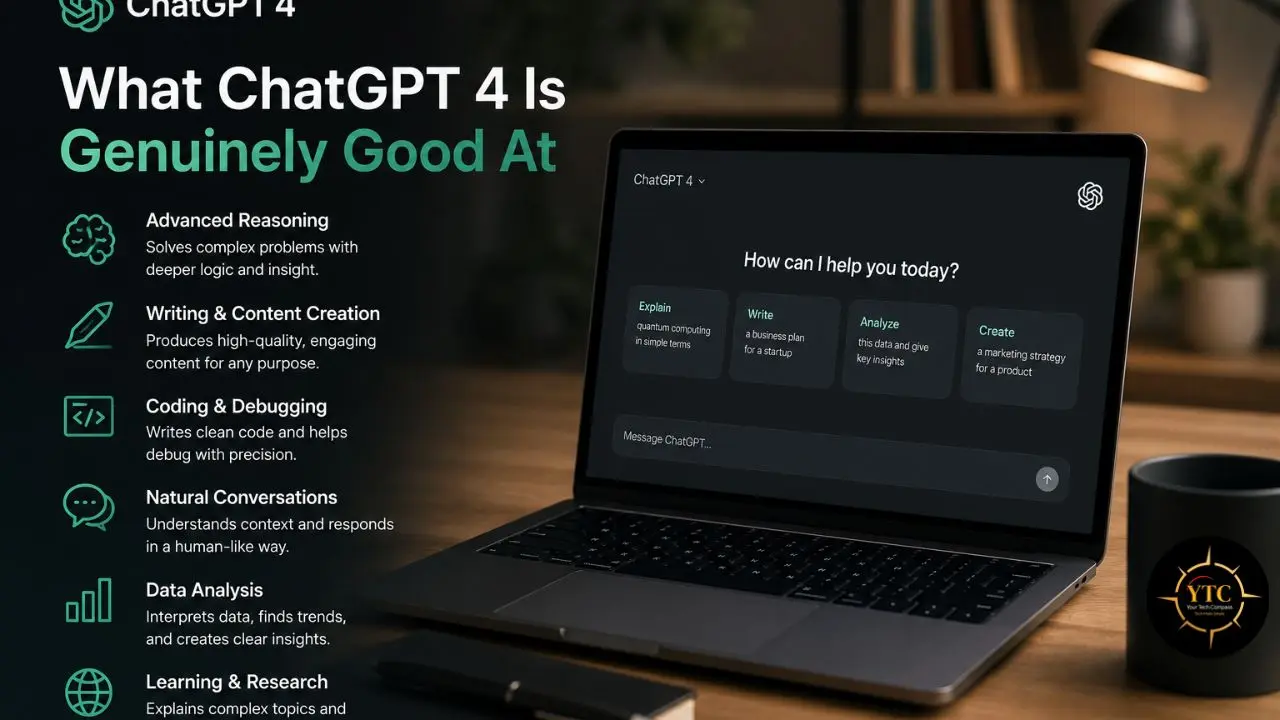
Rather than a generic list, here are the specific use cases where GPT-4 consistently delivers measurable value, with honest context about why.
Research Synthesis and Document Analysis
GPT-4 excels at processing large volumes of text and producing a structured synthesis. Upload a 40-page industry report and ask for the five most important findings and their implications.
GPT-4 delivers this faster than any human researcher and with reasonable accuracy, provided you verify the specific facts it surfaces. The limitation is that it’s synthesizing the document you gave it, not checking those claims against external sources. If the document contains errors, GPT-4 passes them through.
For research tasks where real-time source citation is important, tools like Perplexity AI serve a different purpose: they combine live web search with AI synthesis to provide source-backed answers rather than responses based solely on training data.
Writing Assistance Across Professional Contexts
The strongest use case I’ve observed in professional workflows is using GPT-4 as a first-draft generator. Give it detailed context (the purpose, the audience, the tone, the key points to cover), and it produces a structured first draft that a human then edits into a final deliverable.
This is meaningfully different from using GPT-4 to produce finished copy without review. The former uses AI to accelerate a human process; the latter introduces accuracy and voice risks that often require more revision time than writing from scratch.
Code Writing and Technical Explanation
Developers report the most consistent productivity gains from GPT-4 in tasks such as boilerplate code generation, scaffolding, documentation generation, and explaining unfamiliar code. Writing a function based on a specification, generating test cases, and converting code between languages are all tasks where GPT-4’s accuracy is high enough to serve as a useful starting point for a developer to review and adapt.
Learning and Concept Explanation
GPT-4 is an exceptional on-demand tutor. Ask it to explain a complex concept (transformer architecture, options pricing, contract law, organic chemistry mechanisms), and it adapts the explanation to the level of detail and technicality you specify.
“Explain this like I’m 12” and “explain this assuming I have a PhD in the field” produce genuinely different outputs calibrated to those audiences. This adaptive explanation capability is one of GPT-4’s most underutilized applications.
Honest Limitations of GPT-4

Hallucination: The Core Architectural Risk
The most important limitation is one that every GPT-4 user should understand at a mechanical level: hallucination. GPT-4 produces incorrect information with the same fluency and confidence as correct information because it’s always predicting the most probable next token rather than retrieving verified facts.
When it states something wrong, it’s not uncertain. It just doesn’t distinguish between things it “knows” and those it generates from statistical patterns.
The Practical Implication
Anything GPT-4 tells you that you intend to act on professionally (a legal provision, a scientific fact, a financial figure, a medical claim) requires verification against a primary source. This isn’t a criticism of GPT-4 specifically. It’s the nature of how language models work, and it applies to every model in this category.
Improvements across successive models have significantly reduced hallucination rates. GPT-5.5, for instance, showed a 52.5% reduction in hallucinated claims on high-stakes prompts in medicine, law, and finance compared to earlier models, but no current model has eliminated the risk.
Knowledge Cutoff and Real-Time Gaps
GPT-4’s training data has a knowledge cutoff; events, products, and developments that occurred after that date are not in the base model’s knowledge. In ChatGPT’s current interface, web browsing can be enabled to address this for specific queries.
The API does not include web access by default. For queries about current events, recent data, or anything that changes frequently, web-enabled AI search tools typically produce more accurate results than those from base models.
Context Length Limitations (for GPT-4 specifically)
Original GPT-4 was limited to 8,192 tokens of context, approximately 12 pages of text. GPT-4 Turbo extended this to 128,000 tokens. For tasks involving very long documents, complex multi-session projects, or extensive conversation history, these limits can be a practical constraint that successors like GPT-4.1 (1 million token context) or the GPT-5.4 family have substantially addressed.
Bias and Training Data Limitations
GPT-4 was trained on human-generated text, which means it absorbed the patterns, biases, and gaps present in that data. It performs better in English than in other languages, better on topics with extensive online coverage than on niche subjects, and better at reflecting mainstream perspectives than minority viewpoints. These aren’t failures of the model; they’re inherited characteristics of the training data that every user should keep in mind.
GPT-4 for Work and Business Workflows
In enterprise contexts, GPT-4 has proven genuinely useful as an augmentation layer for language-related tasks such as drafting, summarizing, translating, and formatting. The most consistent business value shows up in high-volume, language-intensive workflows: generating first drafts of customer communications, summarizing meeting transcripts, translating documentation, and analyzing customer feedback at scale.
What organizations have learned from deployments is that GPT-4 performs best when given specific, structured prompts with clear output format requirements, and when human review is built into the workflow rather than treated as optional. The “GPT-4 plus human review” workflow consistently outperforms both GPT-4 alone (accuracy risk) and humans alone (speed bottleneck) for most business language tasks.
For sensitive professional contexts (legal advice, medical information, financial recommendations), GPT-4 should augment human expertise rather than replace it. The risk of hallucinations in these domains creates liability and accuracy concerns that require qualified human oversight, regardless of the underlying model’s capabilities.
GPT-4 for Students and Education

For students, GPT-4 functions as an accessible tutor, available at any hour, infinitely patient with follow-up questions, and capable of explaining the same concept ten different ways until the understanding clicks. The specific use cases with the clearest value: concept explanation (“explain this chemistry mechanism step by step”), worked examples (“show me how to solve this type of problem, then give me a similar one to try”), and writing feedback (“what is weak about this argument structure?”).
The clearest risk in educational contexts is using GPT-4 to bypass the learning process rather than support it. Submitting AI-generated work as your own, having GPT-4 solve problems you’re supposed to be learning to solve yourself, and using it to avoid engaging with difficult material all undermine the educational value the technology could otherwise provide. The distinction between using AI as a learning scaffold and using it as a substitute for learning is the difference between GPT-4 making you smarter and making you more dependent.
ChatGPT 4 vs Other AI Tools: Where It Fits
📊 GPT-4o vs Claude vs Gemini vs DeepSeek at a Glance
Dimension | GPT-4o | Claude Opus 4.6 | Gemini 3.1 Pro | DeepSeek R1 |
Writing Quality | ✅ Excellent | ✅ Best-in-class | ✅ Strong | ⚠️ Good |
Reasoning and Logic | ✅ Strong | ✅ Strong | ✅ Strong | ✅ Strong |
Coding | ✅ Strong | ✅ Excellent | ✅ Strong | ✅ Strong |
Multimodal (Images) | ✅ Full support | ✅ Yes | ✅ Yes | ⚠️ Limited |
Context Window | 128K tokens | 1M tokens | 1M tokens | 128K tokens |
Real-Time Web Access | ✅ With Browse | ✅ Yes | ✅ Native | ⚠️ Limited |
Free Tier | ✅ Limited | ✅ Limited | ✅ Limited | ✅ Yes |
API Pricing (Input) | ~$2.50/M tokens | ~$3–15/M tokens | ~$2/M tokens | Very low |
Privacy/Data Policy | US-based, opt-in | US-based | US-based | Chinese company |
Open Source | ❌ No | ❌ No | ❌ No | ✅ Yes |
For a detailed, direct comparison of ChatGPT and DeepSeek, specifically covering where each model excels, where each falls short, and which tasks favor which tool, our DeepSeek vs ChatGPT comparison covers that decision in depth. The short answer: ChatGPT has a stronger ecosystem, better multimodal support, and more established enterprise compliance. DeepSeek offers competitive reasoning performance, open-source accessibility, and significantly lower API costs, with the important caveat of data handling under a Chinese company’s jurisdiction.
Common Misconceptions About GPT-4

These misconceptions persist among both professional and casual users, and getting them right materially affects how well you use the tool.
- “GPT-4 is looking things up when it answers.” It isn’t. Base GPT-4 generates responses entirely from patterns learned during training; it doesn’t search the internet in real time. Web access must be explicitly enabled and is a separate tool called a layer on top of the language model. When browsing is disabled, the model’s knowledge is limited to its training cutoff.
- “If GPT-4 sounds confident, the answer is probably right.” Confidence of expression is uncorrelated with factual accuracy in language models. GPT-4 delivers incorrect information with the same fluency and certainty as correct information. Confident tone is a feature of how language models generate text, not a signal of accuracy.
- “GPT-4 understands what you’re saying the way a human does.” GPT-4 models the statistical relationships between tokens; it doesn’t comprehend meaning as a human does. It can produce responses that appear to show understanding because it has learned the patterns of human communication at scale, but there’s no comprehension in the cognitive sense.
- “The latest model is always the right choice.” GPT-4o mini outperforms the original GPT-4 on many routine tasks in terms of cost, speed, and efficiency, while producing comparable results. The most capable model isn’t always the most appropriate one; the right model depends on the specific task, the required quality level, and the budget.
FAQs
ChatGPT offers a free tier with limited access to GPT-5.4 Mini and a daily message limit. Access to GPT-4o and above requires a paid subscription. Plus, at $20/month, it is the most common entry point for meaningful access to the GPT-4 family of models. API access to GPT-4 variants is separately billed on a per-token basis and is not included in consumer subscriptions.
No. The GPT-5 family, particularly GPT-5.4 and GPT-5.5, is OpenAI’s current flagship. GPT-4o and GPT-4.1 remain active and well-supported for existing integrations, but the cost-performance argument for using the original GPT-4 has largely been surpassed by later models. If you’re starting a new project, the GPT-5.4 family is the recommended choice.
Accuracy varies significantly by task type. For structured tasks with clear, verifiable outputs (code generation, translation, summarization of provided text), accuracy is high when prompts are specific. For open-ended factual questions, particularly on topics outside the training data or after the knowledge cutoff, hallucination rates are meaningful enough to require independent verification of any important claims.
Not inherently. In the ChatGPT web interface, web browsing can be enabled via a toggle, allowing the model to search the web for specific queries. This is a separate capability layered on the language model; it doesn’t change how the underlying model works. For web access via the API, specific tool integrations are required. For AI tools that combine language generation with native real-time web search as a core feature, Perplexity AI uses this architecture by default and provides cited sources with every response.
GPT-4 and its successors are general-purpose models with strong coding capability. Purpose-built coding tools, such as GitHub Copilot, Cursor, and Blackbox AI, are often more practically useful for in-IDE assistance because they integrate directly into the development environment and maintain awareness of the full codebase. General models like GPT-4 are better suited for architectural discussions, explaining unfamiliar code, and tasks outside the IDE.
Conclusion
GPT-4 is the model that changed what people expected from AI, and properly understanding it remains foundational to understanding every large language model that followed. Its transformer architecture, RLHF-based alignment, and performance on complex language tasks set the template. GPT-4o, GPT-4.1, and the GPT-5 family have all improved in specific dimensions (context length, multimodal capability, reasoning depth, cost), but they’re built on the same architectural principles and share the same fundamental strengths and limitations.
For practical use in 2026: GPT-4o and GPT-4.1 are the current active versions of the GPT-4 family worth using, while the GPT-5 family is recommended for new projects requiring frontier capabilities. The Plus plan at $20/month remains the most practical entry point for professionals who want meaningful access to these models without the overhead of API configuration. And regardless of which tier or model you use, the most important thing you can take from this review is the operational principle: GPT-4 is a powerful language tool with a hallucination risk that requires human judgment to manage. Use it to accelerate and support your work, not to replace the verification and expertise that consequential decisions require.
Every AI tool review, model comparison, and practical guide worth bookmarking lives at YourTechCompass.com, where we give you the complete, honest picture of what these tools actually do.