If you’re reading about C3 AI, you’re likely trying to make sense of a company that sits at the intersection of enterprise software and artificial intelligence. C3 AI builds tools that help large organizations deploy machine learning and AI solutions faster and more reliably. Rather than chasing generative AI chat interfaces meant for consumers, enterprises need consistent data integration, scalable infrastructure, and deep analytics, and that’s C3 AI’s focus.
However, enterprise AI isn’t as straightforward as consumer tools. It involves data pipelines, security concerns, cloud partnerships, and long deployment cycles. To understand why C3 AI matters, and whether it should matter to you, it helps to look under the hood at how it works, what problems it solves, who uses it, and how it compares with other AI offerings on the market.
What Is C3 AI?
At its core, C3 AI is an enterprise AI software provider that offers a comprehensive platform for building, deploying, and scaling AI applications. Rather than focusing on chatbots or simple automation, C3 AI targets companies that need predictive analytics, optimization, and decision support at scale.
Most people think of AI as something like generative content tools such as Tome AI, which helps with presentations, or consumer-facing chatbots. However, enterprise AI, the category C3 AI belongs to, is fundamentally different because it brings artificial intelligence into critical business systems (e.g., energy grids, financial risk models, supply chain planning). If you want a foundational overview of how generative AI systems work, this guide on what generative AI is helps lay the groundwork.
C3 AI’s software is cloud-native, meaning it runs on major cloud providers and integrates with large datasets, enterprise systems, and business processes rather than individual user documents.
How C3 AI Works
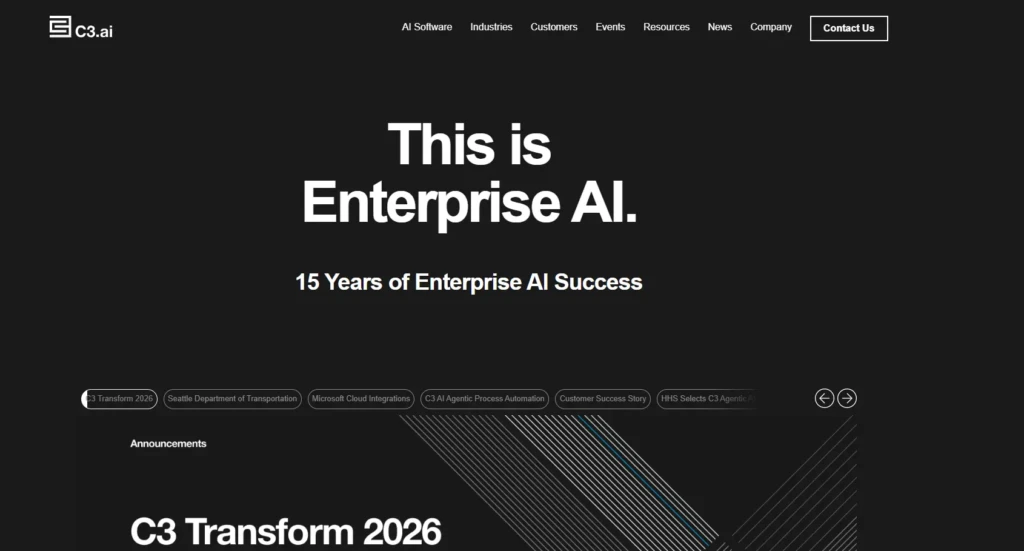
C3 AI’s core platform is built to handle several complex requirements typical in large organizations:
- Data Integration: Enterprise data is often distributed across multiple systems, including ERP systems, IoT sensors, historical databases, and logs. C3 AI aggregates and normalizes these data so the AI models can learn from complete datasets.
- Model-Driven Architecture: Instead of building isolated models, C3 AI uses reusable model components that can be applied across departments and use cases.
- Deployment and Monitoring: Once models are trained, C3 AI helps deploy them into production and monitors performance to ensure accuracy and relevance over time.
- Cloud Partnerships: Partnerships with major cloud providers, including Microsoft Azure, AWS, and Google Cloud, ensure compute scalability and security compliance.
Because of this architecture, C3 AI does not compete directly with consumer tools like ChatGPT or Tome AI; instead, it sits alongside other enterprise systems where uptime, reliability, and compliance are critical.
C3 AI Products and Solutions
This AI offers a suite of configurable, enterprise-grade solutions:
C3 AI Platform
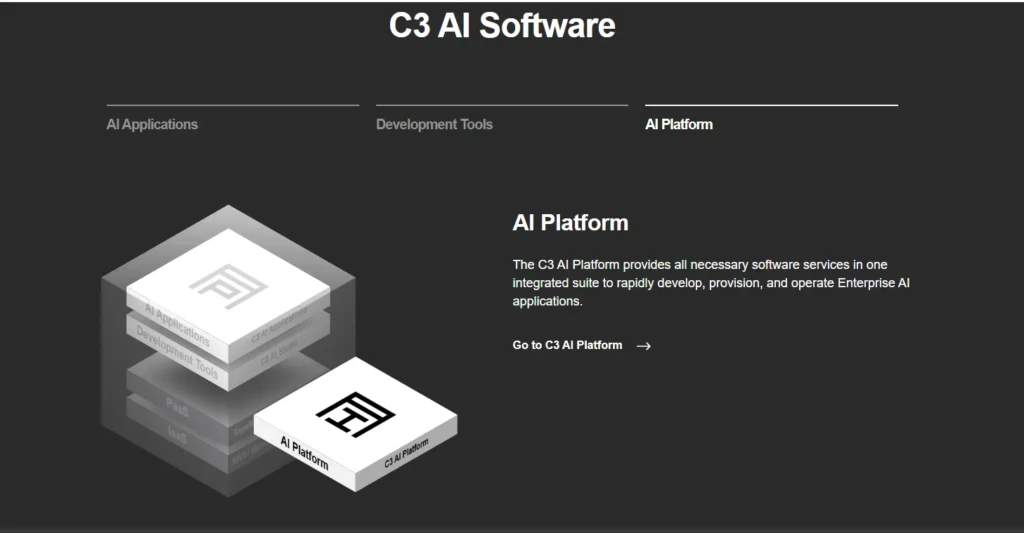
This is the foundational software layer for building and running AI applications. It handles data ingestion, model training, deployment, and monitoring across cloud infrastructure.
Industry-Specific Applications
Rather than giving customers a blank canvas, C3 AI provides prebuilt templates for common enterprise problems. These include predictive maintenance for manufacturing, fraud detection for financial services, and demand forecasting for energy companies.
Generative AI Capabilities
While not a consumer-grade generative AI tool, C3 AI has integrated generative models into workflows to automate insights and draft outputs from enterprise data. If you’re interested in how generative AI as a concept works and what powers large language models at scale, here’s a detailed breakdown of the generative AI landscape.
Predictive Analytics
C3 AI excels at predictive use cases, such as forecasting equipment failures, customer churn, or energy load, where historical data can inform future behavior.
According to C3 AI’s official documentation, enterprises often choose the platform for its robust data architecture and ability to scale across multiple business functions.
Industries That Use C3 AI
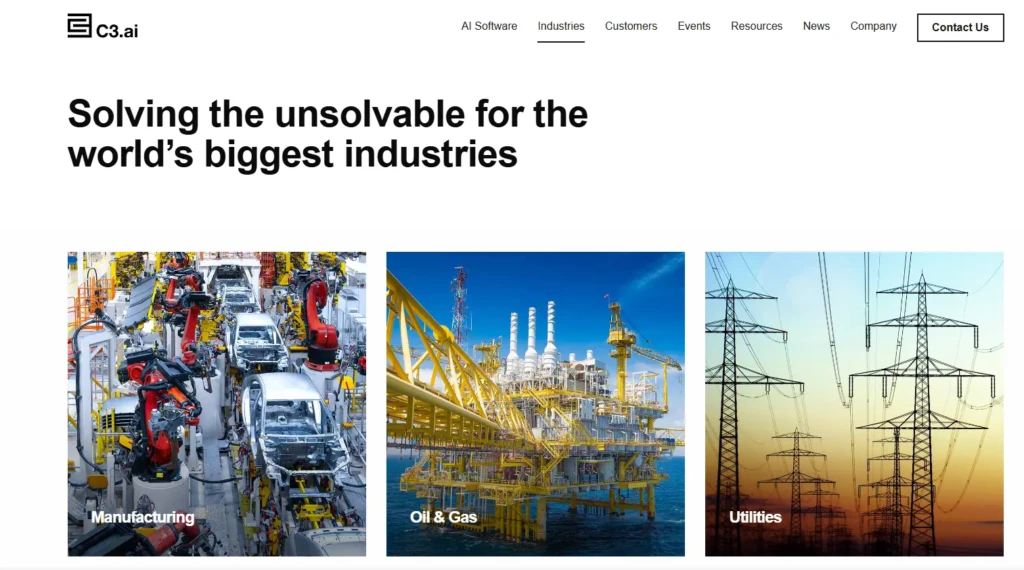
C3 AI is used in a variety of industry sectors, each with distinct data challenges:
- Energy & Utilities: Predictive asset maintenance, energy demand forecasting, and grid optimization.
- Manufacturing: Supply chain forecasting, manufacturing throughput prediction, and quality optimization.
- Financial Services: Risk modeling, compliance automation, and fraud detection.
- Defense & Aerospace: Mission planning, simulation, and predictive system diagnostics.
- Healthcare: Operational optimization, albeit with stricter privacy and compliance layers than other sectors.
These industry applications demonstrate that C3 AI is not a one-size-fits-all tool. Instead, it adapts to the specific analytical needs and data structures of each vertical.
C3 AI vs Other Enterprise AI Platforms
Because enterprise AI is a crowded space, it helps to compare C3 AI with alternatives:
Feature / Capability | C3 AI | Palantir | Snowflake AI | Traditional LLMs |
Enterprise Data Integration | ✅ Strong | Moderate | Moderate | ❌ |
Prebuilt Industry Use Cases | ✅ | Limited | ❌ | ❌ |
Predictive Analytics | ✅ | Variable | Some | ❌ |
Cloud Partner Flexibility | ✅ | Limited | ❌ | Cloud-dependent |
Generative Capabilities | Emerging | Limited | Limited | Strong (text tasks) |
Palantir is known for operational intelligence and data analytics, but it often requires heavier configuration and custom engineering. Snowflake provides data warehousing and some AI tools, but without prebuilt AI use cases, the lift stays with customers. Consumer-oriented LLM providers (like those behind generative chat models) excel at text generation but lack enterprise-grade integration with business workflows.
Strengths of C3 AI
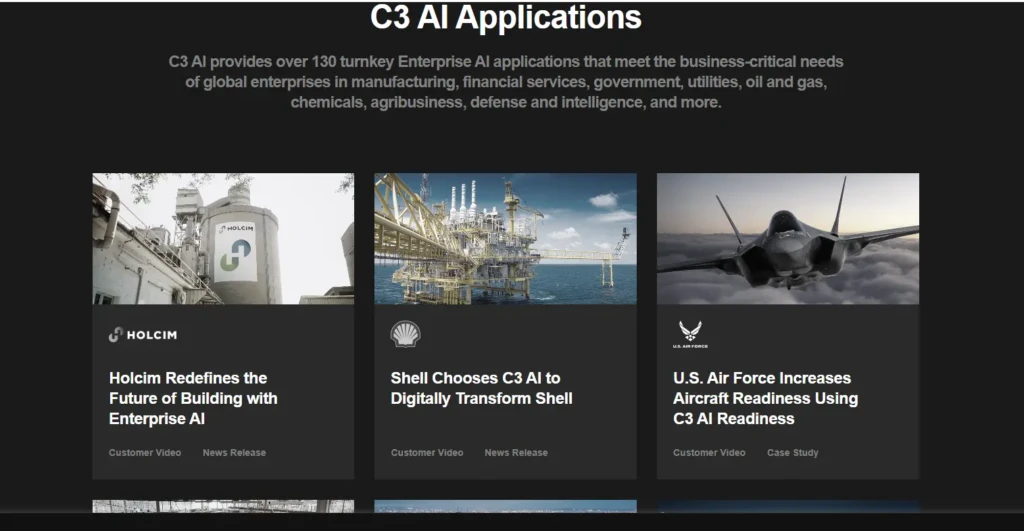
When evaluating whether C3 AI fits your needs, consider these strengths:
- Scalability: Designed for enterprise data volumes and multi-cloud deployment.
- Reusable Models: Model components can serve across departments.
- Industry Depth: Prebuilt solutions accelerate deployment.
- Security & Compliance: Meets enterprise requirements for sensitive data.
These elements make C3 AI appealing for businesses that cannot risk downtime, data leaks, or inconsistent predictions.
Limitations and Risks
As powerful as the platform is, it’s not without constraints:
- Complexity: Implementing enterprise AI still requires technical resources.
- Deployment Cycle: Compared to consumer tools, enterprise deployments take longer.
- Cost: Enterprise AI platforms are priced for organizational budgets, not individual use.
These limitations reflect the reality that enterprise AI investments require thoughtful planning and internal alignment.
C3 AI as a Public Company
C3 AI (NYSE: AI) is one of the few publicly traded pure-play AI software companies, which attracts investor interest. However, public market interest does not guarantee future performance.
Here are key considerations for readers who may be evaluating C3 AI from an investment perspective (not financial advice):
- Subscription Revenue Model: Predictable revenue streams from enterprise contracts.
- Long Sales Cycles: Enterprise deals often take months to finalize.
- Competition: Other platforms and in-house development teams can dilute potential market share.
Because of these factors, analysts often discuss C3 AI differently from consumer tech stocks or generative AI startups without established enterprise footprints.
Who Should Pay Attention to C3 AI?

C3 AI is most relevant if you fall into one of these groups:
- Enterprise IT leaders looking to accelerate AI adoption.
- Data science teams needing scalable infrastructure.
- Business decision makers seeking predictive insights.
- Investors researching AI software companies.
If your interest in AI is from a technical or strategic enterprise perspective, rather than a consumer creative use case, C3 AI warrants serious scrutiny.
Comparison Table: Enterprise AI Platforms at a Glance
Metric | C3 AI | Palantir | Snowflake | Generic LLMs |
Enterprise Data Integration | ⭐⭐⭐ | ⭐⭐ | ⭐⭐ | ⭐ |
Prebuilt Industry Applications | ⭐⭐⭐ | ⭐ | ❌ | ❌ |
Predictive Analytics | ⭐⭐⭐ | ⭐⭐ | ⭐ | ⭐ |
Generative Capabilities | ⭐⭐ | ⭐ | ⭐ | ⭐⭐⭐ |
Cloud Deployment Flexibility | ⭐⭐⭐ | ⭐ | ⭐⭐ | ⭐ |
Ease of Use for Enterprise Teams | ⭐⭐ | ⭐⭐ | ⭐⭐ | ⭐⭐⭐ |
Frequently Asked Questions
It provides an enterprise-grade platform for building, deploying, and maintaining scalable AI applications that integrate with real business data and processes.
Profitability status varies quarter to quarter; evaluate financials on authoritative financial reporting platforms (e.g., SEC filings, company investor relations).
C3 AI embeds AI within business data systems; ChatGPT is a general-purpose language model for text generation and conversational tasks.
Energy, manufacturing, financial services, and aerospace use C3 AI for predictive maintenance, optimization, and risk modeling.
Conclusion
C3 AI represents a powerful example of how artificial intelligence can be brought into large-scale enterprise environments, not just for novelty or marketing, but for tangible business outcomes such as predictive maintenance, operational optimization, and risk modeling. If your work involves complex datasets, multi-system integration, or high-stakes decision making, platforms like C3 AI deserve your attention.
That said, enterprise AI is not the same thing as consumer AI, and tools like Tome AI or generic language models have different strengths and purposes. Understanding these differences helps you choose the right AI approach for your needs, whether you’re building internal solutions, seeking investment insights, or evaluating AI capabilities across business functions. Ultimately, understanding how and where C3 AI fits enables smarter technology adoption decisions, and that’s what matters most.
At Your Tech Compass, we publish practical guides and honest tech reviews to help users make smarter decisions.