Atomesus AI is making headlines in India right now for good reason: it’s an ambitious, locally developed artificial intelligence platform built by a team of young innovators with roots in ISRO (the Indian Space Research Organisation). Unlike many global AI systems that rely on overseas data centers, Atomesus processes and stores data entirely within India, emphasizing both performance and national data sovereignty.
With backing from the Indus Valley Group, the company says it plans to make AI affordable for students, startups, and enterprises. I’ll walk you through what Atomesus AI is, how it works, and why it could shake up the global AI race, and yes, I think this could be a very meaningful moment in India’s AI story.
What Is Atomesus AI?
Atomesus AI is a newly announced artificial intelligence platform designed to deliver powerful AI capabilities in a cost-effective, locally governed manner. Based in Noida, India, the company claims to combine cutting-edge machine learning with strong data protection principles.
Rather than relying on foreign infrastructure, Atomesus AI’s design ensures that all user data stays within India, a key differentiator in a time when data sovereignty has become a major concern.
Origin Story: Who Built Atomesus AI
The most striking detail about Atomesus AI is that it was built by a group of college-age innovators with past research exposure at ISRO. Their experience in high-performance computing and complex systems helped shape an AI product that’s optimized both for speed and cost efficiency.
Backed by the Indus Valley Group, a deep-tech-focused conglomerate, Atomesus AI is being pitched not just as a commercial project, but as a part of India’s national push toward self-reliance in technology.
Technology & Architecture: What Powers Atomesus AI
At its core, Atomesus AI uses a hybrid intelligence architecture that blends proprietary algorithms with licensed external models. This hybrid design helps the system remain lightweight yet powerful, while avoiding the higher costs of purely licensed AI systems.
Here are some of its technical highlights:
- Transformer-based Neural Architecture: Atomesus uses transformer models, the same backbone technology behind most modern large language models.
- Efficiency Optimizations: Techniques such as model quantization (e.g., converting FP32 to lower-precision formats) and knowledge distillation help it run faster and more cost-effectively.
- Secure, India-based Infrastructure: Data is processed on Indian servers or cloud centers, ensuring no cross-border data transfer.
- Regulatory Compliance: The platform reportedly aligns with India’s data protection laws (e.g., the Digital Personal Data Protection Act, 2023) to guarantee data residency.
Features & Capabilities
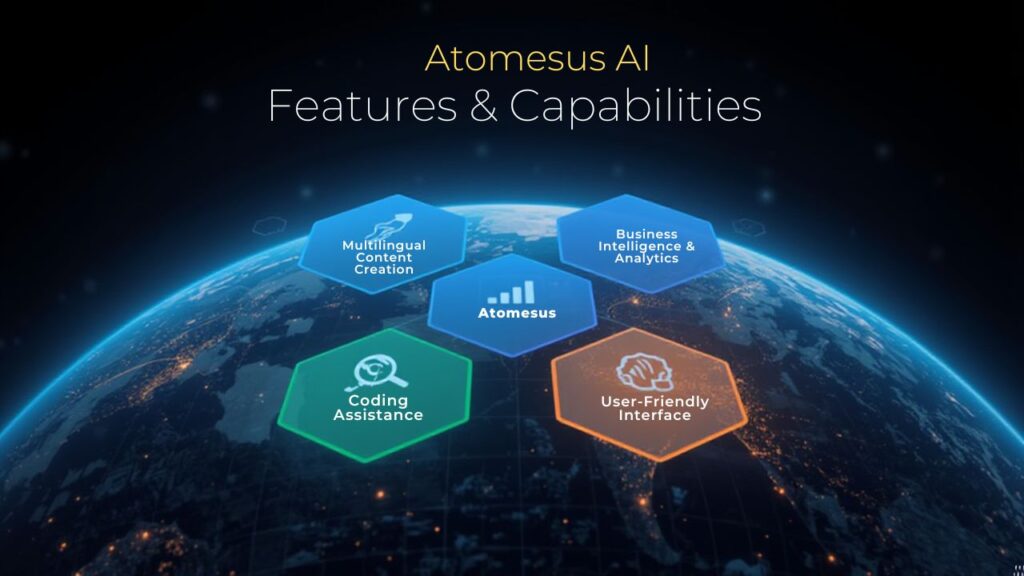
Atomesus AI doesn’t just promise powerful architecture; it aims to deliver real-world utility across several domains:
- Multilingual Content Generation
- Supports multiple Indian languages (Hindi, Tamil, Telugu, etc.), making it more accessible.
- Useful for bloggers, marketers, educators, and researchers who need context-aware writing in regional languages.
- Supports multiple Indian languages (Hindi, Tamil, Telugu, etc.), making it more accessible.
- Business Intelligence & Analytics
- Offers tools for market research, data visualization, and predictive analytics.
- It can be leveraged by startups and SMEs to make data-driven decisions.
- Offers tools for market research, data visualization, and predictive analytics.
- Coding Assistance
- Developers can use it for code generation, debugging, and documentation.
- Helps lower the barrier to entry for smaller development teams or solo creators.
- Developers can use it for code generation, debugging, and documentation.
- User-Friendly Interface
- Designed to be intuitive, whether you’re an AI beginner or pro. According to its backers, the UX is meant to be “fast, simple, and accessible.”
- Pricing tiers (free, low-cost subscription, enterprise) are part of the mission to democratize AI.
- Designed to be intuitive, whether you’re an AI beginner or pro. According to its backers, the UX is meant to be “fast, simple, and accessible.”
Strategic & National Importance
Why does Atomesus AI matter, not just to techies but to India’s long-term ambitions?
- Data Sovereignty: Placing data processing and storage wholly inside India is a major step toward reducing dependence on foreign AI platforms.
- Atmanirbhar Bharat (Self-Reliant India): The platform aligns with India’s broader strategy of technological self-reliance and digital infrastructure development.
- Democratization: By focusing on affordability, Atomesus AI could enable students, startups, and smaller companies to use powerful AI tools, bridging the gap that many global models currently leave.
- Global Vision: While Atomesus starts in India, its backers reportedly plan international expansion, positioning it as more than just a local novelty.
Recent News & Launch Timeline
- According to recent announcements, Atomesus AI is slated to officially launch in November 2025.
- A press release from the Indus Valley Group claims that by 2026, Atomesus could become among the “world’s best AI” platforms, thanks to its unique blend of affordability, performance, and user-friendliness.
- Media coverage (e.g., by Outlook India and The Tribune) has spotlighted its data localization promise, which sets it apart from global competitors.
Competitors & Positioning
To understand Atomesus AI’s place in the global AI ecosystem, here’s how it stacks up against other players:
Platform | Strengths | Atomesus Advantage |
OpenAI / ChatGPT | Mature ecosystem, large user base | Atomesus offers local data residency and a lower cost for Indian users |
Google Gemini | Multimodal capabilities, global infrastructure | Atomesus emphasizes data sovereignty and affordability |
Claude / Anthropic | Ethical AI, safety-focused | Atomesus targets mass adoption with affordable tiers and localized data |
In this comparison, Atomesus AI stands out for its “made in India” value proposition, similar to Blackbox AI’s approach as a powerful AI for developers, but with a different mission. Just as Blackbox helps streamline dev workflows, Atomesus could empower creators, entrepreneurs, and students in India with scalable, affordable intelligence.
Challenges & Risks
While the vision behind Atomesus AI is compelling, it’s not without hurdles:
- Scaling Infrastructure: Running high-performance AI on local infrastructure could get expensive and complex as user demand grows.
- Competition: It’s going up against global AI giants like ChatGPT, Gemini, and Claude, all with massive resources.
- Regulatory Pressure: Data localization brings regulatory burdens. Compliance with India’s evolving AI and data laws isn’t guaranteed to stay easy.
- Adoption Risk: For widespread adoption, Atomesus needs to convince both enterprises and individuals that it’s not just affordable, but also reliable.
What’s Next for Atomesus AI

Looking ahead, here’s what could define the future of Atomesus AI:
- International Expansion: While its first major focus is India, there are signals that the platform could scale internationally once it proves its value domestically.
- Product Evolution: Additional features could include multimodal AI (images, audio), deeper integrations, and enterprise-scale tools.
- Partnerships: Collaborations with educational institutions, government initiatives, and private companies could accelerate adoption.
- Regulatory Engagement: The team will likely need to navigate data policy, AI ethics regulation, and localization compliance as they grow.
Why Atomesus AI Matters to You & the Future of AI
Atomesus AI is more than just another LLM; it’s a statement. By focusing on affordability, localization, and accessibility, it challenges the idea that powerful AI is only for big corporations and wealthy users. For creators, students, and remote workers, it could dramatically reduce the barrier to entry.
In the broader AI landscape, Atomesus shows one way forward: not just competition, but a rethinking of what AI can be, locally built, locally run, and globally minded. If you’re interested in alternative platforms, it’s worth comparing this with Gemini AI (which we explored in our guide on how Gemini AI works), or even developer-focused tools like Blackbox AI (reviewed here). You might also explore Poly AI for conversational AI or Janitor AI for fine-tuned productivity.
Given its mission and technical foundation, I believe Atomesus AI is more than just hype; it could be a meaningful milestone in India’s AI journey, and potentially a global game-changer. I can’t wait to watch.