If you’ve ever used a Netflix recommendation, spoken to an Alexa-powered device, or interacted with a chatbot on a major retail website, there’s a very real chance that AWS AI was working behind the scenes. Amazon Web Services has grown from a simple cloud storage provider into the world’s most comprehensive artificial intelligence and cloud computing platform, powering more than a third of the global internet and serving everything from scrappy startups to the world’s largest governments and enterprises. And in the race to define the future of AI, AWS isn’t just participating, it’s leading the infrastructure charge.
In this in-depth guide, I’m going to walk you through the entire AWS AI ecosystem, from the foundational three-layer architecture that organizes its dozens of services, to the generative AI powerhouses like Amazon Bedrock and Amazon Q, to how it compares against rivals like Microsoft Azure AI and Google Vertex AI. Whether you’re a developer, data scientist, IT decision-maker, or simply someone trying to understand what all the AWS AI buzz is about, this guide is written directly for you. Let’s get into it.
What Is AWS AI?
AWS AI is not a single product, and that’s the first thing you need to understand before going any deeper. It is a comprehensive, layered ecosystem of artificial intelligence, machine learning, and generative AI services built on top of Amazon Web Services’ global cloud infrastructure. Think of it less like a single tool and more like an entire city of AI capabilities, where each district serves a different purpose and level of technical sophistication.
At its broadest, AWS AI is organized into three distinct layers: pre-built AI Services that any developer can consume via API, the ML Services layer centered around Amazon SageMaker for building and deploying custom models, and the ML Infrastructure layer that provides the raw compute power, custom silicon chips, high-performance networking, and GPU clusters that everything else runs on. This layered design is one of AWS AI’s most important architectural decisions because it lets you engage with the ecosystem at exactly the level of technical depth that matches your skills and business needs. No matter where you enter, there’s a legitimate path forward.
A Brief History of Amazon’s AI Journey
Amazon’s AI journey didn’t start in a research lab; it started in a warehouse. Long before “generative AI” entered the mainstream vocabulary, Amazon was quietly building one of the world’s most sophisticated recommendation engines to power its e-commerce platform. Those early systems, which predicted what you’d want to buy next based on your browsing and purchase history, were foundational machine learning at scale and the seeds of what became AWS AI.
The launch of Alexa in 2014 was Amazon’s first major consumer-facing AI moment, demonstrating that large-scale natural language understanding could be productized and shipped to millions of households. Then came Amazon SageMaker in 2017, a landmark launch that gave developers and data scientists a fully managed, end-to-end machine learning platform that didn’t require them to manage any infrastructure.
Over the following years, AWS systematically built out its AI services portfolio, adding computer vision (Rekognition), conversational AI (Lex), intelligent search (Kendra), and dozens more. The most recent, and most consequential, chapter of that story is Amazon Bedrock, launched in 2023 and rapidly expanded into AWS’s generative AI hub, which today powers over 100,000 organizations worldwide.
The Three Layers of AWS AI
Understanding this three-tier architecture is the key to navigating the AWS AI ecosystem without getting lost. Each layer serves a fundamentally different audience and purpose, and knowing which one applies to your needs will save you significant time and money.
Layer 1: AI Services (Pre-Built, API-Driven)
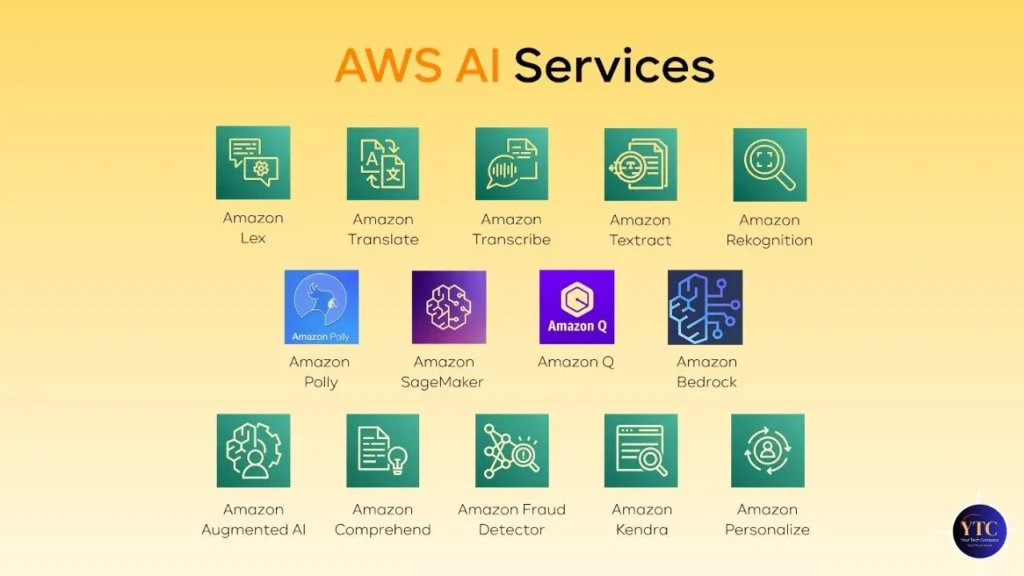
This is the most accessible layer of AWS AI, and it’s where most businesses start. AI Services are fully managed, pre-trained capabilities that you can call via a simple API, no machine learning expertise required. These services cover computer vision (Amazon Rekognition), natural language processing (Amazon Comprehend), speech-to-text (Amazon Transcribe), text-to-speech (Amazon Polly), translation (Amazon Translate), conversational AI (Amazon Lex), document analysis (Amazon Textract), intelligent search (Amazon Kendra), and personalization (Amazon Personalize). If you can make an API call, you can use any of these services in your application today.
Layer 2: ML Services (Custom Model Development)
This is where Amazon SageMaker lives, and it’s designed for data scientists, ML engineers, and technical teams who need to build, train, and deploy their own custom machine learning models. Rather than relying on pre-built capabilities, this layer provides the full ML development lifecycle, including data labeling, experiment tracking, model training, AutoML, MLOps pipelines, and deployment, all within a unified, managed environment. Amazon Bedrock also fits within this layer for teams building generative AI applications on top of foundation models.
Layer 3: ML Infrastructure (The Compute Foundation)
Underneath everything is AWS’s world-class ML infrastructure, the hardware and networking that make high-performance AI workloads possible at scale. This includes EC2 instances with NVIDIA GPUs, AWS Trainium (Amazon’s custom-designed AI model training chip, now in its third generation with Trainium3 UltraServers), and AWS Inferentia (optimized for cost-efficient inference at scale). The recently announced AWS AI Factories extend this infrastructure directly into customers’ own data centers, combining Trainium chips, NVIDIA GPUs, and AWS networking in private deployments that meet stringent data sovereignty requirements.
Key AWS AI Services Explained
Amazon Rekognition: Computer Vision at Scale
Amazon Rekognition is AWS’s computer vision service that can analyze images and video with impressive accuracy. You can use it to detect objects, scenes, text, faces, and unsafe content; identify celebrities; compare faces for authentication workflows; and even analyze video streams for real-time activity detection.
It’s widely used in retail (shelf monitoring and queue management), media (content moderation), and security (access control and identity verification). Because it’s API-driven, you can add computer vision to your application without training a single model yourself.
Amazon Comprehend: Natural Language Processing Made Accessible
Amazon Comprehend is AWS’s NLP service, built to extract meaning and insight from unstructured text. Feed it a customer review, a support ticket, a legal document, or any body of text, and it will identify entities (people, places, organizations), detect sentiment (positive, negative, neutral, mixed), extract key phrases, classify the document, and even detect the dominant language. For businesses drowning in unstructured text data, Comprehend transforms noise into structured, actionable intelligence at scale without ML expertise.
Amazon Lex: Conversational AI and Chatbot Building
Amazon Lex is the same technology that powers Alexa, now available as a fully managed service for building conversational interfaces, chatbots, voice bots, and virtual assistants for any application. It handles both speech recognition and natural language understanding, supports multi-turn conversations, and integrates natively with AWS Lambda for backend fulfillment. If you need to build a customer service bot, an HR FAQ assistant, or an interactive IVR system, Lex is the fastest path from concept to deployment.
Amazon Polly: Neural Text-to-Speech
Amazon Polly converts text into lifelike speech using deep learning. It supports dozens of languages and voice options, including Neural Text-to-Speech (NTTS) voices that sound remarkably natural, removing the robotic quality that made older TTS systems immediately recognizable. It’s used extensively in e-learning platforms, accessibility tools, call center applications, and anywhere else a human-quality voice is needed at scale without the cost of human voice talent.
Amazon Kendra: Intelligent Enterprise Search
Amazon Kendra is a managed intelligent search service that uses machine learning to return genuinely relevant answers from your organization’s internal content, not just a list of documents, but actual answers extracted from those documents. It connects to dozens of data sources (SharePoint, S3, Confluence, Salesforce, and more), understands natural language queries, and dramatically reduces the time employees spend hunting for information. For large enterprises with sprawling knowledge bases, Kendra is transformative.
Amazon Transcribe: Automatic Speech Recognition
Amazon Transcribe converts audio into accurate text transcripts in real time or as a batch job. It supports multi-speaker identification (useful for meeting transcripts), custom vocabularies for domain-specific terminology, and content redaction to automatically remove sensitive information such as credit card numbers from transcripts. Combined with Amazon Comprehend, it creates a powerful pipeline for analyzing spoken content, call center recordings, medical consultations, earnings calls, and more.
Amazon Translate: Neural Machine Translation
Amazon Translate delivers fast, high-quality neural machine translation across 75+ languages. It’s used to localize content at scale, enable multilingual customer support, and translate user-generated content in real time. Custom terminology support lets you define how specific words and phrases (brand names, technical terms) should be translated, a critical feature for businesses where brand consistency across markets is non-negotiable.
Amazon Bedrock: AWS’s Generative AI Hub

Amazon Bedrock deserves its own dedicated section because it is, without question, the centerpiece of AWS’s entire generative AI strategy, and one of the most significant AI infrastructure launches of the past several years. At its core, Bedrock is a fully managed service that gives you access to dozens of high-performing foundation models from leading AI providers, all through a single, unified API, without managing any underlying infrastructure.
What makes Bedrock particularly compelling for enterprise users is what it does beyond raw model access. Bedrock Agents allows you to build autonomous AI agents that can take multi-step actions across tools, APIs, and databases. On the other hand, Bedrock AgentCore (announced at re:Invent 2025) provides a full agentic platform for deploying and operating highly capable agents securely at scale, with built-in quality evaluations, policy controls, and performance monitoring.
Bedrock Knowledge Bases enables Retrieval-Augmented Generation (RAG), allowing your AI applications to query your organization’s private data, documents, databases, and wikis to produce accurate, grounded responses. While Bedrock Guardrails adds customizable safety controls that filter harmful content and block hallucinated responses for RAG and summarization workloads.
Additionally, Bedrock’s Intelligent Prompt Routing can reduce inference costs by up to 30% while maintaining output quality, and distilled models run up to 500% faster at 75% lower cost compared to their full-size counterparts. For a deeper look at how AI models are being deployed for creative and visual applications alongside these enterprise tools, our Seedance 2.0 review is a useful companion read on what state-of-the-art generative AI looks like on the consumer side.
Amazon SageMaker: Building Custom ML Models at Scale
While Bedrock is your gateway to pre-trained foundation models, Amazon SageMaker AI is where you go when you need to build, train, and deploy your own custom machine learning models with full control over every step of the process. It’s the most comprehensive managed ML platform available from any cloud provider, and the 2025 updates at re:Invent have made it dramatically more powerful.
SageMaker Studio is the unified web-based IDE at the center of the SageMaker experience, a single interface that brings together notebooks, experiment tracking, model training, pipelines, and deployment in one cohesive environment. The SageMaker Autopilot handles AutoML, automatically selecting the best algorithm and hyperparameters for your dataset so that teams without deep ML expertise can still build production-quality models. On the other hand, SageMaker Pipelines provides MLOps automation, letting you define, schedule, and monitor end-to-end ML workflows as reproducible pipelines, critical for teams moving from experimentation to production.
Two major 2025 updates transformed SageMaker’s capabilities at scale. Serverless MLflow integration now eliminates all infrastructure management for experiment tracking; you can launch, scale, and monitor ML experiments without provisioning a single server.
And SageMaker HyperPod’s checkpointless training reduces downtime from training failures by over 80% through peer-to-peer state recovery, eliminating the costly checkpoint-restart cycles that previously plagued large-scale AI training runs. For teams with the technical depth to use it fully, SageMaker cuts advanced model customization workflows from months to days, a legitimate competitive advantage in fast-moving industries.
Amazon Q: The Enterprise AI Assistant

Amazon Q is AWS’s answer to the enterprise AI assistant market, its equivalent of Microsoft Copilot and Google Gemini for the workplace, and it comes in two distinct flavors designed for different user profiles. Understanding the difference between them is important before you decide whether Q belongs in your organization’s stack.
Amazon Q Business is designed for knowledge workers and business users. It connects to your organization’s internal data sources, documents, wikis, ticketing systems, CRMs, and email, and allows employees to ask natural-language questions and receive accurate, sourced answers drawn directly from your company’s knowledge base.
Rather than relying on a model’s general training data, Q Business grounds every response in your specific organizational context. The result is a productivity tool that can genuinely accelerate onboarding, internal research, and day-to-day decision-making without requiring employees to know where anything lives.
Amazon Q Developer (formerly CodeWhisperer) is built for software developers and cloud engineers. It provides AI-powered code generation, debugging assistance, security vulnerability scanning, and crucially, deep integration with AWS services for infrastructure guidance, code transformation, and even automated incident response.
The recently announced AWS DevOps Agent, built on Q Developer’s foundation, acts as an autonomous on-call engineer that analyzes data across CloudWatch, GitHub, and ServiceNow to identify root causes and coordinate incident response autonomously. If you’re exploring how AI coding assistants compare across the market, our Blackbox AI review offers a useful contrast with a developer-focused alternative.
AWS AI for Different Industries
One of the strongest arguments for AWS AI isn’t any single service; it’s the breadth of real-world applications it enables across virtually every industry vertical. Let me walk you through the most impactful use cases, sector by sector.
1. Healthcare
AWS AI powers medical imaging analysis through Rekognition and custom SageMaker models, enabling radiologists to flag anomalies in X-rays and MRIs faster and more consistently. Amazon Comprehend Medical extracts clinical entities, medications, and diagnoses from unstructured physician notes, transforming documentation burdens into structured, searchable data. Transcribe Medical handles clinical dictation while ensuring medical vocabulary and content are redacted in accordance with the Health Insurance Portability and Accountability Act (HIPAA).
2. Financial Services
Fraud detection is one of the most mature ML use cases in finance, and AWS AI provides the infrastructure to build, train, and deploy real-time fraud-scoring models at the transaction-level speed banks require. Amazon SageMaker powers risk modeling workflows, while Amazon Bedrock enables the rapid development of document analysis agents for loan processing, compliance review, and regulatory reporting. The pay-as-you-go model is particularly attractive for financial institutions that face highly variable peak loads around month-end and quarter-end processing.
3. Retail and E-Commerce
Amazon Personalize, the same recommendation technology that powers Amazon.com itself, is available to any retailer to deliver personalized product recommendations, search ranking, and email targeting. Combined with Amazon Forecast for demand forecasting and SageMaker for custom pricing optimization models, AWS provides retailers with a genuinely powerful AI stack previously available only to the largest players in the industry.
4. Manufacturing
Predictive maintenance, quality control defect detection, and supply chain optimization are the three most common manufacturing applications of AWS AI. SageMaker’s edge deployment capabilities enable ML models to run directly on factory-floor equipment, detecting equipment anomalies in real time before they become costly failures. The AWS IoT Greengrass service connects plant-floor sensor data to cloud-based ML models, closing the loop between physical operations and AI insight.
5. Media and Entertainment
Content moderation at scale, automatically detecting inappropriate imagery, hate speech, and CSAM in user-generated content, is one of the most critical and demanding applications in media, and Amazon Rekognition is deployed by major platforms for exactly this purpose. Meanwhile, Amazon Personalize powers the recommendation engines that keep viewers engaged on streaming platforms, and Amazon Polly enables the localization of video content into multiple languages without human voice talent costs.
AWS AI Pricing: How Does It Work?
AWS AI pricing follows the same pay-as-you-go philosophy that governs the broader AWS ecosystem, and that’s both its greatest strength and the source of most billing surprises. The short version: you pay for exactly what you use, with no minimum fees or upfront commitments, across most services. But the details matter significantly, so let me break this down service by service.
Amazon Bedrock uses a consumption-based token pricing model. For text models, you’re charged separately for input tokens and output tokens, with rates varying significantly by model and tier. For context, Amazon’s own Titan Text Lite model starts at just $0.0003 per 1,000 input tokens, making it extremely affordable for high-volume applications, while frontier models like Claude or Llama 3 cost more per token but deliver correspondingly more sophisticated outputs.
Bedrock supports four pricing tiers: On-Demand (pay-per-use, no commitment, ideal for variable workloads), Batch (50% discount for asynchronous processing), Provisioned Throughput (reserved capacity for guaranteed performance at scale), and Priority (premium tier at a 75% surcharge for latency-sensitive applications). Importantly, there is no permanent free tier for Bedrock; all usage is charged from day one.
Amazon SageMaker AI uses a different model: you pay for the compute instances used during training and hosting, the storage consumed, and data processing jobs. The SageMaker Free Tier provides a meaningful monthly allowance for new users, including free Studio notebook hours and limited training instance time, making it accessible for experimentation and learning without immediate cost. SageMaker Studio itself is free to access; you only pay for the underlying compute and storage resources you provision.
AWS Pricing Comparison
Here’s a simplified breakdown of AWS AI pricing across the key services to help you compare at a glance:
Service | Pricing Model | Entry-Level Cost | Free Tier? | Best For |
Amazon Bedrock | Per input/output token | From ~$0.0003/1K tokens (Titan Lite) | ❌ No | GenAI app development, foundation model access |
Amazon SageMaker AI | Per instance hour + storage | From ~$0.05/hr (hosting), $0.10/hr (training) | ✅ Yes (limited) | Custom ML model building and deployment |
Amazon Rekognition | Per image/video analyzed | $1.00/1,000 images | ✅ Yes (5K images/mo) | Computer vision applications |
Amazon Comprehend | Per unit of text analyzed | $0.0001/unit | ✅ Yes (50K units/mo) | NLP, sentiment analysis, entity extraction |
Amazon Lex | Per request (text/speech) | $0.004/text request | ✅ Yes (10K requests/mo) | Chatbots, conversational AI |
Amazon Transcribe | Per second of audio | $0.024/minute | ✅ Yes (60 min/mo) | Speech-to-text, meeting transcription |
Amazon Translate | Per character translated | $15.00/1M characters | ✅ Yes (2M chars/mo) | Multilingual content, localization |
Amazon Polly | Per character synthesized | $4.00/1M characters (standard) | ✅ Yes (5M chars/mo) | Text-to-speech, accessibility |
Amazon Q Business | Per user/month | $3/user/month (Lite) | ❌ No | Enterprise knowledge assistant |
Amazon Q Developer | Per user/month | Free tier available | ✅ Yes | AI coding assistant for developers |
One important thing to understand: AWS costs can scale quickly for high-volume AI workloads, particularly with Bedrock when using premium frontier models. The good news is that AWS provides a cost calculator, Bedrock’s Intelligent Prompt Routing reduces inference costs by up to 30%, and model distillation can cut costs by 75% while running 500% faster, so cost optimization is genuinely built into the platform if you know where to look.
AWS AI vs Competitors
The cloud AI market is a four-horse race right now, and each player has genuine strengths worth considering. Here’s an honest, balanced comparison of how AWS AI stacks up against its three main rivals.
AWS AI vs Microsoft Azure AI
Azure AI‘s single biggest advantage is its deep integration with the Microsoft ecosystem. If your organization runs Microsoft 365, Teams, Dynamics, and Azure DevOps, Azure AI slots into your existing workflows with minimal friction.
Azure Machine Learning is a genuinely strong ML platform, and Azure OpenAI Service gives enterprise customers exclusive access to OpenAI’s GPT-4o and o-series models in a private, compliant cloud environment. Where AWS wins: breadth of services, scale of infrastructure, and the depth of the Bedrock model marketplace. Where Azure wins: Microsoft ecosystem integration, enterprise governance tooling, and the fastest path to production for organizations already in the Microsoft stack.
AWS AI vs Google Cloud Vertex AI
Google Vertex AI benefits from Google’s unmatched AI research pedigree, the company that invented the Transformer architecture underlying virtually all modern large language models. Vertex AI’s Gemini model family is state-of-the-art, and Google’s AutoML and data analytics integration (BigQuery ML, Looker) is genuinely best-in-class for data-intensive teams.
However, AWS wins on sheer service breadth, global infrastructure footprint, and the maturity of its enterprise sales and support organization. For pure AI research teams or Google Cloud-native organizations, Vertex AI is excellent. For most enterprise deployments at scale, AWS AI’s ecosystem depth and integration options are hard to beat.
AWS AI vs IBM Watsonx
IBM Watsonx serves a very specific and important niche: regulated industries where AI governance, explainability, and compliance are non-negotiable. For healthcare organizations managing HIPAA workflows, financial firms navigating model risk management requirements, or government agencies requiring full audit trails of every AI decision, IBM’s emphasis on Explainable AI and hybrid/private cloud deployments is uniquely valuable. AWS wins on scale, speed, and breadth of services.
IBM wins on governance, compliance tooling, and the ability to deploy in fully private environments. Many organizations in regulated sectors actually run both AWS for scale and speed, and IBM for compliance and governance.
A Quick Comparison
Here’s how the four platforms compare across the dimensions that matter most to enterprise decision-makers:
Dimension | AWS AI | Microsoft Azure AI | Google Vertex AI | IBM Watsonx |
Breadth of AI Services | ⭐⭐⭐⭐⭐ Widest portfolio | ⭐⭐⭐⭐ Strong and growing | ⭐⭐⭐⭐ Research-heavy | ⭐⭐⭐ Focused on enterprise |
Foundation Model Access | ⭐⭐⭐⭐⭐ ~100 models via Bedrock | ⭐⭐⭐⭐ OpenAI + Azure models | ⭐⭐⭐⭐ Gemini family + OSS | ⭐⭐⭐ IBM + curated partners |
ML Development Platform | ⭐⭐⭐⭐⭐ SageMaker (most mature) | ⭐⭐⭐⭐ Azure ML (great governance) | ⭐⭐⭐⭐ Vertex AI (great UX) | ⭐⭐⭐ Watson Studio |
Ease of Use | ⭐⭐⭐ Steeper learning curve | ⭐⭐⭐⭐ Familiar Microsoft UX | ⭐⭐⭐⭐ Clean, modern UI | ⭐⭐⭐ Enterprise-complex |
Enterprise Governance & Compliance | ⭐⭐⭐⭐ Strong, broad compliance | ⭐⭐⭐⭐⭐ Best for Microsoft orgs | ⭐⭐⭐ Growing | ⭐⭐⭐⭐⭐ Best for regulated industries |
Global Infrastructure | ⭐⭐⭐⭐⭐ Largest footprint | ⭐⭐⭐⭐⭐ Near-parity with AWS | ⭐⭐⭐⭐ Strong | ⭐⭐⭐ Smaller footprint |
Pricing Transparency | ⭐⭐⭐ Complex but well-documented | ⭐⭐⭐ Complex enterprise agreements | ⭐⭐⭐⭐ Transparent, auto-discounts | ⭐⭐ Custom enterprise pricing |
Best For | Most enterprise workloads at scale | Microsoft-stack organizations | AI research, data-heavy teams | Regulated industries |
The broader AI landscape is evolving rapidly on multiple fronts. If you’re curious how today’s leading AI chatbots and language models are competing on the consumer side, a parallel race to what AWS, Azure, and Google are running in the enterprise, our DeepSeek vs ChatGPT comparison is worth reading alongside this one. And for a deeper look at how AI image generation has become a distinct competitive landscape alongside enterprise AI, our Midjourney AI review provides useful context for where creative AI is heading.
Pros and Cons of AWS AI

Being honest about both sides of the equation is the only way to give you a useful assessment. Here’s a straightforward breakdown:
The Pros
- The most comprehensive AI and ML service portfolio of any cloud provider, covering everything from pre-built APIs to custom chip infrastructure.
- Amazon Bedrock provides access to nearly 100 foundation models from leading providers through a single, secure, managed API, with unmatched model diversity.
- True pay-as-you-go pricing with no minimum commitments lets organizations of any size start experimenting without a significant upfront investment.
- World-class enterprise security, privacy, and compliance coverage, including HIPAA, SOC 2, GDPR, FedRAMP, and ISO 27001, making it viable for the most regulated industries.
- Reinforcement Fine-Tuning in Bedrock delivers 66% average accuracy gains over base models, accessible to developers without deep ML expertise.
- AWS AI Factories enable private, on-premises deployment of the full AWS AI stack, critical for data sovereignty and air-gapped environments.
The Cons
- The sheer breadth and complexity of the AWS AI ecosystem create a real learning curve, particularly for teams new to cloud infrastructure.
- Cost predictability is challenging; token-based pricing with Bedrock can produce surprising bills at scale without careful monitoring and cost optimization.
- There is no permanent free tier for Amazon Bedrock (all model inference usage is charged from the first token).
- The service landscape can feel fragmented: switching between Bedrock, SageMaker, and various AI services can require manual effort and architectural expertise to connect them seamlessly.
- Vendor lock-in risk is real; deeply integrating with SageMaker pipelines and Bedrock Knowledge Bases creates dependencies that are non-trivial to migrate away from.
Who Should Use AWS AI?
AWS AI is a powerful platform, but “powerful” doesn’t mean it’s the right fit for everyone in every situation. Here’s who will get the most genuine value from it.
1. Enterprises and Large Organizations
Enterprises and large organizations that need to deploy AI at scale, across multiple use cases, with enterprise-grade security and compliance, will find AWS AI’s depth and breadth genuinely indispensable. The combination of Bedrock for generative AI, SageMaker for custom ML, and the AI Services layer for pre-built capabilities creates a unified stack that can serve every AI initiative in a large organization from a single, integrated platform. According to AWS CEO Matt Garman, task-accomplishing AI agents will deliver massive returns for enterprises in 2026, and Bedrock AgentCore is purpose-built for exactly that.
2. Software Developers and ML Engineers

Software developers and ML engineers who are already building on AWS infrastructure will find that adding AI capabilities via Bedrock or SageMaker requires minimal additional infrastructure setup. Amazon Q Developer (formerly CodeWhisperer) provides AI pair-programming and cloud infrastructure guidance that integrates directly into the tools developers already use. The recently introduced AWS MCP Server also enables AI agents to deploy full web applications from a single natural language prompt, a genuine step-change in developer productivity.
3. Data Scientists and AI Researchers
Data scientists and AI researchers working on custom model development will find SageMaker’s end-to-end ML platform, with serverless MLflow, HyperPod’s checkpointless training, and serverless model customization, one of the most capable environments available anywhere. The 2025 re:Invent updates cut experimentation cycles from weeks to days for teams like Collinear AI, making SageMaker genuinely competitive with specialized ML platforms for serious research work.
4. Startups and SMBs
Startups and SMBs benefit from the pay-as-you-go model, which removes the capital barriers that historically limited AI access to large enterprises. The AI Services layer (Rekognition, Comprehend, Lex, Polly, Translate, Transcribe) provides ready-made, production-quality AI capabilities for common use cases at costs that even a bootstrapped startup can afford. And the SageMaker Free Tier provides enough compute to prototype and validate ML ideas before committing to production-scale spending.
5. Government and Regulated Industries
Government and regulated industries will appreciate AWS AI’s compliance portfolio, covering FedRAMP High, ITAR, DoD IL4/IL5, HIPAA, and dozens of other regulatory frameworks, as well as the new AWS AI Factories capability for fully private, on-premises deployment that meets strict data residency requirements. No other cloud provider offers the same combination of compliance breadth and private-deployment flexibility at this scale.
Getting Started with AWS AI
The best way to get started with AWS AI is to align your entry point with your technical background and your most pressing use case, rather than trying to understand the entire ecosystem at once.
Here’s a practical roadmap.
Step 1: Create Your AWS Account
Navigate to aws.amazon.com and create a free account. New accounts receive 12 months of free tier access across many AWS services, including limited SageMaker compute and API calls for several AI Services. Your credit card is required for account creation, but you won’t be charged until you exceed free tier limits.
Step 2: Find Your Entry Point Based on Your Background
If you’re a business user or developer who wants to add AI to an application without any ML expertise, start with the AI Services layer, Rekognition, Comprehend, Lex, Polly, or Transcribe via the AWS Console. Also, if you want to build generative AI applications on foundation models, head straight to Amazon Bedrock in the console, enable your preferred models (some require explicit activation), and start with the Bedrock Playground to test prompts before writing any code. If you’re a data scientist or ML engineer who needs to train custom models, the SageMaker Studio setup wizard is your starting point.
Step 3: Use AWS’s Free Learning Resources
AWS offers extensive free training through AWS Skill Builder, including dedicated learning paths for generative AI, machine learning fundamentals, and SageMaker-specific development. The AWS Well-Architected Framework for Machine Learning is also an essential free resource for understanding how to build production-ready AI systems on AWS without expensive mistakes.
Step 4: Set Up Cost Alerts Immediately

Before running any significant workloads, configure AWS Budgets to alert you when spending approaches your monthly limit. Given Bedrock’s token-based pricing, a single runaway process can quickly accumulate significant charges. Setting a hard budget alert at your comfortable monthly ceiling is non-negotiable for new users.
Frequently Asked Questions
AWS AI is the umbrella term for the full ecosystem of AI and ML services from Amazon Web Services. Amazon SageMaker AI is one specific service within that ecosystem, designed for data scientists and ML engineers who need to build, train, fine-tune, and deploy custom machine learning models with full control.
Some AWS AI services offer a free tier as part of the standard 12-month AWS Free Tier for new accounts, including limited monthly usage of Rekognition, Comprehend, Lex, Polly, Transcribe, and Translate. Amazon SageMaker also offers a free tier for new users. However, Amazon Bedrock has no permanent free tier; all inference usage is billed from the first token. Always set up a budget alert before running production workloads.
As of early 2026, Amazon Bedrock provides access to nearly 100 serverless foundation models from providers including Anthropic (Claude), Meta (Llama), Mistral AI, Stability AI, OpenAI GPT OSS, Google, NVIDIA, MiniMax AI, Kimi AI, Qwen, and Amazon’s own Nova model family.
The best starting point depends on your goal. To add AI to an existing application, start with one of the AI Services APIs: Rekognition for images, Comprehend for text, Lex for chatbots, or Transcribe for audio, all of which require nothing more than an API call. For experimenting with large language models and generative AI, the Amazon Bedrock Playground in the AWS Console lets you test foundation models through a simple chat interface without writing any code at all.
Final Thoughts
AWS AI stands today as the most comprehensive, deeply integrated, and widely adopted artificial intelligence ecosystem in the cloud, and the pace of innovation coming out of re:Invent 2025, from Bedrock’s Reinforcement Fine-Tuning to SageMaker’s checkpointless training and the launch of AWS AI Factories, makes clear that Amazon has no intention of slowing down. Whether you need pre-built AI APIs you can call in minutes, a fully managed platform for training custom models at scale, or private AI infrastructure deployed in your own data center, AWS AI has a credible, mature answer for each of those needs, under one billing account, one security perimeter, and one integrated console. That breadth of capability, more than any single feature, is what makes it the default choice for enterprise AI infrastructure worldwide.
That said, AWS AI’s greatest strength, its sheer scope, is also its steepest challenge. The learning curve is real, the cost model requires careful management, and navigating dozens of interconnected services demands both architectural expertise and ongoing operational attention.
My Recommendation: start small, start specific, and let your use case guide which layer of the AWS AI stack you engage with first. Set your budget alerts, claim your free tier, and take advantage of AWS Skill Builder’s free training resources before diving into production workloads. The ecosystem rewards deliberate, well-architected adoption, and once you’re inside it, the potential to build genuinely transformative AI applications is limited only by your imagination.
At Your Tech Compass, we publish practical guides and honest tech reviews to help users make smarter decisions.