Headspace is one of the original meditation apps, founded in London in 2010 by Andy Puddicombe, a former Buddhist monk, and Rich Pierson, and it remains one of the most trusted names in digital mindfulness, with over 70 million users across 190 countries. What started as a structured beginner’s guide to meditation has grown into a comprehensive mental wellness platform covering sleep, focus, movement, coaching, therapy, and now an AI companion called Ebb, which received a significant voice mode update in December 2025. If you downloaded Headspace three or four years ago and abandoned it after a month, the app you’d find today is meaningfully different and more capable.
That said, “different” and “worth the subscription price” are two separate questions, and this review addresses both. The meditation app market has matured significantly: Calm now offers celebrity-narrated sleep content and machine-learning recommendations, Insight Timer offers thousands of free meditations from real teachers, and Ten Percent Happier brings depth and secular credibility that didn’t exist at this scale five years ago. Against that landscape, Headspace needs to earn its place in your daily routine rather than rely on brand recognition. This review gives you an honest, direct answer on whether it does.
A note before we begin: every YTC score is earned, never negotiated. If you want to understand exactly how we evaluate apps & tools and how we handle affiliate relationships, our Review Methodology lays it all out.
What Is Headspace?
Headspace was built on a simple but ambitious premise: take the practical principles of mindfulness out of the meditation hall and make them accessible to anyone with a smartphone, regardless of prior experience or spiritual background. Andy Puddicombe’s background as an ordained Buddhist monk gave the app genuine credibility from the start, while Rich Pierson’s marketing background ensured it reached people who would never have walked into a meditation class. Consequently, Headspace grew from a niche meditation tool into one of the most widely downloaded wellness apps worldwide.
The company’s trajectory has been eventful. In 2021, Headspace merged with Ginger, a mental health coaching platform founded in 2011 as one of the first digital mental health services, to form Headspace Health. That merger expanded the app’s scope well beyond meditation, adding coaching and, eventually, therapy services.
By 2023, the company had rebranded back to simply Headspace, consolidating its identity around the consumer app. In 2025, it launched insurance-covered therapy through the app, partnered with the U.S. Navy, and introduced Ebb (its AI companion) as a subscription-included feature rather than an add-on.
Headspace is available on iOS, Android, and web browsers. The enterprise product, Headspace for Work (H4W), serves 4,000+ organizations as a mental health employee assistance program (EAP) replacement, a separate offering from the consumer app with team-specific content and centralized billing.
How Headspace Works
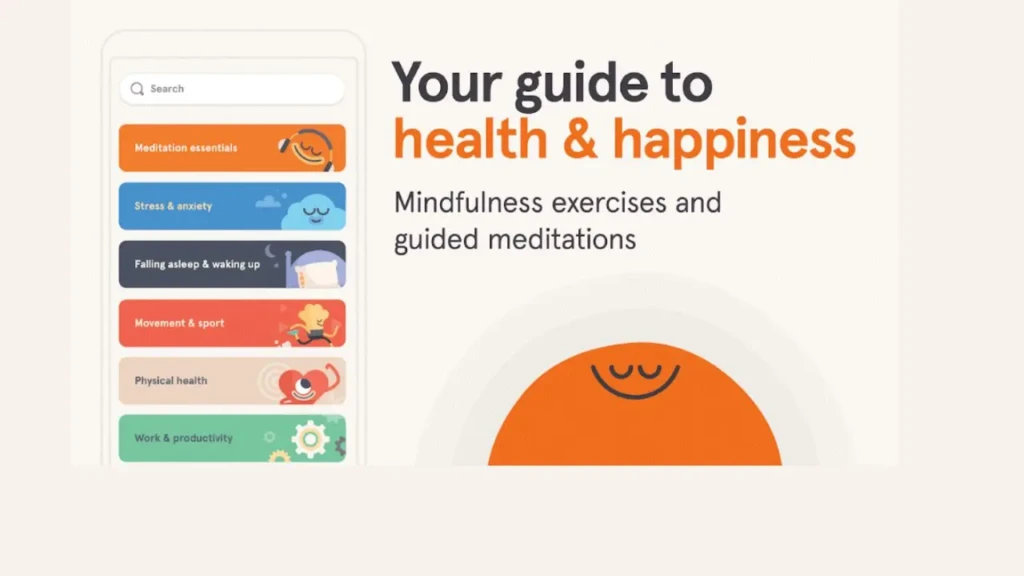
When you first open Headspace, the app walks you through a brief onboarding that establishes your primary goal (stress, sleep, focus, relationships, personal growth, or general mindfulness) and your experience level. That selection shapes which content the app recommends first, though you can explore freely from day one, regardless of your choice. Consequently, the experience feels intentional from the first screen rather than overwhelming.
The Basics course is where most new users start, and it’s genuinely the best-structured introduction to meditation available in any consumer app. In addition, it teaches breathwork, body scanning, and the foundational techniques of mindfulness observation across a series of progressive sessions, each building on the previous one before introducing new concepts. You complete session one before unlocking session two, which some users find frustrating, but which consistently produces better habit formation than free-choice apps.
Sessions range from 3 minutes to 20+ minutes, with Andy Puddicombe’s voice guiding most of the core content. Progress tracking shows your streak, total minutes meditated, and mood patterns over time, and SOS sessions (3 to 12 minutes) are available on demand for moments of acute stress, overwhelm, or anxiety that arise between your scheduled practice. These shorter on-demand sessions are among Headspace’s most practical features for people with high-pressure schedules.
Headspace Key Features
Meditation Library
Headspace’s core library has grown to over 1,000 guided meditations and mindfulness tools, organized by goal (stress, focus, anxiety, relationships, creativity), duration, and experience level. Sessions range from brief 5-minute resets to immersive 2-hour practices, covering both structured multi-week courses and standalone single sessions.
For long-term subscribers, the library is broad enough that repetition rarely becomes a problem in the first year of consistent use.
Sleep Content
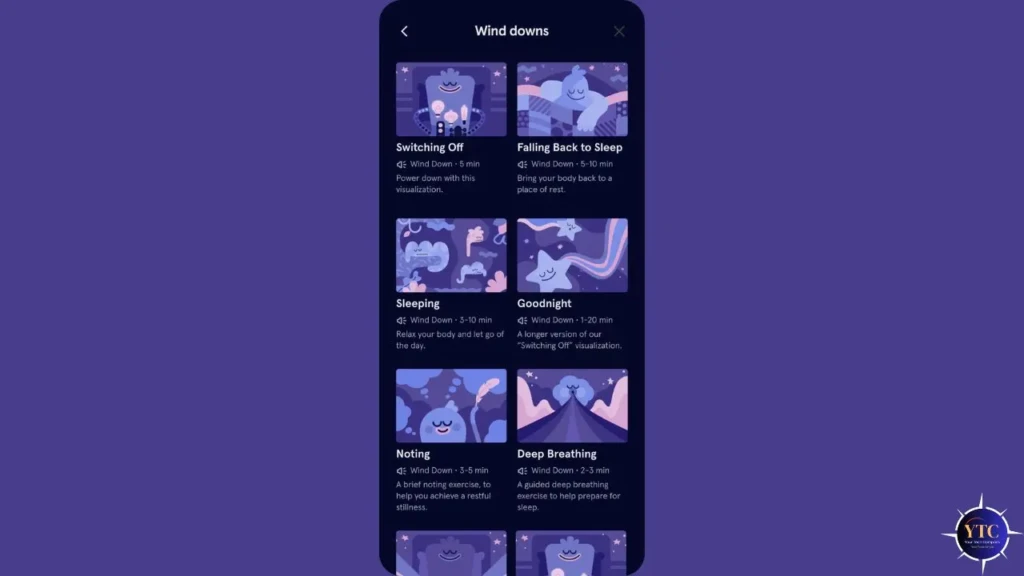
The sleep section is one of Headspace’s genuine strengths and a serious contender for the best audio sleep content in the category. Sleepcasts are immersive audio stories that combine soothing narration with shifting ambient soundscapes; not sleep stories in the traditional sense, but wandering environmental narratives (a rain-soaked night market, a quiet lighthouse) that give an active mind somewhere gentle to land. Additionally, sleep meditations, wind-down exercises, and sleep music round out the section for users who prefer different approaches on different nights.
Ebb: The AI Companion
Ebb is Headspace’s most significant recent addition, an empathetic AI companion built in collaboration with clinical psychologists and behavioral scientists. In December 2025, Headspace launched voice mode for Ebb, allowing you to speak naturally rather than type when processing emotions (a meaningful improvement that makes emotional check-ins feel less clinical). Additionally, Ebb uses motivational interviewing techniques, recalls details from past conversations to maintain continuity, and recommends personalized content from Headspace’s library based on what you share.
Worth Being Direct About: Ebb is not a therapist and does not diagnose or treat conditions. It’s a supportive companion that routes you toward appropriate content and escalates to crisis resources when needed.
Focus Music and Sessions
Headspace offers dedicated focus audio, curated soundscapes, and music specifically designed to support concentration during work or study sessions. Beyond audio, structured focus meditations train the attention skills that make sustained concentration easier over time, a distinction that sets them apart from apps that offer only ambient audio. Consequently, Headspace serves the productivity use case more substantively than most competitors.
Movement Content
The movement section includes yoga flows, mindful walking guides, and light exercise sessions that connect physical activity to mindfulness practice rather than treating them as separate categories. These sessions are designed for the workout-adjacent use case, not a replacement for a fitness app, but a meaningful addition for users who want their physical and mental wellness practice to feel integrated.
If you’re already using health and fitness wearables to track activity alongside your mindfulness practice, our best smart rings for fitness tracking guide and Pixel Watch review cover hardware that pairs well with apps like Headspace.
Kids and Family Content
Headspace for Kids provides age-appropriate guided meditations for children as young as 3, covering emotional awareness, kindness, sleep, and focus in language children understand. The content is available through the Family Plan, making it genuinely valuable for households where parents want to introduce mindfulness to children without a separate app. Additionally, the Kids section includes dedicated sleep meditations for children, one of the most practically useful features for parents dealing with bedtime resistance.
Headspace Care: Coaching and Therapy
In June 2025, Headspace launched Headspace Care, offering licensed therapy through the app, including insurance coverage for many major U.S. plans, so some users can access therapy for under $35 per session. Coaching sessions with trained mental health coaches are also available at an additional cost. These services are available in a separate Care tab and are genuinely distinct from the meditation subscription, which is worth noting if you’re evaluating Headspace as a complete mental health platform rather than a meditation-only tool.
Headspace Pricing and Plans
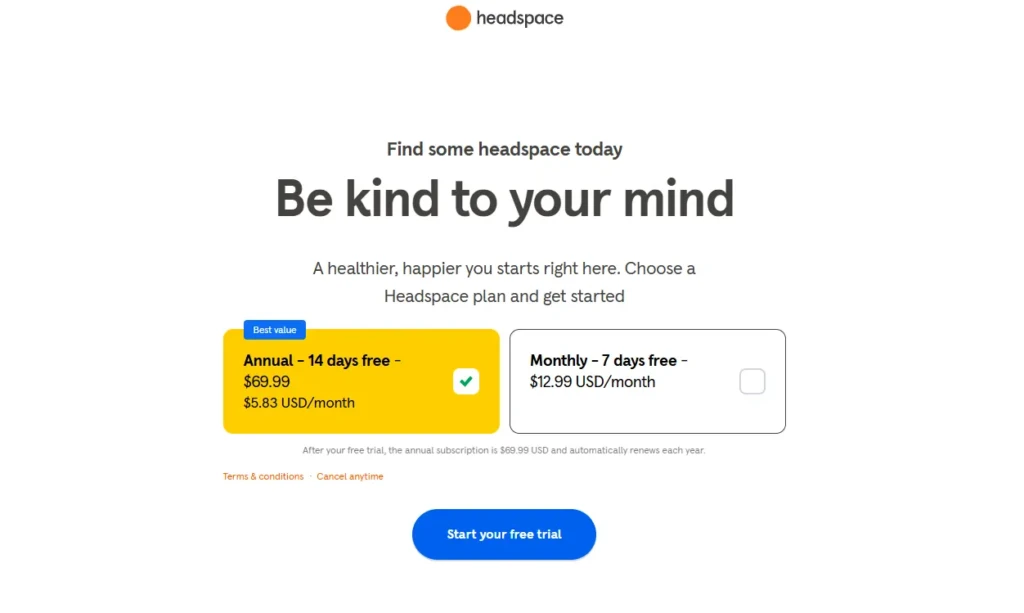
Plan | Price | What’s Included |
Monthly | $12.99/month | Full library; 7-day free trial |
Annual | $69.99/year (~$5.83/month) | Full library; 14-day free trial |
Family Plan | $89.99/year or $19.99/month | Up to 6 accounts (one holder + five members at the same address) |
Student Plan | $9.99/year | Full library; verification required |
Educators (US, UK, Canada, Australia) | Free | Full library; eligibility verification required |
Headspace for Work | Custom per-employee pricing | Enterprise content + EAP features + team tools |
The Honest Free Tier Assessment: Headspace has essentially no meaningful free tier. Everything in the app sits behind a paywall. You get a free trial (7 days on a monthly plan, 14 days on an annual plan), then you pay or lose access. This is a more restrictive approach than that of competitors like Insight Timer, which provides genuine, free access to thousands of meditations indefinitely.
The Student Plan at $9.99/year is the most remarkable value among wellness app subscriptions currently available, less than $1 per month for the full library. On the other hand, the Family Plan at $89.99/year comes to approximately $15 per person for six accounts, making the math work easily for families.
HSA and FSA cards are accepted for annual subscriptions in the US, which meaningfully changes the cost equation for users who allocate health spending accounts to wellness. For comparison: Calm charges $69.99/year (matching Headspace’s annual rate), Ten Percent Happier charges $99.99/year, and Insight Timer’s premium tier costs $59.99/year, with an extensive free library that Headspace doesn’t offer.
Headspace vs Competitors
Feature | Headspace | |||
Free Tier | Trial only (7–14 days) | Trial only | Trial only | ✅ Extensive free library |
Meditation Library | 1,000+ sessions | Large (topic-based) | Smaller (teacher-led) | 100,000+ (free + premium) |
Sleep Content | ✅ Sleepcasts & sleep meditations | ✅ Celebrity Sleep Stories | ⚠️ Limited | ⚠️ Basic |
Focus Audio | ✅ Dedicated focus sessions | ⚠️ Ambient only | ❌ Minimal | ⚠️ Community-led |
Kids Content | ✅ Ages 3+ | ✅ Ages 3+ | ❌ No | ⚠️ Limited |
AI Companion | ✅ Ebb (voice + text) | ⚠️ Recommendations only | ❌ No | ❌ No |
Coaching / Therapy | ✅ Coaching + therapy (June 2025) | ❌ No | ❌ No | ❌ No |
Annual Price | $69.99 | $69.99 | $99.99 | $59.99 (+ free tier) |
Structure | Sequential courses | Free-choice | Free-choice | Free-choice |
Best For | Beginners, habit building, sleep | Sleep, relaxation, celebrity content | Secular depth, teacher variety | Budget, large free library |
Headspace vs Calm
This is the most common comparison, and the answer depends on what you’re actually trying to build.
Headspace is fundamentally a skill-building app: it teaches you to meditate through progressive, structured courses that build on one another, with Puddicombe’s warm, distinctly British voice guiding you every step of the way. Calm, on the other hand, is fundamentally a relaxation app: it helps you unwind in the moment through soothing sleep stories, ambient soundscapes, and celebrity narrators, without requiring you to complete anything in sequence.
Both are excellent; the right one depends on whether you want to learn meditation or simply relax.
Headspace vs Insight Timer
This is the budget question. Insight Timer’s free library contains more meditations than most users will ever listen to in a lifetime, taught by thousands of practitioners across traditions and styles. If you’re on a tight budget, Insight Timer is genuinely the stronger free option. Headspace wins on production quality, structural guidance, and the Ebb AI companion, but those advantages come at a cost of $69.99 per year, which Insight Timer’s free tier doesn’t offer.
What Regular Use Actually Feels Like
The defining quality of Headspace as a daily habit is its low friction. The app opens to a clean, animated interface with warm colors that avoids the clinical feel of some mental health apps and the overly spiritual aesthetic of others. Sessions load instantly, Puddicombe’s voice is consistently warm without being saccharine, and the production quality (sound design, pacing, and placement of silence) is noticeably better than anything in Insight Timer’s free library or most competitors’ lower-priced tiers.
After 30 to 60 days of daily use, most users report that the structured approach pays off differently than expected: not the dramatic transformation the app’s marketing implies, but a quieter, more reliable ability to notice when stress is escalating and interrupt it before it compounds. That kind of benefit is difficult to quantify and easy to dismiss before you’ve experienced it, and Headspace’s sequential course structure is specifically designed to build that capacity gradually rather than promising immediate results.
Where consistency breaks down for most users is around month two or three, when the novelty of the Basics course has worn off, and the habit isn’t yet fully automatic. Headspace addresses this with streak tracking, milestone celebrations, and the Ebb companion’s check-in prompts, but the honest reality is that no app feature can substitute for genuine personal motivation to keep going.
For wellness tools and apps that complement this kind of daily mindfulness practice, our tech guides section covers a wide range of options. Additionally, if sound-based wellness approaches interest you alongside structured meditation, our Soaak app review covers a complementary frequency therapy tool that several users combine with meditation practice.
Limitations and Honest Drawbacks

A Limited Free Tier
The free tier is genuinely limited, more so than any major competitor. Headspace offers no meaningful, ongoing free access beyond the trial period, so evaluating whether the app suits you requires an upfront financial commitment. Insight Timer’s extensive free library makes the contrast particularly stark for budget-conscious users who want to explore meditation before paying anything.
Teaching Style Variety Is Narrow
Andy Puddicombe narrates the majority of Headspace’s core content, and his style is excellent, but if you want to explore different meditation teachers, traditions, and voices, Happier Meditation’s (formerly known as Ten Percent Happier) roster of Joseph Goldstein, Sharon Salzberg, and other credentialed teachers provides a depth of perspective that Headspace simply doesn’t match. Additionally, long-term subscribers consistently report that the core meditation library doesn’t refresh as frequently as they’d like, given the ongoing subscription cost (a genuine frustration for users who meditate daily and exhaust new content faster than Headspace releases it).
The Ginger Merger
The Ginger merger changed the app’s identity in ways that some original users haven’t embraced. The addition of therapy, coaching, and Headspace Care has turned the app into more of a mental health platform than a focused meditation tool, and the interface reflects that breadth.
For users who want clean, focused meditation without mental health platform framing, that evolution feels like scope creep. In addition, coaching and therapy incur extra costs beyond the Premium subscription, increasing the total investment for users who want the full Headspace Care experience.
Who Is Headspace Best For?
Beginners
Complete beginners to meditation get the most consistent value from Headspace. The Basics course is the most thoughtfully structured entry point in the category, and the progressive session design builds confidence before introducing complexity. Therefore, if you’ve tried to meditate on your own and felt uncertain about whether you were “doing it right,” Headspace’s guided approach directly addresses that uncertainty.
People Struggling with Sleep

People struggling with sleep will find the Sleepcasts and sleep meditation library genuinely effective for building a wind-down routine. The combination of immersive audio narratives and structured sleep meditations covers both the cognitively busy mind (Sleepcasts redirect active thinking toward narrative) and the physically tense body (sleep meditations use progressive relaxation techniques). Beyond the app itself, pairing good sleep hygiene tools together creates compounding benefits.
Our Pixel Watch review covers sleep tracking hardware that works alongside sleep apps.
Who Should Look Elsewhere?
Experienced meditators seeking variety among teachers and depth in philosophical instruction should consider Happier Meditation. On the other hand, budget-conscious users who want the most content for the least cost should start with Insight Timer’s free tier before committing to a paid subscription. Lastly, users who want celebrity-narrated content, machine-learning-curated recommendations, and the deepest sleep-story library available will find Calm a better fit for that combination.
If your sleep issues are more physical, specifically snoring or airway weakness, a different type of app may help alongside mindfulness. Airway Trainer takes an exercise-based approach, using daily exercises for the throat and tongue to strengthen airway muscles and reduce snoring over time.
Is Headspace Worth It?
At $69.99 per year, Headspace costs approximately $1.35 per week, or less than a cup of coffee, for something you could use every morning before you make your coffee. That per-unit cost framing is honestly the right way to think about it: the value comes from consistency, not from the subscription existing.
Therefore, if you use Headspace 3 to 5 times per week for a year, the $69.99 price delivers real value. However, if you use it four times and then forget about it, no amount of marketing copy will change the math.
The Honest Bottom Line
Headspace does two things better than any competitor.
First, it teaches beginners how to meditate through progressive, structured courses with production quality and pedagogical care that no free alternative matches. Second, its sleep content (Sleepcasts specifically) is among the most effective audio sleep aids available in any app.
If either of those two use cases describes what you’re looking for, Headspace at the annual rate earns its place. If you primarily want a large free library, a wide variety of teachers, or celebrity narrators, a competitor serves those needs more directly.
Frequently Asked Questions
Headspace has no meaningful ongoing free tier. The monthly plan comes with a 7-day free trial; the annual plan includes a 14-day free trial. After the trial, you pay $12.99/month or $69.99/year for full access. The Student Plan at $9.99/year is the most affordable way to legally access the full library.
Headspace is better for learning meditation through structured, progressive courses and building a daily habit. Calm is better for immediate relaxation, sleep stories narrated by celebrities, and users who prefer free choice over sequential content. Both cost $69.99/year. The right choice depends on whether you want to practice meditation or simply relax.
$12.99/month or $69.99/year for an individual subscription. The Family Plan costs $89.99/year for up to six accounts. The Student Plan costs $9.99/year with verified student status. Educators in the US, UK, Canada, and Australia access Headspace for free.
Yes. Headspace’s structured courses directly address anxiety management through mindfulness-based stress reduction (MBSR) techniques. The SOS sessions are specifically designed for acute anxiety moments. However, Headspace is not a substitute for professional mental health treatment for clinical anxiety disorders; Headspace Care offers therapy for users who need that level of support.
Yes. Headspace for Kids provides meditations for children ages 3 and up, covering sleep, emotional awareness, kindness, and focus in age-appropriate language. Kids’ content is available through the Family Plan, which covers up to six accounts for $89.99/year.
Yes. 7 days on the monthly plan and 14 days on the annual plan. Both require entering payment information, which is charged automatically at the end of the trial. Cancel at least 24 hours before the trial concludes to avoid being charged.
Final Thoughts
Headspace remains one of the best meditation apps available in 2026, not because it dominates every category, but because it does the two hardest things in consumer wellness remarkably well: it teaches complete beginners how to meditate without intimidating them, and it provides sleep content that genuinely helps people fall asleep. The addition of Ebb’s voice mode, the expansion into coaching and insurance-covered therapy, and a library now exceeding 1,000 sessions make the current version of the app significantly more capable than the one most lapsed users remember. The $69.99 annual price is fair for daily users and a reasonable gamble for anyone considering starting a meditation practice.
The limitations are real and worth naming plainly. The free tier is essentially nonexistent, the teaching voice lacks variety, and the library refresh rate frustrates committed long-term users. Therefore, if budget is your primary constraint, Insight Timer’s free library is genuinely extensive. And if teacher depth is your priority, Happier Meditation provides it. But if you want the cleanest, most thoughtfully designed introduction to meditation available on a phone (with solid sleep content, a capable AI companion, and a structure that actually builds a habit), Headspace clearly earns that recommendation.
For more tech guides and honest reviews, visit YourTechCompass.