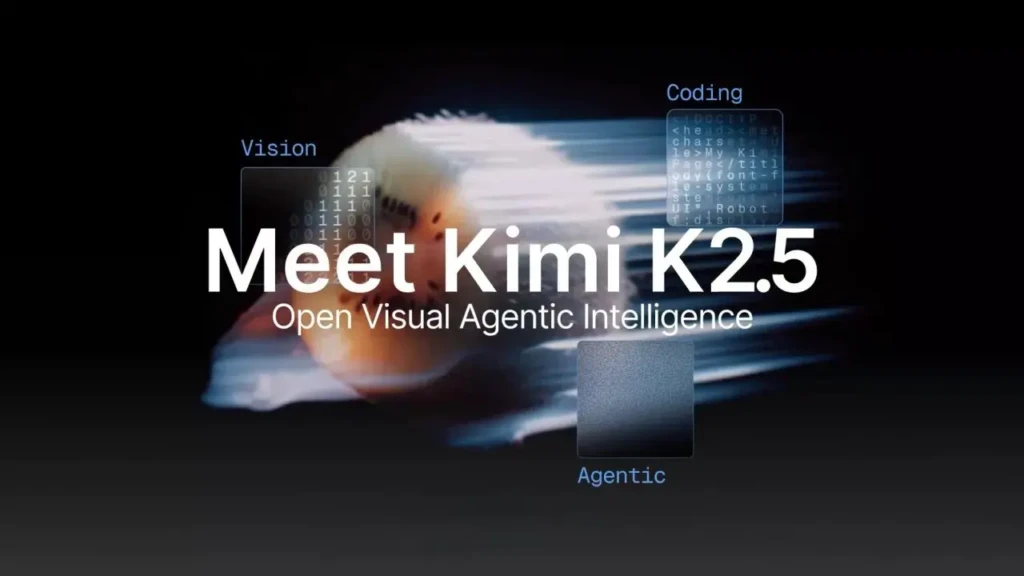
Kimi AI is the AI assistant and large language model series developed by Moonshot AI, a Beijing-based startup founded in March 2023 that has quietly become one of the most serious challengers to OpenAI, Anthropic, and Google in the global AI race. What made Kimi stand out from day one was context length: the original 2023 release supported 128,000 tokens, more than any publicly available model at the time. Since then, Moonshot has shipped a rapid succession of model updates culminating in Kimi K2.5 (January 2026), a 1-trillion-parameter multimodal model with Agent Swarm technology, advanced reasoning, and coding capabilities that benchmark reviewers have called the best open-weight model available right now.
If you’ve been hearing about Kimi AI and wondering whether it deserves a place in your AI toolkit alongside or instead of ChatGPT, Claude, or Gemini, this guide gives you everything you need to make that call. You’ll find a clear breakdown of the full model lineup, every key feature explained in practical terms, honest pricing details, a direct comparison with competitors, and a frank assessment of where Kimi still falls short.
What Is Kimi AI?
Kimi AI is Moonshot AI‘s consumer-facing AI chatbot and the brand name for its series of large language models. Moonshot AI, backed by Alibaba, Hillhouse Capital, Tencent, and others, and valued at over $3 billion following a $700 million funding round in early 2026, built Kimi around the philosophy that context length and accuracy should come first. That commitment showed up immediately: the original Kimi was the first commercially available AI model to support 128,000-token lossless context, making it the early leader for long-document analysis tasks.
Beyond just the chatbot, Kimi is available as a web app at kimi.com, a mobile app on iOS and Android, and through the Moonshot AI developer platform (platform.moonshot.ai) for API access. The distinction between the consumer product and the underlying model infrastructure matters if you’re a developer: what you access via API (the raw Kimi K2, K2 Thinking, or K2.5 models) differs in capability from what you get through the consumer app interface, which wraps those models with tools like Deep Research, OK Computer agent mode, and Kimi Code.
Kimi AI: Key Features
Long Context Window
Kimi’s most distinctive capability, and still one of its strongest competitive advantages, is its context window. The current K2.5 model supports a 256K token context window, meaning you can feed it the equivalent of a full novel, an entire codebase, or hundreds of pages of research papers in a single session without the model losing track of earlier content.
To put that in practical terms: where ChatGPT and Claude might require you to split a long document into chunks, Kimi handles it in one pass. That said, worth noting: a large context window doesn’t mean the model uses every token equally well. Performance on content buried deep in very long contexts still degrades somewhat, a known limitation across all current models.
Document and File Analysis
You can upload PDFs, Word documents, spreadsheets, images, and even video (in K2.5 via API) directly into Kimi, which will then read, summarize, cross-reference, and answer specific questions about your files. Beyond that, Kimi’s Deep Research feature takes this further.
It doesn’t just read a single document; it performs multi-step research across your uploaded files and the web simultaneously, synthesizing a structured report rather than a simple summary. For researchers, lawyers, analysts, and students working with large volumes of reference material, this combination of long context and active research capability is genuinely more useful than what most competing tools offer at equivalent pricing.
Web Search Integration
Real-time web search is built directly into Kimi. It activates automatically when your query requires current information, or you can trigger it manually.
In practice, this means Kimi’s responses on rapidly changing topics (news, market data, recent product releases) are grounded in current sources rather than training data with a knowledge cutoff. What’s more, unlike some AI tools that show you a list of search results and leave the synthesis to you, Kimi actively reads and integrates the retrieved content into a coherent, cited answer.
Multimodal Input (K2.5)
With the January 2026 K2.5 release, Kimi became fully multimodal, understanding images, diagrams, charts, screenshots, and video input alongside text. You can paste a screenshot of an error message, a whiteboard diagram, or a product image, and Kimi will accurately analyze it and respond. Additionally, K2.5’s “OK Computer” agent feature can process up to 1 million rows of data at once and output results in text, audio, images, or video, a capability that goes significantly beyond what most consumer AI tools offer today.
Multilingual Performance
Kimi is one of the strongest bilingual Chinese-English AI models available. Its Chinese language understanding and generation quality are on par with its English performance, a quality that cannot be said of most Western AI models, which typically treat Chinese as a secondary language. Furthermore, Kimi supports a broad range of other languages, though Chinese and English remain where performance is most consistently strong.
Code Generation and Debugging
Kimi K2 (July 2025) achieved state-of-the-art performance on coding benchmarks among open-weight models at launch, specifically on SWE-bench Verified, which tests real-world software engineering tasks rather than synthetic coding puzzles. Kimi-Dev, a separate 72B coding-focused model released in June 2025, set the open-source record on SWE-bench Verified at the time. For you as a developer, this translates to strong performance on code review, multi-file refactoring, debugging, and generating complex functions, particularly when combined with the large context window that lets Kimi analyze an entire codebase rather than isolated snippets.
Kimi Thinking Mode
Every Kimi model from K1.5 onward includes a Thinking Mode, an extended reasoning capability where the model works through complex problems step by step before producing a final answer. Think of it as the equivalent of Claude’s extended thinking or OpenAI’s o-series reasoning models.
You activate it by selecting Thinking Mode in the interface or passing the appropriate parameter in the API. It’s most useful for math problems, multi-step logical reasoning, complex coding challenges, and research synthesis. Tasks where the extra computation time (Thinking Mode responses take longer) yield more accurate and thorough answers.
Kimi AI Models: Understanding the Lineup
Model | Parameters | Context Window | Multimodal | Key Strength | Availability |
Kimi K1.5 | Not disclosed | 128K | ❌ No | Early reasoning model; matched OpenAI o1 on math/coding at launch | API (legacy) |
Kimi K2 | 1T (32B active) | 128K–256K | ❌ Text only | Coding, open-weight, agentic tool use | API + App |
Kimi K2 Thinking | 1T (32B active) | 256K | ❌ Text only | Agentic reasoning, 200–300 sequential tool calls | API |
Kimi VL | 16B (3B active) | Not disclosed | ✅ Vision + text | Open-source multimodal reasoning | Open source |
Kimi K2.5 | 1T (32B active) | 256K | ✅ Vision + video | Agent Swarm (100 parallel agents), visual coding | API + App |
Kimi Linear | 48B (3B active) | Long context | ❌ Text only | Efficiency, speed, Delta Attention architecture | API |
The most important model for most users is Kimi K2.5, the current flagship driving both the consumer app and the API as of early 2026. If you’re a developer who specifically needs the best open-weight reasoning model for agentic workflows, Kimi K2 Thinking is worth evaluating separately. It executes 200 to 300 sequential tool calls without drift, outperforming GPT-5 on several agentic benchmarks according to independent testing.
How to Access Kimi AI
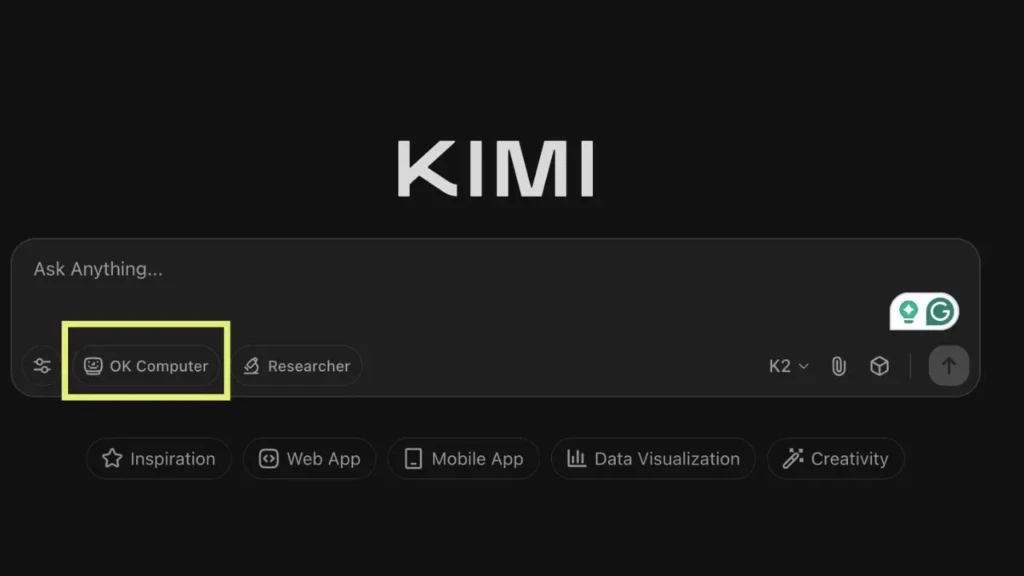
- Web App: Head to kimi.com, create a free account, and you’re in. The interface is clean and straightforward, with mode selectors for Instant (fast responses) and Thinking (extended reasoning) at the top of the chat window.
- Mobile App: Available on iOS and Android. The mobile experience mirrors the web app closely, with file upload support and the same model access on your free account.
- Developer API: Access via platform.moonshot.ai; you’ll need to create a developer account, generate an API key, and add credits. The API is OpenAI and Anthropic-compatible, meaning if you’re already using one of those SDKs, switching to Kimi requires minimal code changes.
- Kimi Code CLI: For developers who want Kimi integrated into terminal workflows, Kimi Code is available as a CLI tool, useful for code review, refactoring, and inline development assistance without leaving your terminal.
Geographic Availability
Kimi is available internationally via kimi.com in English. Chinese users access a separate regional version. Some advanced features roll out to Chinese users first, with international availability typically following within weeks.
Kimi AI Pricing
Plan | Price | What You Get |
Free (Adagio) | $0 | Basic chat, rate-limited access, light Deep Research, core model |
Moderato | ~$19/month | Higher quotas for Deep Research + OK Computer, priority access, faster responses, visual generation |
Allegretto | ~$39/month | Higher concurrency, K2 Turbo access, Agent Swarm beta, annual plan at $374.99/year |
Vivace | ~$199/month | Unlimited OK Computer, highest priority, extended context, fastest inference (built for teams) |
API (K2 / K2.5) | $0.60/M input tokens, $2.50/M output tokens | Pay-per-use developer access |
API (K2 Thinking) | $0.47/M input, $2.00/M output | Reasoning model API |
Three things worth knowing about Kimi’s pricing. First, the free tier is genuinely useful; basic chat, moderate Deep Research access, and file uploads are all available without paying.
Second, API billing and app membership are completely separate; your Moderato subscription doesn’t cover API usage; API usage is billed separately. Third, Kimi’s API pricing is competitive: at $0.60 per million input tokens, it undercuts GPT-4o ($2.50/M) and Claude Sonnet ($3.00/M) significantly for equivalent-tier models.
For comparison, ChatGPT Plus costs $20/month, and Veo 3.1 for AI video starts at $19.99/month, positioning Kimi’s Moderato tier at a competitive price point within the AI subscription category.
Kimi AI vs Competitors
Feature | Kimi AI (K2.5) | ChatGPT (GPT-4o) | Claude (Sonnet 4.5) | Gemini Advanced |
Context Window | 256K tokens | 128K tokens | 200K tokens | 1M tokens (Ultra) |
Free Tier | ✅ Yes (genuinely useful) | ✅ Yes (limited) | ✅ Yes (limited) | ✅ Yes (limited) |
Multimodal (Vision) | ✅ Yes (K2.5) | ✅ Yes | ✅ Yes | ✅ Yes |
Native Web Search | ✅ Built-in | ✅ Built-in | ⚠️ Tool-based | ✅ Built-in |
Reasoning Mode | ✅ Yes (Thinking Mode) | ✅ Yes (o-series) | ✅ Yes (Extended Thinking) | ✅ Yes (Deep Think) |
Agentic Tool Use | ✅ 200–300 sequential calls | ✅ Yes | ✅ Yes | ✅ Yes |
Agent Swarm | ✅ 100 parallel agents (K2.5) | ❌ No | ❌ No | ❌ No |
Open Weight Models | ✅ K2, K2 Thinking, K2.5 | ❌ No | ❌ No | ❌ No |
Coding Benchmark | ⭐⭐⭐⭐⭐ Best open-weight | ⭐⭐⭐⭐ Strong | ⭐⭐⭐⭐ Strong | ⭐⭐⭐ Good |
API Input Price | $0.60/M tokens | $2.50/M tokens | $3.00/M tokens | ~$1.25/M tokens |
Paid Plan Starting Price | $19/month | $20/month | $20/month | $19.99/month |
The comparison table reveals two areas where Kimi genuinely leads: API pricing (significantly cheaper than all three Western competitors) and Agent Swarm (100 parallel agents executing simultaneously has no equivalent in ChatGPT or Claude). In the context window, Gemini Ultra’s 1 million token window beats everyone, including Kimi. On writing quality and nuanced creative tasks, Claude remains the benchmark most professional writers prefer.
ChatGPT’s ecosystem advantage (plugin support, DALL-E integration, and voice mode) is still broader than Kimi’s. In other words, Kimi wins on value, coding, and agentic capability; it doesn’t yet lead on writing quality or ecosystem breadth.
For context on how Kimi fits into the broader AI landscape, our ChatGPT-4 guide and Microsoft AI overview are useful reference points, and if you’re tracking the wider wave of AI tools, our IBM AI guide covers another major enterprise player worth knowing.
What Kimi AI Does Best: Real-World Use Cases
Long Document Analysis
Long document analysis is where you’ll feel Kimi’s advantage most immediately. Feed it a 200-page legal contract, a full research paper, or an entire annual report and ask specific questions.
Kimi reads the whole thing in context and responds with accurate, specific citations rather than vague summaries. That said, for multi-document cross-referencing, comparing claims across five different research papers simultaneously, for instance, the combination of long context and Deep Research mode handles this more reliably than most alternatives.
Bilingual Workflows
Bilingual workflows are a natural fit for teams working simultaneously in Chinese and English. Translating technical documents, reviewing Chinese-language source material, or producing content that needs to be polished in both languages. Kimi handles this without the quality drop that Western models typically show when switching into Chinese.
Complex Coding Tasks

Complex coding tasks across large codebases are where Kimi K2’s benchmark performance translates directly to practical value. Beyond that, Kimi K2 Thinking’s ability to sustain 200+ sequential tool calls makes it genuinely useful for automated coding workflows, such as testing, reviewing, refactoring, and deploying code in an agentic loop without human intervention at every step.
Extended Research Sessions
Extended research sessions where you can’t afford to lose conversational context, such as multi-hour research projects, iterative analysis, or cumulative document builds, benefit directly from the 256K context window, keeping your full history intact.
Kimi AI Limitations and Honest Drawbacks
No Native Image Generation
Kimi understands images but cannot generate them. Consequently, if your workflow requires AI image creation, you’ll need a separate tool, such as Midjourney, Imagen, or similar. This is a meaningful gap compared to ChatGPT’s DALL-E integration and Gemini’s native image generation.
Knowledge Cutoff
Like all LLMs, Kimi has a training cutoff date. Web search compensates for the lack of recent information, but the underlying model’s parametric knowledge has limits. Therefore, for highly time-sensitive factual tasks, always verify via the web search feature rather than relying on base model responses.
Regional Availability Nuances
While Kimi is internationally available, some features reach Chinese users first and international users weeks later. Additionally, a small number of enterprise tools are currently only available on the Chinese platform version.
Data Privacy: The Honest Picture
Conversations are stored on Moonshot AI’s servers in China. Per Kimi’s privacy policy, content may be used to improve the model and can be disclosed to Chinese authorities if legally required under Chinese law. This is a real consideration for users handling sensitive commercial, legal, or personal data, and it’s worth comparing it factually rather than dismissing or overstating.
Western alternatives like OpenAI and Anthropic have their own data retention and government disclosure obligations under US law. The practical advice: don’t share genuinely sensitive proprietary or personal data with any cloud-based AI service, regardless of provider.
Creative Writing Consistency
On open-ended creative writing tasks, such as fiction, nuanced storytelling, and voice-matching, Kimi is capable but less consistently polished than Claude, who remains the benchmark for pure writing quality.
Is Kimi AI Safe to Use?
This is the question most Western users ask first, and it deserves a direct, factual answer rather than either dismissal or panic. Moonshot AI’s privacy policy states that user conversation data is stored on its servers and may be used to improve the model.
More importantly, as a Chinese company, Moonshot AI is subject to Chinese law, which includes data access provisions for government authorities. That’s a real data sovereignty consideration for users in regulated industries or those handling sensitive client information.
That said, the same structural concern applies in different forms to all major cloud AI providers: OpenAI and Anthropic operate under US law with their own government data access obligations, and Google’s data practices are governed by US and EU frameworks. The practical takeaway is consistent across providers: treat any cloud AI tool as unsuitable for genuinely sensitive proprietary or personal data. For general research, coding, content creation, and professional productivity tasks that don’t involve sensitive data, Kimi’s risk profile is comparable to using any other cloud-based AI tool.
FAQs
Yes, the base Kimi app at kimi.com is free with daily rate limits covering general chat, basic Deep Research, and file uploads. Paid plans (Moderato at $19/month, Allegretto at $39/month, Vivace at $199/month) unlock higher quotas and advanced agent features.
The current flagship model, Kimi K2.5, supports a 256K token context window, equivalent to roughly 500 pages of text in a single session. Earlier models like the original Kimi launched with 128K tokens, which was a record at the time.
It depends on the task. Kimi leads on coding benchmarks, API pricing, and agentic parallel execution. ChatGPT leads in ecosystem breadth, image generation, voice mode, and overall consistency in writing quality. For pure value in coding and research tasks, Kimi is the better deal at the same price.
Kimi AI is developed by Moonshot AI, a Chinese AI startup founded in March 2023 and headquartered in Beijing. Backers include Alibaba, Hillhouse Capital, Tencent, and others.
Yes, Kimi is available internationally via kimi.com in English. A separate regional version is available for Chinese users. Some advanced features are still rolling out internationally.
Kimi K2 is Moonshot AI’s open-weight 1-trillion-parameter Mixture-of-Experts model released in July 2025. It achieved state-of-the-art coding performance among open-weight models at launch and is available for self-hosting under a modified MIT license.
Conclusion

Kimi AI is not a ChatGPT clone or a niche regional tool; it’s a genuinely competitive frontier AI model that leads the entire category in specific areas. The long context window, open-weight availability, agentic parallel execution via Agent Swarm, and API pricing that undercuts Western competitors by 60 to 75% make it a compelling choice for developers, researchers, and power users who actually compare products on capability and cost rather than brand recognition. If you’re building AI-powered applications or doing serious research work, Kimi K2 and K2.5 deserve evaluation alongside or ahead of the more familiar names.
Where It Falls Short: No native image generation, creative writing that trails Claude, and data privacy considerations for sensitive use cases are real limitations to factor in, based on your specific workflow.
The free tier is the right place to start: sign up at kimi.com, run a few of your actual use cases through it, and compare the output directly against whatever you’re currently using. For most users doing research, coding, and document analysis, the results will be more competitive than the brand recognition suggests.
Found this helpful? Browse more in-depth tech guides, honest reviews, and step-by-step tutorials at YourTechCompass; your go-to resource for making smarter tech decisions.