Every time you type a question into Google, you get ten blue links and the implicit instruction to figure it out yourself. You open three tabs, scan each one, cross-reference the parts that contradict each other, and eventually arrive at an answer that took you far longer to reach than the question warranted. ChatGPT solves the reading problem; it gives you a fluent, direct answer, but it creates a different problem: you have no idea where the answer came from, and if it’s wrong, you won’t know until something downstream goes sideways. Perplexity AI sits between those two experiences. It gives you a direct, natural-language answer and shows you exactly where it came from, simultaneously. That combination proves more useful than either pure search or pure generation across a wide range of real-world research tasks.
This article covers everything you need to understand Perplexity AI properly: how it actually works under the hood, every feature on the free and paid tiers with real numbers, the use cases where it genuinely outperforms alternatives, the limitations and inaccuracies that real users have documented, and the ongoing legal controversy with publishers that anyone using this tool should understand.
A note before we begin: every YTC score is earned, never negotiated. If you want to understand exactly how we evaluate apps & tools and how we handle affiliate relationships, our Review Methodology lays it all out.
What Is Perplexity AI?
Perplexity AI is an AI-powered conversational search engine, not quite a search engine in the Google sense, not quite a chatbot in the ChatGPT sense, but a hybrid that borrows the best mechanics from both. Founded in 2022 by Aravind Srinivas, Denis Yarats, Johnny Ho, and Andy Konwinski, engineers with backgrounds at OpenAI, DeepMind, Google, and Berkeley, Perplexity has grown to over 15 million daily active users and was valued at approximately $9 billion following its December 2024 funding round.
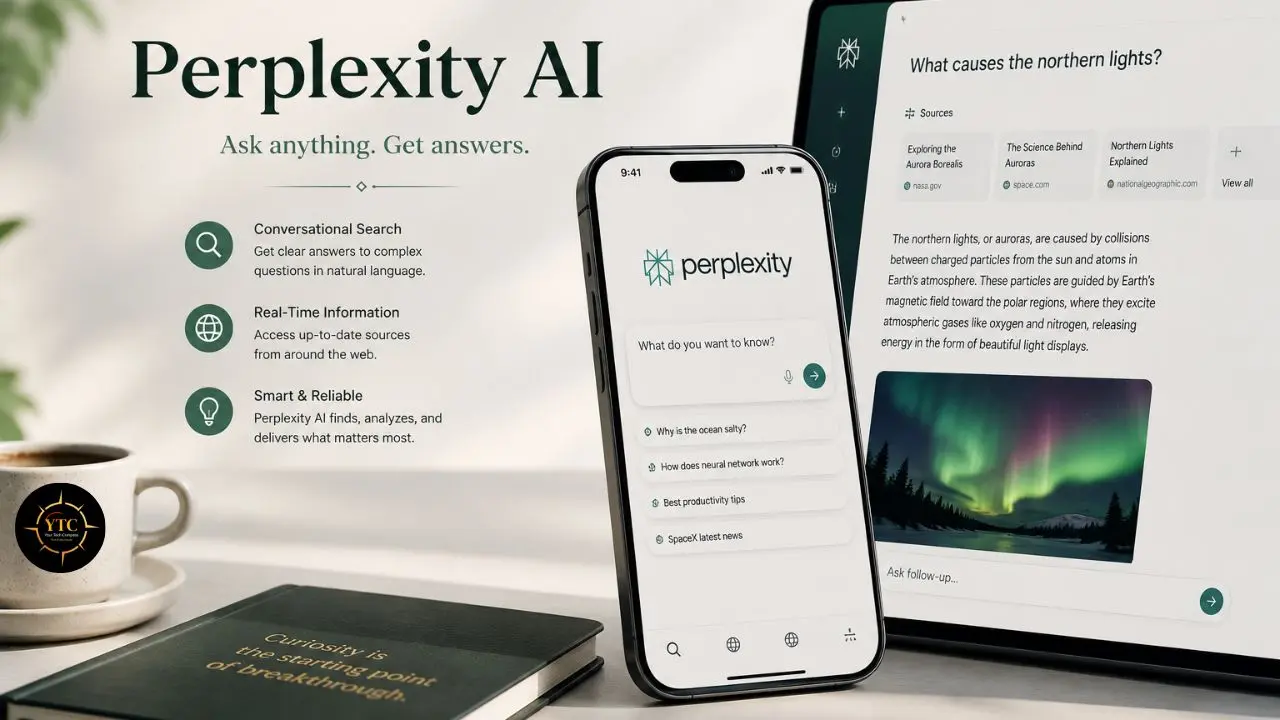
The core idea is straightforward: you ask a question in plain language, Perplexity queries the live web in real time, synthesizes what it finds into a coherent answer using large language model technology, and presents the response with numbered citations linking back to the exact sources it drew from. The answer is immediate, readable, and traceable. You don’t have to open multiple tabs, reconcile contradictions between different articles, or guess whether the AI is inventing something that sounds plausible.
How Perplexity AI Works: The Architecture Behind the Answers
Understanding the mechanics makes it much easier to know when to use Perplexity and when to use something else.
Real-Time Web Retrieval
When you submit a query, Perplexity doesn’t consult only the knowledge encoded in a language model during training. It actively performs a live web search, querying the current internet to find the most relevant sources for your specific question. This is what gives Perplexity a significant advantage over standard chatbots for any question that involves current events, recent data, or topics that have changed since a language model’s training cutoff.
Asking ChatGPT what happened in the news last week gets you a polite explanation of its knowledge cutoff. However, asking Perplexity the same question gets you a sourced answer from today’s web.
Synthesis Through a Large Language Model
Once Perplexity has retrieved its sources, it passes that content to a large language model, the same class of AI technology that powers ChatGPT and Claude. The LLM’s job at this stage is synthesis and explanation: taking multiple source documents, identifying the relevant portions, and producing a single coherent answer written in natural language.
This is meaningfully different from a search engine’s job of returning documents ranked by relevance. The model reads the sources and explains what they say, the way a knowledgeable person would brief you after reading three articles, rather than handing you the articles and asking you to do it yourself.
On Pro and Max plans, you can select which underlying model handles this synthesis step, choosing between Perplexity’s own Sonar models (optimized for speed and citation density) and frontier third-party models like GPT-5 or Claude Opus 4.6 (often more capable for complex reasoning tasks). This model-switching capability is one of the more underappreciated aspects of the Pro plan: it effectively bundles multiple AI subscriptions into a single plan.
Numbered Citations Presented Alongside Every Answer
The citations aren’t an afterthought. They appear as superscript numbers inline with the text ([1], [2], [3]) at the exact sentence or claim they support, not just as a list at the bottom of the response.
Clicking any number takes you directly to the source page. This inline citation format is what makes Perplexity meaningfully more useful than a standard chatbot for research work. You don’t have to guess which part of the answer came from which source; the tool tells you explicitly, at the claim level.
Follow-Up Questions in a Threaded Conversation
Perplexity maintains session context throughout a conversation, allowing you to ask follow-up questions that reference your earlier queries without having to re-explain the topic. “What did you mean by the second point?” and “Can you explain that in simpler terms?” work as you’d expect. Perplexity also generates suggested follow-up questions at the bottom of each response, often surfacing angles you hadn’t considered, which is particularly useful when exploring an unfamiliar topic.
Features: What Perplexity AI Actually Offers
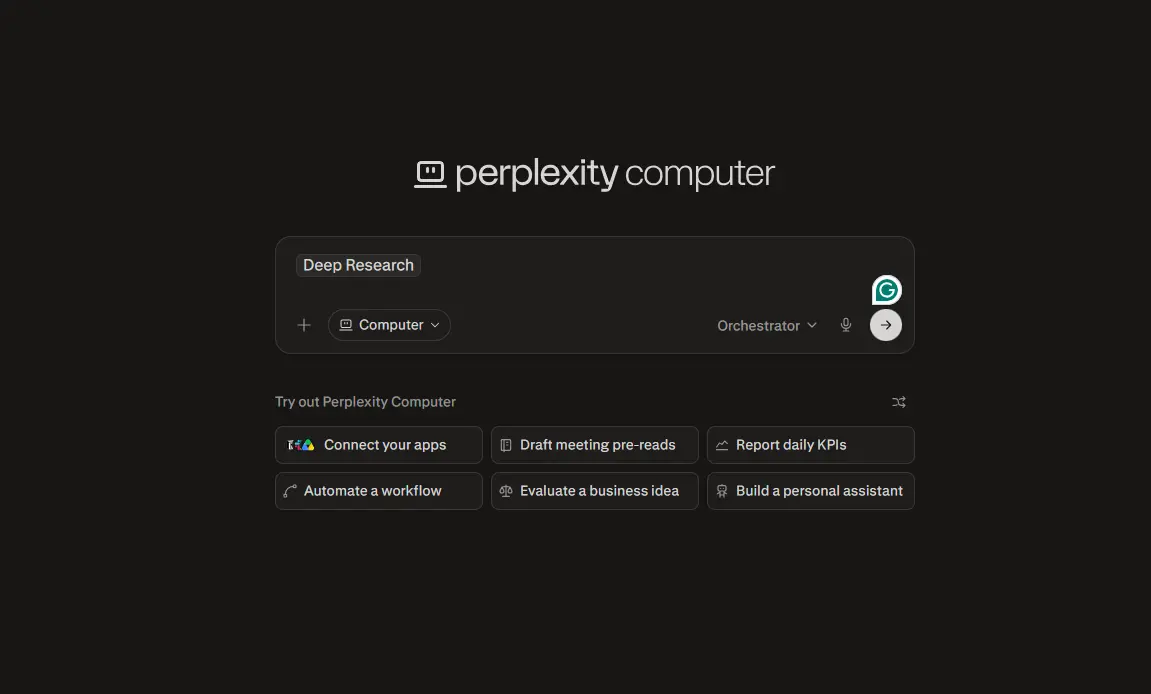
Focus Modes: Directing Where Perplexity Searches
Perplexity includes several Focus modes that restrict its search scope to specific source types. Instead of searching the entire web, you can tell it to search only within specific content categories:
- Web (default): Searches the general web and synthesizes multiple source types.
- Academic: Restricts results to peer-reviewed papers and academic publications; ideal for literature reviews, scientific questions, and evidence-based research where source credibility is the priority.
- YouTube: Returns and summarizes relevant YouTube videos for your query; useful for finding tutorials or video explanations of topics.
- Reddit: Queries Reddit specifically, which is particularly valuable for finding real user experiences, honest product reviews, and community-level opinions that professional publications don’t capture.
- Social: Broader social media search across platforms.
The Reddit focus mode deserves specific mention because it solves a problem created by SEO-driven search results. Search results for product reviews, software comparisons, and “what do real people think about X” are increasingly dominated by affiliate-optimized content. Reddit focus mode bypasses that layer and surfaces actual user discussions: the kind of honest, unfiltered feedback that rarely appears in top search results but often contains the most useful information.
Pro Search: Deeper Multi-Step Research
Standard searches retrieve and synthesize immediately. Pro Search goes further: it performs multiple searches, cross-references findings across sources, and synthesizes a more thorough response that draws on a broader range of material.
In addition, the Pro Search takes longer than a standard query, usually 15–30 seconds versus near-instant, but produces noticeably richer answers for complex multi-part questions. The free tier allows approximately 5 Pro Search queries per day; Pro subscribers have effectively unlimited access.
Deep Research: Extended Report Generation
Deep Research is the most powerful single feature in Perplexity’s toolkit and also the one that requires the most careful verification before you rely on its output. When you activate Deep Research on a query, Perplexity doesn’t just synthesize a few sources; it runs dozens of searches, reads through a much larger corpus of material, and produces a structured, long-form report with extensive citations. For preliminary literature reviews, competitive analyses, background research on unfamiliar topics, and first-draft research outlines, Deep Research can produce in minutes what would take a human researcher hours.
The honest caveat comes directly from verified community reporting: Deep Research can fabricate citations or reference sources that don’t contain the claimed information. One documented case from Q1 2026 involved a 20-source Deep Research report that included four URLs returning 404 errors.
Perplexity’s research team has publicly acknowledged this limitation. For high-stakes research where every source matters, Pro subscribers recommend treating Deep Research output as a starting draft to be verified rather than a finished document.
That’s the right framing. Use it as a first draft and verify every claim you intend to rely on.
Spaces: Shared Knowledge Repositories
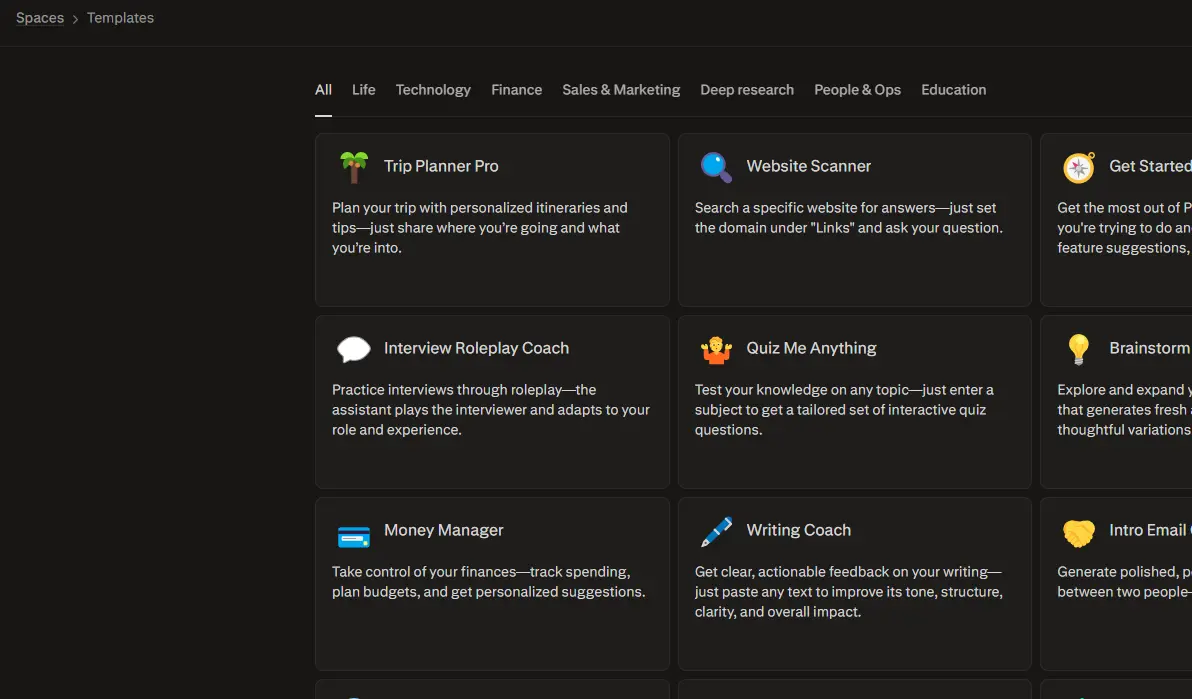
Spaces are private or shared workspaces where teams can upload documents, web content, and notes, and then query across all of it using Perplexity’s search and synthesis capabilities. Think of it as a knowledge base where Perplexity’s AI search runs across your uploaded content rather than the open web.
Pro accounts can create Spaces with up to 50 files per Space; Enterprise accounts have higher limits and shared administrative controls. Spaces are particularly useful for research teams, journalists working on specific investigations, and teams that want to query across a defined corpus of documents.
Pages: Shareable AI-Generated Documents
Pages is a publishing feature that lets you transform any Perplexity response into a formatted, shareable web document with structured sections, embedded citations, and a public URL. They are useful for sharing research findings, creating briefing documents, or producing reference materials that need to be accessible to people without a Perplexity account. The feature is available on Pro and higher tiers.
The Discover Feed
Perplexity’s Discover tab is a curated news feed powered by the same synthesis engine as the search interface, not a list of headlines, but a summarized briefing of current news topics organized by category. It functions as a quick-reading news digest rather than a search tool, and it’s available on the free tier. For users who use Perplexity regularly for research, Discover provides a passive layer of information that doesn’t require active querying.
Finance Hub
The Finance section provides real-time market data, stock performance, earnings summaries, and AI-generated market analysis for individual companies and indices. It functions as a lightweight financial research tool integrated into the same interface as everything else, useful for professionals who need a quick AI-synthesized briefing on a company’s recent performance before a meeting, without switching to a dedicated financial platform.
Comet Browser
The Comet browser is free for all users worldwide as of March 2026. It’s Perplexity’s AI-native browser, available on iOS, Android, Windows, and Mac.
It brings Perplexity’s search and synthesis capabilities directly into the browser interface, with context awareness across your open tabs. Rather than switching between a browser and a separate Perplexity interface, Comet integrates AI assistance directly into the browsing experience.
Perplexity AI Pricing: The Real Numbers
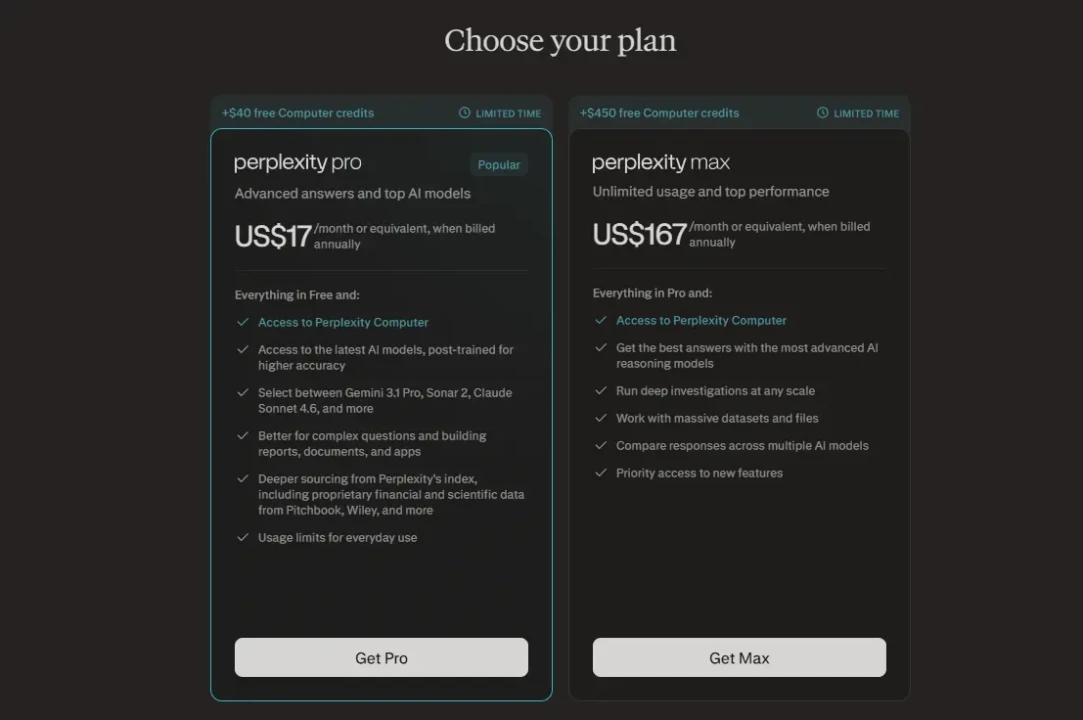
The original version of this article described Perplexity’s pricing as “free with optional subscription tiers” without providing any actual figures. Here’s the complete verified picture.
💳 Perplexity AI Plans at a Glance
Plan | Monthly Cost | Key Features | Best For | Verdict |
Free | $0 | Unlimited basic searches, ~5 Pro Searches/day, citations, Discover | Casual research, first-time users | ✅ Genuinely useful starting point |
Pro | $17/month | Unlimited Pro Search, 20 Deep Research/day, GPT-5, Claude Opus 4.6, Gemini 3.1 Pro, $5 Sonar API credits/month, Spaces (50 files) | Researchers, professionals, students | ✅ Best value for most users |
Max | $167/month | Model Council (parallel multi-model comparison), unlimited Labs, 10,000 Computer credits, Sora 2 Pro video generation, priority support | Power users, intensive daily research | ⚠️ Only for heavy daily users |
Enterprise Pro | $34/user/month | Shared Spaces, admin controls, SSO, SCIM, audit logging, team collaboration | Small to medium research teams | ✅ Required for team features |
The free plan never expires and includes unlimited basic searches with source citations. The catch is a daily cap of around 5 Pro Search queries and no access to Deep Research, Labs, or premium models. Perplexity Pro is $17/month and unlocks unlimited Pro Search, 20 Deep Research queries per day, access to GPT-5, Claude Opus 4.6, and Gemini 3.1 Pro, plus $5 per month of Sonar API credits.
Students and educators at university-level institutions or higher can access a verified Education Pro plan for $10/month, sometimes free for the first 12 months in promotional programs. Verification is handled through SheerID. This is one of the most competitive student pricing structures in the AI tools market.
The annual billing discount (17% off monthly pricing for Pro) is only available on the web; the iOS App Store and Google Play charge platform fees that make annual billing unavailable through those channels.
Perplexity AI vs The Competition: Where It Wins and Where It Doesn’t
📊 Perplexity AI vs ChatGPT, Claude, and Google

Feature | Perplexity AI | ChatGPT (GPT-5) | Claude Opus 4.6 | Google AI Overviews |
Real-Time Web Access | ✅ Core architecture | ✅ With Browse enabled | ✅ With a web tool | ✅ Integrated |
Inline Source Citations | ✅ Every response | ⚠️ Inconsistent | ⚠️ Available | ✅ Yes |
Multi-Model Access | ✅ Pro: GPT-5, Claude, Gemini | ❌ GPT models only | ❌ Claude only | ❌ Gemini only |
Academic Focus Mode | ✅ Yes | ❌ No | ❌ No | ❌ No |
Reddit Focus Mode | ✅ Yes | ❌ No | ❌ No | ❌ No |
Deep Research | ✅ 20/day on Pro | ✅ Available | ❌ Limited | ⚠️ Basic |
Free Tier Value | ✅ Strong | ✅ Strong | ✅ Good | ✅ Free |
Creative Generation | ❌ Not the focus | ✅ Excellent | ✅ Excellent | ✅ Good |
Coding Assistance | ⚠️ Limited | ✅ Strong | ✅ Strong | ✅ Good |
Long-Form Conversation | ⚠️ Research-focused | ✅ Natural | ✅ Excellent | ⚠️ Limited |
Where Perplexity Wins
The combination of inline citations in every response, real-time web retrieval as the core architecture (not an add-on), academic and Reddit-focused modes, and multi-model access under a single subscription makes Perplexity’s Pro tier uniquely versatile for research-oriented workflows. Pro subscribers report that having inline sourcing on every answer changes how they use AI for research, because they can verify claims and trace them back to primary sources without a separate search.
The ability to switch between GPT-5, Claude Opus 4.6, and Gemini 3.1 Pro within a single $20/month subscription is genuinely unusual. It effectively bundles what would otherwise be three separate $20/month subscriptions.
Where Perplexity Loses
For creative writing, open-ended ideation, code generation, and emotionally nuanced conversations, ChatGPT and Claude are better tools. Perplexity’s architecture is optimized for information retrieval and synthesis. It’s an exceptional research tool, not an all-purpose creative assistant.
If you’re looking for conversational AI that adapts to a persona or handles narrative-style interactions, tools like Character AI serve that use case better. However, for developer-focused coding assistance specifically, Blackbox AI is purpose-built for that workflow. And for a broader comparison of how different AI tools handle different task types, our detailed Gemini AI guide covers Google’s approach to the same search-plus-AI challenge.
The Publisher Controversy: What You Should Know Before Using It
Any honest review of Perplexity AI in 2026 has to address the legal and ethical controversy surrounding its relationship with publishers. This isn’t a background issue; it’s an active, ongoing set of lawsuits with real implications for how the product works and where its answers come from.
The Core Allegation
Perplexity scrapes content from publishers’ websites, sometimes bypassing robots.txt restrictions that tell web crawlers not to index certain content, and uses that material in its AI-generated summaries. Publishers argue that Perplexity reproduces their reporting in a way that eliminates the user’s need to visit the original source, effectively stealing the traffic (and advertising revenue) that would otherwise flow to the publisher for producing that content.
The New York Times filed a copyright lawsuit against Perplexity in December 2025. NYT’s complaint goes further than simply alleging scraping; it highlights that Perplexity “proudly proclaimed its tool a direct substitute with a ‘skip the links’ tagline,” an explicit invitation to avoid visiting the original source.
The Chicago Tribune also filed suit. CNN filed a lawsuit against Perplexity in May 2026, accusing the company of unlawfully copying and distributing CNN’s content. CNN stated it had tried to negotiate a licensing deal with Perplexity, but Perplexity refused. As CNN put it: “If Perplexity won’t negotiate, they will have to pay through legal damages. There is no free option.”
Previous investigations by Wired and other publications accused Perplexity of bypassing website restrictions and scraping content from sites attempting to block AI crawlers. Perplexity denied wrongdoing and maintained that it merely aggregates publicly available information.
Some media organizations have opted to strike licensing deals with AI firms rather than go to court; those agreements grant AI companies access to verified news archives in exchange for compensation, attribution, and links back to original reporting. Time, Gannett, Le Monde, and Der Spiegel have taken the licensing route.
Perplexity launched an ad-revenue share scheme to give some money back to publishers. CEO Aravind Srinivas told the Wall Street Journal the startup is interested in working with publishers, stating: “We have no interest in being anyone’s antagonist here.”
Why Does This Matter to You As A User?
There are two practical implications. First, the quality and completeness of Perplexity’s answers depend on the content it can access; if major news organizations begin blocking its crawler or lawsuits result in restricted access, the quality of answers on current events could degrade.
Second, there’s a legitimate question about whether the “skip the links” model (getting a complete answer without visiting the source) is sustainable for the broader information ecosystem that produces the journalism and research Perplexity synthesizes. Using Perplexity thoughtfully means clicking through to sources you find valuable rather than treating the summary as a permanent substitute for the original.
Is Perplexity AI Accurate? The Honest Assessment
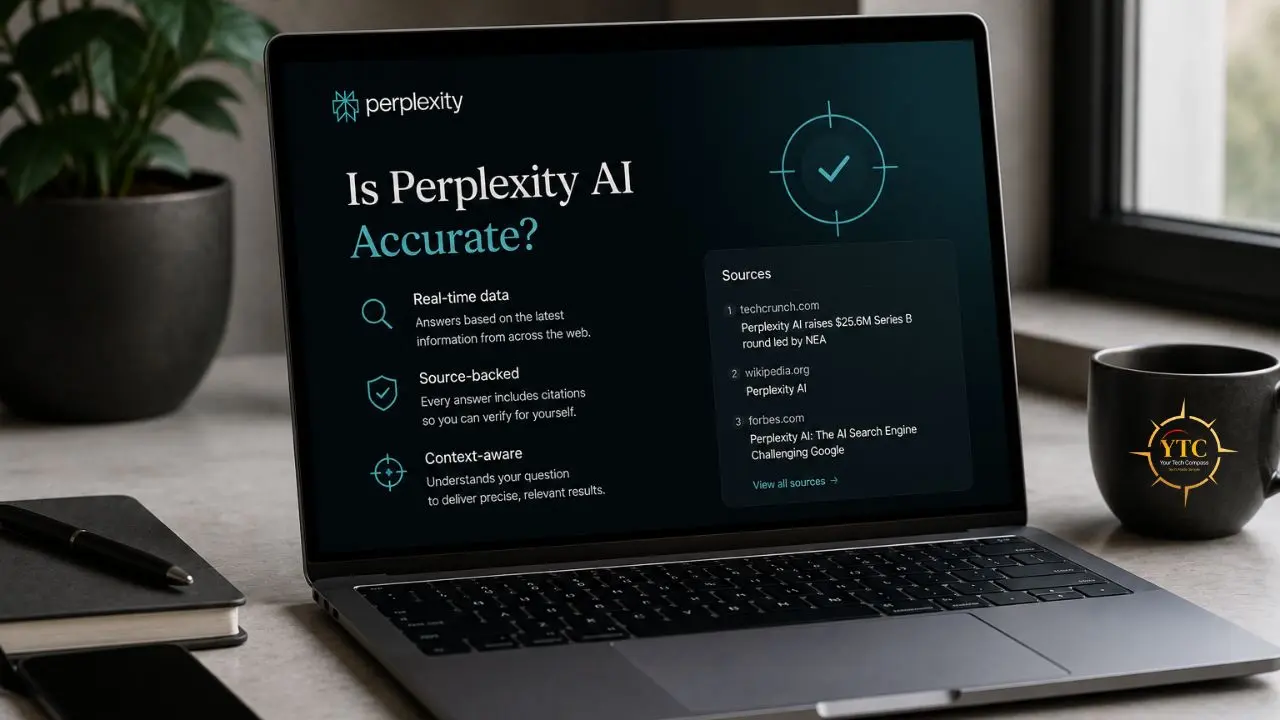
Perplexity’s citation architecture genuinely does reduce the hallucination risk that undermines standard chatbots. When the tool produces a factual claim and attaches a numbered citation to it, you can verify that claim in seconds by clicking the number. That’s a meaningful structural improvement over tools that generate claims with no verifiable basis.
That said, accuracy isn’t guaranteed by the presence of citations alone. Three documented failure modes are worth understanding:
Source Quality Variability
Perplexity doesn’t always retrieve authoritative sources. A query about a contested health claim might surface advocacy websites alongside peer-reviewed research, treating them with equal weight. The Academic focus mode reduces this risk for science and medical questions, but for general web searches, assessing source quality remains your responsibility.
Citation Mismatch in Deep Research
As noted earlier, Deep Research has been documented to produce reports in which some cited URLs return 404 errors or the cited source doesn’t contain the claimed information. Perplexity has acknowledged this. Always verify Deep Research citations for any claim you intend to rely on professionally.
Synthesis Errors on Complex Topics
When Perplexity synthesizes multiple conflicting sources, it sometimes produces a false consensus, presenting a settled answer even though the sources it retrieved reflect ongoing disagreement. This is most common for scientific questions, where research is genuinely contested, and for political or policy topics, where framing varies significantly across sources.
The Practical Guideline
Use Perplexity’s inline citations not as proof of accuracy but as a starting point for verification. The tool is significantly better than an uncited chatbot at getting you to accurate information quickly; it just doesn’t eliminate the need for source judgment.
When to Use Perplexity vs Other AI Tools
Here’s the honest decision framework I use when choosing between AI tools:
- Use Perplexity when you need a factual answer to a specific question and want to verify it quickly. You’re researching an unfamiliar topic and need a sourced overview. You want to know what real users think about something, and Reddit focus mode will surface community-level opinions that SEO-driven results hide. You need current information that other AI tools can’t access because of training cutoffs. You want multi-model access on a single subscription.
- Use ChatGPT when you need creative writing, brainstorming, or open-ended ideation. You want sustained conversational depth or narrative exploration. You need voice mode or image generation integrated into the same conversation. For a deeper look at how AI productivity tools compare across different task types, our best AI productivity apps guide covers the broader landscape.
- Use Claude when you’re working on a long, complex document that requires nuanced writing quality. You want the best available model for multi-step reasoning on ambiguous problems. You’re working on tasks that benefit from Claude’s particular strength in careful, hedged analysis.
- Use Google Search when you need comprehensive results from many sources rather than a single synthesized answer. You’re navigating to a specific known website. You want maximum source diversity rather than a curated synthesis.
Who Perplexity AI Is Best For
The Perplexity Pro plan is a genuinely strong value proposition for a specific user profile and genuinely overkill for another.
Perplexity Is Best Suited For:
- Students doing research-based coursework, especially at the $10/month Education Pro price, because the citation-first architecture directly serves academic work where attribution matters. The Academic focus mode surfaces peer-reviewed sources that general web searches often bury under SEO-optimized content.
- Journalists and researchers who work with information sources professionally and need to trace claims back to their origin quickly. Researchers and journalists, in particular, describe Perplexity Pro as a tool they couldn’t give up once they started using it daily.
- Professionals who need to get quickly up to speed on unfamiliar topics; lawyers reviewing a new case area, consultants briefing on an industry, product managers researching a competitive landscape. The combination of Pro Search depth and citation verification makes this genuinely fast.
Perplexity Is Less Suited For:

- Users whose primary AI use cases are creative writing, content generation, or conversational exploration, where ChatGPT and Claude both provide a better experience by design.
- Users who want emotionally engaging or persona-driven conversations. Perplexity is built for information retrieval, not social interaction. Tools like Poly AI better serve the conversational AI use case.
- Professional researchers who need peer-reviewed citations for their published work. Deep Research’s documented citation errors mean it can’t be used as a reliable source for academic citations without manually verifying every reference.
FAQs
Yes. The free plan is permanent; it never expires and includes unlimited basic searches with source citations on every response. The limitation is approximately 5 Pro Search queries per day and no access to Deep Research, premium AI models, or Spaces. For casual research, the free tier is genuinely functional. For regular daily use, Pro at $20/month unlocks the features that matter most.
More accurate than standard chatbots for factual questions because the citation architecture makes errors verifiable and correctable. Not perfectly accurate: source quality varies, Deep Research has a documented citation reliability problem, and synthesis errors occur on complex contested topics. The right framing is: Perplexity gets you to accurate information faster than most alternatives, but it doesn’t eliminate the need for source judgment.
Perplexity does collect search data. Threads are saved to your account history by default and can be deleted. Perplexity’s privacy policy permits the use of interaction data to improve its models. For sensitive professional queries, such as legal, medical, financial, or confidential business research, review Perplexity’s current privacy policy before using it and consider whether that data handling is appropriate for your use case.
Multiple major publishers, including The New York Times, the Chicago Tribune, CNN, and Reddit, have sued Perplexity, alleging that it scrapes and reproduces their content, including paywalled content, without permission or compensation. Perplexity has denied wrongdoing. Some publishers (Time, Gannett, Le Monde) have chosen licensing arrangements over litigation. The cases are ongoing as of mid-2026. The outcomes could affect what content Perplexity can access and the AI search industry’s relationship with publishers in the long term.
Conclusion
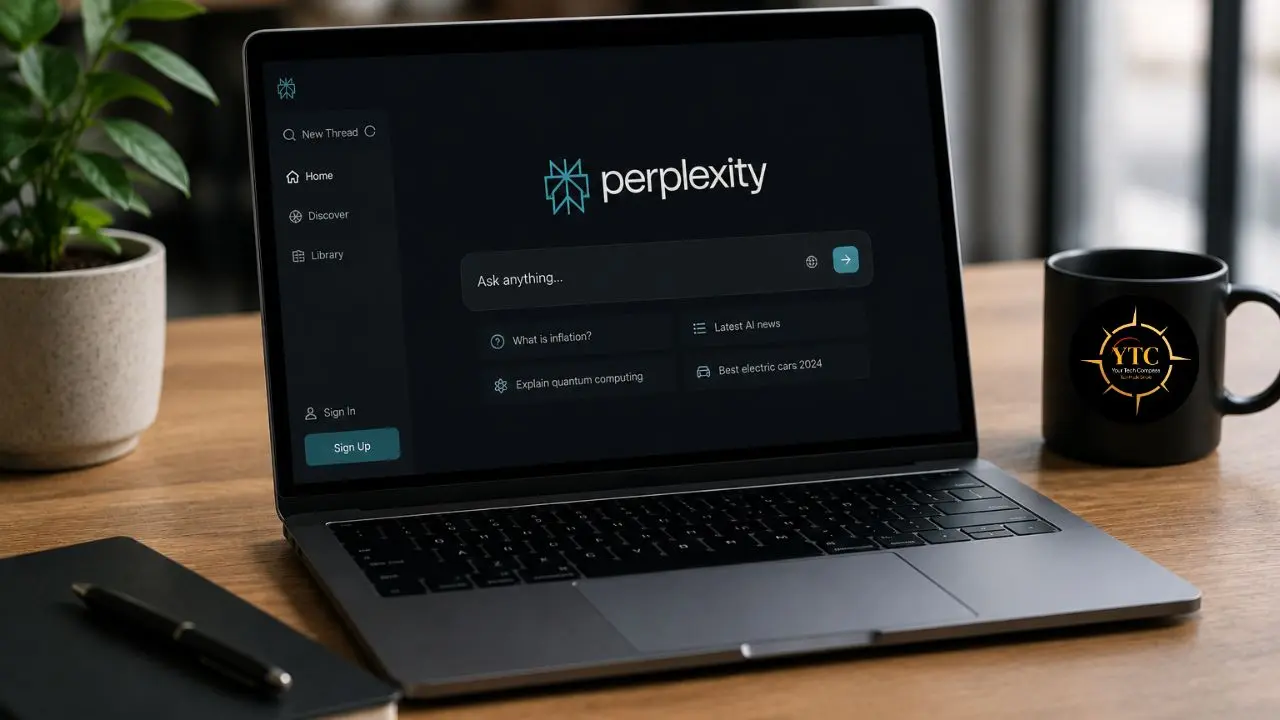
Perplexity AI has established a genuinely useful position in the AI tools landscape, not by doing everything, but by doing one thing exceptionally well. If your work involves researching information, verifying facts, synthesizing multiple sources, or staying current on fast-moving topics, Perplexity’s combination of real-time web retrieval and inline citations addresses those needs more directly than standard chatbots. The free tier is functional enough to evaluate properly; the $20/month Pro plan bundles multi-model access that would otherwise cost $60/month across three separate subscriptions; and the $10/month Education Pro is one of the better-value AI tool deals available for students.
The honest limitations are equally important to understand. Deep Research requires careful verification before you rely on its output in a professional context. The ongoing publisher lawsuits represent a real legal and ethical tension about what a “skip the links” AI search model means for the ecosystem that produces the content it synthesizes. And for creative writing, code generation, or open-ended conversation, other tools are better matches. Perplexity works best when you know what question you’re trying to answer, and you need sources to verify the answer, which, it turns out, covers a very large portion of how most people actually use AI in a working day.
Every AI tool review, honest comparison, and practical guide worth bookmarking lives at YourTechCompass.com, where we give you verified information, real pricing, and the context to decide what actually belongs in your workflow.