Every sales call contains a signal that most organizations never capture. When a buyer mentions a competitor, hesitates at a pricing question, or signals urgency about a timeline, that intelligence exists for exactly as long as the call lasts and the rep’s memory holds. Sales managers can’t attend every call. Reps self-report selectively in the CRM. Recorded calls pile up unreviewed because no one has time to manually listen to 40-minute conversations. Clari Copilot solves this problem at the infrastructure level; it automatically joins every call, transcribes the conversation in real time, identifies the moments that matter, and delivers them to managers and reps in a format that’s reviewable in minutes rather than hours. The result is that the signal hidden inside every sales conversation becomes visible, searchable, and actionable rather than being lost the moment the call ends.
This guide covers exactly what Clari Copilot is, how it works in a real sales team’s daily workflow, what it costs across its pricing tiers, how it compares to Gong, Chorus, and lighter tools like Otter.ai, and the honest verdict on who benefits most from the platform. Whether you’re a sales manager evaluating conversation intelligence tools for your team, a revenue leader trying to understand why deals are slipping, or a sales rep who’s just been told your organization is rolling out Clari Copilot, this is the complete picture before you engage a vendor.
A note before we begin: every YTC score is earned, never negotiated. If you want to understand exactly how we evaluate apps & tools and how we handle affiliate relationships, our Review Methodology lays it all out.
What Is Clari Copilot?
Clari Copilot was originally Wingman, a standalone conversation intelligence startup that Clari acquired in June 2022 and rebranded as Clari Copilot within the broader Clari Revenue Platform. Many users still refer to it as Wingman, which speaks to how strong the product’s identity was before the acquisition.
Clari was founded in 2012 and is headquartered in Sunnyvale, California. It is best known for its revenue forecasting and pipeline management platform, used by organizations including Adobe, Zoom, and Okta. The Wingman acquisition added conversation intelligence to that forecasting foundation, and the subsequent 2023 acquisition of Groove (a sales engagement platform) extended Clari further into a full revenue orchestration suite.
Clari Copilot is specifically the conversation intelligence module of that suite. It records sales calls across Zoom, Google Meet, Microsoft Teams, and phone dialers; transcribes them in real time; uses AI to identify and tag moments that matter (competitor mentions, objections, pricing discussions, next step commitments); delivers coaching insights to managers; and surfaces real-time assistance to reps during live calls.
The platform is SOC 2 Type 2-certified and GDPR-compliant, providing enterprise-grade security for organizations handling sensitive client conversations. It integrates with Salesforce, HubSpot, PipeDrive, Slack, Outreach, Aircall, RingCentral, and the full Clari Revenue Platform, making it a connective-tissue tool rather than a standalone point solution for most organizations that buy it.
What Is Conversation Intelligence And Why Does It Matter?
Before covering what Clari Copilot specifically does, it’s worth spending 2 minutes on what conversation intelligence actually means, because the term is often used loosely and the business case for it isn’t always clearly explained.
Conversation intelligence is a category of software that uses AI (specifically speech recognition, natural language processing, and machine learning) to analyze spoken conversations at scale. Before these tools existed, sales managers had essentially three options for understanding what was happening on calls: attend every call themselves (impossible at scale), rely on rep self-reporting in the CRM (optimistic and selective), or listen to recorded calls manually (time-prohibitive when a team of ten reps each makes twenty calls per week). Consequently, what was being said about the deals was almost entirely opaque to everyone except the rep on the call.
Conversation intelligence changes this by automatically processing every call: transcribing speech, identifying speakers, tagging topics, and surfacing the moments that matter. What makes this commercially important isn’t just coaching; it’s pipeline accuracy.
A deal a rep describes as “on track” in the CRM may have had a call last week in which the buyer mentioned a competitor, raised budget concerns, and declined to commit to next steps. That discrepancy between what the CRM says and what the conversation revealed is exactly where forecast errors and revenue surprises originate. Conversation intelligence makes that discrepancy visible before it becomes a missed quarter, which is why revenue leaders increasingly treat it as foundational infrastructure rather than a nice-to-have coaching tool.
How Does Clari Copilot Work?
The workflow from setup to daily use is more straightforward than most enterprise software, and understanding each stage helps you set realistic expectations for your team.
Setup and Integration
Connecting Clari Copilot to your conferencing tools (Zoom, Google Meet, Teams) and CRM (Salesforce or HubSpot) happens through direct integrations configured at the admin level. Initial setup for a sales team typically takes a few hours of IT configuration plus a brief rep onboarding session.
Once connected, Clari Copilot’s AI assistant joins scheduled sales calls as a bot participant; reps and customers see the Copilot notetaker in the meeting participant list, which satisfies recording consent requirements.
During the Call: Real-Time Assistance
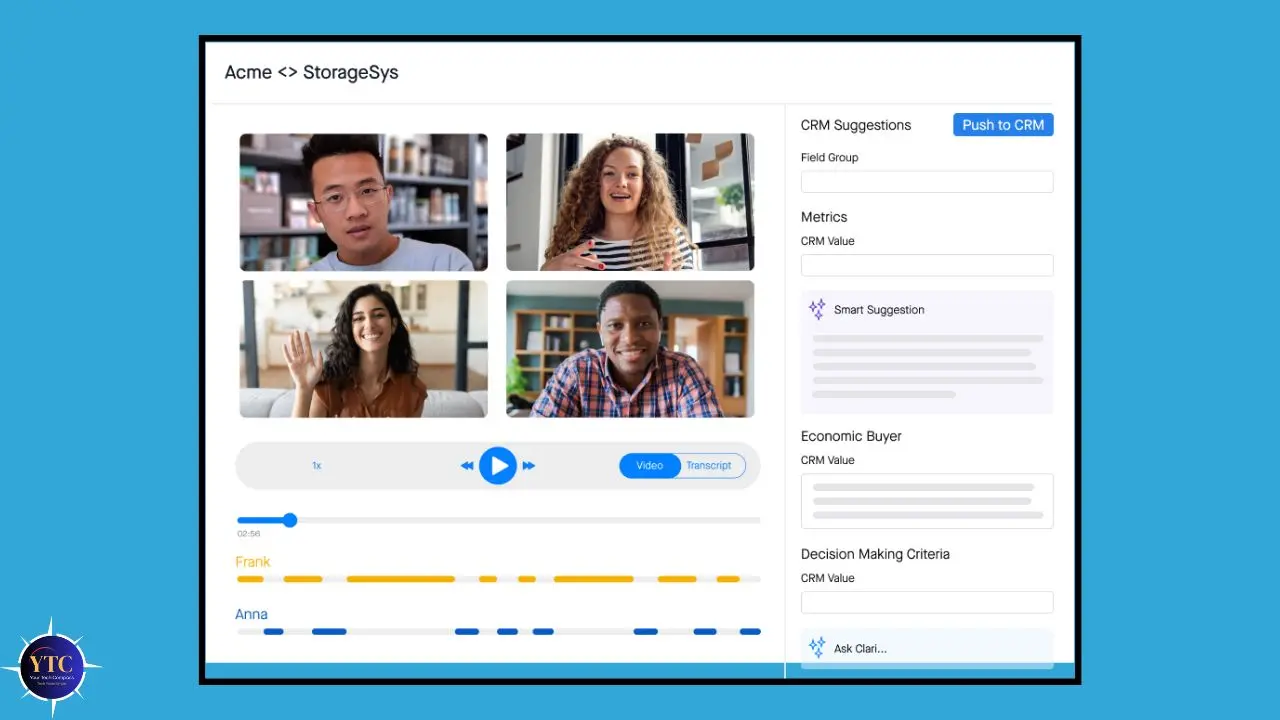
Clari Copilot transcribes the conversation in real time in a companion interface that the rep sees on their screen. When a competitor is mentioned (say, the buyer drops a competing vendor’s name mid-conversation), Copilot automatically surfaces a battlecard with relevant competitive positioning talking points tailored to that specific competitor.
The rep sees this prompt; the customer doesn’t. Additionally, live cues alert reps to specific coaching triggers: a monologue alert fires when the rep has been talking for too long without buyer engagement; filler word tracking flags overuse of “um,” “like,” and “you know”; next-step prompts appear when the conversation is heading toward a close without a clearly established follow-up commitment.
After the Call
Within minutes of call completion, Copilot delivers a structured, AI-generated summary: key topics discussed, action items, objections raised, competitive mentions, next steps committed to, and deal-risk signals identified from the conversation. This summary syncs automatically to the associated CRM record in Salesforce or HubSpot, eliminating the need for manual note entry.
The full transcript is searchable and available immediately. Key moments are tagged and timestamped; instead of listening to a 45-minute recording, a manager can jump directly to the four moments Copilot flagged as significant.
For Managers and Coaches
The manager dashboard shows all team calls, rep performance trends, and deal-level conversation history. The Gametapes feature (Clari’s version of coaching playlists) lets managers build curated libraries of call clips (top objection-handling moments, winning opener examples, best-practice discovery calls) that serve as living training materials, updated with real team content.
Managers can leave timestamped comments at specific moments in calls, flag clips for rep review, and track improvement over time through scorecard analytics. IN addition, the RevGPT feature allows managers and reps to chat with the conversation data, asking questions like “what objections came up most often this week” or “show me all calls where pricing was discussed,” without manually searching through transcripts.
Clari Copilot Key Features
Real-Time Battlecards
Battlecards are Clari Copilot’s most directly revenue-impacting feature, and the reason is straightforward. Competitive positioning training happens in enablement sessions weeks before a call, but the moment a buyer mentions a competitor mid-conversation, that training needs to surface immediately.
Expecting reps to recall detailed competitive differentiation for dozens of potential competitors while simultaneously managing the conversation is an unrealistic cognitive demand. Battlecards solve this by delivering the right competitive talking points at the exact moment they’re needed, inside the conversation where they can actually change what the rep says. Users consistently identify battlecards as the feature that most directly affects call outcomes in real time.
AI-Generated Call Summaries and RevGPT
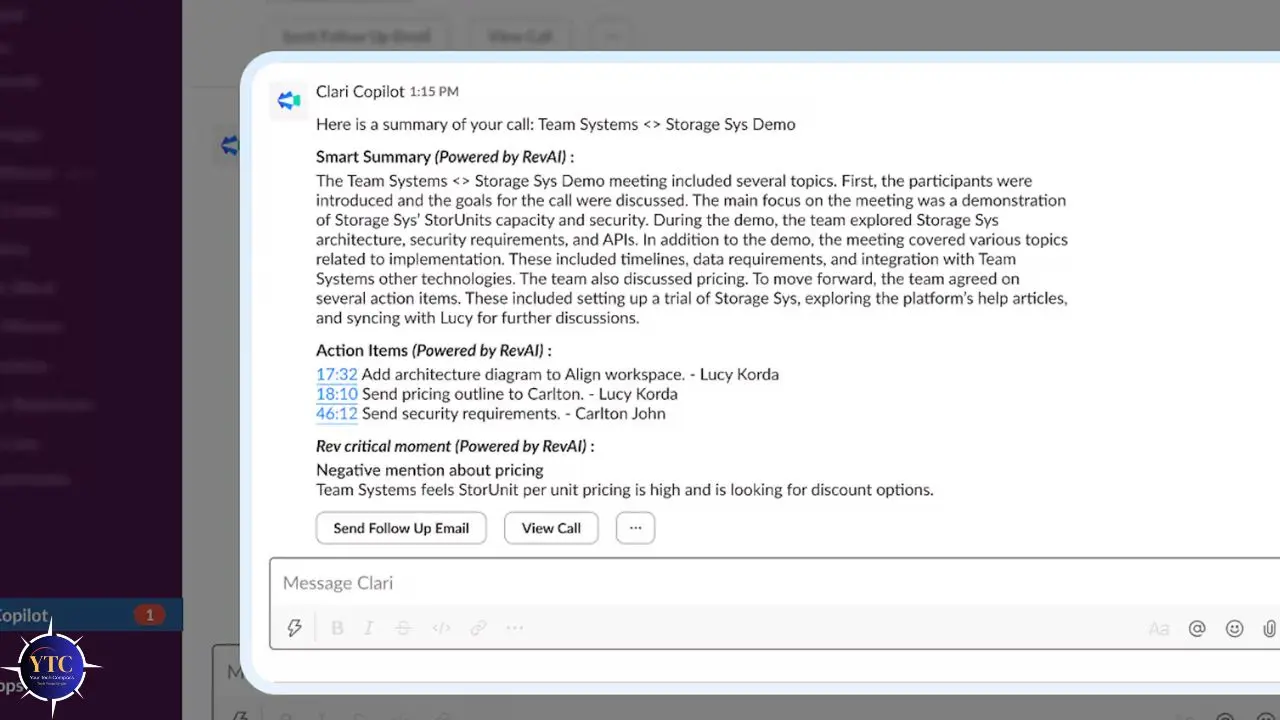
After every call, Copilot generates a structured summary covering topics discussed, action items, objections raised, questions asked, next steps committed to, and deal risk signals. The quality of these summaries, specifically their ability to identify what matters rather than just capturing a wall of transcript text, is one of the most praised aspects of Copilot in verified user reviews.
One G2 reviewer described the AI summaries as “a game changer” that simultaneously improved forecasting accuracy and coaching capacity. In addition, the RevGPT conversational interface allows managers to query the entire library of conversation data in natural language, for instance, “what objections came up most this quarter” or “which deals haven’t had a call in 14 days,” producing insights that would require hours of manual transcript review without it.
Moment Identification and Gametapes
Copilot identifies and timestamps specific moment types throughout every call: competitor mentions, pricing discussions, objection moments, positive and negative sentiment shifts, and next-step commitments. These tagged moments make call review dramatically faster for managers who otherwise face the choice between attending every call or reviewing nothing at all.
The Gametapes feature (coaching playlists) builds curated clip libraries from these tagged moments (a library of how the team’s top performers handle the most common objection, for example, or a collection of discovery calls that followed the ideal discovery framework) that serve as onboarding materials and ongoing coaching resources built from real team conversations rather than scripted role-play.
Talk/Listen Ratio and Behavioral Analytics
Copilot tracks the percentage of each call a rep spends talking versus listening and surfaces this data at the individual-rep and team levels over time. Research on sales performance consistently shows that top-performing reps talk less and listen more than average performers; they ask more questions, let buyers explain their situation in greater detail, and speak less spontaneously about product features.
The talk/listen ratio makes this behavioral difference visible in data rather than in subjective impressions, giving managers a specific, evidence-based coaching conversation rather than a general observation. Additionally, longest-monologue tracking, filler-word frequency, and question-count analytics provide a multi-dimensional behavioral picture that a manager observing a single call would struggle to reliably capture.
CRM Auto-Logging
Every call (including duration, participants, AI-generated notes, key moments, and deal signals) automatically syncs to the associated CRM record after each conversation. This eliminates one of the most consistently resisted behaviors in sales team management: manual CRM data entry.
When reps know that CRM logging happens automatically from the call, they stop avoiding it, stop delaying it, and stop selectively summarizing it. The result is CRM data that reflects actual activity and actual conversation content rather than what reps chose to document. Consequently, for revenue leaders making forecast commitments based on CRM data, the improvement in accuracy is commercially meaningful.
Scorecards and Coaching Playbooks
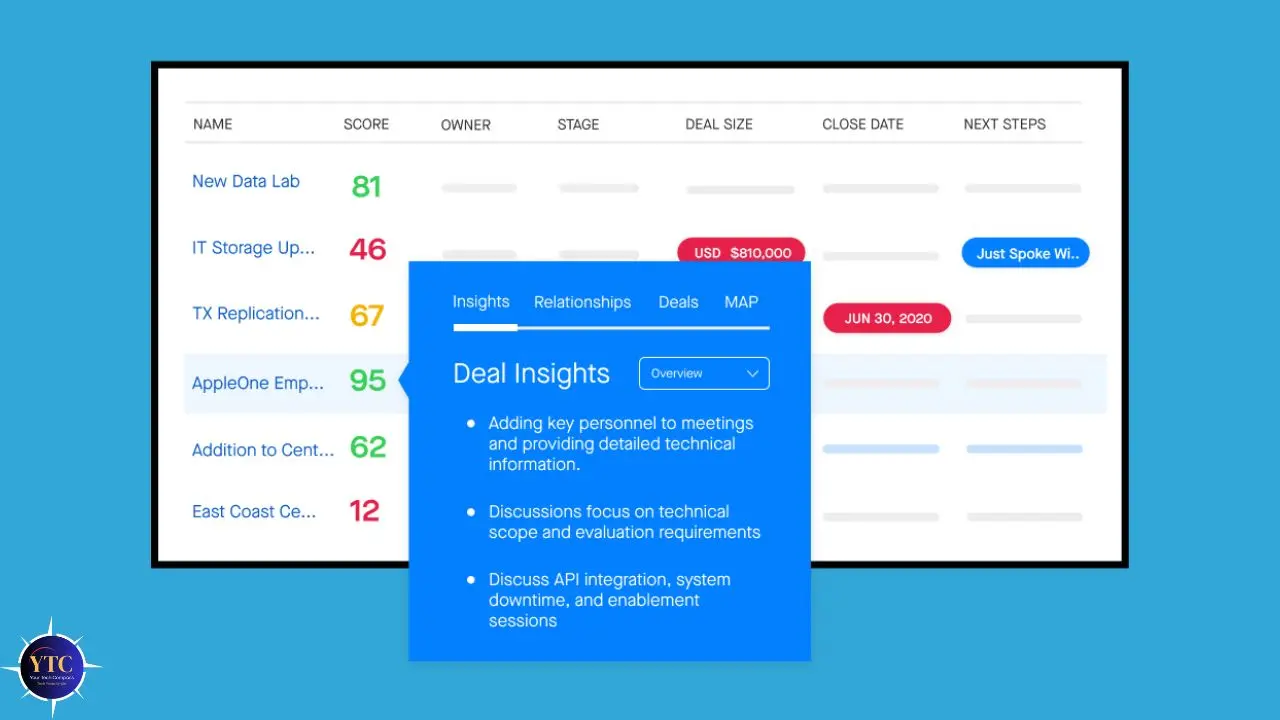
Configurable scorecards automatically evaluate each call against defined best practices, for instance, whether the next step was established. Also, was the business case confirmed? Was competitive differentiation communicated? And was the decision-making process discussed?
The Enterprise plan adds customized call scoring, allowing organizations to define their own criteria aligned with their specific sales methodology. In addition, scorecards make coaching criteria objective and consistent across a team. Therefore, every rep is evaluated against the same standard, rather than whatever a manager happened to notice on a particular shadow call.
Clari Copilot Pricing
Clari Copilot’s pricing is not publicly listed on Clari’s website; all pricing is quote-based and requires a sales conversation. Based on aggregated market research, user-reported pricing, and published analyses, here is the most accurate picture available:
Plan | Annual Cost Per Rep | Key Inclusions |
Accelerator | ~$1,080/year ($90/month) | Unlimited meetings, call data storage, real-time battlecards, AI summaries, CRM sync, basic scoring |
Enterprise | ~$1,320/year ($110/month) | All Accelerator features + customized call scoring, API access, SSO, dedicated support |
Copilot + Core Bundle | ~$200+/user/month | Full Clari Revenue Platform (forecasting + conversation intelligence combined) |
The honest pricing context: These figures represent publicly estimated ranges, as actual pricing depends on team size, contract length, negotiating leverage, and whether you bundle with Core and Groove. Therefore, implementation costs (professional services ranging from $15,000 to $75,000, depending on complexity) and ongoing RevOps overhead substantially increase the total cost of ownership beyond the per-seat rate. Consequently, organizations that buy Clari Copilot as part of the full Clari platform face significantly higher total investment but also significantly more integrated intelligence value.
The standalone Copilot evaluation makes most sense for organizations whose primary need is conversation intelligence without the full forecasting and pipeline platform. For those teams, the Accelerator tier at approximately $1,080 per rep per year is competitive with Gong’s pricing and significantly higher than lighter tools like Otter.ai or Fireflies.ai, reflecting the difference between enterprise sales conversation intelligence and general meeting transcription. Always verify current pricing directly with Clari’s sales team as pricing evolves.
Clari Copilot vs Competitors
Feature | Clari Copilot | Gong | Chorus (ZoomInfo) | Salesloft | Otter.ai / Fireflies |
Real-Time Battlecards | ✅ Yes | ✅ Yes | ✅ Yes | ⚠️ Basic | ❌ No |
CRM Auto-Logging | ✅ Salesforce + HubSpot | ✅ Broad | ✅ Yes | ✅ Yes | ❌ No |
Coaching Playlists | ✅ Gametapes | ✅ Strong | ✅ Yes | ⚠️ Limited | ❌ No |
Deal Intelligence | ✅ Via Clari Platform | ✅ Strong | ✅ Yes | ⚠️ Basic | ❌ No |
Revenue Forecasting | ✅ Full platform | ❌ No | ❌ No | ⚠️ Basic | ❌ No |
Ease of Setup | ✅ Faster than Gong | ⚠️ Complex | ⚠️ Complex | ✅ Moderate | ✅ Simple |
Pricing Tier | ~$90–$110/user/month | ~$130–$150/user/month | Enterprise quote | Enterprise quote | $10–$20/user/month |
Best For | Clari ecosystem teams | Large enterprise standalone | ZoomInfo ecosystem | Salesloft-first teams | General transcription |
Clari Copilot vs Gong
Gong is the market leader in conversation intelligence, with more customers, a broader integration library, deeper analytics for large-enterprise sales motions, and stronger brand recognition. Therefore, for organizations evaluating standalone conversation intelligence without a prior Clari relationship, Gong is typically the stronger evaluation choice.
Clari Copilot’s advantage is for organizations already using or considering the full Clari Revenue Platform; integrating Copilot’s conversation data with Clari’s revenue forecasting creates pipeline intelligence that Gong alone can’t replicate. The two products are genuinely competitive when Clari Copilot is evaluated in its full platform context; Gong leads when the evaluation is limited to standalone conversation intelligence.
Clari Copilot vs Chorus
Chorus was acquired by ZoomInfo in 2021 and is now marketed primarily as part of ZoomInfo’s go-to-market data platform. Organizations already using ZoomInfo’s data products may find the Chorus bundle a natural fit.
Clari Copilot is the stronger choice for Salesforce-first teams whose primary ecosystem is Clari, not ZoomInfo. Neither product has a clear advantage in features; ecosystem fit is the more relevant evaluation criterion for most buyers.
Clari Copilot vs Otter.ai / Fireflies.ai
This comparison comes up often, but addresses a different use case. Otter.ai and Fireflies are general meeting transcription tools at $10–$20 per user per month; they transcribe, summarize, and store meeting content. They lack the sales-specific features that make Clari Copilot a revenue intelligence tool: no battlecards, no deal intelligence, no CRM pipeline integration, no coaching scorecard infrastructure.
Therefore, if you need general meeting notes and transcription, the Otter.ai vs Notta comparison covers lighter transcription tools in detail. And, if you need conversation intelligence that integrates with your sales motion, Clari Copilot operates in a category of its own.
Who Is Clari Copilot Best For?
Sales Managers
Sales managers coaching distributed or remote teams are Clari Copilot’s most consistent high-value users. The ability to review tagged call moments, leave timestamped coaching comments, track behavioral metrics over time, and build coaching playlists from real team calls, all without attending a single call, is the core capability that makes managers advocate for investment in conversation intelligence. For distributed teams where physical call shadowing is impossible, this visibility is functionally irreplaceable.
Revenue Leaders

Revenue leaders who need pipeline accuracy find their most commercially important use case in Copilot’s deal intelligence features. When a rep marks a deal as “strong” in the CRM, but the most recent call transcript shows the buyer mentioning a competitor, expressing budget concerns, and avoiding a next-step commitment, Copilot flags the discrepancy before it becomes a forecast miss. Clari’s own data suggest that conversation-backed forecasting improves accuracy by 20%+ compared to CRM-only pipeline reviews, which, for organizations making multi-million-dollar revenue commitments, represents meaningful risk reduction.
Organizations on the Clari Platform
Organizations already on the Clari platform get the strongest return on Copilot investment. The integration of conversation data with Clari’s revenue forecasting, where call signals directly influence deal health scores and forecast confidence, creates a pipeline intelligence picture that neither Copilot nor Core can deliver alone. For these teams, Copilot isn’t an add-on evaluation; it’s a natural extension of existing infrastructure.
Who Should Look Elsewhere?
- Small sales teams with fewer than 10 reps, where the per-seat cost is difficult to justify.
- Organizations whose primary need is general meeting transcription rather than sales-specific intelligence (our best AI productivity apps guide covers lighter tools for that use case).
- Teams whose primary ecosystem is Gong or ZoomInfo, and who would face integration friction by adding Clari Copilot.
For the broader landscape of AI tools transforming B2B workflows, our AI Unboxed section covers the full range of platforms worth evaluating.
Clari Copilot Honest Strengths
Real-Time Battlecard Feature
The real-time battlecard feature is the most directly revenue-impacting capability in the platform; it delivers competitive intelligence inside the conversation, changing what the rep says, rather than in a training session weeks earlier, where it competes with everything else the rep is learning. Combined with the monologue alerts and live cue system, Copilot’s real-time layer provides reps with coaching during the moments that matter, rather than only after they’ve passed.
The CRM Auto-Logging
The CRM’s auto-logging capability addresses one of the most persistent problems in sales operations (manual CRM entry) by eliminating the need for it entirely. When call data flows automatically from Copilot to Salesforce or HubSpot, CRM data quality improves without any additional behavior change from reps. Therefore, for revenue leaders whose forecasting depends on the accuracy of CRM data, this improvement compounds across every deal in the pipeline.
Clair Ecosystem Integration
The Clari ecosystem integration is Copilot’s most significant competitive advantage over standalone conversation intelligence tools. When conversation signals feed directly into Clari’s revenue forecasting, the forecast becomes conversation-backed rather than CRM-dependent, a qualitatively different and more accurate view of pipeline reality. Users consistently describe this integration as the primary reason their organization chose Clari Copilot over Gong.
Clari Copilot Honest Limitations

Gong Leads on Standalone Conversation Intelligence
For organizations not already in the Clari ecosystem, Gong’s feature depth, integration breadth, larger customer base, and more mature analytics make it the stronger standalone choice in most evaluations. Clari Copilot’s competitive advantage is primarily realized within the full Clari platform context; evaluated in isolation, it’s competitive but not clearly superior to the market leader.
Enterprise-Only Pricing
Enterprise-only pricing and process create friction for smaller organizations or teams that want to trial software before engaging a vendor. No self-serve option exists; every evaluation requires scheduling a demo and engaging Clari’s sales team. Additionally, implementation costs ($15,000–$75,000 for professional services, depending on organizational complexity) and 8–16-week implementation timelines mean the total cost of ownership significantly exceeds the per-seat rate most buyers initially evaluate.
Post-Call Processing Has a Delay
Some users note that Copilot’s post-call summaries and transcript processing take 20–30 minutes after the call ends, rather than being instantaneous, which is a minor friction point for managers who want to review a call summary immediately after it ends.
Bot Join Reliability Varies
Multiple user reviews note that the Copilot notetaker bot occasionally fails to join scheduled calls automatically, requiring manual addition. This isn’t a frequent occurrence, but it happens often enough to appear consistently across user feedback, and a missed recording represents lost intelligence that the entire platform’s value proposition depends on.
FAQs
Clari Copilot is used for conversation intelligence: recording, transcribing, and analyzing sales calls to surface coaching insights, deal intelligence, and competitive signals. Sales managers use it to coach reps without having to attend every call. Revenue leaders use it to validate pipeline health against actual conversation content. Sales reps use their real-time battlecards and live cues to improve performance during calls.
Yes. When integrated with your conferencing tools (Zoom, Google Meet, Teams) and your calendar, Copilot automatically joins scheduled sales calls as a bot participant. Customers see the notetaker bot in the participant list, satisfying recording consent requirements. Some users report occasional missed joins that require manual addition.
Primarily yes. The features are designed for B2B sales use cases: battlecards, deal intelligence, pipeline integration, and rep coaching. That said, customer success teams, implementation teams, and anyone with a significant volume of client calls can use the transcription, summary, and coaching features. The platform’s value proposition is strongest for revenue-generating roles.
Yes. Salesforce is Clari Copilot’s primary CRM integration. Call activity, AI-generated summaries, participant data, and deal signals sync automatically to Salesforce records after every call. The platform also integrates with HubSpot and PipeDrive, but the Salesforce integration is the most mature and most commonly deployed.
Final Thoughts
Clari Copilot is a strong conversation intelligence platform whose value is highest, by a meaningful margin, for organizations already using or seriously considering the full Clari Revenue Platform. The real-time battlecards, CRM auto-logging, Gametapes coaching playlists, RevGPT deal querying, and talk/listen analytics address the core challenges sales managers and revenue leaders face: coaching at scale, pipeline visibility, and forecasting accuracy grounded in actual conversation reality rather than rep self-reporting. When Copilot’s conversation signals feed into Clari’s revenue forecasting, the combined picture is genuinely more powerful than either product delivers on its own. That integration is what separates Clari Copilot from Gong as a conversation intelligence choice, not features in isolation, but what those features enable when connected to the full platform.
The honest limitations are worth naming before any evaluation. Organizations not already in the Clari ecosystem will find Gong a stronger standalone choice for conversation intelligence in most head-to-head comparisons. The enterprise-only pricing model, implementation complexity, and total cost of ownership (all of which significantly exceed per-seat rates) require careful budget planning before committing. And the bot’s join reliability issue, while not frequent, is a practical consideration for teams whose entire value proposition depends on every call being captured. Evaluate Clari Copilot within the context of your full revenue technology stack, not as a point-solution comparison, and the picture of whether it’s the right choice for your team becomes substantially clearer.
The sales tech landscape moves fast, and so does every other corner of the tech world. Stay ahead of what’s worth your attention at YourTechCompass.com, where every review is built to help you make smarter decisions with your time and money.