If you’ve been researching college applications, you’ve likely heard of the Coalition App as an alternative to the Common App, and then spent ten minutes wondering whether it matters, which schools use it, and whether you need to bother with it at all alongside everything else on your senior-year plate. The short answer is that the Coalition App serves a specific purpose for a specific type of student, and understanding that purpose immediately tells you whether it belongs on your radar. The Coalition for College, the nonprofit organization behind the application, was founded in 2015 with a specific mission: making highly selective college education more accessible and affordable, especially for first-generation students, low-income students, and underrepresented communities. The application platform it created reflects that mission in its features, its list of member schools, and the support resources it provides for the application process.
This guide covers everything you need to make an informed decision about the Coalition App: what it is, how it works, which schools accept it, how it compares directly to the Common App, how it connects to QuestBridge, and the honest verdict on when it’s worth your time versus when the Common App is the more practical choice. Whether you’re a high school sophomore thinking ahead, a senior actively building your college list, or a counselor helping students navigate platform decisions, this is the complete picture.
A note before we begin: every YTC score is earned, never negotiated. If you want to understand exactly how we evaluate apps & tools and how we handle affiliate relationships, our Review Methodology lays it all out.
What Is the Coalition App?
The Coalition App, now officially called Apply Coalition with Scoir, is a free college application platform used by more than 150 colleges and universities committed to two criteria: graduating students on time and providing responsible, meaningful financial aid. Founded in 2015 and launched publicly in 2016, the Coalition for College Access and Affordability built the platform as a deliberate alternative to the Common App, with features designed specifically for students who have historically faced barriers to selective college admissions.
An important update you need to know: Coalition discontinued its original standalone MyCoalition platform and now partners with Scoir (pronounced “score”) to deliver the application experience. You no longer apply through coalitionforcollegeaccess.org’s own portal; you apply through Scoir’s platform at scoir.com, which is free for all students regardless of whether your high school uses Scoir.
If your school does use Scoir, your counselor collaboration and application work happen in one integrated system. However, if your school doesn’t use Scoir, you can still create a free independent account and apply to Coalition member schools through the same platform. Additionally, every school in the Coalition’s member network must meet specific admission standards to be a member.
Member schools must demonstrate a six-year graduation rate of at least 70%, commitment to need-based financial aid, and alignment with the Coalition’s access and affordability mission. That selective membership requirement means Coalition schools, as a group, are institutions with genuine track records of getting students through to graduation, not just getting them in the door.
How the Coalition App Works
Creating An Account
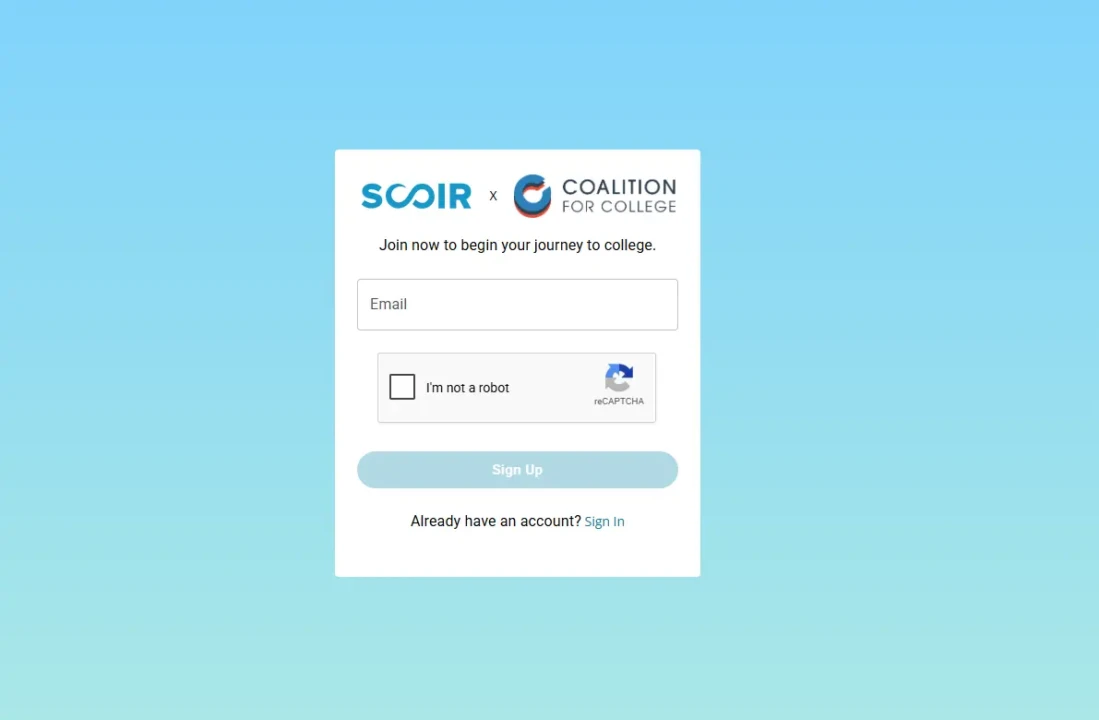
Go to scoir.com and create a free account with your email address. One of the Coalition platform’s most distinctive features is that you can do this as early as ninth grade, significantly earlier than the Common App, which opens August 1 of your senior year. Early access matters because the Coalition’s signature portfolio feature, the Locker, is designed to capture your growth across all four years of high school, not just a senior-year snapshot.
The Locker: The Feature That Sets Coalition Apart
The Locker is a digital portfolio tool with no equivalent in the Common App. You use it to store essays, writing samples, artwork, videos, photos, project documentation, awards, and any other materials that represent your academic and personal development over time.
The Locker is private by default; you decide what to share with each college in your application. In addition, you can also invite teachers, counselors, and mentors to collaborate in your Locker, allowing the people who know your work best to contribute materials alongside you.
For students from schools with fewer resources or less active college counseling support, the Locker provides a structured way to document achievements that might otherwise go unrecorded, before senior-year pressure makes careful reflection nearly impossible.
The Application Itself
The Coalition application has four main sections: Profile (personal information, demographics, family background), Academic Information (grades, courses, test scores with flexibility for test-optional schools), Extracurricular Activities and Work Experience, and Essays and Personal Statements. Each section that you complete for one school automatically pre-populates for the other schools on your list.
You enter your core information once and don’t have to re-enter it for each additional school. Consequently, adding multiple Coalition schools to your list doesn’t require starting from scratch each time.
The Essay Prompts
Coalition provides six prompts for your personal statement; you choose one and respond. The current prompt, which has remained consistent across multiple application cycles, is: Describe an experience that demonstrates your character or has helped shape it.
In addition, describe what interests or excites you and how it shapes who you are; describe a time you had a positive impact on others; describe a time when a belief of yours was questioned and what you learned; describe a success or obstacle and the advice you’d give someone in a similar situation; and an open-ended prompt of your choice.
Coalition essays should be 500 to 650 words, the same upper limit as the Common App, but with a higher lower bound.
Supporting Materials and Submission
Through Scoir, you request letters of recommendation from teachers and counselors, who submit them directly through the platform. Each school may require additional supplemental essays or short-answer questions in addition to the main personal statement. These appear in Scoir once you add a school to your application list.
You submit to each school independently, following that school’s specific deadlines for Early Decision, Early Action, or Regular Decision. Application fees are set by each individual college. The Scoir platform itself is free, and qualifying students can automatically receive fee waivers based on their financial situation.
Which Schools Accept the Coalition App?
This section determines whether the Coalition App is relevant to your specific college list, and the answer matters a great deal.
More than 160 colleges and universities currently accept the Coalition App through Scoir, including private research universities, liberal arts colleges, and flagship state institutions. Critically, the member list includes many of the most selective and well-known institutions in the United States, including all eight Ivy League schools (Harvard, Yale, Princeton, Columbia, Penn, Brown, Dartmouth, Cornell), MIT, Stanford, Duke, Johns Hopkins, Vanderbilt, Rice, Washington University in St. Louis, and major flagship state universities.
Here’s what you need to understand about the school list before making your platform decision:
Many Coalition Schools Also Accept the Common App
When a school accepts both platforms, you choose which one to use, and there is no admissions advantage to either choice. Colleges are genuinely indifferent about which platform your application arrives through.
Admissions officers treat all applications identically, regardless of origin. Consequently, choosing Coalition over Common App at a school that accepts both does nothing to change your chances; it only changes your application workflow.
Some Schools Accept Only One Platform
Before finalizing your application strategy, research each school’s specific requirements. This is because some institutions use only the Common App, some use only the Coalition App, and some accept both. Therefore, your college list determines your platform strategy, not the other way around.
The most notable Coalition member schools include:
Category | Member Schools (Examples) |
Ivy League | |
Other Highly Selective | |
Liberal Arts | |
Flagship State Universities |
Always verify the current member list directly at coalitionforcollegeaccess.org/our-members before making decisions, as membership changes from cycle to cycle, and schools like Yale and Stanford joined relatively recently.
Coalition App vs Common App: Key Differences
Many students applying to highly selective schools can use either platform and reasonably wonder which one serves them better. Here’s the honest, practical comparison.
Feature | Coalition App (via Scoir) | Common App |
Member Schools | 160+ schools | 1,100+ schools |
Essay Word Limit | 500–650 words | 250–650 words |
Essay Prompts | 6 prompts | 7 prompts |
Activity Slots | Up to 10 activities | Up to 10 activities |
Portfolio Feature | ✅ Locker (from 9th grade) | ❌ No equivalent |
Early Access | ✅ From 9th grade | ❌ Opens August 1, senior year |
No Platform Fee | ✅ Free | ✅ Free |
Fee Waiver Process | ✅ Automatic via Scoir | ✅ In-platform request |
Admissions Advantage | ❌ None | ❌ None |
Best For | First-gen students; highly selective lists; Locker users | Broader college lists; wider school coverage |
The Member School Gap Is the Most Decisive Factor
Common App covers over 1,100 schools. On the other hand, Coalition covers roughly 160.
Consequently, if your college list spans a range of selectivity levels, including schools outside the top 25, the Common App almost certainly covers more of your list. Most students with diverse college lists find the Common App the more practical primary platform simply because it reaches farther. That said, if your list is concentrated among Ivy League and top-25 schools, the Coalition App covers most of your targets.
The Locker Is Genuinely Unique
Nothing in the Common App comes close to a longitudinal portfolio that students can build from ninth grade. For first-generation students, students from under-resourced schools, or students with non-traditional achievement paths (students who have meaningful work that doesn’t fit neatly into a senior-year snapshot), the Locker provides real documentation value that the Common App simply can’t replicate. However, for students who start building it early enough, it’s one of the Coalition platform’s clearest advantages.
The Essay Prompts Serve Similar Purposes
Both platforms use broad, reflective prompts designed to elicit personal narrative. The themes overlap substantially. Therefore, if you’ve written a strong Common App essay, adapting it for a Coalition prompt (or vice versa) typically requires targeted revision rather than a complete rewrite.
Start with the story you want to tell, then find the prompt that best frames it. And, for a full breakdown of how the Common App works and what each section requires, our Common App guide covers the platform in complete detail.
There Is No Admissions Advantage to Either Platform
This is confirmed by both admissions professionals and Coalition’s own official communications. Admissions offices receive applications from multiple platforms and evaluate them identically. Therefore, choosing Coalition over Common App, or vice versa, for the same school accomplishes nothing strategically.
The Coalition App and QuestBridge

If you’re a high-achieving student from a low-income family, QuestBridge is worth considering before you decide on an application platform, as it can change the entire picture.
What QuestBridge Is
QuestBridge is a nonprofit scholarship and admissions program specifically for high-achieving, low-income students. Its flagship program is the National College Match, where eligible students apply to QuestBridge, are evaluated, and can rank up to 12 partner colleges as their top choices.
Students who are “matched” with a partner school receive a full four-year scholarship covering tuition, room and board, and other expenses; loan-free, with no required parental contribution. Additionally, QuestBridge’s application is completely free, and matched students receive one of the most financially generous outcomes available in US college admissions.
How QuestBridge Connects to the Coalition App
QuestBridge partner schools substantially overlap with Coalition member schools. If you apply through QuestBridge and are selected as a finalist but not matched in the National College Match round, you can use the Coalition App (or Common App) to apply through regular decision to your remaining schools.
The two platforms are not integrated. Applying through QuestBridge’s National College Match is a separate binding process, and the Coalition App serves as the regular application pathway for the schools remaining on your list after the Match.
Who Should Consider QuestBridge?
Students from families with demonstrated financial need and strong academic records should evaluate QuestBridge before either the Coalition App or Common App, because the scholarship potential is in a different category from anything either application platform can offer on its own. The QuestBridge College Match scholarship makes the platform worth researching on your own before you finalize any application strategy.
For counselors helping students navigate these decisions, our best tech tools for teachers guide covers the broader landscape of digital tools that support student guidance and college prep workflows.
When Should You Use the Coalition App?
Rather than a vague “it depends,” here’s the direct breakdown based on your specific situation.
Use the Coalition App If
- You’re a first-generation college student who wants the Locker to document your achievements over time, starting in ninth or tenth grade.
- Your college list is concentrated among highly selective Coalition-member schools.
- You’re applying to schools that accept only the Coalition App and not the Common App.
- You’re a QuestBridge applicant who needs a regular-decision platform for schools that remain after the Match.
However, Use the Common App If
- Your college list spans a range of selectivity beyond the top 25; the Common App’s 1,100+ member network covers a much broader range.
- You’re applying primarily to schools that only accept the Common App.
- You want the more established, more counselor-familiar platform where guidance resources are more widely available.
- You haven’t started building a Locker and don’t have time to populate it meaningfully before applications are due.
Use Both If
- Your college list genuinely spans schools that accept only the Coalition App and schools that accept only the Common App.
For schools that accept both, pick one and submit through that platform; completing both applications to the same school accomplishes nothing and wastes time you should be spending on supplements and essays.
Honest Strengths of the Coalition App
The Locker is genuinely distinctive and serves a real gap that the Common App doesn’t address. For students who start using it from ninth or tenth grade, it provides a longitudinal record of growth that’s more compelling than a senior-year retrospective. Additionally, the Coalition’s member school requirement (schools must demonstrate a 70% six-year graduation rate and commitment to need-based aid) means that when you apply to a Coalition school, you’re applying to an institution with a verified track record of supporting students through to degree completion. That quality filter is embedded in the membership criteria in a way that the Common App’s broader, less selective member network doesn’t replicate.
Furthermore, the Scoir platform’s automatic identification of fee waivers makes its mission of financial accessibility tangible rather than merely rhetorical. Qualifying students see fee waivers applied automatically based on their financial information rather than having to research and request them individually for each school.
Honest Limitations of the Coalition App

The smaller school network is the platform’s most significant practical limitation. For most students whose college lists span a range of school types and selectivity levels, the Coalition App doesn’t cover enough ground to serve as a primary platform.
Many counselors and college advisors are more familiar with the Common App, which means guidance resources, peer support, and counselor expertise are more readily available there. Additionally, because many Coalition schools also accept the Common App, completing the Coalition application for those overlapping schools provides no strategic advantage; it only creates a parallel workload.
FAQs
Yes. The Coalition App through Scoir is completely free for students. There is no platform fee. Individual colleges may charge their own application fees, but qualifying students can access automatic fee waivers through Scoir based on their financial situation. Some Coalition member schools waive application fees entirely for all applicants.
Yes. Many students do when their college list spans schools that accept only one platform. However, for schools that accept both platforms, choose one and apply through that platform only. Submitting to both schools provides no advantage, and most schools explicitly ask you to submit only one application per cycle.
Neither is objectively better; they serve different students in different situations. The Common App covers more schools (1,100+ vs 160+) and is more familiar to counselors and students. The Coalition App has the Locker, earlier access from ninth grade, and a member list concentrated among highly selective, access-committed schools. The right choice depends on your college list and your situation.
No. Colleges explicitly state they have no preference between application platforms. Admissions offices receive applications from multiple platforms and evaluate them identically. The platform you choose has no impact on your admissions outcome at schools that accept multiple platforms. For a broader look at the apps and digital tools that support the college application process, our apps and tools section covers the full range of student productivity tools worth knowing.
Conclusion

The Coalition App is a legitimate, purposefully designed application platform whose value is concentrated in two specific groups: students applying primarily to highly selective schools covered by the Coalition’s 160+ member network, and first-generation or lower-income students who start building the Locker early enough to make it a genuine representation of their growth over time. For students with broader college lists that extend beyond the top 25, the Common App’s 1,100+ member network makes it the more practical primary choice, and the honest verdict is that most students will use the Common App as their primary platform and the Coalition App selectively, if at all, based on specific schools on their list.
The Coalition App doesn’t compete with the Common App in a winner-takes-all sense. It fills a specific gap: equitable access tools, a member list of schools committed to graduation and affordability, and a portfolio feature that helps under-resourced students document themselves before senior year, making reflection impossible. Understanding the specific purpose immediately tells you whether it belongs in your application strategy. Research your school list, check which platforms each school accepts, and make the decision based on your list rather than on which platform sounds more impressive.
College applications, student tools, and the technology that makes the process work better are all reviewed honestly at YourTechCompass.com, where smarter decisions start with better information.