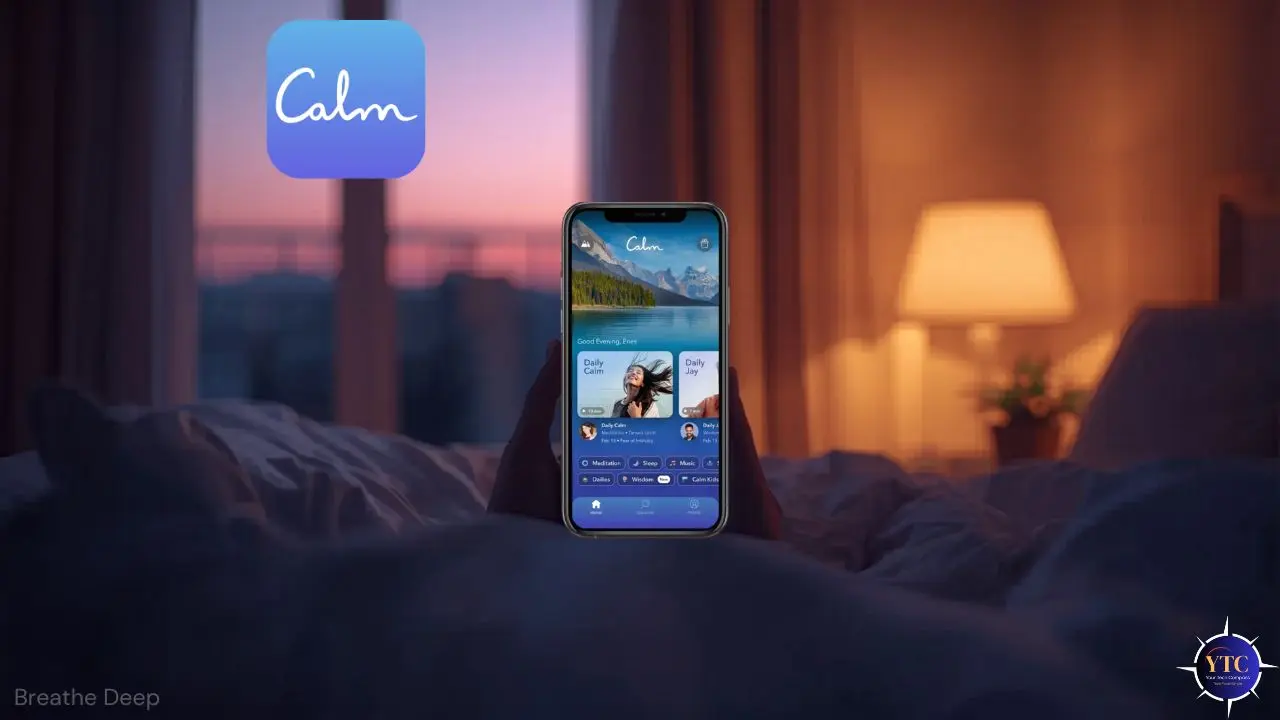
If you’ve ever seen a Calm ad mid-scroll and wondered whether a meditation app could genuinely change how you sleep or handle stress, you’re not alone. Calm has been downloaded more than 140 million times since launch, has over 1.5 million five-star reviews, and sits at the center of a wellness app market that now generates billions annually. But download numbers and star ratings don’t tell you whether the app will actually work for you specifically, whether the Sleep Stories will help you fall asleep, whether the daily meditations will stick as a habit, or whether the subscription is worth paying for when free alternatives exist. Those are the real questions, and they deserve real answers.
This guide covers everything you need to make an informed decision about the Calm app: what it is, how it works, every major feature category, what the free tier actually gives you, what requires a subscription, how Calm compares directly to Headspace and Insight Timer, and the straight verdict on who Calm genuinely serves well and who should look elsewhere. Whether you’re a complete beginner to meditation, a chronic poor sleeper, or someone who tried a wellness app once and abandoned it within a week, this is the honest picture.
A note before we begin: every YTC score is earned, never negotiated. If you want to understand exactly how we evaluate apps & tools and how we handle affiliate relationships, our Review Methodology lays it all out.
What Is the Calm App?
Calm was founded in 2012 by Michael Acton Smith and Alex Tew, two entrepreneurs who spotted something simple yet significant: people desperately wanted a way to slow down, and digital tools hadn’t yet met that need. The origin story is telling.
Tew had previously built a website called “Do Nothing for Two Minutes” in 2011, a page where you could stare at a beach scene and listen to the waves without moving your mouse. Over 100,000 people signed up in two weeks. That response was the signal. Calm launched a few months later, available on iOS, Android, and web browsers, with sync across all devices.
Today, Calm is not purely a meditation app; it’s more accurately described as a sleep and mental wellness platform. Meditation is one of several content pillars alongside sleep, breathing, movement, music, and focus. That distinction matters because it changes how you evaluate the app. You’re not paying for a meditation teacher or a certification program.
You’re paying for access to a large, regularly updated library of guided audio content, and the quality of that library is the product. Calm has held a revenue lead over Headspace since 2018, is estimated to generate $210 million in revenue in 2025, and was valued at $2 billion in its most recent funding round. Additionally, the company recently launched Calm Sleep, a standalone iOS app built entirely around sleep support, signaling where Calm sees its clearest competitive advantage.
How the Calm App Works
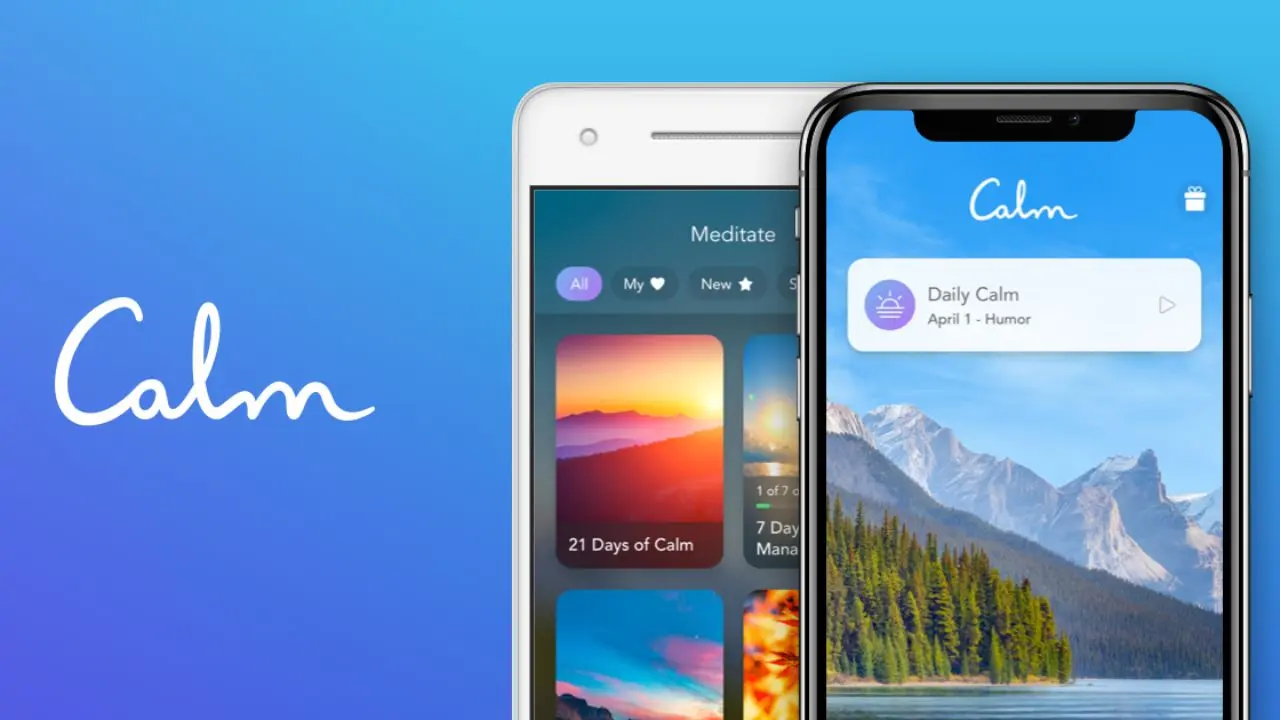
Getting started is straightforward. Download the app, create a free account with your email, Google, or Apple ID, and complete a brief onboarding questionnaire. Calm asks what you’re hoping to improve: sleep, anxiety, stress, focus, self-improvement, or relationships, and your answer shapes what content surfaces first on your home screen. In addition, onboarding takes under 3 minutes, and you’re immediately inside the library.
The core experience is browse-and-choose rather than step-by-step. Unlike Headspace, which guides you through a defined curriculum, Calm presents content categories and lets you pick what resonates with you. Some users find this freedom refreshing and immediately accessible.
Others, particularly beginners who want to be told exactly what to do, find it overwhelming at first. That design choice is the clearest expression of what Calm is: a content library, not a structured course. Consequently, the value you get from Calm is directly proportional to how actively you explore it.
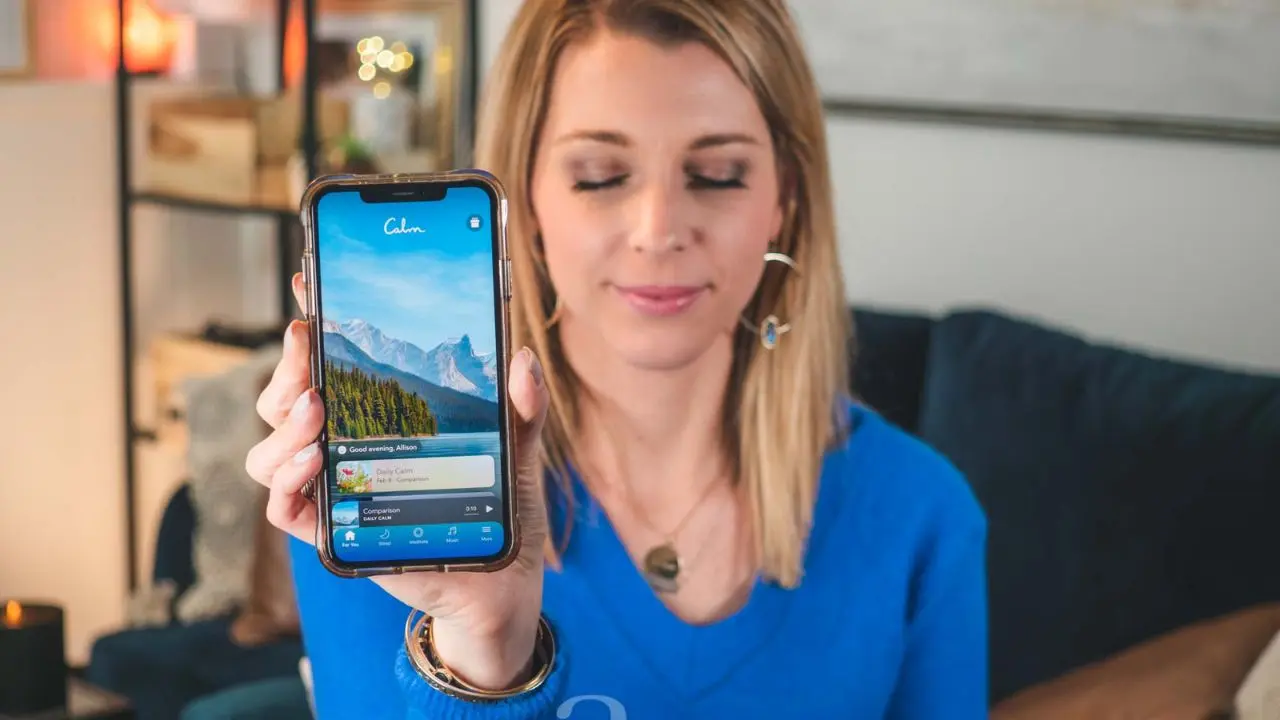
Daily habit formation happens through two anchor features. The Daily Calm is a new 10-minute guided meditation published every single day, narrated by Tamara Levitt, Calm’s Head of Mindfulness.
The Daily Move is a new gentle movement or stretching session added each day. Both features give you a default answer to “what should I do today” without requiring you to browse, which is the friction point that causes most people to close wellness apps and not return. Calm also tracks your listening streaks, session history, and total minutes of practice, not as competitive metrics but as a quiet accountability layer that supports consistency over time.
Calm Key Features
Sleep Stories
Sleep Stories are Calm’s most distinctive commercial feature and the one that most clearly sets it apart from every competing app. These are bedtime audio stories (typically 20 to 40 minutes long) narrated by voices specifically chosen for their calming quality.
The library contains over 500 stories across categories such as fiction, nature, travel, and ASMR, with new stories added weekly. Collectively, Sleep Stories have been listened to more than 1 billion times since launching in 2016.
The celebrity narrator roster is what makes Calm’s Sleep Stories a cultural phenomenon rather than just a product feature. Current narrators include Matthew McConaughey, Harry Styles, Idris Elba, Jennifer Garner, Cillian Murphy, Kate Winslet, LeBron James, Shawn Mendes, Cynthia Erivo, Regé-Jean Page, Laura Dern, Nick Offerman, Lucy Liu, Mandy Moore, and over 50 others.
The stories are deliberately slow-paced, lightly plotted, and unresolved, designed to occupy just enough of your cognitive attention to quiet the cycle of rumination that keeps most people awake, without being interesting enough to keep you from drifting off. That balance between engaging and boring is harder to achieve than it sounds, and Calm has genuinely mastered it.
For users whose primary complaint is lying awake with a racing mind, Sleep Stories are frequently the feature that justifies the subscription on its own.
The Daily Calm
The Daily Calm is a fresh 10-minute guided meditation every day, anchored by Tamara Levitt’s distinctive voice and teaching style. Each session focuses on a single theme, often tied to a broader seasonal or monthly topic, and requires no prior meditation experience to benefit from.
The format is consistent enough to become a genuine habit and varied enough to stay engaging across months of daily use. Additionally, Jeff Warren hosts the Daily Trip, an alternative daily session with a slightly different approach and tone, giving you a choice between two daily options rather than one.
Meditation Programs and Courses
For users who want more structure than the browse-and-choose approach, Calm’s meditation programs provide multi-session courses on specific topics. The beginner sequence starts with 7 Days of Calm, an introduction to the foundations of meditation, and progresses to 21 Days of Calm for users who want three full weeks of daily practice.
Beyond the beginner programs, courses cover managing anxiety, improving focus, building self-compassion, navigating grief, improving relationships, and more. Each program runs 7 to 30 sessions on its specific theme. These programs are Calm’s closest equivalent to the structured curriculum that Headspace uses as its primary organizing principle, but they’re supplementary in Calm’s library rather than central to it.
Breathing Exercises
Calm’s breathing tools are among its most immediately accessible features for skeptics who aren’t ready to commit to sitting meditation. Visual breathing guides walk you through timed inhale-hold-exhale cycles, including the 4-7-8 technique (inhale for 4, hold for 7, exhale for 8) and box breathing (equal counts of inhale, hold, exhale, and hold).
These tools work for acute stress moments (before a difficult conversation, during a panic response, or when you can’t sleep) without requiring you to be in a meditative mindset. Consequently, they’re often the first feature that converts a skeptic into a regular user.
Music and Soundscapes
Calm’s audio environment library is among the strongest in its category. Over 90 soundscape tracks cover natural scenes (rainfall, ocean waves, forest, campfire), urban environments, and white, brown, and green noise, each engineered for different use cases, including sleep, focus, and relaxation.
Beyond soundscapes, Calm offers an extensive ambient music library organized by genre: classical, new age, electronic, and focus music for work sessions. Artists, including Moses Sumney and Tom Middleton, contribute original music to the library.
The soundscapes and focus music work as useful standalone tools entirely separate from meditation or sleep content. Many users run them continuously during work hours without using any other Calm features.
Calm Kids
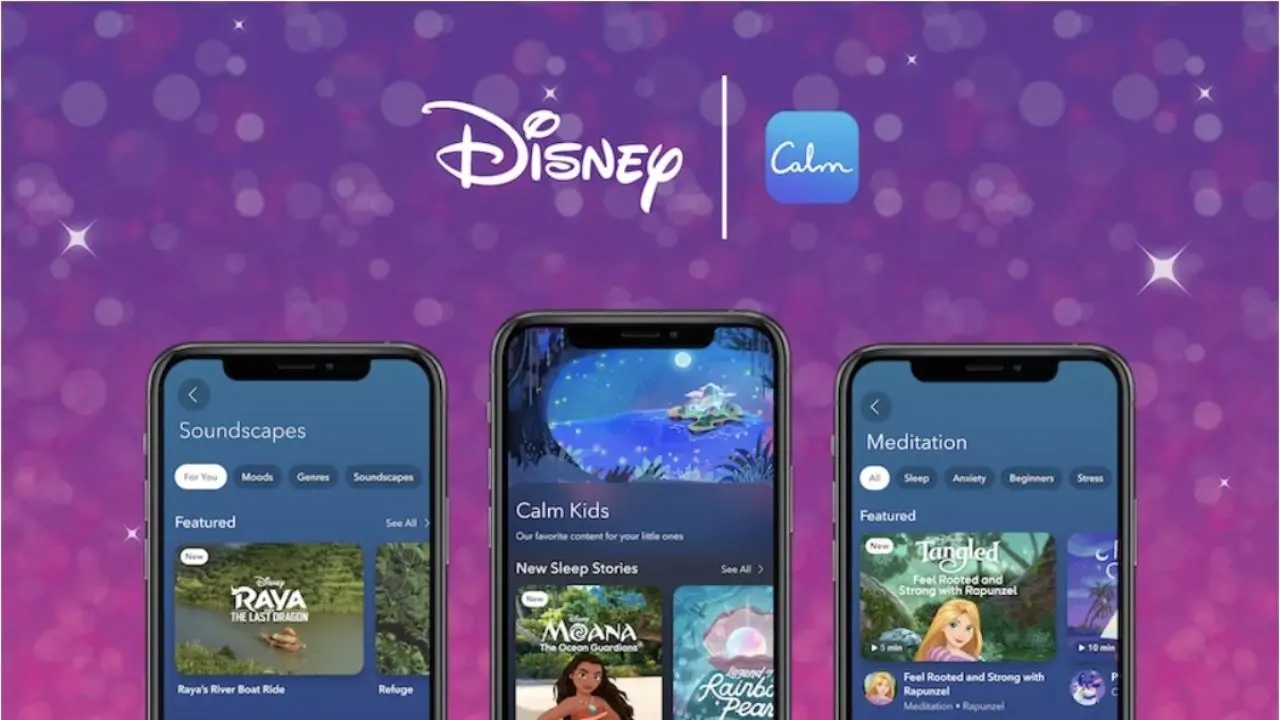
Calm Kids is a dedicated content section for children featuring age-appropriate sleep stories, meditations, and breathing exercises. Sleep Stories for kids include characters from Peppa Pig, Minions, Winnie the Pooh, Transformers, and My Little Pony, making the transition to a bedtime audio routine significantly easier for parents of younger children.
Parents consistently cite Calm Kids as one of the app’s most valuable features, and multiple reviews note that children ask for specific stories by name once the routine is established. The Calm Kids content is included in the family plan, which makes the per-person cost of a family subscription particularly compelling.
Masterclasses
Calm Masterclasses are long-form educational audio sessions from external experts in psychology, neuroscience, sleep science, and wellness. These are distinct from Calm’s own meditation programs; they feature outside voices to cover topics such as the neuroscience of anxiety, the science of sleep, creativity, emotional intelligence, and personal development.
The Masterclass format sits between a podcast episode and an online course, and the quality is uneven; some are genuinely excellent, others feel like padded introductory content. That said, they represent a meaningful expansion of Calm’s offerings beyond meditation, and for users who engage with them seriously, they add real value to the subscription.
Calm Sleep App
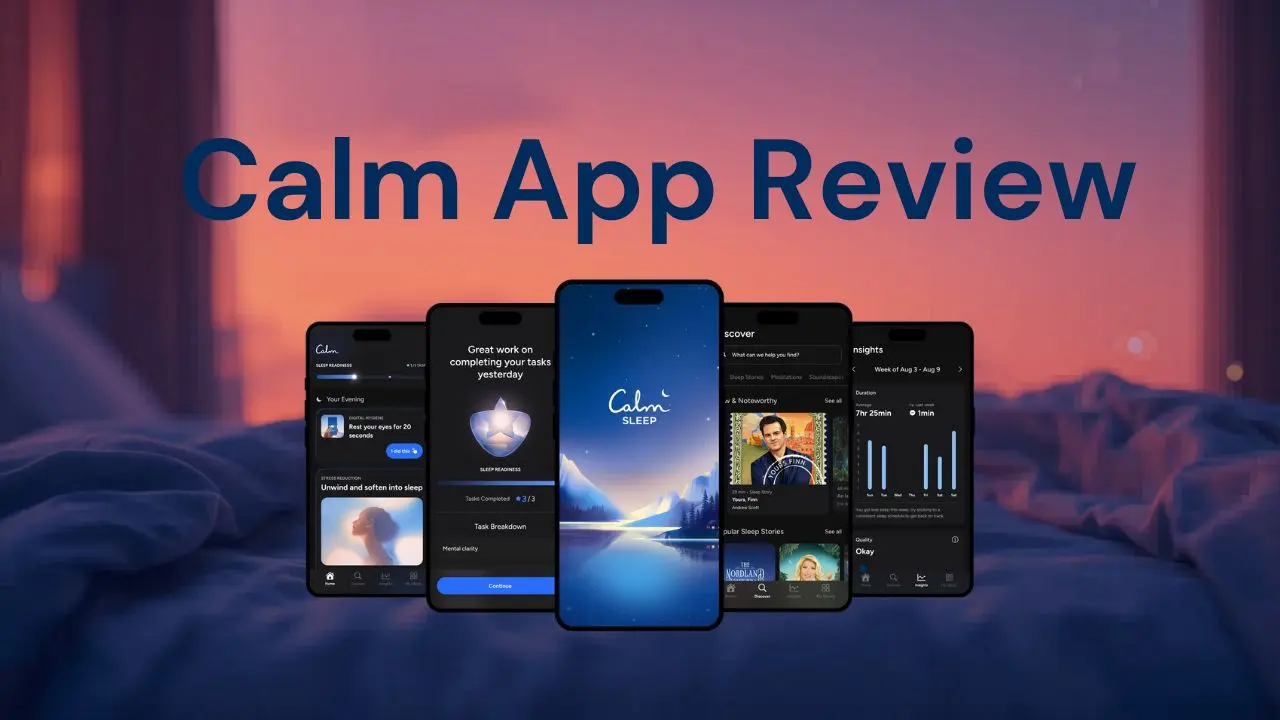
In September 2025, Calm launched Calm Sleep, a standalone iOS app built entirely around the sleep experience. The app starts with a short onboarding questionnaire and creates a personalized sleep plan including recommended content and daily tasks focused on digital hygiene, exercise, stress reduction, and sleep environment.
A “sleep readiness” bar tracks your daily habits and increases as you complete tasks. At launch, the library included over 300 hours of sleep content and 500 Sleep Stories. New sleep content is available exclusively on Calm Sleep for four weeks before being released on the main Calm app, a meaningful incentive for sleep-focused users to engage with the dedicated platform.
Calm Pricing
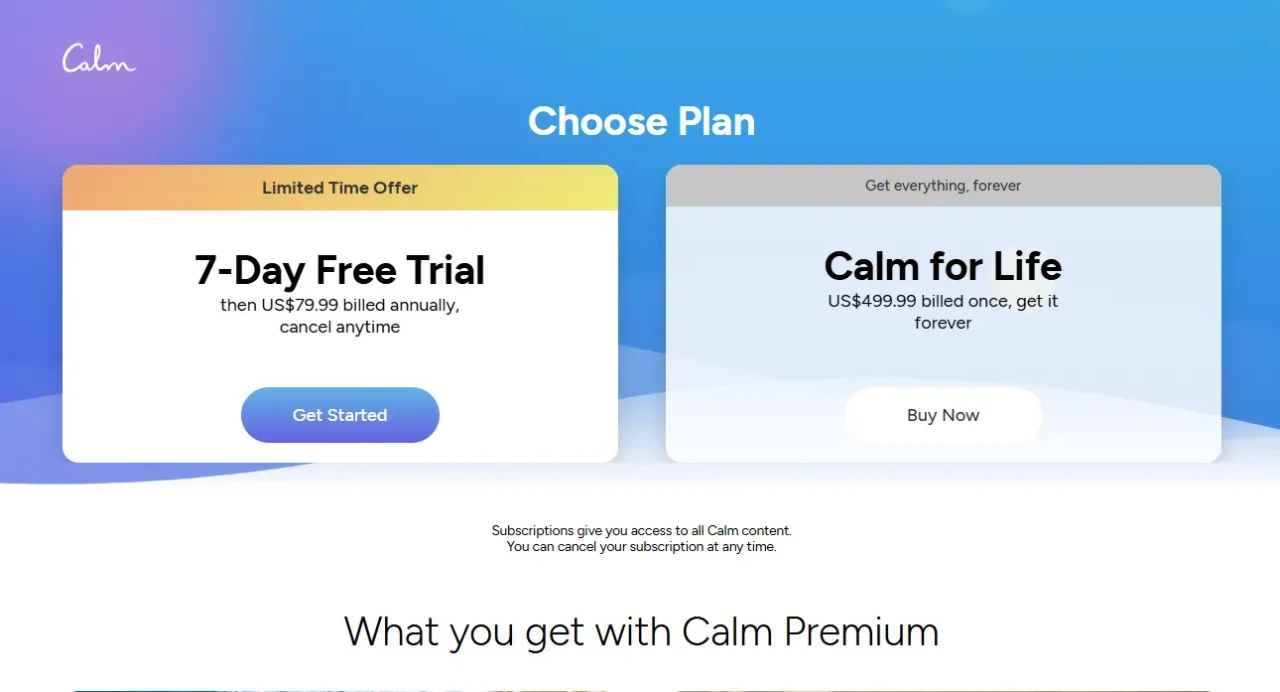
Calm’s pricing structure is straightforward once you understand the two billing paths:
Plan | Cost | What’s Included |
Free | $0 | Limited meditations, introductory breathing, some soundscapes, and mood check-ins |
Premium Monthly | ~$14.99/month | Full library: all Sleep Stories, Daily Calm, all programs, Masterclasses, Calm Kids, music |
Premium Annual | $79.99/year (~$6.83/month) | Everything in monthly (53% less than monthly billing) |
Family Plan | $99.99/year | Up to 6 people, separate accounts, all Premium content, including Calm Kids |
Lifetime | $499.99 (one-time) | All Premium content is permanently available (however, it’s not available for the family plan) |
7-Day Free Trial | Free | Full Premium access, no charge until trial ends |
The honest pricing assessment starts with this: the free tier is not generous enough to help you determine whether Calm will work for you. Unlike Insight Timer’s genuinely comprehensive free library, Calm’s free tier is designed to demonstrate value.
It includes introductory meditations, some breathing exercises, mood check-ins, and a handful of soundscapes, but it locks most of the compelling content behind the subscription. Furthermore, none of the free content is geared toward kids, so parents evaluating the family plan can’t assess the children’s section without subscribing.
The 7-day Premium free trial is the right evaluation period. That’s enough time to listen to several Sleep Stories, complete a Daily Calm session, run a breathing exercise during a stressful moment, and decide whether the library serves your specific needs. At $79.99/year, roughly the cost of a single therapy session, the annual plan is a reasonable investment for anyone who uses it consistently.
For users who receive Calm through employer benefits or health insurance, always verify that coverage first before paying out of pocket. Calm for Organizations is widely distributed, and many users are eligible for free access that they don’t know about.
Calm vs Headspace vs Insight Timer
These three apps dominate the consumer meditation space, and the right choice depends almost entirely on what you’re trying to accomplish.
Feature | Calm | Headspace | Insight Timer |
Free Tier Quality | ⚠️ Limited (trial vehicle) | ⚠️ Limited | ✅ Genuinely comprehensive |
Structured Curriculum | ⚠️ Secondary | ✅ Primary | ❌ User-directed |
Sleep Stories | ✅ 500+ titles, celebrity narrators | ⚠️ Sleepcasts (45-min audio) | ❌ Minimal |
Celebrity Narrators | ✅ 50+, including McConaughey, Styles | ❌ No | ❌ No |
Daily Guided Session | ✅ Daily Calm + Daily Trip | ✅ Daily Headspace | ✅ Community sessions |
Community Features | ❌ Solo experience | ❌ Solo experience | ✅ Strong community |
Kids Content | ✅ Dedicated section | ✅ Basic | ⚠️ Limited |
Annual Price | $69.99/year | $69.99/year | Free / $60/year Pro |
Lifetime Option | ✅ $399.99 | ❌ None | ✅ Available |
Best For | Sleep, stress relief, beginners | Structured mindfulness education | Free content volume, community |
Calm vs Headspace
Calm vs Headspace comes down to philosophy. Headspace is curriculum-first; it takes you through a defined learning path with explicit mindfulness education, animated explainers, and clear skill progression. Using Headspace feels like taking a course. While using Calm feels like accessing a library.
Headspace is the stronger choice if you want to genuinely understand and develop a meditation practice with measurable progression. However, Calm is the stronger choice if your primary goal is to improve sleep, reduce daily stress, and access content without committing to a structured program. Notably, both apps charge $69.99/year, so pricing doesn’t differentiate them.
The full breakdown of Headspace’s features, structure, and verdict is available in our Headspace app review.
Calm vs Insight Timer
Calm vs Insight Timer is a different kind of comparison. Insight Timer offers a free library of over 100,000 guided meditations contributed by teachers globally, a genuinely comprehensive free tier that beats Calm’s paid library on sheer volume. However, because the content is user-contributed rather than curated and produced by a professional team, quality varies enormously.
Calm’s library is smaller but consistently higher in production quality, audio engineering, and editorial standards. Insight Timer also has a strong community layer: teacher following, group meditations, and live events that Calm lacks entirely.
For cost-conscious users willing to browse for quality content, Insight Timer’s free tier is a compelling option. However, for users who want curated, high-production-value content with a specific focus on sleep, Calm wins.
The Honest Verdict By Use Case
Calm for sleep and daily stress relief; Headspace for structured mindfulness education; Insight Timer for maximum free content and community. Additionally, if you’re interested in sound-based wellness tools that take a different approach to stress and anxiety relief, our Soaak app review covers a platform built around frequency-based audio therapy rather than guided meditation.
For a broader look at wellness and health apps worth knowing, our apps and tools section covers the full landscape.
Calm’s Honest Strengths
Sleep Stories Are Genuinely Effective and Have No Real Equivalent
The combination of 500+ titles, celebrity narrators, deliberate pacing, and weekly additions creates a sleep-aid library that competing apps haven’t replicated with the same production quality. The fact that Sleep Stories have been played over one billion times since 2016 is not marketing noise; it reflects a feature that consistently works for many people and has become a daily habit.
The Daily Calm Builds Real Habits
A new session every day eliminates the friction of choosing, which is the moment most wellness app habits break down. When you don’t have to decide what to do, just open the app and listen to today’s session; consistency becomes significantly easier.
Users who make the Daily Calm part of their morning routine frequently report the highest long-term satisfaction with the subscription.
Production Quality Is the Best in the Category
Calm’s audio engineering, voice talent selection, and content curation set a standard that competing apps haven’t matched. Every session sounds professionally produced rather than recorded in a spare bedroom. That quality difference is subtle in any single session and unmistakable across weeks of daily use.
The App Is Non-Intimidating for Complete Beginners
No required progression, no performance metrics, no jargon. You can open Calm and listen to something useful in under 60 seconds without reading instructions or understanding meditation theory. For people who feel vaguely embarrassed or skeptical about meditation, this accessibility removes a genuine barrier.
Calm’s Honest Limitations

The Free Tier Is Effectively a Demo
If you’re evaluating Calm on a tight budget, the free version won’t give you a meaningful picture of the app’s value. You need the Premium trial to assess the library honestly. That said, the 7-day free trial with no charge until it ends is genuinely risk-free.
Therefore, use it seriously before deciding.
No Structured Learning Path for Serious Meditators
Calm doesn’t teach meditation systematically. Users who want to understand the neuroscience of mindfulness, progress through defined skill levels, or develop a serious long-term practice will outgrow Calm’s content structure.
The programs exist, but they’re supplementary. That’s because Calm is not designed to be a meditation teacher.
No Community Features
Calm is entirely a solo experience. There are no teacher profiles to follow, no group sessions, no accountability partners, no community forums. Users who benefit from social accountability, shared practice, or a sense of belonging in a wellness community won’t find any of that here.
Content Quality Outside the Flagship Features Is Uneven
The Sleep Stories and Daily Calm are excellent. Some of the secondary Masterclasses and supplementary programs are less consistently compelling, occasionally feeling padded or surface-level. As the library has expanded, the signal-to-noise ratio in less prominent content categories has widened.
The App Interface Has Become More Complex
Earlier versions of Calm were famously simple. As content categories have expanded, navigation has grown more layered. Finding specific content types now requires more browsing, and first-time users can feel overwhelmed by the volume of options rather than being guided toward what’s most useful for them.
Who Is Calm Best For?
People with Sleep Problems
If falling asleep or staying asleep is your primary challenge, Calm is the strongest app in the category for this specific use case. The Sleep Stories, sleep meditations, body scan sessions, and soundscape library combine to create the most comprehensive sleep aid toolkit available in a single app. Additionally, the new Calm Sleep app offers a more focused experience for users whose primary wellness priority is sleep quality.
Stressed Professionals Who Need Accessible Tools

The combination of breathing exercises, short daily meditations, and focus music is ideal for someone who needs to decompress quickly, reset between meetings, or wind down after a high-pressure day, without requiring a significant time investment or prior meditation experience.
Complete Beginners to Meditation
The non-prescriptive, browse-and-choose approach removes the performance pressure that structured apps can accidentally create. Beginners who tried Headspace and felt overwhelmed by the curriculum frequently find Calm more accessible and less demanding as an entry point.
Parents
The family plan at $99.99/year covers up to six people, and the Calm Kids content genuinely serves children of all ages. Parents who want to introduce mindfulness and better sleep habits to their children can find dedicated, age-appropriate content featuring beloved characters that makes habit formation feel natural rather than forced.
Who Should Look Elsewhere?
- Serious meditators who want structured progression and depth should consider Headspace or Waking Up.
- Cost-conscious users who primarily want meditation volume should explore Insight Timer’s free library first.
- Users who want a community of practitioners will find Insight Timer’s social layer far more developed than Calm’s solo experience.
FAQs
At $69.99/year ($5.83/month), Calm is worth it for anyone who uses it consistently, particularly for sleep improvement and daily stress relief. Users who regularly engage with the Daily Calm and Sleep Stories find that the subscription pays for itself quickly. Users who subscribe and don’t build a regular habit are paying for content they’re not using. The 7-day trial is the honest way to determine which category you fall into before committing.
Calm is a content library focused on sleep, stress relief, and flexible access to wellness audio. Headspace is a structured curriculum that teaches mindfulness meditation through a defined learning progression. Calm lets you browse and choose what resonates with you. Headspace guides you through a sequential program. Both cost $69.99/year. The choice is between a library and a course.
Yes. The Calm Family Plan at $99.99/year covers up to six people, each with their own account, listening history, and profile. This makes the per-person cost approximately $17/year for a family of six, significantly better value than individual subscriptions. Family members do not have to live in the same household to be included.
Sleep Stories are audio bedtime stories, typically 20 to 40 minutes long, designed to distract your mind from the cycle of rumination that keeps most people awake. They feature deliberate pacing, original music, and sound effects layered under narration by celebrity voices, including Matthew McConaughey, Harry Styles, Idris Elba, Jennifer Garner, Cillian Murphy, and 50+ others. The library contains over 500 stories with new additions weekly. Stories can be downloaded for offline listening.
Conclusion
Calm is genuinely one of the strongest wellness apps available, not because it does everything, but because, when it does what it does best, it does it better than anyone else. The Sleep Stories are a category-defining feature that no competitor has matched in production quality or in the depth of its celebrity narrators. The Daily Calm creates the kind of low-friction daily habit that actually sticks. The soundscape and focus music libraries are useful on their own. For users whose primary goals are better sleep and manageable daily stress, the $69.99/year subscription is an easy recommendation, particularly for anyone who confirms through the 7-day trial that they’ll actually use it.
The limitations are real and worth knowing: the free tier won’t show you whether Calm is right for you, the app isn’t designed for serious meditators who want structured depth, and the solo experience means there’s no community accountability if that’s what you need to stay consistent. Use the free trial seriously; focus on Sleep Stories and Daily Calm as your primary evaluation criteria, and decide whether those two features alone justify the cost. Most users whose primary concern is sleep or stress will.
The apps and tools that genuinely improve your life are out there; finding them just takes an honest guide. Explore reviews, comparisons, and practical breakdowns of everything worth trying at YourTechCompass.com, where every recommendation is built around what actually works.