If you’re applying to college in the United States, you will almost certainly encounter the Common App, and understanding how it works before you start filling it out makes the entire process significantly less stressful. The Common Application is a free, nonprofit online platform that lets you complete one application and submit it to over 1,100 member colleges and universities simultaneously, rather than filling out a separate application for each school on your list. Founded in 1975 by just 15 colleges, it has grown into the most widely used undergraduate admissions application in the country. In the 2024–2025 cycle alone, approximately 1.5 million first-year applicants submitted over 10 million applications through the platform, which shows that for most students, the Common App isn’t an option (it’s the process).
This guide covers everything you need to use the Common App effectively, including how it’s structured, what each section requires, how the essay and activities sections actually work in practice, what the different deadline types mean, and the specific strategies that separate strong applications from forgettable ones. Whether you’re a high school senior opening the platform for the first time, a parent trying to understand what your child is working on, or a transfer student evaluating your options, this is the complete picture you need before you type a single word.
A note before we begin: every YTC score is earned, never negotiated. If you want to understand exactly how we evaluate apps & tools and how we handle affiliate relationships, our Review Methodology lays it all out.
What Is the Common App?
The Common App is a centralized platform that standardizes the application process across member institutions. You create one account, fill out one set of core information (personal details, academic history, activities, essay), and then submit that same core application to multiple colleges.
Each school you add to your list may require additional supplemental essays or questions on top of the shared components, but the core information travels with you across every submission. That structure eliminates the need to re-enter your name, GPA, and activities list for each school individually, saving meaningful time across a typical application list of 8–12 schools.
Over 1,100 colleges and universities currently accept the Common App, including the majority of selective private universities, hundreds of public universities, and schools in more than 20 countries. Some notable institutions use their own independent applications: MIT, Georgetown, and the University of California system (which uses the UC Application for all nine undergraduate campuses) are among the most prominent non-members.
The Common App platform opens on August 1 for each new application cycle. And the current 2025–2026 cycle follows the same schedule; the platform received a fresh visual redesign, and navigation is now called “My Common Application,” with progress bars appearing throughout to help you track completion across sections.
The Common App itself is free to use. Individual colleges charge their own application fees, typically ranging from $0 to $90 per school, which you pay through the Common App platform when you submit to each school. Importantly, over 400 Common App member institutions charge no application fee. Fee waivers are available for qualifying students and are covered later in this guide.
How the Common App Is Structured
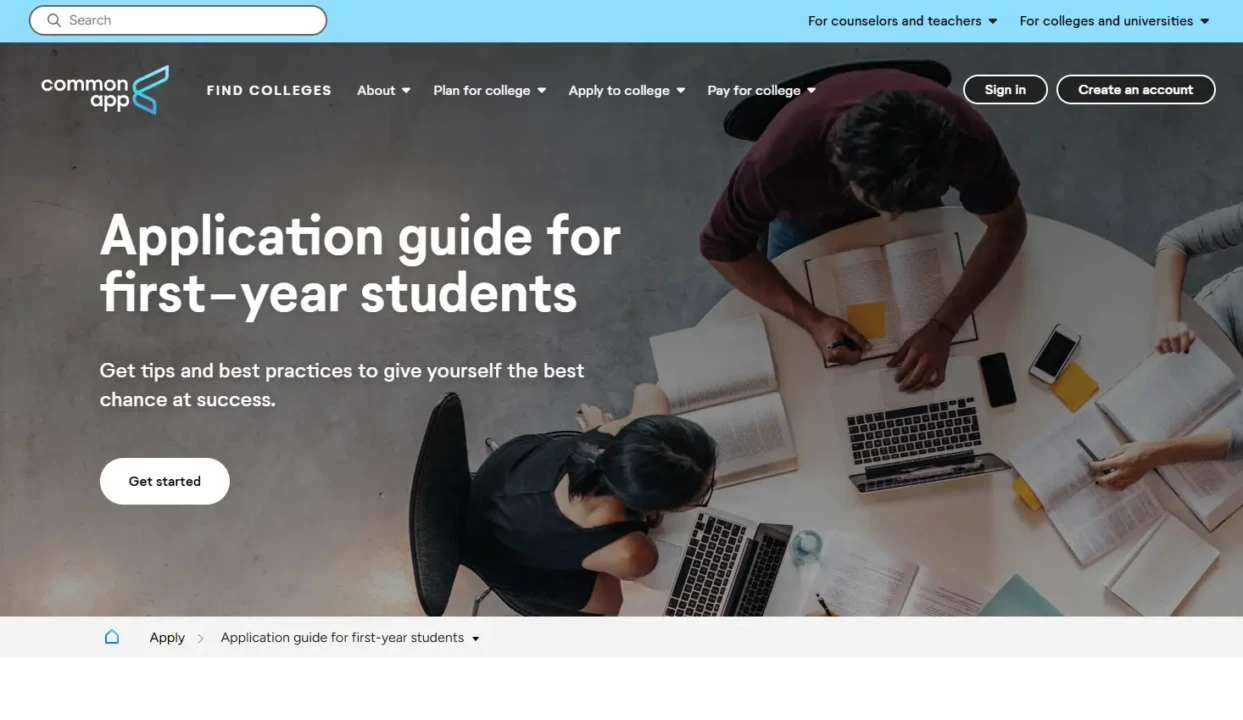
The Common App is organized into seven core sections that every applicant completes, plus the supplemental questions specific to each college you add. Understanding what each section asks for (and why) helps you approach each one with the right intention rather than treating it as a form to fill out mechanically.
- The profile covers your basic personal information, including your legal name, address, contact information, citizenship status, languages spoken at home, and demographic background. This section is straightforward and primarily administrative.
- Family asks for information about your parents or guardians, their education levels, employment, and whether they attended college. This context helps admissions offices understand your background and may be relevant for first-generation student consideration.
- Education is where you enter your high school or schools attended, your GPA if your school reports it numerically, class rank if applicable, your graduation date, and the courses you’re currently taking. Accurate, honest reporting is essential here; your official transcript, submitted by your school counselor, will be compared against what you enter.
- Testing covers SAT, ACT, AP, IB, and other standardized test scores. You enter the scores you want to report here. Given that close to 80% of US institutions still maintain some version of a test-optional policy, you can also indicate that you’re applying test-optional and leave this section blank. The decision of whether to submit scores should be based on whether your scores fall within or above the middle 50% range for each school. Check each college’s published data before deciding.
- Writing contains your Common App essay (personal statement) and the Additional Information section, both covered in detail below.
The Common App Essay: What You Need to Know
The personal statement is the most impactful written component of the Common App, and the section where most students either distinguish themselves or blend in. Every college you apply to through the Common App receives the same essay, which means it needs to work across your entire list without being tailored to any specific school.
The Seven Prompts
You choose one of seven essay prompts to respond to. The 2025–2026 prompts are confirmed unchanged from previous cycles, and the Common App officially confirmed they will carry forward into 2026–2027 as well, so the prompts you’re working with right now are stable.
The seven prompts cover: a meaningful background, identity, interest, or talent; lessons learned from obstacles; a time you questioned a belief or idea; gratitude toward someone whose influence shaped you; personal growth through a challenge or setback; intellectual curiosity and passion for learning; and an open-ended topic of your choice. In addition, the prompts are deliberately broad precisely because the goal isn’t to answer a specific question; it’s to give you a framework for telling whatever story most authentically represents who you are.
The practical advice that college admissions professionals consistently give is this: don’t start with the prompt and work backward. Therefore, start with the story you most want to tell and then find the prompt that frames it. Admissions officers typically don’t note which prompt a student chose; they’re reading for authenticity, self-awareness, and voice, not for which box you selected.
Word Count and Length
Your essay must be between 250 and 650 words. The platform enforces both limits; it will not accept an essay under 250 or over 650 words.
Most strong essays use the majority of the available space. Therefore, aim for 500 to 650 words, because that length gives you enough room to develop a narrative, add specific detail, and reflect meaningfully on what the experience reveals about your character. Shorter essays can work, but they frequently feel rushed or incomplete because the most common essay weakness is insufficient depth rather than excessive length.
What Admissions Officers Are Actually Reading For
Admissions officers read your essay to understand who you are as a person in a way that your grades, test scores, and activities list cannot show. Your transcript tells them what you’ve accomplished. Your essay tells them how you think, what you value, and what kind of person you will be on their campus.
The most common essay mistake isn’t a bad topic; it’s narrating an experience without reflecting on its meaning. A former admissions officer frames it plainly: the best essays take one specific event and spend five focused paragraphs revealing what it shows about the student’s character, values, and perspective, rather than summarizing everything that has ever happened to them.
Strong essay topics are not necessarily dramatic. The persistent myth is that you need a life-changing event (a serious illness, an immigration story, a sports injury) to write a compelling essay. What admissions officers consistently report is that essays about specific, seemingly small topics (a recurring observation, a niche passion, a family ritual) often produce more distinctive and memorable writing than essays about dramatic events that hundreds of other applicants write about at a surface level. Specificity is what makes an essay stand out, not the weight of the topic.
The voice test is one of the most reliable quality checks available to you: read your essay out loud. However, if it doesn’t sound like how you actually speak and think, it needs revision. An essay written to sound impressive usually sacrifices the authenticity that makes it effective.
For students who want to polish their writing to the highest possible standard before submitting, our Grammarly vs ProWritingAid comparison covers the two strongest AI writing tools for catching grammar, clarity, and style issues in essay drafts.
The Activities Section: Making 150 Characters Count
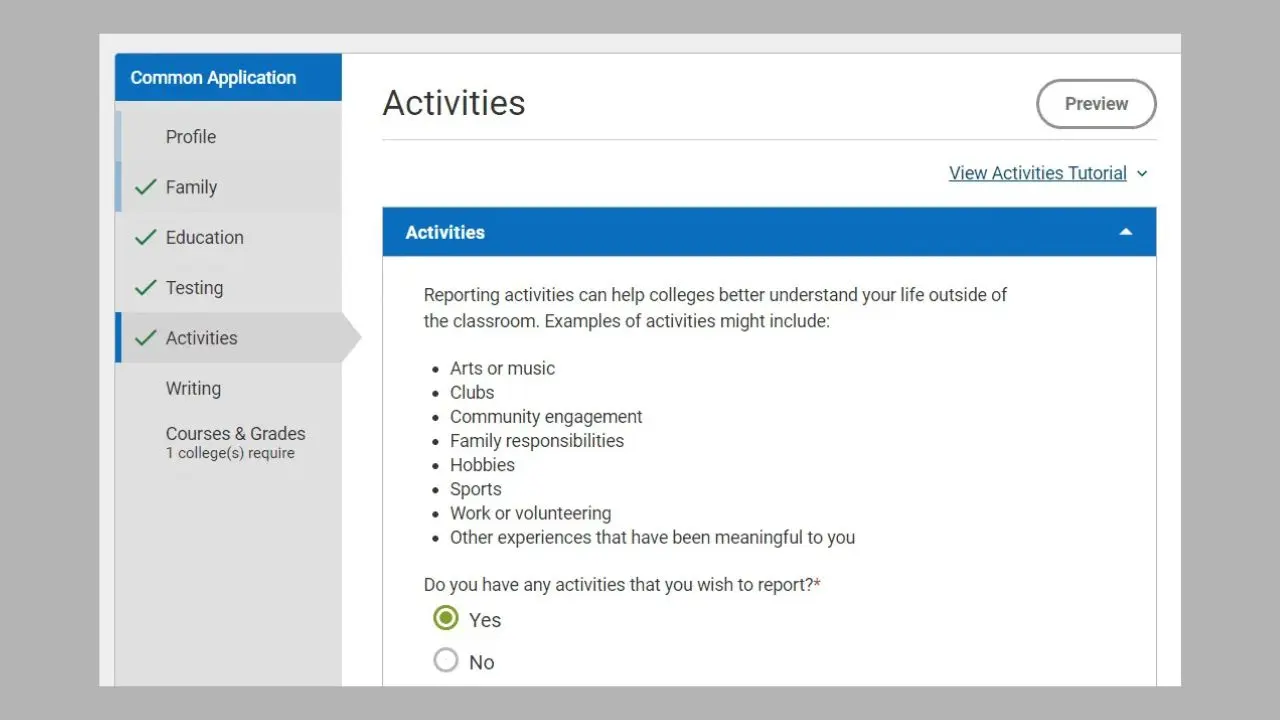
The Activities section is consistently the most underutilized part of the Common App, and one of the sections where strong applicants stand out from those who treat it as a formality.
You can list up to 10 activities in ranked order; rank them by their significance to who you are and to your application narrative, not by chronology. Each activity receives a category, an organization name, your position or leadership role, and a 150-character description field, approximately the length of one tweet. That constraint is where most students lose ground. With 150 characters, every word must justify its presence.
The most common mistake in the Activities section is a vague description. “Participated in school events and worked with team members on various projects” tells an admissions officer almost nothing specific. “Led weekly meetings for 23-member club; coordinated 3 community outreach events reaching 400+ attendees” is specific, quantified, and memorable.
The difference is whether you described what you technically did or what you actually accomplished, and quantifying wherever possible is the fastest way to make that shift. Additionally, numbers make activities concrete: “tutored students” is weak; “tutored 12 students in Algebra II, average grade improvement of one letter grade” is credible and specific.
Additionally, selective admissions increasingly reward depth over breadth. A student with three activities pursued with genuine commitment and measurable impact often reads as more compelling than a student with ten activities pursued superficially to fill the list. Therefore, the quality of engagement matters more than the quantity of involvement, and your activities ranking should reflect which involvements genuinely shaped you, not which ones look most impressive on paper.
Common App Deadlines: Understanding Your Options
The type of deadline you apply under affects both your timeline and, in some cases, your chances of admission. Understanding each type clearly before you build your college list is essential.
Early Decision (ED)
ED is a binding commitment. If you apply ED and are admitted, you must attend that school and withdraw all other applications. ED deadlines are typically November 1 or November 15. Applying ED can increase your chances of admission at many schools because it signals genuine first-choice interest and allows the college to plan enrollment. The important caveat: apply ED only to your true first-choice school, and only after you’ve done thorough financial aid research. You won’t be able to compare aid packages from other schools before committing.
Early Decision II (ED II)

ED II carries the same binding commitment as regular ED but with a later deadline, typically January 1 or January 15. It’s a useful option if you identify a first-choice school after the regular ED deadline has passed or if you were deferred or denied from your ED school.
Early Action (EA)
EA is non-binding. You apply early (typically by November 1 or November 15), receive a decision in December, but are not required to commit until the universal May 1 deadline. EA lets you compare financial aid packages from multiple schools before deciding, which is a significant practical advantage over ED.
Restrictive Early Action (REA)
REA (also called Single Choice Early Action) is used by Harvard, Yale, Princeton, Stanford, and a small number of other highly selective institutions. REA is non-binding but restricts you from applying to EA or ED to any other private institution simultaneously. You can still apply to public universities using EA. If you’re applying REA to one of these schools, check the specific rules carefully; they vary slightly between institutions.
Regular Decision (RD)
RD is the most common option. Non-binding; deadlines typically fall January 1–15; decisions are typically released March through April; and you have until May 1 to commit. RD gives you the most time to strengthen your application and compare offers.
Rolling Admissions
Used by many large public universities, Rolling Admissions means applications are reviewed as they arrive rather than being held for a single decision release. Applying earlier in a rolling cycle is generally advantageous as seats fill as students are admitted.
Common App Fee Waivers

The Common App fee waiver automatically waives the application fees charged by member colleges for students who meet qualifying criteria, and applying with a fee waiver is completely equivalent to applying with a paid application fee from the college’s admissions perspective. There is no disadvantage to using a fee waiver.
You qualify if you are enrolled in or eligible for the free or reduced lunch program, your family receives public assistance, your annual family income falls within federal Income Eligibility Guidelines, you are experiencing homelessness, you are in foster care or are a ward of the court, or you qualify for an ACT or SAT fee waiver. To request the waiver, complete the qualifying questions in the Profile section of the Common App. If you qualify, the waiver is automatically applied to your submissions across member colleges.
Common App vs Other Platforms
Platform | Member Colleges | Binding Option | Who It’s For | Key Difference |
Common App | 1,100+ | Yes (ED) | Most US applicants | Largest member network |
Coalition Application | ~150 | Yes (ED) | First-gen focus | Digital portfolio feature |
QuestBridge | ~50 partners | Yes (Match) | High-achieving, low-income | Full-ride scholarship access |
UC Application | 9 UC campuses | No | California applicants | Required for all UC schools |
School-Specific | MIT, Georgetown, etc. | Varies | Specific institutions | Required; no Common App |
Common App vs Coalition Application
The Coalition App is used by approximately 150 schools, many of which also accept the Common App. It offers a digital portfolio and was designed for first-generation college students. Therefore, if a college accepts both, there is no admissions advantage to choosing one over the other. Use whichever platform you find more comfortable.
Common App vs QuestBridge
QuestBridge is a scholarship and admissions program specifically for high-achieving, low-income students. If you qualify, applying through QuestBridge before considering the Common App for the same partner schools gives you access to full-ride scholarship matches that the Common App cannot provide. QuestBridge is not an either/or; it’s a first consideration for students seeking to qualify.
Common App vs UC Application
The University of California system uses its own application for all nine undergraduate campuses. UC schools do not accept the Common App. If UC schools are on your list, you’re completing two separate application processes.
Common App Tips That Actually Make a Difference
Start Your Essay Before August 1
The Common App opens August 1, but the essay prompts are available and confirmed in advance. Students who begin drafting their personal statement in June or July enter the application cycle with a strong draft, rather than starting from a blank page while simultaneously managing school, activities, and supplemental essays for each school. Therefore, starting early is the single most impactful scheduling decision you can make.
Research Supplemental Requirements Before Finalizing Your College List
Some schools require multiple supplemental essays totaling over 1,000 words. If you add 12 schools to your Common App list and most of them have significant supplements, the total writing workload is considerably larger than the personal statement alone. In addition, check the “My Colleges” tab for each school’s specific supplemental requirements before finalizing your list, not after.
Good note-taking tools help manage the research and drafting workflow. And our best tablets for note-taking apps guide covers the hardware side of keeping your application work organized.
Ask Recommenders Early and Give Them Context
Invite your recommenders through the Common App platform at least six weeks before your earliest deadline, not one week before. Give them a brief written summary of your goals, the schools you’re applying to, and what you’d most like them to highlight.
Recommenders who understand what you’re hoping to convey write more targeted, specific letters than recommenders who receive a generic request with no context.
Don’t Repeat Yourself Across Sections

If your personal statement focuses on your research project, don’t also spend your Activities description and Additional Information space on the same project. Use each section to reveal something different.
The application works as a complete picture, and redundancy wastes space that could be used to introduce another dimension of who you are.
Submit To Safety Schools First
Submit to schools where you feel most confident first. This confirms the system is working, your counselor’s documents are being received, your fee waiver is processing correctly, and you know exactly what to expect before you submit to your most important schools.
Common App servers genuinely slow down on peak deadline dates. Therefore, submitting at least 48 hours before any deadline eliminates that risk entirely.
For educators and school counselors helping students through this process, our best tech tools for teachers guide covers the platforms and apps that effectively support the counseling and college prep workflow.
Common App Mistakes to Avoid
Submitting Without Thorough Proofreading
Once you submit to a specific school, you cannot edit that submission. A typo in your activities description or an essay that cuts off mid-sentence because you accidentally exceeded the word limit is permanent. Therefore, have two people proofread every section before you submit to any school, not just your essay, but also your activity descriptions, additional information, and profile details.
Writing Generic Supplemental Essays
The “Why This School?” supplemental question is nearly universal among selective institutions, and nearly universal in its poor answers from most applicants. Vague praise (“I love your diverse community and strong academics”) tells the admissions officer nothing that couldn’t be said about any school.
Specific references, for instance, a professor’s research you’d want to work with, a specific course you’ve investigated, a program or initiative unique to that campus, demonstrate genuine interest in a way that generic praise never can. Writing strong supplements requires actual research into each school, not just a list of positive adjectives.
Treating Test-Optional As Test-Blind

Test-optional means you can choose not to submit standardized test scores, but it doesn’t mean scores are irrelevant if you do submit them. If your scores fall within or above a school’s published middle 50% range, submitting them helps you. Therefore, research each school’s specific policy and published score ranges before deciding whether to include scores on a school-by-school basis.
Missing the Additional Information Opportunity
The Additional Information section (now called “Challenges & Circumstances” in the 2025–2026 cycle, with a reduced 300-word limit) is an optional field that most applicants leave blank. This is a missed opportunity for students who have context worth sharing, a significant grade drop with an explanation, a school change, a family circumstance that affected their high school experience, or an additional achievement that the rest of the application didn’t capture. Consequently, if you have something genuinely relevant to add, this section exists precisely for that purpose.
For a broader look at the apps and digital tools that support the entire college application process, our apps and tools section covers the full range of student productivity and academic tools worth knowing.
FAQs
The Common App platform itself is completely free to use. Individual colleges charge their own application fees (typically between $0 and $90 per school), paid through the Common App at submission. Over 400 member institutions charge no application fee. Fee waivers are available for qualifying students and are automatically applied through the Profile section of the application.
No. Once you submit to a specific school, that submission is locked and cannot be edited. You can continue editing and improving your application before submitting it to other schools on your list, since each school is submitted independently. This is why submitting to safety schools first and proofreading carefully before any submission is strongly recommended.
For most applicants, the Common App is the right choice simply because it has a significantly larger network of over 1,100 schools than the Coalition’s approximately 150. If a school accepts both platforms, neither has an admissions advantage. Choose the interface you find more comfortable to work in.
The Common App opens on August 1 for each new application cycle. The platform is available nearly year-round, closing for approximately one week before the new cycle launches. Essay prompts are available and confirmed before August 1, which means you can begin drafting your personal statement in June or July, before the platform technically opens.
Conclusion
The Common App is the infrastructure of US college admissions for most applicants. Understanding its structure removes the anxiety of the unknown and lets you focus your energy on the parts that actually differentiate applications: the quality of your personal statement, the specificity of your activity descriptions, the research behind your supplemental essays, and the timing of your submissions relative to deadlines. The platform is straightforward once you understand what each section asks for and why it exists. The strategy is where the real work happens.
Start your essay before August 1. Quantify your activities. Research supplements before finalizing your college list. Ask recommenders early and give them context. Submit before the deadline day, not on it. None of those steps are difficult, but all of them require starting earlier than most students do. The applicants who consistently submit their strongest work are the ones who treat the application process as a project that begins in the summer, not as a form to be filled out in November.
Found this helpful? Browse more in-depth tech guides, honest reviews, and step-by-step tutorials at YourTechCompass; your go-to resource for making smarter tech decisions.