The dating app market has never been more crowded or more confusing. There are apps built around volume, apps built around compatibility, apps built around specific communities, and apps built around the philosophy that you should find a relationship and delete them as quickly as possible. The problem isn’t finding a dating app. The problem is finding the right one for your specific relationship goal, age group, location, and tolerance for pay-to-win subscription models that dominate the category. Choosing the wrong app means spending weeks in the wrong pool before realizing the active users there don’t match what you’re looking for.
This guide covers the best dating apps for every relationship type, from the world’s largest platform for casual and serious dating to apps designed for intentional relationships, LGBTQ+ communities, and mature daters over 50. Every app is reviewed honestly, including free-tier limitations, what each subscription actually adds, and who each platform genuinely serves best. The global dating app market generated $6.18 billion in revenue in 2024, with approximately 350 million active users across platforms, so the category is clearly working for many people. This guide helps you figure out whether it can work for you and exactly where to start.
Dating App Comparison Table
App | Best For | Free Tier | Monthly Price | Who Messages First | LGBTQ+ Inclusive | Countries |
Tinder | Maximum user pool | ⚠️ Limited | ~$30 (Gold) | Anyone | ✅ Yes | 190+ |
Hinge | Serious relationships | ✅ Generous | ~$30 (Hinge+) | Anyone | ✅ Yes | 20+ |
Bumble | Women (balanced gender) | ✅ Solid | ~$25 (Boost) | Women first (het.) | ✅ Yes | 150+ |
OkCupid | Compatibility matching | ✅ Best free tier | ~$20 (Premium) | Anyone | ✅ Extensive | Global |
Match.com | Serious (35+) | ❌ Browse only | ~$35–$45 | Anyone | ✅ Yes | US/global |
eharmony | Marriage-minded | ❌ Very limited | ~$35–$65 | Anyone | ✅ Yes | US/global |
Grindr | Gay/bi men | ✅ Ad-supported | ~$30 (Unlimited) | Anyone | ✅ Built for LGBTQ+ | 190+ |
HER | Queer women | ✅ Community access | ~$15 (Premium) | Anyone | ✅ Built for LGBTQ+ | Global |
SilverSingles | Mature dating (50+) | ⚠️ View only | ~$28–$37 | Anyone | ✅ Yes | US/UK/CA/AU |
What to Look for in a Dating App
Before you download anything, spending two minutes answering a few questions about what you actually want saves you from the most common dating app mistake: choosing the most popular option instead of the right one.
Relationship Intent Alignment (the Most Important Factor)
Every major dating app has a dominant user culture that doesn’t always match its marketing. Tinder is used for both casual and serious dating despite its reputation, but the casual culture is genuinely dominant.
Hinge’s culture is intentional and relationship-focused; 87% of its users report looking for serious relationships. Therefore, understanding the culture before you create a profile matters more than the app’s feature list.
User Base Density in Your Area
A dating app with 50 million global users means very little if only a few hundred people in your city actively use it.
Urban users have far more choice across all platforms. However, rural and small-city users should prioritize apps with the largest active user bases in their region over niche alternatives with small local user bases. No subscription upgrade fixes a market with few active users.
Free Tier Quality
Hinge and Bumble are genuinely functional on their free tiers. You can match and message without paying.
On the other hand, Tinder’s free tier is deliberately frustrating to push you toward Gold. Additionally, Match.com and eHarmony are effectively paywalled from the start. Knowing this before you download prevents the disappointment of creating a profile only to hit a hard paywall immediately.
The Best Dating Apps Right Now
A note before we begin: every YTC score is earned, never negotiated. If you want to understand exactly how we evaluate apps & tools and how we handle affiliate relationships, our Review Methodology lays it all out.
1. HER

HER is the largest dating and social platform built specifically for lesbian, bisexual, queer, and non-binary women, and what sets it apart from generic dating apps is that it functions as both a dating platform and a social community. Beyond matching, HER includes event listings, community feeds, and group features that connect users to the broader LGBTQ+ women’s community in their area and worldwide. That social layer matters for users who want more than just a swipe interface.
The free tier includes basic matching and access to community features. HER Premium at approximately $15/month adds advanced filters, the ability to see who liked you, and unlimited likes. The honest limitation is that HER’s active user pool is smaller than Grindr’s and significantly smaller than the major straight-oriented apps.
In smaller cities, the local dating pool on HER can be very thin. For users in major cities with active LGBTQ+ communities, however, HER provides a depth of community context that no other dating app delivers.
Why It Stands Out
- The largest dating and community app for LGBTQ+ women.
- Community features (events, feeds, groups) extend value beyond pure dating.
- The most affordable premium tier on this list is approximately $15/month.
- Social network elements provide connection value independent of matching outcomes.
- Safe space specifically designed for and by queer women.
2. Hinge
Hinge is the fastest-growing major dating app and the strongest choice for intentional, relationship-focused dating in major cities. Its Q4 2025 revenue hit $186 million (up 26% year-over-year), while Tinder’s revenue declined, and Bumble’s paid users dropped 16%. That growth story reflects a genuine product advantage: Hinge’s profile format requires written prompt responses alongside photos, which gives every conversation a natural starting point that photo-first swipe apps simply don’t provide.
You don’t just match with someone on Hinge. You like a specific photo or a specific prompt answer, which means your first interaction already has context and direction. Additionally, Hinge’s algorithm is based on the Nobel Prize-winning Gale-Shapley stable matching algorithm, which optimizes for mutual compatibility rather than sheer volume.
The free tier is Hinge’s other major advantage over competitors. Free users get 8 likes per day and can see who liked them one at a time without paying. That’s a feature that Tinder and Bumble charge a premium price for.
Why It Stands Out
- Prompt-based profiles create instant conversation starters (no more “hey” openers).
- Free users can see who liked them (one at a time). This is a paid feature on every other major app.
- Nobel Prize-winning Gale-Shapley algorithm optimizes for genuine compatibility.
- 87% of users report seeking serious relationships, the most relationship-intent user base of any major app.
- 35% of app-met married couples used Hinge, the highest among dating platforms.
- AI Convo Starters and Prompt Feedback, added in 2025, help users improve their profiles and opening messages.
3. Bumble
Bumble’s defining structural feature (women must send the first message in heterosexual matches, with men having 24 hours to respond or the match expires) has made it the second-largest Western dating app and the platform most associated with reducing unsolicited low-effort messages. That women-first mechanic genuinely changes the inbox experience for female users: the volume of opening messages drops dramatically, and the conversations that do start tend to come from women who chose to initiate rather than from men carpet-bombing their matches.
Bumble’s gender ratio reflects this. It has approximately 55% female and 45% male users, the most balanced of any major dating app, and is significantly better for male users than Tinder’s 67% / 33% split. Beyond dating, Bumble offers BFF (friendship matching) and Bizz (professional networking) modes within the same app, making it a broader social platform for users who want more than one use from their download.
Why It Stands Out
- Women-message-first mechanic reduces low-effort and unsolicited messages for female users.
- Most balanced gender ratio among major dating apps.
- BFF and Bizz modes extend the app’s utility beyond dating.
- 72% of users are under 35 (strong young-adult user base).
- A 24-hour match expiry creates urgency, driving more active conversations.
- AI-driven Deception Detector scans profile photos automatically for fake profiles.
4. OkCupid
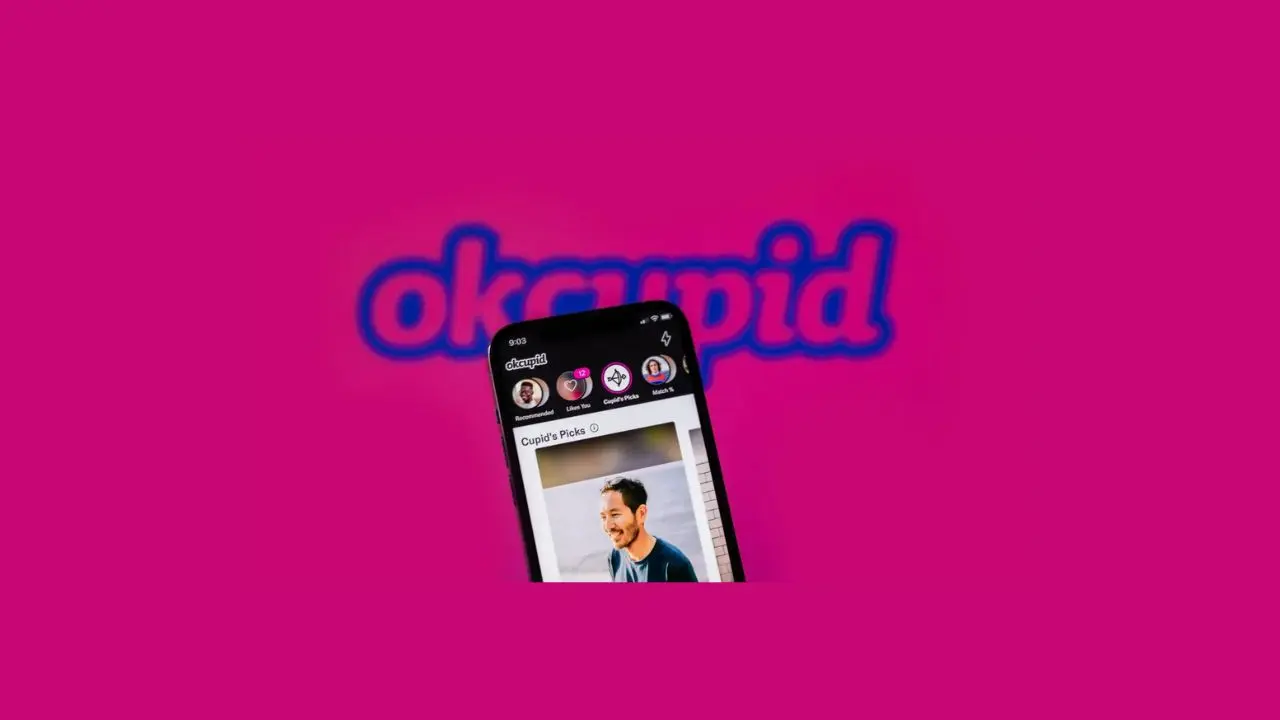
OkCupid takes a fundamentally different approach to matching than every other app on this list. Rather than leading with photos and letting attraction do the filtering, OkCupid uses hundreds of optional questionnaire questions covering values, lifestyle, politics, relationship style, sexual preferences, and dealbreakers to calculate compatibility percentages between users.
When you see someone on OkCupid, you already know how well your stated values and priorities align before you decide whether to like them. That compatibility layer produces a meaningfully different quality of conversation than photo-first apps because shared values and interests are visible up front. In addition, OkCupid has been LGBTQ+-inclusive since 2014, offering extensive orientation and gender identity options that binary-focused apps still don’t match.
The free tier is one of the most functional of any dating app; matching, messaging, and profile browsing all work without paying. OkCupid Premium at approximately $20/month adds Beeline (see who liked you), advanced filters, Boost features, and ad removal.
Why It Stands Out
- Compatibility percentage calculated from hundreds of values and lifestyle questions.
- Free messaging (one of the few major apps where you can message matches without paying).
- Most LGBTQ+-inclusive major dating app.
- Questions create a conversation context that photo-only profiles never provide.
- Personality-based matching produces higher-intent conversations than appearance-first apps.
5. eharmony
eHarmony is the most deliberate marriage-oriented dating platform available at scale for consumers. Its Compatibility Matching System uses a detailed questionnaire covering 29 dimensions of personality and relationship compatibility, and rather than letting you browse freely, it sends you a curated set of daily matches based on your compatibility scores.
You don’t choose who to evaluate; the algorithm does. That constraint produces a more intentional experience than any other app on this list. Every profile you see is someone eHarmony has determined is genuinely compatible with you based on deep personality alignment, not just geography and appearance. Additionally, the platform claims responsibility for more than 2 million couples, according to its published data.
The significant limitations are equally worth naming plainly. The free tier is extremely limited; you can complete the questionnaire and see who your matches are, but you cannot communicate without a subscription, which costs approximately $35–$65/month, depending on plan length. That makes eHarmony the most expensive platform on this list, and the curated-only browsing system means you can’t use it the way you use other dating apps.
Why It Stands Out
- 29-dimension compatibility matching (the deepest personality-based algorithm of any consumer platform).
- Curated daily matches remove the paralysis of choice that comes with open browsing.
- Claims 2 million+ couples (the strongest relationship outcome claim of any platform).
- Self-selects for marriage-minded users by aggressively framing commitment.
- A significant discount on 6- and 12-month plans rewards long-term commitment to the process.
6. SilverSingles
SilverSingles is specifically built for users over 50, and that specificity is its primary value proposition. The profile setup, interface design, matching algorithm, and overall tone are calibrated for mature daters whose relationship priorities, life circumstances, and communication preferences differ meaningfully from those of 25-year-olds on Tinder.
The platform uses a personality test to generate compatibility matches rather than open browsing, a deliberate design choice that reflects how mature users tend to approach dating differently from younger users on the app. Consequently, SilverSingles self-selects heavily for users in the same life stage who understand what they want and are serious about finding it.
The free tier lets you create a profile and view your matches. However, communication requires a subscription at approximately $28–$37/month. The user base of 800,000+ active members is small compared to mainstream apps, which means the local pool in smaller cities may be limited. The platform is most effective in the US, UK, Canada, and Australia, where its user concentration is highest.
Why It Stands Out
- Purpose-built for over-50 dating (interface and tone match the audience).
- Personality-test-based compatibility matching reduces swipe fatigue in photo-first apps.
- Strong self-selection for serious, mature users at the same life stage.
- No need to filter out users who are decades younger; the age alignment is built in.
7. Tinder
Tinder is the world’s most downloaded dating app, and the statistics behind that title are genuinely staggering. With around 50 million monthly active users and availability in 190+ countries, no other platform comes close to Tinder’s sheer scale. That scale is Tinder’s defining advantage: wherever you are in the world, there’s a high probability that the largest local pool of single people is on Tinder rather than any competing app.
The honest picture is that Tinder’s free tier is the most deliberately limited of any major app, and the pay-to-win structure is real and intentional. You get a limited number of right swipes per 12 hours; who liked you appears in a permanently blurred grid; and features like Rewind and Passport are locked behind Gold, which costs approximately $30/month.
That said, Tinder Gold’s “See Who Likes You” feature, which reveals your blurred grid and lets you proactively like back, is genuinely the most commercially impactful single feature in any dating app subscription. It converts the passive waiting game into active, informed outreach.
Why It Stands Out
- Largest active user pool of any dating app.
- Available in 190+ countries.
- Gold tier’s See Who Likes You converts passive discovery into active matching.
- Tinder Platinum’s Message Before Matching lets you stand out before a match is made.
- Photo verification and LGBTQ+ Traveler Alerts in regions with anti-LGBTQ+ laws demonstrate a genuine commitment to safety.
- Works for casual dating, serious relationships, and everything in between; the platform doesn’t restrict intent.
8. Match.com
Match.com is the oldest major dating platform, founded in 1995, making it older than Google, and it remains one of the most relationship-focused options available for users over 35. Its age and reputation have created a strong self-selection effect: people who download Match.com in 2026 are overwhelmingly looking for serious, long-term commitment rather than casual dating.
The profile setup is more comprehensive than swipe-first apps, which adds friction but also filters for users who are genuinely serious about finding a partner rather than browsing casually. Consequently, Match has facilitated more reported dates and relationships than any other dating site, according to its own research, a claim that’s difficult to independently verify but consistent with its positioning.
The honest limitation is that Match.com is effectively paywalled from meaningful use. This means you can browse profiles but cannot read or send messages without a subscription, which costs approximately $35–$45/month. That paywall is more aggressive than those of Hinge and Bumble, and the interface feels dated compared to modern apps.
Why It Stands Out
- Oldest and most established dating platform.
- Strong self-selection for serious, commitment-minded users.
- More comprehensive profiles than swipe-first apps.
- Extensive search filters for finding matches by very specific criteria.
- Claims the most reported dates and relationships of any dating site.
9. Grindr
Grindr is the world’s largest social networking and dating app for gay, bi, trans, and queer people, by a significant margin. Its grid-based layout shows nearby users by distance in real time, which creates a fast-moving, location-first experience that reflects how the app’s core user base uses it. With 13 million+ monthly active users across 190+ countries, Grindr’s global reach means it’s the effective default for gay and bi men internationally, not just in major Western cities.
The platform has invested in safety features, including profile verification and LGBTQ+ travel alerts that warn users when they’re in regions with laws criminalizing same-sex relationships. Additionally, the free tier is functional with ads; core matching and messaging work without paying. Grindr Unlimited, at approximately $30/month, removes ads and adds advanced filters, incognito mode, read receipts, and additional profile views.
Why It Stands Out
- Largest LGBTQ+ dating app globally.
- Real-time distance grid provides immediate local discovery.
- Available in 190+ countries (relevant in markets where other LGBTQ+ apps have small user bases).
- LGBTQ+ travel alerts warn users about legal risks in specific regions.
- Community-oriented features beyond pure dating.
Dating App Safety: What Every User Should Know
Every app on this list has safety tools, but the most important safety practices apply across all of them equally, regardless of which platform you use.
Use Photo Verification Wherever It’s Available
Tinder, Bumble, and Hinge all offer selfie-based photo verification. However, Bumble reports that verified profiles are 56% more likely to receive matches, which means verification helps you and protects others. Therefore, prioritize matching with verified profiles when available, and verify your own profile to signal authenticity.
Never Share Personal Contact Information Before Establishing Real Trust
Your phone number, workplace, home neighborhood, and financial information should remain private until a meaningful in-person connection is established. Additionally, meet for all first dates in busy public locations, such as a coffee shop, a restaurant, or a public park, and tell a trusted friend the person’s name, their profile, and where you’re meeting before you go. These aren’t overcautions; they’re standard practices that every experienced dating app user follows instinctively.
Trust Your Instincts and Report Problematic Profiles
If a conversation feels off, pressure feels unusual, or something doesn’t add up, unmatch immediately.
Every app on this list has reporting tools that protect other users when you flag a profile. Using those tools takes 30 seconds and can prevent other users from encountering the same problem.
Free vs Paid: Do You Need to Subscribe?
The honest answer is that most dating apps are functional on the free tier; what subscriptions add is efficiency and information, not access to the core experience.
- Hinge’s free tier is the strongest: 8 likes per day, see who liked you one at a time, and full messaging with matches.
- Bumble’s free tier is solid: matching and messaging are free; Boost and Premium add convenience.
- OkCupid’s free tier includes messaging, making it the only major app that lets you have full conversations without subscribing.
- Tinder’s free tier is the most deliberately limited; the swipe restriction and blurred likes are designed to create pressure to upgrade rather than provide genuine value.
The subscription worth paying for on most apps is the “see who liked you” feature, whether that’s Tinder Gold, Hinge+, Bumble’s Beeline, or OkCupid Premium. That feature converts the passive, uncertain experience of waiting for mutual matches into active, informed outreach.
Honest Recommendation: Try any app free for two weeks before paying. If the free tier produces matches in your market, a subscription will accelerate that. If the free tier produces nothing, no subscription fixes a thin local user pool; that’s a market problem, not a features problem.
For a broader look at apps that improve your daily life across categories, our best Google Play Store apps guide covers the top-rated apps across every category. In addition, our best AI productivity apps and best productivity apps for remote workers are worth exploring if you’re also optimizing your professional life alongside your personal one.
FAQs
Tinder leads by a significant margin with over 50 million monthly active users across 190+ countries. Bumble has approximately 40 million users across its ecosystem, and Hinge has 32 million. If sheer user pool size in your area is the priority, Tinder is the starting point.
It depends on what you’re optimizing for. Hinge is better for intentional, relationship-focused dating, as most of its users seek serious relationships; its free tier is more generous, and its prompt-based profiles produce better conversations. Tinder, on the other hand, is better for maximum user pool size, geographic coverage, and flexibility across relationship types. Many people use both simultaneously.
OkCupid offers the most functional free tier, including messaging with matches, making it the strongest free dating experience among major apps. However, Hinge’s free tier is excellent for relationship-focused users. Bumble’s free tier is solid for users who want the women-message-first dynamic without paying. But Tinder’s free tier is the most limited of the major apps.
Yes. Most apps on this list include safety tools such as photo verification, reporting, blocking, and date check-in. The baseline safety practices that apply everywhere are: verify profiles before meeting, meet first dates in public places, tell someone where you’re going, and trust your instincts if something feels wrong.
Grindr is the dominant platform for gay and bi men with 13 million+ monthly active users across 190 countries. However, HER is the strongest platform for lesbian, bisexual, queer, and non-binary women. OkCupid, on the other hand, has the most extensive orientation and gender identity options of any mainstream app and is genuinely inclusive across all LGBTQ+ identities.
Conclusion
The best dating app for you depends on two things above all else: your relationship goals and where you live. If you want the most options and the broadest geographic coverage, start with Tinder; no other platform matches its global active user base. And if you want intentional, relationship-focused matching with a genuinely strong free tier, Hinge is the clearest recommendation for most 25–35-year-olds in urban markets. If you want a more controlled inbox experience as a woman, Bumble’s women-message-first structure delivers that. However, OkCupid is the right choice for anyone who wants compatibility-based matching and free messaging. Match.com and eHarmony serve serious, commitment-oriented users over 35 who are willing to pay for a more curated experience. Grindr and HER serve gay and queer users at scale and with the specificity that no mainstream app can replicate.
The most common dating app mistake isn’t picking a bad app; it’s paying for a subscription before trying the free tier, or staying on a platform where the local user pool is genuinely thin and hoping that money changes the math. Start free, evaluate what the platform delivers in your specific market, and upgrade only when the results justify it. The apps listed in this guide all work; the question is simply which one’s culture, user base, and design philosophy match what you’re actually looking for.
For more tech guides and honest reviews, visit YourTechCompass.