
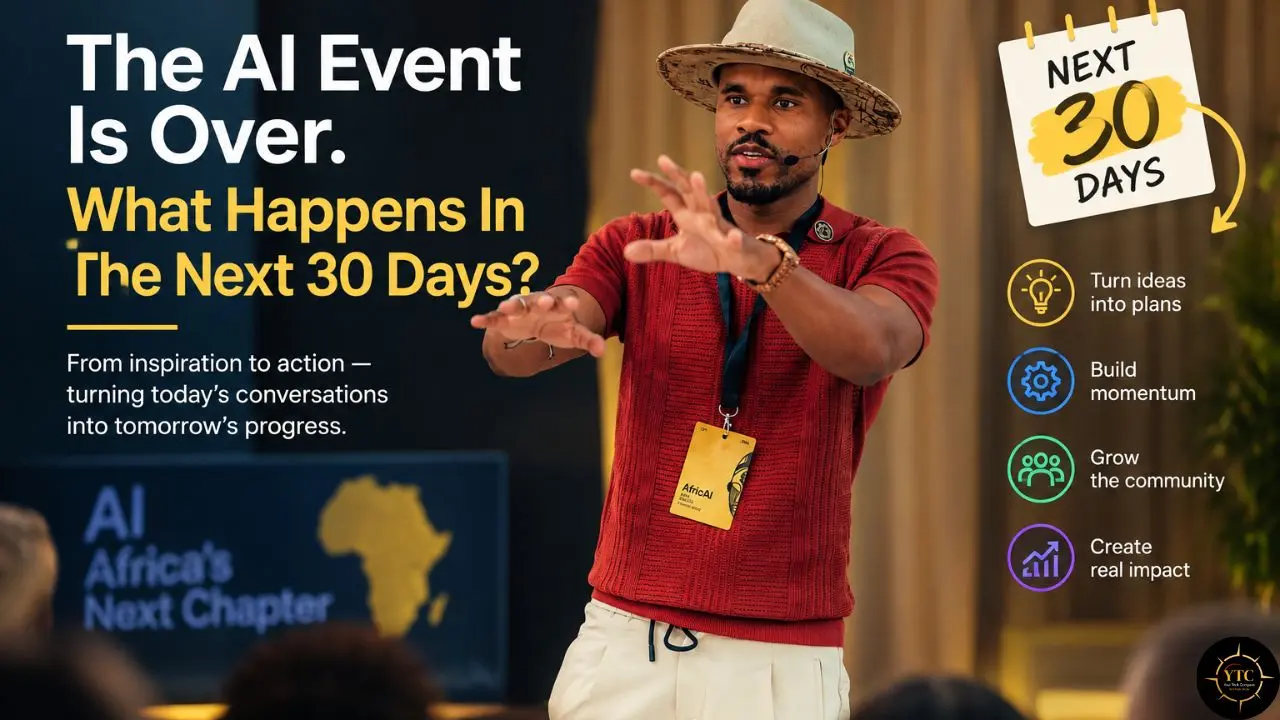
An AI event can give you a lot to feel good about. The room looks great. Someone shows a tool that makes people pull out their phones. You leave with new contacts and a list of things you want to try. Then Monday comes: your clients still need answers, your team still requires direction, and the idea you were excited about is somewhere in your notes, underneath everything you already had to do. That’s the part of an AI event I want us to spend more time designing.
I founded AfricAI and mAIstro, and I led a practical AI workshop at iHub Nairobi on August 3, 2026. Our organizer reporting brief documents the event and its limits, but it does not establish how many people continued to use what they learned, and that distinction matters to me. Hosting the room gives me a perspective on the work; it doesn’t give me permission to invent the results. Here is how I would design the first month after an AI event: a proposed operating plan, with examples, rather than a claim that every step has already been tested across our events.
Before People Leave: Choose One Thing Worth Doing
The follow-up starts while everyone is still there.
Give people ten minutes to decide what they will actually try when they get home. Ask them to name a task they already do and describe what a useful improvement would look like.
A small business owner might choose turning meeting notes into a draft follow-up email. A creator might choose organizing ideas for the next video. Neither needs to rebuild their whole business by Friday.
Make the next step small enough to fit into a working week. Write down who will do it and when they will try it. If the answer is “when I have time,” help them find a real slot.
I would also ask how they handle that task today. Without a starting point, it’s easy to confuse an impressive demonstration with an improvement.
The CDC’s guidance on evaluating training programs distinguishes learning from applying that learning at work, and it recommends following up after learners have had a chance to use the material. That’s a useful principle here, even though the guidance comes from public health training.
Days 1 To 3: Make It Easy To Restart
Send a short message to help someone reopen the task they selected.
Include the relevant exercise, the material needed to repeat it, and a clear place to ask for help. A recording can be useful, but don’t make someone search through three hours of video to find the five minutes they need.
For the meeting follow-up example, that might include a sample set of fictional notes, the instructions used in the workshop, and a draft that still needs checking.
Explain what a person should inspect before using the result. Did the draft invent a promise? Did it assign the wrong person a task? Can the business owner explain why they accepted the output?
Keep real client information out of practice exercises. People should be able to learn the process without exposing someone else’s private details.
And tell participants what follow-up they are signing up for. Attending a workshop shouldn’t quietly become an excuse for endless sales messages.
Days 4 To 7: Find The Point Where People Stopped
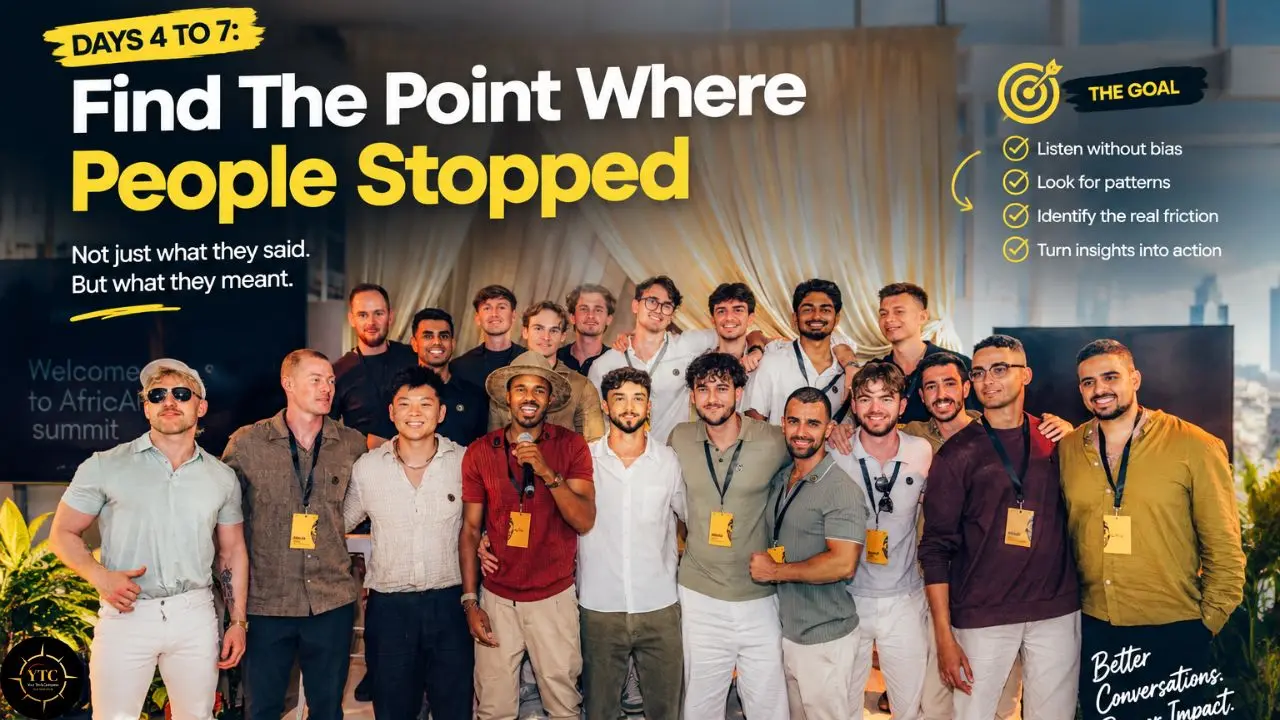
The most useful question this week is simple: where did you get stuck?
Someone may have understood the workshop perfectly and still be unable to repeat it. Perhaps the tool requires a paid account. Perhaps the demonstration used a laptop they don’t have. Maybe their manager hasn’t approved the software.
Those are different problems. Sending the same tutorial again won’t solve all of them.
Offer a short support session around the actual blockers people report. Give participants a way to submit a question privately too. Nobody should have to ask a basic question in front of a room full of strangers to get help.
For an event serving people across African markets, ask about their actual setup. Check connectivity, device access, payment options, and supported languages. Don’t assume that what worked on the presenter’s machine will work for everyone.
A useful first-week result could be one person independently repeating one task. Record what happened, including any help they needed. Keep the description that specific.
Days 8 To 14: Give Relationships A Reason To Continue
“We should do something together” is a nice thing to say. It needs a next step.
With both people’s permission, make an introduction around a concrete need. A founder trying to organize customer inquiries might benefit from speaking to another operator who handles a similar workload. They don’t necessarily need another sales call from a tool vendor.
Explain why you are connecting them. Suggest a small exchange they can complete without a big commitment: compare their current process, review a sample, or test one idea together.
Then let them decide whether to continue. Don’t turn the introduction into a partnership announcement.
A group chat can support this, but someone has to look after it. Set a purpose, answer questions, and make it clear that unsolicited pitches aren’t the price of entry. Otherwise, the quietest people may disappear before they get anything useful.
This is where an organizer can earn trust after the event. Make a helpful connection, respect people’s time, and leave them room to say no.
Days 15 To 21: Try It Inside Ordinary Work
By now, move beyond repeating the workshop exercise.
Take the meeting email example. The owner could try the process on several suitable meetings, reviewing every draft before sending it. Keep track of the time spent correcting the output as well as the time spent generating it.
A draft that appears instantly but takes longer to fix hasn’t automatically saved anyone time.
Choose a simple comparison that fits the task. That could be time spent, errors caught, or whether the intended recipient had to ask for missing information. Record enough detail to understand the result without collecting unnecessary information.
Agree on a stopping point too. If the output keeps inventing details, pause and change the process. If a human review step is doing all the work, say so.
I don’t think we help people by making every experiment sound successful. Discovering that a tool doesn’t fit a task can be a useful outcome, especially before someone starts depending on it.
Days 22 To 30: Report What You Can Actually Support
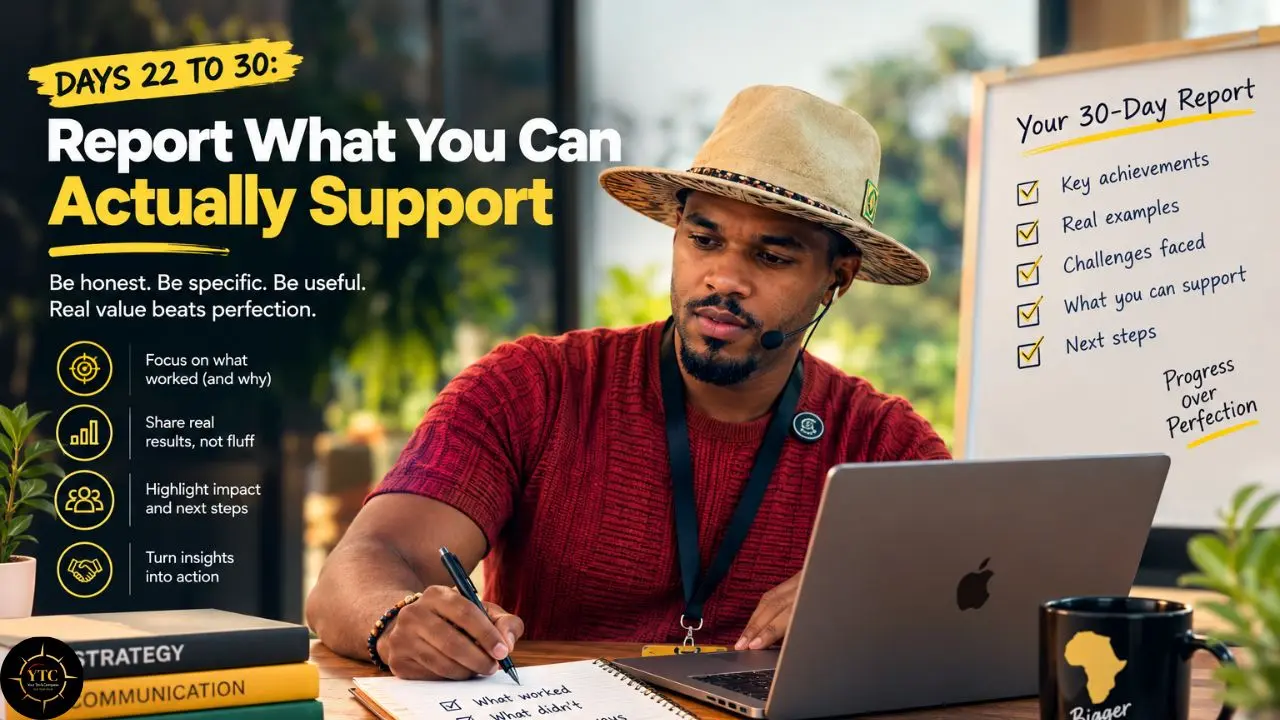
Now ask what continued.
Who attempted the task? Who used it again? What did they change? Who stopped, and why?
Give people a short way to respond. Where appropriate, invite a demonstration or a redacted example. Separate what someone tells you from what you have actually reviewed.
Imagine an organizer contacts 40 participants and hears back from ten. Six say they used the workflow again. That is six reports from ten respondents. It doesn’t establish what the other 30 did, nor does it prove the event caused a business improvement. Those numbers are an illustration, not AfricAI results.
Publish the limits beside the finding. Keep unanswered follow-ups visible as unknowns. Don’t turn silence into success, and don’t turn it into failure either.
The team also needs a simple place to store this information. A spreadsheet is enough. Assign an owner to each follow-up, record the next action, and keep a link to any evidence the participant has agreed to share.
Set aside time for that work before selling the next event. Otherwise, follow-up becomes something everyone supports in principle, but no one has the space to do it. Budget for a person to answer questions, help with introductions, and close the month properly. A smaller promise delivered consistently is easier to trust than a community program that disappears after the opening message.
Before closing out the month, send participants something useful. If they took the time to explain a problem, tell them what you changed as a result. Share a corrected exercise or a clearer answer to a question that kept coming up. Ask permission before sharing anyone’s example; even if the result looks positive, people should recognize their experience in the way you describe it. This also gives the organizer a better starting point for the next conversation; you can ask about the task they were trying to finish, instead of opening with another invitation and hoping they remember who you are.
Then use what you learned to change the next program. If people struggled to choose a task, spend more time on that. If access was the barrier, redesign the exercise around what they can use.
FAQs
Thirty days is enough to see whether someone can repeat a task independently, find where they got stuck, and try it inside real work at least once; longer programs tend to lose momentum without adding much new signal.
Treating attendance and enthusiasm as proof of adoption. A full room and good feedback forms tell you how the event felt, not whether anyone used what they learned a week later.
Report exactly who responded, what they said, and what you couldn’t verify, and keep the people who never replied visible as unknowns instead of quietly dropping them from the count.
Ask directly about connectivity, device access, payment options, and language before assuming a tool that worked on the presenter’s laptop will work for everyone in the room.
One task done well beats several tools introduced quickly. The goal of the first thirty days is one person repeating one task independently, not broad tool literacy.
Tell participants upfront what kind of follow-up they’re signing up for. Turning post-event support into ongoing sales messages erodes the trust that made the follow-up worth doing in the first place.
Bring It Back To The Person
The African Union’s Continental AI Strategy sets out an Africa-centric approach to responsible and inclusive AI development, and an event organizer can’t deliver that ambition alone. But we can take responsibility for a small, practical piece of it: making room for someone to ask a question without feeling behind, helping them try an idea in their own business, and connecting them with someone who understands the problem. That’s a theme this site keeps returning to across our African tech coverage: the gap between an AI demo and an AI habit is where most of the real work actually happens.
For me, the point is whether that work gives a person something back. Maybe a task becomes easier. Maybe they feel confident enough to test another idea. Or maybe they get an hour back to spend with their family. Find out; ask them after the lights come down, and build time into the plan to listen to the answer.
The best AI event isn’t the one people remember; it’s the one they’re still quietly using thirty days later.
About the Author: Akil Wade is the founder of AfricAI and mAIstro. The Nairobi reporting brief referenced above is an organizer-owned source. The 30-day plan and illustrative examples are his recommendations, not a published evaluation of participant outcomes.
Found this helpful? Browse more in-depth tech guides, honest reviews, and step-by-step tutorials at YourTechCompass, your go-to resource for making smarter tech decisions.