
Picture a parliament chamber in Harare on a Friday morning in March 2026. President Emmerson Mnangagwa stands at the podium, describing artificial intelligence as a force reshaping economies worldwide, while outside that same building, a family in Mutoko is rationing candlelight because the national grid failed again the night before. That contrast is not a criticism dressed up as an anecdote. It is the actual terrain Zimbabwe’s National Artificial Intelligence Strategy 2026–2030 has to cross, and if you want to understand whether this strategy is real policy or ceremonial paperwork, you have to hold both images in your head at once: the ambition in the room, and the infrastructure outside it.
I’m writing this because most coverage of African AI strategies falls into one of two traps: either it treats a government launch event as proof of progress, or it dismisses the whole exercise as another unfunded document destined for a filing cabinet. Neither approach tells you anything useful. In this piece, I’ll walk you through what Zimbabwe’s strategy actually contains, how it stacks up against the countries that got here first (Mauritius, Egypt, Rwanda, Kenya, and Nigeria), and what the real constraints are, so that if you’re a developer, an investor, or a policymaker trying to decide how seriously to take this, you have something more substantial than a press release to work from.
What Zimbabwe Actually Launched
Let’s start with the sequence of events, because it matters. Zimbabwe’s Cabinet approved the National Artificial Intelligence Strategy in October 2025, months before the public ever saw it.
A UNESCO delegation formally handed over the completed document to the Minister of ICT, Postal and Courier Services, Tatenda Mavetera, in mid‑October 2025, and the strategy was then publicly launched at Zimbabwe’s New Parliament House on March 13, 2026, with the UN’s Resident and Humanitarian Coordinator, Edward Kallon, standing alongside the President. That sequencing (technical vetting and drafting first, cabinet approval second, public ceremony last) tells you this wasn’t rushed together for headlines. It followed a process that leaned heavily on UNESCO’s Artificial Intelligence Readiness Assessment Methodology, which has been running in Zimbabwe since 2025 and is anchored in UNESCO’s 2021 Recommendation on the Ethics of Artificial Intelligence.
What distinguishes Zimbabwe’s version of a national AI strategy from, say, Egypt’s or Rwanda’s is the governance philosophy underneath it. Rather than importing frameworks wholesale from Brussels or Washington, Zimbabwe explicitly grounds its approach in Ubuntu, the Bantu philosophical tradition summarized as “I am because we are.” That’s not just a nice line for a foreword. It shapes how the strategy emphasizes collective benefit over individual optimization, and it echoes a theme our AI policy in Africa coverage has tracked across the continent: African governments increasingly want governance language that reflects local values rather than translated EU regulations. Whether that framing survives contact with enforcement is a separate question, and I’ll get to that.
The Six Pillars and What Each One Actually Does
The strategy rests on six pillars, and each one answers a specific “why does this exist” question rather than sitting there as filler.
- AI Talent and Capacity Development exists because Zimbabwe cannot build sovereign AI capacity without people who can build it. President Mnangagwa called for a reorientation of the education system “from primary to tertiary level” toward STEM, coding, and data literacy, with National AI Centers of Excellence funded to anchor research and, crucially, an attempt to make AI careers financially attractive enough that trained Zimbabweans stay.
- AI Infrastructure and Computational Sovereignty addresses the blunt reality that you cannot run models you don’t have the hardware to train. This pillar centers the Zimbabwe Center for High-Performance Computing (ZCHPC) and commits to Tier IV-standard data centers and interoperable national data systems, an effort to reduce dependence on foreign cloud infrastructure that mirrors the compute-sovereignty push happening elsewhere on the continent, which we broke down in our look at Africa’s AI factories and who actually gets to use them.
- AI Adoption and Service Transformation is the delivery pillar: getting AI into agriculture, mining, health, finance, and public administration in ways citizens can feel, not just read about.
- Governance, Ethics, and Regulatory Frameworks builds the National AI Council (NAIC) and the AI Strategy Implementation Office (AISIO), the two bodies responsible for turning Ubuntu-centered principles into actual oversight rather than aspiration.
- Research, Development, and Innovation aims to move Zimbabwe from an AI consumer to an AI producer, complete with an intellectual property strategy and a research pipeline that connects universities to industry.
- Strategic International Collaboration and Diplomacy, the sixth pillar, positions Zimbabwe as a participant in the global AI order rather than a passive recipient of it, explicitly framed around advocating for the Global South’s interests in international AI governance conversations.
The Rollout Has Three Phases, Not One Big Bang

Implementation runs on a schedule that deserves more attention than it’s gotten. A 100-day foundation-building sprint covered the first quarter of 2026. That’s followed by an 18-month build phase meant to deliver core infrastructure and launch flagship programs. The scaling phase then runs through 2030, focused on sector-wide adoption and, per the strategy’s own framing, positioning Zimbabwe as a regional AI hub for Southern Africa.
Two flagship initiatives are already visible: Project Pangolin, the government’s sovereign national AI and data platform, and the AI Grand Challenge (branded AI4I, or Artificial Intelligence for Impact), which ran in Mutare from late July into early August 2026 and had multidisciplinary teams building AI prototypes for priority sectors, with the strongest ideas earmarked for piloting and scaling. That’s a genuinely concrete deliverable, not a slide in a deck, and it’s the kind of signal worth watching if you’re trying to separate strategy theater from strategy execution.
Where Zimbabwe Sits in the Continental Race
Here’s the context that puts Zimbabwe’s timing into perspective. As of mid-2025, roughly 16 of Africa’s 54 countries had launched a national AI strategy, according to continental tracking cited by policy researchers, with dozens more still drafting. Zimbabwe is not a pioneer here.
Mauritius published Africa’s first national AI strategy back in 2018, built around its ocean economy and skills programs. Egypt began its AI governance push in 2019, launched its first strategy in 2021, and doubled down with a second strategy for 2025–2030 that targets growing ICT’s share of GDP to 7.7%, seeding 250 AI startups, and training 30,000 AI specialists. Rwanda unveiled its strategy in 2023, chasing a regional-hub ambition that Zimbabwe’s strategy now explicitly echoes for Southern Africa. Kenya took a task force-first approach, and Nigeria, Africa’s most populous nation, moved with a strategy built around scale rather than niche specialization.
So where does that leave Zimbabwe?
Later than the early movers, earlier than most of the continent, and distinct in one specific way: its governance pillar is built on cultural philosophy rather than GDP arithmetic. Egypt leads with a dollar figure. Zimbabwe leads with a value system. Neither approach is inherently superior, but they tell you what each government thinks will motivate compliance and public buy-in. If you want the fuller landscape of how these national efforts fit together continentally, our AI in Africa guide maps the broader picture, and our AI in Africa category tracks every new entrant as strategies get published.
Table: National AI Strategies in Africa
Country | Strategy Launched | Core Framing | Standout Target |
Mauritius | 2018 | Ocean economy, sector-specific | First mover in Africa; AI Council established |
Egypt | 2019 (governance), 2021 (first strategy), refreshed 2025–2030 | Human capacity + scientific research | 7.7% of GDP from AI, 30,000 specialists by 2030 |
Rwanda | 2023 | Regional AI hub ambition | Position as East Africa’s leading AI destination |
Nigeria | 2024 | Scale-driven, population-first | Broad sectoral adoption across Africa’s largest economy |
Zimbabwe | 2026–2030 | Ubuntu governance, sovereignty-first | Upper-middle-income status by 2030 via AI |
That last column matters more than it looks. Egypt’s target is a percentage. Zimbabwe’s is a national income classification, which tells you this strategy isn’t being sold as a tech ministry project. It’s being sold as an economic transformation vehicle, tied directly to Vision 2030. Ambitious framing, certainly. Whether it’s achievable is the next question, and it’s where the infrastructure numbers start doing a lot of the talking.
The Infrastructure Reality Check

I want to be direct with you here, because this is the section where good intentions meet electricity bills. According to Zimbabwe’s telecoms regulator, POTRAZ, internet penetration now sits in the mid‑80s (87.39% in Q1 2026), which sounds workable until you look one layer deeper: independent estimates put actual internet usage closer to 38–42%, and only about 11% of households own a computer. Mobile penetration is high, near 96% of households, but most of that access runs through smartphones on mobile data, not the fixed, high‑bandwidth connections that AI training and deployment actually require. And then there’s the number that undercuts everything else: only about 14% of Zimbabweans enjoy a reliable electricity supply from the national grid, even though around 60% have some form of access.
That’s not a footnote. It’s the single biggest variable standing between this strategy’s ambitions and its outcomes. Pillar two, computational sovereignty, depends on stable power feeding data centers and base stations. If you can’t guarantee the lights stay on, you can’t guarantee the compute stays running, and every downstream promise about AI‑improved service delivery inherits that fragility. This is precisely the tension our broader artificial intelligence Africa guide keeps returning to across different countries: policy ambition consistently outpaces grid reliability across much of the continent, and Zimbabwe is not an exception to that pattern; it’s a fairly stark illustration of it.
Here’s where I’ll offer an honest opinion rather than just a balanced description: the strategy’s most realistic near‑term wins are not going to come from citizens using AI tools directly. They’re going to come from institutions using AI to cut costs and improve back‑office efficiency: the same pattern seen regionally, where insurers and banks report double‑digit efficiency gains from AI in claims, underwriting, and operations. That’s a real, bankable result. It’s also a result that required none of the household‑level infrastructure that’s currently missing for most Zimbabweans. In practice, expect the first few years of this strategy to look like enterprise and government efficiency gains, with citizen‑facing AI access trailing well behind, concentrated in Harare and Bulawayo long before it reaches rural districts.
Talent, Brain Drain, and the Skills Question
Every AI strategy on the continent eventually runs into the same wall: you can train people faster than you can retain them. Zimbabwe’s talent pillar leans on National AI Centers of Excellence, education, and training investments from primary to tertiary, and a stated push to make AI careers financially attractive to young Zimbabweans. That’s the right instinct. The problem is that Zimbabwe’s skilled‑professional emigration pattern is well documented and predates this strategy by decades, and nothing in the current document fundamentally changes the wage gap between a Zimbabwean AI engineer working locally and the same engineer working remotely for a company paying in dollars or pounds.
The strategy’s own answer to this is diaspora engagement, treating Zimbabweans abroad as a talent resource to be tapped rather than a loss to be mourned. That’s a reasonable pivot, and it’s one South Africa has also had to grapple with, which our coverage of South Africa’s AI skills paradox examined in detail: high executive confidence in AI ROI colliding with a genuine shortage of people who can actually build the systems. Zimbabwe’s version of that paradox may be sharper, given the smaller domestic tech job market relative to South Africa’s.
It’s also worth noting, on the talent side, that the barriers aren’t gender‑neutral. Our reporting on women building AI across Africa found that infrastructure gaps, funding gaps, and professional‑culture gaps compound specifically for women in AI fields, and while Zimbabwe’s strategy explicitly names women, youth, and persons with disabilities as priority groups, there’s little public detail yet on the kind of deliberate, family‑and‑community‑level intervention that actually closes that gap rather than just naming it.
Governance, Surveillance Risk, and What Ubuntu Actually Constrains
I promised you balance, and this is the section where I need to push back on the strategy’s own framing a little. The governance pillar sounds genuinely thoughtful on paper: human dignity, privacy, transparency, inclusivity, safety, and accountability, all explicitly built into the National AI Council’s mandate. But researchers tracking digital rights across the region, including analysis from the Collaboration on International ICT Policy for East and Southern Africa (CIPESA), have flagged that Zimbabwe, like several other African governments, has already invested in “smart city” surveillance systems with limited transparency about how citizen data is collected, stored, or audited. That’s not a hypothetical risk sitting in the strategy’s future. It’s an existing pattern the strategy has to actively counteract, not just gesture toward.
So here’s my honest read: Ubuntu‑centered governance is a genuinely distinctive contribution to how African nations are talking about AI ethics, and I don’t think it’s cynical marketing. But a philosophy is not an enforcement mechanism. The real test isn’t whether NAIC and AISIO exist on an org chart. It’s whether either body has the independence and the teeth to say no to a surveillance deployment that a ministry wants and citizens haven’t consented to. That question won’t be answered by this document. It’ll be answered by what NAIC actually does, or doesn’t do, over the next 18 months. For the continental regulatory backdrop this sits inside, our AI policy in Africa coverage tracks how governance frameworks across the region are handling, or failing to handle, exactly this tension.
What This Means for Zimbabwe’s Sectors
You don’t need every sector explained in equal depth here, so let me give you the concrete, plausible version of each.
Agriculture
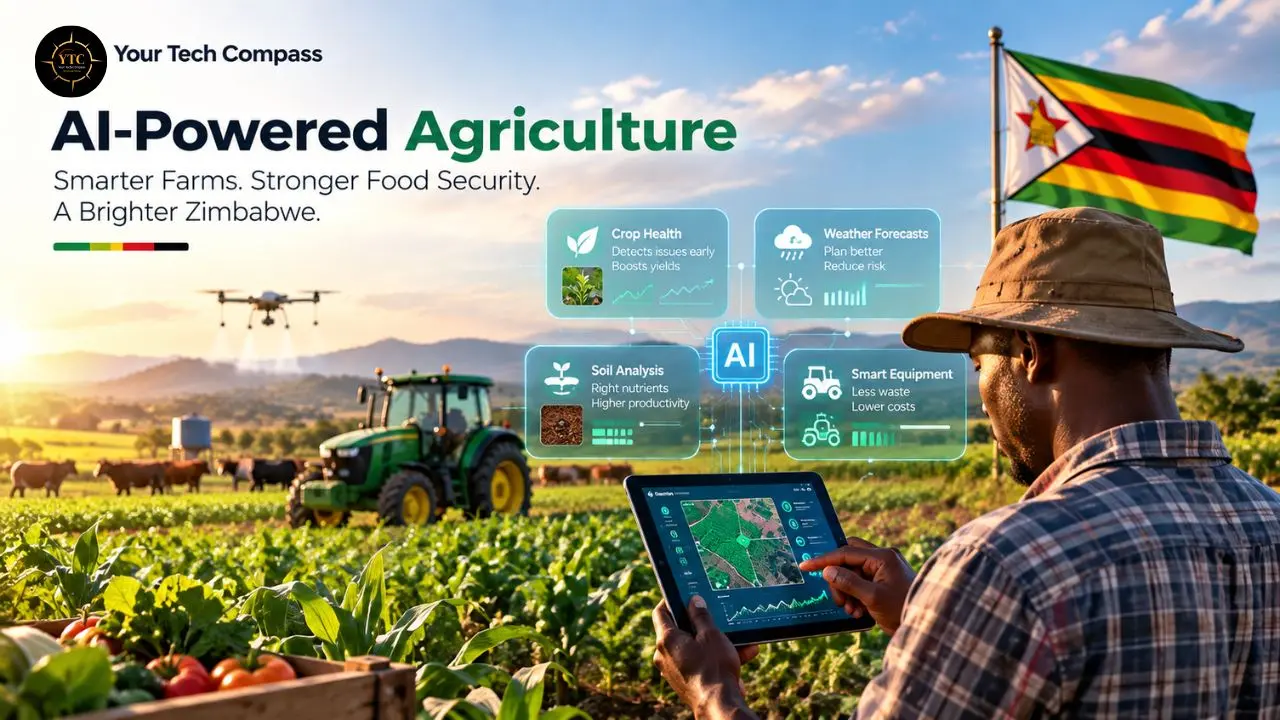
This is the sector with the clearest near-term case, since Zimbabwe’s economy still depends heavily on it, and AI-assisted crop monitoring and disease prediction have already shown results elsewhere on the continent. Our guide to how AI is revolutionizing agriculture in Africa, alongside our reporting on AI in West African cocoa farming, covers the model Zimbabwe would likely need to adapt: low-bandwidth, SMS- or app-based tools that work on the connectivity farmers actually have, not the connectivity a data center in Harare enjoys.
Health
This sector has real early-adoption potential too, but the honest caution is capacity. Our coverage of AI healthtech startups across Africa shows that the strongest health AI deployments on the continent pair local clinical data with dedicated infrastructure investment, exactly the combination Zimbabwe’s strategy promises but hasn’t yet funded at scale.
Finance
This is where I’d expect the fastest visible progress, since Zimbabwe’s banking and mobile money sector already runs on digital rails, and AI-driven fraud detection or credit scoring doesn’t require the household-level device access that citizen-facing tools do. Our African fintech category tracks this kind of AI-finance convergence across the continent, and the logistics layer underneath commerce, covered in our piece on AI routing in African e-commerce and logistics, is another plausible near-term adopter, given Zimbabwe’s push toward digital trade infrastructure.
Mining and Education
These two sectors round out the list in the strategy, but both face the same infrastructure ceiling described above, meaning progress here will likely track the pace of the compute and connectivity buildout rather than outrun it.
Ambition vs. Feasibility: Where This Could Break
Let’s be blunt about the risk list, because a strategy this ambitious deserves scrutiny proportional to its promises. Funding continuity is the first and biggest variable; Zimbabwe’s macroeconomic history includes currency instability that has derailed multi-year government programs before, and a five-year AI strategy is precisely the kind of initiative that a forex crisis can quietly starve.
Political will is the second variable, since ambitious pillar documents are common across African governments while sustained, cross-administration follow-through is rarer. Centralization risk cuts both ways: too much state control over AI infrastructure could crowd out the kind of private innovation that made Masakhane and the Deep Learning Indaba genuinely effective elsewhere on the continent, as our piece on women building AI in Africa documented in detail, while too little oversight risks the surveillance drift already flagged above. And cybersecurity is a real, named threat to sovereign infrastructure that hasn’t yet been stress-tested at scale.
None of this means the strategy is doomed. It means the next 18 months, the “build phase” the strategy itself defines, are the actual test. Watch whether ZCHPC gets the funding it needs, whether AI4I’s Mutare prototypes make it past the pilot stage, and whether NAIC issues any actual rulings rather than just holding meetings. Those are the concrete signals, not the launch-day rhetoric.
What This Means for You: Developers, Investors, and Policymakers
If you’re a Zimbabwean developer or founder, the practical opportunity right now sits in Project Pangolin and the AI Grand Challenge pipeline. Ideas that performed well at AI4I in Mutare are explicitly earmarked for piloting and scaling, which makes that competition worth tracking closely if you’re building anything AI-adjacent locally.
If you’re an investor, the government’s own signaling points toward fiber backbone, data center capacity, cloud infrastructure, and rural connectivity as the priority investment areas, echoing the same compute-access gap our AI factories coverage found across the continent, where only a small fraction of African AI talent currently has access to serious computational resources. And if you’re a policymaker elsewhere in Africa studying Zimbabwe’s approach, the exportable lesson isn’t the Ubuntu language itself; it’s the phased 100-day-then-18-month-then-scaling structure, which gives a strategy concrete near-term accountability checkpoints instead of a single distant 2030 deadline that’s easy to quietly abandon.
For a wider comparative lens on how different regions are approaching AI adoption at a national level, our Africa vs. India AI adoption analysis is a useful companion read, and our African NLP and local LLMs coverage shows what genuinely locally built AI infrastructure looks like when it succeeds.
FAQs
It’s a government framework, led by the Ministry of ICT, Postal and Courier Services, that sets out how Zimbabwe intends to develop and govern artificial intelligence between 2026 and 2030. It’s built around six pillars covering talent, infrastructure, sectoral adoption, governance, research, and international collaboration, and it’s explicitly tied to Zimbabwe’s Vision 2030 development goals.
AI Talent and Capacity Development, AI Infrastructure and Computational Sovereignty, AI Adoption and Service Transformation, Governance, Ethics and Regulatory Frameworks, Research, Development and Innovation, and Strategic International Collaboration and Diplomacy.
Zimbabwe arrives later than pioneers like Mauritius (2018) and Egypt (2019) and roughly in the same window as Nigeria. What sets it apart is its Ubuntu-centered governance philosophy, rather than the GDP-percentage targets that define Egypt’s approach, and its explicit ambition to become Southern Africa’s regional AI hub, echoing Rwanda’s earlier positioning in East Africa.
Not yet, and not evenly. POTRAZ’s latest data show internet penetration in the mid‑80s (87.39% in Q1 2026), but only about 11% of households own a computer, and reliable grid electricity reaches only around 14% of the population despite broader access. That gap means near‑term AI gains are far more likely at the institutional and enterprise level than at the individual citizen level, particularly outside Harare and Bulawayo.
The Compass Is Set. The Power Isn’t
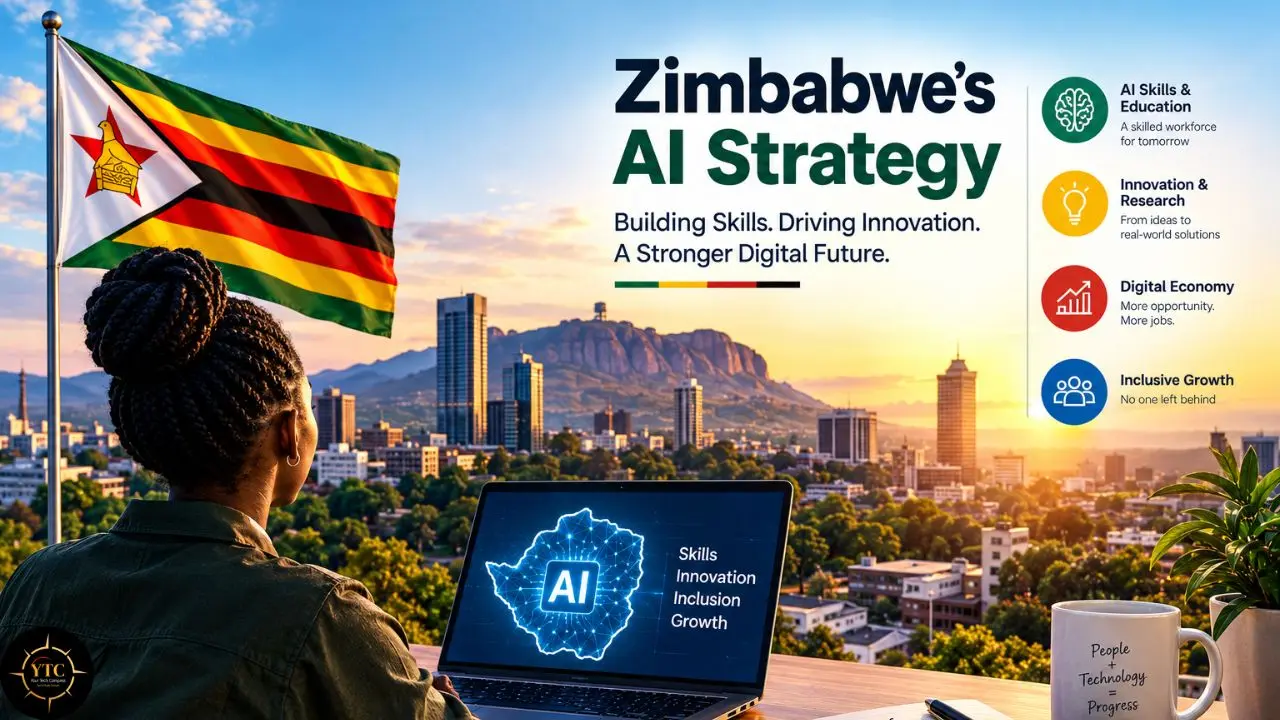
Zimbabwe’s National AI Strategy is not vaporware, and it’s not a solved problem either. It’s a genuinely structured, phased, institutionally backed plan, with real money already committed through Cabinet approval, a real competition that’s already produced prototypes, and a governance philosophy that at least attempts to reflect Zimbabwean values rather than importing someone else’s regulatory template wholesale. That’s more than a lot of national AI strategies manage in their first year. What it doesn’t have, yet, is the electricity grid, the device penetration, or the wage competitiveness to guarantee that six well-written pillars become six delivered outcomes by 2030.
If you take one thing from this piece, let it be this: judge this strategy by what happens in its 18-month build phase, not by what was said at its launch. Watch whether the high-performance computing/sovereign compute program gets funded at the scale the document promises, whether the AI Grand Challenge’s Mutare prototypes actually reach citizens, and whether NAIC does anything beyond convening meetings. Those are the markers that separate a serious national AI strategy from a well-produced one. Zimbabwe has written an ambitious plan. Whether it becomes a delivered one is a story still being written, one quarter at a time.
For continued, honest coverage of how Africa’s AI strategies move from paper to practice, keep your bearings set on YourTechCompass.com.