The headphones you choose for Spotify and Apple Music matter more than most buying guides will tell you, not because any pair will fail to play music, but because the right pair unlocks features you’re already paying for. Apple Music’s Spatial Audio with dynamic head tracking, Spotify’s 320 kbps high-quality streaming, and LDAC’s high-resolution wireless codec (none of which work fully on the wrong hardware). Whether you’re on iPhone or Android, whether you subscribe to lossless or standard streaming, and how you actually listen all determine which pair gives you the most from the platform you use every day.
That said, the good news is that the current headphone market is exceptional. Released between May and September 2025 alone, three of the best consumer headphones ever made launched within months of each other, and all of them are covered in this guide. Consequently, whether your budget sits at $249 or $449, you’re choosing between genuinely outstanding options rather than settling for compromises. This guide tells you exactly which headphones suit which platform, which specs actually matter, and which pick is best for your ears.
A Quick Comparison Table
Headphone | Form Factor | Best Platform | ANC | Codec | Spatial Audio | Battery |
Over-ear wireless | Both | ✅ Excellent | LDAC / AAC | 360 Reality Audio | 30 hrs | |
In-ear wireless | Apple Music / iOS | ✅ Excellent | AAC only | ✅ Full head-tracked | 8 hrs (24 total) | |
In-ear wireless | Both (any OS) | ✅ Best-in-class | aptX Adaptive / AAC | ✅ iOS + Android | 6 hrs (24 total) | |
In-ear wireless | Spotify / Android | ✅ Strong | LDAC / AAC | Limited | 8 hrs (24 total) | |
Over-ear wired | Apple Music Lossless | ❌ None | Wired (no compression) | ❌ None | N/A (wired) |
What to Look for in Headphones for Spotify and Apple Music

Audio Codec Support
The audio codec is the compression format your headphones and phone use to transmit wireless audio, and it’s the most misunderstood spec in this category. AAC is Apple Music’s primary wireless codec, natively supported by AirPods and Beats. Additionally, it delivers excellent quality on iOS but degrades on Android devices, where AAC encoding is inconsistent.
LDAC (Sony’s flagship codec) transmits up to 990 kbps, significantly higher than AAC’s 250 kbps, making it the best wireless option for Spotify’s high-quality streams on Android. aptX Adaptive, on the other hand (used by Bose and others), supports 24-bit hi-res lossless audio wirelessly and works across both iOS and Android.
Spatial Audio and Dolby Atmos
Apple Music offers Spatial Audio with Dolby Atmos on thousands of tracks. With the right headphones, it genuinely transforms the listening experience from sound coming from inside your skull to sound appearing around you in three-dimensional space. Additionally, Dynamic head tracking (exclusive to AirPods and some Beats hardware) adjusts the audio field as you move your head, anchoring sound to the room rather than your head. Bose’s Immersive Audio and Sony’s 360 Reality Audio offer their own spatial audio implementations, but neither integrates as deeply with Apple Music as Apple’s own hardware does.
Noise Cancellation and Transparency
ANC matters significantly for Spotify and Apple Music streaming because the quality of what you hear is only partly about the headphones; it’s also about what you’re competing against. Outstanding ANC on the current market (Sony WH-1000XM6, AirPods Pro 3, Bose QC Ultra 2) removes 80–90% of ambient noise, letting compressed streams sound cleaner than they would in a noisy environment. Transparency mode, which passes through environmental sound naturally, is equally important for daily wear, and the current generation of transparency modes (particularly Apple’s and Bose’s) is indistinguishable from not wearing headphones at all.
Platform Fit: iOS vs Android
This is the practical decision most guides gloss over. If you use an iPhone, AirPods Pro 3 give you capabilities no other earbuds can match: Personalized Spatial Audio with head tracking on Apple Music, seamless automatic switching between all Apple devices, Siri hands-free, and heart rate monitoring. If you use Android and Spotify, Sony’s LDAC codec and direct Spotify app integration (Spotify Tap in Sony’s Headphones Connect app) deliver the best wireless audio quality available on that platform.
For a deeper breakdown of how these platforms compare in terms of audio quality, our Spotify vs Apple Music guide covers the streaming differences in full detail.
The Best Headphones for Spotify and Apple Music
1. Sony WH-1000XM6
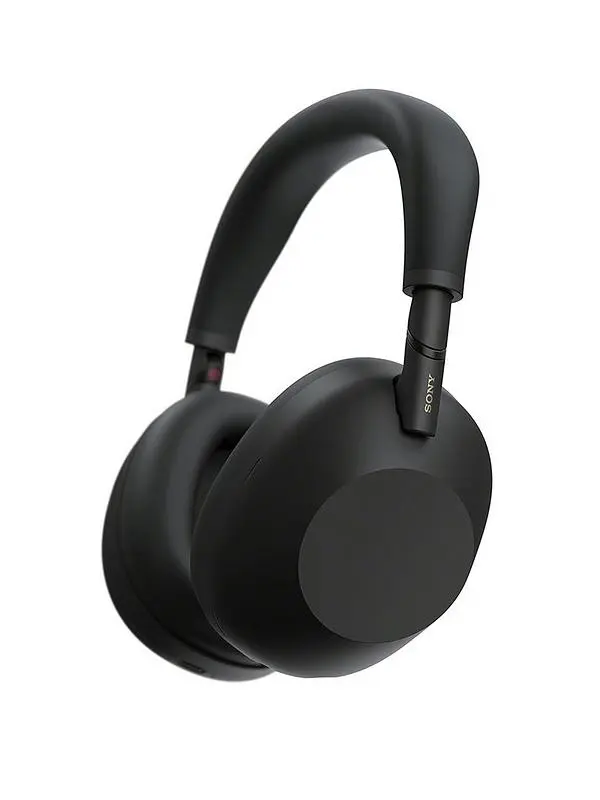
The Sony WH-1000XM6 launched in May 2025 as the successor to the XM5 (three years in development) and earns its place at the top of this list for one reason above all others: it’s the best wireless headphone for both Spotify and Apple Music simultaneously, regardless of which phone you carry. The new QN3 processor, which is seven times faster than the QN1 in the XM5, drives 12 microphones for adaptive noise cancellation that adjusts in real time to your environment, how the headphones sit on your head, and even the surrounding sound pressure. Additionally, LDAC codec support provides high-resolution wireless streaming that makes a genuine, audible difference when Spotify’s 320kbps streams are paired with properly encoded Android hardware.
Sound quality across every review from What Hi-Fi, TechRadar, Tom’s Guide, and TrustedReviews consistently describes it as clearer, brighter, and better separated than the XM5, with stronger bass that doesn’t muddy the midrange. For Spotify listeners specifically, the Sony Headphones Connect app’s direct Spotify Tap integration lets you resume playback by pressing the power button, and Speak-to-Chat automatically pauses music the moment you start talking.
Key Specs
- Processor: Sony QN3 with 12-microphone adaptive ANC
- Driver: 30mm carbon fiber dome driver
- Codec: LDAC, aptX HD, aptX, AAC, SBC
- Battery: 30 hours (ANC on); USB-C fast charge (3 min = 3 hrs)
- Connectivity: Bluetooth 5.3, multipoint (2 devices), NFC
- Weight: Approximately 250g
- Colors: Black, Platinum Silver, Midnight Blue, Sand Pink
Why It Stands Out
- QN3 processor, 7× faster than the previous generation, delivers the best adaptive ANC in the over-ear category.
- LDAC support provides the highest wireless audio quality available for Spotify Android users.
- Direct Spotify integration via the Sony Headphones Connect app (Spotify Tap).
- 360 Reality Audio and head-tracking for spatial listening on Sony’s own platform.
- Foldable design returns for travel-friendly storage, a significant improvement over the XM5.
- 30-hour battery is best-in-class for an ANC flagship.
Best For: Anyone who wants the best all-around wireless headphones for either Spotify or Apple Music, regardless of device.
2. Apple AirPods Pro 3
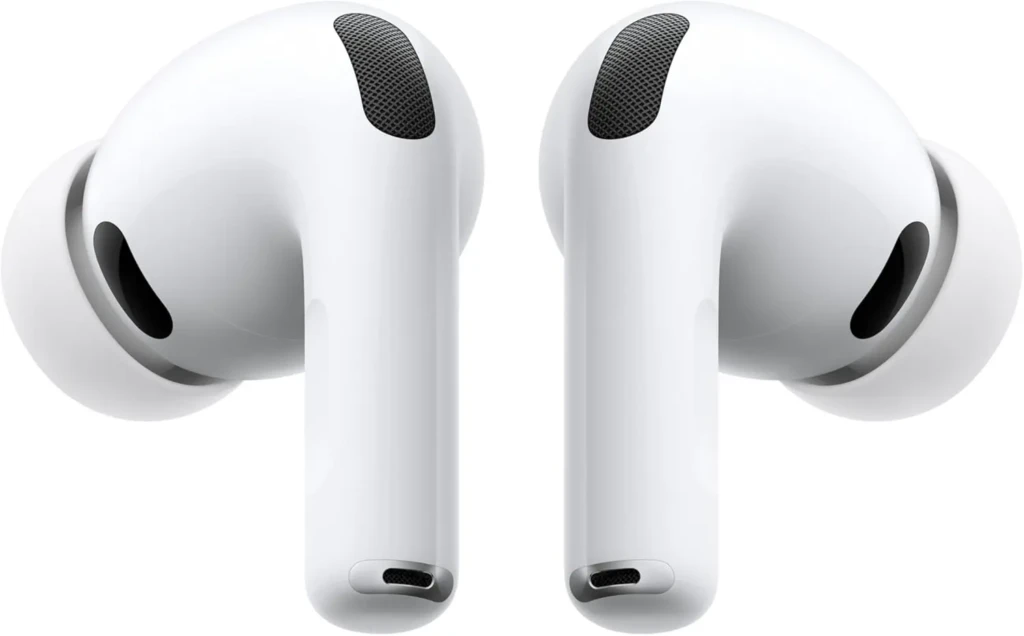
The AirPods Pro 3 launched in September 2025 and represent the largest leap in Apple’s earbuds lineup in several years. For Apple Music subscribers on iPhone, these are the only earbuds in the world that deliver Personalized Spatial Audio with dynamic head tracking, and the experience on Dolby Atmos-encoded tracks is genuinely unlike anything else at this price; sound appears to come from outside your head, anchored to the physical space around you as you move. Beyond music, the H2 chip drives Apple’s noise cancellation, which it claims is 2× more effective than the Pro 2.
For Spotify users on iPhone, the AirPods Pro 3 work excellently; AAC streaming quality is strong on iOS, but you won’t get Spatial Audio on Spotify tracks (it’s an Apple Music exclusive feature), and the seamless ecosystem integration advantages diminish somewhat if Spotify is your primary app.
Key Specs
- Chip: Apple H2
- ANC: 2× more effective than AirPods Pro 2 (Apple specification)
- Codec: AAC, SBC (no LDAC or aptX)
- Battery: 8 hours per charge (ANC on); 24 hours total with case; 5 min charge = 1 hour
- Water Resistance: IP57
- Extra Features: Heart rate sensor, Live Translation, Conversation Awareness, Find My
Why It Stands Out
- Only earbuds with full Apple Music Spatial Audio + dynamic head tracking.
- IP57 (best water resistance rating of any earbuds in this guide).
- Seamless automatic switching between iPhone, iPad, Mac, and Apple Watch.
- Heart rate sensor and Live Translation add genuine lifestyle utility beyond music.
- 2× ANC improvement over Pro 2 (competitive with Bose for best-in-class isolation).
- Five ear tip sizes (XXS through L) for the broadest fit compatibility Apple has offered.
Best For: iPhone users who subscribe to Apple Music and want the deepest platform integration in a compact, durable earbud.
3. Bose QuietComfort Ultra Earbuds 2nd Gen
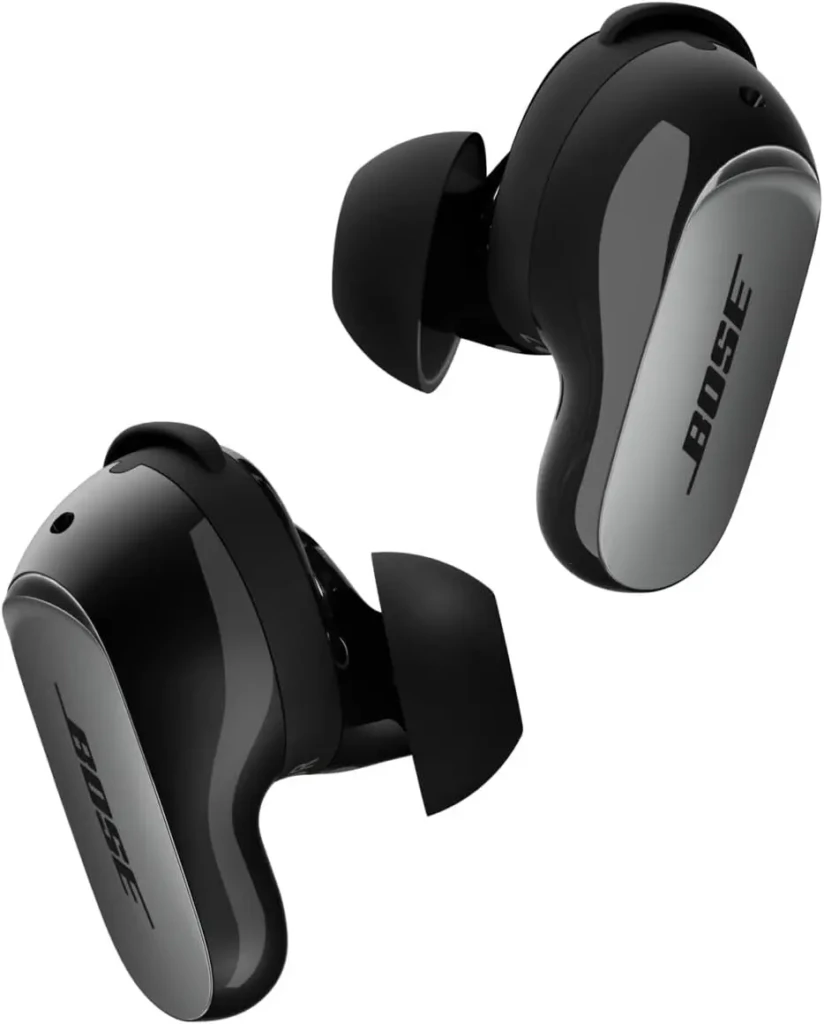
The Bose QuietComfort Ultra Earbuds 2nd Gen launched in July 2025 and immediately established itself as the benchmark for noise cancellation in the true wireless category. And in that one specification, independent testing consistently places these earbuds slightly ahead of even the AirPods Pro 3. Additionally, Bose’s “Quiet mode” removes ambient sound, creating an eerie, near-complete silence that no current competitor fully matches; multiple reviewers describe it as the most effective noise isolation they’ve ever experienced with an earbud.
Beyond noise cancellation, the 2nd Gen adds wireless charging to the case and a refined “Cinema Mode” for spatial audio, and, crucially, Bose Immersive Audio works across both iOS and Android, including with Spotify, unlike Apple’s head-tracked Spatial Audio, which is iOS-only and Apple Music-only.
Key Specs
- ANC: Three levels (Quiet, Aware, Immersion); fully customizable presets
- Codec: aptX Adaptive (24-bit hi-res lossless), AAC, SBC
- Battery: 6 hours per charge (with spatial audio); 24 hours total with case
- App: Bose Music app (available for iOS and Android)
- EQ: 3-band equalizer in app
- Extras: Stability bands included; wireless charging case
Why It Stands Out
- Best-in-class noise cancellation; marginally ahead of AirPods Pro 3 in purist testing.
- aptX Adaptive supports 24-bit hi-res lossless wirelessly (the best codec on this list for Android).
- Bose Immersive Audio spatial mode works on both iOS and Android, with both Spotify and Apple Music.
- 3-band EQ in the app lets you customize sound, something that AirPods Pro 3 lacks entirely.
- Works equally well with any phone; no iOS dependency for core features.
Best For: Android users who want the absolute best noise cancellation available in a true wireless earbud, or anyone on either platform who wants hi-res wireless codec support alongside strong spatial audio.
4. Sony WF-1000XM6
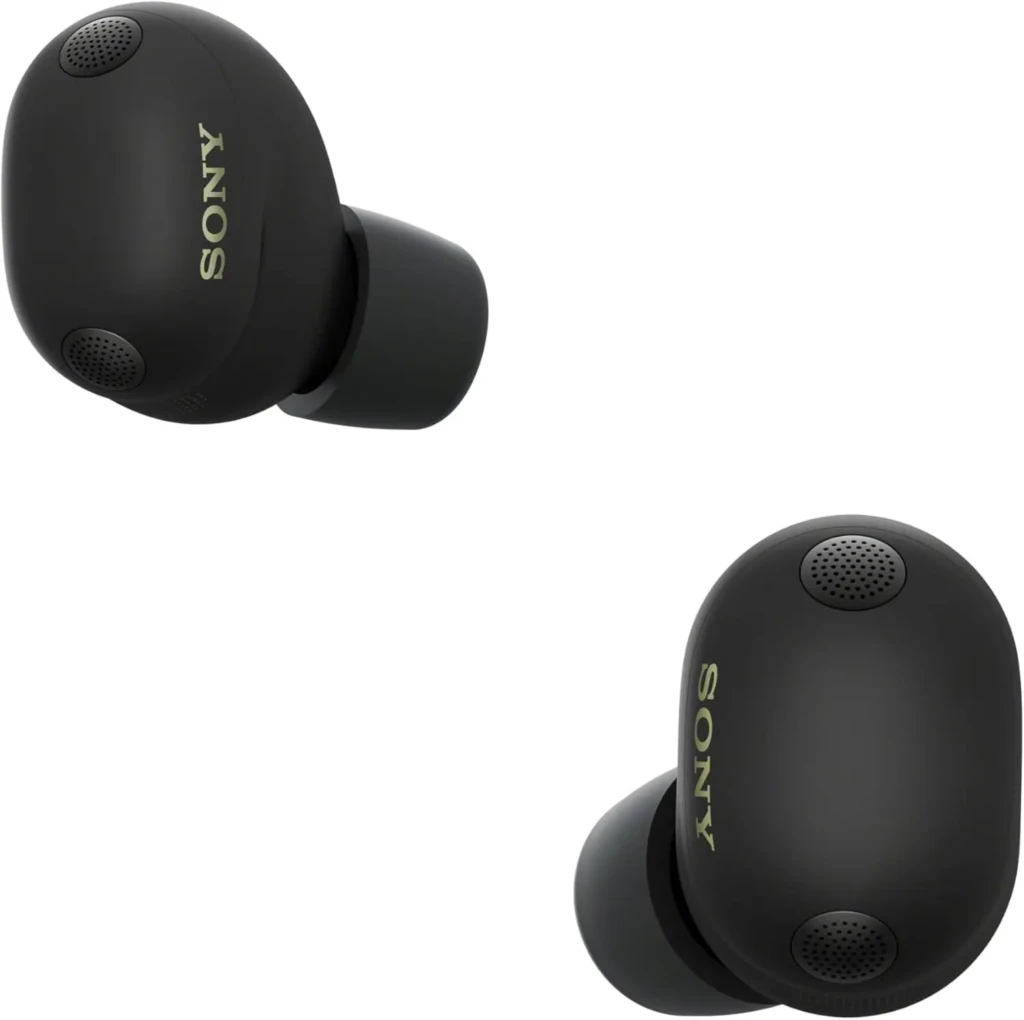
The Sony WF-1000XM6 launched in February 2026 and delivers what Mashable describes as the most impressive audio performance in Sony’s current lineup, including the flagship WH-1000XM6 over-ear headphones. The new QN3e noise-canceling processor (3× faster than the WF-1000XM5’s chip) achieves a 25% reduction in ambient noise compared to the XM5, with particular improvements in the mid-to-high frequencies most common in commuting and public spaces. The redesigned form factor is approximately 11% slimmer than its predecessor, with a ventilation structure added to reduce occlusion effects (the annoying amplification of chewing and footstep sounds that plague sealed-fit earbuds).
For Spotify and Apple Music streaming specifically, LDAC remains the flagship high-quality wireless codec for Android users, and the Sony Headphones app’s Spotify Tap integration carries over from the over-ear XM6.
Key Specs
- Processor: Sony QN3e (3× faster ANC processor than WF-1000XM5)
- ANC: 25% more effective than WF-1000XM5
- Codec: LDAC, AAC, SBC (no aptX Adaptive)
- Battery: 8 hours per earbud; 24 hours total with case; 5 min charge = 1 hour
- Water Resistance: IPX4
- Colors: Black, Platinum Silver
Why It Stands Out
- The QN3e processor delivers 25% better ANC than the WF-1000XM5 (the biggest noise-cancellation jump in this generation).
- LDAC supports high-resolution wireless streaming for Android and Spotify power users.
- Spotify Tap integration via the Sony Headphones Connect app.
- Matte finish returns (replacing the divisive glossy XM5 surface) based on user feedback.
- Bone conduction + AI beamforming for best-in-class call quality in this category.
- 11% slimmer body with anti-occlusion ventilation (noticeably more comfortable for all-day wear).
Best For: Spotify listeners on Android who want Sony’s flagship true wireless experience with LDAC codec support and direct Spotify app integration in a slimmer, more comfortable form than the over-ear WH-1000XM6.
5. Sennheiser HD 560S (Wired)
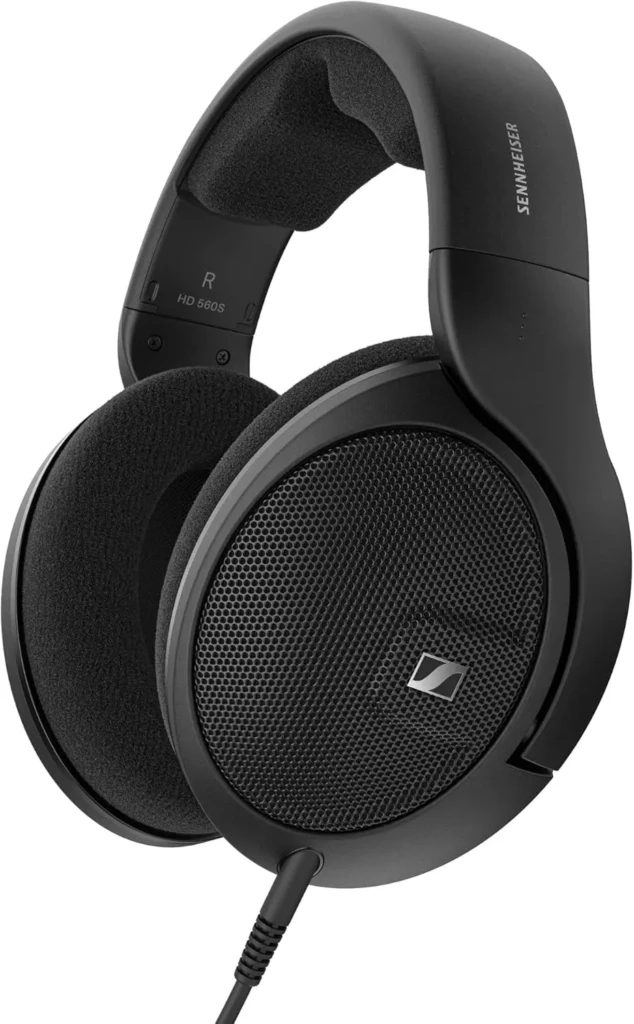
The Sennheiser HD 560S is the only wired headphone on this list, and its inclusion is intentional. Apple Music Lossless (ALAC up to 24-bit/192kHz) and Hi-Res Lossless (up to 24-bit/192kHz) are entirely wasted on Bluetooth headphones, because every wireless codec compresses the audio before it reaches your ears. Consequently, the only way to actually hear what Apple Music Lossless sounds like (the real quality difference you’re paying for with the Lossless tier) is through a wired connection. The HD 560S’s open-back design and reference-level neutral tuning reveal detail in well-mastered recordings that closed-back and wireless headphones mask: micro-dynamics in the vocals, instrument separation across a genuinely wide soundstage, and reverb tails in the recording space.
The HD 560S delivers a listening experience that wireless headphones at 2× or 3× its price cannot match, even with technically excellent source material. The tradeoff is obvious and worth being honest about: open-back design means sound leaks both in and out, making it unsuitable for commuting, offices, or any shared space.
Key Specs
- Driver: 38mm dynamic driver
- Impedance: 120 Ohm (benefits from a dedicated headphone amplifier or DAC)
- Frequency Response: 6Hz–38,000Hz
- Design: Open-back, over-ear
- Cable: Detachable 3m cable; 3.5mm with 6.35mm adapter included
- Weight: 240g
Why It Stands Out
- It’s the only headphone on this list that fully unlocks Apple Music Lossless and Hi-Res Lossless.
- Open-back design produces a natural, wide soundstage that closed-back headphones can’t replicate.
- Reference-neutral tuning reveals what’s actually in the recording, no added warmth or artificial bass.
- Detachable cable for easy replacement.
- At sub-$200, it delivers critical listening quality that challenges headphones at 3× the price.
Best For: Apple Music Lossless subscribers who want to hear the genuine quality difference that lossless streaming provides at home, through a wired connection, for dedicated critical listening sessions.
Apple Music vs Spotify: Does Your Platform Affect Which Headphones You Buy?
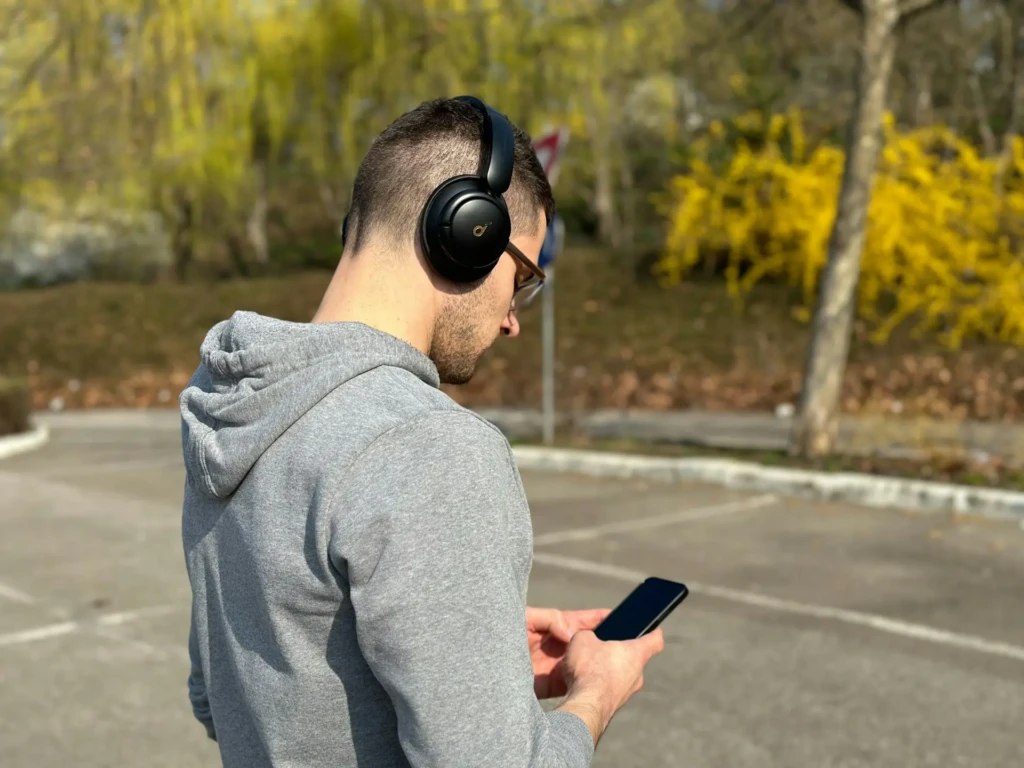
The short answer is yes, meaningfully. Apple Music and Spotify have different codec chains, spatial audio implementations, and ecosystem integrations that measurably favor different hardware.
For iPhone users with Apple Music subscriptions, AirPods Pro 3 are the clear choice if you want to use the platform the way Apple designed it. Personalized Spatial Audio with head tracking on AirPods Pro 3, where the audio field stays anchored to the room as you move, is genuinely different from any other headphone’s spatial audio implementation. No Sony, Bose, or Sennheiser headphone currently replicates this experience on Apple Music specifically.
For Spotify users on Android, Sony’s LDAC codec is the most important hardware differentiator. Spotify’s highest quality streams (320kbps OGG Vorbis) delivered over LDAC at 990kbps provide measurably better wireless audio quality than AAC at 250kbps, and the Sony Headphones Connect app’s Spotify Tap and Speak-to-Chat integrations are features no other headphone manufacturer currently offers with Spotify.
The Honest Conclusion: For most casual listeners, the headphone’s physical sound quality and comfort matter more than codec optimization. But if you’ve paid for Apple Music Lossless or Spotify’s premium tier and want to use what you’re paying for, codec- and platform-matching delivers a real, audible difference.
Tips for Getting the Best Sound From Spotify and Apple Music
Beyond choosing the right headphones, a few settings changes make an immediate difference to what you hear, and most of them are turned off by default.
On Spotify: Open the app, go to Settings → Audio Quality, and set the streaming quality to “Very High” (320 kbps). Normalize volume should stay on for playlist listening, but can be turned off for critical listening sessions where you want the full dynamic range.
On Apple Music: Go to Settings → Music → Audio Quality and enable Lossless Audio (if your plan includes it) and Dolby Atmos under Spatial Audio settings. Both are off by default; enabling them makes an immediate difference on supported tracks with compatible headphones.
For Sony headphones, keep the Headphones Connect app up to date. Sony regularly ships firmware updates that improve ANC performance, codec stability, and sound tuning, and each update is worth installing. Additionally, use Adaptive Sound Control to let the headphones automatically adjust ANC levels as you move between environments; it genuinely works better than manually toggling between modes throughout the day.
For more streaming app comparisons, tips, and audio tool reviews, our apps and tools section covers the full landscape.
FAQs

On Android, the Sony WH-1000XM6 or WF-1000XM6 offer the best combination: LDAC for maximum wireless audio quality and direct Spotify Tap integration in the Sony app. For Spotify on iPhone, AirPods Pro 3 work excellently on AAC, though Spotify doesn’t support Apple’s Spatial Audio feature.
Yes. AirPods Pro 3 work with Spotify and deliver excellent sound quality via AAC on iPhone. However, Spatial Audio with head tracking is an Apple Music-exclusive feature and does not activate on Spotify tracks, even with AirPods Pro.
On Android with Spotify, yes, LDAC transmits audio at up to 990 kbps versus AAC’s 250 kbps, and the difference is audible on well-mastered tracks through quality headphones. On iOS, Apple’s AAC implementation is significantly better optimized than Android’s, making the gap between AAC and LDAC smaller on iPhone.
Yes, but with diminishing returns above $300. The jump from $50 budget headphones to $249 AirPods Pro 3 or Sony WH-1000XM6 is substantial and audible. Beyond $450, you’re paying for incremental refinements rather than transformative quality differences specifically for streaming use.
For wireless listening, no. Bluetooth compression means any wireless headphone delivers equivalent quality regardless of the lossless tier. For wired listening, however, Apple Music Hi-Res Lossless (24-bit/192kHz) is fully audible through a high-quality wired headphone like the Sennheiser HD 560S, connected to a dedicated DAC or via the iPhone’s USB-C port with a compatible adapter.
Conclusion

For most iPhone users who stream Apple Music daily, the AirPods Pro 3 are the straightforward answer: head-tracked Spatial Audio on Apple Music, class-leading ANC, IP57 water resistance, and Apple ecosystem integration that no other hardware provides at any price. However, for Android users, Spotify streamers, or anyone seeking the best over-ear wireless experience across both platforms, the Sony WH-1000XM6 remains the benchmark: 30-hour battery life, adaptive ANC driven by 12 microphones, LDAC for high-resolution wireless audio, and direct Spotify integration make it the most versatile choice on the list. And if you’ve paid for Apple Music Lossless and want to hear what it actually sounds like, uncompressed, the Sennheiser HD 560S is the honest answer: wired, open-back, and the only way to experience what lossless means in practice, genuinely.
The most important single decision in this guide is ecosystem fit. Buy AirPods Pro 3 if you’re in Apple’s ecosystem and use Apple Music seriously. Buy Sony if you’re on Android, use Spotify, or want the best all-rounder that works equally well on both. And buy Bose QC Ultra Earbuds 2nd Gen if noise cancellation is your absolute priority above everything else; nothing else in the true wireless category blocks sound as effectively.
For more tech guides and honest reviews, visit YourTechCompass.