Language-learning apps have reshaped how adults and beginners alike learn a new language. When it comes to the long-standing debate between Duolingo and Babbel, the core question for many learners is straightforward: should you choose a gamified, free platform with broad accessibility or a structured, subscription-based system focused on deeper instruction? Both apps have strong followings, but their methodologies, pricing, and learning outcomes differ in important ways, and those differences matter depending on your goals and learning style.
This comparison gives you the current 2026 picture, the real subscription prices for both apps, including the tiers and traps that older comparisons miss, the AI features each company has added and how differently they’ve approached adding them, and an honest breakdown of where each app genuinely earns its reputation versus where the marketing outpaces the reality. By the end, you’ll know exactly which app fits your specific goal, not just which one has the better app store rating.
A note before we begin: every YTC score is earned, never negotiated. If you want to understand exactly how we evaluate apps & tools and how we handle affiliate relationships, our Review Methodology lays it all out.
Duolingo vs Babbel: Quick Comparison Overview
To start, here’s a quick snapshot of how Duolingo and Babbel differ in philosophy and execution, two factors that often determine which app aligns best with your learning goals.
Feature | Duolingo | Babbel |
Learning Approach | Gamified, bite-sized drills | Structured, course-like lessons |
Best For | Casual learners, habit-building, language exploration | Serious learners wanting guided progression |
Grammar Instruction | Implicit, limited | Explicit, integrated into every lesson |
AI Conversation Practice | Duolingo Max only ($29.99/month) | Babbel Speak is included in every paid plan |
Languages Offered | 40+, including niche and constructed languages | 14 languages, all major European/global languages |
Subscription Covers | All languages on one subscription | One language per subscription |
Free Tier | Yes (fully functional with ads and an energy limit) | No (first lesson of each course only) |
Cheapest Paid Tier | Super: ~$95.99/year ($8/month) | 12-month plan: $107.40/year ($8.95/month) |
Lifetime Option | Not available | $299.99 (all languages, one-time payment) |
The honest summary: Duolingo wins in breadth, cost of entry, and habit formation. Babbel wins on depth, grammar instruction, and genuine conversational preparation. Neither one is simply “better”; they’re built for different learners with different goals.
What Is Duolingo?
Duolingo is a freemium language learning platform and one of the most downloaded educational apps in the world. Its model blends genuinely free access with optional subscription upgrades, using gamification (points (XP), streaks, leaderboards, and unlockable achievements) to keep learners coming back daily. Lessons are short, often five minutes or less, and built around bite-sized exercises that teach vocabulary and sentence patterns through repetition rather than explicit explanation.
Duolingo’s defining characteristic is its implicit teaching philosophy: rather than walking you through a grammar rule before testing you on it, Duolingo places you directly into exercises and lets you absorb patterns through repeated exposure. Some research suggests this approach can meaningfully improve reading and listening proficiency, with some studies showing gains comparable to several semesters of university coursework. But the same implicit method that makes Duolingo frictionless for casual learners also means many users can recognize a phrase without understanding why it’s structured that way, a gap that becomes more noticeable the longer you use the app.
The recent change in the energy system is worth knowing about directly. Duolingo replaced its older “hearts” mistake-limit system with a broader energy system that governs how much you can practice before hitting a wall, and the shift has generated real, documented user frustration; forum complaints about running out of energy after just one or two lessons, even when answering correctly, are common across user communities. If you’ve used Duolingo’s free tier before and found the limits more restrictive than you remember, this is why.
What Is Babbel?
Babbel is a subscription-based language learning platform built around structured, professionally designed courses rather than gamified repetition. Each lesson (typically around 15 minutes) moves through a sequence of varied interactive drills: listen-and-repeat exercises, fill-in-the-blanks, image matching, mock conversations, and short grammar explanations, woven directly into the flow rather than presented as a separate, dense lesson. Babbel’s content is created by real language professionals, and the company has publicly committed not to use AI to generate its course content, a deliberate positioning choice that distinguishes it from Duolingo’s recent direction, as covered below.
Babbel’s design philosophy centers on helping you understand why a language works the way it does, not just recognizing that it does. Grammar explanations are genuinely embedded in lessons, typically a brief one- or two-sentence note followed immediately by a drill that reinforces it, which keeps the structure-focused approach from feeling like a dense textbook chapter. Babbel covers considerably fewer languages than Duolingo, currently around 14, but the tradeoff is depth: each course is built specifically for that language by people who actually teach it, rather than templated across dozens of languages simultaneously.
AI Features: How Each App Has Actually Approached This
This is the section most older Duolingo vs Babbel comparisons miss entirely, and the difference in approach between the two companies is genuinely instructive.
Duolingo Max
This is the premium AI tier, priced separately and steeply above the standard Super subscription at $29.99/month or $167.99/year. It includes an AI Video Call feature for simulated conversation practice and a Roleplay mode for scenario-based speaking exercises, currently limited to five languages on mobile. As of January 2026, “Explain My Answer,” AI-generated grammar explanations that clarify why a specific answer is correct, moved from the paid Max tier to the free tier, a genuinely meaningful improvement for budget-conscious users who previously had no access to that explanatory layer.
The more controversial AI development is Duolingo’s broader strategic shift toward relying more heavily on AI to generate course content itself, an announcement that has drawn visible pushback from longtime users concerned that AI-assisted course material may be lower quality than content created by human course designers. This isn’t a settled question, and reasonable people disagree about how much it matters in practice, but it’s a genuine point of tension within Duolingo’s own user base worth knowing about before you commit.
Babbel Speak
Babbel takes a different approach entirely: it’s included in every standard paid Babbel plan rather than being gated behind a premium tier. It uses an AI speaking trainer to guide you through scripted, realistic dialogue scenarios with live feedback and visual cues, moving you from passively recognizing vocabulary to producing it aloud.
Babbel has been explicit that it does not use AI to design its actual course content or curriculum. AI is layered on top of human-designed lessons specifically for conversation practice and does not replace the underlying instructional design.
The Practical Comparison
If AI-powered speaking practice matters to your decision, Babbel includes it as standard for roughly $9/month, while Duolingo locks its more advanced AI Video Call feature behind a $29.99/month tier that costs more than three times as much.
Learning Experience: Gamification vs Structured Courses
The most noticeable difference between Duolingo and Babbel is the learning experience itself. Duolingo leans heavily on gamification, points, streaks, and levels, which keep users coming back day after day and help build consistent habits.
This approach is enjoyable for many beginners and constructive if motivation is your main barrier to sticking with language practice. However, research suggests that overuse of gamification may distract learners from deeper engagement with linguistic structure.
By contrast, Babbel’s structured courses resemble classroom learning more than games. Lessons build logically from fundamental topics to more advanced structures, and explicit grammar notes make it easier to understand not just what to say, but why, a valuable distinction for learners aiming for fluency. For this reason, Babbel often feels more serious and less “playful” than Duolingo, but it also equips learners with tools for practical communication.
Language Coverage and Course Depth
When comparing Duolingo vs Babbel in terms of language selection, Duolingo wins on sheer breadth. Duolingo offers dozens of languages, ranging from popular ones like Spanish and French to niche or constructed languages, making it accessible for exploring several languages without a financial commitment. Babbel, by contrast, offers a more limited set of languages, each with deeper, professionally developed content.
If your priority is dipping into multiple languages or sampling different language families, Duolingo’s extensive catalog may be more appealing. Conversely, if you want to focus on mastering one language with structured progression and content depth, Babbel’s offerings tend to align more closely with that objective.
Speaking, Listening, and Grammar Training
Both platforms include speaking and listening practice, but the depth differs substantially. Duolingo’s speech recognition exercises provide basic pronunciation feedback, useful for initial exposure to how a language sounds, but they don’t simulate anything resembling real conversation, and it generally tells you whether you said something rather than how well you said it.
Babbel integrates listening comprehension with dialogues that mirror real-life scenarios, guided speaking exercises, and, since the introduction of Babbel Speak, genuine AI-supported conversation practice included in the standard subscription. Grammar instruction is the area where the gap is most consistent across independent tests: Babbel embeds explicit grammar explanations directly into lessons, while Duolingo’s approach remains comparatively implicit. Even with “Explain My Answer” now free, the core lesson structure still relies on repetition rather than explanation as the primary teaching mechanism.
Pricing and Subscription Value
Duolingo Pricing
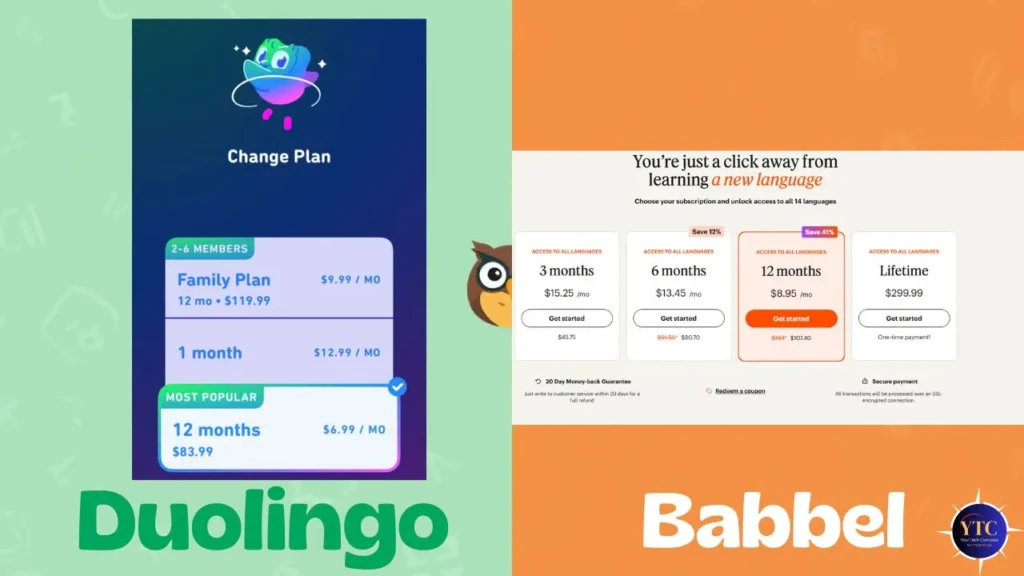
- Free: Fully functional with ads and an energy system limiting daily practice volume; genuinely usable for long-term learning, not just a trial.
- Super (Duolingo Plus): Approximately $12.99/month or $95.99/year (roughly $8/month); removes ads, removes the energy limit, adds personalized practice.
- Family Plan: Approximately $119.88/year for up to 6 members, meaningfully cheaper per person if you’re splitting it.
- Max: $29.99/month or $167.99/year; adds AI Video Call and Roleplay, currently limited to 5 languages on mobile.
Babbel Pricing
- Free: No meaningful free tier; only the first lesson of each language course is available without payment.
- 3-Month Plan: Approximately $15.25/month; the shortest available commitment as of 2026, since Babbel discontinued its 1-month option.
- 12-Month Plan: $8.95/month, billed as $107.40/year; Babbel’s default recommended plan and best ongoing value.
- Lifetime Plan: $299.99 one-time payment; covers every language Babbel offers and pays for itself versus the annual plan in under three years if you stick with it long-term.
- Babbel Live: Group video classes with real human teachers, starting at $99/month; a separate, considerably more expensive product from the standard self-study subscription.
The Honest Value Comparison
Scenario | Better Choice | Why |
You want to try language learning at zero cost | Duolingo | Genuinely usable free tier; Babbel’s free access is just one lesson |
You’re studying multiple languages | Duolingo | One subscription covers every language; Babbel charges per language |
You want AI speaking practice without a steep premium | Babbel | Babbel Speak is included standard; Duolingo’s AI Video Call costs $29.99/month |
You want the cheapest serious annual commitment | Duolingo Super | ~$96/year vs. Babbel’s ~$107/year |
You want lifetime access across all languages | Babbel | $299.99 one-time; Duolingo has no lifetime option |
You want explicit grammar instruction included by default | Babbel | Grammar is embedded in every lesson; no premium tier required |
Ease of Use and Platform Availability
Both Duolingo and Babbel are available on mobile and desktop, allowing learners to practice wherever they are. Duolingo’s interface emphasizes simplicity and engagement, making it easy for beginners to jump right in.
Babbel’s interface is similarly intuitive, though its structured nature might feel more like a traditional learning environment than a game. Both platforms offer offline access with paid plans, which adds convenience for studying on the go.
Who It’s Best For
Choose Duolingo if:
- You want a free or low-cost way to start learning
- You’re motivated by gamified rewards and daily streaks
- You plan to explore multiple languages casually
Choose Babbel if:
- You want structured lessons with explicit grammar explanations
- You’re focused on practical language use and conversation
- You are willing to pay for guided progression
Duolingo vs Babbel for Different Use Cases
- Absolute beginners generally find Duolingo’s playful, low-stakes format the gentlest possible introduction; there’s genuinely no pressure, and the free tier means there’s no financial commitment standing between curiosity and starting.
- Travelers preparing for a specific trip tend to get more practical value from Babbel, since its dialogue-based lessons and real-world phrase focus are built specifically around situations you’ll actually encounter: ordering food, asking directions, and checking into a hotel.
- Students and professionals working toward a measurable skill outcome (a certification, a work requirement, genuine conversational competence) generally benefit more from Babbel’s structured progression and explicit grammar instruction, which builds toward demonstrable competence rather than just app-based engagement metrics.
- Long-term fluency seekers will likely need to go beyond either app eventually, since both platforms (despite their real strengths) tend to plateau learners at an A2-equivalent level without supplementary real-conversation practice. Babbel’s depth gets you further along that path than Duolingo’s gamified repetition does, but neither fully replaces speaking with real people once you’ve outgrown the basics.
For learners building broader study habits alongside language practice, a fast capture tool like the one covered in our Google Keep guide is genuinely useful for jotting down new vocabulary or grammar notes the moment they come up, outside a structured lesson, in the middle of your day, before you forget them.
FAQs
Duolingo’s gamified, low-pressure format makes it easier to start without feeling intimidated, and its genuinely free tier removes any financial barrier to trying it. That said, some learners find that Babbel’s structured lessons promote better early retention, specifically because grammar concepts are explained rather than left to be inferred through repetition. If cost is your main concern, start with Duolingo’s free tier; if you’re ready to commit and want a more guided introduction, Babbel’s first free lesson in each language is worth trying too.
Duolingo can meaningfully improve reading and listening proficiency, with some studies showing results comparable to several semesters of formal coursework. However, achieving genuine conversational fluency typically requires supplementing Duolingo with real speaking practice (talking to native speakers, a tutor, or a dedicated conversation tool) since Duolingo’s core lesson structure emphasizes recognition and translation over producing original spoken language.
For learners specifically seeking structured grammar instruction and practical, real-world conversation skills, most users find Babbel’s subscription genuinely worthwhile, particularly because explicit grammar explanations and AI-powered speaking practice (Babbel Speak) are included as standard rather than gated behind an expensive premium tier. At $8.95/month on the 12-month plan, it’s a reasonable cost for the instructional depth it offers, though it requires a greater upfront financial commitment than Duolingo’s free option.
Babbel, fairly decisively. Its guided dialogues, scenario-based exercises, and the Babbel Speak AI conversation feature (included in every standard paid plan) offer considerably more practical speaking development than Duolingo’s basic speech recognition. Duolingo’s more advanced AI Video Call conversation feature does exist, but it’s locked behind the considerably more expensive Duolingo Max tier at $29.99/month.
Duolingo’s Super tier costs approximately $95.99/year ($8/month), while Babbel’s 12-month plan costs $107.40/year ($8.95/month), making them genuinely comparable at the entry paid tier. The bigger cost difference appears at the premium end: Duolingo Max costs $29.99/month for AI conversation features, while Babbel includes AI speaking practice in its standard plan. Babbel also offers a $299.99 lifetime option covering all languages, which Duolingo doesn’t offer.
Final Verdict: Duolingo vs Babbel
There’s no single winner in the Duolingo vs Babbel debate, and that’s not a hedge; it’s the honest conclusion of comparing two apps built for genuinely different jobs. Duolingo’s free, gamified model makes language learning accessible, low-pressure, and genuinely habit-forming, which matters enormously for learners whose biggest obstacle is simply showing up consistently. Babbel’s structured courses and embedded grammar instruction better support learners who are serious about measurable progress and real conversational ability, at a subscription cost that, while real, buys considerably more instructional depth than Duolingo’s equivalent tier.
The decision genuinely comes down to your specific goal. If low cost, breadth across multiple languages, and consistency matter most, Duolingo delivers strong, legitimate value, and its free tier alone is worth trying before you spend anything. If grammar depth, structured progression, and genuine conversational readiness are your priorities, Babbel’s subscription is considerably more likely to justify its cost, and its Lifetime plan is worth serious consideration if you know you’re committing for the long haul.
At Your Tech Compass, we publish detailed tech guides, reviews, and comparisons to help you choose the right tools for your goals, whether that’s learning a new language, organizing your day, or finding the software that actually fits how you work.