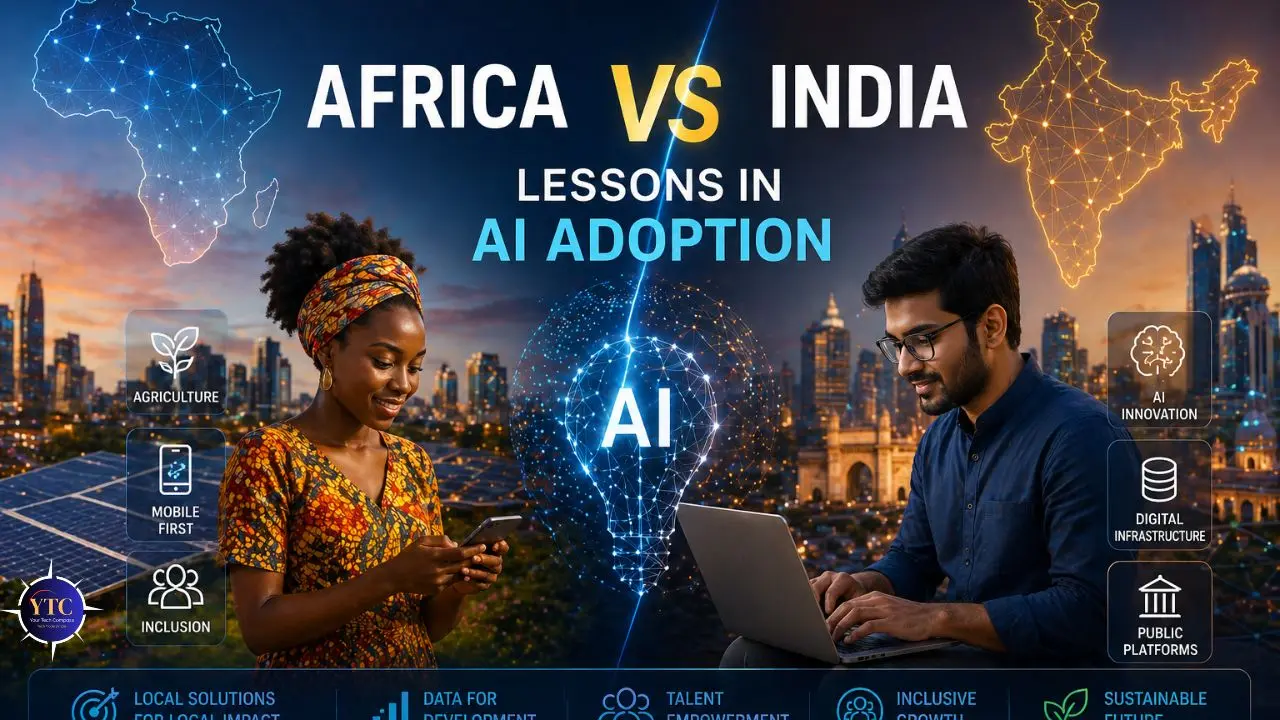
Two economies. Nearly three billion people between them. Both mobile-first. Both young. And they are racing to use artificial intelligence to solve problems that richer countries either don’t have or have already solved, with infrastructure that Africa and India never built. The comparison of AI adoption in Africa vs. India isn’t a story about who’s winning a technology race. It’s a story about two of the world’s most consequential digital experiments running simultaneously, each making choices that will shape not just their own futures, but the blueprint for how the Global South builds intelligent systems at scale.
Here’s what makes this comparison worth your time. India has a head start on a $22.8 billion AI market in 2025, according to Grand View Research (a government-backed IndiaAI Mission with $1.25 billion committed over five years), 600,000 AI professionals, and a sovereign digital identity and payments infrastructure that the IMF has called a global leading example. Africa has something different: 1.4 billion people, the world’s youngest population, a mobile-first architecture built without the legacy constraints that held back wealthier economies, and a community-driven AI research movement that is solving language problems the rest of the world hasn’t yet figured out. Neither story is complete without the other. This article is for you, whether you’re a policymaker, an investor, an AI researcher, a tech entrepreneur, or simply someone tracking where the next chapter of global AI is actually being written.
Setting the Stage: Two Giants, Two Paths
Before you can compare, you need a clear picture of where each ecosystem stands in 2026. Start with the numbers, but don’t stop there.
India’s AI market generated $22.8 billion in revenue in 2025 and is projected to reach $325 billion by 2033, growing at a CAGR of 38.1%. IBM data shows that 59% of enterprise-scale organizations in India already use AI, and government-cited NASSCOM data indicates that 87% of enterprises are actively using AI. Furthermore, the IndiaAI Mission, launched in March 2024 with a government commitment of about ₹10,372 crore, has onboarded over 38,000 GPUs at subsidized rates and approved or shortlisted around 30 AI applications across healthcare, agriculture, and governance by mid-2025. IndiaAI has also supported startup-led foundation model efforts, though the number of participating startups varies with each program update.
Africa’s AI market is growing quickly, and the African Union adopted its Continental AI Strategy in 2024 with a 2025–2030 implementation plan focused on infrastructure, governance, and skills. South Africa currently leads the continent in generative AI adoption, followed by Nigeria and Kenya, though exact percentages vary by source and reporting date.
The most important structural difference between the two is that India operates as a single regulatory environment. Africa, on the other hand, operates as 54. That single fact shapes everything: the speed of policy implementation, the cost of cross-border AI deployment, the ability to train models on data from a single coherent digital ecosystem.
That said, both share critical conditions: large unbanked and underserved populations, mobile-first connectivity, overwhelming youth demographics, and significant infrastructure gaps outside major cities. The framework for this comparison isn’t “who’s ahead.” It’s “what can each teach the other,” because the lessons run in both directions.
Where India Leads: What Africa Can Learn
India’s advantages in AI adoption are real, specific, and instructive. Here’s what Africa should be paying close attention to.
Digital Public Infrastructure as AI’s Foundation
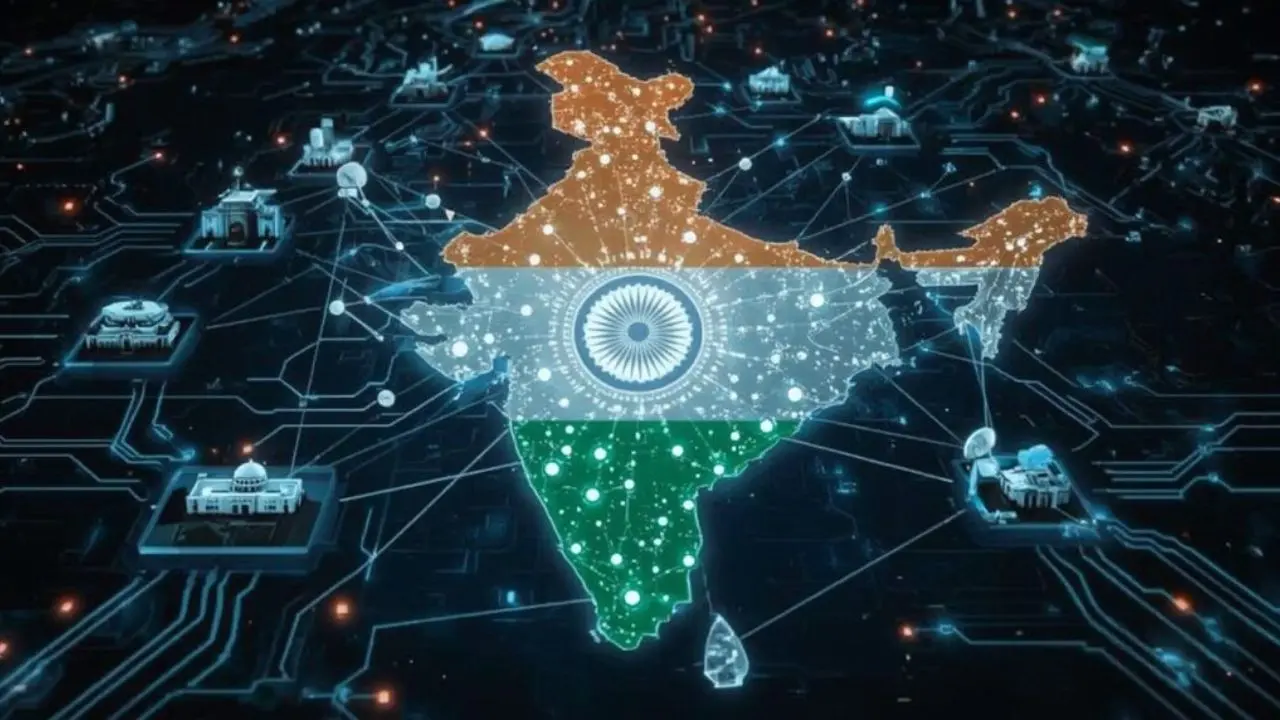
This is India’s single most transferable lesson, and arguably the most important thing any developing economy can learn about building AI at scale. India’s Digital Public Infrastructure (DPI) stack, Aadhaar (1.4 billion biometric digital identities), UPI (a real-time payment interface that has processed over 15,223 crore transactions since inception), DigiLocker, and the Open Network for Digital Commerce (ONDC) provide the data rails that make AI both useful and trustworthy.
Aadhaar alone powers over 2,240 government welfare schemes. UPI has made India’s default payment system one of the most sophisticated in the world, and it’s being exported.
During PM Modi’s 2025 visit to Ghana, India committed to sharing UPI expertise with the country, while Uganda, Rwanda, and Mozambique have all expressed interest. Furthermore, nine of the eleven countries that have implemented MOSIP, the Modular Open-Source Identity Platform inspired by Aadhaar, are in Africa.
That shows Africa already sees the value of India’s DPI model. The lesson isn’t just to adopt it; it’s to prioritize it. The World Economic Forum’s April 2026 analysis put it plainly: without DPI, nations risk becoming dependent on foreign large language models for AI, a form of digital colonialism. AI is only as powerful as the data rails beneath it. India built those rails first and is now reaping the compounding benefits.
The IndiaAI Mission: Government Backing at Scale
India’s government didn’t just talk about AI. It committed $1.25 billion, created a dedicated implementation body under the Ministry of Electronics and IT, built subsidized GPU infrastructure at ₹65 per hour, and established 31 AI labs in Tier 2 and Tier 3 cities.
Furthermore, the IndiaAI Mission is funding AI talent development through fellowships and research support, while AIKosh provides a national repository of AI-ready datasets, models, and tools for developers. Publicly reported counts have varied over time, ranging from 1,200+ datasets and 217 models in earlier government materials to 10,000+ datasets and nearly 300 models in later reporting.
Africa’s AU Continental AI Strategy is a genuine and important policy document. However, the gap between a continental strategy and a funded national mission with subsidized GPU compute, dedicated implementation bodies, and sector-specific AI applications is significant.
The lesson for African governments is specific: don’t just write the strategy; fund the infrastructure. Rwanda and Kenya are closest to demonstrating what committed national AI investment looks like. The rest of the continent needs to follow their lead with equal conviction.
Talent Pipeline at Scale
India’s IITs, IISc, and 600,000-strong AI professional community feed a global ecosystem that is now starting to reinvest domestically. The talent flywheel (Indian engineers train at world-class institutions, join global AI labs, build capital and networks, then return to build Indian AI companies) is producing compounding returns.
Bengaluru, Hyderabad, and Mumbai have the VC infrastructure, accelerator culture, and talent density to sustain serious AI startups. Moreover, AI4Bharat’s IndicTrans2 model, trained on 22 Indian languages, outperforms many global models on local-language tasks, demonstrating that building domestic talent and tools for domestic problems works.
Africa has Zindi, ALX Africa, and the Deep Learning Indaba, producing trained AI practitioners with strong employment outcomes. But the continent currently holds only 3% of global AI talent, and brain drain to foreign employers remains severe. The lesson from India is clear: invest aggressively in AI education, build it into universities at scale, and create enough domestic opportunities to retain the talent you’re producing.
Where Africa Leads: What India Can Learn

This section deserves equal weight because Africa’s advantages are genuine and underappreciated by most global AI discourse.
Mobile-First Architecture as a Distribution Advantage
Africa didn’t build AI on top of legacy banking, desktop-first internet, or physical branch networks. It built financial and social infrastructure on mobile from day one, and that architectural choice is now an advantage in AI distribution.
When Kenya’s Jacaranda Health uses AI to deliver personalized maternal health advice via SMS, it reaches women in remote areas without requiring a smartphone, a data plan, or a clinic visit. When Apollo Agriculture in Kenya uses AI credit scoring to extend loans to smallholder farmers, it relies on mobile transaction history rather than credit bureau reports, which don’t exist.
India’s Jan Dhan–UPI–Aadhaar stack has made enormous progress on financial inclusion. However, India still has hundreds of millions of people who have not yet been meaningfully reached by AI-driven services in their local languages on the devices they actually use.
Africa’s constraint-first design philosophy (build for the lowest common denominator of connectivity and literacy, or don’t build at all) produces AI tools that are more robust, more accessible, and more universally applicable than tools designed for resource-rich environments. Moreover, this is directly relevant to India’s own challenge of reaching its 490 million informal workers, who NITI Aayog’s October 2025 report identified as the primary target for AI-driven inclusion.
Community-Driven AI Research: The Masakhane Model
Here is something specific that Indian AI researchers have explicitly said Africa does better. A Telangana Today analysis published in April 2026 described Masakhane’s community-driven model as “the most transferable model for India” in the context of its language data challenge.
Masakhane built open-source models and datasets for over 50 African languages by training and paying local community speakers to label data in their own languages. The results outperformed centralized outsourced labeling because the annotators understood the cultural context behind the words, not just the literal translation.
India’s AI4Bharat has gathered 15,000 hours of transcribed data across 22 scheduled languages, and BharatGen is building a multimodal LLM for all 22. That’s significant work. But India’s language AI is largely driven by institutional and corporate actors, including IIT Bombay, government-backed consortia, and venture-backed startups.
Africa’s Masakhane, by contrast, operates as a decentralized network of volunteers and researchers, with 400+ open-source models, 20+ African-language datasets, and a governance philosophy that centers community ownership. Additionally, Lelapa AI’s InkubaLM, with only 0.4 billion parameters, performs comparably to much larger models because it was built for efficiency from the ground up.
Both India and Africa are tackling the same language problem. Africa’s community-driven, open-source, efficiency-first approach has produced lessons that India’s more institutional model would benefit from adopting.
Regulatory Sandbox Culture
Rwanda, Kenya, and Ghana have built regulatory environments that move faster than almost any comparable economy at their income level. Rwanda’s National Bank sandbox has been operational since 2020. Kenya’s CBK has consistently been among the first central banks globally to formalize frameworks for mobile money, digital credit, and now AI-adjacent fintech. These aren’t just policy wins; they represent a cultural openness to letting technology prove itself in a controlled environment before being locked into rigid compliance frameworks.
India’s regulatory environment is improving; the IndiaAI Mission has initiated 13 responsible AI projects, including bias mitigation and explainability, but its broader bureaucratic culture moves more slowly. Fintech regulation in India has historically been reactive rather than proactive, and the institutional weight of NITI Aayog and multiple ministries creates coordination friction.
Consequently, the lesson for India is specific: invest in the kind of nimble, testbed-first regulatory culture that Africa’s best markets have built. The window to shape AI governance thoughtfully is closing fast.
AI for Agriculture: Parallel Struggles, Different Tools
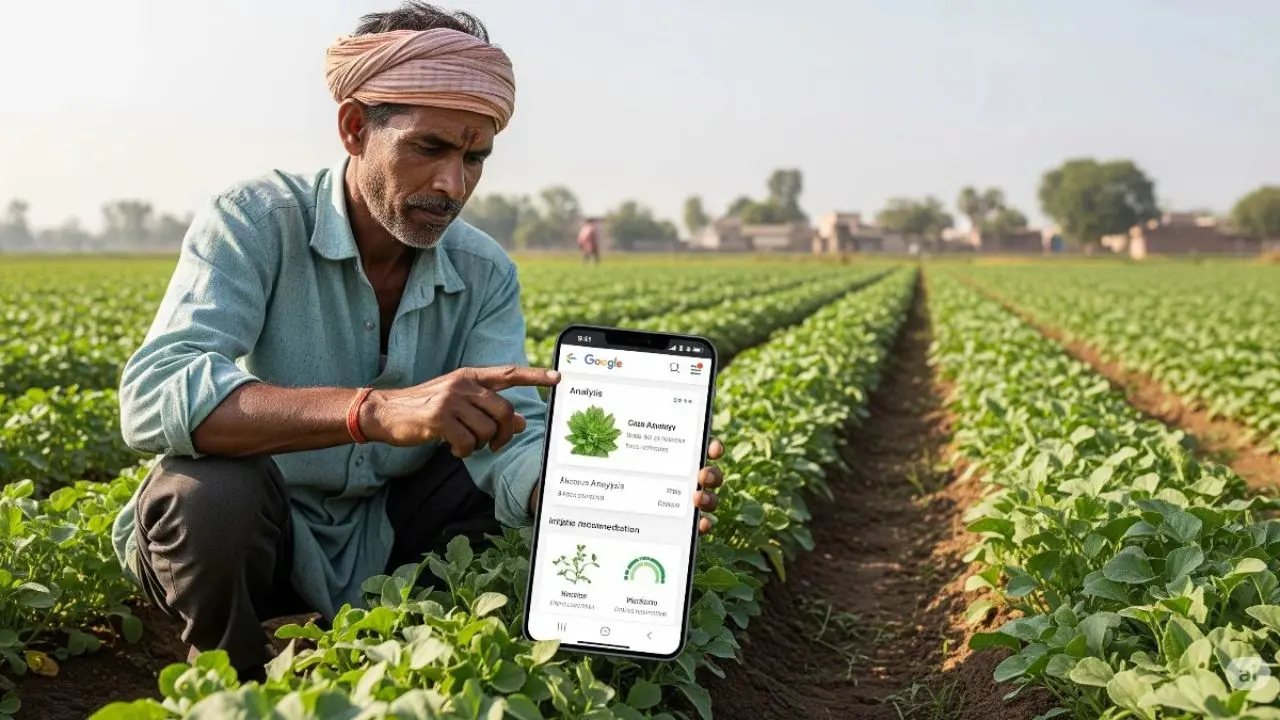
Agriculture is where both ecosystems face their most urgent AI challenge, and where the cross-pollination opportunity is most obvious.
Agriculture contributes approximately 20% of India’s GDP and absorbs roughly 50% of its labor force. Across Africa, the sector employs over 60% of the workforce and contributes about 23% of continental GDP. Both have large populations of smallholder farmers who lack access to the data-driven tools used by large commercial operations. Furthermore, both face the same fundamental barrier: getting AI-generated advice to farmers who may be semi-literate, who operate in local languages, and who access the internet on basic phones with intermittent connectivity.
India’s approach has been government-backed and multilingual. The Kisan AI initiative delivers crop advisory chatbots in Hindi and regional languages. AI4Bharat’s Jugalbandi chatbot answers questions about welfare schemes across Indian languages via WhatsApp, a genuinely clever distribution choice, given that WhatsApp reaches 500 million people in India.
Startups like CropIn and Fasal use satellite imagery and AI to predict yields and advise on irrigation. Moreover, AI data centers are projected to consume 3–5% of India’s total power grid by 2027, underscoring the scale of infrastructure investment in agricultural AI.
Africa’s approach, as you’ve seen in our AI in Africa guide, is more mobile-first and more constraint-driven. Apollo Agriculture’s AI credit model is built for farmers who have never spoken to a lender. Additionally, Aerobotics’ 95% yield-estimation accuracy is based on drone-mounted computer vision accessible to commercial farmers.
Furthermore, Zindi’s agricultural competitions channel African data scientists toward food security problems. The common gap in both ecosystems is the same: last-mile trust.
Farmers in Punjab and farmers in western Kenya share a healthy skepticism toward advice from a machine they can’t interrogate. Building that trust through consistent accuracy, local-language delivery, and visible economic benefit is the work that neither ecosystem has fully solved.
AI for Healthcare: Where Both Are Experimenting

Healthcare is the sector where both India and Africa are demonstrating that AI built for resource-constrained environments can genuinely save lives.
India’s healthcare AI ecosystem is among the most sophisticated in any developing economy. Qure.ai has deployed AI radiology tools in over 70 countries, including multiple African markets, reading chest X-rays and CT scans faster and more accurately than many human radiologists in under-resourced settings.
Niramai uses thermal imaging and AI to detect breast cancer without radiation, particularly important in markets where mammography infrastructure is sparse. Furthermore, eSanjeevani, India’s government-backed telemedicine platform, has crossed 250 million consultations (the largest public telemedicine program in the world) and is increasingly integrating AI triage into its workflow. Consequently, India’s healthcare AI is becoming a genuine export, with tools designed for Indian conditions finding direct application in Africa.
Africa’s healthcare AI, as explored in our AI in Africa coverage, is built for an even more extreme version of the same constraint. Ubenwa diagnoses birth asphyxia via smartphone audio; no specialist required, no hospital equipment needed. And Jacaranda Health’s PROMPTS platform delivers AI-driven maternal health advice via SMS to rural Kenyan women who may never see an obstetrician.
Aga Khan University Hospital (AKUH) in Nairobi, Kenya, launched an AI-powered radiotherapy system in 2026, expanding access to cancer treatment where it previously didn’t exist. The key distinction is architectural depth: India’s tools are increasingly sophisticated and designed for semi-urban settings with some infrastructure in place.
Africa’s tools are designed for genuinely zero-resource environments, which makes them, paradoxically, more universally applicable. The lesson flows both ways: India should adopt Africa’s constraint-first design philosophy for its last-mile populations, and Africa should leverage India’s more mature diagnostic AI tools that are already designed for low-resource settings.
The Language Problem: A Shared Crisis With Different Urgency

This is the issue where Africa and India are both fighting the same battle, but with different levels of urgency and different strategic approaches.
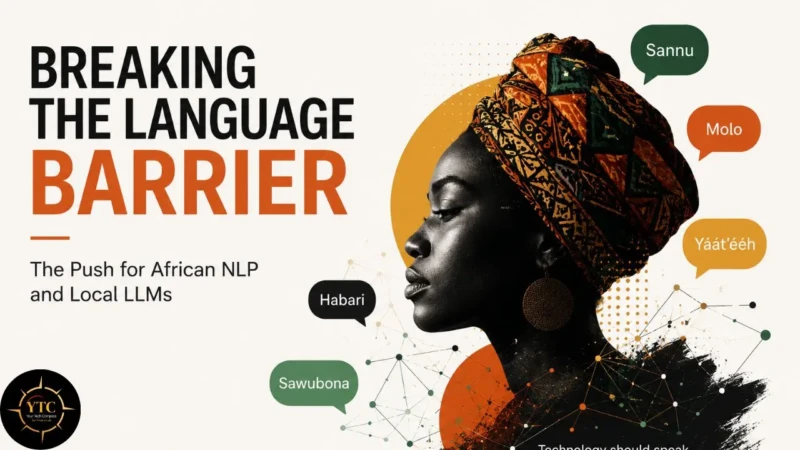
India has 22 official languages and more than 780 dialects. Africa has over 2,000 languages. Both ecosystems face the same foundational problem: the overwhelming majority of AI training data exists in English, which means AI systems are significantly less capable, or entirely nonfunctional, for users in local languages. This isn’t a niche academic concern. It directly determines whether AI-powered healthcare chatbots, agricultural advisory tools, and government services reach the people who need them most.
India’s institutional response has been impressive at the research level. AI4Bharat’s IndicTrans2 covers 22 scheduled languages. BharatGen is building India’s first government-funded multimodal LLM. Sarvam AI’s Vikram model, with 35 billion parameters, was unveiled at a major AI summit.
India’s Bhashini initiative provides AI-enabled multilingual and voice support, integrated directly with Aadhaar, UPI, and DigiLocker, thereby embedding language AI in the core DPI stack. Moreover, Indian researchers at universities and startups are playing an increasingly important role in shaping multilingual AI globally: techniques refined in India for multilingual embeddings and mixed-language understanding are being reused across markets from Southeast Asia to Africa.
Africa’s response differs in structure and is arguably more globally instructive. Masakhane has built over 400 open-source models and 20+ datasets for African languages through a decentralized, community-driven model.
Lelapa AI’s InkubaLM achieves performance comparable to much larger models with just 0.4 billion parameters because it was built for efficiency from the start, not scaled down from a bloated architecture. Furthermore, a Telangana Today analysis explicitly named Masakhane as “the most transferable model for India,” recommending that India adopt Africa’s community-annotation approach to address its own data scarcity.
The mutual lesson is stark: neither ecosystem can afford to let English dominate its AI future. The models being built in Johannesburg and Nairobi will matter as much for the Global South as those being built in Bengaluru, and both need each other’s methodologies.
Language AI Comparison
Dimension | India | Africa |
Official Languages | 22 official + 780 dialects | 2,000+ languages |
Key Initiative | AI4Bharat, BharatGen, Bhashini | Masakhane, Lelapa AI, GSMA collaboration |
Model Architecture | Institutional, large-scale (Vikram: 35B params) | Efficiency-first (InkubaLM: 0.4B params) |
Research Model | University + government-backed | Community-driven, open-source |
Languages Covered | 22 scheduled languages | 50+ African languages (Masakhane) |
Integration with DPI | ✅ Embedded in Aadhaar, UPI, DigiLocker | ⚠️ Partial (varies by country) |
Global Transferability | High (multilingual embedding techniques) | Very high (community model replicable globally) |
Infrastructure and Compute: The Hard Reality

Neither ecosystem has solved the compute problem. But the gap between them is significant and honest.
India has made major progress on AI infrastructure. The IndiaAI Mission has onboarded over 38,000 GPUs for developers at subsidized rates, and the Adani Group has announced a $100 billion AI-ready data center investment plan through 2035.
India was expected to commission 45 new data centers in 2025 alone, adding over 1,000 megawatts of capacity. Furthermore, the IndiaAI Mission aims to reach a national GPU capacity of 58,000+. In terms of electricity (the foundational requirement for AI infrastructure), India has achieved approximately 99% electrification. That’s not a minor advantage. Reliable power is the prerequisite for everything else.
Africa’s computing situation is dramatically more constrained. As you can read in our AI in Africa breakdown, recent reports put the continent at about 0.6% of global data-center capacity despite housing roughly 18%–20% of the world’s population.
African AI innovators also face an unmet training demand of over 7 million GPU hours over the next three years, while access to electricity remains a major structural constraint. Partnerships like Cassava Technologies with NVIDIA and IXAfrica with Safaricom are helping close the gap, but Africa’s best near-term strategy is to build efficient models, improve energy infrastructure, and expand distributed, energy-aware compute rather than replicate data-center density too quickly.
The key lesson here for Africa is architectural: build for small, efficient models that don’t require the infrastructure Africa doesn’t yet have. Lelapa AI’s 0.4-billion-parameter InkubaLM, which performs comparably to much larger models, isn’t just a research achievement; it’s a blueprint for how Africa should approach AI development until its infrastructure catches up. India’s push for large-scale GPU infrastructure is appropriate for its stage of development. Africa’s equivalent investment should be in energy infrastructure and distributed, energy-efficient compute, not in replicating data center density that requires power grids the continent is still building.
Policy and Governance: Who’s Moving Faster?

Policy is where the comparison gets most nuanced, because both ecosystems have genuine strengths and genuine blind spots.
India’s national AI governance is more centralized and institutionally developed than most peers, with IndiaAI as the implementing mission and NITI Aayog’s 2025 roadmap targeting India’s 490 million informal workers. The Safe & Trusted AI pillar has already approved 13 Responsible AI projects spanning bias mitigation, explainability, privacy-preserving ML, deepfake detection, and governance testing. That said, India’s formal regulatory standards are still evolving, and implementation at the ground level remains uneven. Africa’s governance picture is more heterogeneous: some countries have nimble, innovation-friendly frameworks, while others are still building the basics.
Kenya’s regulatory approach to mobile money, detailed in our mobile money Africa guide, is a global case study in progressive financial regulation. However, the continental story is more fragmented. The AU Continental AI Strategy is real, but harmonizing 54 different national frameworks is a multi-decade project. Consequently, what Rwanda does well tomorrow, a larger market may not implement for years.
The Honest Comparison
India has more coherent national AI governance; Africa has more innovative and faster-moving country-level implementation. Both need ethical AI frameworks that reflect their specific populations, and the Global DPI Summit in Cape Town in November 2025 and the AI Impact Summit in New Delhi in February 2026 both flagged the same warning: models trained on skewed DPI datasets risk amplifying existing biases.
Neither ecosystem has fully cracked this. The window to get governance right before harm occurs is closing for both.
The Talent Story: Brain Drain, Diaspora, and the Flywheel

Talent is where the gap between India and Africa is most visible, and where Africa’s path forward is clearest.
India’s talent flywheel is the envy of every emerging economy. IIT and IISc graduates feed Google, Meta, OpenAI, and Microsoft. They build capital, networks, and expertise. Then, increasingly, they return to build Sarvam AI, Gnani AI, and hundreds of other Indian AI companies.
The diaspora effect is compounding: India’s diaspora remittance is the world’s largest at over $120 billion annually, and a meaningful share of that capital is flowing into domestic tech investment. Furthermore, India’s 17 million active developers (having added 5.2 million in the last year alone) represent a massive, low-cost R&D capacity for global AI applications. The flywheel turns faster every year.
Africa’s talent flywheel is earlier in its rotation, but it’s turning. The continent currently holds 3% of global AI talent, a number that understates actual capability, because African talent is significantly undercounted in global indices.
Masakhane’s decentralized research network, the Deep Learning Indaba’s annual conference, Zindi’s 50,000+ data scientists, and ALX Africa’s training programs with 85% employment rates are all building the pipeline. Additionally, LemFi’s £100 million UK investment commitment and Moniepoint’s expansion of its London team, as discussed in our coverage of African fintech startups, show that African tech companies are building the international footprint that creates diaspora networks.
Africa’s diaspora remittances have grown to nearly $97 billion annually and represent the fastest-growing remittance market in the world. That capital, channeled into AI education and research, can dramatically accelerate the talent flywheel.
FAQs
India is ahead in absolute terms, with a larger market, more developed infrastructure, a deeper talent pool, and a more mature government AI strategy. India’s AI market generated $22.8 billion in 2025, compared with Africa’s $4.5 billion, and India’s enterprise AI adoption rate significantly exceeds that of Africa’s best-performing markets. However, “more advanced” doesn’t tell the whole story. Africa leads in mobile-first AI deployment, community-driven language AI research, and constraint-driven tool design. In specific areas such as open-source multilingual NLP and AI for zero-resource healthcare environments, African researchers are producing globally relevant work that India is explicitly seeking to replicate.
Three things above all. First: invest in sovereign digital identity and payments infrastructure before anything else; AI is only as powerful as the data rails beneath it. Second: fund AI development at the national government level with specific, measurable commitments. A Continental AI Strategy is a starting point, not an end point. Third: build the talent flywheel deliberately: AI education in universities, PhD fellowships, and diaspora engagement programs that bring skills back rather than letting them compound elsewhere.
Also, three things. First: adopt community-driven, culturally grounded data annotation for local languages. Masakhane’s model is explicitly more accurate than centralized outsourcing. Second: building AI tools from a constraint-first philosophy (designing for the most limited connectivity and literacy first) produces more universally applicable products. Third: invest in the nimble, sandbox-first regulatory culture that Rwanda and Kenya have built; it moves faster and causes less friction than reactive, top-down regulatory frameworks.
South Africa is the closest in terms of infrastructure, with AWS and Azure present, 74.7% internet penetration, and a 21.1% AI adoption rate. Kenya is closest in terms of regulatory sophistication, mobile-first AI application, and the depth of its startup ecosystem. Rwanda is closest in terms of government AI strategy and regulatory friendliness. None of Africa’s individual markets yet matches India’s combination of infrastructure scale, talent depth, and government investment, but South Africa, Kenya, and Rwanda together represent what India-level AI development looks like at an African country scale.
Conclusion
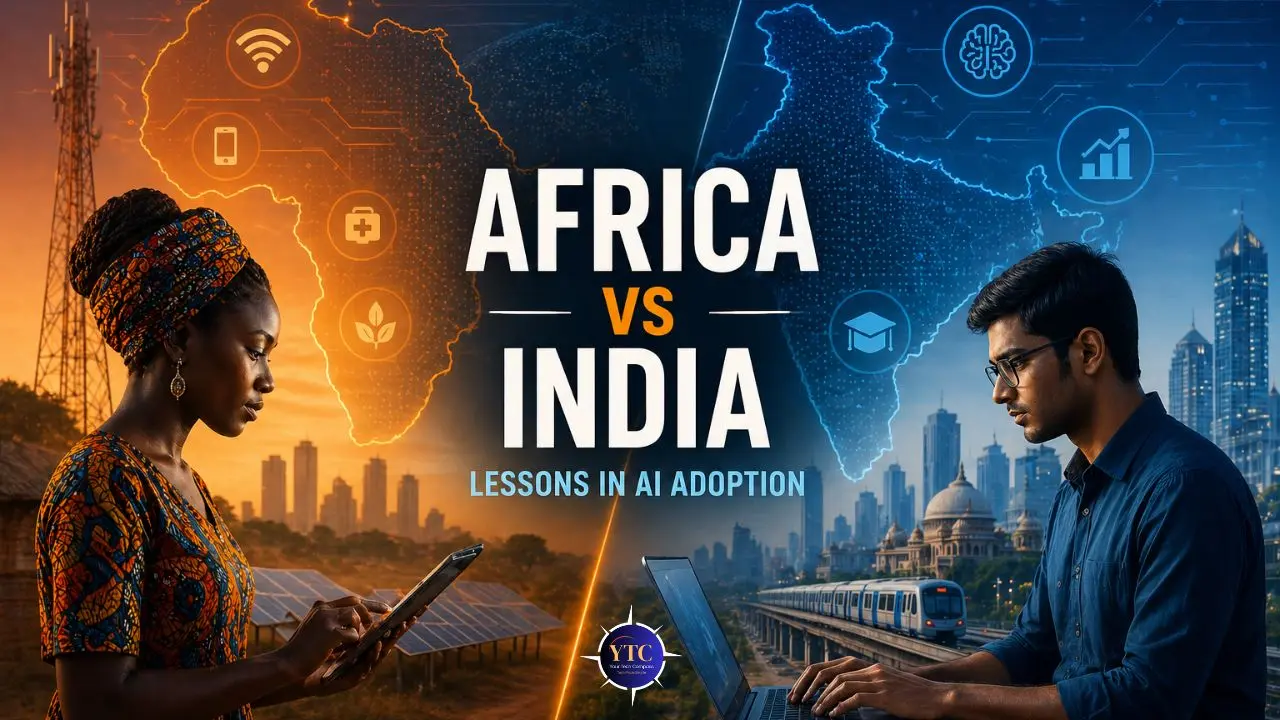
The comparison of AI adoption in Africa and India ultimately reveals something more important than a ranking. It reveals a design philosophy. India chose to build sovereign digital infrastructure first (identity, payments, data exchange), and is now layering AI on top of a foundation that no other developing economy has replicated at the same scale. That foundation gives Indian AI data richness, distribution reach, and governance coherence that Africa’s more fragmented ecosystem is still building toward. Furthermore, India’s talent scale, government commitment, and institutional research capacity mean it will continue to pull ahead in absolute market terms for the foreseeable future. If you’re building AI infrastructure policy in Africa, India’s playbook is the most relevant global model available.
But Africa is doing something that India has not yet replicated, and that the rest of the world is beginning to notice. It is building AI from constraint, not from abundance. It is also about building small, efficient, community-owned language models. It is designing healthcare tools for genuinely zero-resource environments. And it is running the world’s most important experiment on whether AI can be built by a community, for a community, and owned by a community, not just deployed to a community from a foreign cloud server. Consequently, the next chapter of global AI will not be written only in Bengaluru or Nairobi. It will be written in the space where both ecosystems learn from each other, where India’s infrastructure scale meets Africa’s constraint-first ingenuity, and where the result is AI that actually works for the three billion people these two economies represent.
The conversation between Africa and India on AI is just beginning, and you’re in a position to follow it more closely than most. Bookmark Your Tech Compass, stay current on what’s being built across emerging markets, and keep asking the question that matters: not who’s winning the AI race, but who’s building AI that actually works for everyone.