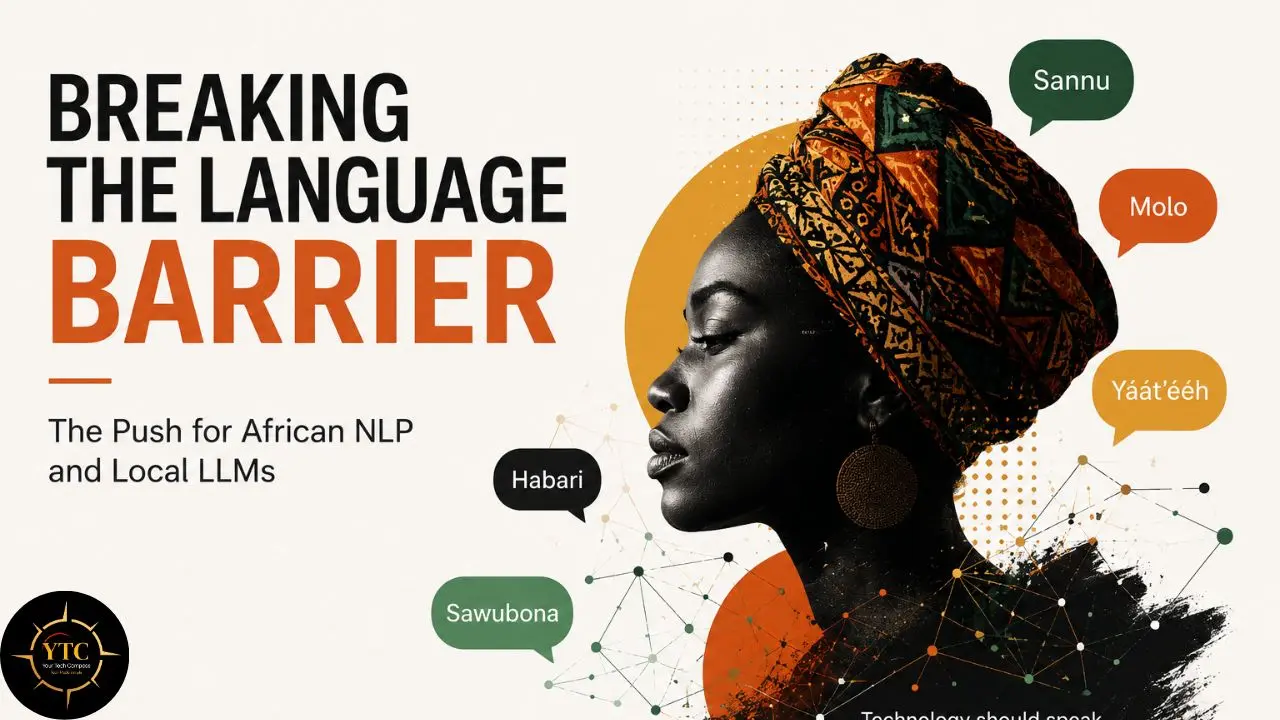
Africa is home to roughly 2,000 languages, making it one of the most linguistically diverse regions in the world. Yet only a small share of those languages is meaningfully represented in modern AI systems. The frontier models behind today’s AI boom were trained predominantly on English-language data, while African languages remain vastly underrepresented in the web-scale corpora that feed many large language models. As a result, users asking questions in Hausa, Tigrinya, Amharic, Wolof, or other African languages often get weaker performance than English speakers, and research consistently shows that multilingual models still lag on low-resource languages. This isn’t a perception gap. It’s a performance gap that researchers have documented consistently across multilingual benchmarks.
I want to be direct about why this matters beyond cultural representation, because the economic and social consequences of AI language exclusion are concrete and costly. When healthcare diagnostic AI systems can’t interpret patient descriptions in local languages, they can’t be deployed at the primary care level in most of Africa. When agricultural advisory AI can’t communicate in Hausa or Shona, smallholder farmers (the majority of Africa’s food producers) can’t access its recommendations. When government service chatbots can’t handle Amharic or Wolof, digital public service delivery remains accessible only to the minority who are fluent in colonial-legacy languages. African languages remain underrepresented due to data scarcity, tokenization inefficiencies, and bias in AI models, and the organizations trying to fix this are building the linguistic infrastructure that determines whether AI’s economic benefits reach all of Africa or only a privileged subset. This guide covers who those organizations are, what they’re building, where the remaining gaps are, and what the realistic timeline looks like for African-language AI to reach production-grade quality across priority use cases.
The Scale of the Problem: Why AI and African Languages Don’t Talk to Each Other
Before the solutions make sense, you need to understand the structural causes of the data gap, because the reason a given model works in Swahili but fails in Yoruba or Tigrinya almost always traces directly back to one of these underlying factors.
The Data Imbalance: The Numbers Behind the Gap
The quantitative reality of training data distribution is stark and specific. English Wikipedia contains millions of articles, while Yoruba, Hausa, and Swahili Wikipedias contain only tens of thousands each, highlighting how much less digital text is available for many African languages. That imbalance is reflected in broader LLM training corpora, where high-resource languages dominate, and many African languages remain underrepresented.
Even Swahili performs relatively better than most African languages in frontier models because it has a stronger digital footprint, a long written tradition, a wider diaspora presence, and official recognition by international institutions. For the other 1,900-plus African languages, the situation ranges from very limited to effectively zero.
The quality gap compounds the quantity gap in genuinely important ways. Even where African-language data exists, critical gaps persist, particularly in healthcare, where accuracy and trust are essential.
Machine-translated content, multilingual pages where the African-language portion is minimal, and scraped content from outdated digitization projects can degrade model performance on a specific language rather than improve it. A genuinely trained Swahili model often outperforms a large multilingual frontier model on Swahili-specific tasks precisely because it was trained on clean, native-speaker text rather than machine-translated English.
Why the Data Gap Exists: The Structural Causes
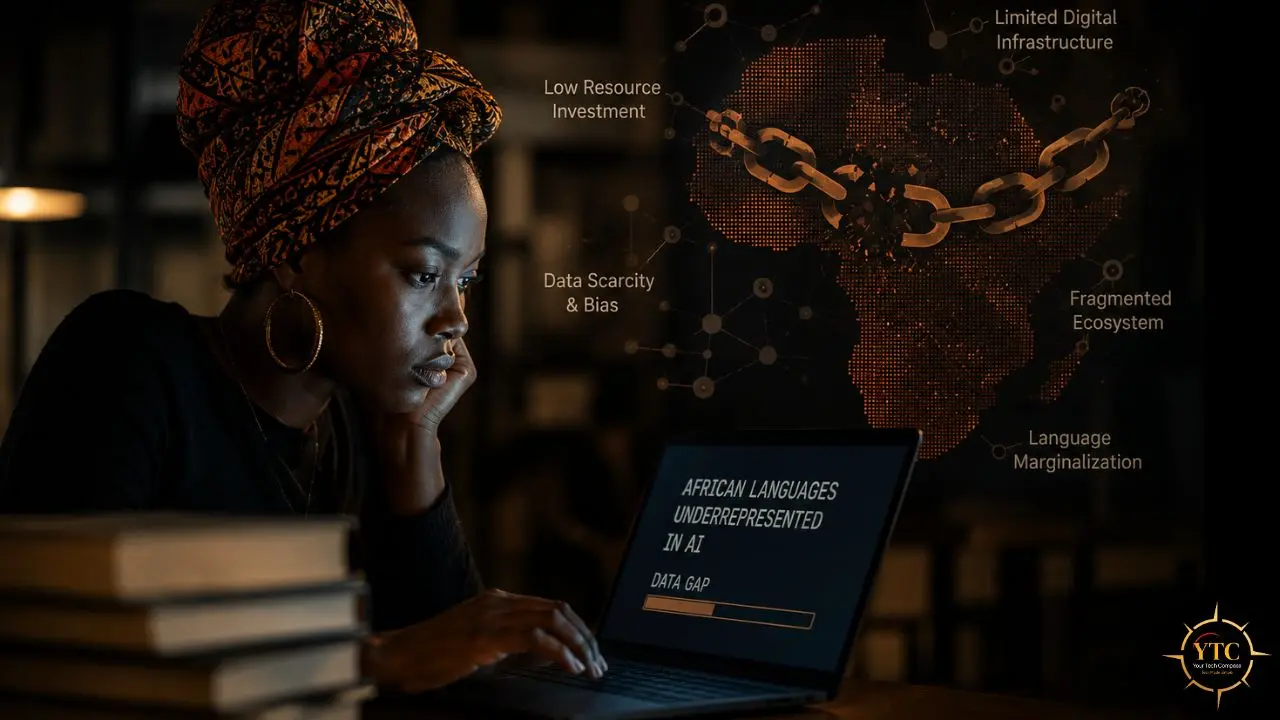
Understanding why the data gap is so persistent helps explain both why it won’t close on its own and why specific interventions are required.
Oral Language Tradition
Many African languages have primarily oral rather than written traditions. Zulu, Xhosa, and many West African languages accumulated centuries of cultural knowledge in oral form, meaning there is no equivalent of the English internet to scrape, no archive of digitized books, no database of digitized newspapers going back generations.
Colonial-Era Language Politics
Official written records, government documents, educational curricula, and formal media were produced in European languages, such as French, English, Portuguese, and Afrikaans, across much of Africa for decades. As a result, the written record that exists in digital form is disproportionately in colonial languages rather than in the languages most Africans speak at home.
Script Complexity
Some African languages use scripts that don’t map cleanly to standard Unicode processing. Ge’ez (the script for Amharic and Tigrinya) and N’Ko (used for Manding languages in West Africa) pose OCR and text-processing challenges that don’t exist for Latin-script languages, making digitization and dataset creation more labor-intensive.
Tonal Language Complexity
Many African languages are tonal; Yoruba, Igbo, and most Bantu languages encode meaning through pitch variation. Standard ASR and TTS systems built for non-tonal languages fail significantly on tonal languages, and the diacritic marks used to indicate tone in written Yoruba are frequently dropped in digitally produced text because mobile keyboards and standard input methods don’t support them easily.
Dialect Variation
What’s labeled “Hausa” or “Arabic (Moroccan)”, or even a standardized language variety in another African context, often does not transfer cleanly to the specific variety spoken by your target users. The gap between literary or standardized forms and living vernacular speech is significant in many African languages.
The Consequence for AI Applications in Africa
The real-world failures are specific and worth naming. Medical AI that can’t accept a patient’s history in the patient’s local language in front of you can’t be deployed at the primary care level, and primary care is exactly where AI’s leverage is highest in Africa’s healthcare system, as explored in our AI Healthtech Startups Africa guide.
Chatbot-based financial services that operate only in English limit access to the formal economy for rural and peri-urban populations, whose financial inclusion would drive the greatest economic impact. Agricultural advisory systems requiring English literacy reach the educated urban minority, not the smallholder majority whose productivity AI could most dramatically improve, a gap our AI precision farming in Africa and AI cocoa farming in West Africa guides document in specific crop and region contexts.
AI language exclusion is not a diversity problem with an optional solution. It’s an infrastructure problem with direct, measurable economic consequences.
The Dataset Layer: Building the Foundation
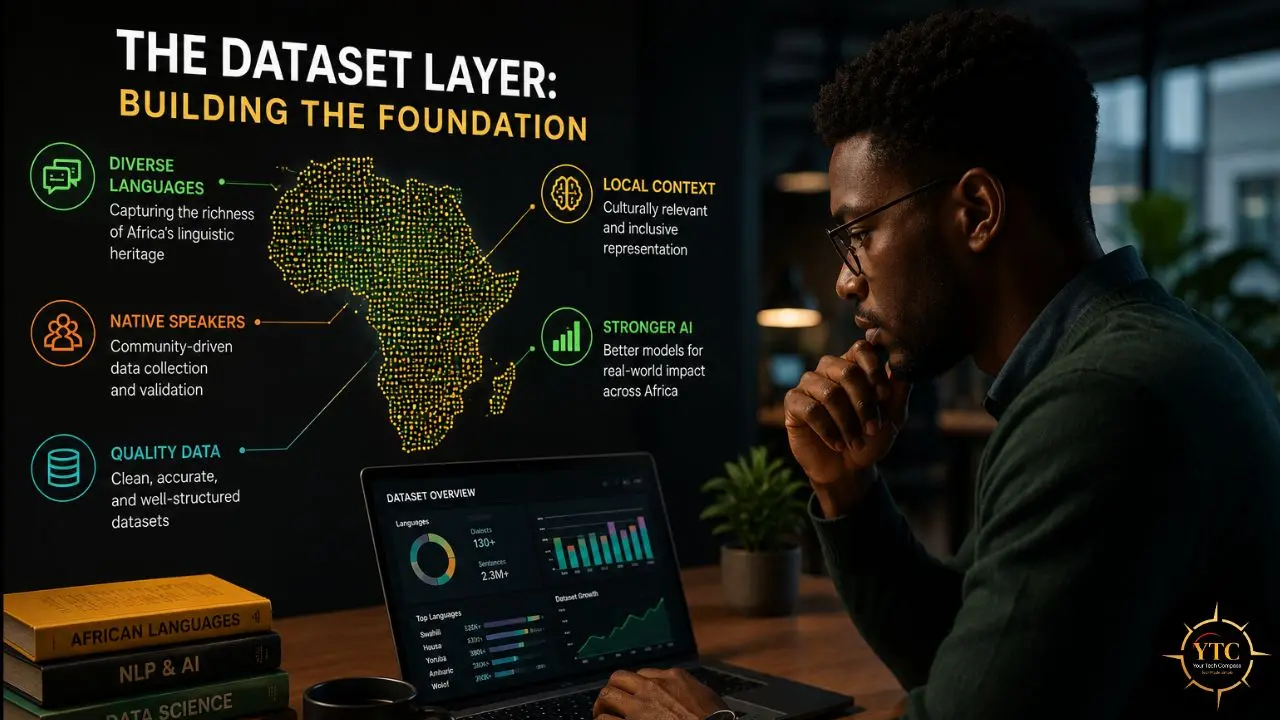
No model is better than its training data. Before discussing models, you need to understand who is actually doing the foundational dataset work that makes everything else possible.
Masakhane: The Research Consortium That Started the Community
Masakhane is a pan-African NLP research community whose mission is to bring African languages into mainstream NLP research. Africa’s linguistic landscape is one of the richest in the world, with over 2,000 languages and dialects spoken across the continent. This diversity creates a unique environment for innovation in natural language technologies.
Founded in 2019, Masakhane has grown into a broad research network working across many African countries and languages. The community’s approach is deliberately open-source and community-first: datasets are publicly released to create a commons that both commercial organizations and independent researchers can build on.
The datasets Masakhane has produced form an important foundation for modern African NLP. Prominent initiatives include MasakhaNER, which provides named entity recognition annotations for African languages; AfriSenti, which supports sentiment analysis across multiple African languages; MASAKHANEWS, which enables news classification in several African languages; MasakhaSent, which provides sentiment analysis benchmarks; MAFAND, which covers translation between English and African languages; and AfriSpeech, which supports speech recognition research for African-accented speech.
Beyond the datasets themselves, Masakhane’s broader impact has been to help establish African NLP as a serious research area. Its community members have received recognition at major NLP venues, helping attract more institutional attention and new researchers to the field.
Mozilla Common Voice: Spoken Language Infrastructure
Mozilla’s Common Voice project runs crowdsourced voice data collection campaigns for African languages, gathering recorded speech samples from volunteer contributors and validating the quality of these samples. Kinyarwanda is one of Common Voice’s major African-language success stories, with more than 2,000 hours of validated speech in recent releases, making it among the largest publicly available Kinyarwanda speech datasets, according to Mozilla’s documentation.
For languages like Swahili, Common Voice campaigns provide the transcribed speech data required to train ASR systems that understand real human speech, a prerequisite for voice-enabled applications that need to serve speakers of those languages.
The Lacuna Fund and Dataset Funding Infrastructure
The Lacuna Fund is a collaborative initiative funding the creation of labeled datasets in Global South languages, specifically addressing the labeled data gap. The difference between raw text and text annotated for specific NLP tasks, such as entity recognition, sentiment classification, translation alignment, and question answering, is that the latter requires skilled human annotators who understand the language and the task. Lacuna Fund grants have supported data collection and labeling projects in healthcare, agriculture, climate, and education across multiple African languages, addressing specific use cases where labeled data is most valuable and scarcest.
IrokoBench: The New Evaluation Standard
IrokoBench is a benchmark for African languages in the age of large language models, published by researchers including Masakhane community members and colleagues at international institutions. The benchmark evaluates frontier and open-weight models on African-language tasks, including natural language inference, mathematical reasoning, and multiple-choice question answering, across 16-17 African languages, depending on the version described. The consistent finding is that even the strongest frontier models still exhibit a clear performance gap on African-language tasks relative to high-resource languages, reinforcing the argument that scale alone does not solve the African-language gap.
The NLP Tooling Layer: Making African Languages Processable
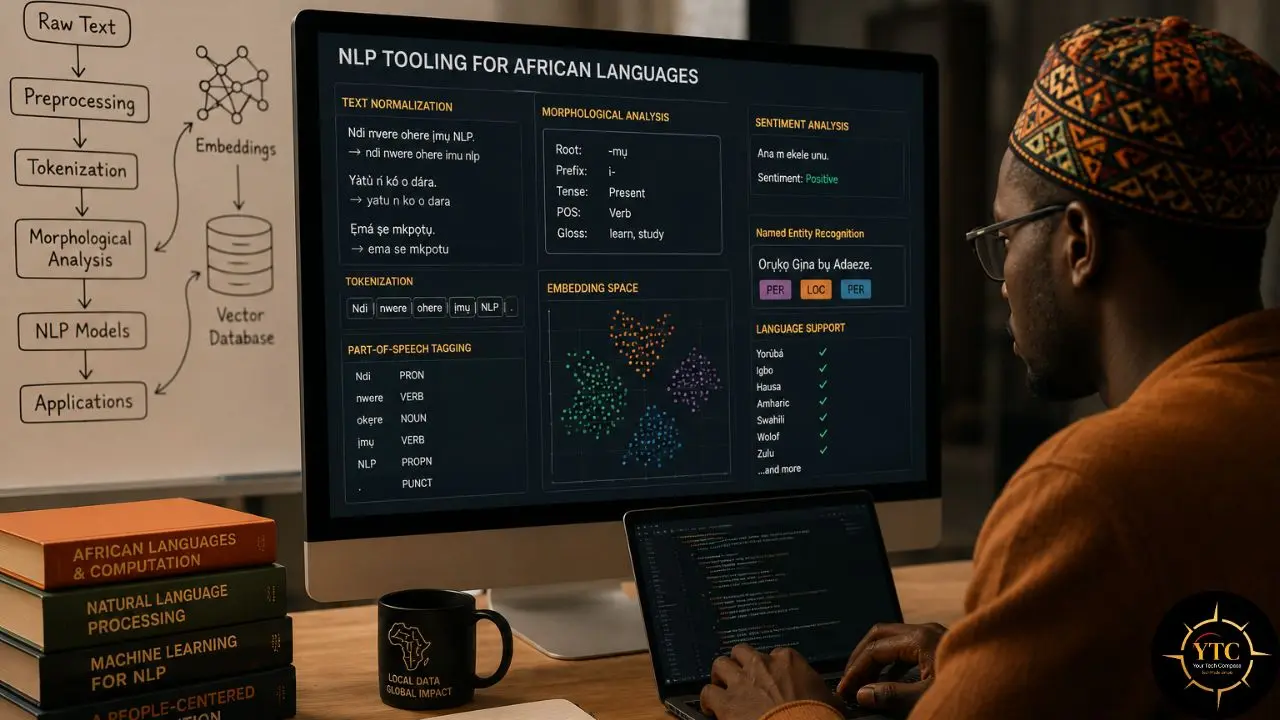
Between raw data and working LLMs sits a tooling layer that most users never see, but without which no production AI system functions properly. For African languages specifically, several tooling gaps create problems that dataset quantity alone can’t solve.
The Tokenizer Problem: Why Standard Methods Fail
Language models process text by breaking it into tokens, or subword units. Standard tokenizers such as BPE and SentencePiece are often trained on high-resource languages and tend to work best where training data is abundant. When applied to African languages with different morphological structures and word-formation patterns, they can yield less efficient tokenization.
A Practical Illustration
A single Yoruba word may encode information that would require three or four English words to express, and that same Yoruba word may be broken into many more tokens than an English equivalent when run through a standard BPE tokenizer. This increases computational cost, reduces the effective context window for African language content, and degrades model performance on the language because the model spends more of its “attention budget” on tokenization artifacts rather than semantic content.
Several Masakhane researchers have published foundational work in African-language NLP across tasks such as named entity recognition and transfer learning. The broader development of African-language-specific NLP tooling, including research into tokenization, is an active subfield with direct production implications.
Morphological Complexity in Agglutinative Languages
Many major African languages (Swahili, Zulu, Xhosa, Amharic) are agglutinative: single words combine multiple meaning-bearing elements (prefixes, infixes, suffixes) that would be expressed as separate words in English. For instance, “watoto wanacheza” in Swahili translates to “the children are playing”; the plurality of the subject, the tense, and the agreement between the subject and the verb are all encoded in the verb’s morphology.
NLP systems that treat words as atomic units fail significantly on agglutinative languages without morphological analysis preprocessing. University of Cape Town’s language technology group, along with other African NLP researchers and community projects, is building tools that support the analysis of morphologically rich African languages. At UCT, this includes work on morphological segmentation and related modeling for South African languages. Masakhane’s broader ecosystem also supports African-language NLP infrastructure through projects such as POS tagging and annotation datasets, which are important foundations for morphological analysis.
Automatic Speech Recognition Challenges Specific to Africa
ASR for African languages remains challenging due to limited labeled data and the difficulty of building effective systems in low-resource settings. Although pretrained models such as Whisper, XLS-R, MMS, and W2v-BERT have improved access, their comparative performance across African languages varies significantly.
Three challenges specific to African language ASR deserve particular attention. These include:
- Tonal Languages: Yoruba, Igbo, and most Bantu languages use pitch variation to distinguish meaning: “ọbẹ” (knife) versus “ọ̀bẹ̀” (soup) in Yoruba are distinguished by tone, and ASR systems trained on non-tonal languages systematically fail to capture this distinction.
- Code-Switching: African speakers frequently mix languages within a single utterance: English-Swahili in Nairobi, Yoruba-English in Lagos, French-Wolof in Dakar. Production ASR systems need to handle this in-the-wild pattern rather than assume clean, monolingual input.
- Accent Diversity: Even for English-language ASR, African-accented English often performs worse on models trained predominantly on American and British English speech. Recent benchmarking work on African-accented English shows systematic variation across accents, countries, and domains.
African Language LLMs: The Model Layer
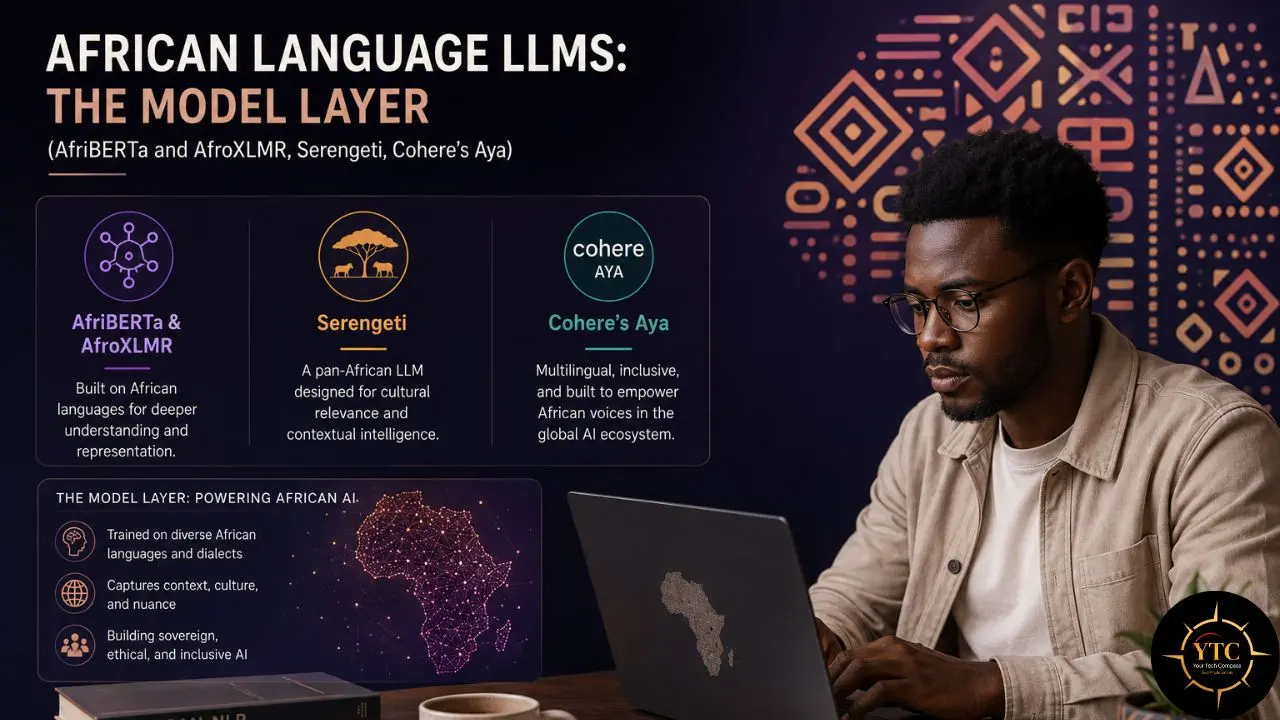
This is where the most visible progress has happened in 2024–2026: the transition from academic datasets to actual language models, both research-grade and commercial-grade.
AfriBERTa and AfroXLMR: The BERT-Era Foundation
This is where the transition from datasets to usable models became especially visible: African-language work moved from benchmark building into real pretraining, fine-tuning, and downstream deployment. Models like AfriBERTa and AfroXLMR showed that African-language-specific pretraining can outperform incidental coverage in large multilingual models on African NLP tasks.
AfroXLMR is an adaptation of XLM-R for African languages, and its model card shows strong results on African named-entity recognition benchmarks such as MasakhaNER. AfriBERTa likewise demonstrated that smaller, language-focused pretraining can outperform larger, generic multilingual baselines on tasks such as classification and entity recognition.
These models established a key proof of concept: for African languages, dedicated pretraining is not just helpful; it can materially improve performance over relying on general multilingual coverage.
Serengeti: 517 Languages in One Model
Serengeti is a multilingual model covering 517 African languages in a single architecture, making it one of the broadest coverage single models specifically built for African languages. It shows that large-scale multilingual coverage across the continent is feasible in a single architecture, and it performs strongly on a range of African NLP tasks.
For many low-resource African languages, broad models like SERENGETI provide useful baseline coverage in the absence of specialized models. That said, broader coverage can come with trade-offs, so specialized models may still be preferable when a single language or task is the priority.
Cohere’s Aya: Community-Built, Globally Significant
Aya is a massively multilingual open model from Cohere that follows instructions in 101 languages, with African-language coverage treated as an important part of the project. Cohere describes Aya as developed through a large global community effort, with thousands of researchers contributing instructional data and annotations.
The model is an important proof of concept for creating community-driven multilingual datasets at scale, especially for underserved languages. It shows that broad, globally distributed collaboration can produce a practical open model with meaningful African-language coverage.
InkubaLM and Vulavula: Africa’s First Commercial LLM Stack
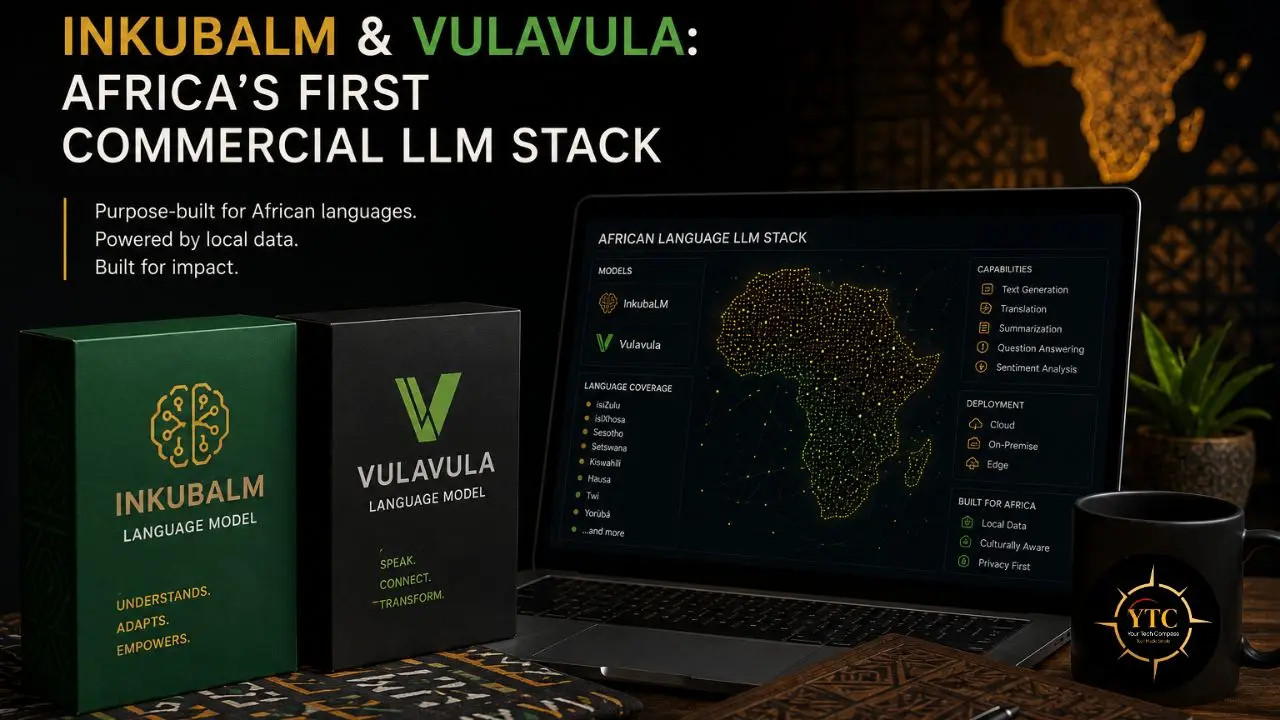
One of the most important commercial developments in African language LLM infrastructure is the InkubaLM/Vulavula ecosystem from Lelapa AI, and the company’s story is worth understanding because it illustrates the shift the African NLP field is trying to make.
Pelonomi Moiloa co-founded Lelapa AI in December 2022 alongside Jade Abbott. The Johannesburg-based research and product lab has since launched InkubaLM, a multilingual language model for African languages, and Vulavula, a natural language processing service for transcribing, translating, and analyzing text in local languages, including isiZulu and Sesotho.
InkubaLM-0.4B was trained from scratch on 1.9 billion tokens of data across five African languages (isiZulu, Yoruba, Hausa, Swahili, and isiXhosa) as well as English and French, for a total of 2.4 billion tokens. The name “InkubaLM” references the dung beetle, a creature known for moving far more than its own weight, signaling that a 0.4-billion-parameter model trained on relatively modest data can still perform strongly on the African-language tasks it was built for.
InkubaLM suggests that smaller, well-targeted models can compete effectively with much larger models on specific African language tasks. In resource-constrained contexts, models like InkubaLM offer a more practical and efficient path for building and deploying NLP applications. This is the “small, efficient, local” model philosophy in practice: an LLM designed for lower-resource infrastructure, where connectivity constraints and compute economics differ markedly from those of the Silicon Valley context in which most frontier models were developed.
On the platform side, Lelapa turns its models into usable infrastructure through Vulavula, a multilingual API that offers speech recognition, translation, sentiment analysis, and intent detection for African languages and code-switching. It packages its own models into tools like Transcribe, Converse, Analyze, and Translate, with built-in SDKs and hosting, so other African startups do not need to rebuild the language stack from scratch.
Vulavula converts multilingual call-center conversations into structured text, ready for analytics, QA, and compliance systems. Built for contact centers in telecoms and financial services, it represents commercial traction rather than research: financial services companies and telecom operators are paying for Vulavula because it solves a real operational problem, namely call-center quality assurance in Zulu and Xhosa, not English alone.
In March 2025, Microsoft President Brad Smith publicly cited Lelapa AI as one of the startups Microsoft had partnered with. Moiloa has also been recognized as one of Time magazine’s Most Influential People in AI and as a recipient of the Mozilla Rise 25 Award.
As soon as one telco or bank offers Africans the opportunity to engage in their preferred languages, the public will begin to expect that language choice as a standard service feature. This shift is likely to redefine customer expectations across industries.
Language Case Studies: Swahili, Yoruba, and Amharic
Three languages at different points on the African NLP development curve illustrate the range of current capability and the specific challenges remaining in each case.
Swahili: One of Africa’s Best-Represented Languages in AI
Swahili’s relatively strong representation in AI training data is the result of several converging factors, including its status as the official language of the East African Community. In addition, it has a long written tradition and a significant diaspora digital presence that generates online text.
The practical state of Swahili NLP in 2026 is genuinely encouraging. Google Translate Swahili is usable for most practical purposes. Meta’s NLLB-200 includes Swahili among its stronger-performing African languages. Lelapa AI’s Vulavula covers Swahili in addition to its primary focus on South African languages. Helsinki NLP’s Opus-MT models provide machine translation in both the Swahili-English and English-Swahili directions.
The remaining gaps are real but specific: dialectal variation between Kenyan and Tanzanian Swahili, and between coastal varieties, is not well handled by current models. Code-switching in urban Swahili (specifically Sheng in Nairobi), which blends Swahili, English, and other languages in patterns that shift rapidly across generations, remains an immature area even within Swahili. And Swahili, at “well-represented for Africa,” still sits far below the performance threshold that English, French, and Mandarin speakers experience as normal in the same AI systems.
Yoruba: The Test Case for Tonal African Language AI
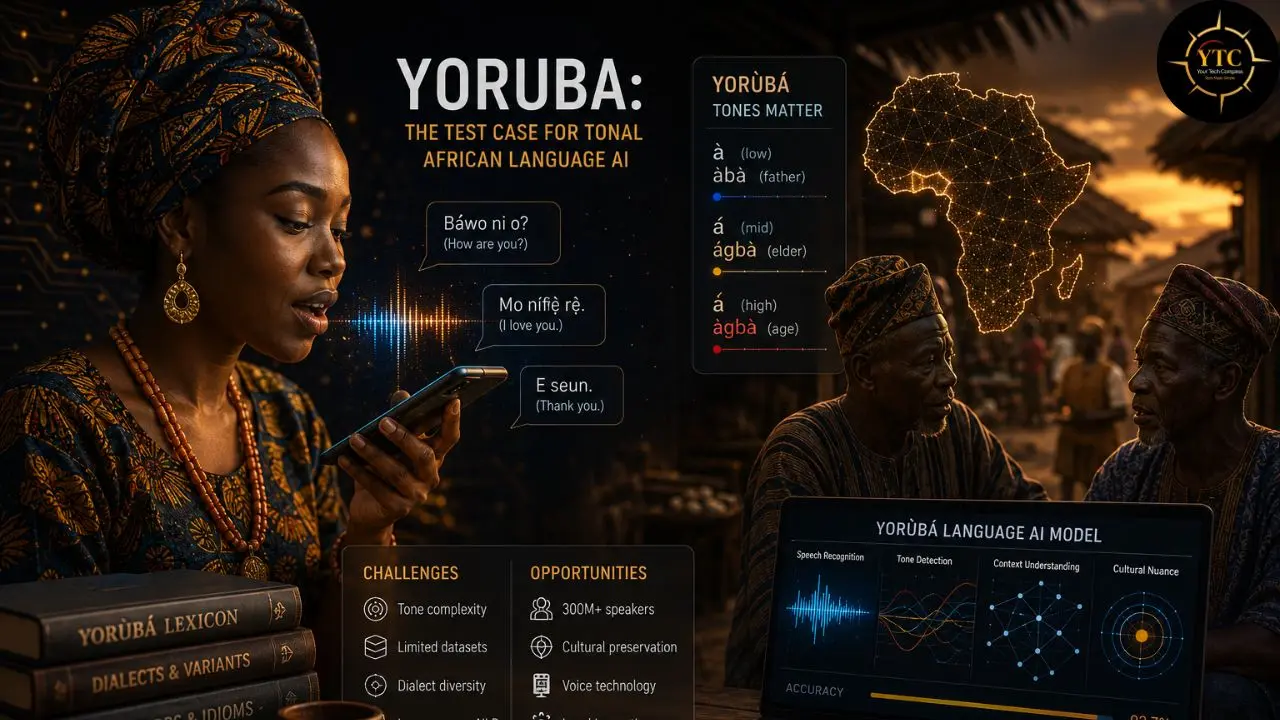
Yoruba is spoken by approximately 40–45 million people, primarily in Nigeria, with significant communities in Benin and in the diaspora. Lagos, one of Africa’s largest cities and a premier economic hub, lies in a majority Yoruba-speaking region. The language’s demographic and economic weight has attracted substantial NLP research, but its tonal structure poses genuine technical challenges with no simple solutions.
Research on Yoruba–English machine translation explicitly examines the effects of domain and diacritics in neural machine translation, highlighting how diacritics make Yoruba distinctively difficult. Most digitally produced Yoruba text omits the diacritical marks used to indicate tone because standard keyboards and mobile text input do not readily support them.
This creates a systematic mismatch between the “clean” Yoruba in many training datasets (with correct tone marks) and the “real” Yoruba that users actually type. Models must either handle diacritic-stripped input with degraded performance or incorporate diacritic restoration as a preprocessing step, which adds system complexity and potential error propagation.
Yoruba is included in the MasakhaNER 1.0 and 2.0 datasets and benefits from a relatively rich set of NLP resources compared to many African languages. Researchers at Nigerian universities and international partner labs have published multiple Yoruba NLP models and corpora. Commercial deployment remains limited: Yoruba voice assistants and chatbots exist mainly in research or prototype form, and production-grade Yoruba ASR that robustly handles real conversational speech remains an active research problem rather than a solved one.
Amharic: The Ge’ez Script Challenge
Amharic has approximately 35–40 million first-language speakers and is the national language of Ethiopia. It uses the Ge’ez (Ethiopic) script, a syllabary with around 276 distinct characters representing consonant–vowel combinations.
Research on Amharic, Ge’ez, and English parallel datasets addresses the specific challenges of this script family. The Ge’ez script introduces OCR difficulties, Unicode processing edge cases, and tokenization challenges that compound the standard low-resource language problems.
Paradoxically, Amharic may be the most commercially advanced of these three case studies. The Ethiopian government has identified Amharic NLP as a national technology priority and has made specific investment commitments.
iCog Labs, the Addis Ababa-based AI research organization and one of Africa’s oldest AI institutions, has Amharic NLP as a core focus: building local Amharic ASR, natural language understanding, and conversational AI products for commercial clients in the telecom and banking sectors. Both Ethiopian Telecom and Ethio Telecom use Amharic NLP in customer service applications.
AfriBERTa includes Amharic among its 11 core languages. Masakhane has Amharic NER and sentiment datasets. The combination of policy attention, established local research institutions, and emerging deployments makes Amharic one of the African languages with a relatively clear and active pathway from research toward production, though how it compares to languages such as Swahili or Yoruba depends on the metrics used.
African Language AI Startups and Infrastructure Builders
Beyond Lelapa AI, a cohort of commercial organizations is building the African language AI infrastructure layer:
Botlhale AI (South Africa)
Botlhale AI trains speech and language models on its own conversational datasets, with a strong orientation toward code-switching, slang, and the way people actually speak across Southern Africa, patterns that many Western ASR systems struggle to handle. As an infrastructure provider, it turns these models into a contact-center AI stack with APIs for transcription, intent detection, routing, and analytics, giving banks, telecom companies, and other enterprises plug-and-play African-language customer experience tools without needing to build their own speech or NLU systems.
Botlhale’s specific focus on how people actually speak (code-switching, slang, vernacular) rather than clean, standardized language is exactly the right orientation for production deployment in South African business contexts, where mixing languages within a single conversation is normal, not exceptional.
iCog Labs (Ethiopia)
iCog Labs is one of Africa’s earliest dedicated AI research organizations, founded in Addis Ababa by Getnet Aseffa, with a research agenda spanning artificial general intelligence theory and applied NLP. Its Amharic and local-language NLP work includes ASR models, conversational AI infrastructure, and NLU systems developed in collaboration with public and private organizations. iCog represents the institutional research organization pathway: a well-established research lab with strong university ties and national visibility that can develop foundational language AI that startups and other actors then build on.
Sunbird AI (Uganda)
Sunbird AI is building NLP for East African languages, particularly Acholi, Luganda, and other Ugandan languages that are underrepresented even within African NLP efforts. Its focus on languages outside the typical “top 10 African languages” that receive most research attention is specifically valuable for linguistic diversity, representing the long tail of African languages where even basic NLP tooling doesn’t yet exist.
The Deep Learning Indaba Pipeline
The Deep Learning Indaba (an annual pan-African ML conference) has been the primary venue for connecting African NLP researchers and building the community that feeds commercial startups. Many startup founders, including those at Lelapa AI and Sunbird AI, came through the Masakhane and Indaba research community.
As of 2024, over 2,400 African startups are building AI infrastructure or leveraging existing systems, according to an AfriLabs report, a figure that reflects how the research community has successfully seeded a commercial ecosystem. The broader picture of these AI startups across verticals is explored in our AI in Africa category and our comprehensive guide.
How African Language AI Compares to Global Multilingual Models
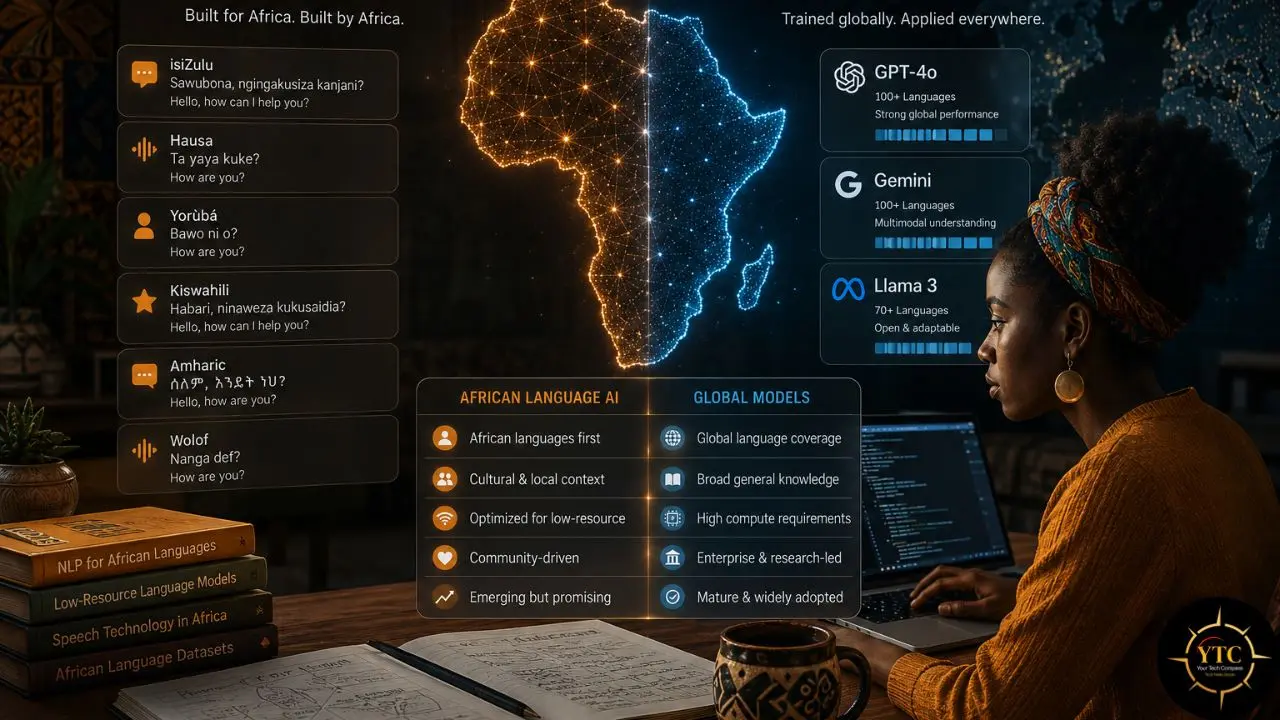
It’s worth understanding where global frontier models, including those reviewed elsewhere on YourTechCompass, stand on African language coverage, because the picture is more nuanced than “big Western models ignore African languages.”
Model / Initiative | African Language Coverage | Depth for Top Languages | Open‑Source? | African‑Language Specific? |
GPT‑Class (OpenAI) | Limited but growing | Swahili: moderate; most: poor | ❌ | ❌ |
Gemini 1.5+ (Google) | Broad multilingual, with stronger support for some African languages than many competitors | Swahili: good; others: variable | ❌ | ❌ (multilingual) |
Meta NLLB‑200 | 50+ African languages (MT focus) | Translation: strong; generation: limited | ✅ | ❌ (multilingual) |
Cohere Aya | Dozens of African languages (approx. 20–25) | Instruction‑tuned multilingual | ✅ | ❌ (multilingual) |
AfroXLMR (Masakhane) | 20+ African languages | NER, classification: strong | ✅ | ✅ |
InkubaLM (Lelapa AI) | 5 languages (isiZulu, Yoruba, Hausa, Swahili, isiXhosa) | Purpose‑built: high efficiency | ✅ | ✅ |
Serengeti (Meta) | 517 African languages | Breadth > depth | ✅ | ✅ |
Vulavula API (Lelapa AI) | South African languages primary | Production‑grade ASR, translation | ❌ (commercial API) | ✅ |
Our Qwen 3 review covers how Alibaba’s multilingual model approaches low-resource language coverage and relevant context, as Chinese AI labs have faced parallel challenges with minority Chinese languages and have developed interesting methodological approaches. In addition, our DeepSeek AI Explained and DeepSeek V4 reviews cover a model whose open-weight philosophy (MIT license, full public weights on Hugging Face) is directly relevant to African NLP researchers who want to fine-tune existing frontier models on African-language data.
Our GLM-4.7 Zhipu AI review covers another non-Western frontier model whose approach to multilingual coverage differs in instructive ways from OpenAI’s. Furthermore, our broader AI Unboxed category tracks all significant model developments relevant to understanding how African language representation fits within the global model landscape.
The Infrastructure and Deployment Reality
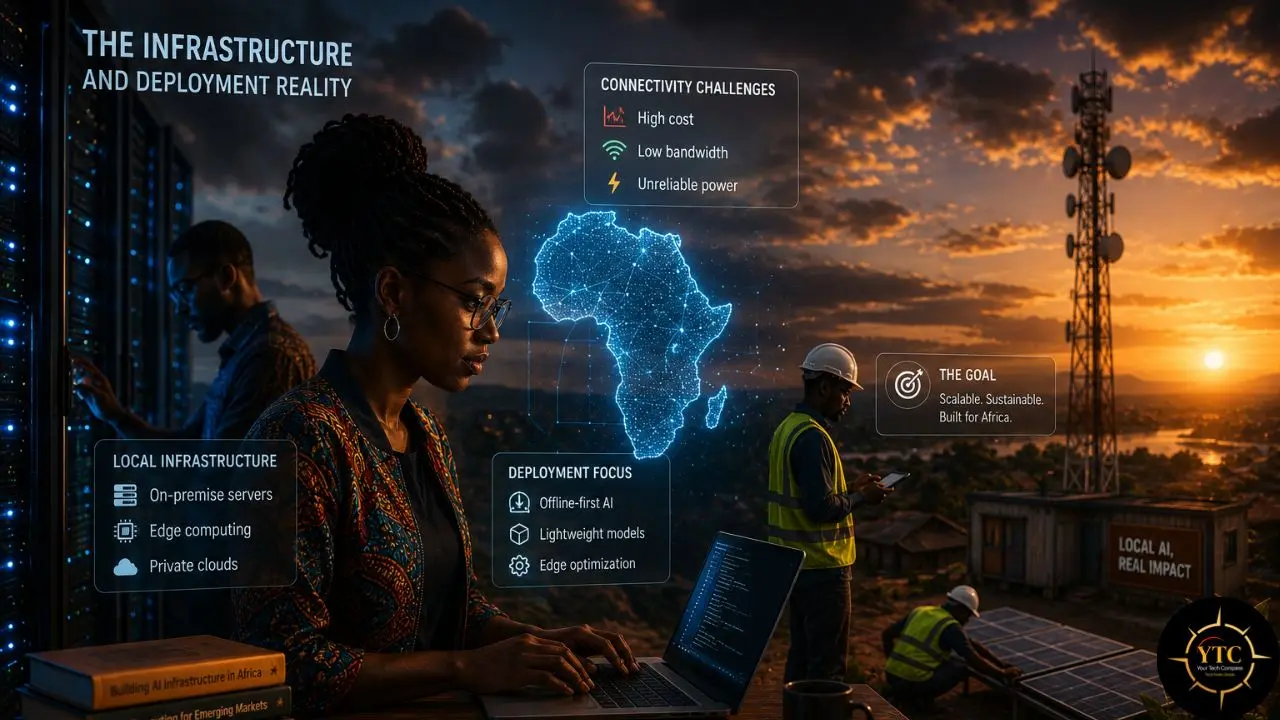
Even the best African language model faces deployment challenges specific to the African context that models built for Silicon Valley deployment never have to address.
Compute Economics and the Case for Small Models
Training frontier-scale models requires GPU compute at costs that are significant relative to the revenue potential of early-stage African markets. African AI startups face a structural disadvantage: cloud compute costs in global markets combined with lower initial revenue ceilings make the economics of building and maintaining large models challenging without external grant funding.
InkubaLM demonstrates the potential of low-resource approaches. In resource-constrained contexts, smaller models offer more practical and efficient solutions. The “small, efficient, local” philosophy isn’t a compromise; it’s a recognition that a 0.4-billion-parameter model that runs on a laptop and performs well on the five languages it was specifically trained for is more useful in most African deployment contexts than a 70-billion-parameter model that requires datacenter-scale compute and performs mediocrely on those same languages.
The technology must be built for Africa’s infrastructure constraints. This includes offline-capable models, TinyML architectures, and compute-efficient systems optimized for low-connectivity settings and low-cost hardware.
Connectivity and On-Device Inference
A language model requiring low-latency API calls to a cloud server isn’t accessible to a rural healthcare worker in a low-connectivity environment. On-device NLP (quantized, distilled models that run inference without internet connectivity) is the right form factor for high-impact use cases in agricultural advisory, basic healthcare triage, and education. The comparison between Africa and India in AI adoption patterns explored in our Africa vs India AI adoption guide shows how different connectivity and infrastructure realities shape which AI deployment patterns are viable in each context.
Code-Switching as a Production Requirement
Startups like Botlhale AI train models that understand code-switching, slang, and the way people actually speak across Southern Africa, something Western ASR systems usually get wrong. Most African language users in production are multilingual code-switchers rather than monolingual speakers of a single language.
A Nairobi professional typing in Sheng, a Lagos entrepreneur WhatsApping in Yoruba-English, a Cape Town call center customer alternating between Zulu and English mid-sentence — these are the real users. Systems that assume clean monolingual input fail immediately in production even when they work well in laboratory conditions.
Policy Dimensions: Who Decides Which Languages Get AI
Africa’s linguistic landscape is one of the richest in the world. This diversity creates a unique environment for innovation in natural language technologies. But it also creates a priority problem: with 2,000 languages and limited research and commercial resources, the implicit market logic (invest where speaker populations are largest and commercial returns are most visible) systematically underserves smaller languages.
The national policy responses vary significantly by country. Ethiopia’s national AI strategy explicitly prioritizes local-language NLP, including Amharic, alongside Afan Oromo, Tigrinya, and Somali, backed by concrete institutional and budgetary commitments (e.g., a ~42% budget increase for the Ethiopian AI Institute and plans for an indigenous LLM trained on multiple Ethiopian languages). South Africa’s post-apartheid language policy (11 official languages) establishes a government mandate for multilingual digital services, which indirectly drives investment in NLP for Zulu, Xhosa, Sesotho, and other official languages.
Rwanda’s Kinyarwanda has achieved relatively strong ASR dataset coverage partly through diaspora community mobilization and targeted donor investment. Kenya’s official status of Swahili is increasingly driving demand for digital government services in Swahili. The broader AI policy landscape, including how these language-specific policies fit within continental AI governance frameworks, is analyzed in our AI Policy in Africa guide.
The open-source versus proprietary debate is particularly consequential in the context of African languages. Open-source African language datasets (Masakhane) create public goods that anyone can build on, but may be commercially underinvested relative to the scale of the problem. If the best Hausa or Yoruba LLM is owned by a single company, African language AI becomes a commercial dependency rather than public infrastructure. Several pan-African bodies, including the African Union and Smart Africa, have discussed “African language AI commons” frameworks but have yet to produce binding commitments, a policy gap that the current generation of African NLP researchers is actively advocating to close.
FAQs
Swahili currently has the best overall AI support among African languages, with reasonably good machine translation, growing ASR capability, and coverage in most major multilingual models. Amharic has one of the most active commercial NLP ecosystems in Africa, driven by iCog Labs and a strong emphasis by the Ethiopian government on local-language AI. Hausa, Yoruba, IsiZulu, and IsiXhosa form the next tier, with strong representation in Masakhane datasets and significant coverage in African-focused models and products such as Lelapa AI. The majority of Africa’s 2,000+ languages have minimal or no AI support.
Masakhane is a pan-African open-source NLP research community founded in 2019, now with 800+ researchers across 40+ African countries working on 300+ languages. It matters because it created the foundational datasets (MasakhaNER, MAFAND, AfriSenti, IrokoBench) that all subsequent African NLP work builds on, and because it built and legitimized an African NLP research community that is now producing recognized work at top international venues. Without Masakhane, much of what Lelapa AI and other commercial organizations are building simply wouldn’t have the training data to exist.
Most major frontier models (ChatGPT, Claude, Gemini) have some Swahili capability and limited capability in a handful of other African languages, but performance varies significantly and is measurably worse than for English, French, or Mandarin. IrokoBench testing shows consistent performance degradation on African-language tasks, even for the most capable frontier models. For production applications requiring African language understanding, purpose-built models like Lelapa AI’s Vulavula typically outperform frontier models on the specific languages they cover.
Data scarcity is the primary structural challenge; there simply isn’t enough high-quality digitized text in most African languages to train models on. But the data problem is compounded by specific technical challenges: handling tonal languages such as Yoruba and Igbo, processing the Ge’ez script for Amharic and Tigrinya, handling agglutinative morphology in Swahili and Zulu, and the code-switching behavior that characterizes real urban African speech. Addressing all of these requires not just more data but different approaches to tokenization, preprocessing, and model architecture.
Yes, and the most significant commercially is Lelapa AI, a Johannesburg-based company building InkubaLM (Africa’s first multilingual small language model, covering IsiZulu, Yoruba, Hausa, Swahili, and IsiXhosa) and Vulavula (a commercial API for speech recognition, translation, and sentiment analysis in African languages). Botlhale AI is building contact center AI for Southern African languages. Sunbird AI is building NLP for East African languages, including local Ugandan languages. iCog Labs is the established institution for Amharic NLP in Ethiopia.
For the highest-priority languages with active research and commercial investment (Swahili, Amharic, Hausa, Yoruba, IsiZulu), production-grade quality for specific, bounded use cases (speech recognition for call centers, machine translation for customer service, sentiment analysis for social media monitoring) is achievable within three to five years with current investment trajectories. General-purpose AI quality comparable to what English speakers experience across the full range of AI applications is a longer horizon, likely a decade or more for major languages, and longer, or never, for languages that don’t reach commercial investment viability. The timeline is fundamentally a function of data investment, research funding, and policy priorities, not purely of technical capability.
Conclusion
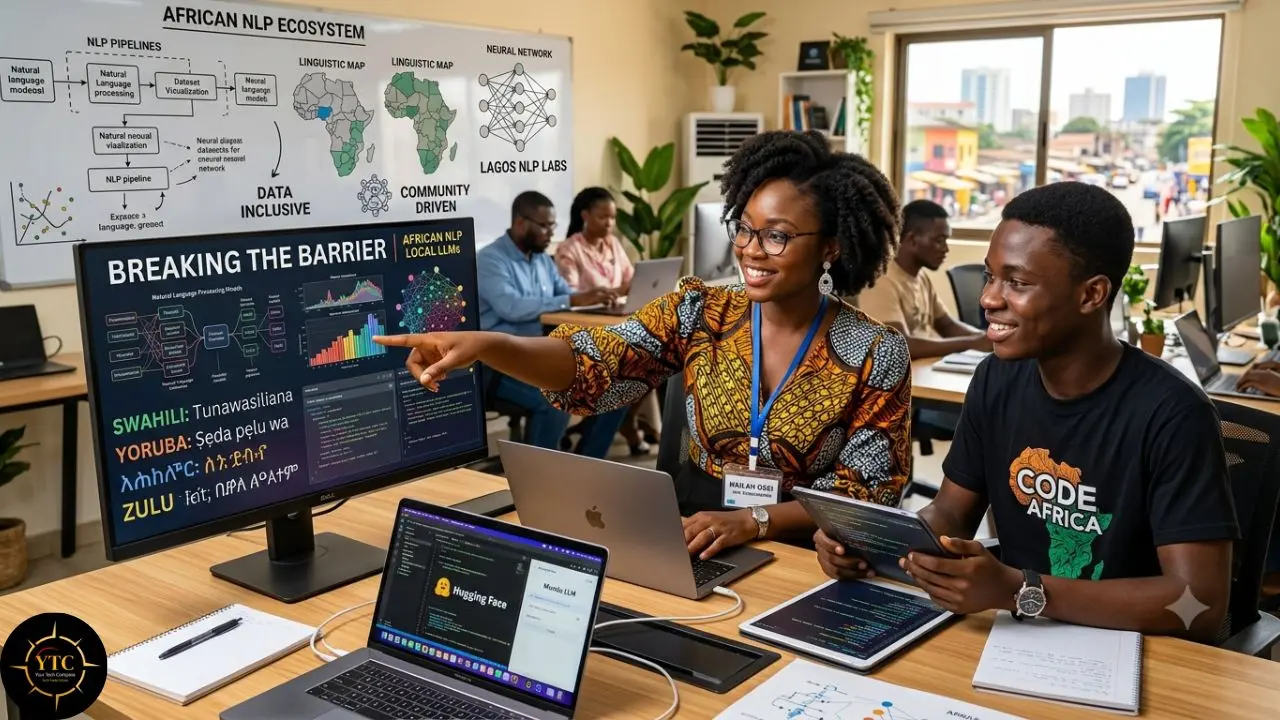
The African NLP landscape in 2026 is dramatically more developed than it was in 2019 when Masakhane was founded, and dramatically less developed than it needs to be for AI to genuinely serve Africa’s 2,000+ language communities. Africa’s AI movement has shifted from consumerism to foundational building. Startups are building language models that understand local context, creating systems that reflect the realities of low-connectivity environments and scarce compute. The datasets that didn’t exist seven years ago now do. The models that couldn’t be trained without those datasets are now being published and deployed. Commercial companies are generating revenue from AI products in African languages within the telecom and financial services sectors. The pipeline from academic research to production infrastructure is real, even if it’s measured in years rather than months.
What the pipeline still needs is proportionate investment. Lelapa AI’s mission is to build the world’s most efficient language infrastructure to expand digital inclusion, ensuring African languages are not left behind in the age of AI. That mission requires funding, policy support, institutional partnerships, and sustained researcher attention across a much broader set of languages than the 20 or 30 languages currently receiving most of the field’s focus. The gap is real. The organizations closing it are real. The technical approach (small, efficient, locally-trained models built specifically for African linguistic realities) is validated. The question now is whether the investment and institutional commitment keep pace with the ambition, because the alternative is an AI revolution that, like so many previous technological revolutions, delivers its greatest benefits primarily to the English-literate minority of a continent with 2,000 languages and the talent to serve them all.
AI development across Africa, from NLP infrastructure to agricultural applications to healthcare AI, represents some of the most consequential technology work in the world. Head to YourTechCompass.com for ongoing coverage of AI in Africa, African fintech, and the technology shaping the continent’s digital future.