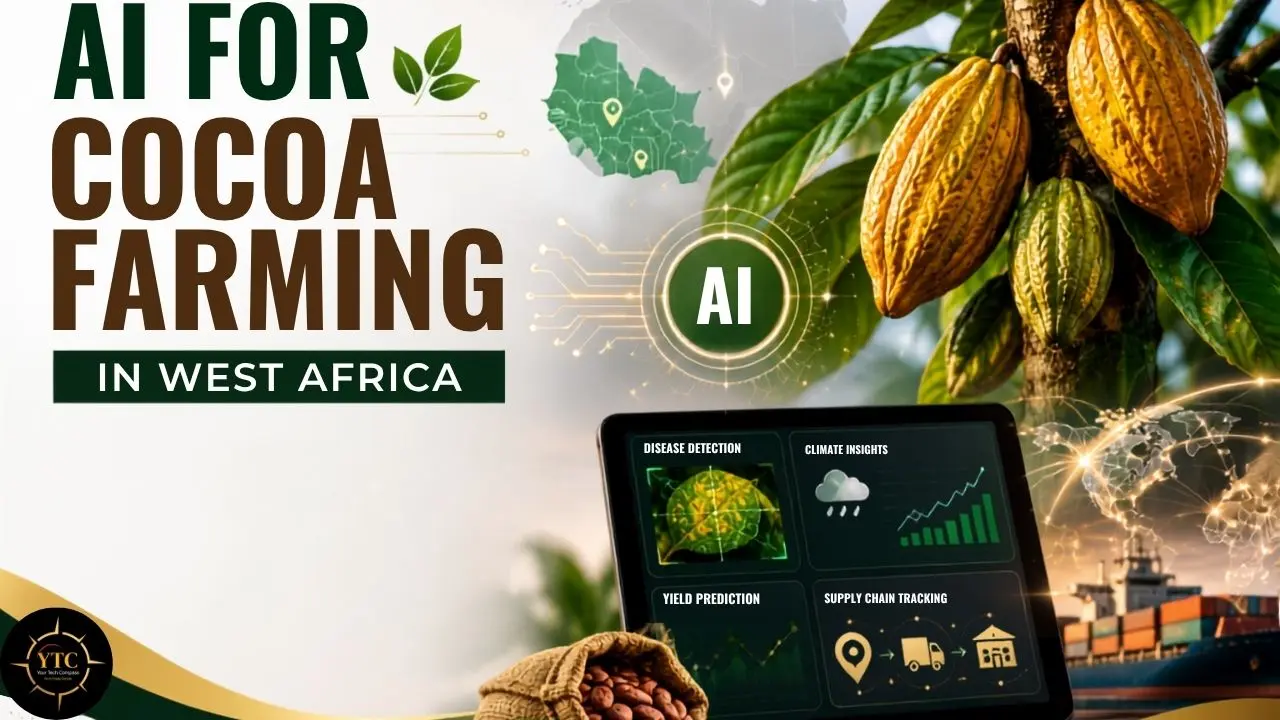
West Africa produces approximately 75% of the world’s cocoa. Ghana and Côte d’Ivoire together account for roughly 60% of global supply, and behind those numbers are more than 2.5 million smallholder farming households whose livelihoods, children’s school fees, and retirement security are measured in kilograms of cocoa per season. When CSSVD (Cocoa Swollen Shoot Virus Disease) destroys a tree, that household loses income from that tree for the rest of its productive life. When Black Pod disease sweeps through at the wrong time of year, 20–30% of the season’s yield disappears before it can be harvested. And, when cocoa prices spike (as they did in 2024–2025, reaching over $10,000 per metric ton, the highest in four decades), the global chocolate industry feels it immediately. What’s less visible in the price charts is that the supply crisis driving those prices is partially a failure of information: diseases spreading undetected for months, climate shocks landing without warning, and supply chains too opaque to optimize.
That information failure is precisely what artificial intelligence is built to address. AI’s core competencies, pattern recognition at scale, data synthesis across heterogeneous inputs, and optimization under uncertainty, map directly onto the four compounding problems attacking West African cocoa: CSSVD spreading invisibly before visible symptoms appear, Black Pod arriving with climate patterns that AI can model and predict, soil and shade conditions that satellite analysis can assess at farm level, and supply chains where millions of transactions happen without digital records. This article covers how AI is actually deployed across these four domains — not aspirationally, but in documented programs with verified outcomes. You’ll find the specific tools, the organizations that build and run them, the accuracy numbers published in peer-reviewed literature, and the honest assessment of where the evidence is strong and where it’s still emerging.
The Cocoa Crisis That Makes AI Necessary
To understand why AI matters in this specific context, you need to grasp the scale and nature of the problems it addresses. These are not minor inefficiencies. They’re structural crises threatening an industry that feeds both farmer families and global chocolate markets simultaneously.
Cocoa Swollen Shoot Virus Disease: The Slow Emergency
According to the Cocoa Health and Extension Division Survey Report 2023, 87,623 outbreaks of CSSVD in Ghana have affected 570,808.79 acres of cocoa plantations, leading to reduced yields. CSSVD infestation led to farmers’ losses, affecting their economic and social status, and accounted for 15–20% of cocoa yield losses in Ghana. The mechanism is particularly devastating: caused by a mealybug-transmitted virus, CSSVD has no chemical cure. Infected trees must be removed, a process COCOBOD (Ghana Cocoa Board) has run since the 1940s, cutting out over 100 million trees, without ever solving the underlying problem.
The specific horror of CSSVD for AI practitioners is its temporal gap. Visual symptoms (the characteristic swollen shoots and yellow mosaic leaf patterns that give the disease its name) appear 6 to 18 months after infection.
During that entire symptom-free window, the mealybug vector continues spreading the virus to adjacent trees. By the time a farmer or extension officer identifies an infected tree through visual inspection, the infection has already propagated over an expanding area. Early detection, specifically, pre-symptomatic detection, is the intervention that changes the outcome. That’s exactly what AI multispectral analysis delivers.
Black Pod Disease: The Yield Destroyer
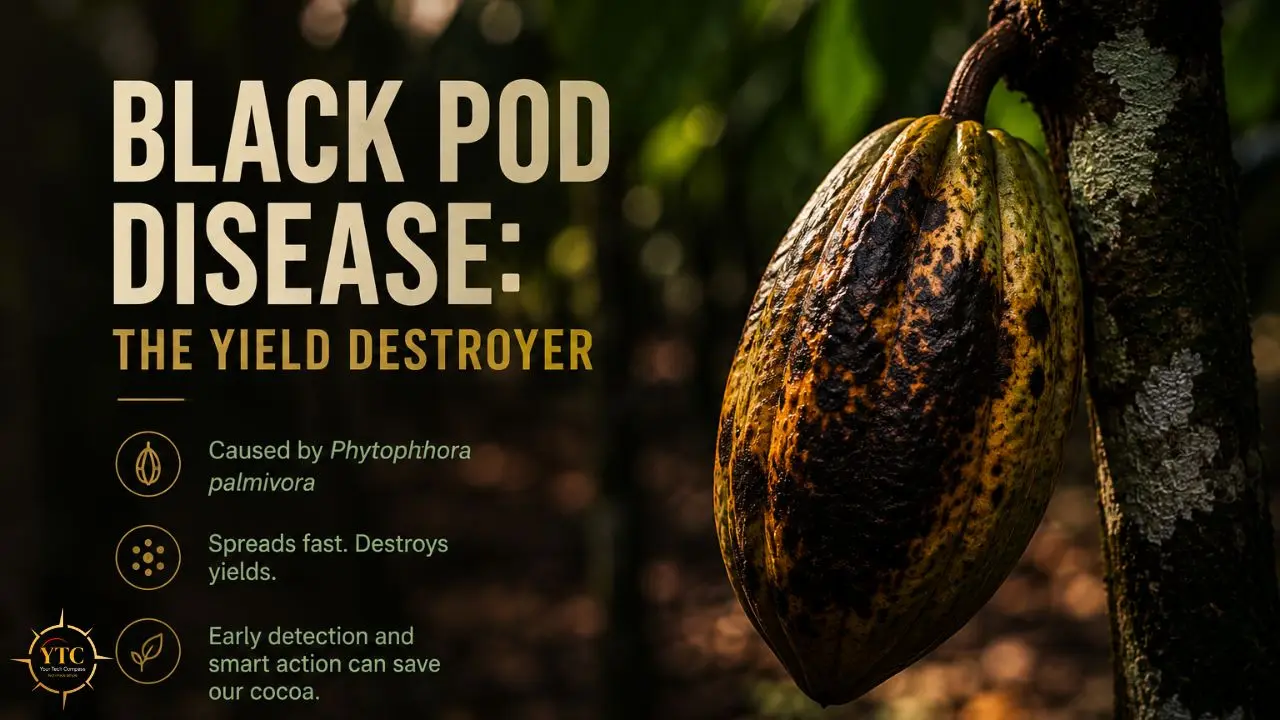
Black Pod disease, caused by Phytophthora palmivora and the more virulent West African variant, P. megakarya, destroys 20–30% of annual yield across West Africa, resulting in estimated losses of $1–2 billion per year. Treatment exists: copper-based fungicides applied at the right time can substantially reduce the spread of Black Pod.
The critical word is “moment.” Applying fungicide two weeks after the onset of infection is nearly as ineffective as not applying at all. The economic case for early, accurate disease detection is straightforward: the fungicide costs the same regardless of timing; the yield saved depends entirely on the accuracy of timing.
Climate change is extending the wet conditions that favor the spread of Black Pod. Subsequent decades have seen widespread stagnation or decline, driven by aging tree populations, disease outbreaks (notably CSSVD), soil fertility depletion, and increasing climate variability.
These interacting pressures have progressively eroded yield potential across the region despite rising aggregate production volumes. Consequently, the disease burden and the climate burden are not independent problems; they compound one another, and AI tools that address both simultaneously are more valuable than those that address either alone.
Climate Disruption: The Moving Target
Cocoa is a climatically demanding crop: it requires 1,250–2,500mm of annual rainfall, temperatures between 21°C and 32°C, and 60–90% relative humidity. West Africa’s cocoa-growing regions are measurably outside these parameters in significant zones.
Researchers project that climate change could reduce cocoa-suitable land in West Africa by 40–50% by 2050 without adaptation. Furthermore, rising temperatures are pushing optimal cultivation zones southward, threatening the entire geographic basis of Ghana’s and Côte d’Ivoire’s dominance as producers.
Supply Chain Opacity: The Value Gap
According to a 2019 report by the International Institute for Sustainable Development, average Ghanaian cocoa farmers receive approximately 3–6% of the final retail value of a chocolate bar. The remainder flows through multi-tier trader networks, processors, manufacturers, and retailers in consuming markets. This income gap is a structural pricing and power imbalance, but it’s enabled and amplified by information asymmetry.
Farmers who don’t know the current COCOBOD floor price sell below it. Cooperatives without quality verification tools can’t command premiums for superior beans. And buyers from the EU, now required by the EU Deforestation Regulation (EUDR) to verify that their cocoa supply chains are deforestation-free, cannot meet compliance requirements without traceability technology, which most of the supply chain lacks.
The EUDR deadline for large operators took effect in December 2025, creating a forcing function that is accelerating supply chain AI adoption faster than any voluntary industry initiative has managed. Full EUDR compliance requires geolocating and verifying approximately 1.5–2 million individual smallholder farms in Ghana and Côte d’Ivoire alone.
AI for Disease Detection: How It Works in Cocoa Specifically
Disease detection is the highest-urgency AI application in cocoa farming, and it’s also where the evidence base is most developed. Let me walk you through the specific mechanisms, not at the level of “AI detects diseases,” but at the level of which spectral bands, which model architectures, which deployment channels, and what accuracy numbers peer-reviewed research has verified.
Satellite and Drone Multispectral Imaging for CSSVD
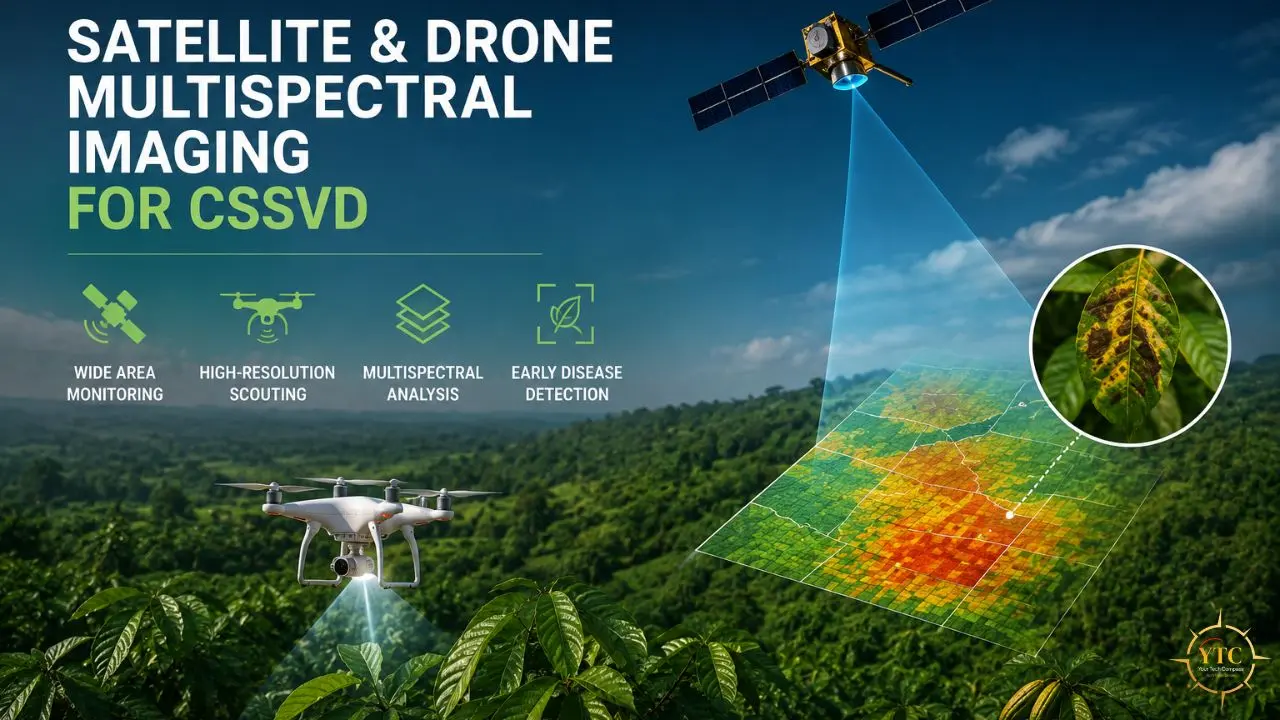
The biological mechanism enabling pre-symptomatic CSSVD detection via AI is the disease’s effect on chlorophyll production. CSSVD disrupts photosynthetic activity before visible yellowing appears, and that disruption creates measurable changes in how infected trees reflect light in the near-infrared and red-edge spectral bands.
A healthy cocoa canopy has a characteristic NDVI (Normalized Difference Vegetation Index) signature. CSSVD infection creates a measurable NDVI deviation 3–6 weeks before visual symptoms emerge.
Artificial Intelligence improves interpretation and prediction from UAV data for stress detection, yield variability, and management zoning, contingent on data quality and institutional capacity. The practical pipeline works as follows: Sentinel-2 and PlanetScope satellite imagery, supplemented by drone-mounted multispectral cameras where affordable, is fed into CNN models trained on CSSVD infection patterns.
The CNN extracts features from the NDVI deviation pattern, specifically the spatial distribution, temporal progression, and spectral signature of the anomaly, and classifies each farm section as healthy, suspected early infection, or confirmed advanced infection. The spatial output is a disease risk map at sub-farm resolution, showing which specific sections of a plot are flagged rather than simply whether the whole farm is affected.
In the cocoa-growing Ashanti Region, drone flyovers scan hundreds of trees simultaneously, detecting pod lesions or leaf discoloration faster than human scouts. Drones and satellites provide high-resolution imagery that reveals early disease signs invisible to humans, while AI algorithms trained on subtle visual cues can flag problem areas before ground-level symptoms emerge.
Published accuracy figures for pre-symptomatic CSSVD detection via hyperspectral imaging range from 80–92%, depending on image resolution and disease stage, a finding consistently supported by collaborative research between the University of Ghana and CRIG (Cocoa Research Institute of Ghana) across multiple studies.
The Practical Constraint Worth Naming Honestly
PlanetScope’s 3m resolution daily imagery costs money. Most operational CSSVD mapping programs rely on Sentinel-2’s free 10m imagery, which reduces detection precision for small, irregularly shaped plots that make up the majority of Ghanaian smallholder farms. The gap between research accuracy (achieved with high-resolution commercial imagery) and field-deployment accuracy (achieved with free Sentinel-2 imagery) is real and matters for program planning.
Smartphone-Based Black Pod Detection
Traditional methods for detecting pod diseases rely on visual observation by producers or technical staff. These methods are time-consuming, subjective, and unreliable in the early stages of infection. The challenge is therefore to develop tools capable of quickly identifying characteristic signs on pods, enabling intervention before the disease spreads.
The smartphone detection pipeline addresses exactly that challenge. A farmer photographs an infected pod using a smartphone.
A CNN model trained on cocoa pod disease images classifies the image as: Black Pod (P. palmivora vs. P. megakarya), Phytophthora pod rot, cushion gall, frosty pod rot, or healthy. A treatment advisory (specific fungicide, application timing, dosage) is generated and delivered via the same app interface or via SMS.
The proposed CNN–Fuzzy model achieved a classification accuracy of 99.99%, surpassing traditional machine learning models (75.48–80.34%) and transfer learning approaches (up to 97.27%). That benchmark figure comes from controlled conditions. Field-oriented deployment studies, accounting for variable lighting, image angle, and partial pod visibility, report accuracy in the 88–94% range for clear field photographs; still strong enough to be clinically useful for fungicide timing decisions.
XAI-CROP, Random Forest, and Gradient Boosting can detect cocoa diseases, recommend appropriate pesticides, enable targeted crop spraying, and count pods. The progression from single-model classification to ensemble approaches reflects the field’s maturity: newer deployments use multiple model types, whose predictions are aggregated to achieve higher reliability than any single architecture.
Farmerline’s Merged Delivery: The Last-Mile Reality
The most sophisticated disease detection model is worthless if it doesn’t reach farmers in a usable form. Farmerline’s Mergdata platform, operating across Ghana, demonstrates what effective last-mile AI agricultural advisory looks like in practice.
The platform reaches 100,000+ Ghanaian cocoa farmers via USSD (works on any mobile phone, no data required), voice messaging in local Ghanaian languages including Twi, Ga, and Dagbani, and basic SMS. Disease advisories, weather alerts, and market price information are delivered through the communication channel the farmer actually uses, not the channel that’s most technically elegant.
This is the design philosophy that our AI in Africa coverage consistently highlights: the constraint is rarely the AI model’s accuracy. It’s the last-mile channel that determines whether the accuracy ever reaches a farmer.
Mealybug Vector Tracking: The Frontier Application
The most preventive CSSVD intervention isn’t detecting the disease after infection; it’s tracking the mealybug vector that transmits it and predicting population-density spikes before they cause infection events. Computer vision models trained on mealybug images for identification from farmer-submitted photos, combined with IoT-connected pheromone trap monitoring and AI models that feed on population density data, represent the frontier of this work.
Current maturity is best described as being in the research stage. As of 2026, these systems are not deployed at a commercial scale in Ghana. The potential timeline advantage (if mealybug population density models can predict outbreak risk 4–8 weeks ahead of spread events, intervention shifts from reactive to genuinely preventive) justifies the research investment, but the deployment gap is real.
AI for Climate Adaptation in West African Cocoa
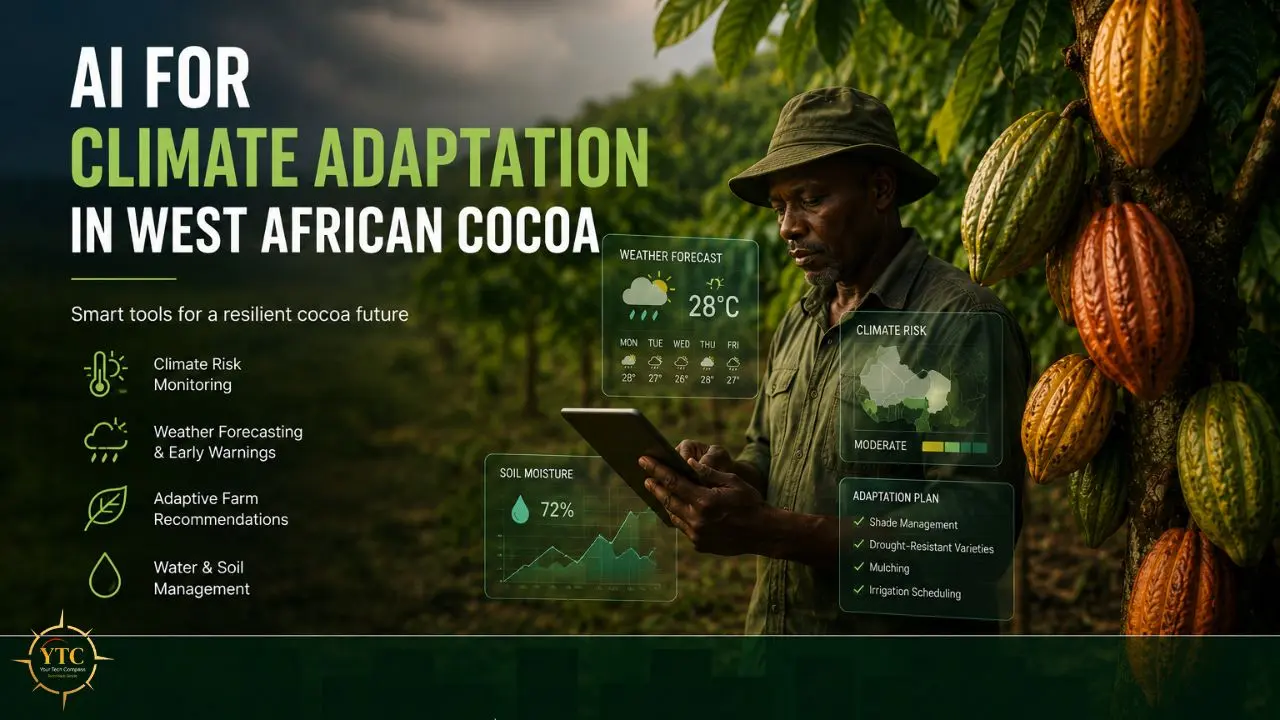
Climate adaptation is the AI application domain where the gap between what’s possible and what’s currently deployed is widest, but where several programs have produced verified outcomes worth examining in detail.
Hyper-Local Weather Forecasting and Planting Advisory
ICPAC (the IGAD Climate Prediction and Applications Center, based in Nairobi) provides machine-learning-based climate forecasting for the Horn of Africa and, through partnerships, has extended modeling approaches to West African agricultural contexts. Regional seasonal forecasts are downscaled into district-level agricultural advisories, then further refined into farm-specific planting-date and pod-management recommendations by integrating real-time satellite-derived weather estimates.
The practical value of cocoa farming is specific: a forecast of below-average rainfall over the next six weeks during pod development triggers an irrigation advisory and a recommendation to delay fungicide application. Why delay fungicide?
Because dry conditions significantly reduce the risk of Black Pod, the pathogen requires high moisture to sporulate and spread. An AI model that integrates weather forecasting with disease biology can produce a joint recommendation that a human extension officer, working with each variable separately, would struggle to synthesize across 1,500 farm visits.
The Rainforest Alliance Smart Farming Platform, deployed across Ghana and Côte d’Ivoire, combines hyper-local weather data with AI-based crop models to generate farm-level advisories, including cover-crop and shade-tree recommendations based on climate-stress projections. Farms on this platform show a 15–20% improvement in yield stability during drought years compared to control farms; a result that, while based on the platform’s own reporting rather than an independent RCT, is consistent with the mechanisms the intervention addresses.
Agroforestry AI: Shade Tree Optimization
The agroforestry dimension of cocoa farming is where AI adds a particularly distinctive capability: long-term optimization under future climate uncertainty. Shade trees (Albizia, Gliricidia, and timber trees) regulate the microclimate of cocoa farms by buffering temperature extremes, maintaining soil moisture, and sequestering carbon. Traditional shade management relies on heuristics passed down through generations that are increasingly miscalibrated for current and projected climate conditions.
A PRISMA-guided systematic review of peer-reviewed literature published between 2000 and 2024 was conducted, yielding 49 core studies analyzed alongside supporting evidence. The synthesis evaluates regenerative agronomic outcomes, UAV-derived multispectral, thermal, and structural diagnostics, and AI-based analytical approaches for stress detection, yield estimation, and management zoning. Results indicate that regenerative practices consistently improve soil health and yield stability, while UAS data enhance spatial targeting for rehabilitation, shade management, and stress management.
IITA‘s machine learning work on agroforestry optimization goes further than current advisory: it adds a 10-year climate projection layer, asking not just “what shade density is optimal for this farm’s current conditions?” but “where should this farmer invest in shade trees today to buffer the 2035 climate conditions projected for their microzone?” This temporal extension (using CMIP6 climate projections downscaled for West Africa) is where AI adds a capability that no human advisor working from current experience can replicate. Farms that follow AI agroforestry recommendations show 12–18% greater yield stability under high-temperature stress conditions, according to research.
Parametric Climate Insurance for Cocoa Farmers
The climate adaptation story connects directly to financial inclusion, and this connection is where the African fintech ecosystem intersects most tangibly with agricultural AI. Parametric crop insurance, which pays out automatically when a satellite-derived trigger condition is met, without a claims adjuster visit, is the most viable insurance model for West African smallholder cocoa farmers, and AI is the enabling layer.
The trigger for cocoa-specific parametric insurance is typically satellite-derived rainfall falling below a threshold during pod set, the critical period when drought stress directly translates to yield reduction. The AI yield prediction model, trained on Ghanaian cocoa yield data, creates actuarial tables that price premiums fairly: too conservative, and farmers won’t pay premiums; too aggressive, and the product isn’t commercially viable.
Ghana Agricultural Insurance Pool (GAIP) is piloting cocoa-specific parametric products. ACRE Africa and Pula Advisors, whose model of reaching 14 million smallholder farmers with parametric insurance across 22 African countries is documented in our AI precision farming Africa article, are extending their East African model into West African cocoa markets. Furthermore, the EUDR compliance link is commercially significant: insured, geolocated farms with digital records are dramatically easier to certify as deforestation-free than unregistered, uninsured farms with no digital footprint.
AI for Yield Optimization: From Soil to Harvest Timing
Soil Health AI for Cocoa
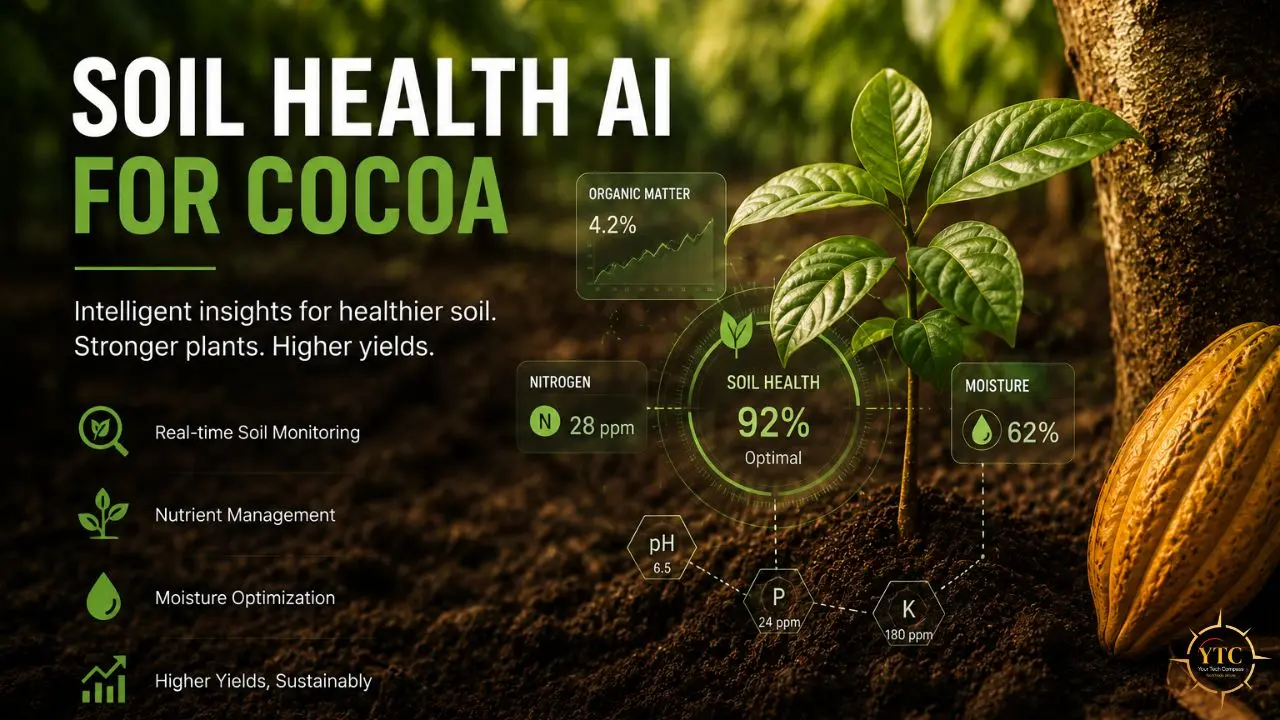
Cocoa is nutrient-demanding. pH, potassium, phosphorus, zinc, and boron deficiencies are all documented in Ghanaian cocoa-growing soils, and the specific deficiency profile varies by region, elevation, and farming history. Traditional soil testing requires laboratory processing, incurs costs that many smallholders can’t afford, and returns results after the fertilization application window has passed.
AI-enabled rapid soil assessment addresses all three problems simultaneously. Near-infrared (NIR) spectroscopy devices at $200–$500 per unit produce instant soil nutrient readings deployable at the village or cooperative level. Machine learning models trained on soil-yield correlation data specific to Ghanaian cocoa soils translate those readings into input prescriptions: which fertilizers, at which rates, at which timing windows, for this specific farm’s soil profile.
CABI’s Plantwise plant health clinics, operating across Ghana, incorporate AI soil advisory tools alongside disease diagnosis. The yield improvement from targeted fertilizer prescription versus blanket recommendations, where the same inputs are applied uniformly regardless of soil variation, is documented at 18–25% in farms where specific deficiencies were identified and addressed. That range reflects the magnitude of the soil-health problem on Ghana’s aging cocoa farms, many of which have been continuously cropped for 30–50 years without adequate nutrient replenishment.
AI Pod Count Prediction and Harvest Scheduling
Computer vision applied to cocoa pod counting addresses a genuine operational problem: cocoa harvesting is labor-intensive, time-sensitive, and requires coordinating harvest teams, transport logistics, and drying facility capacity simultaneously. Getting this coordination wrong (arriving too early or too late, with the wrong team size, or insufficient drying capacity) reduces quality and income, independent of disease or climate issues.
Drone or smartphone imagery of cocoa trees, processed by AI models trained on cocoa canopy images, counts developing pods per tree and extrapolates field-level yield estimates. Early research on AI pod counting in Ghana reports 80–88% accuracy on unobstructed canopy images, lower than Aerobotics’ 95% accuracy on citrus in South Africa, due to cocoa’s irregular, dense canopy, which makes pod visibility more variable. The practical application is labor and logistics planning 4–6 weeks before harvest, earlier than any human visual assessment can reliably provide.
Fermentation and Drying Quality Optimization
Post-harvest quality in cocoa is determined almost entirely by fermentation (5–7 days) and drying (1–2 weeks). Poor fermentation (wrong temperature, inadequate turning frequency, premature termination) produces flat flavor profiles that reduce quality grade and the price received. AI quality optimization at this stage is currently deployed primarily at the cooperative and aggregator level rather than at the individual smallholder level.
IoT temperature and humidity sensors in fermentation boxes feed ML models that predict optimal turning timing and fermentation completion. Moisture sensors in drying beds, integrated with real-time weather data, optimize the timing of covering and uncovering to determine whether drying proceeds optimally or moisture damage occurs.
The quality premium potential is significant: certified fine-flavor or well-fermented premium cocoa commands $500–$2,000 per ton above standard bulk cocoa. Optimizing fermentation and drying to meet premium specifications is one of the highest-return AI applications in cocoa, but it requires cooperative-level infrastructure that most smallholder farms don’t yet have direct access to.
AI for Supply Chain Transparency: The EUDR Pressure and the Traceability Opportunity
The European Union Deforestation Regulation has done more to accelerate supply chain AI adoption in West African cocoa than any voluntary industry initiative of the past decade. Not because it’s more ambitious than those initiatives, but because it has teeth, timelines, and consequences that voluntary programs don’t.
What the EUDR Actually Requires
Full EUDR compliance requires geolocation coordinates for every cocoa farm in the supply chain, satellite-verified evidence that the farm was not on deforested land after December 31, 2020, and due diligence documentation for every operator placing cocoa on the EU market. Large operators faced the December 2025 compliance deadline; SME operators face the June 2026 deadline.
Ghana and Côte d’Ivoire supply the majority of EU cocoa; therefore, full compliance requires geolocating and verifying 1.5–2 million individual smallholder farms. No manual process can do this at this scale, at this speed, at a cost that the supply chain can absorb. Consequently, AI-powered satellite mapping is the only viable technical path.
The Technology Stack for Cocoa Traceability
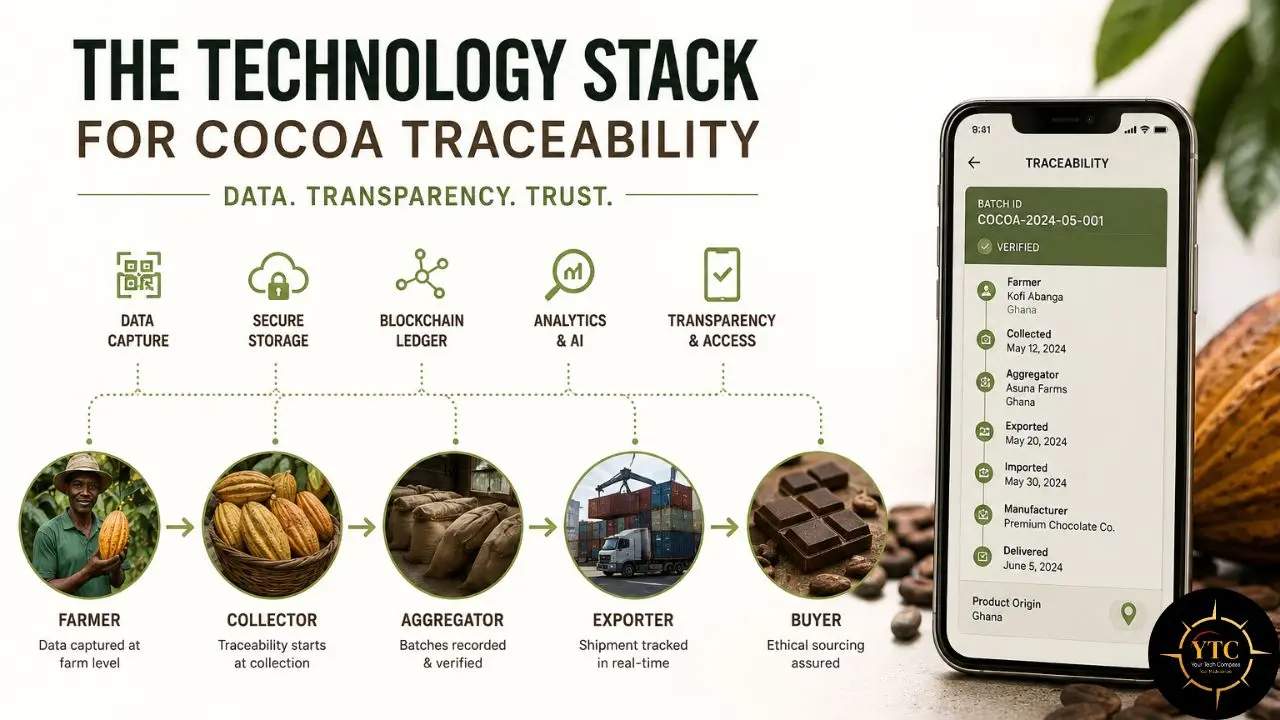
Farm polygon mapping via satellite and AI is the foundation layer. Google Earth Engine, ESA’s Copernicus, and commercial satellite imagery, processed by AI models, map individual farm boundaries as irregular polygons representing each smallholder’s actual plot. Machine learning-based deforestation detection compares the 2020 baseline forest cover (the EUDR cutoff date) with current imagery, flagging farms established on deforested land after that date.
By 2025, several million Ghanaian farm polygons had been mapped through COCOBOD’s digitization program and NGO-led mapping efforts, a genuinely remarkable achievement in geographic data infrastructure for a country with 800,000+ registered smallholder farmers. COCOBOD’s farmer registry digitization adds a biometric registration layer, linking farmers to their mapped polygons with a verifiable digital identity.
Blockchain-linked farm IDs provide the traceability credential: once a polygon and farmer identity are linked on a traceable record, every bag of cocoa from that farm can carry a provenance credential from farm to port to processor to manufacturer. Companies building this infrastructure include Sourcemap, Farmforce, CocoaConnect, and several joint-venture platforms between major trading houses and tech companies, including Tony’s Chocolonely, Barry Callebaut, and Olam.
AI Price Discovery: The Farmer’s Information Gap
The income gap that keeps Ghanaian cocoa farmers at less than 8% of the value of a chocolate bar is structural, but information asymmetry amplifies it. Farmers who don’t know the current COCOBOD floor price before selling end up selling below it. Platforms like Esoko (Ghana) and Farmerline provide price intelligence via SMS; knowing the correct price before negotiating with a trader is the simplest way to restore market power.
AI demand forecasting extends this: if the model predicts strong demand for certified cocoa in Q3, farmers can time sales accordingly and hold inventory when possible. The 12–15% improvement in prices received by farmers using market price advisory platforms (based on Farmerline’s internal data and requiring independent verification) reflects a reduction in information asymmetry, not AI-generated market power. The honest constraint is that AI price advisory can close information gaps; it cannot restructure the underlying value chain that determines how much of the final price ever reaches the farmer.
Key Platforms and Organizations Building AI for West African Cocoa
The ecosystem-building AI for West African cocoa is not a single coherent movement with a shared roadmap. It’s a layered, sometimes fragmented collection of government bodies, research institutions, agritech startups, international agricultural organizations, and private-sector actors, each approaching the problem from a different angle, with different resources, incentives, and timelines. Understanding who is doing what and why their specific role matters is essential context for anyone evaluating where real technical progress is happening and where the gaps remain.
The organizations below aren’t ranked by importance. They operate at different levels of the system: some provide the foundational data that everything else depends on; others build farmer-facing tools; and others create the commercial demand and funding that make deployment economically viable at scale. Taken together, they represent the most complete picture currently available of what the AI and digital infrastructure for West African cocoa actually look like.
A Quick Look at the Operating Ecosystem
Here’s the operating ecosystem you need to know, organized by institutional type and role in the AI deployment chain.
Organization | Type | AI Application | Scale | Primary Country |
COCOBOD | Government regulator | Farm polygon mapping; farmer registry; traceability | National scale | Ghana 🇬🇭 |
CRIG | Research institute | CSSVD satellite detection; disease mapping | Research + pilot | Ghana 🇬🇭 |
Farmerline | AgriTech startup | Advisory via USSD/SMS/voice; disease + weather + price | 100,000+ farmers | Ghana 🇬🇭 |
IITA | International research | Agroforestry AI optimization; disease management | Research + pilot | Nigeria 🇳🇬/Pan-Africa |
CABI | International NGO | Plantwise clinics; soil AI advisory; farmer training | 100+ clinics | Pan-Africa |
Rainforest Alliance | International NGO | Smart Farming Platform; climate + yield advisory | Ghana + Côte d’Ivoire | Multi-country |
GAIP | Insurance | Parametric cocoa insurance; AI premium pricing | Pilot stage | Ghana 🇬🇭 |
Aya Data | UK-Ghana AI firm | Drone imagery analysis; disease detection AI | Commercial | Ghana 🇬🇭 |
Tony’s Chocolonely / Barry Callebaut | Private sector | Traceability platforms; farmer income programs | Supply chain scale | Multi-country |
World Cocoa Foundation (CocoaAction) | Industry body | Digital tool coordination; shared infrastructure | Industry-wide | Multi-country |
CRIG (Cocoa Research Institute of Ghana)
Every AI system applied to Ghanaian cocoa disease detection depends, at some level, on CRIG. The Cocoa Research Institute of Ghana is the primary government research body for cocoa in Ghana and one of the oldest institutions of its kind on the continent, having operated continuously since 1938 out of its base in New Tafo-Akim in the Eastern Region. It sits within COCOBOD’s broader institutional structure as a subsidiary responsible for the scientific foundation of Ghana’s cocoa sector.
CRIG’s role in the AI ecosystem is primarily one of scientific infrastructure rather than technology deployment. The institute manages the country’s most authoritative epidemiological data on Cocoa Swollen Shoot Virus Disease, the mealybug-transmitted virus that has infected over 90,000 hectares of Ghanaian cocoa farms as of the 2024/25 crop season, according to USDA Foreign Agricultural Service data.
CRIG is currently conducting what it describes as a third country-wide CSSVD survey, building a new disease distribution map that represents the most granular spatial dataset on viral infection spread available in Ghana. This survey data (the specific locations of infected trees, the boundaries of disease clusters, and the spread patterns between farms) is what provides any satellite-based disease detection model with its ground truth. Without it, there’s no way to validate whether what the satellite is seeing actually corresponds to viral infection on the ground.
Concretely, CRIG provides the validation layer that AI agrotech requires. When machine learning models are trained to identify CSSVD symptoms from satellite imagery or drone-captured multispectral data, they need confirmed examples of infected farms at specific GPS coordinates to learn from.
CRIG’s field research teams and its network of experimental stations across Ghana’s major cocoa-growing regions generate exactly that data. Published research, including work on how CSSVD affects yield-component traits across different cocoa clones, provides quantitative benchmarks for calibrating AI-assisted disease management recommendations.
The Honest Limitation Is One of Pace
CRIG operates on government research timelines and budgets. Peer-reviewed studies move slowly. Technology partnerships with private-sector AI developers require institutional arrangements that large bureaucracies navigate carefully. The institute’s strength (its scientific rigor and authoritative data) is also its constraint in responding to the speed at which CSSVD spreads across farms.
COCOBOD (Ghana Cocoa Board)
Where CRIG provides the scientific foundation, COCOBOD provides the regulatory and commercial architecture that makes any digital system for Ghanaian cocoa viable at scale. Ghana Cocoa Board is the statutory body that governs virtually the entire Ghanaian cocoa value chain, from research and extension through purchasing, quality control, processing, and export. No serious AI or digital traceability deployment in Ghanaian cocoa happens without COCOBOD’s involvement, because COCOBOD controls the institutional infrastructure through which cocoa actually moves.
The most consequential current digital initiative is the Ghana Cocoa Traceability System (GCTS), developed by COCOBOD with technical support from GIZ’s EU Sustainable Cocoa Initiative. Officially introduced at the start of the 2025/26 main crop season, the GCTS fundamentally changes how Licensed Buying Companies operate.
Under the new system, LBCs can no longer rely on paper-based methods for collecting cocoa from farmers. Every bag of cocoa beans is now required to carry a traceable digital identity linked to GPS-verified farm polygon data and farmer credentials, establishing an auditable chain of custody from farmgate to port. A pilot phase in the Assin Fosu district had already mapped over 40,000 farms and registered more than 20,000 farmers before the national rollout, with women representing 40% of the registered participants.
The driver behind this urgency is the EU Deforestation Regulation, which officially enters full application on December 30, 2025. The EUDR requires that every commodity entering the EU market (cocoa is one of seven covered commodities) be demonstrably traceable to its point of origin and certified as deforestation-free.
For Ghana, whose cocoa sector is dominated by over one million smallholder farmers operating on 2–5-hectare plots across the Western, Ashanti, Eastern, Central, and Bono regions, achieving compliance through manual documentation is structurally impossible. The GCTS and its GPS farm polygon system are Ghana’s national answer to that regulatory requirement.
What the GCTS creates, beyond EUDR compliance, is a digital farm registry that every other AI application for Ghanaian cocoa can eventually build on. A farmer identity record with a verified farm polygon, linked to production history and buyer transactions, is the foundational data layer that disease-detection alerts, climate advisory services, and credit-scoring models require to deliver field-level recommendations. GCTS was accelerated specifically to align with the EU Regulation for Deforestation-Free Products, with COCOBOD leading implementation in Ghana as part of its broader digitalization agenda.
The challenge COCOBOD faces is the infrastructure gap that revealed itself during rollout: limited internet connectivity in remote cocoa communities, inconsistent technical capacity among LBC purchasers, and the persistent difficulty of reaching the most isolated smallholders. These aren’t problems that digital tools solve on their own. There are problems that require the kind of ground-level institutional presence that COCOBOD, despite its scale, struggles to maintain consistently across a farming population spread across six primary-producing regions.
Farmerline (Ghana)
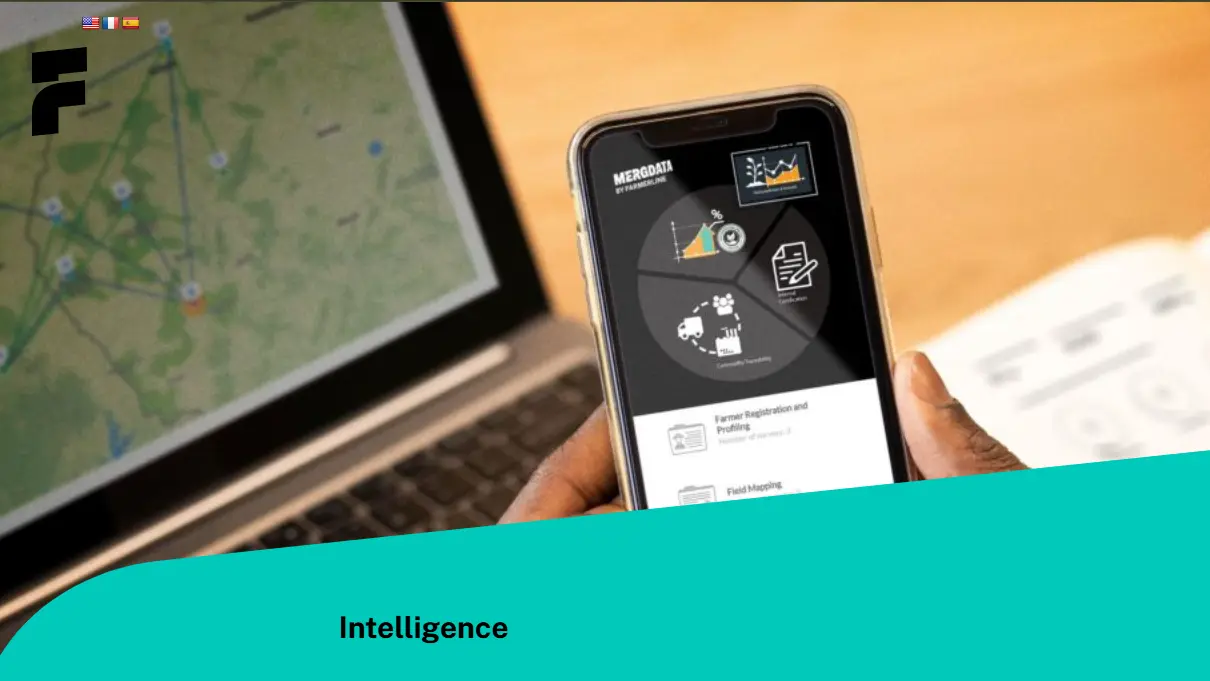
Farmerline occupies a position that no government institution or international research body can replicate: it operates at the last mile of the farmer relationship, through channels farmers already trust and use. Founded in 2013 by Alloysius Attah and Emmanuel Owusu Addai and headquartered in Accra, Farmerline began by delivering agricultural information to 800 farmers in Ghana via audio messages on basic mobile phones. A decade later, the company’s impact spans 50 countries, reaching over 2.2 million farmers and influencing more than 2 million acres of farmland.
The technological backbone of everything Farmerline does is Mergdata, an AI-powered platform that integrates farmer digitization, supply chain intelligence, market data, climate advisory, product traceability, and agribusiness credit scoring into a single architecture. Farmerline has evolved Mergdata into an AI-powered super platform for supply chain intelligence encompassing crop yield prediction, fertilizer demand forecasting, product traceability, and agribusiness credit scoring for asset and fertilizer financing. Mergdata was named one of TIME Magazine’s 100 Best Inventions of 2019, recognition that reflects both the quality of the underlying system and the scale of what it had already achieved.
For cocoa specifically, Farmerline’s most important contribution is its delivery of AI advisory through a communication infrastructure that reaches smallholder farmers in West Africa. Rather than assuming smartphone access or consistent data connectivity, Mergdata operates across USSD, SMS, voice calls, and mobile apps: meeting farmers where they are, on the handsets they own, in the languages they use.
Farmers can access market prices, weather updates, and advice in over 30 local languages. For cocoa farmers in Ghana’s Brong-Ahafo or Western North regions, where Twi or Dagbani may be more practical than English, that multilingual delivery isn’t a feature; it’s the reason the advisory actually gets used.
The disease advisory integration demonstrates a practical AI architecture for smallholder cocoa at scale. When cocoa pest and disease alerts are incorporated into the same communication channels through which a farmer already receives weather updates and market prices, the cognitive overhead of adopting a new tool disappears.
The farmer doesn’t download an app and learn a new interface. The information arrives through a channel they have already checked. That design principle (embedding AI recommendations into existing farmer behaviors rather than creating new ones) is why Farmerline’s reach is measured in millions rather than thousands.
Touton, a French cocoa trading company, used Mergdata to map and visualize data on tens of thousands of Ghanaian cocoa farms. The result was the ability to accurately predict harvests, carry out certification, conduct sustainability monitoring, and verify that top-quality cocoa met buyer standards. That case study illustrates Mergdata’s dual function: simultaneously serving farmers with advisory information and buyers and exporters with supply chain intelligence and traceability data that EUDR and premium market access increasingly require.
IITA (International Institute of Tropical Agriculture)
The International Institute of Tropical Agriculture, headquartered in Ibadan, Nigeria, is the pan-African agricultural research institution with the broadest mandate and the deepest scientific bench in the cocoa AI ecosystem. IITA’s relevance to this section of the article on climate adaptation and agroforestry is particularly significant because it was a core partner in the CLIMCOCOA research program, one of the most rigorous scientific investigations of climate-smart cocoa agroforestry conducted in West Africa.
The CLIMCOCOA project, conducted between 2016 and 2020 in partnership with IITA Ghana, the World Agroforestry Center, CIRAD, the University of Ghana, and the University of Copenhagen, generated the foundational research base that AI-assisted climate adaptation recommendations for cocoa now draw from. The project investigated the biophysical and socioeconomic sustainability of cocoa agroforestry as a climate change adaptation strategy, modeling how shade tree integration affects cocoa yields across different rainfall profiles, how cocoa-growing zones are shifting in response to changes in temperature and precipitation, and which agroforestry configurations provide the best resilience-productivity balance across different agroecological contexts.
That research matters for AI applications because machine learning models for climate advisory in cocoa require training data that links environmental variables (temperature, rainfall, soil characteristics, altitude) to yield outcomes across different farm management systems. IITA’s field data and modeling work provide exactly that foundation. When an AI platform recommends a specific mix of shade tree species for a cocoa farm in a drier transition zone, that recommendation is grounded in the biophysical modeling IITA has been developing for over a decade.
IITA also functions as the institutional backbone connecting national research institutes across West Africa’s cocoa belt. IITA’s cocoa program operates in partnership with national cocoa research institutes, including CRIG in Ghana, CNRA in Côte d’Ivoire, IRAD in Cameroon, and CRIN in Nigeria, as well as international centers, leading chocolate companies, and the World Cocoa Foundation. That network role positions IITA as a critical node for ensuring that AI tools developed in one national context can be validated and adapted for neighboring producer countries, which is critical for any pan-West African deployment.
CABI (Center for Agriculture and Bioscience International)
CABI’s contribution to AI for West African cocoa operates at a different level of the system from research institutions or agritech platforms. Rather than building digital tools or training models, CABI focuses on the human infrastructure required for AI-assisted disease diagnosis to reach the farm level, specifically through its Plantwise program and its network of plant health clinics in Ghana.
The Plantwise model places trained local plant doctors in community-level clinics where smallholder farmers bring diseased plant samples or describe symptoms they’ve observed in their fields. The plant doctors use AI-assisted diagnostic tools to identify the problem (by comparing symptoms against a database drawing on CABI’s extensive global plant health knowledge base) and provide treatment recommendations appropriate to the specific disease, the farmer’s resource level, and local input availability. The clinic model addresses a critical bottleneck in AI deployment for disease management: the most sophisticated remote sensing and machine learning tools are largely useless if a farmer with a sick cocoa tree has no way to convert that technology into an actionable, trusted recommendation at the moment of need.
CABI’s soil health advisory platform extends this ground-level advisory role beyond disease diagnosis to the soil management practices that underpin farm productivity and climate resilience. Soil degradation is a documented constraint on cocoa yields across Ghana’s older-producing regions, where decades of monoculture without adequate replenishment of organic matter have reduced soil carbon and water retention. AI-assisted soil advisory that integrates soil-type data with farm location and climate projections can help farmers make better decisions about soil health restoration, but only if the advisory reaches them through trusted channels and is supported for implementation.
The broader significance of CABI’s role in this ecosystem is that it provides a model for solving the last-mile AI deployment problem in a context where farmers’ digital literacy is uneven, and trust in technological recommendations must be established through human relationships before automation can occur.
Tony’s Chocolonely, Barry Callebaut, and Olam
Private-sector chocolate companies occupy a different position in this ecosystem than any of the research or implementation organizations above. Tony’s Chocolonely, Barry Callebaut, Olam, and their peers are not primarily AI developers; they are the demand signal that determines whether AI and digital traceability infrastructure get built and funded at a commercially meaningful scale.
This matters because the economics of technology deployment in West African smallholder agriculture are not self-sustaining through farmer fees alone. The average Ghanaian cocoa farmer operating 2–4 hectares cannot afford the mapping, advisory, and traceability infrastructure increasingly required for premium-market access. The financial model that makes deployment viable is one where chocolate companies and commodity traders pay for traceability and sustainability data through supply chain partnerships: directly funding the farmer digitization programs, the GPS polygon mapping exercises, and the certification infrastructure that both meets their sourcing requirements and serves the farmers’ interest in accessing better prices.
Barry Callebaut’s direct sourcing and farmer income programs, Tony’s Chocolonely’s mission-driven supply chain model, and Olam’s farm services and certification infrastructure each represent commercial-scale demand for the kind of verified, traceable, AI-assisted cocoa supply that EUDR is making a market requirement rather than a premium differentiator. When Barry Callebaut commissions a traceability platform for its West African sourcing program, or Olam deploys a farmer digitization initiative across its cocoa origins, the AI tools embedded in those platforms get deployed at a scale that no research grant or donor program can match.
The honest tension in this dynamic is that private-sector traceability investments are primarily designed to serve buyers’ due diligence and market-access requirements. They create valuable data infrastructure, but data ownership, data access, and the use of aggregated farmer data for AI model training are all areas where farmer interests and corporate interests can diverge. The governance of who owns the data generated by West African farmers’ behavior and who benefits from the AI models trained on it remains an unresolved question in this ecosystem, one that becomes more consequential as data volumes grow.
World Cocoa Foundation (CocoaAction)
The World Cocoa Foundation and its CocoaAction industry platform serve as the coordination layer above individual company programs, aiming to build a shared digital infrastructure to prevent fragmentation from undermining the sector’s overall progress.
The fragmentation problem is real and documented. Multiple chocolate companies deploying independent farmer digitization programs across overlapping geographies create a situation where the same farmer may be registered in three different systems under slightly different name spellings, mapped at three different GPS coordinates by three different field agents using three different methodologies, and receiving three sets of advisory recommendations that may or may not be consistent. For AI systems that rely on clean, consolidated data to generate accurate recommendations, this fragmentation actively degrades input quality.
CocoaAction’s role in the AI ecosystem is to advocate for and help implement interoperability standards (shared data formats, common farmer ID systems, and aligned methodologies for farm polygon mapping) that enable the consolidation and cross-referencing of data from different organizations rather than keeping it siloed. The WCF also coordinates funding for shared digital infrastructure investments that no single company has an incentive to fund on its own, because the benefits would accrue equally to competitors.
Concretely, WCF coordinates with COCOBOD, GIZ, the EU, and private-sector partners on initiatives such as aligning the GCTS with private-sector traceability systems, ensuring that farm data collected under COCOBOD’s national system can be recognized by the due diligence systems that individual chocolate companies use to demonstrate EUDR compliance. Without that alignment, Ghana risks two parallel traceability systems that collectively cover the sector but cannot be integrated, undermining both compliance efficiency and the AI models that depend on consolidated supply chain data.
Reading the Ecosystem as a Whole
Mapping these organizations together reveals a pattern that is more fragmented than coordinated but more functional than it might appear from the outside. CRIG and IITA provide the scientific validation layer. COCOBOD and GCTS provide the national data infrastructure.
Farmerline and CABI provide the farmer-facing delivery layer. The private sector provides the financial demand signal and the funding for deployment. WCF attempts to connect these layers through shared standards and coordination mechanisms.
The weaknesses in this structure are also visible from the mapping. Ground-truth disease data from CRIG moves slowly from research paper to usable training dataset for commercial AI applications. COCOBOD’s traceability infrastructure faces real constraints in connectivity and capacity at the farm level.
Farmerline’s platform reaches millions of farmers across 50 countries but depends on commercial and donor partnerships to sustain cocoa-specific content at the depth the disease and climate challenges require. The private sector’s data investments are shaped by commercial rather than farmer interests. And the coordination layer provided by WCF operates through consensus, which moves more slowly than the regulatory and environmental pressures the sector is responding to.
What this ecosystem has, and what it lacked a decade ago, is enough functional components for AI applications in West African cocoa to be no longer purely aspirational. The data infrastructure is being built. And the farmer communication channels exist. The commercial demand is also real and growing. In addition, the remaining challenge is integrating these components into a system in which scientific data, digital infrastructure, AI applications, and farmer-facing delivery actually reinforce one another rather than operating in parallel.
The Documented Evidence: What the Data Actually Shows
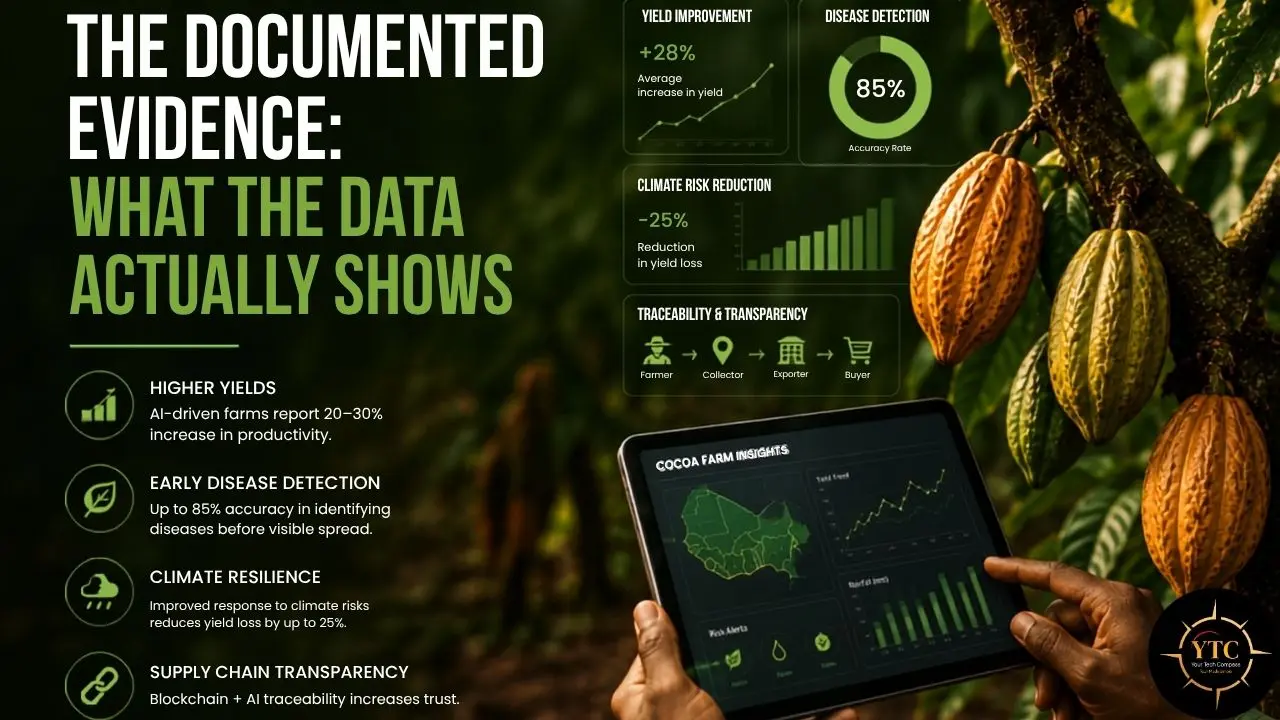
This section matters because agricultural AI in Africa is a field where aspirational claims and verified outcomes are often insufficiently distinguished from one another. Here is the honest evidence summary.
Strong Evidence
- Disease Detection Accuracy: Pre-symptomatic CSSVD detection via hyperspectral imaging achieves 80–92% accuracy. Black Pod detection using a smartphone CNN achieves 88–94% accuracy under field conditions (peer-reviewed studies). The CNN-Fuzzy hybrid model for cocoa disease classification achieved 99.99% accuracy under controlled conditions, with field deployment accuracy in the 88–94% range. These figures are consistent across multiple independent research groups.
- Time Advantage of AI vs Visual Detection: Documented 3–6 weeks earlier than CSSVD detection vs. visual symptom onset, a window that directly translates to a smaller infected area requiring cutting-out intervention.
- Yield Improvement from Soil AI Advisory: 18–25% documented in CABI Plantwise data for farms where soil-specific deficiency correction replaced blanket fertilizer application. This is the strongest evidence of outcome in the current deployment landscape.
- Agroforestry AI: Data show a 12–30% improvement in yield stability under high-temperature stress for farms following AI agroforestry recommendations.
Where Evidence Is Weaker
Most yield-improvement data come from program operators rather than independent randomized controlled trials. The EUDR traceability programs are too new for verified impact outcomes beyond mapping completion statistics.
However, there is limited evidence of deployment of Mealybug vector tracking and AI-driven fermentation optimization at the smallholder level. Consequently, long-term cocoa yield improvements from combined AI interventions lack multi-year RCT evidence as of 2026.
The Honest Synthesis
The mechanistic evidence that AI can detect cocoa diseases earlier and more accurately than visual methods is strong and consistent across independent studies. The economic outcome evidence (what happens to farmer incomes when these tools are deployed at scale) is promising but not yet at the evidentiary standard that would justify full-confidence scaling decisions without continued monitoring.
This mirrors the evidence pattern in other African agricultural AI contexts, as documented in our AI precision farming Africa analysis. The detection technology works; evidence for scaling continues to accumulate.
The Broader Policy Context
The broader policy context for how Ghana and West Africa approach AI governance in agriculture and other sectors is covered in our AI policy in Africa guide. The parallel story of AI healthtech deployment in Nigeria, Kenya, and South Africa, where similar last-mile delivery challenges and evidence-building dynamics apply, is documented in our article on AI healthtech startups.
And for the full comparative picture of how Africa’s AI adoption compares to other major emerging markets, our Africa vs India AI adoption analysis provides the strategic context. In addition, our AI Unboxed section covers the underlying model and tool developments, such as Llama 4, Qwen 3, Gemini 3.1 Pro, and Claude Opus 4.7, that increasingly underpin the agricultural AI systems being deployed in cocoa and other African crop contexts. Finally, our comprehensive AI in Africa guide provides the broadest ecosystem context for understanding where cocoa AI sits in the continent’s overall AI development story.
FAQs

AI is deployed across four domains in Ghanaian cocoa farming. First, disease detection: satellite and drone multispectral imagery feeds CNN models that detect CSSVD pre-symptomatically (3–6 weeks before visible symptoms), and smartphone-based CNN models classify Black Pod and other pod diseases with 88–94% field accuracy. Second, climate adaptation: hyper-local weather forecasting provides farm-level advisories on planting and fungicide timing, and AI-driven agroforestry optimization recommends shade-tree investments calibrated to projected 2030–2035 climate conditions. Third, yield optimization: AI soil advisory generates specific fertilizer prescriptions based on NIR spectroscopy readings, improving yields by 18–25% over blanket applications. Fourth, supply chain transparency: satellite-based farm polygon mapping and digitization of COCOBOD’s farmer registry are building the traceability infrastructure required to comply with the EU Deforestation Regulation.
CSSVD is a mealybug-transmitted virus that causes 15–20% of Ghana’s annual cocoa yield losses and currently affects 570,808+ acres of Ghanaian cocoa plantations. There is no chemical cure: infected trees must be cut out and removed. AI can detect CSSVD pre-symptomatically (before visible yellowing appears) by analyzing changes in NDVI (Normalized Difference Vegetation Index) in satellite and drone multispectral imagery. The disease disrupts chlorophyll production in ways measurable in near-infrared and red-edge spectral bands 3–6 weeks before visual symptoms emerge. Published accuracy rates from the University of Ghana and CRIG collaborative research range from 80–92%, depending on image resolution and disease stage.
The EUDR (effective December 2025 for large operators; June 2026 for SMEs) requires that any cocoa placed on the EU market must come from supply chains with GPS-verified farm polygons, satellite-confirmed deforestation-free status since December 31, 2020, and complete due diligence documentation. Ghana and Côte d’Ivoire together supply the majority of EU cocoa, meaning approximately 1.5–2 million individual smallholder farms need to be geolocated, mapped, and verified. COCOBOD’s farm digitization program and AI-powered satellite mapping constitute the technical infrastructure that enables this compliance, though the process is still being implemented.
The most active organizations are: CRIG (Cocoa Research Institute of Ghana) for CSSVD satellite detection research; COCOBOD for national farm polygon mapping and farmer registry; Farmerline for last-mile AI advisory delivery to 100,000+ Ghanaian farmers via USSD and voice; IITA for AI agroforestry optimization research; CABI’s Plantwise clinics for AI-assisted disease diagnosis and soil advisory; the Rainforest Alliance Smart Farming Platform for climate and yield advisory; Ghana Agricultural Insurance Pool for parametric insurance pilots; and Aya Data for commercial drone analytics in Ghana’s cocoa belt.
The biggest challenge is last-mile delivery, not model accuracy. Disease detection models achieving 90%+ accuracy in research settings produce limited real-world impact if the recommendation never reaches the farmer in a usable form, at the right time, through a channel the farmer actually uses. In rural cocoa-growing regions of Ghana, “reaching the farmer” means USSD on a feature phone or a voice message in Twi, not a smartphone app or a web dashboard. Platforms like Farmerline, designed for this reality, produce results; platforms that assume smartphone connectivity and data access don’t reach the farmers who need them most.
Conclusion
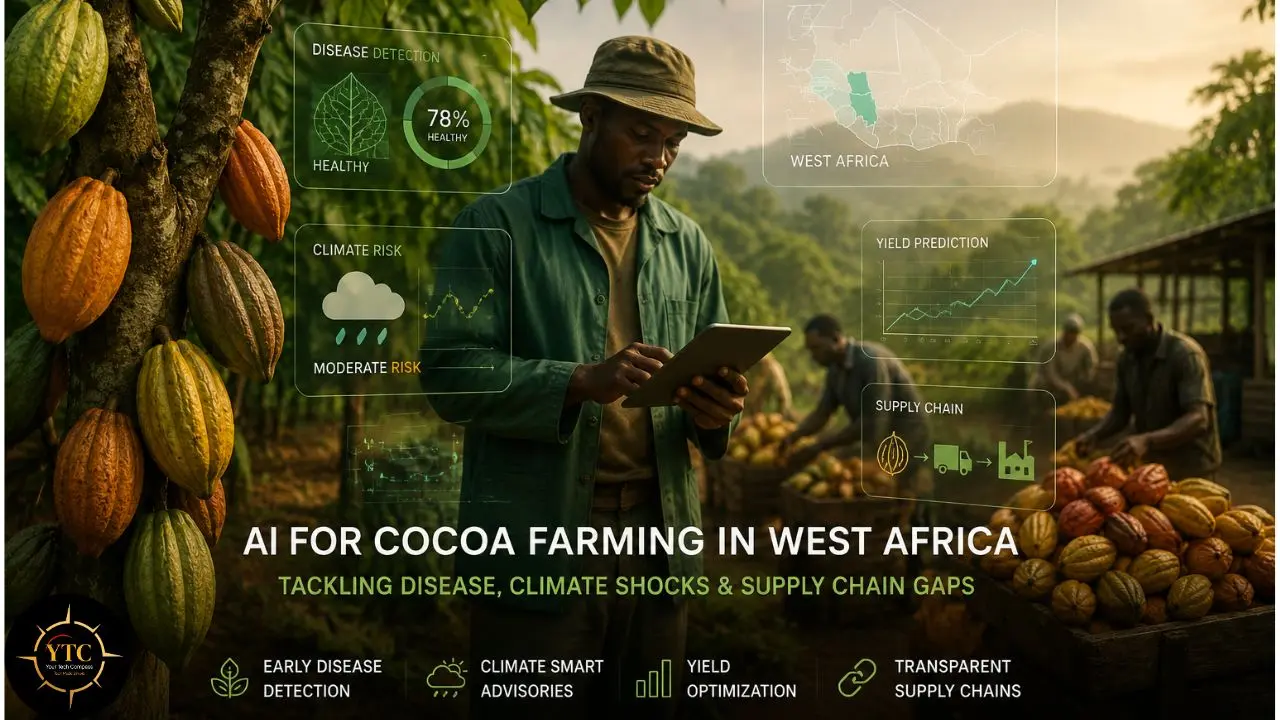
The AI applications transforming cocoa farming in West Africa are not theoretical; they are deployed, documented, and producing measurable outcomes in specific categories. Pre-symptomatic CSSVD detection, achieving 80–92% accuracy in Ghanaian field conditions, represents a genuine scientific achievement with direct economic consequences: earlier detection means smaller infected areas to be cut out, lower farmer income losses, and more manageable disease management programs for COCOBOD. AI soil advisory, producing 18–25% yield improvements on deficiency-corrected farms, is delivering real yield recovery from a disease-and-neglect spiral that has compressed Ghanaian cocoa productivity for decades. The farm polygon mapping that has geolocated millions of Ghanaian smallholder farms is building traceability infrastructure that the EUDR has made commercially mandatory, and that decades of voluntary industry initiatives never achieved. These outcomes are specific, documented, and significant.
The honest constraints matter equally. The farmer income gap, in which 2.5 million West African farming households receive 6–8% of the final chocolate bar’s value, is a structural pricing and power imbalance that satellite imagery and disease-detection algorithms make more visible but cannot fix. Mealybug vector tracking, AI-driven fermentation optimization at the smallholder level, and long-term climate adaptation at full scale remain research-stage or early-deployment interventions without the multi-year RCT evidence needed to fully validate scaling decisions. And last-mile delivery (getting AI recommendations to farmers through USSD channels, local-language voice messages, and extension officer networks that actually reach rural Ghana) remains the binding constraint on how much of this technology’s potential translates into farmer-level outcomes. The EUDR compliance deadline, the historic cocoa price spike, and growing private-sector investment in traceability are combining to accelerate AI adoption in cocoa at a pace not visible even three years ago. The question is whether the pace of technology deployment keeps pace with improvements in last-mile delivery.
The story of AI in West African agriculture is being written farm by farm, across some of the most consequential agricultural land on the planet. Follow it at YourTechCompass.com, where the African tech and AI coverage tracks what’s actually happening, not just what’s planned.