
You send a survey. Three hundred responses come back. Half of them are open-ended text, and now you’re the one who has to read through every single response, manually tag themes, and try to spot patterns buried somewhere in the noise. That’s not a feedback system. That’s manual labor with a progress bar. Traditional survey tools were built to collect responses. What most teams actually need is something that transforms those responses into decisions, and that’s exactly where the best AI-powered feedback and survey tools in 2026 have moved the conversation forward.
The shift is meaningful. According to McKinsey, AI usage across organizations rose from 50% to 72% in a single year, with customer experience and feedback teams among the leading adopters. The best platforms in this category no longer just collect responses; they detect sentiment in real time, automatically cluster open-ended text into themes, score urgency, and trigger workflows based on what the data actually says. Consequently, this guide reviews eight of the most capable platforms currently on the market. Each entry covers verified features, honest pricing, clear limitations, and a straight verdict on who it’s actually built for, so you can make a decision without spending three weeks in free trials.
What Makes an AI Feedback and Survey Tool Actually Worth Using?
Before getting into specific tools, it’s worth being clear about what separates genuinely useful AI survey platforms from those that just slap “AI” on their marketing page and call it a day. Not all AI capabilities are equal, and knowing what to look for will save you from paying for features that sound impressive but don’t change how your team works.
AI survey generation is the first layer. Can the tool build a complete, unbiased questionnaire from a single text prompt and score the questions for clarity and bias? Or does it just autocomplete one question at a time? That’s a meaningful difference.
Open-text analysis at scale is where most tools still fall short. The ability to automatically cluster hundreds of open-ended responses into themes and tell you what percentage of respondents mentioned each one is genuinely valuable. Without it, you’re still reading responses manually.
Sentiment and emotion detection go one step further, identifying not just what a response says, but the emotional intent behind it. Frustration, urgency, satisfaction, and confusion are signals that raw text doesn’t surface spontaneously.
Adaptive survey logic means the survey adjusts its questions based on how a respondent answers previous ones, which drives higher completion rates and richer data. However, closed-loop workflows are arguably the most underrated feature: the ability to automatically route negative feedback to the right team, trigger an alert, or create a support ticket without anyone having to check a dashboard. Finally, the depth of integration determines whether your survey data feeds your CRM and analytics stack or sits in a separate silo that nobody checks.
If you’re evaluating platforms across these dimensions, our Apps and Tools section covers a wide range of complementary tools worth stacking alongside your feedback platform.
📊 Full Comparison: Best AI-Powered Feedback and Survey Tools

Tool | Best For | AI Standout Feature | Starting Price | Free Plan | Verdict |
Zonka Feedback | Enterprise CX & VoC programs | Unified AI Feedback Intelligence + closed-loop workflows | ~$199/month | ❌ Very limited | ✅ Deepest AI analysis |
SurveyMonkey | All-around survey platform | Genius AI builder + question bias scoring | ~$25/month | ⚠️ Restricted | ✅ Most versatile |
Typeform | Conversational design, completion rates | Adaptive logic + AI question generation | Free / ~$25/month | ✅ 10 responses/mo | ✅ Best respondent UX |
Qualtrics XM | Enterprise research & prediction | Text iQ + churn prediction + xID profiles | Custom | ❌ No | ✅ Most powerful |
Survicate | In-product & website feedback | Behavior-triggered surveys + analytics integrations | ~$99/month | ✅ 25 responses/mo | ✅ Best for SaaS |
Qualaroo | In-moment feedback + sentiment AI | IBM Watson sentiment + behavioral targeting | Free / ~$19.99/month | ✅ Forever free tier | ✅ Best sentiment AI |
SurveySparrow | NPS tracking + employee engagement | Chat-style format + recurring survey automation | ~$19/month | ❌ Trial only | ✅ Best for NPS + HR |
Pollfish | Market research + audience panel | AI question generation + 250M+ consumer panel | ~$0.95/response | ❌ Pay-per-use | ✅ Best for market research |
The 8 Best AI-Powered Feedback and Survey Tools
A note before we begin: every YTC score is earned, never negotiated. If you want to understand exactly how we evaluate apps & tools and how we handle affiliate relationships, our Review Methodology lays it all out.
1. Zonka Feedback: Best for End-to-End AI Feedback Intelligence
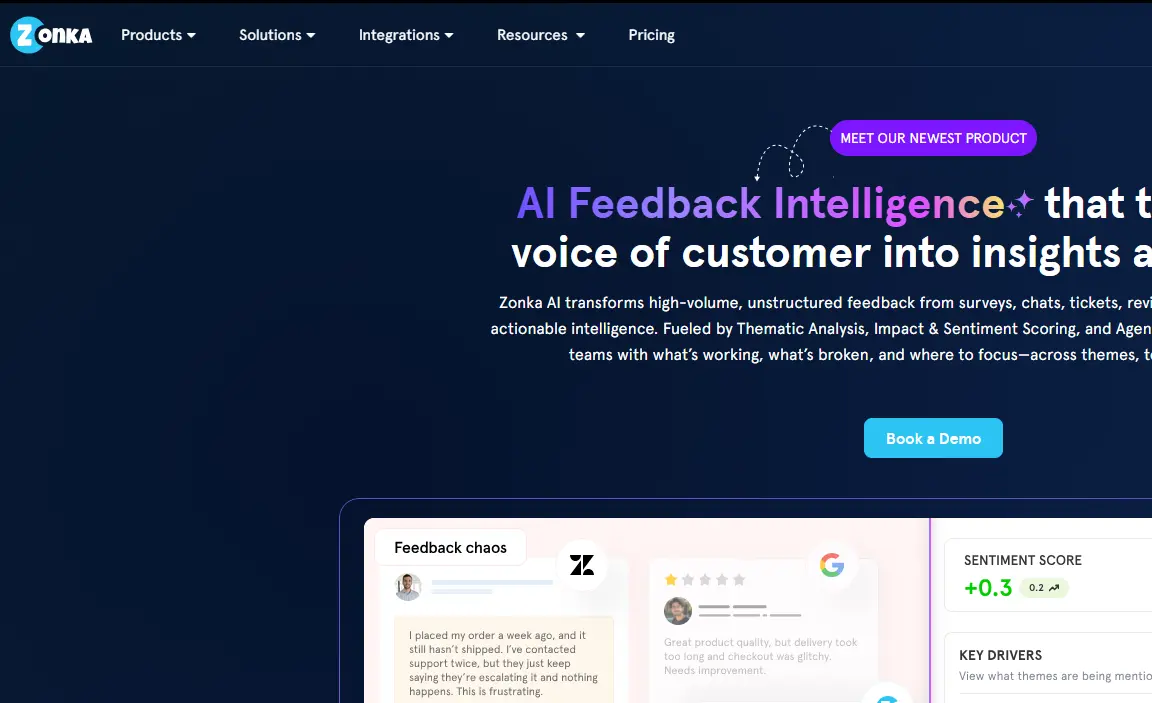
If your team needs to collect feedback from multiple channels, analyze it with genuine AI depth, and close the loop automatically, Zonka Feedback is the strongest platform on this list for that combination of use cases. It’s not a survey builder with analytics bolted on. It’s a feedback intelligence platform built from the ground up around what happens after responses arrive.
Zonka’s AI Feedback Intelligence layer is the standout feature. It unifies surveys, support tickets, reviews, chats, and calls into a single analysis pipeline, bringing together feedback sources that typically live in separate silos and treating them as a single continuous signal. From there, it applies thematic analysis, impact and sentiment scoring, entity recognition, and real-time agentic AI recommendations.
Role-based dashboards then surface the right view for each team: executives see trends, support teams see urgent tickets, and product teams see feature-level feedback. Nobody gets data that isn’t relevant to their decisions. Notably, one verified customer (SmartBuyGlasses) reported a 30% increase in NPS after implementing the platform, a result attributed specifically to the AI’s ability to surface actionable themes from high-volume response data.
Omnichannel collection covers email, SMS, WhatsApp, web widgets, in-app surveys, kiosks, and offline mode, so you can capture feedback at every touchpoint, including in physical environments where connectivity isn’t guaranteed. It integrates with 50+ platforms, including Salesforce, HubSpot, Zendesk, Intercom, Freshdesk, and Zapier.
Zonka earned 22 G2 badges in Winter 2026 and was named Best Survey Software in Capterra’s Pricing Value Report. It’s also ISO 27001:2022 certified, GDPR and HIPAA compliant, and offers regional data hosting in the US, Europe, Australia, and India.
Pricing
- Feedback Management tier at approximately $199/month.
- AI Feedback Intelligence tier at approximately $999/month.
- Enterprise pricing is custom.
Always confirm directly with Zonka, as plan names and features have been updated.
Honest Limitations
This is not a tool for small teams or solo users; the pricing is targeted at mid-market and enterprise users. Setup for the AI Intelligence tier requires initial configuration and learning time. The free plan is heavily restricted.
Best For
CX leaders, VoC managers, product teams, and enterprise operations are running multi-channel feedback programs at scale. Teams that want to move from “we have feedback data” to “we know what to do and who should do it.”
2. SurveyMonkey: Best All-Around Platform with AI Survey Design
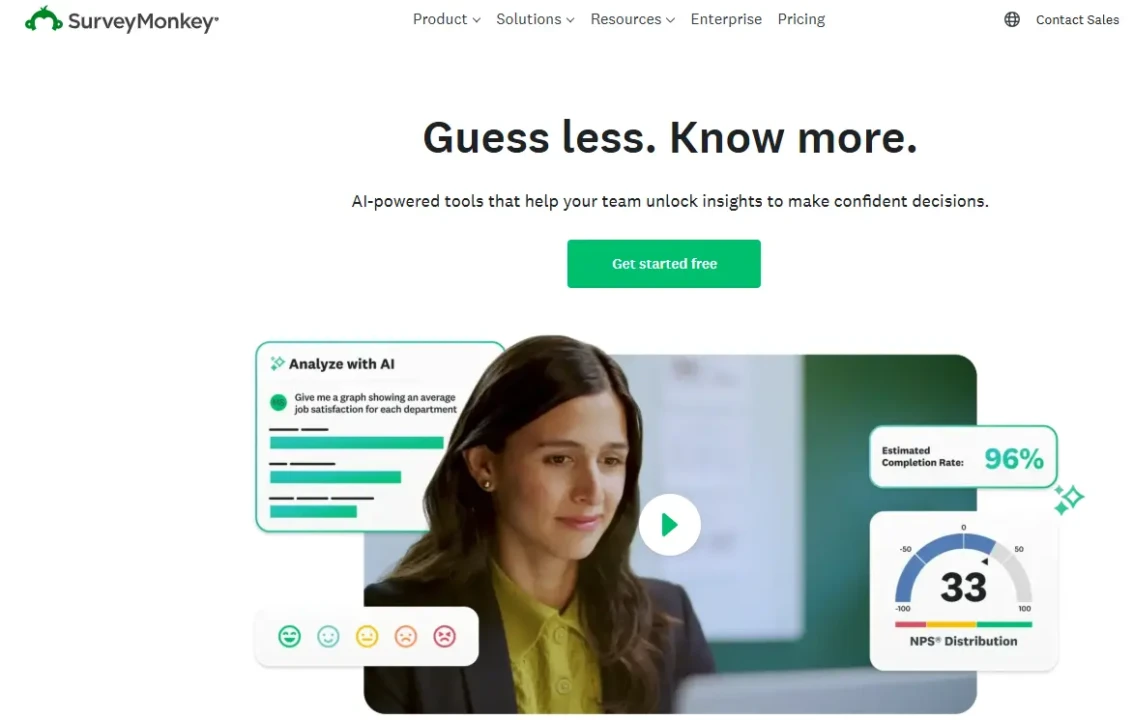
SurveyMonkey remains the most recognized survey platform on the market, and there’s a reason it’s still the default recommendation for teams that don’t want to overthink their choice. It covers roughly 80% of survey use cases out of the box, and its AI features have matured meaningfully with the introduction of SurveyMonkey Genius.
Genius generates full surveys from a text prompt and then scores each question for clarity, bias, and effectiveness, flagging leading questions or ambiguous wording before you send anything. That alone saves meaningful time for teams that run surveys regularly and care about data quality.
Beyond generation, the platform offers 400+ pre-built, methodologically validated templates across customer feedback, employee engagement, market research, and event feedback. The built-in audience panel lets you reach external respondents at approximately $0.15 per response, useful when you don’t have your own respondent pool.
Advanced analytics include cross-tabulation, statistical significance testing, and benchmarking against industry averages across comparable surveys. Additionally, 200+ native integrations cover Salesforce, HubSpot, Slack, Marketo, Zendesk, Tableau, and Google Drive.
Pricing
- Individual plans from approximately $25/month (annual billing).
- Team plans start at approximately $25/user/month.
- Enterprise pricing is custom.
Honest Limitations
The free tier is notably restrictive; response caps and feature gating quickly push users toward paid plans. AI analysis of open-text responses is functional but lighter than what Zonka, Qualtrics, or dedicated text analysis tools offer. Phone support is available only for Enterprise; email response times vary.
Best For
Teams that need a proven, general-purpose survey platform with broad integrations, solid analytics, and a large template library. Particularly strong for market research and surveys where question quality and statistical rigor matter.
3. Typeform: Best for Conversational Surveys and Completion Rates
If respondent experience is your top priority, and you’d rather get 85% of people to finish a shorter survey than 30% to complete a longer one, Typeform consistently delivers higher engagement than any other platform on this list. The one-question-at-a-time conversational format is the reason, and it works.
Rather than presenting respondents with a wall of questions, Typeform surfaces one question at a time in a clean, interactive layout. Each answer leads to the next question, which can be branched conditionally based on the previous response, creating a personalized path for each respondent.
AI-powered question generation helps you build surveys faster from a prompt, and logic jumps allow dynamic routing without any coding. The design customization is genuinely polished: fonts, colors, backgrounds, images, and even GIFs can be embedded in questions, which matters for customer-facing surveys where brand alignment is important. Furthermore, Typeform integrates with 500+ tools via native connections and Zapier, including Salesforce, HubSpot, Slack, Google Sheets, and Mailchimp.
Pricing
- Basic: Free (10 responses/month).
- Plus: Approximately $25/month (annual).
- Business: Approximately $83/month (annual).
- Enterprise: Custom.
Honest Limitations
Backend analytics are lighter than SurveyMonkey, Qualtrics, or Zonka. For serious analysis, you’ll likely need to export responses into another tool.
The free plan’s 10-response cap makes it useful for testing, but not for collecting real feedback. Therefore, this tool is not built for enterprise VoC programs or large-scale research.
Best For
Marketing teams, designers, startups, and any team where survey completion rates and respondent experience matter more than analytical depth. Excellent for customer-facing surveys, lead qualification, post-event feedback, and NPS.
4. Qualtrics XM: Best for Enterprise Research and Predictive Analytics
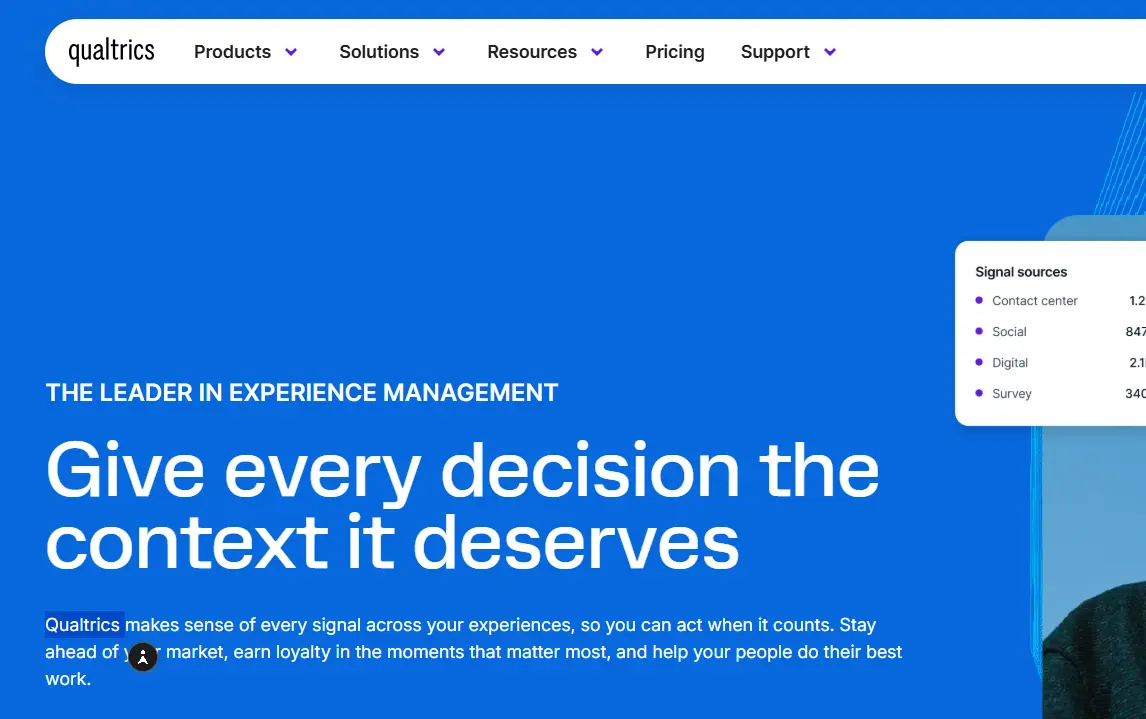
Qualtrics is the most powerful platform on this list for enterprise-scale research. It’s also the most complex and the most expensive. Consequently, it earns its cost for organizations that need capabilities simpler tools cannot replicate: advanced research methodology, predictive analytics, and compliance coverage at scale.
The Text iQ engine performs advanced sentiment analysis, emotion detection, and theme discovery across open-ended responses at a massive scale, surfacing not just what respondents said but also the emotional drivers behind it and the themes statistically linked to changes in NPS or CSAT scores. In addition, predictive analytics can forecast customer behavior, churn risk, and satisfaction trends before they appear in revenue reports.
The Experience ID (xID) system builds unified customer profiles from feedback collected across all touchpoints, giving organizations a longitudinal view of individual customer experiences over time. Beyond standard survey logic, Qualtrics supports conjoint analysis, MaxDiff, experimental design, and other specialized research methodologies that no other platform on this list handles natively. It’s HIPAA-, FedRAMP-, and SOC 2-compliant and is used by over 13,000 brands globally.
Pricing
Custom only. Annual contracts typically start in the thousands. Also note that a sales conversation is required before you can access pricing.
Honest Limitations
Given the platform’s significant complexity and steep learning curve, most organizations need a dedicated team to realize its full value. The custom pricing model makes it difficult to budget without a sales call.
And, for most mid-size companies, it’s overkill. One verified reviewer on software advice platforms noted, “I love the major CX tools like Qualtrics, but that is so expensive,” a sentiment that comes up consistently in comparisons.
Best For
Large organizations with dedicated CX or research teams who need compliance coverage, advanced research methodology, predictive intelligence, and AI-powered insight at scale.
5. Survicate: Best for In-Product and Website Feedback
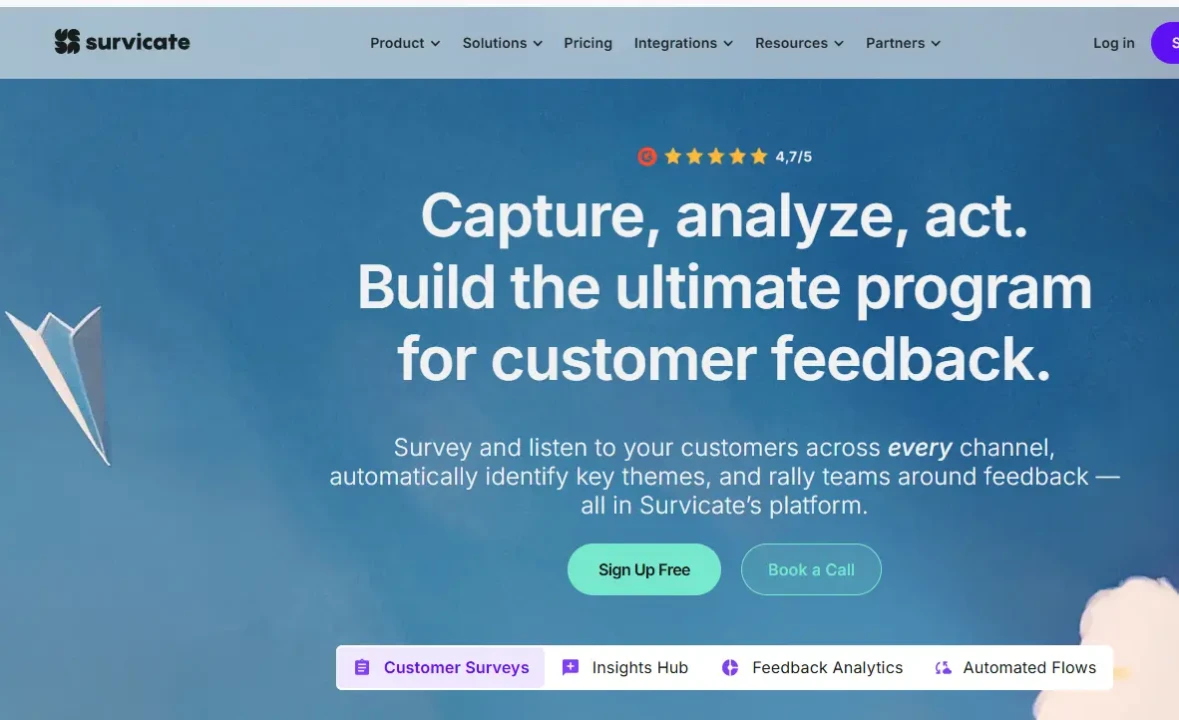
If your feedback gap isn’t in post-purchase email surveys but rather in your product or on your website, Survicate is the most capable tool on this list for that specific problem. It’s built for SaaS teams who want to capture feedback in context, triggered by what users actually do, not just by a batch email.
Survicate’s behavior-triggered surveys are the core capability: pop-ups, slide-ins, and embedded widgets that fire based on user actions, page visits, scroll depth, exit intent, or any combination of custom conditions you define. That means you’re asking the right question at the exact moment a user experiences something, which produces meaningfully richer data than any after-the-fact survey. Beyond that, Survicate integrates natively with HubSpot, Salesforce, Intercom, Segment, Amplitude, and other analytics tools, so survey responses flow directly into the systems your team already uses.
AI-powered response tagging and sentiment detection automatically handle open-ended answers. Additionally, NPS, CSAT, and CES tracking with trend visualization rounds out the analytics layer.
Pricing
- Free plan: Up to 25 responses/month.
- Good: Approximately $99/month (annual).
- Better: Approximately $209/month (annual).
- Best: Approximately $419/month (annual).
Honest Limitations
Analytics depth is lighter than Zonka or Qualtrics. Therefore, Survicate is better at collecting in-context feedback than performing sophisticated downstream analysis.
Response limits on lower plans can be restrictive for high-traffic sites or apps. Consequently, Survicate is best paired with a dedicated analytics tool for serious analysis.
Best For
SaaS companies and product teams that need in-product or website feedback embedded into the user experience, with clean native integrations into their existing analytics and CRM stack.
6. Qualaroo: Best for In-the-Moment Targeted Feedback with Sentiment AI
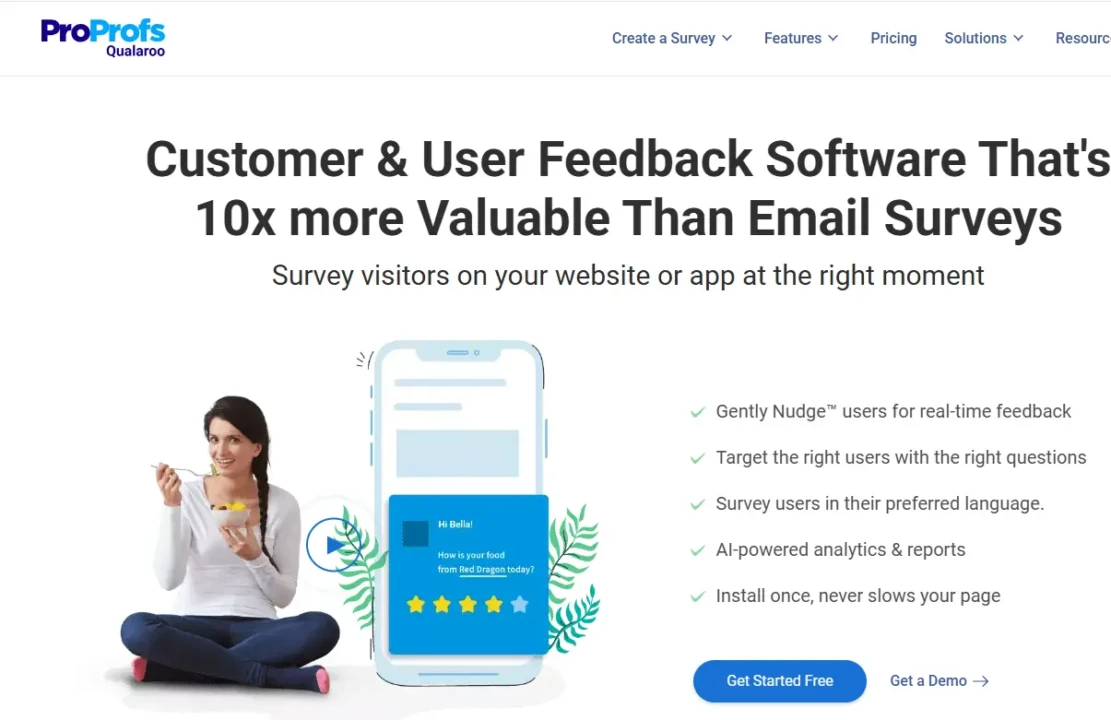
Qualaroo’s strength lies in a specific combination that most tools don’t get right: asking the right question at the right moment and then telling you what the answer’s emotional tone actually means. The IBM Watson sentiment analysis engine is what sets it apart from behaviorally triggered tools that stop at collecting a response.
Qualaroo’s “Nudge” surveys are micro-surveys that appear precisely when and where you configure them; on specific pages, after specific scroll depths, after a user completes a specific action, or based on traffic source and device type. In addition, the targeting granularity is strong, covering user attributes, behavior, time on site, and custom segment definitions.
IBM Watson-powered sentiment analysis then classifies each response by emotional tone (positive, negative, or mixed) rather than just by frequency counts. Furthermore, AI-generated question suggestions help you write better questions that align with your stated survey goal.
The result is a feedback system that tells you not just what users said, but whether they were frustrated, satisfied, or somewhere in between when they said it. Integrations cover Salesforce, HubSpot, Slack, Mailchimp, and Zapier.
Pricing
- Essentials: Free forever (core features with limited responses).
- Advanced: Approximately $19.99/month (annual, up to 50 responses/month).
- Business: Custom pricing.
Honest Limitations
Response limits on lower plans are tight for high-volume use cases; the free and $19.99 tiers are genuinely limited. Therefore, Qualaroo is best suited for website and in-product contexts; not built for large-scale email survey campaigns. Additionally, IBM Watson’s sentiment analysis is strong at detecting broad emotions but can miss sarcasm, cultural nuance, and tonal complexity.
Best For
Product teams, UX researchers, and growth teams who want in-the-moment targeted feedback with real sentiment intelligence behind the analysis, not just response counts.
7. SurveySparrow: Best for Conversational NPS and Employee Engagement
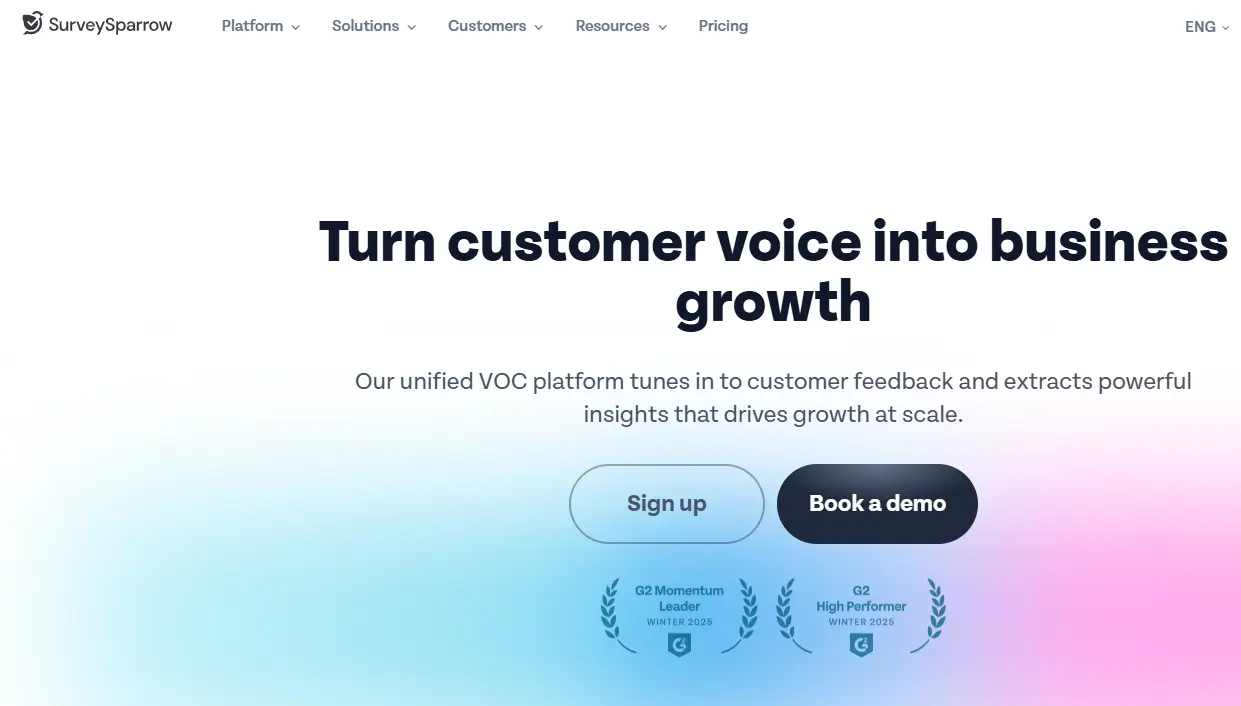
SurveySparrow occupies an interesting position: it combines Typeform-style conversational design with stronger backend features for NPS tracking and employee experience management. That makes it particularly well-suited for teams running both customer and internal feedback programs simultaneously without wanting to manage two separate platforms.
The chat-like survey interface consistently boosts completion rates compared to traditional form layouts, and the NPS, CSAT, and CES tracking includes built-in trend visualization, benchmarking, and year-over-year comparison. Consequently, for HR and people teams, the 360-degree employee performance review module with automated workflows delivers genuine value beyond what a standard survey tool can offer.
AI-powered response summaries and theme detection handle open-ended answers across both customer and employee programs. Additionally, recurring surveys on automated schedules are useful for pulse surveys, quarterly engagement checks, and ongoing CX measurement. White-label options make it a practical choice for agencies managing feedback programs for multiple clients.
Pricing
- Basic: Approximately $19/month (annual, 3 users).
- Starter: Approximately $39/month (annual, 600 responses/quarter).
- Business: Approximately $79/month (annual). Enterprise: Custom.
Honest Limitations
Analytics depth doesn’t match Qualtrics or Zonka for enterprise-scale analysis. In addition, lower plans have quarterly response limits that can catch teams off guard during peak survey periods or high-traffic campaigns.
Best For
Mid-size teams that want conversational survey design with solid NPS tracking and the ability to run customer and employee feedback programs from a single platform without doubling their tool stack.
8. Pollfish: Best for Market Research with a Built-In Audience Panel
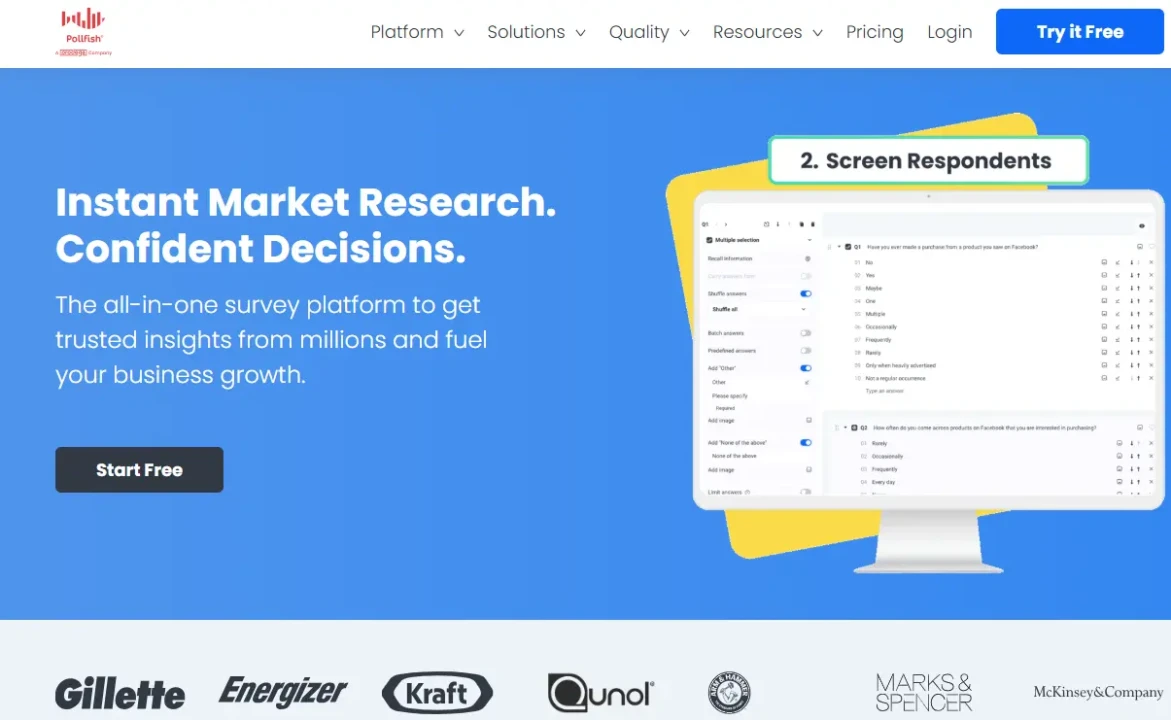
Pollfish is the only tool on this list that pairs an AI survey builder with direct access to a panel of 250 million+ real consumers across 100+ countries. That combination makes it the fastest route from “I need market research” to “I have verified responses from my target audience,” without having to source respondents separately or manage a panel database.
The AI survey builder generates a complete questionnaire from a single prompt, and practitioners who’ve tested it report that the AI-generated questions are often more precise and less leading than those written by hand. Furthermore, audience targeting is specific: you can filter by demographics, psychographics, device type, behavior, location, and custom screener questions designed to qualify respondents before they enter the survey.
Real-time results arrive as responses come in; no batch reporting cycles. In addition, 24/7 customer support via chat and phone (including evenings and weekends) is a genuinely differentiating service model compared to most platforms in this space. And for teams running time-sensitive research, access to support matters.
Pricing
Pay-per-response, approximately $0.95–$3.00+ per response, depending on targeting complexity. No monthly subscription required for basic use. Enterprise custom pricing available.
Honest Limitations
Per-response pricing compounds quickly for large-scale studies. Therefore, always calculate the total cost before launching a campaign.
In addition, Pollfish is not suited for ongoing internal programs (employee engagement, in-product surveys) that require recurring subscription access, as this is more cost-efficient. This is because deeper analysis typically requires exporting to a dedicated analytics tool.
Best For
Market researchers, product teams, and agencies that need fast access to verified external respondents, accurate demographic targeting, and pay-as-you-go pricing without managing their own panel.
How to Choose the Right Tool for Your Situation

Choosing between these platforms is less about features and more about aligning the tool’s design philosophy with the problem you’re trying to solve. Here’s a direct decision framework.
- If you need to collect, unify, and analyze large volumes of customer feedback across multiple channels with genuine AI depth, go with Zonka Feedback for mid-market and enterprise, or Qualtrics if your organization needs enterprise research methodology and compliance coverage at scale.
- If you need a reliable, proven, general-purpose survey tool that handles most situations without a steep learning curve, SurveyMonkey is still the safest all-around choice. It covers 80% of use cases, offers the broadest integrations, and has the most mature template library.
- If respondent experience and survey completion rates are your top priority, go with Typeform or SurveySparrow. Typeform for design-first surveys; SurveySparrow if you also need NPS tracking and employee feedback in the same platform.
- If you’re a SaaS company that needs feedback embedded inside your product, choose Survicate. Its behavior-triggered surveys and native analytics integrations are built specifically for this use case.
- If you need real respondents fast without managing your own panel, Pollfish is your best option. Pay-per-response, no subscription required, and results arrive in real time.
- If in-the-moment emotional intelligence matters more than volume, choose Qualaroo. The IBM Watson sentiment layer tells you how users felt, not just what they said.
- If your budget is the primary constraint, start with Typeform’s free plan, Qualaroo’s forever-free tier, or Google Forms (unlimited responses, Gemini AI suggestions, and no cost). Those three cover most entry-level needs before you need to invest in a paid platform.
One More Thing Worth Saying Plainly
The gap between collecting data and acting on it is where most feedback programs fail. A tool that gives you a chart is not the same as one that tells your customer success team which account is at risk of churn right now. Consequently, when evaluating any platform on this list, ask specifically how it closes that loop, and verify the answer with a real use case before you commit.
For teams looking to stay current on AI tool releases, new entrants, and platform updates, AI Unboxed tracks what’s worth paying attention to as the landscape evolves. And if you’re looking for a platform specifically designed to make AI-powered feedback collection faster and more intuitive, FeedAura is worth a look. It’s built for teams that want smarter feedback loops without enterprise-level complexity.
FAQs
Regular survey tools collect responses and produce charts. AI survey tools go further: they generate questions from prompts, analyze open-ended text at scale using NLP, automatically detect sentiment and themes, predict churn risk, and trigger follow-up workflows based on the data itself. The difference isn’t cosmetic; it’s the gap between having data and having decisions.
Typeform’s free plan (10 responses/month with conversational design), Qualaroo’s forever-free tier (with real IBM Watson sentiment analysis), and SurveySparrow’s Basic plan (~$19/month) are the strongest starting points for small teams. Each offers meaningful AI features without requiring an enterprise budget.
Typeform’s free plan, Qualaroo’s forever-free tier, and Google Forms (unlimited responses, basic Gemini AI suggestions at no cost) are the strongest free options. For most teams just getting started, Typeform offers the best combination of AI-assisted design and zero cost. Qualaroo is the best free option specifically for sentiment intelligence.
Honestly, usually not. Qualtrics is built for large organizations with dedicated research teams, advanced compliance requirements, and predictive analytics needs. For most mid-size companies, Zonka Feedback’s Feedback Management tier (~$199/month) or SurveySparrow’s Business plan delivers 80% of the practical value at a fraction of the cost. Qualtrics earns its price tag for organizations that specifically need MaxDiff, conjoint analysis, FedRAMP compliance, or enterprise-scale predictive CX modeling.
Conclusion
AI-powered feedback and survey tools have moved well beyond collecting responses. The best platforms covered in this guide don’t just tell you what your customers said; they tell you what it means, which themes are emerging, how urgent the signal is, and what your team should do next. That shift (from data collection to intelligence) is what separates tools that sit in a dashboard nobody checks from systems that actually change decisions. Zonka Feedback leads in AI depth and closed-loop capability. SurveyMonkey leads in versatility. Typeform leads in engagement. Qualtrics leads in enterprise power. Each earns its position for a different set of real needs.
The most important practical advice is also the simplest: match the tool to the problem, not the feature list. Start with one feedback program, one channel, and one metric you care about. Get that working before expanding. Always verify pricing directly with the vendor before committing; the landscape moves quickly, and rates change more frequently than comparison articles are updated. The right tool is the one your team will actually use consistently enough to build the feedback loop that changes how you make decisions.
The feedback tools, AI platforms, and productivity apps that are genuinely worth your time are all reviewed honestly and compared clearly at YourTechCompass.com, where every recommendation is built around what actually moves the needle for real teams.