In July 2026, a lab most developers still file under “the Kimi people” shipped the largest open-weight model released at the time, and you could download it eleven days later. Then the footnotes arrive. The checkpoint weighs about 1.56 TB, the license has strings, and by October Moonshot had already released K3.1 Pro, a post-trained successor in the K3 family.
This article weighs Kimi K3 on evidence: what it is, what independent testing says, what it costs by route (API, third-party host, GPU cluster), what the license allows, and what African teams should check first. It draws on official documentation and independent evaluations, not hands-on testing, and it labels opinion wherever it appears.
A note before we begin: every YTC score is earned, never negotiated. If you want to understand exactly how we evaluate apps & tools and how we handle affiliate relationships, our Review Methodology lays it all out.
Quick Verdict
- Best For: Teams running long-horizon coding or agent workloads that want near-frontier results with open weights or lower per-token costs.
- Skip It If: You need high-stakes factual accuracy without a verification layer, need strict data residency but cannot self-host the required infrastructure, or expect to run it yourself on modest hardware.
- Bottom Line: K3 was the strongest open-weight model on Artificial Analysis’ Intelligence Index at launch, but “open” does not mean cheap, local, or low-risk.
What Is Kimi K3?
Kimi K3 is Moonshot AI’s previous-generation flagship model. Moonshot, a Beijing-based AI company founded in March 2023 and backed by Alibaba, launched K3 through its API on July 16, 2026; the weights followed on July 27. The model has 2.8 trillion total parameters (Fortune reported 2.7 trillion, while Moonshot’s technical blog says 2.8), about 104 billion active parameters per token, a 1-million-token context window, and native vision.
The lineage explains the pace. K2 arrived in preview in July 2025, with its formal release following in September; K2.5 arrived in January 2026, K2.6 in April, K2.7 Code in June, and K3 in July. K3.1 Pro launched in late October as a post-trained successor in the K3 family, with its open weights released on November 4.
You can reach K3 through the API, the Kimi app’s K3 Max and K3 Cluster Max tiers, or Kimi Code, a command-line coding agent. My opinion: the most useful signal here isn’t K3’s rank but its release pace, because it turns migration planning into part of any adoption decision. For wider context on how fast these models move, our AI Unboxed coverage tracks the field.
Under the Hood: Architecture and Version History
K3 is a sparse mixture-of-experts (MoE) model with 896 routed experts and 16 active per token, plus 2 shared experts. That is how 2.8 trillion parameters run with roughly 104 billion working at a time. A hybrid attention design called Kimi Delta Attention aims to make the 1-million-token context affordable to serve. Moonshot also trained the model quantization-aware in MXFP4, so the released weights need no lossy conversion step.
Those choices decide what you can run. MXFP4 keeps the checkpoint near 1.56 TB, against roughly 5.6 TB in BF16, but it also favors hardware and inference stacks with strong MXFP4 support.
Moonshot also retires models quickly. It retired kimi-k2.5 and moonshot-v1 on August 31, 2026, and closed K2.6 and K2.7 Code to new accounts on October 31, so any workflow built on a K2-series model should plan for migration. Our multi-model AI guide covers working across several models, which is the practical hedge.
Benchmarks: Vendor Claims vs. Independent Evidence
Start with what Moonshot says. It positions K3 as a major step forward from K2.6, with strong agentic results and native multimodal input. But a vendor’s own suite is a claim, so independent measurement comes next.
Artificial Analysis found K3 comparable to Claude Opus 4.8 and GPT-5.5, while Claude Fable 5 and GPT-5.6 Sol still led overall. In my view, Artificial Analysis’ Intelligence Index is one of the most useful independent yardsticks available.
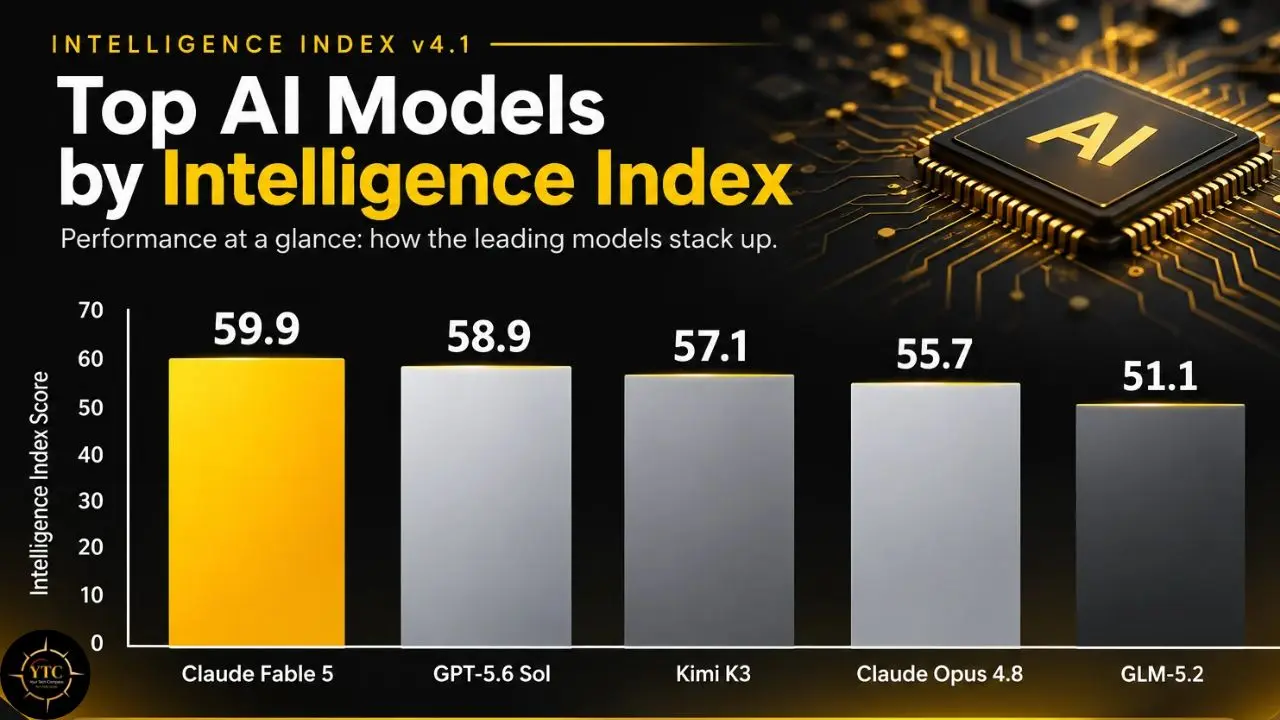
Artificial Analysis headlined K3 as #3; other rankings can place it fourth depending on which model configurations they count, so treat the rank as approximate. K3 placed second on AA-Briefcase, a long-horizon knowledge-work test, and first on AutomationBench-AA. It also used 21% fewer output tokens than K2.6.
Here is the number to chart, and it requires reading two different scorecards. On Artificial Analysis’s independent AA-Omniscience knowledge test, K3’s accuracy rose from 33% to 46% over K2.6, but its hallucination rate rose from 39% to 51%. That rate isn’t the share of wrong answers; it measures how often the model gave a confident wrong answer instead of abstaining, among the questions it didn’t get right.
Moonshot’s own documentation tells a different story using a different yardstick. On Kimi Hallu Bench Hard, an internal stress test designed to probe situations where models are prone to errors, Moonshot reports K3’s claim-level hallucination rate at 23.4%. (Moonshot later reported this internal rate falling to 8.3% for its successor, K3.1 Pro).
The gap between 23.4% and 51% comes down to definitions: Kimi’s internal bench measures claim-level errors on deliberately crafted stress prompts using its own fact-checking agents, while AA-Omniscience measures confident wrong answers instead of abstentions on a broad knowledge test. For a buyer, the independent 51% figure is the safer baseline to plan around, because it reflects how the model behaves when it doesn’t know the answer.
In plain terms, K3 gets more questions right and also guesses more when it doesn’t know. Check how other models score on the same metric on Artificial Analysis’s model pages before you rank anything from this single number.
Scores also move with the agent harness, so one benchmark can yield three different results for the same model. Vendor claims, an independent lab, and secondary blogs disagree on ranks and details, which is why each source is named above.
In Artificial Analysis’ July launch assessment, K3 trailed Claude Fable 5 by about three index points (57.1 versus 59.9) and shipped open weights, which Fable does not.
Standout Strengths, and Where K3 Falls Short
K3 is built for long-horizon agentic coding: multi-hour loops in which an agent edits files, runs commands, and checks its own work. Teams running those loops at volume benefit most when K3 replaces more expensive frontier-model calls, because per-token costs compound. The trade-off is review: greater autonomy produces more output for a human to verify, and, in my view, review capacity often determines whether agents pay off.
Native vision and a 1-million-token context window let K3 process scanned records, forms, and large codebases in a single context. That can help document-heavy teams, although requests that use more context consume more billable input tokens.
Two limits matter. First, K3 is a poor fit for unchecked factual work. While Moonshot’s internal stress tests put K3’s claim-level hallucination rate at 23.4%, independent testing by Artificial Analysis puts the rate of confident wrong answers at 51%. When a vendor’s internal benchmark and an independent lab’s benchmark diverge this sharply, plan your verification workflow around the independent number. Second, K3’s $15 output price is 3.75 times the K2 line’s $4.00, and K3.1 Pro already undercuts it.
Kimi K3 Pricing: What You’ll Actually Pay
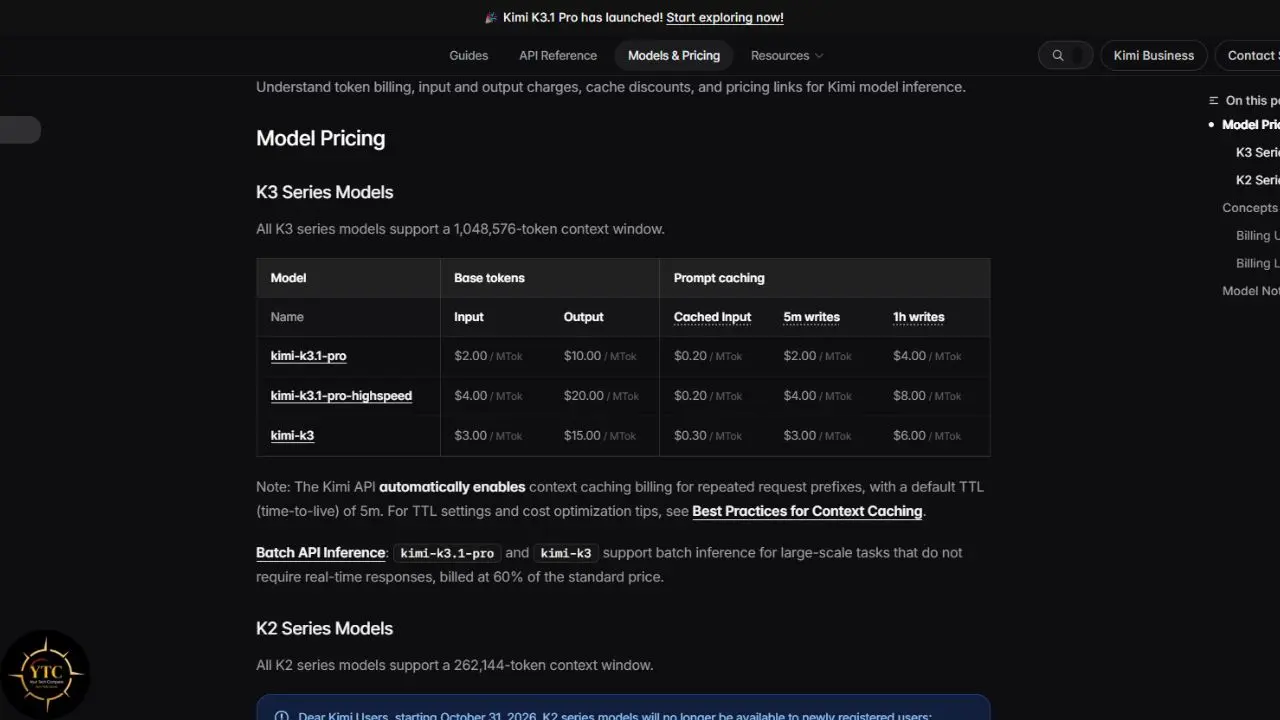
Moonshot’s official API charges $3.00 per million cache-miss input tokens, $0.30 per million cache-hit input tokens, and $15.00 per million output tokens. K3 supports a 1,048,576-token context window, and both K3 and K3.1 Pro are eligible for Batch inference at 60% of standard rates. Cache writes are billed separately according to the cache TTL, so include them in production estimates.
K3.1 Pro is listed by third-party trackers at $2.00 per million cache-miss input tokens and $10.00 per million output tokens; confirm the current official rates before budgeting.
Third-party hosted pricing varies substantially by provider, and some hosts may offer quantized variants. Prices and availability change frequently, so check each provider’s current pricing page.
For an illustrative workload of 10 million input tokens and 2 million output tokens per month:
Route | Calculation | Monthly Cost |
|---|---|---|
K3, list price | (10M × $3) + (2M × $15) | $60.00 |
K3, 90% of input from cache hits | (1M × $3) + (9M × $0.30) + (2M × $15) | $35.70, before cache-write charges |
K3.1 Pro, reported list price | (10M × $2) + (2M × $10) | $40.00 |
Per-task cost can tell a more useful story than per-token price. Artificial Analysis estimated K3 at $0.94 per Intelligence Index task, compared with $1.04 for GPT-5.6 Sol (max) and $2.75 for Claude Fable 5 (max).
Output tokens can dominate the bill, particularly for reasoning-heavy workloads. Retry rates, tool calls, and error-driven reruns should also be included in a realistic cost model.
Access Route | Price Signal | The Catch |
|---|---|---|
Moonshot API | $3.00 per million cache-miss input tokens; $0.30 per million cache-hit input tokens; $15.00 per million output tokens | Cache writes are billed separately by TTL; review Moonshot’s data-handling and training terms before sending sensitive material. |
Third-Party Host | Varies by provider | Uptime, latency, model version, and quantization can vary; verify the exact model and pricing before committing. |
Kimi App | Free and paid plans are reported | Usage caps, feature limits, and plan pricing can change; verify directly with Kimi before relying on a specific tier. |
Self-Hosting | Hardware and operating costs | You avoid per-token API charges, but must budget for GPUs, electricity, hosting, maintenance, and model-serving infrastructure. |
Open Weights, the License, and the Self-Hosting Reality
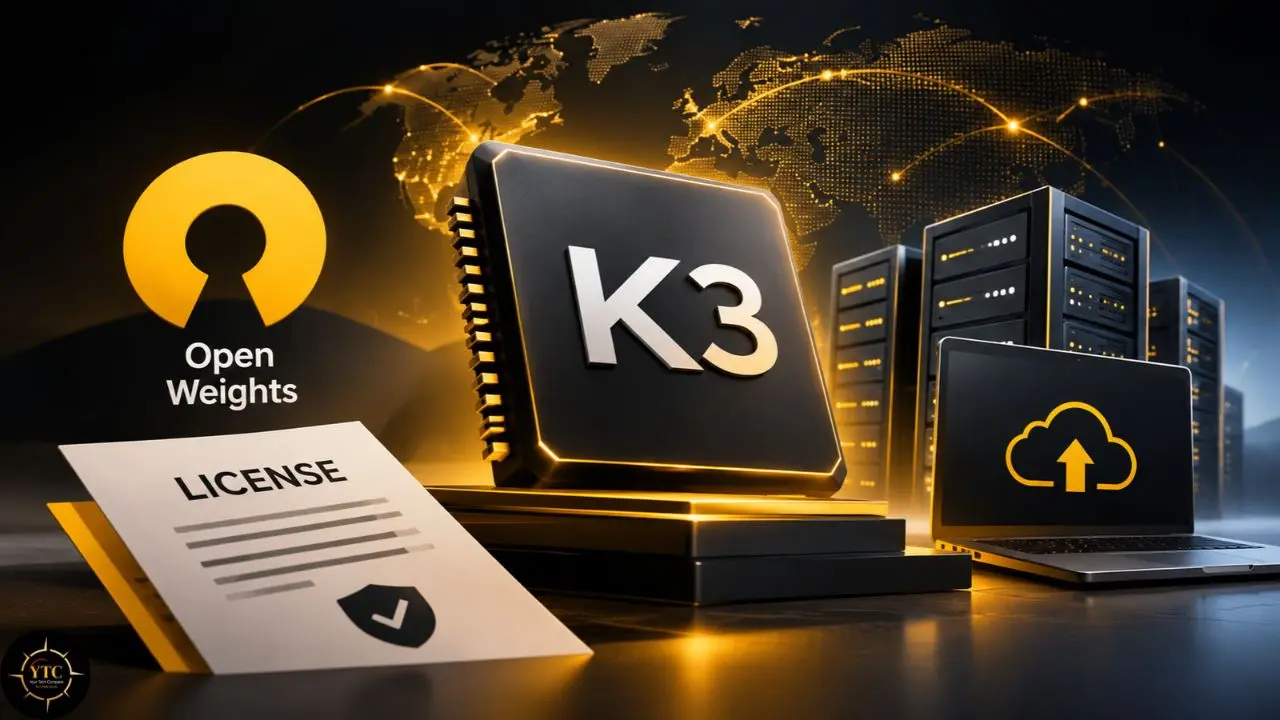
Moonshot published the weights on Hugging Face on July 27 as a native MXFP4 checkpoint of roughly 1.56 TB. The release combines MXFP4 weights with MXFP8 activations, alongside BF16 and F32 components, so it is not a uniformly 4-bit model. That full checkpoint is about 1.42 TiB, larger than the 1,128 GB of memory on an eight-GPU H200 node. An eight-GPU B200 node has 1,536 GB, so the checkpoint can fit in principle, but with little headroom for context, activations, and serving overhead.
For most teams, that makes self-hosting a serious infrastructure project rather than a simple download-and-run exercise. The practical deployment target depends on the inference engine, context length, concurrency, and how much memory is reserved for KV cache and framework overhead.
The license is custom, not standard open source. Internal use is exempt from its scale-based conditions; model-as-a-service businesses above $20 million in revenue over any consecutive 12 months need a separate agreement with Moonshot, and commercial products above 100 million monthly users or $20 million in monthly revenue must prominently display “Kimi K3.” Reporting has described potential revenue-sharing arrangements for large inference providers, but the published license does not specify a percentage, so read the license text on Hugging Face yourself.
For most teams, open weights means a hosted API run by someone else.
Privacy, Data Handling, and Legal Risk
Start with where your data goes, because the answer depends on the route you take. Moonshot’s international platform is run by its Singapore entity, and its OpenPlatform privacy policy says collected information is stored on servers in Singapore, while also noting that data may be transferred outside your country of residence. The policy covers where collected information is stored, not where inference runs, so ask Moonshot directly if that distinction matters to you.
Training and retention deserve a careful read. The same policy lists training and refining Moonshot’s underlying technology, including machine-learning models, among the uses of user content, and it keeps account and input information while your account is active. Do not assume that API inputs are excluded from model improvement; get the controlling terms in writing before you send anything sensitive.
Third-party hosts and self-hosting change the picture again. A host brings its own policy, jurisdiction, and uptime record, and self-hosting keeps prompts on your own hardware, though it carries the cost covered above.
K3 ships under the custom Kimi K3 License, with the revenue and user thresholds described above. It is usable today, but its commercial terms are not equivalent to a standard open-source license. Treat the LICENSE file in the Hugging Face repository as the authority over any summary.
For how governments are approaching data and AI rules across the continent, our AI policy Africa coverage is a useful companion.
Kimi K3 vs. the Alternatives
The table compares K3 with closed leaders and smaller open models on what decides a purchase beyond the index score.
Option | Weights | Typical Route | Main Catch | Best For |
|---|---|---|---|---|
Kimi K3 | Open (custom license) | Moonshot API, third-party hosts, self-hosting | Hardware, license terms | High-volume agentic coding |
Claude Fable 5, GPT-5.6 Sol | Closed | Vendor APIs and apps | No weights, no self-hosting | Top Artificial Analysis scores |
Qwen 3, GLM-5.2 | Open (see our reviews) | Local or hosted | Lower ceiling than K3 | Teams that must run models themselves |
Compared with Qwen 3 and GLM right now: smaller open models such as those in our Qwen 3 review and GLM-5.2 coverage trade headroom for hardware you can actually obtain. GLM-5.2 scored 51 on the Artificial Analysis Intelligence Index at K3’s launch, about six points below K3’s 57.
Compared with closed frontier models right now: Fable 5 and GPT-5.6 Sol lead K3 on Artificial Analysis’s Intelligence Index, but they ship no weights. For how closed models compare with each other, see GPT-5.5 vs. Claude Opus 4.8, Claude Opus 4.7, and ChatGPT 5.4.
If you’re weighing coding agents more broadly, our Devin Desktop review covers one.
Real-World Use Cases

- Long-Running Coding Agents: Kimi Code runs K3 in a terminal for multi-step software tasks, and a human should still approve merges. Moonshot specifically recommends using a compatible harness and imposing clear behavioral constraints, because K3 can act unexpectedly when instructions are ambiguous.
- Document and Scan Processing: Native vision reads forms and records, but extracted figures need rigorous checking. Moonshot’s internal benchmarks claim low hallucination rates, but independent tests show the model confidently guesses wrong over half the time when it lacks context. Never pipe K3’s extracted data directly into a database without a regex or human verification layer.
- Workflow Automation: K3’s 58.3% AutomationBench-AA result suggests promise, so pilot it on low-stakes flows first. Budget for token use, latency, and retries; Artificial Analysis’s separate AA-Briefcase evaluation found K3 averaged 83 turns, $10.57, and 56.4 minutes per task.
- A Hypothetical: Picture a Nairobi fintech engineering team piloting K3 through a third-party host in a jurisdiction they’ve vetted, for internal tooling only, with human approval on every merge and no customer data in prompts.
Who Should Use Kimi K3, and Who Should Skip It
Use it if:
- You run agent loops at volume, can validate outputs, and have budgeted for token, latency, and retry costs.
- You want open-weight leverage and can rent or reach serious GPU capacity; Moonshot recommends deployments with 64 or more accelerators.
- You can choose a hosting route that fits your data obligations.
Skip it if:
- Errors are costly, and nobody reviews the output.
- Your data must stay in-country and you can’t self-host or find a compliant host.
- You expect to run a frontier model on a laptop.
The Review Landscape: An Honest Note
Coverage of K3 agrees on the headline and wobbles on the details. Outlets disagree on its rank (third or fourth) largely because Artificial Analysis’s ranking depends on the index version and whether differently configured entries are counted separately. They also vary on parameter count, with 2.7 trillion appearing in some early coverage while Moonshot’s official documentation says 2.8 trillion.
Checkpoint size is another source of confusion, though it is less a disagreement than a difference in measurement: some coverage cites the roughly 1.4 TB MXFP4 weight payload, while others cite the roughly 1.56 TB full repository. At least one early write-up initially described the license as modified MIT, a characterization the license text does not support.
Most of the reporting leans on benchmark charts, and far less of it examines data terms, running costs, or what any of this means for teams outside the major cloud regions. That’s my read of the sources I reviewed, not a measured survey, so treat it as opinion.
Kimi K3 in Africa: Accessibility and Practical Realities
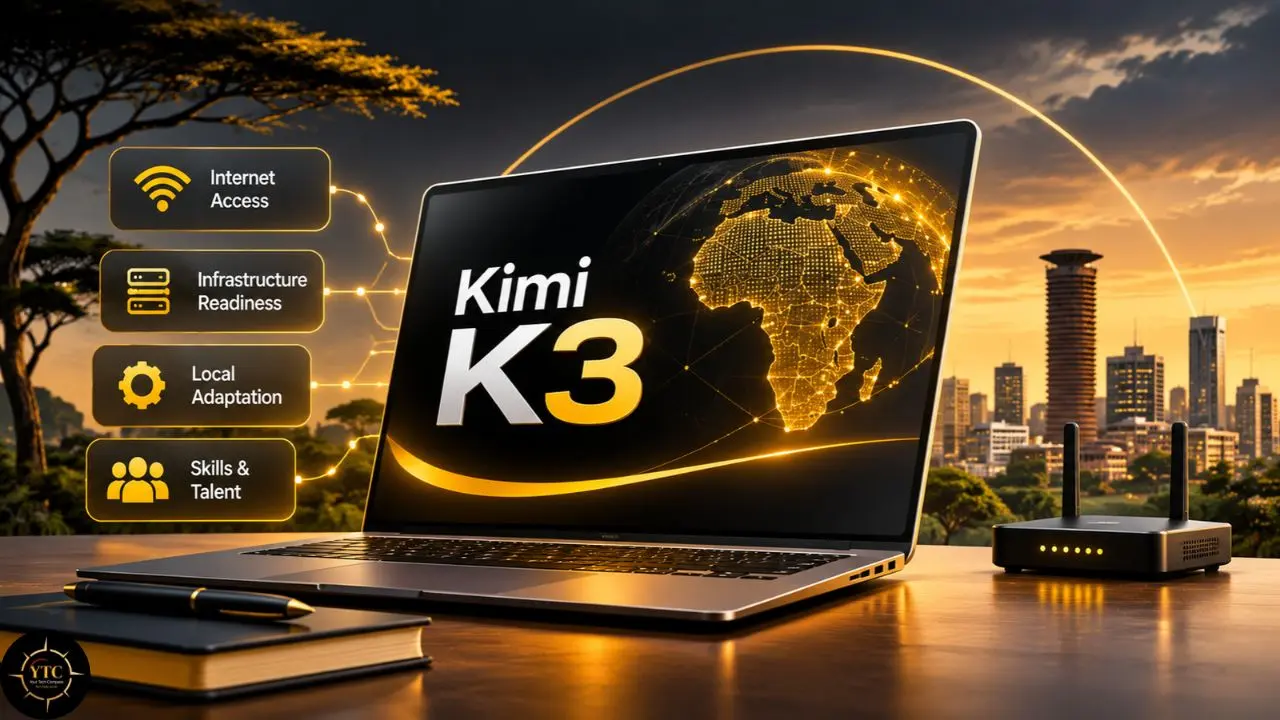
Our AI in Africa coverage tracks how teams across the continent adopt frontier models, and five issues shape the picture for K3.
Pricing Barrier
Pay-as-you-go tokens avoid per-seat fees, which suits small teams, but prices are in dollars. At list price, the 10-million-input, 2-million-output workload above costs $60 a month, so run the numbers at your own cost per task before you commit.
Payment Barriers
Moonshot’s published API pricing is denominated in U.S. dollars. Confirm the accepted payment methods, foreign-transaction fees, and any currency-conversion costs with your bank or card issuer before committing. Our mobile money guide explains why payment access matters across the continent.
Connectivity and Infrastructure
Self-hosting K3 locally is out of reach for nearly everyone, so the realistic route is an API or a regional GPU provider. Cassava Technologies announced in March 2026 that it was deploying an NVIDIA-powered AI factory in South Africa, reported at about 3,000 GPUs in its initial phase, with expansion planned for Nigeria, Kenya, Egypt, and Morocco. It offers GPU-as-a-service and its CAIMEx multi-model exchange. I couldn’t confirm that K3 is available there or which GPU generation backs it, so ask before you plan around it, and see our piece on Africa’s AI factories for who fills such capacity.
Data Protection and Data Residency
Kenya’s Data Protection Act 2019, Nigeria’s Data Protection Act 2023, and South Africa’s POPIA all regulate sending personal data abroad. Compare three routes: Moonshot’s own API (stored in Singapore, per its policy), a third-party host in a jurisdiction you accept, and a self-hosted or in-country deployment. Keep personal data out of prompts until you’ve made that choice.
Language and Localization
Rest of World reports that K3 can be reshaped to answer in languages including Swahili, but adapting a model takes compute and data, and I did not find an independent evaluation of K3 in African languages. Test it on your own language before you rely on it.
The Alternative
If K3’s footprint is out of reach, smaller open models are the realistic path, and our guide to running open-source LLMs locally walks through a safe setup.
FAQs
Kimi K3 is Moonshot AI’s flagship open-weight model, released July 16, 2026, with 2.8 trillion parameters, a 1-million-token context window, and native vision.
Its weights are public on Hugging Face, but it uses a custom Kimi K3 License with conditions for large service providers and very large products, so it is not a standard open-source license.
Moonshot lists $3 per million uncached input tokens, $0.30 cached input, and $15 output. K3.1 Pro is listed at $2 input and $10 output. Hosts vary, so check each provider.
Not on a laptop or a single older GPU node. The checkpoint is roughly 1.4 to 1.56 TB, and reported deployments require a multi-GPU server, so most teams will use a hosted API.
On Artificial Analysis’s Intelligence Index, K3 scores 57.1 against 59.9 for Claude Fable 5 and 58.9 for GPT-5.6 Sol, and it edges Claude Opus 4.8 at 55.7. It also has a higher reported hallucination rate on Artificial Analysis’s factual-accuracy testing, so “better” depends on your task.
That depends on where it runs. Moonshot’s Kimi OpenPlatform policy says collected information is stored in Singapore and describes user content as potentially used to improve and train its technology. By contrast, Moonshot says data submitted through the Kimi API is not used for model training. Third-party hosts vary, and self-hosting keeps data on your own hardware, so match the route to your data-protection obligations.
They are measuring different things. Moonshot’s official documentation reports a 23.4% claim-level hallucination rate for K3 on Kimi Hallu Bench Hard, an internal stress test evaluated by its own agents (a figure Moonshot says dropped to 8.3% for the newer K3.1 Pro). Artificial Analysis, an independent lab, reports a 51% hallucination rate on its AA-Omniscience test, which measures how often the model gives a confident wrong answer instead of abstaining when it doesn’t know the facts. Because the definitions and judges differ, treat the independent 51% figure as the safer baseline for planning your verification workflow.
Downloadable Isn’t Usable: Your Tech Compass on Kimi K3
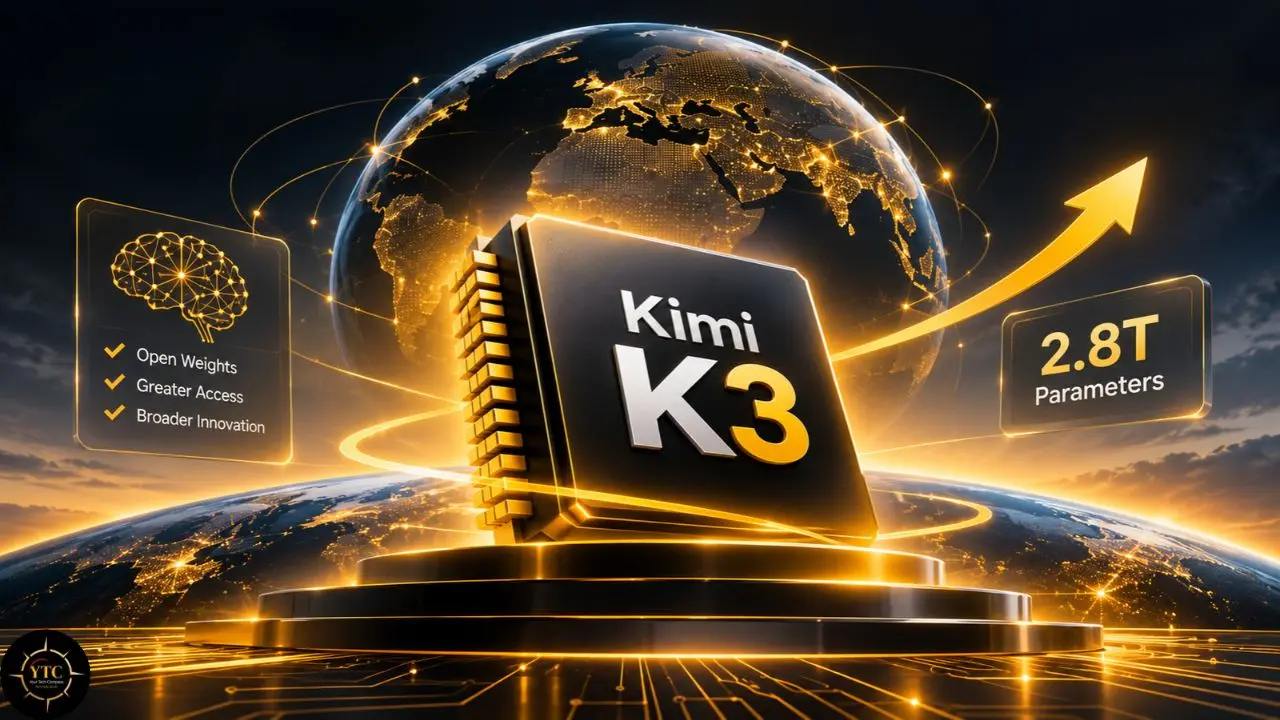
Open and closed models are now close enough that the gap is under three index points, but the gap between downloadable and usable has not moved. K3 proves that near-frontier capability can ship with public weights, yet those weights need a data-center cluster, the license carries conditions, and Moonshot has already moved on to K3.1.
Before you commit, run a 20-task pilot on your own workload and measure accuracy, retries, and cost per task, not benchmark ranks. Investors and policymakers should weigh hosting, data residency, security, and vendor dependence, since the practical choice often turns on who runs the model and under what data and licensing terms, not simply whether the weights are public. And budget for the next version change, because Moonshot has already retired several model families within months and plans to retire the remaining K2 models by the end of December.
Frontier models change monthly; the questions worth asking don’t. Bring them to YourTechCompass.com.