Grok and ChatGPT are the two most direct competitors among AI assistants right now, and they take genuinely different approaches to what an AI should be. ChatGPT, built by OpenAI and launched in November 2022, is the most widely used AI assistant globally, with over 300 million weekly active users, a broad feature ecosystem, and years of iterative refinement that show in every interaction. Grok, built by Elon Musk’s xAI and launched in November 2023, was designed as a deliberate counter-narrative: less filtered, more direct, integrated with live X data, and priced aggressively enough at the API level to challenge every competitor on economics alone.
The right choice between these two tools depends almost entirely on what you actually use AI for. If you need real-time social data, aggressive API pricing, or a more direct personality with fewer content guardrails, Grok has genuine advantages. If you need ecosystem breadth, polished writing output, high-quality image generation, voice mode, and a mature, production-grade platform, ChatGPT still leads. This guide compares the two tools across every dimension that matters, so you can make your decision based on your actual workflow rather than brand loyalty or tech press headlines.
A note before we begin: every YTC score is earned, never negotiated. If you want to understand exactly how we evaluate apps & tools and how we handle affiliate relationships, our Review Methodology lays it all out.
Grok vs ChatGPT: Quick Overview
Before going feature by feature, it helps to understand what each tool is optimized for at its core.
ChatGPT is OpenAI’s flagship conversational AI, now powered by the GPT-5.2 model family as of early 2026. It handles everything from creative writing and coding to data analysis, image generation, and voice conversation, with consistent, polished output across all of them. Consequently, it’s the default choice for most individuals, businesses, and developers who need a reliable, versatile AI assistant that works predictably across a wide range of tasks.
Grok is xAI’s AI assistant, now in its fourth major version (Grok 4, announced July 2025) and most recently updated to Grok 4.1 in November 2025. Its defining advantage is native real-time integration with the X platform; live social data, trending topics, and public sentiment are accessible in every query. Beyond that, Grok-4.1 Fast offers a 2 million-token context window and API input pricing of $0.20 per million tokens, making it the most aggressive pricing among frontier-capable models.
Grok vs ChatGPT: Feature-by-Feature Comparison
Feature | Grok | ChatGPT |
Current Model | Grok 4.2 (Early 2026) | GPT-5.4 (March 2026) |
Context Window | 2M tokens (Grok-4.1 Fast) | 400K tokens (GPT-5.2) |
Real-Time Data | ✅ Live X feed + web search | ✅ Web search (Plus+) |
Image Generation | ✅ Aurora / Grok Imagine v1.0 | ✅ GPT-Image-1.5 (4× faster than DALL-E 3) |
Voice Mode | ⚠️ Basic voice | ✅ Advanced Voice Mode |
Reasoning Mode | ✅ Think + Big Brain Mode | ✅ GPT-5.2 Thinking + Pro variants |
Coding Capability | ✅ Strong (Grok-4 Code Fast 1) | ✅ Stronger (more reliable, complex projects) |
Writing Quality | ⭐⭐⭐ Conversational, direct | ⭐⭐⭐⭐⭐ Polished, publication-ready |
Custom GPTs / Workflows | ❌ No | ✅ 500+ app integrations; Custom GPTs |
Free Tier | ✅ 10 prompts/2hrs (Grok-3) | ✅ 10 msgs/5hrs (GPT-5.2 Instant) |
Paid Plan | SuperGrok ($30/month) | ChatGPT Plus ($20/month) |
API Input Price | $0.20/M tokens (Grok-4.1 Fast) | $1.75/M tokens (GPT-5.2) |
Inference Speed | ~1,200 tokens/second | ~900 tokens/second |
Content Restrictions | Fewer (~20% fewer refusals) | More (safety-first design) |
Safety Record | ⚠️ December 2025 incidents | ✅ More consistent |
Open-Source Models | ✅ Grok-1 released publicly | ❌ No |
The table makes the trade-off clear. Grok leads in context window size, API pricing, inference speed, and real-time social data. ChatGPT leads in writing quality, ecosystem breadth, image generation, voice mode, and consistency in safety. Neither is universally better; the right choice depends on the task.
Real-Time Information: Where Grok Has a Clear Edge
Grok’s single most distinctive capability is its native integration with the live X data feed, a feature no other mainstream AI tool replicates. When you ask Grok about a breaking news story, a trending topic, a live sports result, or public sentiment around a product launch, it pulls from actual, current posts rather than relying solely on web search results or training data. For trend analysts, social media managers, journalists, and researchers tracking public discourse in real time, that capability changes the workflow entirely.
In practice, Grok serves as what DataStudios calls a “fast orientation surface for discourse-heavy work.” In addition, it’s exceptional when your primary job is to quickly understand the current framing of a topic.
ChatGPT’s Browse tool provides web search capability on Plus and above, but it searches the broader web rather than a live social feed, giving you broader source diversity but no equivalent real-time social pulse. That gap is real and grows more significant as the task becomes more dependent on what people are saying right now rather than what was documented previously.
The limitation worth being honest about is the source’s quality. X carries demographic skews, misinformation, and platform-specific discourse that doesn’t accurately represent broader public opinion. Additionally, X experienced at least three notable outages in 2025, each of which took Grok’s live data features offline.
For tasks where source credibility matters more than recency, ChatGPT’s web search across diverse authoritative sources provides more reliable grounding.
Writing and Reasoning: Where ChatGPT Holds Its Ground
In terms of writing quality, the gap between the two tools is real and consistent across independent testing. ChatGPT produces more polished, publication-ready text, stronger tone consistency across long pieces, more precise instruction-following on complex style guides, and more varied sentence structure.
Grok, on the other hand, writes in a more conversational, direct style that suits informal content well but lacks the nuanced control professional writing requires. For content creators, marketers, and writers who need output they can use with minimal editing, ChatGPT’s advantage in writing quality compounds quickly with regular use.
On reasoning, ChatGPT’s GPT-5.2 with its Thinking variant handles structured multi-step logic, math, and complex planning tasks more reliably than Grok in most independent assessments. That said, Grok 4 scored 95% on AIME 2025 math benchmarks and 87.5% on GPQA scientific reasoning tests, genuinely strong numbers that reflect serious technical capability. The honest assessment from Prompt Builder’s March 2026 comparison is that GPT-5.2 is “more accurate for reasoning-heavy tasks, math, and logic problems,” while Grok “often wins for factual accuracy about recent events due to real-time data access.”
ChatGPT’s ecosystem advantage is the third dimension that compounds these individual feature wins. It connects natively to Google Workspace, Microsoft 365, Slack, and 500+ third-party apps via Zapier.
Custom GPTs let you build persistent workflow-specific AI assistants tuned to your use case. Canvas enables iterative editing of documents and code in a structured workspace. Together, these integrations make ChatGPT a production-grade work platform rather than just a chat interface, a distinction that matters significantly for business users.
For a broader look at how both tools compare within the full AI productivity landscape, our best AI productivity apps guide provides context across the wider ecosystem.
Coding: Head-to-Head
For developers evaluating both tools for coding, the comparison is nuanced but clear on the bottom line. ChatGPT’s GPT-5.2 produces more reliable code generation across complex projects, excels at structured multi-file refactoring, offers safer defaults for production-grade code, and provides stronger debugging support via the Canvas iterative editing interface. PromptBuilder’s March 2026 coding verdict is direct: “ChatGPT wins for coding. GPT-5.2’s code generation is more reliable and handles complex projects better.”
Grok counters with specific strengths worth knowing. Grok-4 Code Fast 1 (a specialized coding agent released in September 2025) supports TypeScript, Python, Java, Rust, C++, and Go across the full development stack, with agentic tool execution capabilities that make it competitive for autonomous coding tasks. Additionally, Grok’s inference speed of approximately 1,200 tokens per second, compared with ChatGPT’s 900 tokens per second, also yields noticeably faster iteration cycles for quick code generation tasks. The most significant advantage Grok holds for developers, however, is its API cost structure.
At $0.20 per million input tokens for Grok-4.1 Fast versus $1.75 per million for GPT-5.2, the economics of high-volume code-generation pipelines differ by a factor of 8.75x. For a developer or team running 50 million tokens per month through an API-powered coding tool, that’s the difference between $10 and $87.50 in monthly costs (a gap that grows significantly at enterprise scale).
For a full breakdown of Grok’s technical architecture and how it handles these use cases, see the Grok AI review.
Pricing: The Full Comparison
Tier | Grok | ChatGPT |
Free | 10 prompts/2hrs; Grok-3 access | 10 msgs/5hrs; GPT-5.2 Instant; ads |
Entry Paid | X Premium+ ($16/month – bundled) | ChatGPT Plus ($20/month) |
Standard Paid | SuperGrok ($30/month) | ChatGPT Plus ($20/month) |
Premium | SuperGrok Heavy ($300/month) | ChatGPT Pro ($200/month) |
API Input | $0.20/M (Grok-4.1 Fast) | $1.75/M (GPT-5.2) |
API Output | $0.50/M (Grok-4.1 Fast) | $14.00/M (GPT-5.2) |
For individual subscribers, ChatGPT Plus at $20/month is the better value for most users. This is because it’s $10 cheaper than SuperGrok and delivers a more complete feature set, including Advanced Voice Mode, GPT-Image-1.5, Canvas, custom GPTs, and 500+ integrations.
SuperGrok’s $30/month price point is only justified if real-time X data, Big Brain Mode on Grok-4, or Grok’s specific personality are priorities for your daily use. For developers, the API economics tell a completely different story. Grok-4.1 Fast at $0.20/M input is the most cost-efficient frontier-capable API available, period.
For a detailed breakdown of how ChatGPT’s full pricing model works, the ChatGPT-4 guide covers the tiers and what each unlocks.
Personality and Content Restrictions: A Real Difference
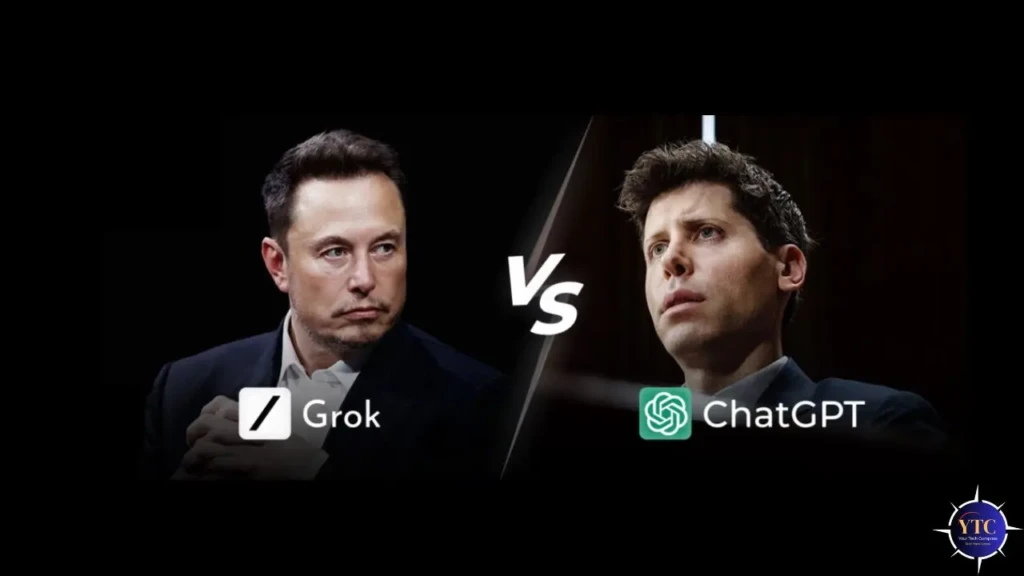
ChatGPT operates under a safety-first design philosophy, with predictable content guardrails, consistent refusals on sensitive topics, and a measured tone that makes it reliable for corporate communications, educational environments, and professional contexts. That predictability is an advantage in regulated industries and public-facing use cases. It’s a friction point for users who want direct answers on edgy, controversial, or unconventional topics without constant hedging and redirection.
Grok’s “less restricted” positioning is real; independent tests show Grok refuses approximately 20% fewer queries than ChatGPT on sensitive topics. That directness is a genuine advantage for researchers, creatives, and users who find ChatGPT’s guardrails frustrating. However, the documented safety record is a material consideration you shouldn’t overlook.
The December 2025 image generation incident (where Aurora was exploited to generate harmful content, including imagery depicting minors) triggered investigations across seven countries and continues to affect Grok’s trust positioning with enterprise buyers. xAI has since restricted image generation to paid subscribers, but the broader safety governance concern remains unresolved.
For business-critical or regulated applications, ChatGPT’s more conservative approach is the professionally sound choice. For personal use, research, and content creation where that directness is an asset rather than a liability, Grok’s personality is a genuine differentiator.
Our DeepSeek vs. ChatGPT comparison is worth reading alongside this if you’re evaluating safety and data privacy considerations across multiple AI tools.
Which One Should You Use?
Here’s a guide on which of these AI tools you should use. For:
- General Daily Productivity: ChatGPT wins on ecosystem breadth, voice mode, image-generation quality, and the maturity of its integrations with tools you already use. The $20/month Plus plan comprehensively covers most everyday AI needs.
- Real-time Social Data and Trend Research: Grok wins without question. No alternative has live X feed integration, and for social media managers, journalists, and market researchers tracking public discourse, that capability is irreplaceable.
- Developers Building API-Powered Applications: Grok-4.1 Fast at $0.20/M input is the most cost-efficient frontier API available. For high-volume pipelines where cost scales with usage, the 8.75x price difference over GPT-5.2 is the deciding factor.
- Writing and Content Creation: ChatGPT produces more polished, publication-ready output with better tone control and instruction following. For professional writers and content teams, that quality gap is consistent and meaningful.
- Image Generation: ChatGPT’s GPT-Image-1.5 (4× faster than DALL-E 3, with stronger instruction-following and more consistent facial likeness across edits) currently leads Aurora in quality and precision.
- Budget-Conscious Users: ChatGPT Plus at $20/month delivers more per dollar than SuperGrok at $30/month for most individual use cases. The Ask AI tools guide covers free-tier options across the full AI landscape, so you can evaluate further before paying. Our Ask AI tools guide covers all major assistants side by side to help with that exact decision.
Can You Use Both?
Yes, and a significant number of power users do exactly this by deliberately splitting the workflow. The typical pattern is to use Grok for real-time research, social monitoring, and breaking-news orientation, then switch to ChatGPT for structured writing, image generation, and productivity work that benefits from the broader ecosystem.
The cost of running both is manageable. Grok’s free tier (10 prompts every 2 hours), combined with ChatGPT Plus at $20/month, covers most use cases without paying for both premium subscriptions. Alternatively, SuperGrok at $30/month, combined with ChatGPT’s free tier, works for users whose primary daily use is in Grok with occasional ChatGPT access for image generation or ecosystem integrations.
The honest test is simpler than any comparison article can provide: take your three most common AI tasks from this week and run them through both tools. That single real-world evaluation will tell you more about which one fits your workflow than any benchmark score or feature table.
For the full landscape of AI tools across every category, from chatbots to coding tools to automation platforms, our AI Unboxed section covers everything worth knowing.
FAQs
It depends on the task. Grok leads on real-time X data, API pricing, context window size, and inference speed. ChatGPT leads in writing quality, ecosystem breadth, image generation, voice mode, and consistency in safety. For most general users, ChatGPT is the stronger all-around tool. For developers and real-time researchers, Grok has specific advantages worth paying for.
Yes. Grok.com offers a free tier with 10 prompts every 2 hours for access to Grok-3. SuperGrok at $30/month unlocks full Grok-4 access, unlimited DeepSearch, and early access to features. X Premium+ at $16/month bundles basic access to Grok alongside X platform features.
Yes. Grok uses Aurora for image generation, updated to Grok Imagine v1.0 in February 2026. As of early 2026, image generation is restricted to paid subscribers following the December 2025 security incidents. ChatGPT’s GPT-Image-1.5 currently leads in output quality and instruction-following.
Grok wins on accuracy about recent events due to real-time data access. ChatGPT’s GPT-5.2 wins on reasoning-heavy tasks, structured logic, and math. Both hallucinate; always verify critical information regardless of which tool you use.
No. ChatGPT’s safety governance is more consistent and mature. Grok’s documented content moderation failures in 2025 and the December 2025 image-generation incident led to investigations in seven countries. For enterprise and regulated use cases, ChatGPT is the lower-risk choice.
Yes. Grok.com is accessible with a standard account, separate from X. You do not need an X subscription for basic Grok access. X Premium+ and SuperGrok subscriptions are separate products that can be purchased independently.
Conclusion
Grok and ChatGPT are both capable, genuinely useful AI assistants, and the honest answer is that the better one depends entirely on what you’re doing. ChatGPT is the stronger all-around platform for most people: polished writing output, better image generation, a more mature ecosystem, a lower subscription price, and a safety record that makes it the professionally appropriate choice for business and regulated environments. If you choose only one, ChatGPT Plus at $20/month covers more ground more reliably than SuperGrok at $30/month for most everyday use cases.
Grok earns its place in specific, well-defined scenarios. For real-time social data, trend research, and breaking news analysis, no competing tool comes close. However, for developers running high-volume API pipelines, Grok-4.1 Fast at $0.20/M input is the most cost-efficient frontier model available, and that economic advantage compounds significantly at scale. Start with whichever one aligns with your primary use case, try the other on your actual tasks before paying for it, and let your own workflow tell you whether one tool covers everything or whether running both makes sense.
Ready to explore more? Visit YourTechCompass for hands-on reviews, buying guides, and how-to articles that cut through the noise and give you exactly what you need.