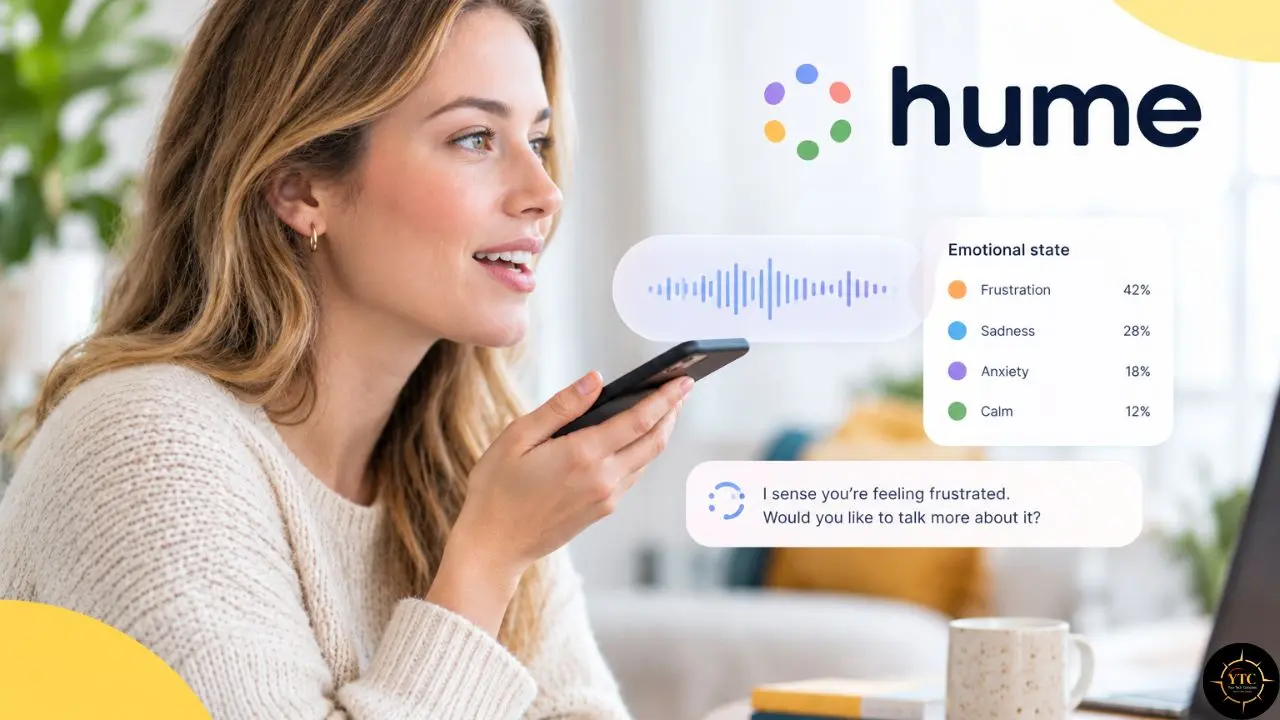
You’ve had this call before. A customer service bot cheerfully chirps, “I genuinely understand your frustration!” in the same sunny monotone it used two sentences ago to confirm your appointment time, and somehow that mismatch makes you angrier than the original problem. I’ve had that exact moment more than once, and it’s the precise failure point Hume AI was built around: not making voice AI sound more human, but making it actually listen to how you’re saying something, not just what you’re saying.
In this detailed review, I’ll walk you through how Hume AI’s Empathic Voice Interface (EVI) analyzes tone, pace, and prosody in real time; what the Octave voice‑design tools actually do; the real cost math behind its tiered, usage‑based pricing; the genuinely fresh company risk you should know about following major leadership changes in 2026; and how it stacks up against ElevenLabs and OpenAI’s Realtime API. Everything below is grounded in Hume’s own published pricing, independent benchmark testing, and 2026 reporting, with opinions clearly flagged as mine.
A note before we begin: every YTC score is earned, never negotiated. If you want to understand exactly how we evaluate apps & tools and how we handle affiliate relationships, our Review Methodology lays it all out.
Quick Verdict
- Best For: Developers building customer service, wellness, or research applications where detecting genuine emotional tone, not just words, meaningfully changes the outcome.
- Skip It If: You need studio‑polished voice content at scale, a no‑code setup, or you’re not prepared to think carefully about the ethics of processing emotional voice data.
- Bottom Line: Hume AI is among the most scientifically credible options in emotion‑aware voice AI, and its research team is refreshingly honest about what the technology can’t do, but you’re trading some raw voice polish and paying a real premium for that emotional layer.
What Is Hume AI, and How Does It Work?
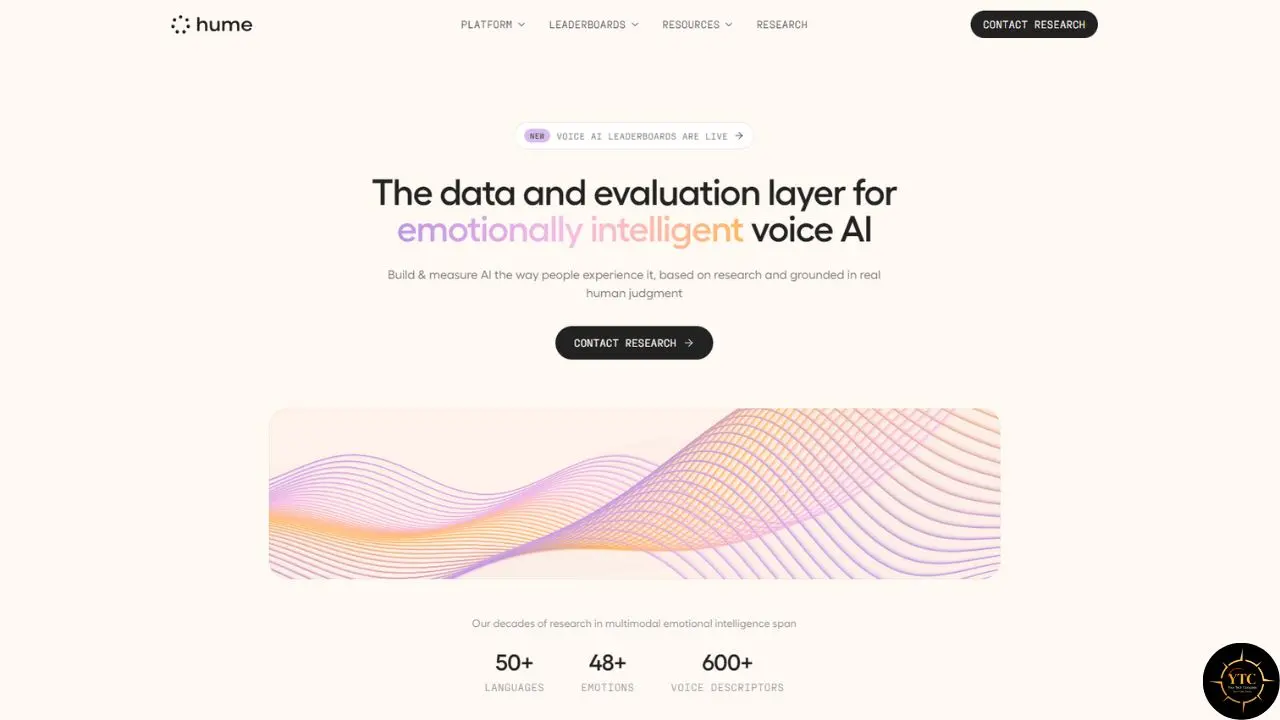
Hume AI started life differently than most AI startups you’ll read about, as a research lab studying affective computing, the science of how emotion shows up in expression, before it became a developer platform at all. That research‑first identity still shows in the product: rather than just converting text to speech, Hume’s models analyze prosody (the tune, rhythm, and timbre of speech) alongside the words themselves, then use that combined signal to shape a response.
The flagship product is EVI, the Empathic Voice Interface, a real‑time speech‑to‑speech API that listens to live audio and returns both generated audio and a transcript enriched with measures of vocal expression. Hume’s own speech‑language model guides this process, but here’s the architectural flexibility that matters for developers: EVI can be combined with other LLMs in your stack, including Claude or GPT, letting you pair Hume’s emotional intelligence layer with whichever model actually handles your reasoning and content generation. If you’re new to how these AI building blocks connect under the hood of a product like this, our AI Unboxed coverage and our LangChain explained guide both break down the plumbing without the jargon.
The version history moves fast here. EVI 3 launched with access to a library of over 100,000 custom voices on Hume’s TTS platform, brought latency under 300 milliseconds, and added support for 11 languages, though the system remains English‑first in optimization. That pace of iteration is worth noting upfront, because it’s directly relevant to a company‑stability story I’ll cover honestly later in this review.
Standout Features (and Where They Fall Short)
EVI: The Empathic Voice Interface (The Flagship)
EVI’s core promise is real‑time emotional responsiveness: when a caller sounds frustrated, the system is designed to shift its tone to match, rather than repeating the same scripted cheerfulness regardless of context. That’s a genuinely different design philosophy than most voice AI, which treats the transcript as the only source of truth and throws away everything the audio itself was communicating.
Now, the honest limitation, and it’s an important one that belongs squarely on the flagship feature. Emotion inference from voice is inherently probabilistic, not certain, and remarkably, Hume’s own research team says so directly, publishing that AI cannot truly “detect” emotions or read minds, only identify emotion‑related patterns in observable expression.
My Opinion: That kind of public self‑correction is rare in this industry and genuinely builds credibility, but it also means you should treat EVI’s emotional reads as a helpful signal, not a diagnostic fact, especially across different accents and cultural expression norms.
Octave TTS and Custom Voice Design
Octave is Hume’s separate text‑to‑speech engine, designed to generate expressive voices with configurable behavior rather than only technical parameter tuning. The voice‑creation process is geared toward developers and teams who want more emotionally varied output from text.
Hume positions Octave as an expressive TTS system optimized for empathic communication, not as a pure fidelity‑focused narrator engine. In other words, its design priority is the emotional layer, not necessarily the cleanest possible audio.
Custom Model API
For teams that need something more bespoke, the Custom Model API offers a developer‑focused path to build your own emotion‑aware predictions using transfer learning from Hume’s expression‑measurement foundations. This is squarely a developer‑and‑researcher feature rather than something a marketing team would touch directly.
Architectural Flexibility: Pairing EVI with External LLMs
Perhaps Hume’s most underrated strength is architectural: EVI is designed as a real-time speech-to-speech interface that can be combined with other components in a voice stack. In practice, developers can retain Hume’s speech processing, prosody analysis, turn-taking, and expressive voice capabilities while routing conversation logic through another supported language model or a custom service in their application.
Anthropic’s prompt-caching documentation indicates that caching can reduce input costs by up to 90% and latency by up to 80% in suitable Claude workloads, which may be relevant when EVI is configured to use Claude or another external language model. These figures apply to the Claude API component (not automatically to EVI’s complete voice pipeline), and actual savings depend on factors such as repeated prompt prefixes, cache hits, cache duration, and traffic patterns.
Pricing: The Real Cost Math
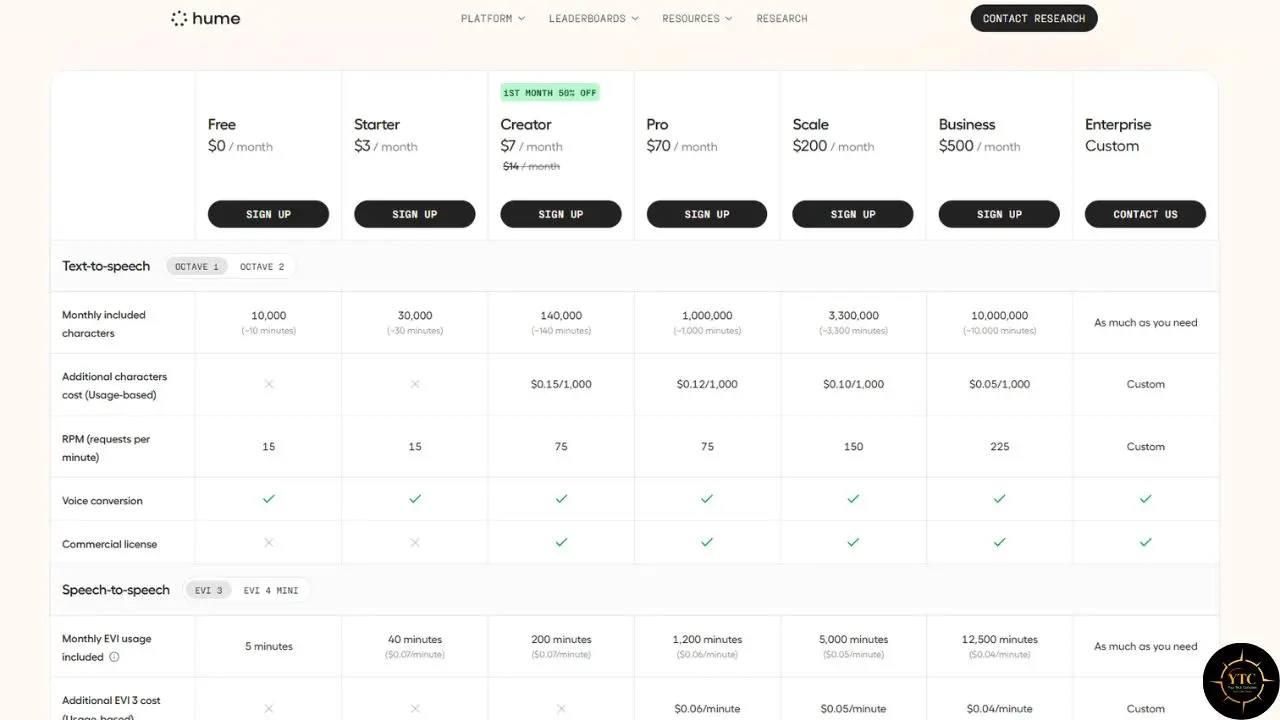
Unlike plenty of AI platforms that gate pricing behind a “book a demo” form, Hume AI publishes self-serve pricing for its TTS, EVI, and voice features, and that transparency deserves credit because it lets you estimate costs before committing engineering time to an integration.
Plan | Monthly Cost | Included Usage | Overage Rate |
Free | $0 | 10,000 TTS characters, 5 EVI minutes | No additional usage rate listed |
Starter | $3/mo | 30,000 TTS characters, 40 EVI minutes | No additional usage rate listed |
Creator | $14/mo | 140,000 characters, 200 EVI minutes | TTS from $0.15/1,000 characters; EVI from $0.07/min |
Pro | $70/mo | 1,000,000 characters, 1,200 EVI minutes | TTS from $0.12/1,000 characters; EVI $0.06/min |
Scale | $200/mo | 3,300,000 characters, 5,000 EVI minutes | TTS from $0.10/1,000 characters; EVI $0.05/min |
Business | $500/mo | 10,000,000 characters, 12,500 EVI minutes | TTS: $0.05/1,000 characters; EVI: $0.04/min |
Enterprise | Custom | Usage and limits negotiated | Custom |
Hume currently lists a first-month promotional price of $7 for Creator, followed by the standard $14 monthly price.
Here’s the math that actually matters. Hume estimates that 10 million TTS characters represent roughly 10,000 minutes of generated speech, using an approximate ratio of 1,000 characters per minute. A business-tier team, therefore, receives enough included TTS capacity for approximately 10,000 minutes of audio, alongside 12,500 included EVI minutes. Additional usage costs $0.05 per 1,000 TTS characters and $0.04 per EVI minute. Whether that is competitive with another provider depends on factors such as voice quality, included allowances, concurrency, commercial rights, and whether you are comparing TTS alone or a complete conversational voice pipeline.
The Expression Measurement API should not be treated as a current pay-as-you-go product. Hume’s documentation says the API was sunset, with June 14, 2026, as the last day to use it and download job results. Historical prices such as $0.0828 per minute for video with audio, $0.0639 per minute for audio-only analysis, and $0.00024 per word for text analysis should, therefore, be removed or explicitly labeled as legacy figures.
My Practical Advice: Start on the free tier to test whether EVI’s conversational and expressive behavior improves your specific use case before paying for a larger plan. Move to Starter or Creator when you need additional usage, and verify the commercial requirements before launching publicly. If you connect your LLM API key or custom language model, Hume says it does not charge for that LLM usage, although Hume-managed external LLMs may add separate charges.
Legal, Privacy, and Risk Considerations
This section deserves more weight than a typical tool review because Hume may process voice recordings and infer patterns related to a person’s vocal expression. Depending on the jurisdiction and use case, that information can create heightened privacy and data-protection risks. Consent, purpose limitation, access controls, and retention, therefore, matter more than they might for an ordinary text-generation workflow.
Hume advertises enterprise compliance capabilities, including SOC 2 Type II, GDPR, and HIPAA-related support, but those protections should be confirmed in the applicable contract rather than assumed to apply automatically to every plan. In addition, Hume’s terms state that HIPAA-covered entities and business associates require an express written agreement, or Business Associate Agreement.
Hume documents privacy controls for its EVI API, including zero data retention for chat histories and voice recordings and an option to opt out of using interaction data for model training. However, its documentation says EVI data retention and the use of anonymized interaction data for training are enabled by default, meaning customers must actively change those settings. Organizations should therefore review Hume’s privacy documentation, configure these controls deliberately, and avoid sending sensitive information unless their legal and security requirements have been satisfied.
There is also a scientific and ethical debate worth naming plainly rather than glossing over. Some researchers have challenged whether AI systems can reliably infer a person’s internal emotional state from observable signals, particularly across cultures, contexts, and individuals. Hume’s framing is narrower: its systems analyze expression-related behavior patterns and vocal characteristics rather than claiming definitive access to what someone objectively feels. That distinction is important, but it does not eliminate questions about validity, bias, consent, or how downstream users interpret the results.
The legal context can also depend heavily on deployment. For example, the EU AI Act prohibits AI systems used to infer emotions in workplaces and educational institutions, except where the system is intended for medical or safety reasons. A deployment can, therefore, raise compliance problems even when the underlying model is technically functional, and the people being analyzed have been informed.
The mental-health use case deserves its own explicit caution, separate from the general privacy discussion. An AI that responds with apparent emotional attunement to someone distressed is not a substitute for a licensed professional, crisis service, or emergency response. Products aimed at vulnerable users should make that limitation clear, avoid diagnostic or therapeutic claims unless appropriately authorized, provide escalation pathways, and include human oversight and crisis-handling procedures in the product design rather than leaving those safeguards implicit.
Hume AI vs. the Alternatives
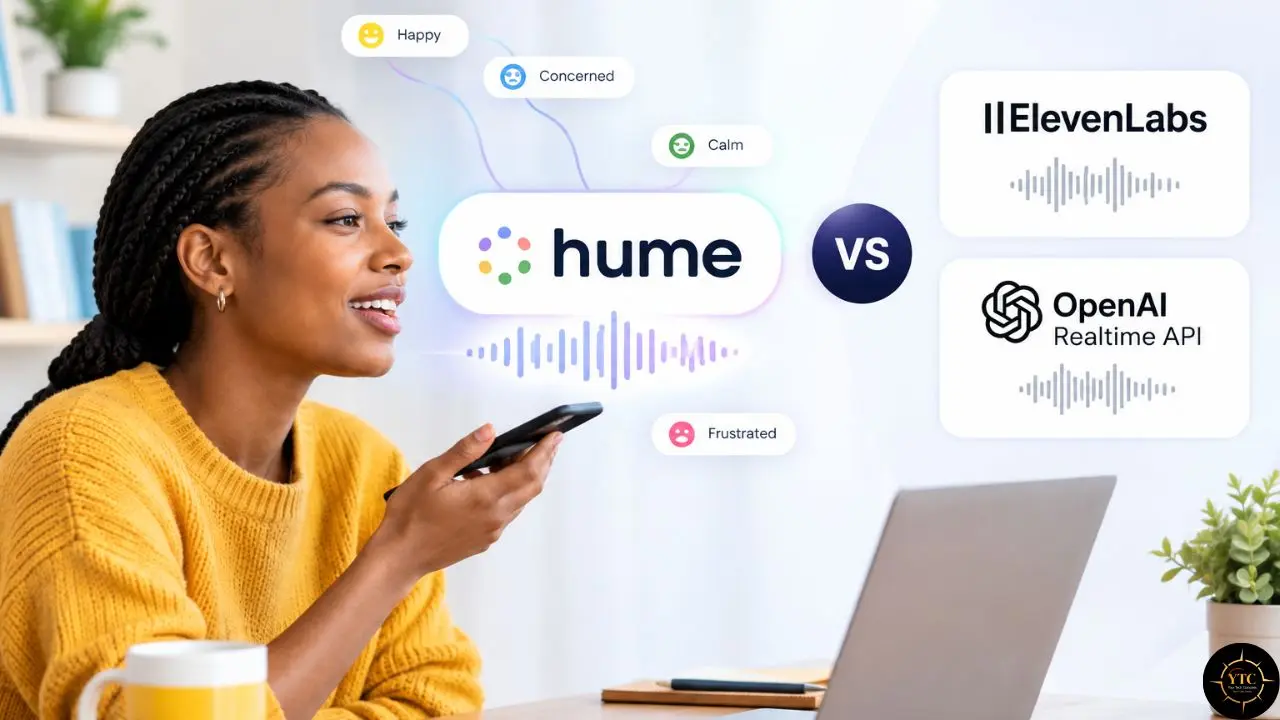
Voice AI now spans several overlapping categories, and Hume occupies a different position from its most obvious competitors. Hume emphasizes expressive, emotionally informed voice interaction and prosody analysis; ElevenLabs is best known for voice generation, cloning, and conversational audio; and OpenAI’s Realtime API provides a general-purpose, low-latency speech-to-speech interface built around GPT models.
The comparison below should be treated as a product-positioning guide rather than a universal performance ranking.
Platform | Core Focus | Expression or Emotion Capabilities | Voice Naturalness | Latency | Pricing Model | Best For | Weakest At |
Hume AI | Empathic voice interaction and expression analysis | Native prosody and expression analysis, not definitive mind-reading | Strong, but benchmark results vary by test | Depends on EVI version, model, network, and configuration | Tiered subscription plus usage charges | Empathic CX, expressive agents, and voice research | May require more integration work when raw speed or conventional TTS polish is the main priority |
ElevenLabs | Voice generation, cloning, and conversational audio | Expressive voice generation, but no directly comparable Hume-style expression-analysis layer | Frequently highly rated, but scores depend on the benchmark and model | Flash TTS inference can be approximately 75 ms for typical short inputs; end-to-end agent latency is higher | Credits, subscriptions, and product-specific usage pricing | Audiobooks, dubbing, voice cloning, and high-volume audio | Dedicated analysis of vocal expression and emotional cues |
OpenAI Realtime API | General-purpose multimodal, speech-to-speech GPT interaction | No Hume-equivalent dedicated expression-analysis workflow | Strong and steerable, varying by model and voice | Designed for low-latency interaction; actual results depend on configuration and network | Token-based audio and text pricing | Teams already using OpenAI’s models, tools, and infrastructure | Specialized expression analysis and Hume-style voice customization |
The pattern is clear: Hume prioritizes an expression-aware interaction layer rather than competing solely on raw voice-generation speed or polish. ElevenLabs may be the stronger choice when the primary requirement is highly polished voice production, while OpenAI may be more attractive when a team wants a general-purpose speech-to-speech agent integrated with GPT models and tools. These are architectural trade-offs, not universal quality rankings.
Compared with ElevenLabs right now: Hume’s advantage appears when the application needs to analyze vocal expression and use that information during a conversation, rather than simply generate natural-sounding speech. ElevenLabs remains a strong option for voice naturalness, cloning, dubbing, and production-scale audio, but claims that it “wins decisively” should be supported by a named, transparent benchmark rather than a single competitor-published score.
Compared with OpenAI’s Realtime API right now: Hume offers a more specialized expression-oriented approach, while OpenAI offers a broader GPT-based speech-to-speech platform with tool use and multimodal capabilities. OpenAI’s Realtime API is designed to avoid a conventional speech-to-text-to-LLM-to-text-to-speech chain, but it is not automatically the fastest option in every deployment. Its current pricing is usage-based rather than a universal fixed per-minute rate, and the available voices and model features can change over time.
Hume’s emphasis on custom, emotionally expressive voice design also places it alongside other creative AI-generation tools reshaping their categories. If you’re curious how a similar generative, text-to-output approach works in music, our Suno AI review covers it, while our Runway AI review examines the same broader shift in video creation.
Real-World Use Cases
Picture a customer service platform handling a billing dispute call. Instead of the agent bot repeating the same scripted apology regardless of how the caller sounds, EVI detects rising frustration in the caller’s tone and, when configured emotion thresholds are crossed, automatically triggers an escalation to a human agent, not because a keyword was mentioned, but because the emotional signal itself met the criteria. That’s the kind of intervention a transcript‑only system simply can’t make.
Now consider a wellness app offering a supportive daily check‑in conversation. The app uses EVI’s emotional responsiveness to shift its tone when a user sounds low, while keeping the mental‑health caution front and center in the product’s own messaging: a supportive layer, explicitly not a substitute for care, and deployed with appropriate clinical governance. Used this way, the emotional‑intelligence layer adds something genuinely different from a standard chatbot without overstating what it can do.
Honest Limitations

Beyond the flagship’s emotion‑detection caveat, several structural issues become clear once you move from demo to production. Raw voice quality is the most consistently cited gap; independent benchmark testing in 2026 puts Hume’s speech naturalness at 78.50% versus ElevenLabs at 89.60%, with ElevenLabs also ahead on pronunciation accuracy, so if your product’s primary need is polished, human‑indistinguishable audio for pre‑recorded content, Hume is not the strongest fit.
Cost at production scale deserves a second, harder look than the headline pricing suggests. Between EVI minutes and Octave TTS characters, a team running emotionally aware voice at volume can accumulate real monthly spend faster than a single pricing table communicates, and that combination genuinely surprises teams who budget off the subscription tiers alone. Historically, Hume also offered a separately billed Expression Measurement API for batch emotion analysis, but that standalone API was deprecated in 2026 (new jobs ended May 14; full access ended June 14), with expression scoring now bundled inside EVI rather than metered as a separate line item.
Language and accent coverage remain narrower than category leaders. EVI’s emotional nuance was built and benchmarked predominantly around English, and as of late 2026, documented language support is limited. EVI 4‑mini lists eleven languages (English, Japanese, Korean, Spanish, French, Portuguese, Italian, German, Russian, Hindi, Arabic), so accuracy for accents and cultural expression styles outside the training distribution deserves real scrutiny before you deploy this for a global audience, not an assumption that it generalizes cleanly.
The most significant limitation right now, though, isn’t technical at all; it’s organizational, and it’s fresh. In January 2026, Google DeepMind entered a non‑exclusive licensing agreement with Hume AI that brought CEO Alan Cowen and roughly seven senior engineers over to work on Gemini’s voice features, while Hume continued operating independently under new CEO Andrew Ettinger.
My opinion, based on this reporting: This is not evidence Hume is failing; the company reportedly projects $100 million in revenue for 2026, but any leadership and core‑engineering departure of that size is a real continuity risk, and teams building critical infrastructure on Hume should watch the platform’s roadmap closely over the coming months.
Who Should Use Hume AI (and Who Shouldn’t)
Use it if you:
- Are building a product where detecting genuine emotional tone changes the outcome, not just a “nice to have” feature.
- Have engineering resources to integrate a real-time API, since this is a developer platform, not a no-code tool.
- Value transparent, self-serve pricing and want to test on a genuinely usable free tier before committing.
- Are prepared to build clear ethical and consent safeguards around processing emotional voice data.
Skip it if you:
- Need the most polished, human-indistinguishable voice output for pre-recorded content; ElevenLabs will outperform here.
- Want a no-code setup with zero developer involvement.
- Need broad, proven accuracy across many languages and accents today, not just English.
- Aren’t ready to treat emotion-detection output as probabilistic guidance rather than a certain fact.
Hume AI in Africa: The Accessibility Check
For developers across Africa, Hume AI’s self-serve, published USD pricing is a genuine advantage over demo-gated competitors; you can sign up with an international card and start building on the free tier without a sales call, which removes one common barrier immediately. That technical accessibility matters, and it’s part of the same broader pattern our AI in Africa coverage tracks: developer-facing AI tools increasingly don’t require local infrastructure to start experimenting.
The gaps show up past that first step, though. EVI’s emotional-intelligence layer was built and benchmarked predominantly around English, and the demographic-bias concerns raised earlier in this review apply with real force here; a system trained mostly on North American and European vocal expression patterns may read tone and emotion less reliably for African accents and speech patterns, a caveat worth testing directly rather than assuming away. If you’re building a customer-facing product for an African market specifically, I’d treat that as a genuine evaluation question before launch, not an afterthought.
The broader African tech ecosystem is moving fast enough that this gap likely narrows over time, and it’s worth watching alongside developments across the continent’s wider innovation landscape; our African tech category follows that story as it develops.
FAQs
Hume AI is used to build voice applications that detect and respond to emotional tone in speech, spanning customer service, mental wellness apps, human-computer interaction research, and any product where knowing how something was said matters as much as what was said.
Yes, with real usable limits rather than a locked demo. The Free tier includes 10,000 TTS characters and 5 EVI minutes per month plus unlimited non-commercial voice cloning, though a commercial license requires upgrading to at least the Creator plan.
ElevenLabs focuses on producing the most natural-sounding, highest-fidelity voice output, and independent benchmarks show it winning on pure audio quality. Hume AI’s differentiation is its emotional-intelligence layer (analyzing and responding to vocal tone in real time), which ElevenLabs doesn’t offer as a core feature.
It can add a genuinely supportive, emotionally responsive layer to a wellness product, but it should never be positioned or relied on as a substitute for professional mental health care. Any product built this way needs that boundary made explicit to users, not left implied.
Financially, yes, Hume reportedly projects $100 million in 2026 revenue and continues operating independently. Organizationally, the January 2026 departure of its CEO and roughly seven senior engineers to DeepMind is a real continuity risk worth monitoring if you’re building critical infrastructure on the platform.
Beyond the Words: A True North for Empathic AI

Hume AI is doing something genuinely rare in AI right now: building a real product on top of contested science while being unusually honest about exactly where that science’s limits sit. EVI’s emotional responsiveness is a legitimate differentiator for the right use case; Octave’s voice design is accessible even to non-experts; and the published, transparent pricing lets you actually plan before you build, but none of that erases the real gaps in raw voice polish, the added cost of layering expression measurement onto production use, or the fresh uncertainty a major leadership departure introduces.
The practical takeaway is this: if emotional nuance is genuinely core to what you’re building, not a feature you’d like to bolt on, Hume’s scientific grounding and architectural flexibility with other LLMs make it worth the integration effort. If you just need the most polished voice output possible, or you’re not ready to build real ethical guardrails around processing emotional voice data, start with ElevenLabs or OpenAI’s Realtime API instead and revisit Hume once your product’s emotional intelligence needs are proven, not assumed.
Some tools point you toward a destination; this one’s worth checking against your compass first at YourTechCompass.com.