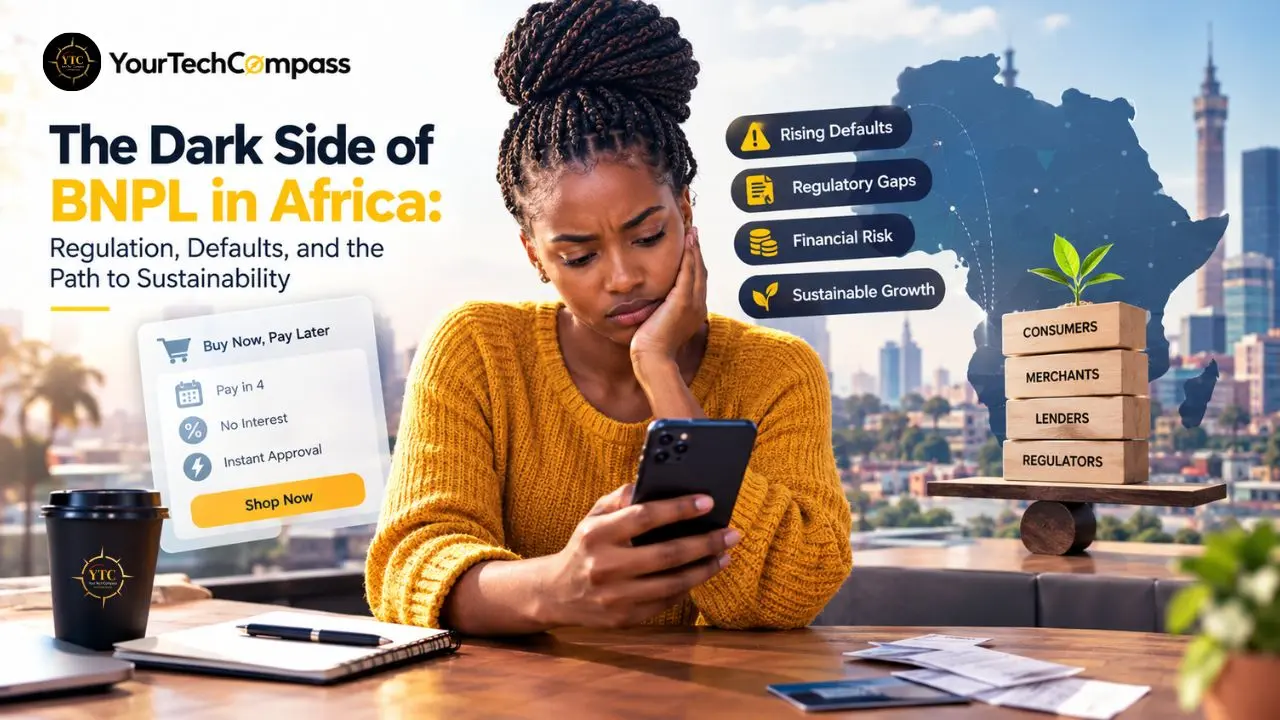
A university student in Nairobi sees a smartphone she cannot afford, clicks “Pay in 4,” and walks out with the device. A shop owner in Lagos restocks inventory using a six-week installment plan instead of depleting cash reserves. A young professional in Johannesburg splits a fashion purchase into interest-free installments because the monthly budget is already stretched. The pitch is irresistible: instant gratification, low friction, minimal paperwork, and a less stigmatizing alternative to conventional borrowing. But beneath the sleek app interfaces and influencer marketing lies a harder question: can short-term digital credit expand responsibly in economies marked by uneven incomes, limited credit histories, currency volatility, and incomplete consumer protection frameworks?
Africa’s BNPL payment market was estimated at $5.34 billion in 2025 and is projected to reach $10.63 billion by 2030, according to a ResearchAndMarkets forecast. Yet the sector’s expansion has also exposed business and regulatory vulnerabilities. Kenya’s LipaLater entered administration on March 24, 2025, after financial difficulties and unsuccessful fundraising efforts. South Africa’s BNPL sector remains in a regulatory grey area, with ongoing uncertainty over whether (and how) these products fall under the National Credit Act. In Nigeria, the Federal Competition and Consumer Protection Commission has tightened oversight of digital lenders through measures including app-store delisting and its 2025 digital-lending regulations; after a court challenge temporarily halted enforcement in 2026, the regulations were upheld in July, allowing implementation to resume. This is not simply a story about one failed company or one assertive regulator. It is about what happens when frictionless credit meets fragile incomes, volatile currencies, uneven consumer protection, and macroeconomic pressure, and whether the industry can develop a sustainable model before weak underwriting, consumer harm, or regulatory fragmentation undermines its promise.
The BNPL Boom Across Africa
Market Size and Growth Trajectory
The numbers suggest a rapidly expanding market. A Mordor Intelligence estimate puts the combined Middle East and Africa BNPL market at $24.93 billion in 2025 and projects it to reach $65.39 billion by 2031, implying a compound annual growth rate of 17.45%. In South Africa, a separate ResearchAndMarkets estimate puts the 2025 BNPL market at approximately $815 million, with annual growth forecast at 13.6%. These figures should be treated as commercial estimates rather than definitive measurements; other research places South Africa’s 2025 market at $81.1 million, suggesting that providers are using materially different definitions of market size.
Growth at this pace can create strong incentives to prioritize customer acquisition and transaction volume, making underwriting quality, affordability assessments, and repayment performance critical questions for the sector. In our coverage of the African fintech ecosystem, we have tracked how investor enthusiasm can support consumer-credit models that become vulnerable when funding conditions tighten, or economic conditions deteriorate. BNPL is not immune to those pressures. Demand is genuine, but the sector is also expanding amid uneven regulatory treatment, particularly where products occupy a grey area between payments and credit. That can create gaps in affordability checks, fee disclosure, credit reporting, and consumer recourse, although the strength of those gaps varies across Lagos, Nairobi, Johannesburg, and other African markets.
Why BNPL Took Off in African Markets
Low credit-card ownership and limited access to conventional consumer credit created an opening for BNPL. In South Africa, Nigeria, and Kenya, many consumers have limited or fragmented credit histories, leaving them with fewer options for short-term borrowing. Digital lenders may supplement credit-bureau information with alternative data, such as transaction activity, repayment behavior, and, depending on the provider, device or application signals to make rapid credit decisions. The appeal is clear: BNPL can convert an existing digital-payment relationship into a source of short-term credit, although the use of alternative data raises questions about privacy, transparency, accuracy, and responsible underwriting.
E-commerce integration accelerated adoption. One commercial estimate puts online transactions at 78.12% of BNPL market activity across the Middle East and Africa in 2025, although the figure is regional and may vary depending on how market activity is measured. Kenya’s mature mobile-money ecosystem, together with Nigeria’s expanding digital-payments and fintech infrastructure, helped reduce the distribution and repayment barriers facing digital lenders.
Research identifies millennials as a leading BNPL user group, while Gen Z is among the fastest-growing cohorts, although the precise demographic shares vary by source. These are also consumers for whom affordability checks matter. Young or financially constrained borrowers may be particularly vulnerable when the speed and convenience of checkout make unsecured credit feel like an ordinary payment method. Research has linked BNPL use with increased short-term purchasing power, but also with overspending and higher personal debt. The risk is greatest when marketing emphasizes instant access and low or zero interest without giving equal prominence to repayment obligations, late fees, missed-payment consequences, and the effects of taking on multiple purchases.
The Default Crisis: When the Model Breaks Down
The LipaLater Collapse

LipaLater was once presented as a leading example of Africa’s BNPL opportunity. Founded in 2018 by Eric Muli, the Kenyan startup offered installment financing to consumers and businesses, allowing customers to pay a deposit, take possession of goods, and repay over time. In its merchant-financing model, LipaLater paid merchants upfront and assumed responsibility for collecting repayments. The company raised approximately $12 million in a 2022 pre-Series A round, later secured additional debt financing, and acquired the e-commerce platform Sky.Garden for about KSh250 million, and was included in the Financial Times’ ranking of fast-growing African companies.
By March 2025, however, LipaLater had entered administration.
According to founder Eric Muli, the company’s difficulties began during COVID-19, when repayment inflows fell sharply as customers’ incomes came under pressure. He also attributed the failure to a currency and liability mismatch: LipaLater had borrowed in US dollars while earning much of its revenue in Kenyan shillings. As the shilling weakened from roughly KSh100 to around KSh170 per dollar over the relevant period, servicing dollar-denominated obligations became pricier in local-currency terms. Muli further cited rising defaults, reports that some customers resold financed devices and abandoned repayments, pressure to grow quickly, and the company’s inability to secure fresh funding. These explanations are based principally on the founder’s account and should not be treated as a complete, independently audited explanation of the administration.
LipaLater’s administration is therefore best understood not as proof that BNPL is inherently unworkable, but as an illustration of how quickly a credit business can become vulnerable when foreign-currency liabilities, local-currency revenues, weak repayment performance, funding dependence, and rapid expansion converge. The case shows that sustainable BNPL requires more than customer growth; it also depends on disciplined underwriting, currency-risk management, reliable collections, adequate capitalization, and a funding model that can withstand economic shocks.
Default Rates and the Hidden Stress
Headline BNPL charge-off rates can look deceptively low, but they measure only one form of repayment failure. In U.S. data, BNPL borrowers defaulted on approximately 2% of BNPL loans between 2019 and 2022, while defaulting on about 10% of the credit cards they held. More recent CFPB data put the BNPL loan charge-off rate at 2.63% in 2022 and 1.83% in 2023. These figures come from U.S. providers and should not be treated as global or Africa-specific default rates.
Consumer surveys tell a different story: roughly one-third to two-fifths of U.S. BNPL users have reported at least one late payment, although a late payment is not the same as a charge-off and may later be cured.
CFPB research also found that about one-fifth of borrowers were heavy users, originating more than one BNPL loan per month on average, while many borrowers held simultaneous loans from multiple providers. This suggests that the central risk is not necessarily the failure of any single installment. It is the accumulation of several obligations whose combined repayment burden may be difficult for households and lenders to see. When credit reporting is incomplete, and borrowers face an income shock, loan stacking can turn manageable payments into broader repayment stress.
Macroeconomic Headwinds
When a BNPL provider borrows in dollars but collects repayments in naira or shillings, the provider faces a currency mismatch: depreciation raises the local-currency cost of servicing foreign-currency liabilities while weakening borrowers’ purchasing power. Kenya’s shilling depreciated by approximately 29% against the dollar between January 2023 and January 2024, while Nigeria’s official exchange rate depreciated sharply after foreign-exchange reforms in 2023 and 2024. Egypt’s pound also underwent major devaluations, including a 65% depreciation during fiscal year 2022/23 and another substantial adjustment when the exchange rate was floated in March 2024.
These shocks can affect BNPL providers through funding costs, merchant prices, imported-goods costs, and borrower repayment capacity. In LipaLater’s case, the founder cited dollar-denominated liabilities, weaker repayment performance, COVID-era income disruption, and difficulties in raising fresh capital as factors behind the company’s administration; currency depreciation should therefore be treated as a contributing pressure rather than the sole cause.
At the same time, African fintech funding became more selective after the sector’s earlier funding boom. Partech reported $3.2 billion in total African startup funding in 2024, down 7% from 2023, although fintech still attracted $1.4 billion in equity funding. For BNPL teams in Nairobi or Lagos, the result is a more demanding operating environment: unstable currencies, expensive funding, weaker household purchasing power, and less room to absorb repayment losses.
The Regulatory Vacuum and the Rush to Fill It

South Africa: The Grey Zone
South Africa has the continent’s most sophisticated financial regulatory framework. If BNPL can occupy a regulatory grey zone there, it can do so almost anywhere. And that is precisely what has happened.
Many BNPL products currently operate outside the core protections of South Africa’s National Credit Act. Their legal treatment depends on how they are structured, but interest-free and fee-free arrangements may not meet the Act’s definition of a regulated credit agreement. The Intergovernmental Fintech Working Group has acknowledged that BNPL currently falls into a “regulatory void.” Regulatory responsibility is fragmented: the National Credit Regulator administers the NCA, while the Financial Sector Conduct Authority administers the Financial Advisory and Intermediary Services Act.
Providers argue they are not credit providers because they charge no interest or upfront fees. This creates a regulatory escape hatch: products outside the NCA may not be subject to mandatory affordability assessments, NCR registration, the Act’s disclosure requirements, or its formal credit-provider complaint framework. The National Financial Ombud warned in December 2025 that BNPL products were not covered by the NCA and therefore lacked several consumer protections normally associated with regulated credit.
In practice, a South African consumer can hold various simultaneous BNPL arrangements from different platforms without any single provider necessarily seeing the full exposure. Historically, BNPL obligations were not comprehensively reported to credit bureaus, making loan stacking difficult to detect during affordability assessments. The National Credit Regulator has now issued requirements for BNPL data to be reported to registered credit bureaus from February 1, 2027, with implementation work scheduled for completion by January 31, 2027. Until those requirements take effect, the system remains vulnerable to opacity. In our analysis of African fintechs vs. global giants, we examined how local regulatory frameworks often lag behind product innovation. South Africa’s BNPL gap remains one of the clearest examples on the continent.
Kenya: From Wild West to Mandatory Licensing
Kenya learned the hard way from predatory digital loan apps. The Central Bank is not waiting for another consumer-protection disaster before expanding its reach. Through the Business Laws (Amendment) Act of 2024, Parliament broadened the CBK’s authority beyond digital credit providers to cover non-deposit-taking credit providers. The expanded framework includes BNPL arrangements, defined as agreements under which consumers purchase goods or assets and pay later in installments, with or without interest.
The CBK published Draft Non-Deposit-Taking Credit Providers Regulations in August 2025. Under the draft framework, providers with initial capital above KSh20 million would require a CBK license, while smaller providers would be required to register. Capital requirements, reporting obligations, and consumer-protection standards would apply. Providers would have six months to apply for a license or registration after the regulations formally commenced, not simply after the draft was published. The era of unregulated BNPL in Kenya is ending.
This matters for the entire East African corridor. Kenya’s regulatory approach could influence how Uganda, Rwanda, and Tanzania address similar non-deposit-taking credit models, although each country will set its own rules. If the CBK’s licensing framework succeeds in bringing BNPL providers into formal oversight without eliminating responsible innovation, neighboring regulators will have a model to study.
Nigeria: The FCCPC’s Heavy Hand
Nigeria’s approach is among the most aggressive on the continent. The Federal Competition and Consumer Protection Commission introduced the Digital, Electronic, Online or Non-Traditional Consumer Lending Regulations, known as the DEON Regulations, in 2025. The framework covers digital and non-traditional consumer lending and is broad enough to capture products such as BNPL, airtime credit, and some earned-wage-access arrangements where they fall within the regulations’ definition of consumer lending. Registration or approval is mandatory for covered operators. Corporate violations can attract fines of up to ₦100 million or 1% of annual turnover, while directors may face sanctions including disqualification for up to five years.
The industry fought back. The Wireless Application Service Providers Association of Nigeria challenged the FCCPC’s authority in court and secured an interim order in April 2026 that temporarily halted enforcement. But on July 20, 2026, Justice Ambrose Lewis-Allagoa of the Federal High Court in Lagos dismissed WASPAN’s suit, upheld the validity of the DEON Regulations, and discharged the interim order restraining implementation. The FCCPC subsequently resumed enforcement. It had already removed non-compliant digital lenders from its published register, and legal reporting indicates that enforcement may also restrict access to app stores and payment providers.
WASPAN filed an appeal with the Court of Appeal on July 21, 2026, and sought interim relief pending the appeal, so the legal battle is not over. But the signal is clear: Nigeria will not tolerate unregistered digital consumer lending, and the cost of compliance is rising. In our digital lending coverage in Nigeria, we have tracked how the FCCPC’s intervention is reshaping the credit landscape. BNPL providers whose products fall within the DEON definition are now inside that regulatory perimeter.
Regulatory Position by Market
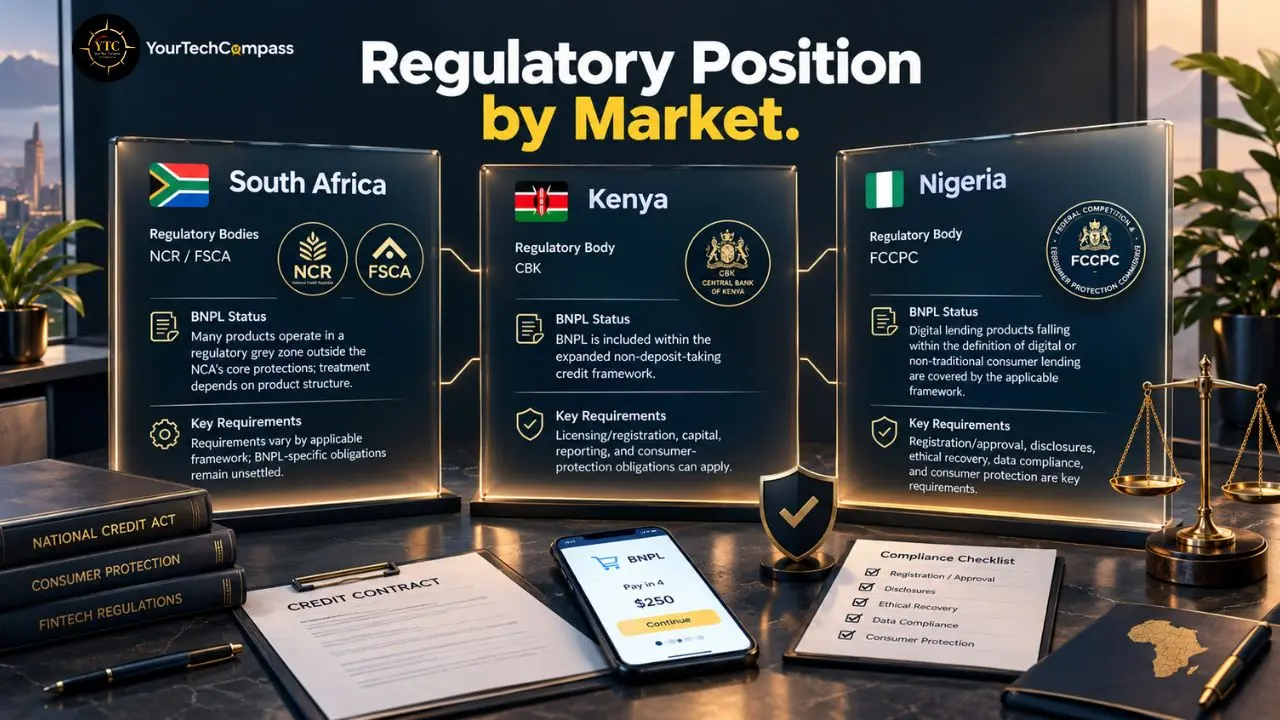
Country | Regulatory Body | BNPL Status | Key Requirements | Potential Consequences |
South Africa | NCR / FSCA | Many products operate in a regulatory grey zone outside the NCA’s core protections; treatment depends on product structure | Requirements vary by applicable framework; BNPL-specific obligations remain unsettled | General consumer, payments, data, contractual, and other applicable remedies; dedicated NCA sanctions may not apply to products outside the Act |
Kenya | CBK | BNPL is included within the expanded non-deposit-taking credit framework | Licensing or registration, capital requirements, reporting, and consumer-protection obligations under the applicable framework | Licensing or registration sanctions, fines, and other regulatory measures |
Nigeria | FCCPC | Covered by the DEON Regulations where the product falls within their definition of digital or non-traditional consumer lending | Registration or approval, disclosures, ethical recovery, data compliance, and consumer-protection requirements | Corporate fines of up to ₦100 million or 1% of annual turnover; directors may face sanctions, including disqualification for up to five years |
How BNPL Differs from Traditional Credit and Why That Matters
The Affordability Assessment Gap
A bank will usually ask how much you earn before lending. A BNPL app may ask how quickly you can click “accept.” That difference is not always innovation. Sometimes it is an omission.
Traditional credit providers commonly use income information, credit-bureau records, repayment histories, and affordability assessments, although the exact process varies by lender and product. BNPL providers may use alternative data, including transaction history, repayment behavior, device or application signals, and spending patterns, to make decisions within seconds. Some also use formal credit checks and internal affordability controls, but requirements remain less consistent across African markets.
The Bank for International Settlements found that BNPL users are typically younger, have less education, carry more debt, have lower credit scores, and experience higher delinquency rates than traditional-credit users. These findings are drawn from international evidence rather than Africa-specific data, but they highlight why BNPL borrowers require meaningful affordability assessments and clear disclosure.
Loan Stacking and the Invisible Debt Burden
Consumers across Lagos, Nairobi, and Johannesburg can hold multiple simultaneous BNPL obligations across several platforms. In many African markets, BNPL exposure is not yet comprehensively visible across providers, making it difficult for lenders to assess a customer’s total repayment burden.
A consumer with five active BNPL plans may be severely overextended, but no single provider may see the full picture. Kenya’s expanded non-deposit-taking-credit framework and Nigeria’s DEON Regulations are bringing covered digital lenders under greater oversight, while South Africa’s new BNPL credit-bureau reporting requirements are scheduled to take effect in February 2027.
The psychology compounds the problem. “Interest-free” marketing can obscure late fees, penalty charges, and merchant-funded pricing that may affect the final cost of goods. Small installment sizes make large purchases feel affordable until they accumulate. Splitting a ₦50,000 purchase into four payments may feel manageable. Splitting five purchases into twenty payments can create a repayment burden that exceeds the household’s available cash flow, especially when income is irregular or an unexpected expense arrives.
The Players and Their Survival Strategies
South Africa’s Established Players
South African BNPL is consolidating around providers with balance sheets and institutional backing strong enough to absorb regulatory costs and periods of elevated defaults. Payflex, founded in 2018, was acquired by Australia’s Zip Co in stages between 2021 and 2022 before Zip sold its South African operations to FeverTree Finance in June 2023. It offers Pay in 4 over six weeks and other installment options, with no interest when scheduled payments arrive on time. Under its earlier fee schedule, default charges were capped at R255 or 50% of the purchase price, whichever was lower; its current terms list a Pay in 4 cap of R285 or 50% of the purchase price.
PayJustNow, founded in 2019, was acquired by HomeChoice International through its Weaver Fintech subsidiary, which purchased an 85% stake in 2022. The platform splits purchases into three equal, interest-free installments and has expanded its merchant network through HomeChoice’s retail distribution and partnerships. Mobicred operates differently, functioning as a revolving digital-credit facility rather than a conventional Pay-in-3 or Pay-in-4 product, with interest applying under its credit terms to outstanding balances.
TymeBank’s parent, Tyme Group, has strengthened its position as a bank-backed digital-finance competitor. In December 2024, Nubank invested $150 million in Tyme Group as part of a $250 million Series D round that valued the group at $1.5 billion. The investment was directed toward Tyme Group’s broader digital-banking expansion rather than a specifically announced BNPL business. Bank-backed BNPL is nonetheless emerging as a significant competitive force: one commercial forecast projects the global bank- and financial-institution-backed segment to grow at a 23.7% CAGR, supported by banks’ access to lower-cost funding, established customer relationships, transaction data, and regulatory infrastructure.
M-Kopa and the Asset-Backed Alternative
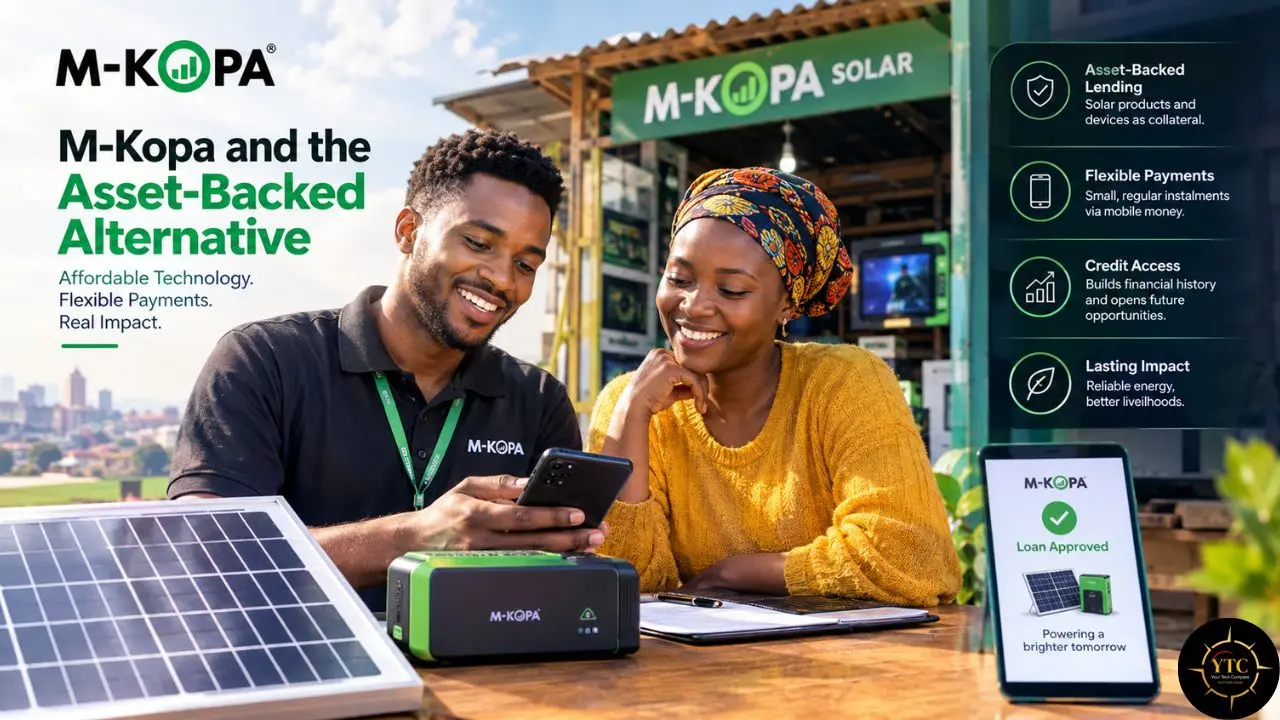
M-KOPA understood something pure BNPL platforms often miss. If the lender retains title to the asset, a default can trigger remote locking, voluntary return, or repossession rather than an immediate unsecured credit loss.
The company’s pay-as-you-go model for smartphones and other financed assets uses daily micropayments, mobile-money collections, and remote device-locking technology. M-KOPA reported well over 10 million cumulative customers across Kenya, Uganda, Nigeria, Ghana, and South Africa by July 2026, although that figure covers its broader asset-financing and digital-financial-services business rather than smartphones alone. Customers who experience payment difficulties may be able to return an eligible device, receive a full or partial refund of the initial payment depending on the product’s condition and applicable terms, and be released from the remaining repayment obligation. The asset, therefore, provides a backstop that can reduce the severity of default, although it does not eliminate every consumer or lender loss.
This model is harder to scale than an app-based BNPL model. It requires physical distribution, service centers, agents, device management, and inventory operations. But it is also more resilient in one important respect: the financed asset remains linked to the repayment obligation. In our mobile money evolution Africa coverage, we traced how M-Pesa’s transaction data became part of the foundation for digital credit. M-KOPA applies a related principle, using repayment and device-usage data to build a picture of customer behavior and creditworthiness, while the financed asset provides a physical backstop.
The Fintech-Bank Partnership Model
The future of African BNPL may increasingly involve banks, telcos, and other regulated incumbents with existing customer data, distribution networks, regulatory relationships, and access to lower-cost capital. Standalone BNPL startups face greater pressure to control defaults, diversify funding, and demonstrate sustainable unit economics. In our African fintech startups to watch in 2026, we have noted that partnerships with regulated incumbents can give fintech companies a more durable route to scale than operating independently.
For pure BNPL startups, one path forward runs through embedded finance and B2B partnerships. Rather than lending directly from their balance sheets, platforms can white-label their checkout, underwriting, payment, and collections technology for banks, merchants, and telcos that already hold the customer relationship and, where required, the regulatory license. This structure can reduce funding and compliance pressures, although it does not remove the need for responsible affordability assessments and effective credit-risk management.
The Path to Sustainability
Responsible Underwriting Over Growth-at-All-Costs
The LipaLater lesson is stark. Rapid merchant and customer acquisition without sustainable unit economics can end in administration. The BNPL provider that slows onboarding to verify income may lose market share to the competitor that does not, until that competitor collapses. Sustainability requires regulatory alignment, not just competitive discipline.
Platforms must conduct real affordability assessments, even if doing so reduces conversion rates. They have to avoid borrowing in hard currency while collecting repayments in soft currency. And they must build provisions for macroeconomic shocks rather than assuming the growth curve will always point upward. LipaLater’s reported combination of capital-intensive merchant financing, repayment problems, foreign-currency exposure, and difficulty raising fresh funding demonstrates how quickly these pressures can compound.
Embedded Finance and the B2B Pivot
Consumer BNPL in Africa may turn out to be a loss-leading acquisition channel. The profits may instead come from B2B embedded finance and merchant services. In our Fincart coverage, we examined how Egyptian e-commerce merchants need working capital embedded within their logistics workflows rather than presented as a separate loan product. The same logic can apply across the continent.
B2B BNPL for inventory financing, supplier payments, and SME working capital offers higher ticket sizes, deeper merchant relationships, and more transaction data. The merchant may be stickier than the consumer, and business revenue can provide stronger underwriting signals than an individual’s informal income. But B2B lending does not automatically produce predictable cash flows or lower defaults: small businesses can have irregular revenues, thin reserves, and significant exposure to inflation and currency volatility.
Regulatory Compliance as a Competitive Moat
Early compliance with Kenya’s CBK licensing framework and Nigeria’s FCCPC registration requirements can create barriers to entry and strengthen providers that invest in compliance, reporting, underwriting, and consumer-protection systems. Kenya’s 2024 legislation brought BNPL within the broader non-deposit-taking credit framework, while the CBK’s detailed 2025 NDTCP regulations remained in draft form in the latest official materials reviewed. Nigeria’s DEON Regulations impose registration and conduct requirements on covered digital and non-traditional lenders.
Over the coming years, the African BNPL landscape is likely to become more regulated, with licensed operators and well-capitalized fintech-bank partnerships gaining an advantage over firms that depend on regulatory gaps. The question is who survives the transition.
For founders, this means building compliance infrastructure now rather than waiting for an enforcement notice. For investors, it means due diligence must include regulatory-pathway analysis, funding structure, currency exposure, credit performance, and unit economics, not just growth metrics. And for consumers, it means the Wild West phase of African BNPL is ending, which, despite complaints from some operators, is precisely what should happen.
Navigating the Credit Currents
BNPL in Africa grew on a promise of financial inclusion and frictionless commerce, but LipaLater’s administration, reports of repayment and collection stress, and regulatory gaps raise questions about whether parts of the sector prioritized growth over sustainability. The African BNPL market was estimated at $5.34 billion in 2025 and is projected to reach $10.63 billion by 2030, according to a ResearchAndMarkets forecast. The market is not inherently toxic, but it is inherently risky when deployed in economies with volatile currencies, thin social safety nets, and consumers with limited experience of formal credit. The technology can work. But a balance-sheet-heavy business model becomes vulnerable when funding costs rise, currencies depreciate, repayment performance weakens, and lenders cannot see borrowers’ total obligations.
For consumers, the lesson is that “interest-free” does not mean risk-free, and splitting a purchase into four payments does not make it affordable. And for founders and investors, the path forward runs through regulatory compliance, responsible underwriting, and models that may include asset-backed finance, B2B lending, or embedded partnerships rather than pure unsecured consumer credit. For regulators, the challenge is protecting consumers without stifling the financial innovation that responsible BNPL can deliver. The next two years may determine whether African BNPL matures into a responsible credit layer or struggles under the weight of its speed.
Let YTC be the sentinel that warns you when fintech’s shine masks structural rust. Navigate wisely at YourTechCompass.com.