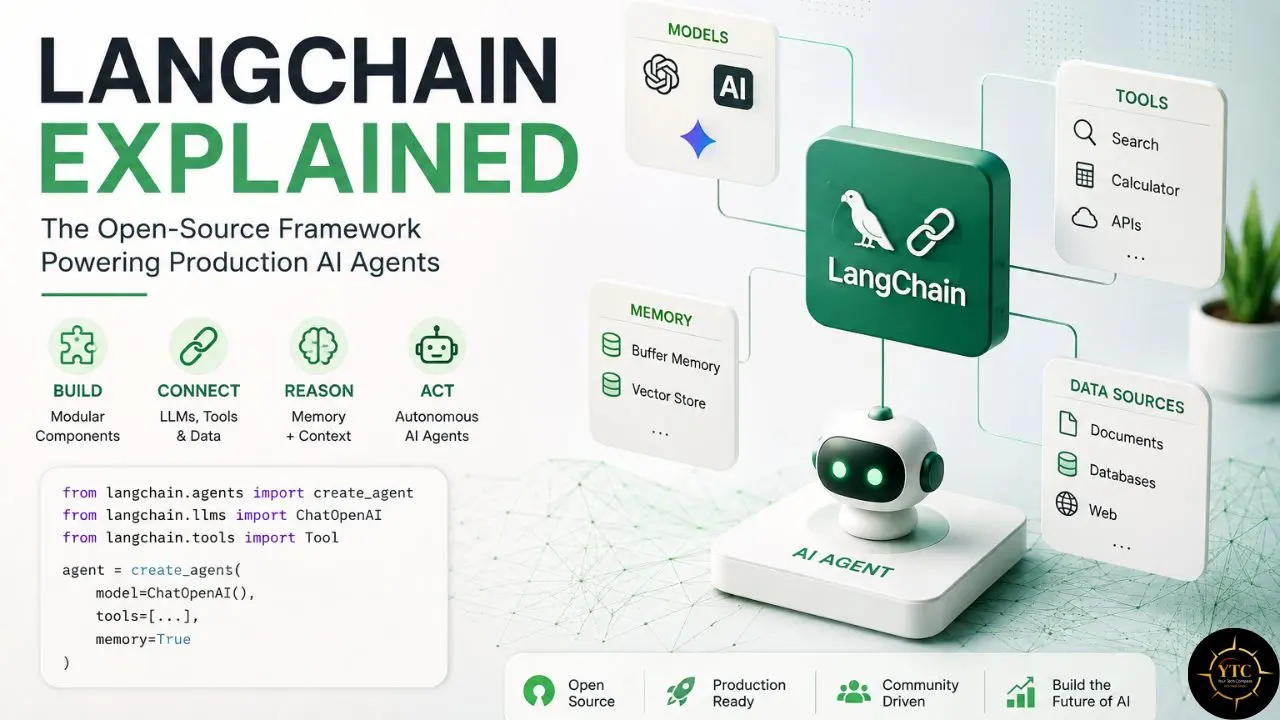
Technical depth warning: This piece covers LangGraph, state management, and production infrastructure. If you’re learning LLMs for the first time, our AI Unboxed beginner guides are a better entry point.
Every time someone mentions LangChain in 2026, three contradictory things happen at once. Some developers point to production agents built with it. Others roll their eyes and complain about abstraction bloat, dependency weight, API churn, or debugging friction. And someone in the back asks whether it is free or paid, because the ecosystem combines open-source libraries with LangSmith, a commercial platform for observability, evaluation, deployment, and other agent-engineering services. All three reactions contain some truth. LangChain remains one of the most visible and most-starred LLM application frameworks on GitHub, although GitHub popularity alone does not prove that it is the best choice for every production team. LangChain, Inc. also announced a $125 million Series B at a $1.25 billion valuation in 2026, highlighting the commercial scale surrounding the open-source ecosystem.
This article will cut through that noise. The core LangChain and LangGraph libraries are genuinely free and MIT-licensed, while LangServe is distributed under a separate license and is no longer the recommended starting point for new deployments. LangChain itself can be installed with a single package command, but a production application may still require paid model APIs, databases, hosting, and other infrastructure. LangSmith includes a free individual tier, while team features and higher usage introduce per-seat and usage-based charges. Understanding that split is the actual decision point for any developer or technical founder evaluating the stack. By the end, you will know what LangChain actually is, how LangGraph and LangSmith fit around it, the real 2026 pricing picture, the honest limitations that keep surfacing in developer communities, and where this ecosystem fits for African builders specifically.
A note before we begin: every YTC score is earned, never negotiated. If you want to understand exactly how we evaluate apps & tools and how we handle affiliate relationships, our Review Methodology lays it all out.
Quick Verdict
- Best For: Engineering teams building multi-step, stateful, or multi-agent LLM applications that need durable orchestration, production observability, and standardized integrations with multiple model providers, without implementing every integration and runtime primitive from scratch.
- Skip It If: You are building a single, simple LLM call; you are pre-technical and not writing your own code; or you want to avoid managed per-seat SaaS costs entirely and are comfortable using direct provider APIs, leaner frameworks, self-hosted tooling, or alternative observability platforms.
- Bottom Line: LangChain and LangGraph can be a worthwhile trade for teams building complex production agent systems, but whether LangSmith is worth paying for depends on team size, usage, compliance needs, and the value of managed observability and deployment. In 2026, LangGraph is the more relevant layer for durable, stateful, and multi-agent orchestration, while LangChain remains useful for higher-level agents, model integrations, tools, retrieval, and simpler workflows. For basic, single-purpose LLM features, direct provider APIs or a lighter abstraction will often have a lower adoption cost.
What Is LangChain?
LangChain is an open-source Python and JavaScript/TypeScript framework for building applications powered by large language models. It provides standardized interfaces for model providers, integrations for tools and retrievers, and reusable components for agents, document processing, and retrieval-augmented generation workflows. You can install the Python package with pip install langchain, add the provider integrations your application needs, and start composing LLM workflows without writing provider-specific wrappers from scratch. Switching providers can still require application changes, however, because models differ in tool calling, structured outputs, context limits, pricing, and other capabilities.
The framework sits within the broader AI tooling landscape we track across our AI Unboxed coverage. Since its launch, LangChain has become one of the most visible entry points for developers building LLM applications, and its core repository has more than 100,000 GitHub stars. LangGraph, the ecosystem’s lower-level orchestration framework, has also achieved substantial adoption. In July 2026, it recorded approximately 69.9 million rolling monthly PyPI downloads, compared with roughly 30 million for CrewAI and 40 million for the OpenAI Agents SDK. Those figures indicate package-distribution activity, not unique users or production deployments, so they should be treated as an adoption signal rather than a definitive industry ranking.
That scale matters. It means more integrations, examples, community discussions, and third-party tutorials are available for common implementation problems. It also creates a learning curve. Older chain-centric patterns now coexist with newer agent and graph-based approaches, but that is not simply a replacement of one framework by another: LangChain remains useful for higher-level agents, model integrations, tools, and retrieval, while LangGraph provides lower-level orchestration for stateful, durable, and complex agent workflows.
How LangChain Works: Chains, Agents, and the LangGraph Shift
The Original Chain-Based Model
A “chain” in LangChain is a composable sequence of steps that connects prompts, model calls, retrievers, functions, and output parsers into an executable pipeline. You can define a prompt template, pipe it to a language model, pipe the result to a parser, and invoke the resulting runnable as a single object. This pattern helped reduce the boilerplate involved in calling model APIs, formatting prompts, parsing outputs, and connecting common LLM components.
The limitation becomes clearer as applications grow more complex. A basic sequential chain is designed for linear execution, although LangChain’s broader runnable system also supports features such as parallelism, branching, streaming, and retries. Workflows that require durable state, repeated loops, fault-tolerant execution, or human approval are usually easier to build and operate with LangGraph. A customer-support agent that checks a database, calls a refund API, and escalates to a human when the refund exceeds $500 is not merely a prompt-to-parser pipeline. It needs state, conditional routing, persistence, and the ability to pause and resume execution.
LangGraph: The Agent Orchestration Layer
LangGraph is LangChain’s lower-level orchestration framework for managing complex, stateful agent workflows. Inspired in part by Pregel and Apache Beam, it models applications as graphs made up of nodes, edges, and a shared state schema. You define nodes for individual actions, connect them with sequential or conditional edges, and can add persistence, checkpointing, streaming, and human-in-the-loop interruptions. Durable state and resumable approval steps require configuring the graph with a checkpointer; they are not automatic in every LangGraph execution.
LangGraph is also MIT-licensed and available as a free open-source library. It is not a paid upgrade to LangChain, although LangChain’s managed deployment and agent-engineering services are commercial products. It represents the current architectural direction of the ecosystem. LangChain and LangGraph reached version 1.0 on October 22, 2025, with stable releases following semantic versioning policies. As of August 24, 2026, PyPI listed langchain-core at 1.5.3 and LangGraph at 1.2.11. The pivotal change is that create_agent, LangChain’s standard front-door API for building agents, runs on LangGraph’s runtime under the hood. Older agent APIs, such as AgentExecutor, are deprecated, so new projects should use create_agent or LangGraph directly rather than relying on a historical migration deadline.
In practice, most developers should start with create_agent and move to an explicit LangGraph graph or functional APIs when they need custom state transitions, durable checkpoints, complex routing, long-running loops, or fine-grained execution control. Human approval, retries, guardrails, and some multi-agent handoffs can also be implemented through higher-level middleware and interrupts without defining a graph. This layered approach (high-level API first, lower-level orchestration when necessary) is the intended path, not a workaround.
LangServe
LangServe is a Python utility that exposes LangChain Runnables, including chains, retrieval pipelines, and agents, as HTTP API endpoints without a subscription. It supports input validation, asynchronous execution, and streaming, reducing boilerplate in FastAPI. In addition, it remains useful for self-managed Python services, but its separate license and recommendation to use LangGraph Platform make it a less suitable default for new projects.
LangSmith: The Commercial Layer Explained Honestly
What LangSmith Actually Adds
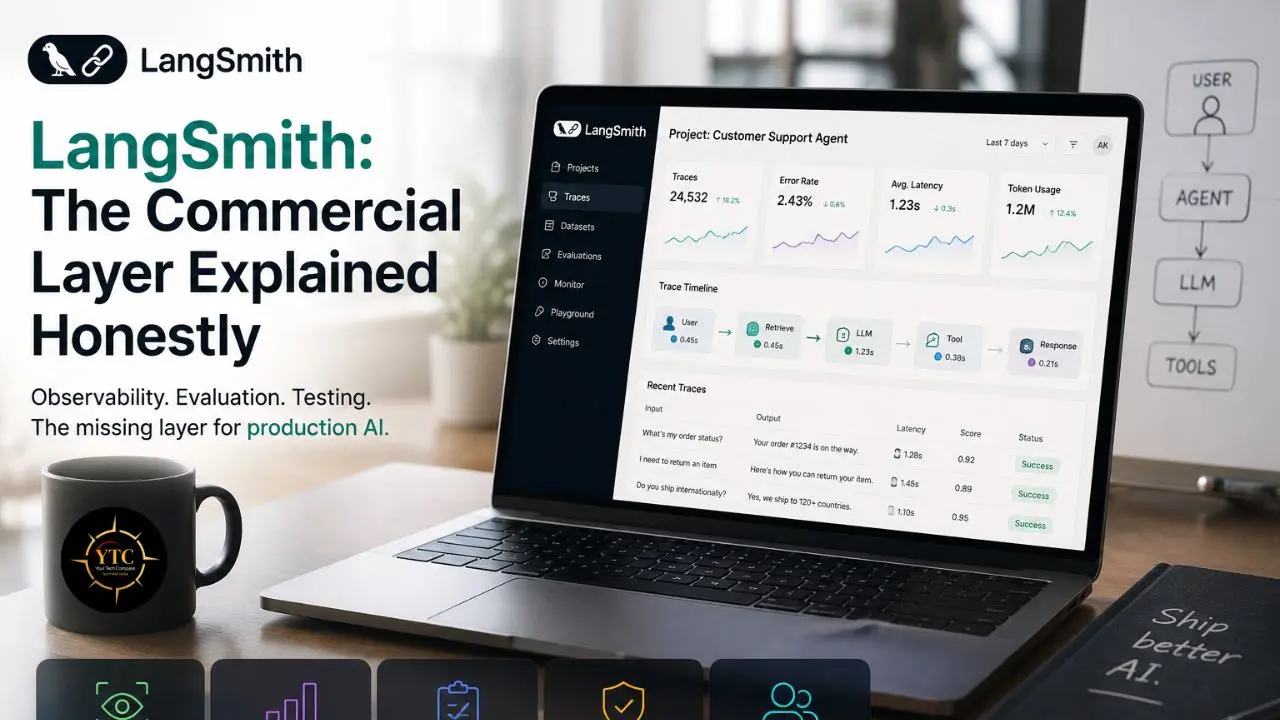
LangSmith is a managed platform for observability, tracing, evaluation, prompt management, and monitoring. LangChain includes the underlying callbacks and instrumentation hooks, but LangSmith packages them into a unified interface for inspecting end-to-end executions. A trace can group multiple model calls, tool invocations, retrieval steps, middleware runs, and intermediate outputs into a single debuggable record. LangSmith also versions prompts, allowing teams to compare changes and roll back to earlier commits, and runs evaluations against datasets to benchmark releases and detect regressions.
For teams running complex production agents, this visibility is often extremely valuable. Debugging a multi-step agent without tracing is like debugging a distributed system without logs: possible, but unnecessarily difficult once failures can occur across models, tools, retrieval systems, and state transitions.
LangSmith is not mandatory (teams can use structured logs, OpenTelemetry, self-hosted systems, or other observability platforms), but it provides an integrated way to inspect, evaluate, and monitor these workflows. Its usefulness is strongest when the cost of unexplained failures exceeds the cost of adopting another managed service.
The Limitations
LangSmith is an engineering and debugging platform, not a complete business-intelligence or finance system. It will not replace your billing database, accounting software, or revenue dashboard. However, it can estimate model costs per trace, model, thread, or tagged user when token counts, provider details, and pricing data are available.
You can use those figures to estimate the cost of an agent interaction, but revenue, infrastructure costs, customer-level margins, and complete unit economics still require your own billing and analytics pipeline. LangSmith shows you what your agent did, how much model usage it generated, and where a run failed; the broader business math remains your responsibility.
Another limitation is that LangSmith Cloud is a proprietary commercial service rather than an MIT-licensed observability product. LangChain does offer BYOC and fully self-hosted options for Enterprise customers, including deployments designed for data residency, private-network, and air-gapped requirements. If you need a self-hostable platform without an Enterprise LangSmith contract, consider alternatives such as Langfuse, Helicone, or Arize Phoenix, but be sure to check their licenses carefully. Langfuse remains MIT-licensed for its core open-source project after its January 2026 acquisition by ClickHouse; Helicone uses Apache 2.0, while Phoenix uses the Elastic License 2.0.
A Note on Pricing Verification
Exact LangSmith trace-pricing figures can vary across third-party sources and may change as LangChain updates its billing model. As of August 24, 2026, LangSmith’s official usage documentation lists a base-trace charge of $0.50 per 1,000 traces and an extended-retention cost of $5.00 per 1,000 traces. The public pricing page also lists free monthly allowances (5,000 base traces on Developer and 10,000 on Plus) followed by pay-as-you-go billing. Because LangSmith pricing includes seats, trace retention, LCUs, LSUs, deployments, and other usage-based charges, always verify the current figures directly on LangSmith’s official pricing page and in its billing documentation before finalizing a budget.
LangChain and LangSmith Pricing: The Complete 2026 Picture
The Free Stack
LangChain and LangGraph are MIT-licensed open-source libraries that can be used without a subscription. LangServe is also available without a LangSmith seat fee, but it uses a separate license and is a Python serving utility rather than an MIT-licensed npm package. These components can be self-hosted under their applicable licenses, but your total cost still includes compute, model API calls, databases, storage, networking, and operations. For a developer learning the framework or a startup prototyping an agent, the software layer can be genuinely free, even though a full deployment is not.
LangSmith Developer Tier
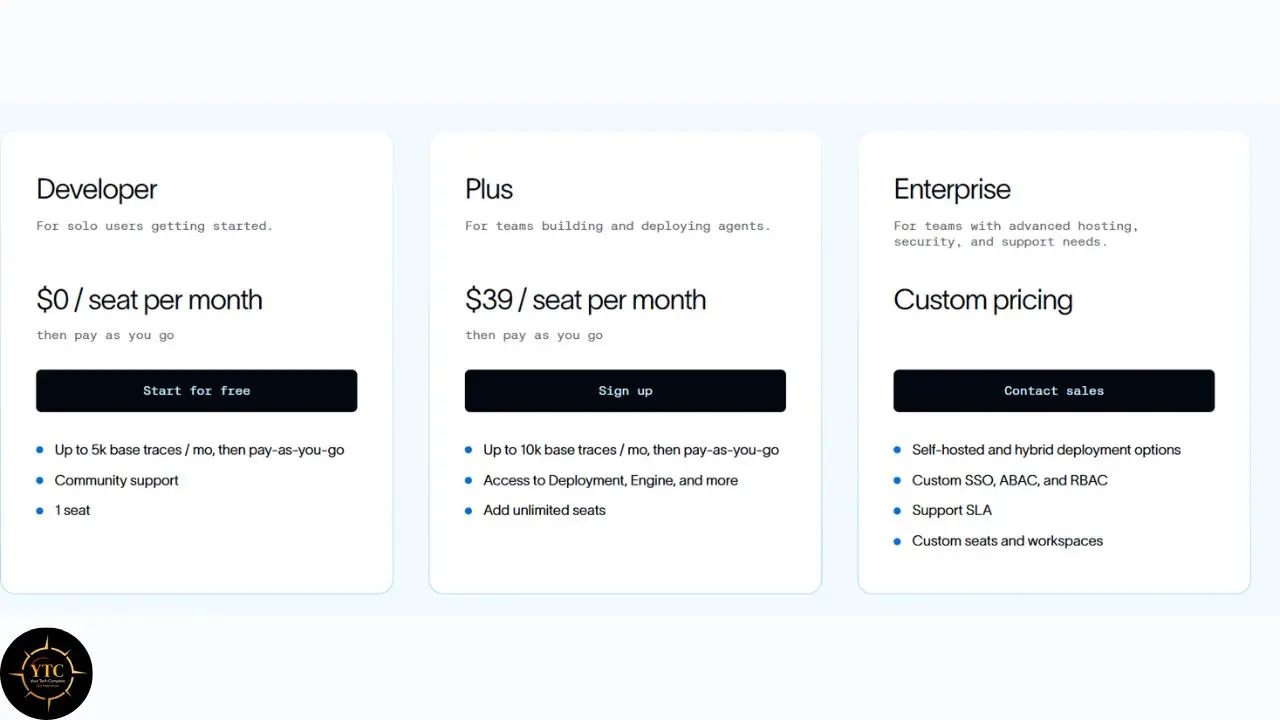
The Developer plan is free for one seat and includes 5,000 base traces per month with 14-day retention. That is generally enough for learning, prototyping, and low-volume debugging, but a busy production agent may exhaust the allowance quickly.
The 14-day period applies to base-trace retention; it does not mean every useful result disappears permanently, because important runs can be preserved in datasets or retained under an extended plan. Whether you can exceed the free allowance depends on your billing setup, so confirm the current account and overage rules before relying on it for production.
LangSmith Plus
The Plus plan costs $39 per seat per month and includes 10,000 base traces. According to the current usage documentation, additional base traces cost $0.50 per 1,000, while extended-retention traces cost $5.00 per 1,000. Base traces have a 14-day retention period, while extended traces have a 400-day retention period. Moving from the base rate to the extended rate represents a $4.50 difference per 1,000 traces under those documented rates, although LangSmith’s billing model can change and should be checked before budgeting.
The per-seat component scales linearly at the listed rate. A ten-person team therefore costs $390 per month before usage overages, taxes, negotiated terms, or other LangSmith services. If the team grows, the seat cost grows with it, even when some members mainly review dashboards rather than generate traces.
LangSmith Deployment
LangSmith Deployment (formerly associated with LangGraph Platform) is LangChain’s managed hosting and workflow-orchestration service for deploying LangGraph applications. Cloud deployments require a Plus plan or higher, and the current Plus price is $39 per seat per month. Deployment costs depend on the selected serverless or dedicated size, provisioned CPU and memory, replicas, storage, runtime, and related usage.
A more complex agent can still cost more overall because it may make additional model and tool calls, run for longer, generate more traces, and persist more state. But platform compute is not priced simply by counting graph steps. A 15-step looping agent and a two-step retrieval agent may incur similar infrastructure charges if they use the same deployment resources, even though the longer workflow will often produce higher model, tool, tracing, or execution costs.
💳 LangChain Stack Costs at a Glance

Component | Cost | What You Get | Best For |
LangChain framework | $0 | Open-source model, tool, agent, and retrieval components | LLM application development |
LangGraph framework | $0 | MIT-licensed stateful orchestration, persistence, and graph workflows | Durable and multi-agent workflows |
LangServe | $0 subscription | Python utility for exposing LangChain Runnables as HTTP APIs | Existing self-managed Python services |
LangSmith Developer | $0 | 1 seat, 5,000 base traces per month, 14-day retention | Learning, prototyping, and low-volume use |
LangSmith Plus | $39/seat/month | 10,000 base traces plus paid usage beyond included allowances | Team observability, evaluation, and deployment |
LangSmith Deployment | Plus plan or above | Managed deployment for LangGraph applications, with resource-based charges | Production agent hosting |
The Real Cost Math
The open-source framework has no subscription fee, but a production budget still includes model API calls, managed observability, deployment infrastructure, databases, vector stores, storage, networking, and engineering time. For a five-person team, LangSmith Plus contributes $195 per month at the listed $39-per-seat price. Managed LangSmith Deployment requires Plus or higher, but its hosting cost depends on provisioned resources, runtime, storage, replicas, and scaling behavior, rather than a simple, separate “Platform Plus” fee.
At higher volumes, trace costs can become significant. Ten Plus seats cost $390 per month before usage. With 500,000 monthly traces and 10,000 included base traces, the current documented base-trace rate produces approximately $245 in overage, for a total of about $635 before deployment, model, and other usage costs. Using extended retention for the 490,000 overage traces would produce approximately $2,840, including seats, subject to the account’s billing rules.
The instrumentation-granularity warning is real, but the exact effect depends on how traces are structured. One billable root trace per user session is cheaper than one billable root trace per conversation turn, and six turns could create six times as many billable traces if each turn is submitted separately. Child model and tool runs nested inside a parent trace are not automatically equivalent to six separate root traces, so teams should verify their own trace counts before estimating costs.
Compared with building an orchestration and observability layer in-house, LangChain’s free framework can reduce integration work, but managed monitoring still incurs recurring costs for seats, traces, retention, and deployments. A self-built or self-hosted observability system may avoid per-seat pricing, but it replaces that bill with infrastructure, maintenance, security, and engineering costs. The right comparison is therefore not “SaaS tax versus free software,” but managed convenience and predictable support versus greater control and ongoing operational responsibility.
The Honest Limitations

A recurring criticism in developer discussions is that LangChain’s abstraction layer can add indirection, making debugging take real time when something breaks. A failure may involve nested Runnables, middleware, callback handlers, provider integrations, or LCEL composition before reaching the underlying model or tool error. The framework reduces repetitive integration code, but the additional layers can make execution harder to follow, especially when an application combines retrieval, tools, retries, and agent loops.
Teams that skip LangSmith still have several debugging options, including structured application logs, local LangChain Studio, OpenTelemetry, provider dashboards, and competing observability platforms. LangSmith is particularly useful for collecting and inspecting end-to-end traces, but it is not mandatory and does not automatically identify the root cause of every failure. The broader lesson is that complex agent workflows need deliberate observability; the framework and the observability product are related, but LangSmith is not the only way to operate a LangChain application.
The learning curve is also a genuine adoption cost. LangChain’s ecosystem contains several API styles, including legacy chains, LCEL and Runnables, create_agent, middleware, and explicit LangGraph graphs. A developer joining in 2026 must determine which patterns are current, which belong to older releases, and which problem each layer is intended to solve. The 1.0 releases established a clearer direction and a semantic versioning policy, but they did not remove older APIs or outdated tutorials, so documentation versioning and migration guidance remain important.
LangChain vs. Building Without a Framework vs. Alternatives
Choosing between LangChain and its alternatives depends on what you are building and how much infrastructure you want to own.
⚡ LangChain vs. Custom-Built vs. LlamaIndex: Side-by-Side
Dimension | LangChain + optional LangSmith | Custom-Built | LlamaIndex |
Framework Cost | LangChain and LangGraph are free, MIT-licensed; LangSmith has free and paid tiers | No framework fee; engineering and infrastructure costs | Core libraries are free/open source; hosted services may cost extra |
Observability | LangSmith, OpenTelemetry, or other self-hosted and third-party tools | Build or integrate your own | Callbacks plus integrations such as Langfuse or Phoenix |
Agent Orchestration | LangGraph for stateful, durable, and complex workflows | Implement orchestration yourself | AgentWorkflow, orchestrator, and custom multi-agent patterns |
Primary Strength | Broad integrations, high-level agents, and LangGraph orchestration | Maximum control and minimal framework dependency | Data ingestion, indexing, retrieval, and data-centric agent workflows |
Best For | Multi-step production agents and broad LLM application stacks | Simple features or highly specialized systems | Retrieval-heavy and document-centric applications |
Key Trade-off | Less integration work, but more ecosystem complexity and optional SaaS cost | More control, but more code and operational responsibility | Strong data abstractions, but different APIs and deployment choices |
Where LangChain Genuinely Earns Its Adoption
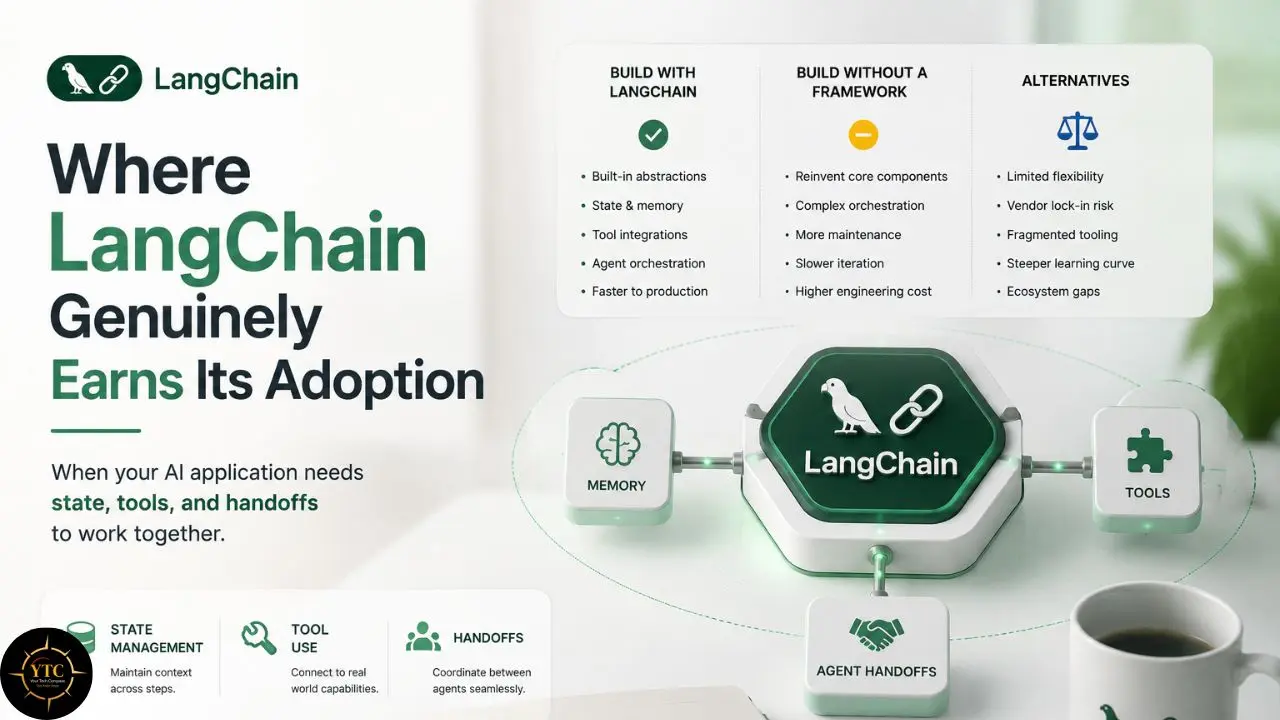
LangChain earns its place in scenarios where agent systems require state management, tool use, and handoffs. Klarna has reported that its AI assistant handles roughly two-thirds of customer-service chats and performs work equivalent to about 700 full-time agents; LangChain’s later customer story describes the assistant as powered by LangGraph and LangSmith. These are company-reported results, not independent proof that LangChain alone guarantees production readiness. Provider integrations also matter: you can prototype with GPT-5.5, evaluate Claude Opus 4.8, and test a local Llama model while preserving much of your orchestration logic. Model-specific testing, configuration, tool-calling behavior, and prompt changes may still be necessary.
For teams standardizing on one stack from prototype to production, LangChain can offer continuity that a collection of ad hoc integrations may not. Shared abstractions, provider integrations, testing patterns, and operational tooling become more valuable when several engineers need to maintain the same system. That advantage is not automatic (well-designed custom code can also provide continuity), but LangChain gives teams an established set of conventions to adopt.
Where It Doesn’t
A simple, single-purpose LLM feature (a chatbot that typically calls a single API and returns a single response) does not need a framework. In those cases, calling OpenAI’s SDK directly can be faster, lighter, and easier to debug. A framework may still be justified if the feature requires structured outputs, retries, provider switching, tools, or standardized tracing, but those needs should be demonstrated rather than assumed.
If your center of gravity is retrieval rather than orchestration, LlamaIndex may be the more natural fit. Its indexing, retriever, and data-ingestion primitives are designed around document-centric RAG workflows, while its AgentWorkflow also supports multi-agent patterns. As our AI inference cost optimization guide explores, retrieval can become a major performance and cost bottleneck, although model generation, tool calls, network latency, and database configuration can dominate in other workloads.
For Chinese-language models and regional AI infrastructure, our GLM-4.7 Zhipu AI review and Qwen 3 reviews cover model options that LangChain integrates with via standard provider interfaces.
Real-World Use Cases
Multi-agent customer-support systems can use LangGraph’s state management to route inquiries between specialized agents for billing, technical issues, and returns. Conditional edges can send cases to human reviewers when application-defined conditions, such as negative sentiment, uncertainty, or refund thresholds, are met. These policies are not automatic; the development team must implement and test the routing and escalation logic. Enterprise IT teams running managed service operations can use similar agentic patterns. Flamingo’s OpenFrame platform automates tier-1 ticket resolution using AI agents, reducing manual IT work in a way similar to how customer support agents handle inquiries.
AI product teams often need production-grade tracing before shipping complex agents to enterprise clients. LangSmith’s prompt versioning, evaluations, trace inspection, and audit log capabilities can provide useful evidence of application behavior and quality changes. Procurement teams may also require access controls, retention policies, security documentation, data residency, SSO, and compliance evidence, so prompt history alone is not a complete procurement audit trail.
Technical teams can prototype on the free Developer tier, collect initial traces, and evaluate agent behavior within its one-seat and 5,000-base-trace allowance. They may upgrade to Plus when they need additional seats, longer retention, managed deployment, governance, or higher usage, not only when production traffic increases. Cloud agent deployments require a Plus plan or above.
Fintech and compliance-heavy teams can use LangGraph checkpointing and human-in-the-loop interrupts to pause workflows before sensitive transactions execute. However, checkpointing alone does not guarantee authorization or prevent an agent from acting. The application must add permission checks, fail-closed behavior, explicit approval gates, idempotency, audit logging, and independent transaction controls before allowing the operation to proceed.
An Honest Note on the Review Landscape
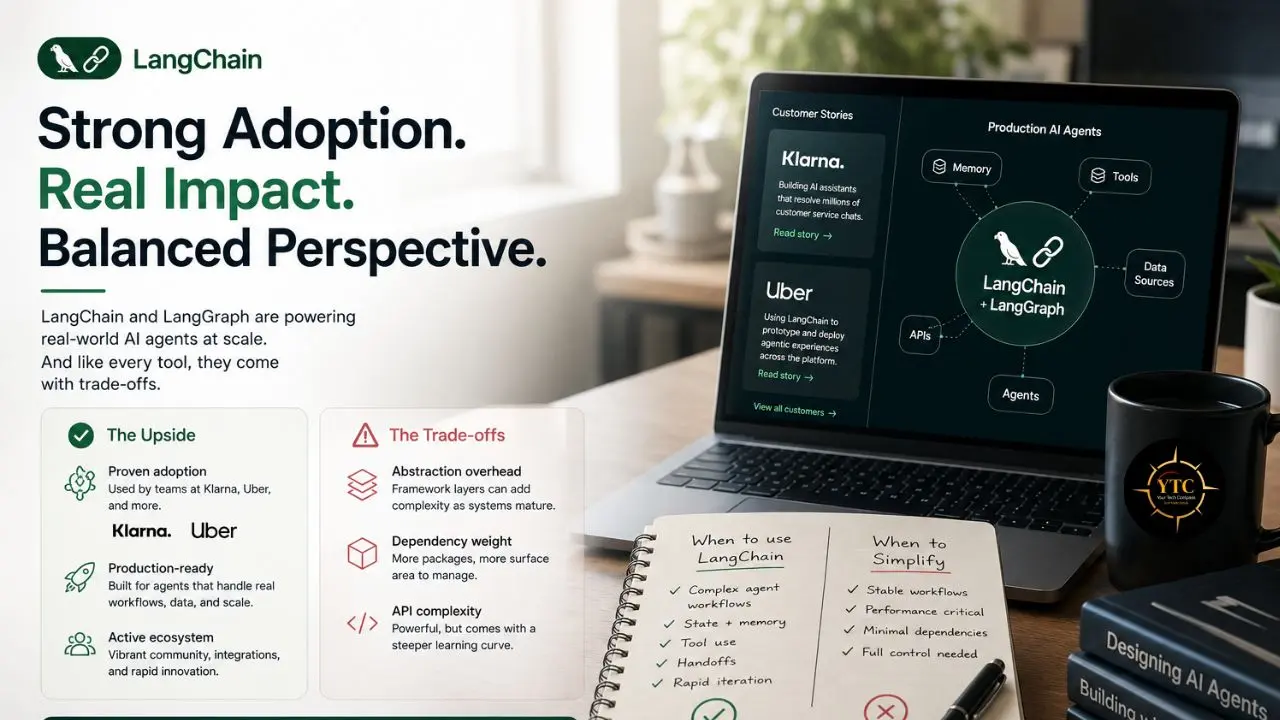
LangChain and LangGraph have strong adoption and credible production references, including customer stories involving Klarna and Uber. At the same time, some developers and production teams report that framework abstractions, dependency weight, or API complexity can become disadvantages as their systems stabilize. Both signals are worth taking seriously.
The ecosystem is mature enough to support demanding production deployments, but that does not make it the best fit for every application. A balanced conclusion is that LangChain and LangGraph are strong starting candidates for teams building stateful, multi-step, or multi-agent systems, while simpler features may be better served by direct SDKs, lighter abstractions, or custom code.
LangChain for African Developers: A Genuine Accessibility Story
LangChain and LangGraph are free, MIT-licensed, and self-hostable, making them unusually accessible to developers and startups in Africa. You can install the libraries on a laptop in Lagos, Nairobi, or Accra, prototype with a local model, and avoid subscription fees at the framework level. LangServe is separately licensed, and production deployments still require compute, storage, databases, networking, and operational maintenance.
The real costs begin when you use hosted LLM APIs or managed services. OpenAI, Anthropic, and other providers typically list prices in US dollars, while LangSmith Plus is priced at $39 per seat per month. At approximately August 24, 2026 exchange rates, that equals about ₦52,600 or KSh5,050 per seat, before usage charges. For a bootstrapped startup, that can be significant.
The important advantage is that teams can defer some managed-service costs. They can build on open-source frameworks, use local models or a regional cloud provider where practical, and start with basic logging or self-hosted observability. They should not defer all observability, however: even early systems benefit from error tracking, cost measurement, and structured traces. This gives African AI startups and fintech teams a path to reduce upfront licensing costs without pretending that production infrastructure is free.
The broader AI tooling landscape on the continent is something we track as part of our AI in Africa coverage. For teams looking at open-source productivity stacks more broadly, our best open-source productivity tools roundup covers complementary infrastructure that pairs well with LangChain’s free model.
Final Thoughts
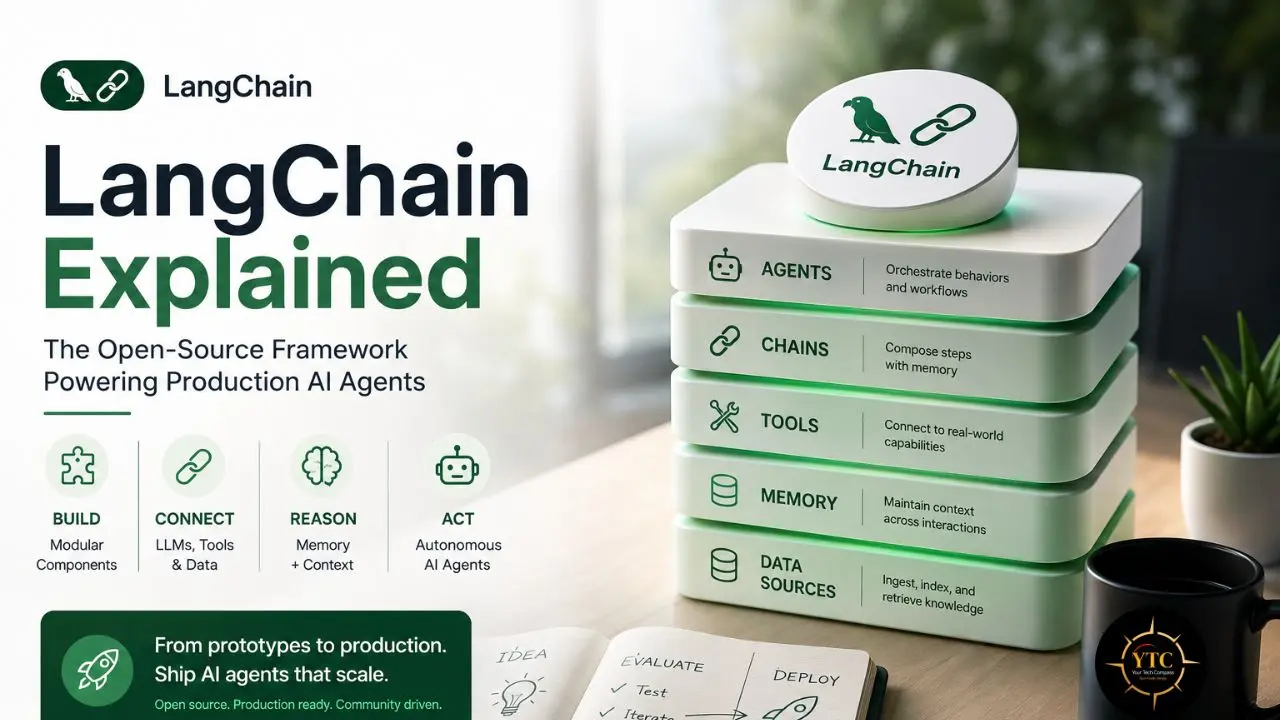
LangChain’s free open-source libraries and optional commercial services can be a worthwhile trade for teams building complex, stateful, or multi-agent production systems. LangChain and LangGraph can reduce repetitive integration work, while LangGraph provides one of the most mature open-source runtimes for durable agent workflows. Standardized model interfaces also reduce dependence on a single provider, although switching models still requires testing and may require application changes.
The framework is not a universal default. For simple, single-purpose LLM features, the abstraction overhead may outweigh the benefit, and calling a provider SDK directly is often the smarter choice. The ecosystem has a real learning curve; some developers find its abstractions frustrating to debug, and LangSmith’s per-seat and usage-based pricing can become significant relative to model costs in certain deployments. Evaluate those trade-offs rather than automatically adopting LangChain.
If this guide helped you separate LangChain’s genuine value from its marketing noise, head back to YourTechCompass.com before you commit to a stack, because the right framework at the wrong level of complexity is still the wrong framework.