A merchant in Cairo wakes up to 17 orders placed overnight. Each one is to be paid for via cash on delivery. She must reconcile which courier will pick up which package, track whether yesterday’s deliveries actually resulted in cash collection, figure out if she has enough working capital to restock her best-selling phone cases, and somehow predict which customers will actually be home when the driver arrives. This is not a failure of entrepreneurship. It is a failure of infrastructure and the daily reality for hundreds of thousands of Egyptian small and medium enterprises trying to sell online.
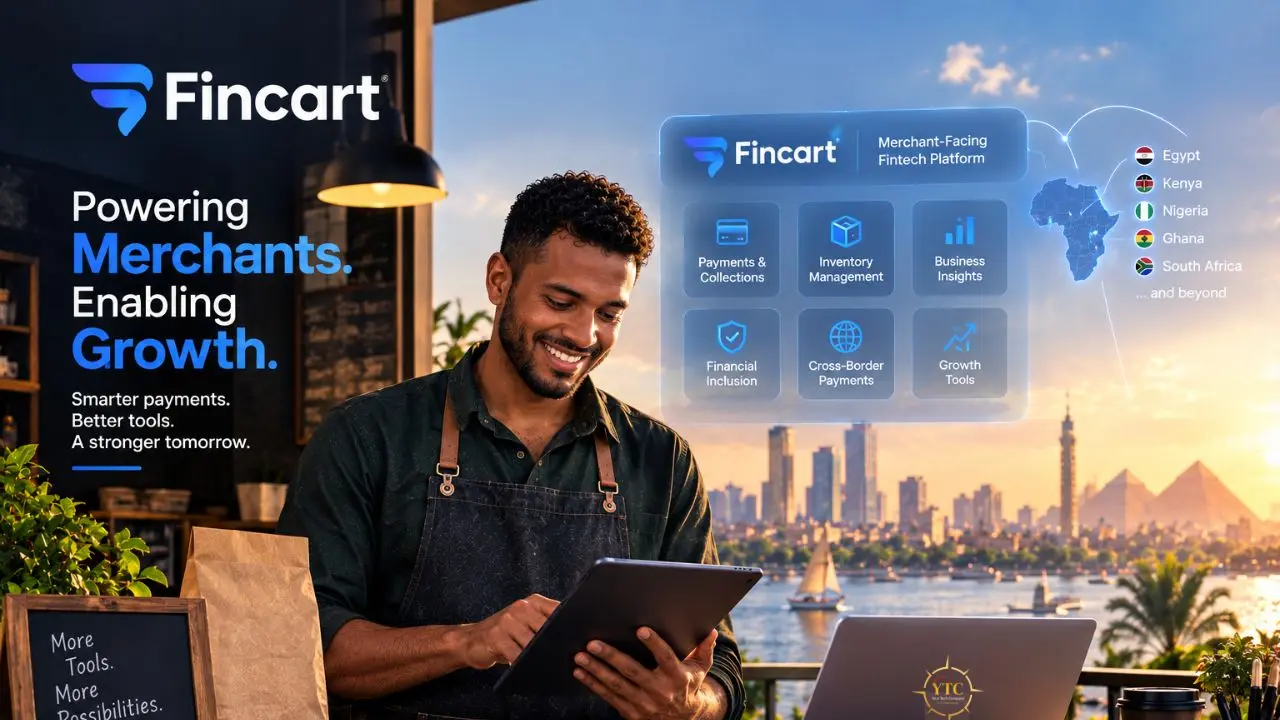
The consumer fintech revolution in Africa gave us mobile money, digital wallets, and instant payments. But the merchant on the other side of those transactions has been largely left to stitch together her own operational stack. That gap is now closing. Fincart, an AI-powered merchant operating system founded in 2023, recently raised a $2.8 million seed round to consolidate logistics orchestration, cash-on-delivery reconciliation, and embedded working capital into a single dashboard. This is not just a Cairo startup getting funded. It signals a broader continental shift from consumer-facing financial apps to merchant-facing infrastructure that addresses the B2B operational layer where most value actually leaks.
Why Egyptian E-Commerce Merchants Need an Operating System, Not Just a Payment Gateway
The Cash-on-Delivery Trap
Cash-on-delivery still dominates Egyptian e-commerce. In 2024, CoD held the largest share of the payment market at 45%, with 55–70% of online orders placed via the method. Even as digital wallets grow at a 15.18% compound annual growth rate, the combined share of cash-on-delivery and bank transfers still accounted for 34.37% of e-commerce payment value in 2025.
Most Egyptian e-commerce founders eventually discover that the hardest part of the business is not acquiring customers. It is getting the cash from the driver’s pocket into their bank account. CoD creates a reconciliation nightmare. A driver collects EGP 3,000 from six deliveries. Two customers refuse the package. One address was wrong. The merchant only finds out twelve hours later when the courier’s Excel sheet arrives via WhatsApp. Meanwhile, she has already committed inventory that she may not get paid for.
The operational cost runs deeper than frustration. Failed deliveries burn fuel, waste driver hours, and erode customer trust. In a market where prepaid digital orders still face trust gaps, every missed delivery is a potential permanent churn event.
Fragmented Logistics and the Courier Management Problem
Egyptian e-commerce logistics moved 220 million shipments in 2025, with average logistics revenue per parcel at $6.82. That volume sounds impressive until you realize most merchants manage five to ten different courier relationships manually. One courier works best for Alexandria. Another offers cheaper rates for bulky items. A third is the only one willing to deliver to Upper Egypt. The merchant toggles between WhatsApp groups, paper manifests, and conflicting tracking links.
There is no unified view of delivery performance, customer satisfaction, or return rates. The Egyptian merchant is essentially running a mini-logistics company on top of her retail business, and most were never trained for either. Delivery costs near $5 per package make low-ticket orders economically marginal. Without route density or address quality, even established couriers struggle to profit on individual e-commerce drops.
The Working Capital Crunch
The cash flow cycle for CoD merchants is brutal. A customer places an order on Monday. The package ships Tuesday. The driver collects cash on Wednesday. The courier reconciles on Thursday. The merchant sees the money in her account (if she is lucky) by Friday or the following week. That is a seven-to-ten-day gap between inventory commitment and cash realization.
Traditional banks require collateral, audited financials, and personal guarantees that informal merchants cannot provide. Egypt’s alternative lending market is projected to reach $2.41 billion in 2025, growing 15.4% year-on-year. But demand still far outstrips supply. The merchant who needs EGP 50,000 today to restock before a weekend sales spike has few formal options and often turns to informal lenders who charge predatory rates.
What Fincart Actually Built and How It Works
From Logistics Aggregator to Merchant Operating System

Mostafa Masry and Nihal Ali launched Fincart in 2023 as a logistics management platform. The original premise was straightforward: give Egyptian e-commerce merchants a single interface to manage multiple courier relationships. But the founders quickly discovered that shipping was just the entry wound. Merchants needed cash reconciliation, working capital, customer engagement tools, and inventory visibility. They were running separate apps for each function, leaving business data siloed and automation impossible.
The pivot was aggressive and deliberate. Fincart evolved from a shipping aggregator into a merchant operating system combining logistics management, embedded financing, and AI-powered customer engagement. In July 2026, the company announced an oversubscribed $2.8 million seed round co-led by Launch Africa and Antler MENAP, with participation from Yango Ventures, Five35 Ventures, Bluestream Capital, Hi2 Global, and Kalahari Venture Labs. This followed a pre-seed round in early 2025 led by Plus VC with Plug and Play and Orbit Startups.
The traction is unusually transparent for an early-stage Egyptian startup. Fincart has onboarded more than 450 merchants, including larger enterprise customers, and processed close to EGP 1 billion (roughly $20 million) in merchandise value through automated shipping and cash reconciliation workflows. Revenue comes from shipping fees and tiered software subscriptions running from EGP 1,584 to EGP 7,199 per month depending on feature access. Strikingly, 40% of new customers arrive through referrals with zero marketing spend. That metric matters more than any press release. It means the product solves a problem so painful that merchants tell each other about it.
The Product Stack: Shipping, Cash, and Capital
Fincart’s current platform integrates with more than 40 courier companies across Africa, providing merchants with a single interface for managing multiple couriers. A seller in Giza can compare rates, assign shipments, and track packages without leaving the dashboard. When deliveries are complete, the system automatically reconciles cash-on-delivery payments, flagging discrepancies between the amount the driver collected and the amount the merchant expected.
The embedded financing layer is where things get interesting. Merchants can access short-term working capital advances based on their sales history and delivery performance rather than traditional credit scores. The platform knows how much a merchant sells, how often deliveries succeed, and how quickly customers pay. That data becomes the underwriting model. For a cosmetics seller in Nasr City, this means she can restock before Ramadan without having to pledge her apartment as collateral.
Fincart’s product architecture reflects a fundamental insight that many global fintech platforms miss. Egyptian merchants do not need another payment method. They need visibility into the methods they already use. In our coverage of the African fintech ecosystem, we have mapped how the continent’s most successful financial tools meet users where they actually are, not where Silicon Valley assumes they should be. Fincart follows that same philosophy by building for CoD reconciliation rather than pretending digital wallets have already won.
The AI Layer Beneath the Surface
The AI functions are not chatbots or marketing gimmicks. They are operational predictions that directly affect merchant margins. Fincart uses machine learning to predict delivery success rates by customer, address, and time of day. If the model identifies that a specific customer in Shubra tends to refuse deliveries on Friday afternoons, the merchant can adjust her shipping schedule or require a confirmation call.
Automated workflow optimization decides which orders to batch, which courier to assign, and when to advance capital. The compounding data advantage is real. Every delivery improves the recommendation engine for the next merchant on the platform. In our AI in Africa coverage, we have examined how artificial intelligence is moving from theoretical promise to practical infrastructure across the continent. Fincart represents one of the most grounded applications: using predictive models not to replace human judgment but to remove the administrative drudgery that kills small businesses.
The Egyptian Fintech Ecosystem: Context and Competition
Market Size and Regulatory Environment
Egypt’s fintech market was valued at approximately $886 million in 2025 and is projected to reach $2.3 billion by 2032, growing at a compound annual growth rate of 14.6%. The ecosystem has expanded to 177 startups and payment service providers across more than fourteen subsectors, with 60% concentrated in lending, payments, and B2B marketplaces. Financial inclusion reached 77.6% in 2025, representing 54.7 million active transactional accounts.
The regulatory environment is tightening in productive ways. The Financial Regulatory Authority recorded default rates below 3% for regulated finance activities in 2025, demonstrating that digital credit can be underwritten responsibly at scale. Factoring activity grew 77.3% in the same period, signaling strong demand for working-capital solutions.
Egypt ranks among the top five African fintech markets by revenue, broadly alongside Nigeria, the UAE, South Africa, and Kenya. The market is large enough to support specialization and competitive enough to demand it.
Fawry and the Incumbent Shadow

No discussion of Egyptian merchant fintech can ignore Fawry. The company dominates with 35 million users, 166,000 service points, and over 370,000 POS terminals. Its myFawry app crossed 15.9 million downloads by September 2024. Fawry’s buy-now-pay-later portfolio reached EGP 2.45 billion by Q3 2024, and its ‘BNPL for Business’ product onboarded 120,000 small merchants while processing EGP 10 billion.
Fawry proved that Egyptian merchants will adopt digital financial tools at scale. But Fawry is a generalist. Its infrastructure serves everyone from utility bill payers to grocery stores. Fincart’s opportunity lies in serving the e-commerce-specific workflows that Fawry’s broad network cannot address. A merchant shipping forty packages a day needs courier reconciliation, not bill payment. She needs delivery-specific working capital, not generic BNPL.
Capiter and the B2B Marketplace Model
Capiter raised $33 million in a 2021 Series A co-led by Quona Capital to build a B2B marketplace connecting FMCG suppliers, wholesalers, and merchants. The platform served over 50,000 merchants, supported 6,000 SKUs, and embedded working capital through bank partnerships. Capiter’s model targeted traditional retail (mom-and-pop stores, cafes, and hotels) rather than e-commerce sellers.
The distinction matters. Capiter solved inventory procurement for physical retailers. Fincart solves order fulfillment for digital merchants. Both use embedded finance, but their workflows, risk profiles, and customer behaviors are entirely different. Capiter is now listed as inactive on multiple startup databases, suggesting that the B2B marketplace model in Egypt faced challenges that verticalized operating systems may avoid.
How Fincart, Fawry, and Capiter Compare
Company | Target Merchant | Core Model | Financing Mechanism | Current Status |
Fincart | E-commerce sellers | Merchant OS: logistics + CoD reconciliation + embedded capital | AI-driven advances based on sales and delivery history | Active; 450+ merchants; $2.8M seed (July 2026) |
Fawry | General merchants & consumers | Payments super-app + BNPL + POS network | BNPL for business via Contact partnership | Active; 35M+ users; 370K+ POSs |
Capiter | Traditional retail (FMCG) | B2B marketplace + inventory procurement + bank credit | Working capital via local bank partnerships | Inactive as of 2025 |
The Merchant-Facing Fintech Wave Across Africa
Why B2B Fintech Is the Next Frontier
Consumer fintech in Africa got the headlines. Merchant fintech gets the margins. The merchant is stickier, transaction values are higher, and underwriting data is richer. The Middle East and Africa payments market was valued at about $0.75 trillion in 2025 and is on track for $1.8 trillion by 2031, with B2B flows among the fastest-growing segments. That is not a niche. It is the primary economic fabric of the continent.
In our coverage of African fintech startups to watch in 2026, we have tracked a shift in investor attention from digital wallets and remittance apps to platforms that streamline operational workflows for businesses. The logic is simple. A consumer might switch between three mobile money apps in a month. A merchant who has integrated her shipping, reconciliation, and capital into a single platform will not switch unless you offer something ten times better.
Embedded Finance as the Operating Model
Embedded finance means integrating lending, insurance, and payments into non-financial workflows. Fincart’s version embeds capital inside the shipping workflow. A merchant sees her daily reconciliation, notices a cash gap, and accesses an advance without leaving the same screen. The financing is contextually aware. The platform knows exactly how much she can afford to borrow because it knows her real-time sales velocity.
This model is spreading. In Nigeria, digital lending platforms have demonstrated how alternative data can replace collateral for SME credit. In Kenya, Moniepoint’s expansion demonstrates how merchant-acquiring fintechs can layer additional services on top of payment acceptance. The pattern is consistent across the continent. Financial services are most valuable when they disappear into the operational tools merchants already use.
Regional Expansion and the Cross-Border Challenge
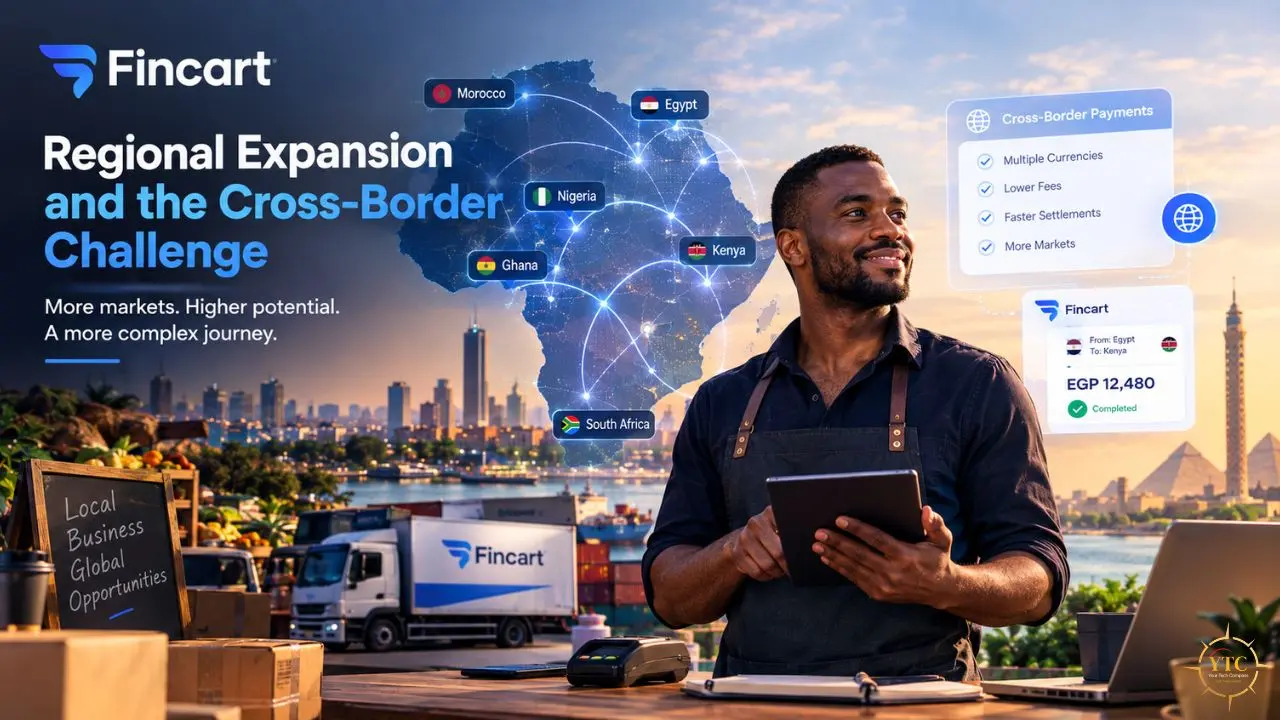
Fincart has announced plans to expand beyond Egypt starting in 2027, targeting the Middle East and Africa. The ambition is logical. Egypt’s e‑commerce market is already in the low double‑digit billions and is projected to exceed $14–15B by the end of the decade, while the broader MENA e‑commerce market is expected to reach roughly $75–85B by 2028.
But there is a catch. Every market has its own courier ecosystem, regulatory requirements, and CoD penetration rates. What works in Cairo may fail in Casablanca if the address infrastructure, consumer payment behavior, or courier reliability differs. In our cross‑border payments analysis for Africa, we examined how regulatory fragmentation creates friction for fintech expansion. Merchant‑facing platforms face the same challenge, multiplied by local logistics complexity.
What This Means for Egyptian SMEs and the Broader Economy
Operational Efficiency as Competitive Advantage
A unified logistics and reconciliation dashboard does more than save time. It reduces the cognitive load that prevents small merchants from scaling. For a Cairo cosmetics seller running her business from a spare bedroom, Fincart is not a fintech app. It is the difference between processing 50 orders a day and being stuck at 15 because she cannot manage the operational overhead.
The psychological impact is underrated. When a merchant no longer spends two hours every morning reconciling WhatsApp messages from five different couriers, she can focus on merchandising, customer relationships, and growth. Operational clarity creates strategic bandwidth.
Democratizing Access to Working Capital
Traditional SME lending in Egypt requires collateral, audited financials, and personal guarantees. Fincart’s alternative underwriting uses delivery history, GMV trends, and customer behavior data. This is not merely a faster loan application. It is an entirely different risk model that expands the addressable market of creditworthy businesses.amgeca+2
Egypt had around 3.6 million microfinance and small‑project beneficiaries in 2025, but the vast majority still lack access to formal working capital. Platforms like Fincart do not just lend money. By recording and structuring merchants’ operational data, they help build digital credit profiles for merchants with thin or nonexistent traditional credit histories. In our mobile money evolution Africa coverage, we traced how M‑Pesa transformed financial inclusion by generating transaction data that became credit data. Fincart is applying the same principle to e‑commerce logistics.
The Data Flywheel
Every transaction on Fincart’s platform feeds three systems: a courier recommendation engine, a delivery success prediction model, and a credit scoring layer. This flywheel effect is particularly powerful in Egypt because baseline address and mapping data quality is so low. When a rider successfully delivers to an unmapped or informally described address, say, in 6th of October City, the system captures coordinates, timing, and verification patterns. Over months, these points form a navigable layer.
The compounding advantage favors scale. Larger networks train better models. A merchant who joins Fincart today benefits from delivery and risk data generated by the 450+ merchants already on the platform. This is one of Fincart’s biggest strengths and also the barrier that makes late entry difficult for competitors.
The Hard Problems Merchant-Facing Fintech Hasn’t Solved
The Cash-on-Delivery Dependency
You can optimize CoD reconciliation all day long, but until Egyptian consumers trust digital payments enough to prepay, the last mile will always involve a man with a bag of cash. Bank account penetration is roughly 35% among adults (2024 Global Findex), and credit card ownership is around 6–7%, even though broader financial inclusion (counting wallets, postal accounts, and prepaid cards) stands at 77.6–79%. That figure includes basic transactional accounts, not the credit instruments and digital trust that enable prepaid e‑commerce.
No fintech platform can fully eliminate the security risk of drivers carrying EGP 15,000–40,000 in cash daily. CoD also delays merchant settlement cycles, compressing margins and limiting inventory turnover. The technology solves the tracking problem. It does not, by itself, solve the trust problem.
Courier Quality and Reliability

Fincart integrates forty-plus couriers, but it does not control their service quality. A driver in Alexandria might be meticulous. A driver in Aswan might be careless. Vehicle breakdowns, address ambiguity, and customer unavailability still hurt a merchant’s reputation, even when the platform optimizes everything else.
The gap between algorithmic optimization and field execution remains the hardest part of African logistics. In our broader African tech coverage, we have consistently found that the best technology cannot compensate for unreliable physical infrastructure. Merchant-facing fintech is no exception.
Regulatory Complexity for Cross-Border Expansion
Each African market has distinct central bank regulations, KYC requirements, and lending license frameworks. Egypt’s Financial Regulatory Authority maintained strict creditworthiness requirements in 2025 even as digital lending expanded. A platform that underwrites merchants based on delivery data in Cairo may find that regulators in Nairobi or Lagos require traditional documentation for the same advances.
Data sovereignty adds another layer. Where can Egyptian merchant data be stored? Can a Cairo-based algorithm underwrite a merchant in Riyadh? These questions do not yet have clear answers, and they will determine whether Fincart’s 2027 expansion is a natural growth phase or a regulatory labyrinth.
FAQs
A payment gateway processes transactions. A merchant operating system manages the entire workflow around those transactions: shipping, inventory, cash reconciliation, customer engagement, and working capital. For Egyptian e-commerce sellers, the difference is the difference between having a checkout button and having a business that can scale.
Fincart integrates with over forty courier companies and automatically matches delivery outcomes against expected cash collections. When a driver completes a drop, the system updates the merchant’s dashboard in real time, flagging discrepancies, failed deliveries, and return reasons. This eliminates the manual WhatsApp-and-Excel reconciliation that most Egyptian merchants currently endure.
Egypt has 177 fintech startups, 77.6% financial inclusion, and an $886 million fintech market projected to grow at 14.6% annually through 2032. Most importantly, the merchant infrastructure layer is underdeveloped. The opportunity is not just the market size. It is market whitespace. For context on how this compares regionally, see our analysis of African fintech vs. global giants.
Fincart’s AI models analyze historical delivery data to predict success rates by address, customer, and time slot. This reduces failed deliveries and improves courier selection. For working capital, the same data (sales velocity, delivery reliability, and customer payment patterns) replace traditional collateral-based underwriting with real-time behavioral credit scoring.
The primary constraints are cash dependency, variance in courier quality, and regulatory fragmentation. CoD remains dominant because consumer trust in digital payments is still building. No platform can fully control third-party courier behavior. And every country requires different lending licenses, KYC frameworks, and data localization policies. Our mobile money Africa guide explains how gaps in payment infrastructure shape fintech adoption across the continent.
Charting the Merchant Fintech Frontier

Fincart is not merely a logistics aggregator or a lending app. It is an operating system built for the specific reality of Egyptian e‑commerce: cash‑heavy, logistics‑fragmented, and chronically underbanked at the SME level despite high headline financial inclusion. The $2.8 million seed round signals growing investor conviction that merchant‑facing fintech is the next high‑growth layer of African digital finance. But the broader story is about infrastructure. The merchants powering Egypt’s e‑commerce market need tools that reflect how they actually work, not how Silicon Valley assumes they should.
For Egyptian SME owners, the practical implication is clear. Operational efficiency is now a competitive advantage that technology can deliver without enterprise budgets. For investors and founders, the opportunity lies in verticalized B2B infrastructure: solving specific workflows for specific merchant categories rather than building horizontal financial apps that try to be everything to everyone. For policymakers, the priority should be enabling data‑driven underwriting and interoperable payment rails that let merchant‑facing platforms scale without falling into the regulatory gaps that have slowed consumer fintech in the past. The consumer fintech wave built awareness. The merchant fintech wave will build the economy.
Let Your Tech Compass guide you through the infrastructure layers powering Africa’s digital commerce. Set your course at YourTechCompass.com.