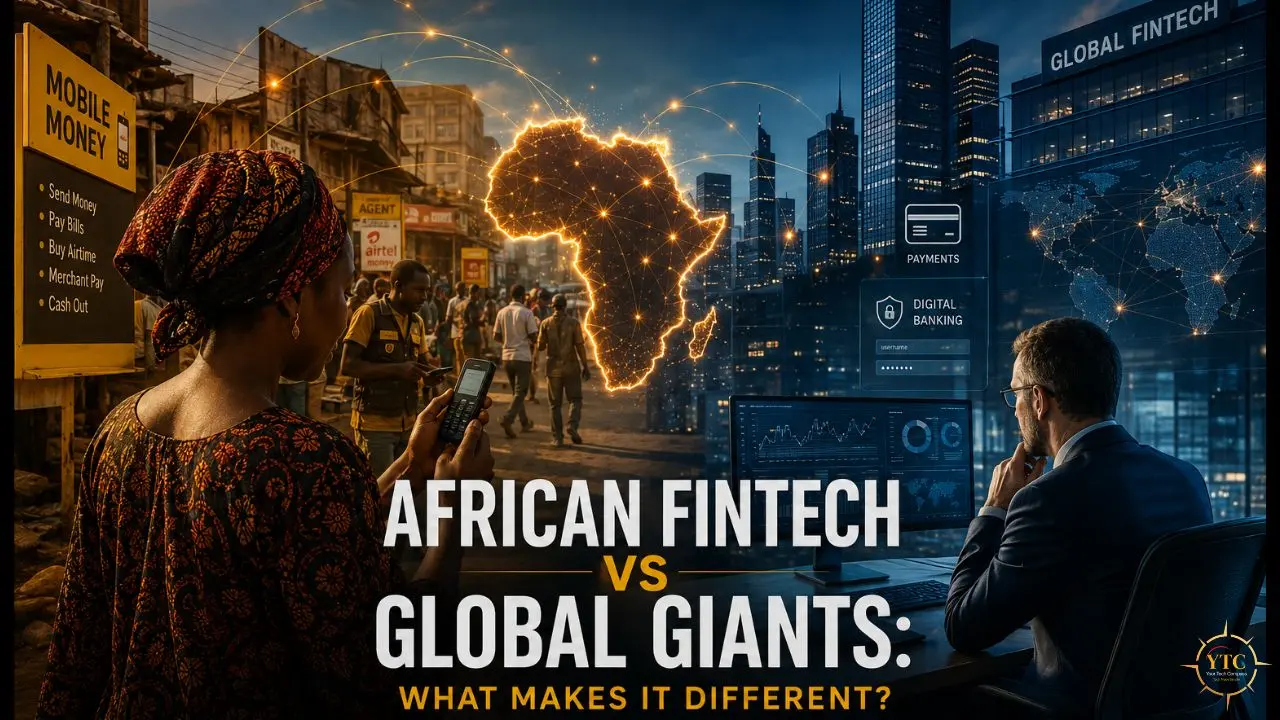
When Silicon Valley investors or European fintech operators enter African markets, they frequently apply what I’d call a “scaling down” mental model: the assumption that African fintech is essentially global fintech minus infrastructure, and that the solution is to build the same products with greater mobile-friendliness and lower price points. That mental model is responsible for more failed market entries, misallocated capital, and products that didn’t work than any other single mistake in the sector. The companies that have genuinely succeeded in African fintech (M-Pesa, Flutterwave, OPay, Wave, GoTyme Bank, Moniepoint) didn’t succeed by scaling down a Silicon Valley playbook. They succeeded by building on fundamentally different assumptions about who their users are, what infrastructure exists, what financial problems actually need to be solved, and how trust in financial systems is established when the starting point is millions of people who have never held a bank account.
Africa now accounts for roughly 74% of global mobile money transaction volume, reflecting both innovation and structural necessity. A 2026 BCG report estimates that Africa’s fintech revenues could rise from roughly $10 billion to more than $65 billion by 2030, representing a more-than-sixfold increase. As Zekarias Amsalu, Managing Director of the Africa Fintech Summit, observed in 2026, African fintech is moving from “going global” to “becoming the globe itself,” powered by African founders, capital, talent, and infrastructure. These aren’t projections built on hope. They’re projections built on structural differences that the scaling-down mental model completely misses. This article unpacks those structural differences across six specific dimensions: the starting point, the user, the infrastructure, the business model, the regulatory context, and the areas where Africa has genuinely innovated first, with data, specific examples, and the practical implications that matter whether you’re a founder, an investor, or an operator trying to understand this market on its own terms.
1. Leapfrogging vs Layering: Where It All Started
The most important structural difference between African fintech and global fintech isn’t a feature or a business model choice. It’s the condition into which each category was born.
Global Fintech Built on Top of What Already Existed
Global fintech, whether you’re looking at the US, the UK, the European Union, or developed Asian markets, has emerged as a layer on top of existing, mature financial infrastructure. By the time Stripe, Revolut, Robinhood, Chime, or Affirm came along, the underlying architecture was already in place:
- Credit card networks (Visa and Mastercard) were ubiquitous and accepted almost everywhere
- Bank account penetration was above 80% in most developed markets
- ATM networks, physical bank branches, direct debit systems, and credit bureaus were mature
- The regulatory frameworks governing financial services were established and well-documented
In that context, the opportunity for fintech innovation was specific and bounded: make the existing system faster, cheaper, better UX, or more digitally native. Stripe made it easier for developers to integrate payments. Revolut, on the other hand, made FX cheaper for travelers.
Chime made banking less punitive for people with low balances. Robinhood made equity trading cheaper for retail investors. Every one of these companies assumed an underlying bank account, card network, or regulatory framework that they could sit atop rather than build themselves.
African Fintech Built the Infrastructure Itself

African fintech arrived in a categorically different context. When M-Pesa launched in Kenya in 2007, formal bank account penetration in Sub-Saharan Africa was approximately 20–25%.
Card networks had limited reach outside urban formal employment settings. Overall account ownership in Sub-Saharan Africa was 49% in 2017 and rose to 58% by 2024, while mobile money account ownership climbed to 40%.
The infrastructure that global fintech could assume simply didn’t exist. Rural and peri-urban populations (the majority in most African markets) managed their financial lives entirely through cash, rotating savings groups (chamas, susu, njangi, ajo), and informal credit networks based on relationship and reputation rather than credit scores or documented income.
In that context, the fintech innovation opportunity wasn’t “to improve the existing financial system.” It was “build a financial system where the existing one doesn’t reach.” That’s a fundamentally different problem with fundamentally different product requirements.
Leapfrogging Has a Specific, Precise Meaning Here
“Leapfrogging” is a term that gets used loosely. In African fintech, “mobile money” has a specific architectural meaning: it didn’t improve the banking experience; it created a financial identity and a transaction rail for people who had never had either. The “leap” was from physical cash directly to mobile digital payment, bypassing the bank account and card network layer entirely.
M-Pesa’s architectural innovation wasn’t making banking cheaper. It was building a financial system that worked without a bank, using SIM cards, SMS/USSD text menus, and a distributed network of local agents as the rails.
That’s not a better mousetrap. It’s a completely different approach to the same problem.
The Product Architecture Consequence
Products built on top of incumbents optimize for switching costs, integration, and UX improvement. Products that are the incumbent layer must solve trust, reach, financial literacy, connectivity, and device constraints simultaneously — a more comprehensive, harder product problem.
The result is a tendency toward vertical integration that defines the most successful companies in African fintech in ways with no direct global equivalent. M-Pesa is simultaneously a telco, a payment rail, an agent network, a savings product, and a lending platform.
OPay began in logistics and embedded payments into that context. Moniepoint handles merchant acquiring, SME banking, and credit scoring within a single product architecture. This isn’t strategic empire-building; it’s a rational response to the absence of an underlying layer you can rely on.
2. The User: Who Is Actually Being Served
Understanding who African fintech is serving and why they need specific things is the second structural difference that the scaling-down mental model misses most catastrophically.
The Global Fintech User Profile

Global fintech’s primary innovation was serving the banked-but-underserved; people who had bank accounts but were being poorly treated by existing financial institutions:
- Chime targeted people with bank accounts who were paying $30 overdraft fees
- Revolut targeted people with bank accounts paying high FX fees on travel
- Affirm and Klarna targeted people with credit access who preferred installment structures
- Robinhood targeted retail investors who had brokerage access but faced high commissions
Notice what all of these user profiles have in common: they start with formal financial inclusion. The innovation is about reducing cost or friction within a system the user already participates in.
The African Fintech User Profile
African fintech’s primary innovation was serving the unbanked and informally banked; people whose financial lives were real and complex but conducted entirely outside the formal financial system. The target user often has no credit history, no formal bank account, no payslip, no utility bill in their name, and no relationship with any bank.
And yet their financial life is genuinely sophisticated. Understanding this requires understanding informal finance, which has centuries of structural development across the continent:
- Rotating Savings Groups: Chamas in Kenya, susu in Ghana and West Africa, njangi in Cameroon, ajo and esusu in Nigeria are structured, trust-based financial instruments with sophisticated governance, regular contribution schedules, and rotating lump-sum distributions. They represent a form of financial engineering built before formal banking reached these communities.
- Informal Credit: Shopkeeper credit extended to regular customers, supplier credit in agricultural supply chains, community lending based on personal reputation; operates through social trust mechanisms with no formal documentation.
For many users, their first interaction with a formal financial system was a mobile money account, not a bank account. That’s not a gap in their sophistication. It’s a history of exclusion from formal finance, which creates specific trust dynamics that global fintech doesn’t have to address.
The Income Volatility Design Constraint
Most global fintech products assume relatively predictable income: a salary, consistent self-employment revenue, regular investment activity. African mass-market users frequently have highly variable, irregular incomes: day traders at urban markets, subsistence farmers with seasonal cash flows, gig workers on informal platforms, and petty traders whose daily revenue swings with foot traffic and weather.
That income variability isn’t an edge case to design around. It’s the median user condition.
African fintech products that work are built on the assumption of income variability: savings products must be flexible rather than penalty-based, credit products must account for irregular repayment capacity, and insurance premium payments must flex with the user’s cash position. The products that fail in African markets often fail precisely because they impose global fintech’s assumption of income regularity on users for whom it’s categorically false.
The USSD Interface Dimension

Smartphone penetration varies dramatically across African markets and income brackets. USSD (the text-menu interface that works on any mobile phone with any network connection, requiring no internet and no data) remains a primary channel for mass-market financial services in many African markets.
Engineering a product for USSD is a fundamentally different design challenge from engineering for a mobile app or web browser. It’s a constraint that shaped M-Pesa’s architecture, continues to shape the products of any company serious about reaching beyond urban, smartphone-holding demographics, and has no meaningful parallel in global fintech product development.
3. The Infrastructure: Building What Doesn’t Exist
Global fintech companies routinely describe themselves as “technology companies” to distinguish themselves from traditional financial institutions. In African fintech, the distinction is less clear because companies have frequently had to build not just the technology but also the physical, institutional, and data infrastructure that underlies it.
Agent Networks as Distributed Banking Infrastructure
The single most important infrastructure investment that African fintech requires, and that has no global fintech equivalent, is the agent network. Banking the unbanked requires reaching people where they are, not where banks are. M-Pesa’s agent network in Kenya alone exceeds 500,000 agents, each serving as a cash-in/cash-out point, making the digital system usable for people who still primarily transact in physical currency.
Building and managing an agent network is not a technology problem. It’s a problem of logistics, trust, training, fraud prevention, liquidity management, and relationship management.
No European neobank, American challenger bank, or Asian super-app has had to build an equivalent distribution infrastructure to serve its core market. The agent network cost structure (commissions paid per transaction to hundreds of thousands of agents) creates margin pressure that pure-digital global fintechs simply don’t face.
Alternative Credit Scoring Infrastructure
Without credit bureau coverage (thin or absent in many African markets), lending requires building the scoring infrastructure from scratch using alternative data. Companies like Moniepoint, Carbon, FairMoney, Branch, and Tala have built proprietary scoring systems from:
- Mobile money transaction history and velocity
- Airtime purchase patterns and recharge frequency
- Social graph and behavioral data
- E-commerce transaction history
- Utility payment records where available
This isn’t just a clever use of data. It’s the construction of credit infrastructure that the formal market didn’t provide.
The companies that built these scoring systems effectively built the data layer that formal lenders now want to access. That’s infrastructure creation, not infrastructure optimization; a categorically different business activity from what most global fintech companies have had to do.
Our digital lending in Nigeria guide examines how this alternative credit infrastructure has been built and deployed specifically in Africa’s largest lending market.
Regulatory Infrastructure Creation

In many African markets, the regulatory category for digital financial services didn’t exist when mobile money launched. M-Pesa operated for years under a Central Bank of Kenya “Letter of No Objection” before formal mobile money regulation existed. The product scaled, demonstrated its effects, and then regulation followed, a “build first, regulate later” dynamic that most global fintechs operating in established regulatory environments simply haven’t experienced.
The positive consequence: first movers built distribution before regulation created entry barriers, enabling a scale that regulation later protected. The negative consequence: regulatory uncertainty was a persistent cost and an existential risk that capital had to price in across multi-year-horizon investments.
4. The Business Model: Revenue Without the Same Assumptions
Once you understand the differences in infrastructure and user context, the differences in business models follow directly.
Global Fintech Revenue Mechanics
Revenue Model | Global Example | Structural Assumption |
Card Interchange Fees | Card-based transactions at scale | |
Net Interest Margin | Deposit base + lending spread | |
Subscription Fees | High willingness to pay for premium features | |
AUM-Based Fees | Investable assets above minimum threshold | |
Premium Upsell on Free Base | Most neobanks | Established banking behavior to improve |
How African Fintech Actually Makes Money
Transaction Fee Economics from Non-Card Rails
Card interchange revenue is structurally lower or absent in many African markets. Instead, mobile money transfer fees, USSD service charges, and merchant discount rates on mobile payment acceptance form the transaction revenue base. The economics are high-volume, lower-margin per unit, which works at the scale African mobile money has achieved (74% of global mobile money volume) but looks different on a per-transaction basis than global fintech models assume.
The Payments-to-Credit Pipeline
African fintechs are building proprietary payment systems rather than relying on legacy banking rails. Many African fintech companies build payment products specifically to generate the transaction data required to offer credit.
The payment product is the data acquisition engine, and credit is the margin product. This pipeline is more explicit and central in African fintech than in most global equivalents, where credit and payments are often treated as separate strategic tracks.
SME Banking as Primary Market, Not Extension
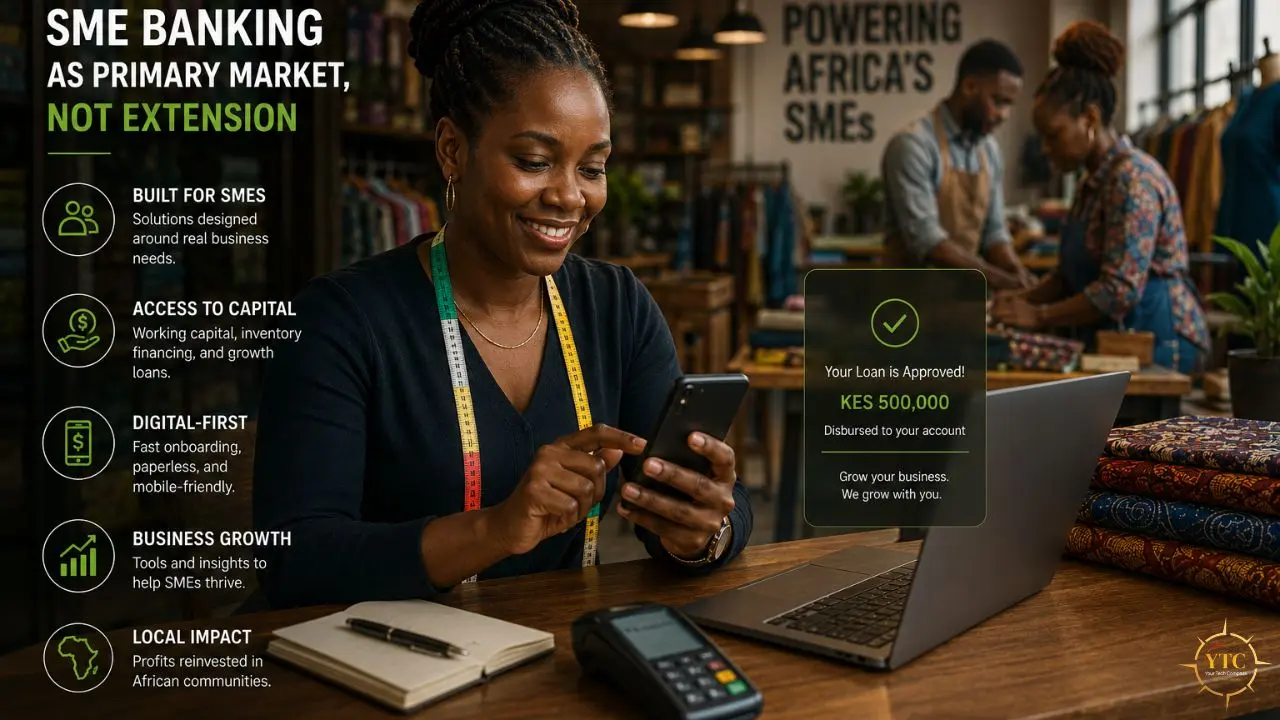
Global fintech followed a consumer-first growth path, adding SME and enterprise products later. African fintech frequently reverses this sequence.
SMEs in African markets have better credit repayment capacity and more well-documented cash flows than unbanked consumers, yet they are dramatically underserved by formal banks; the credit gap translates directly into lending opportunities with better risk characteristics. Moniepoint, Flutterwave Business, and Chipper Cash Business all reflect a commercial logic that treats SME banking as a primary market rather than a subsequent segment.
Embedded Finance Before It Had a Name
African fintech has firmly positioned itself as the structural backbone of the continent’s digital economy. The embedding of financial services within non-financial contexts (M-Pesa within Safaricom’s telco service, OPay within logistics, agricultural fintech within farming supply chains) was not a strategic choice inspired by global fintech trend reports.
It was an adaptive distribution strategy that African fintech adopted out of necessity. And it’s the same model that global fintech is now recognizing as a primary growth vector. Interoperability and embedded finance are among the major trends shaping Africa’s fintech sector in the coming years.
Telco-Bank Convergence as the Next Phase
“Telcos with millions of subscribers and mobile money users will be acquiring licenses in the regulated banking space and baptizing themselves as ‘banks’ in 2026 and beyond,” as the African Fintech Summit projected. This consolidation of telco and banking infrastructure under a single license, already underway at Safaricom, MTN, and Airtel, has no global fintech equivalent because no global fintech context has produced a scenario in which a telecommunications company serves as the primary banking infrastructure for the majority of the population.
5. The Regulatory Context: Rules Built Alongside Products
The Global Regulatory Starting Point
Global fintech operates in environments where financial regulation largely predated the product. The challenge is navigating existing frameworks, securing appropriate licenses within established categories, and managing the compliance overhead of operating in a mature regulatory environment. PSD2 in Europe, the OCC charter debate in the US, and FCA sandbox applications in the UK: all of these involve negotiations with regulatory frameworks that existed before the fintech company did.
The African Regulatory Starting Point
In many African markets, digital financial services regulation was created in response to fintech innovation rather than in anticipation of it. The M-Pesa prototype established a pattern that has repeated across categories: the product demonstrates its effects at scale, regulators observe the impact, and formal frameworks follow. This “build → scale → regulate” sequence is the African fintech regulatory experience, not the exception.
Several regulators have since moved toward proactive sandbox frameworks, recognizing that the reactive approach creates uncertainty that raises the cost of capital. The Bank of Ghana’s FinTech and Innovation Office, the Central Bank of Nigeria’s Regulatory Sandbox, the Bank of Zambia’s FinTech framework, and the SARB’s Intergovernmental Fintech Working Group all represent a shift toward structured, innovation-friendly regulatory engagement.
Our AI policy in Africa guide covers how this broader regulatory evolution is extending to AI governance specifically across financial services.
The 54-Country Fragmentation Problem

Every global fintech company that has attempted pan-African expansion has encountered the same constraint: the absence of a continental regulatory passport. A product licensed in Nigeria cannot simply extend to Ghana, Kenya, and South Africa.
Each market requires separate licensing, local banking partnerships, and compliance infrastructure calibrated to that specific regulatory environment. This fragmentation makes pan-African-scale operations structurally more expensive and time-consuming than scaling within a single regulatory zone; a fixed cost that materially affects the economics of continental expansion in ways that investors from single-jurisdiction markets frequently underweight. The operational implications of this fragmentation for cross-border payments, specifically, are covered in depth in our cross-border payments Africa guide.
6. Where Africa Innovated First: The Global Implications
The framing of “African fintech vs global fintech” can inadvertently position Africa as behind, catching up, or borrowing. That framing is historically inaccurate in specific, important ways.
Mobile Money Preceded Every Digital Wallet You Know
M-Pesa launched in 2007. WeChat Pay launched in 2013. Apple Pay in 2014. Google Pay in 2015.
The mass-market digital payment system, running at scale using telecommunications infrastructure as the payment rail, distributed agents as cash-in/cash-out infrastructure, and a simple mobile interface accessible without a smartphone, was built in East Africa before any Silicon Valley company built a comparable system. The architectural innovation of using SIM cards and SMS/USSD as a payment rail, rather than building on card networks, was not subsequently adopted by African fintechs globally. It influenced later systems such as Bangladesh’s bKash, Pakistan’s EasyPaisa, and other emerging-market mobile money services.
Our guide to the evolution of mobile money in Africa covers the full history of its development and scaling.
Alternative Credit Scoring at Scale Came From Africa
The systematic use of mobile money transaction history, airtime purchasing patterns, and behavioral data to generate credit scores for people without credit bureau records was developed and deployed at scale in Africa, beginning with products like M-Shwari (2012) and followed by app-based lenders such as Tala (2014) and Branch (2015), before becoming a recognized category in global fintech. The methodological approach of using mobile behavioral data as a credit signal is now applied in Southeast Asia, South Asia, and Latin America, having been pioneered in African markets.
Africa Has Produced the World’s Most Advanced Mobile Payment Ecosystem (for Mobile Money)
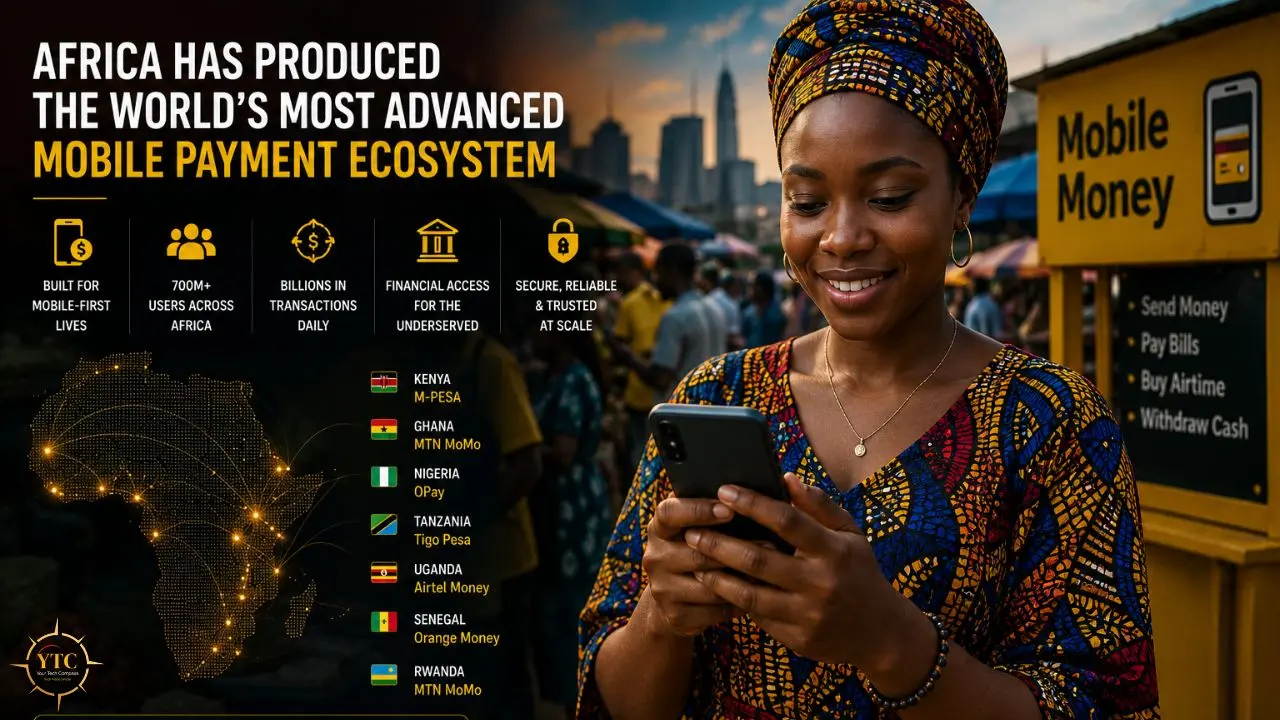
This isn’t a claim about Africa’s potential. It’s a current-state fact underscored by industry data: in 2025, Africa accounted for 74% of global mobile money transaction volume (about 92 billion of 125 billion transactions) and roughly two-thirds of value, per the GSMA State of the Industry Report on Mobile Money 2026.
BCG’s March 2026 report highlights the same 74% figure and notes that ~40% of adults in Sub‑Saharan Africa use mobile money. On the specific dimensions that define mobile money (agent network density, telco-led payment rails, USSD/SMS accessibility, and mobile-money-specific regulation), Africa leads the world. Not by heritage or narrative. By volume.
The Superapp Trajectory
OPay in Nigeria, the evolution of M-Pesa’s expanded service offering, and the multi-service model of several West African platforms represent a superapp approach to financial services, built in Africa alongside (if not ahead of) the formalization of fintech as a strategic category. OPay launched in 2018 with an explicitly Asian-inspired superapp playbook (ride-hailing, food, logistics, e-commerce) and then refocused on payments, credit, savings, and merchant tools as market realities dictated. The integration of payments, credit, savings, logistics, and commerce into a single platform is now a recognized global strategy; African implementations blend that playbook with local necessity, producing some of the most scaled, agent-heavy, mobile-first financial superapps in emerging markets.
Our guide, “African fintech startups to watch in 2026,” profiles the companies building in this direction right now. For the full ecosystem context (hubs, funding, regulatory environments), our African fintech ecosystem guide provides a comprehensive structural picture.
Investment and Valuation: The Metrics That Actually Matter
For investors evaluating African fintech, the valuation frameworks that work in global fintech require significant adaptation.
In 2025, African tech startups raised roughly $3–3.9 billion in total, with fintech accounting for about $1.2–1.4 billion of that, including approximately $685–770 million in equity financing, as the sector rebounded from the 2024 trough. The 2020–2021 boom period saw valuations that reflected addressable market projections and financial inclusion narratives sometimes disconnected from near-term revenue reality. In addition, the 2022–2023 correction recalibrated significantly, as foreign exchange restrictions in key markets (particularly Nigeria), regulatory changes, and higher-than-modeled customer acquisition costs produced outcomes that standard valuation frameworks hadn’t adequately weighted.
The metrics that actually predict business quality in African fintech differ from global equivalents:
- Active Users vs. Registered Users: Signup numbers dramatically overstate actual engagement in markets where creating a free account is easy. The engagement rate on registered accounts is the metric that matters, not the headline user count.
- Transaction Volume and Frequency Per User: Revenue is earned on transactions in most mobile money models, not on account balances. Depth of use, not breadth of registration.
- Agent Network Efficiency: Cost per transaction through the physical agent network is a critical operational metric, with no direct global fintech equivalent, that directly affects unit economics at the scale where agent-dependent businesses operate.
- Non-Performing Loan Ratios Under Market Stress: For fintech lenders, NPL ratios during foreign exchange volatility events, currency devaluation episodes, and macroeconomic shocks tell you what the credit book actually looks like under African market conditions. Smooth-weather NPL data understate risk in ways that have repeatedly surprised investors.
- Regulatory Licensing Portfolio: In a fragmented 54-country regulatory environment, the quality and breadth of licenses held are a genuine competitive moat; they represent years of relationship-building and compliance investment that late entrants can’t shortcut.
The broader AI-powered tools and infrastructure being built around these financial services, from credit scoring models to fraud detection to regulatory compliance automation, are increasingly relevant context for evaluating what African fintech companies are actually building. Our AI in Africa category tracks how AI is being deployed specifically within African financial services.
Our full African Fintech category provides a comprehensive overview of the sector’s development. And for anyone exploring contactless payment and digital identity innovations that extend the financial services rail into everyday commerce, our DTB wearables Kenya review covers one of the most interesting hardware-layer experiments on the market right now. Furthermore, our mobile money Africa guide provides a comprehensive, up-to-date picture of how mobile money infrastructure underpins all of this.
Five Practical Takeaways for Founders, Investors, and Operators

1. The Mental Model Must Come First
African fintech is not a smaller version of global fintech, and products designed on the global model rarely transfer intact. Build from the specific user’s financial reality (income variability, trust dynamics, interface constraints, informal finance history), not from a scaled-down version of a product that worked in a market with categorically different starting conditions.
2. Infrastructure Investment Is Unavoidable
The global fintech playbook assumes infrastructure you can rent. In most African markets at a meaningful scale, you will need to build parts of the stack yourself: agent networks, alternative credit scoring, USSD interface engineering, and regulatory frameworks in new markets. Budget for it explicitly, or your “technology company” will hit walls that aren’t technology problems and that no amount of technical investment will resolve.
3. SME Banking Is an Underappreciated Primary Market
The dominant narrative of African fintech centers on financial inclusion for unbanked consumers. The commercial reality is that SME banking (merchant acquiring, business accounts, working capital credit) is frequently where unit economics work soonest and where the credit gap between supply and demand is most acute and most immediately addressable.
4. Regulatory Strategy Is Product Strategy
In a fragmented, evolving regulatory environment, your licensing roadmap determines your geographic expansion roadmap. The order in which you enter markets, the local partnerships you build, and the regulatory relationships you invest in are product decisions, not compliance overhead. Treat them accordingly.
5. Trust Is Built Locally, Not Transferred Globally
Global brand recognition doesn’t translate into trust in African financial services markets, where institutional trust has been damaged by specific historical experiences that vary by market rather than across the continent. Distribution through community-embedded agents, local referral networks, and product experiences that deliver immediate, tangible value is the trust-building mechanism, and it works market by market, not once globally.
FAQs
Yes. Africa has emerged as the fastest-growing fintech market globally. By 2030, revenues are projected to grow roughly 13-fold to approximately $65 billion, the highest growth multiple of any region. The structural drivers (a population projected to exceed 1.7 billion by 2030, smartphone penetration forecast to surpass 50%, and a massive credit gap between supply and demand) suggest this growth trajectory is structural rather than cyclical.
The most common reason is applying a mental model developed in markets with mature financial infrastructure to markets where that infrastructure doesn’t exist, the user profile is structurally different, and the business model requirements differ in ways that aren’t visible until you’re already operating. Specifically: underestimating the cost of building or accessing distribution, overestimating the speed of regulatory progression, and assuming income regularity in a market where income variability is the norm.
The foundational difference is the starting point. US fintech is built on top of a mature financial infrastructure (card networks, bank accounts, credit bureaus) that already serves most of the population. African fintech had to build its own infrastructure in markets where the formal financial system reached only a minority of people. That difference cascades through every dimension: the user, the product architecture, the business model, the regulatory context, and the distribution strategy.
Flutterwave processes payments across 34 African countries and has expanded into diaspora payment corridors globally, including the US and UK. Chipper Cash handles cross-border payments across Africa and into the UK and European markets. Wave has become the dominant payment platform in Senegal and is expanding across Francophone West Africa. Industry observers note that “fintech platforms born out of necessity are now enabling cross-border trade, remittances, and digital finance far beyond the continent, while African engineers, founders, and creatives are building products that serve global users at scale.”
Because it solved a specific problem that card-based digital payments couldn’t: it created a financial identity and transaction mechanism for people who had no bank account, no card, and often no smartphone, using only a basic mobile phone and a nearby agent. The problem mobile money solved in Africa doesn’t exist at a comparable scale in markets where bank accounts were already widespread. Africa accounts for roughly 74% of global mobile money transaction volume, reflecting both innovation and structural necessity.
Several things, most of which are increasingly relevant as global fintech looks toward emerging markets for next-phase growth: how to build financial products for income-variable users, how to design for constrained device and connectivity environments, how to use alternative data for credit scoring where formal credit infrastructure is absent, how to build distribution through physical agent networks as a complement to digital channels, and how to create embedded finance architectures within non-financial platforms as a distribution strategy. These were African fintech’s adaptive responses to specific constraints, and they’re increasingly recognized as best practices in emerging-market financial services globally.
Conclusion
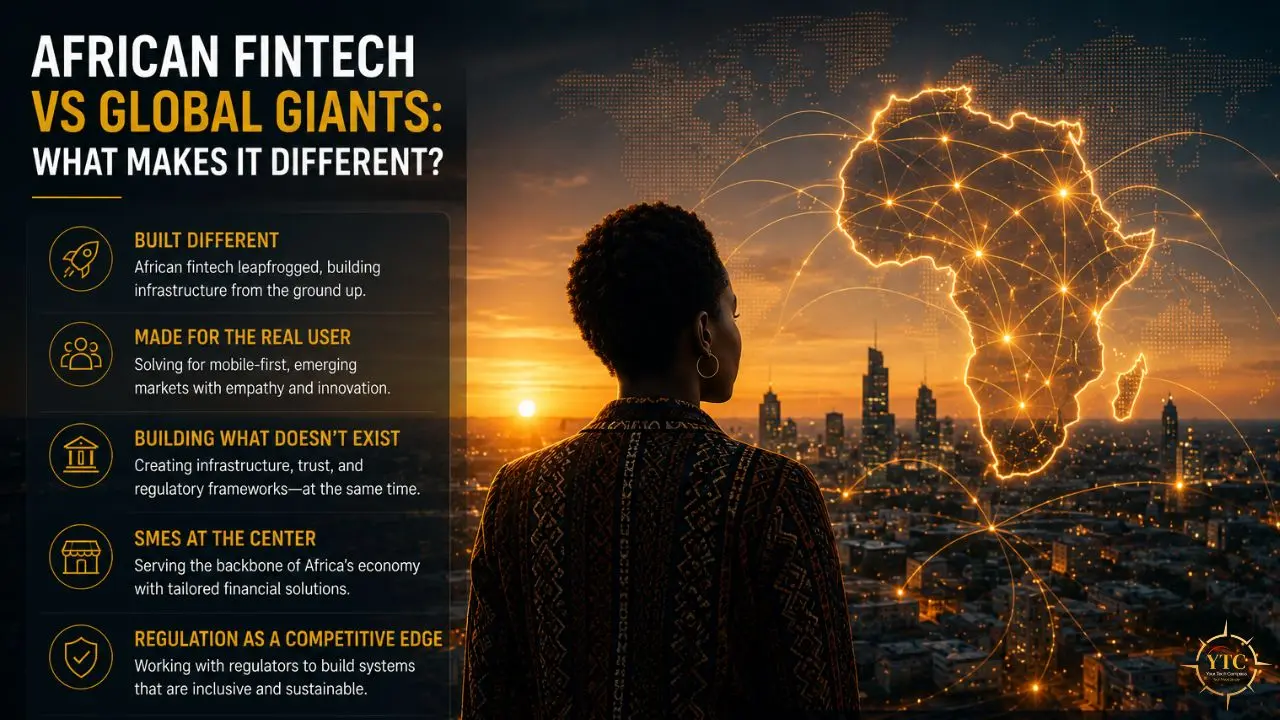
African fintech is structurally distinct from global fintech across every dimension that matters for building, investing in, or operating within it: the starting point (infrastructure creation rather than infrastructure optimization), the user (informally banked and unbanked rather than banked-but-underserved), the distribution model (agent networks as physical infrastructure rather than pure digital reach), the business model (payments-to-credit pipelines, SME-primary markets, embedded finance within non-financial contexts), and the regulatory context (rules built alongside products rather than navigated from a stable pre-existing framework). Understanding those structural differences isn’t an academic exercise. It’s the prerequisite for understanding why M-Pesa preceded Apple Pay by seven years, why the world’s most advanced mobile payment ecosystem is in East Africa, and why fintech products that work brilliantly in San Francisco or London fail their first six months in Lagos or Nairobi.
“The developments that mattered most were the structural ones: more active regulators, improving interoperability in some markets, and a stronger focus on risk by banks and mobile money operators. These changes are pushing the ecosystem toward higher standards and more reliable infrastructure.” As global fintech reaches saturation in high-penetration Western markets and turns toward emerging markets for next-phase growth, the African fintech model is the relevant reference point, not the lagging benchmark. The companies and investors who understand that distinction early, who build from African market conditions rather than applying a scaling-down mental model, have a structural advantage that the others will spend considerable time and capital discovering they don’t have.
The African fintech story is one of the most consequential in global technology and commerce right now. Visit YourTechCompass.com for more detailed, research-backed coverage of African fintech, AI in Africa, and the technology reshaping the continent’s economic future.