Let’s start with a hypothetical: imagine a small business owner who needs a product explainer in three languages by Friday. She has no camera, no presenter, and no studio budget, and every agency quote costs more than a month of her sales. That gap between needing video and being able to afford it is exactly where AI avatar tools have taken root.
HeyGen is one of the best-known platforms in this category, and 2026 has been a busy year for the company. In this guide, I’ll walk you through what HeyGen is, how Avatar V, Digital Twins, and video translation work, and what the credit system really costs once you do the math. We’ll cover the consent and deepfake questions you need to settle first, how HeyGen compares with Synthesia, Colossyan, and D-ID, and what African creators and businesses should know. Everything below comes from HeyGen’s official documentation, pricing pages, and published product information rather than my own testing, so read my opinions as informed judgment, not lab results.
A note before we begin: every YTC score is earned, never negotiated. If you want to understand exactly how we evaluate apps & tools and how we handle affiliate relationships, our Review Methodology lays it all out.
Quick Verdict
- Best For: Marketers, trainers, and small businesses that need talking-head and multilingual video without a studio.
- Skip It If: You need long-form or frequently revised video on a tight budget, or you are not prepared to manage the consent, likeness, and disclosure responsibilities that come with synthetic people.
- Bottom Line: HeyGen offers strong realism potential and useful translation, but its credit system means your real cost per minute depends heavily on the avatar engine you choose and on how often you revise a scene.
What Is HeyGen?

HeyGen is an AI video platform that turns scripts into videos with digital presenters, translates existing videos into other languages, and generates footage from text prompts. You can use a stock avatar, build a digital twin of yourself, or animate a photo. The pitch is simple: skip the camera, the crew, and the reshoots.
The company says more than 100,000 businesses use its platform, though that is HeyGen’s own figure. HeyGen announced a $60 million Series A in June 2024, while third-party funding trackers estimate its total raised capital at roughly $65.6 million across five rounds; treat those broader figures as reported estimates rather than independently audited facts. What matters for you is the product family, which now includes HeyGen Studio, Digital Twins and Photo Avatars, Video Translation, Video Agent, and LiveAvatar for real-time interactive avatars.
In my opinion, HeyGen’s biggest strength is that it covers much of the video workflow, from script to translated export, in one browser-based platform. That breadth is also why the pricing takes some unpacking, which I’ll get to shortly.
How HeyGen Works, and What Changed in 2026
HeyGen works as a loop with five broad steps. You write or upload a script, choose or create an avatar, pick a voice and language, generate the video, and then edit and export it. Many steps can draw on a shared pool of credits, so the engine, model, and features you choose shape your costs.
The headline change this year is Avatar V. According to HeyGen’s announcement, it builds a digital twin from roughly a 15-second recording and aims to keep your face, voice, and presence stable across angles and long videos. HeyGen frames the key problem as identity drift, meaning an avatar that starts as you and slowly stops looking like you.
Here’s a practical example. You record yourself once, then generate the same product update in five languages and three different looks, without filming again. HeyGen says Avatar V separates your real performance from your appearance, so you can change outfits and settings while your motion stays yours. That’s a company claim, so I’d test it on your own face before you build a workflow around it.
HeyGen has also integrated ByteDance’s Seedance 2.0 video model, and it says its consent system lets real, verified human faces appear in that cinematic footage. Here’s how the year has unfolded.
When | What happened | Source |
|---|---|---|
February 2026 | HeyGen released the Video Agent API for prompt-to-video workflows. | |
March 2026 | HeyGen launched its Canva integration, enabling users to create AI avatar videos within Canva. | |
April 7–8, 2026 | HeyGen integrated Seedance 2.0 across its platform and released Avatar V research. | |
April 2026 | HeyGen released its CLI, v3 developer APIs, and open-source HyperFrames. | |
May 2026 | HeyGen released MCP and OAuth integrations, HyperFrames Studio, Avatar V upgrades, and its Android app. | |
October 2026 | HeyGen announced Video upgrades, HeyGen Voice, and Voice Turbo; Voice Turbo was free through November 30 on shared capacity. | |
By October 29, 2026 | HeyGen’s pricing page listed limited Avatar V access on Creator, plus Seedance 2.5 and Cinematic Avatars on Pro. The exact change date and price stability remain unverified. |
Standout Features
Avatar V and Digital Twins
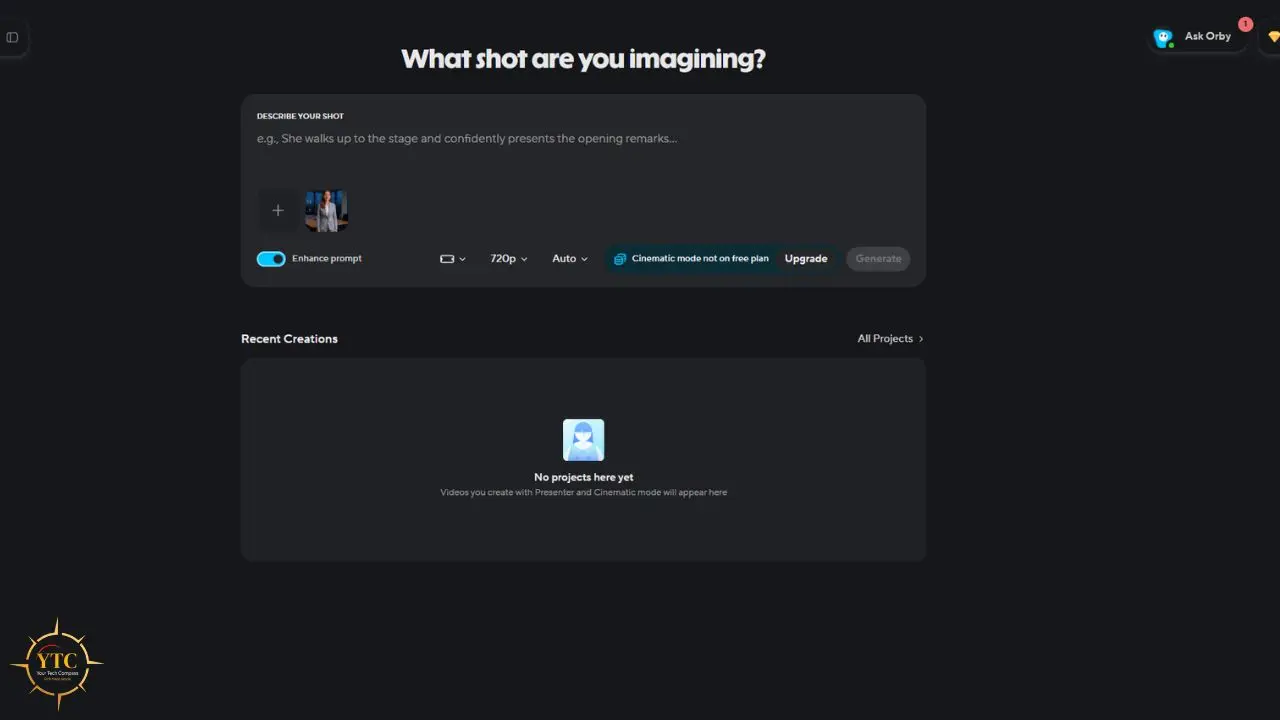
Avatar V is HeyGen’s flagship avatar model, and a digital twin is the reusable video version of you that it creates. It helps most when you need a consistent face across many videos, such as training modules or sales updates. The catch is cost, because Avatar V sits at the expensive end of the credit scale.
Video Translation
Video Translation re-voices a video in another language and, in its Speed or Precision modes, re-syncs the speaker’s mouth. HeyGen’s pages cite 175+ languages and dialects, though other sources give different counts, so confirm the languages you need. HeyGen currently lists Audio Only at 4 credits a minute, Speed at 6, and Precision at 10.
Why does that matter? Localization is where small businesses get the most value, since one recording can reach several markets. HeyGen itself advises that a native speaker should review the translated script, and I’d treat that advice as non-negotiable.
Video Agent
Video Agent builds a finished video from a text prompt, handling the script, visuals, voiceover, and editing. It suits people who want a draft fast and don’t have footage. The trade-off is credits: HeyGen estimates Standard Video Agent at 60–80 credits a minute and Seedance Mode at 180–240, so it can cost more than Avatar V.
Seedance and Cinematic Shots
HeyGen integrates Seedance 2.0 to generate cinematic hooks and b-roll, including footage that can feature your digital twin. It’s useful for short-form marketing where an opening shot has to grab attention. In my opinion, it’s the most impressive and the least predictable part of the product, because creative models vary a lot from run to run.
The API, MCP, and Interactive Avatars
Developers can generate video through HeyGen’s API, which bills from a separate prepaid USD wallet rather than your plan credits. HeyGen also lists MCP connectivity, so AI tools can call it directly. If you’re new to the idea, our Model Context Protocol explainer covers it, and our reviews of Zapier, Make, and n8n show how teams wire tools like this into their workflows. LiveAvatar, the real-time interactive product, is priced separately from the plans below.
Where the Flagship Feature Falls Short
Avatar V is the headline, so it deserves the hardest look. HeyGen says it’s the most realistic avatar model in the world and cites a G2 ranking, but those are company claims, and independent testing is thin. Avatar V also sits at the top of the standard avatar-engine credit scale, so the most realistic option is the one that burns your allowance fastest.
Realism has limits, too. Reviewers still describe moments where expressions feel slightly off, especially in long videos. And because the model makes it easy to create a convincing likeness, the consent and disclosure duties fall on you.
Compared to Synthesia right now: Synthesia’s published plans are generally structured around video minutes, while HeyGen charges credits that vary by engine. One third-party analysis calls HeyGen cheaper per finished minute on its self-serve plans, though that depends on the avatar you pick. My opinion: Synthesia’s simpler billing suits predictable training libraries, while HeyGen’s flexibility suits marketers who experiment.
HeyGen Pricing in 2026
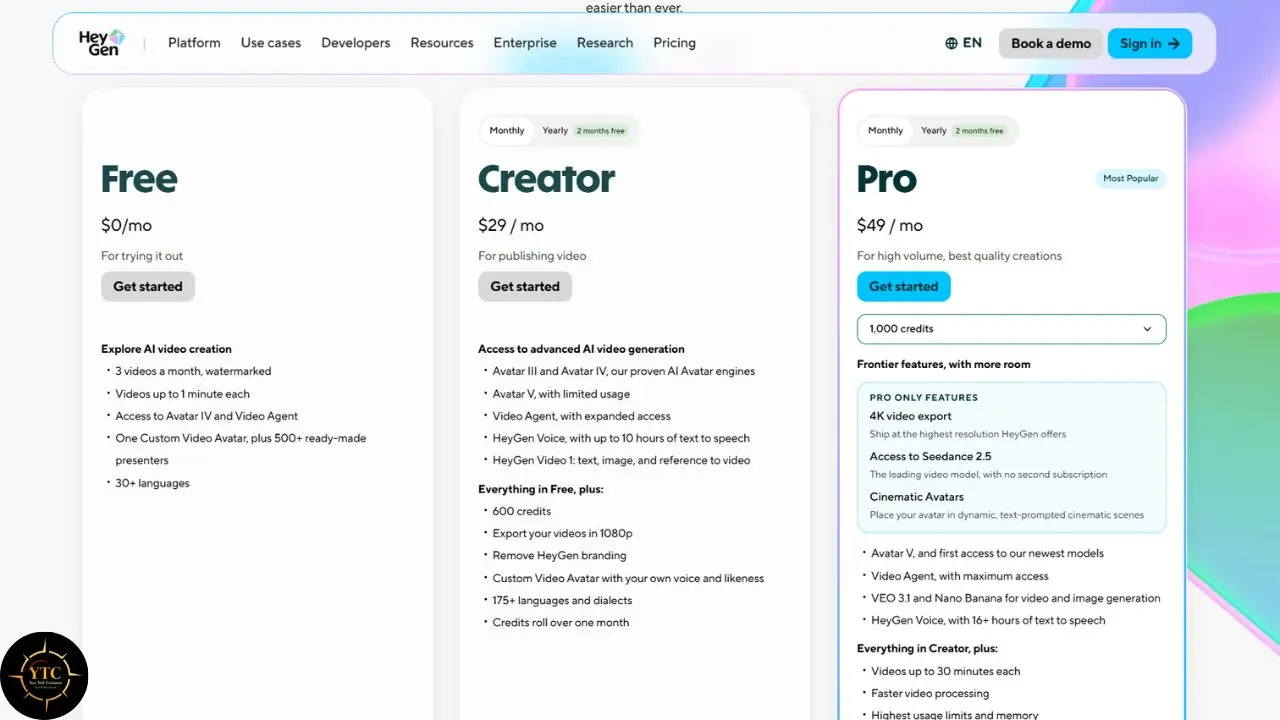
HeyGen sells plans in dollars and charges video in credits, which is why the real price takes some arithmetic. According to its pricing page, the plans look like this.
Plan | Price | Credits | Notes |
|---|---|---|---|
Free | $0 | None | 3 videos per month, up to 1 minute each, watermarked |
Creator | $29/month, or $24/month billed annually | 600 | 1080p, videos up to 30 minutes, no standalone credit packs |
Pro | From $49/month | 1,000 base | 4K, higher credit tiers |
Business | $149/month for the first seat, plus $20 per added seat | 1,500 shared | SSO, SCIM, SCORM, credit top-ups |
Enterprise | Custom | Custom | Custom security and support; annual billing only |
Now for the math. At $29 for 600 credits, Creator costs about $0.048 per credit. HeyGen’s help center lists Avatar III’s Video Look at 4 credits per minute, Avatar IV’s Video Look at 31, and Avatar V at 48.
Engine | Credits per minute | Minutes on 600 credits | Approx. cost per minute on Creator |
|---|---|---|---|
Avatar III, Video Look | 4 | 150 | $0.19 |
Avatar IV, Photo Look | 16 | 37.5 | $0.77 |
Avatar IV, Video Look | 31 | 19.4 | $1.50 |
Avatar V, Video Look | 48 | 12.5 | $2.32 |
So a 30-second Avatar V ad costs about $1.16 on Creator, and one minute of Avatar V costs about 12 times as much as one minute of Avatar III’s Video Look. A solo creator making 20 three-minute Avatar IV videos needs 960 credits with a Photo Look or 1,860 credits with a Video Look; the latter overshoots both Creator’s 600 and Pro’s 1,000.
Translation math tells a similar story. A 10-minute training video translated with Speed lip-sync at 6 credits a minute uses 60 credits, about $2.90 on Creator. Five languages means 300 credits, or exactly half of the monthly pool; Precision translation would use 500 credits, or about 83% of it.
Business works differently. A five-seat team pays $149 plus four seats at $20, or $229 a month. The listed price adds seats without stating an additional credit allocation, and Business users can buy credit top-ups; verify the current top-up price directly before relying on it.
Annual billing lowers Creator to $24 a month, which saves $60 a year. Also, the API doesn’t draw on plan credits, so budget for it separately if you automate.
Legal, Privacy, and Risk Considerations
Consent and Likeness
For a digital twin, HeyGen requires the person to record an on-camera consent statement, and its documentation describes a verification process for that consent. A third-party guide says screen recordings and AI-generated clips fail verification. HeyGen’s Trust & Safety page says users must have legal rights and explicit consent for any likeness they upload.
The practical rule is simple: never build a digital twin of anyone without documented permission, and keep a record of every video that features each twin. That way, if someone withdraws consent, you can promptly pause, remove, or restrict use of that twin instead of scrambling to find where it appeared.
Deepfakes and Disclosure
The same tools that save you production time can enable impersonation. Reporting around avatar platforms keeps returning to deepfakes, impersonation, and brand-trust risks. I’d label synthetic presenters clearly, since disclosing up front protects trust far better than hoping nobody asks. HeyGen prohibits deceptive content and misinformation, but its policies do not replace your own disclosure and reputational responsibilities.
Rules and Security Claims
HeyGen’s Trust & Safety page lists SOC 2 Type II, GDPR, CCPA, EU AI Act alignment, and the Data Privacy Framework, and it states U.S. data locations for several services. These are company claims and framework alignments rather than a single compliance certification, so verify them in HeyGen’s security portal if a client requires them.
Synthetic-media disclosure rules, including the EU AI Act’s transparency duties, are still being implemented and interpreted, so check the current requirements for your audience. Also ask whether your plan permits HeyGen to use your content for model training: HeyGen says enterprise customer data is not used for training, while non-enterprise customers may opt out.
Faces, Voices, and Local Law
Faces and voices can count as biometric or sensitive personal data under many laws. Nigeria’s Data Protection Act 2023, Kenya’s Data Protection Act 2019, and South Africa’s POPIA can all matter, depending on who appears in your videos and how their data is processed. It’s worth separating what HeyGen permits from what your local law requires.
HeyGen vs. the Alternatives
The table below summarizes how HeyGen stacks up against three common rivals, using current vendor pricing.
Platform | Pricing model | Entry price | Free plan | Best fit |
|---|---|---|---|---|
HeyGen | Credits; rate varies by avatar engine and feature | $29/month (Creator) | Yes, limited | Marketers and creators who localize video |
Synthesia | Hybrid: 10 included minutes plus credits | $19/month (Starter), or $14/month billed annually | Yes, Basic | Enterprise training and corporate communications |
Colossyan | Video minutes, with paid plans and collaboration features | $59/month (Professional) | Yes, Starter | Collaborative learning-and-development teams |
D-ID | Monthly video-minute plans | $5.90/month (Lite) | 14-day trial, not a free plan | Photo animation and quick personal-use clips |
Prices and allowances can change quickly, so confirm each on the vendor’s current pricing page before you decide.
HeyGen vs. Synthesia
Both make presenter-led video, but Synthesia combines a fixed monthly video allowance with credits and leans toward enterprise training, compliance features, and predictable team workflows. HeyGen’s edge is flexibility: its credit cost varies by avatar engine, and its product cadence has been aggressive in 2026.
If you need a predictable monthly video allowance for training libraries, Synthesia may suit you better. If you need to localize marketing assets or experiment with different avatar engines, HeyGen is likely the stronger fit.
HeyGen vs. Colossyan
Colossyan focuses on collaborative learning-and-development workflows, including course creation, SCORM export, and Colossyan Learn. Its free Starter tier is useful for testing, but its listed Professional plan costs more than HeyGen Creator.
Pick Colossyan if your team builds courses together and needs training-specific workflows. Pick HeyGen if your priority is localized marketing video, avatar realism, or a broader range of generation modes.
HeyGen vs. D-ID
D-ID is the budget route for animating a photo into a talking clip. Its Lite plan is inexpensive, but it is watermarked and limited to personal use; commercial use starts on Pro.
For a wider tour of tools beyond video, browse our Apps and Tools category.
Real-World Use Cases
- Marketing explainers and ads: You write a script, pick a presenter, and ship a 30-second spot without a shoot. The cost per ad can be modest, but variations, revisions, and premium engines add up in credits.
- Training and onboarding: An L&D team turns documents into narrated lessons. If your scripts begin as long-form content, our Jasper AI review and Frase review cover tools that can help you draft and structure the copy first.
- Multilingual localization: One recording becomes several language versions through lip-sync translation. Budget time for native-speaker review.
- Personalized sales outreach: A rep records once and generates tailored intros for prospects. Disclose that the video is synthetic.
- The agritech startup or bank in Nairobi or Lagos: A short how-to video localized into several languages can reach customers who prefer their own language. You’d need to confirm that HeyGen supports each language you need, and have a native speaker check every script.
Honest Limitations
- Credits burn unevenly: The avatar engine you pick changes cost by many times, and Creator can’t buy extra packs.
- A limited free plan: Watermarked videos of up to 1 minute, with 3 videos a month.
- Frequent changes: Plans, features, and credit rates moved several times in 2026, so older reviews can mislead.
- Vendor-reported realism: The strongest claims come from HeyGen, not independent tests.
- Duties that fall on you: Consent, disclosure, and local-law compliance are your responsibility.
- Seat charges on Business: Each added seat raises the bill, and HeyGen’s pricing page does not state that it adds credits.
The Review Landscape: Strong Ratings, Credit Complaints
Software-review sites rate HeyGen highly. G2 currently shows a 4.8 out of 5 rating from nearly 2,000 reviews, and HeyGen says it led G2’s Summer 2026 reports. Treat the second claim as marketing.
The recurring complaint is credits. Plenty of analyses warn that credits can burn quickly and unpredictably, and that running out mid-month may force an upgrade rather than a simple top-up.
My read is that satisfaction tracks how well your volume fits your plan. People who model their credit use first seem to be happier than people who discover the math after subscribing.
Who Should and Shouldn’t Use HeyGen
Use HeyGen if you are:
- A marketer or founder who needs presenter-led video without a studio.
- A trainer who wants to localize lessons into several languages.
- A small business that can model its credit use before subscribing.
- A team ready to manage consent and disclosure.
Skip HeyGen if you are:
- Producing hours of video a month on a tight budget.
- Unwilling to disclose synthetic presenters.
- Needing a predictable per-minute invoice.
- Unable to obtain documented consent for every likeness, voice, or persona you use.
HeyGen for African Creators and Businesses
The free plan is the best on-ramp. It lets you test an avatar and a short video before you pay, and HeyGen’s pages say it includes one Digital Twin slot. Free videos are limited to one minute, carry a watermark, and export as 720p sharing links.
After that, Creator costs $29 a month, or $24 on annual billing, in dollars. Currency swings against the naira, cedi, shilling, or rand will shape your real cost, so run the credit math in your own currency. HeyGen says it accepts credit and debit cards, Cash App, bank accounts, preauthorized debit, and PayPal in selected countries, so check the options available in your country before you plan around a card or wallet. Our African FinTech coverage tracks how payment rails are evolving for exactly this kind of problem.
Language is the exciting part and the big unknown. HeyGen cites 175+ languages and dialects, and its documentation lists Afrikaans, Amharic, Somali, Swahili, and Zulu among its supported voice and translation languages. I could not verify Yoruba or Hausa in HeyGen’s current language lists, so do not assume a language is available just because the platform supports “175+ languages.” Test your target language during the free plan, and have a native speaker review everything.
Bandwidth matters too. Uploading source clips and downloading 1080p or 4K files eats data, so draft at lower resolution and export once. For the wider picture of how AI tools are reshaping work across the continent, see our AI in Africa category.
FAQs
HeyGen has a free plan with watermarked videos of up to 1 minute, and sources say you get 1 to 3 videos a month depending on region. Free videos export as 720p sharing links, and paid plans start at $29 a month.
Creator costs $29 a month ($24 on annual billing). Pro starts at $49, and Business starts at $149 for the first seat plus $20 per added seat. Enterprise pricing is custom, and the API bills separately through pay-as-you-go credits.
Plans include a monthly credit pool, and each feature uses credits at its own rate per minute. Avatar V costs 48 credits a minute for a Video Look, while Avatar IV costs 16 credits a minute for a Photo Look or 31 credits a minute for a Video Look, so confirm current rates in HeyGen’s help center.
Avatar V is HeyGen’s latest avatar model, which builds a digital twin from roughly a 15-second recording. HeyGen says it keeps your face and voice consistent across angles, looks, and videos of up to three minutes.
It depends on how you work. HeyGen offers credit-based flexibility and strong translation, while Synthesia uses per-second credit metering and leans toward structured training and enterprise workflows.
HeyGen requires consent verification for digital twins and publishes a moderation policy, but you remain responsible for consent, disclosure, and local law. Never use someone’s likeness without documented permission, and be especially careful with photo avatars, where HeyGen says the user is responsible for obtaining and retaining consent.
Navigating the Synthetic Screen: Where HeyGen Fits on Your Video Map
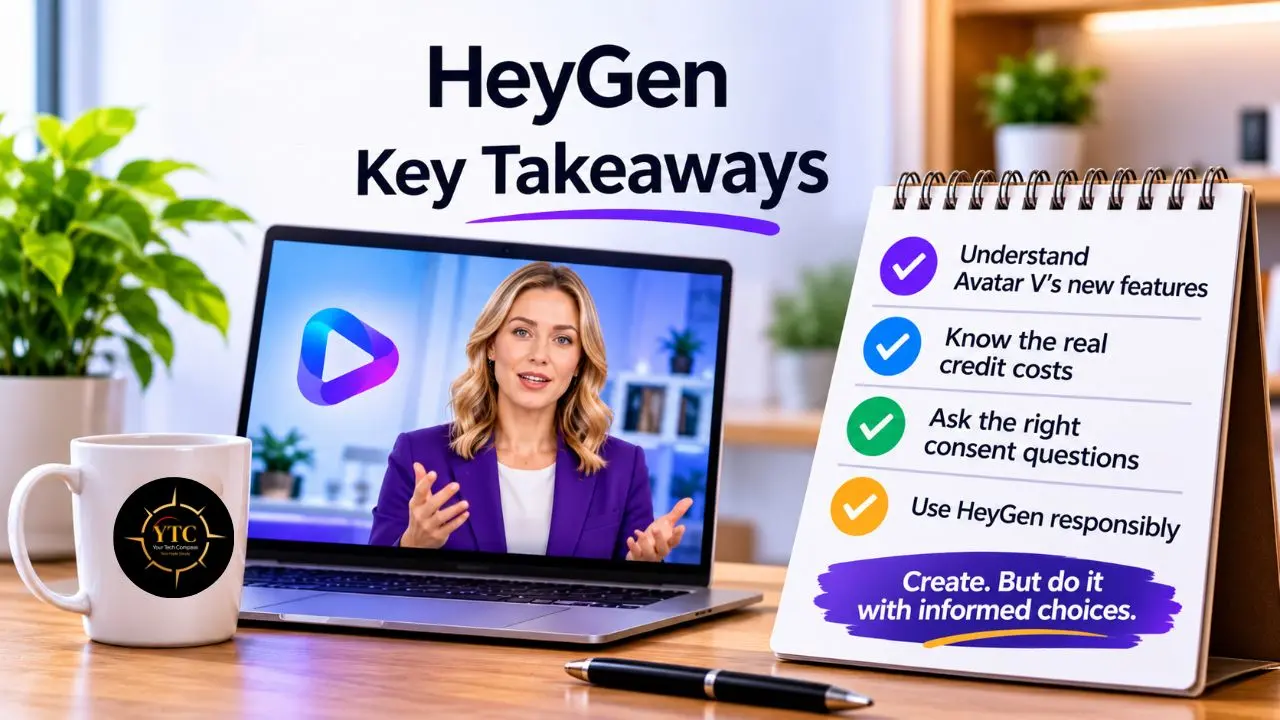
HeyGen makes a clear bet: a short clip should be enough to create a presenter you can reuse in any language. Avatar V, lip-sync translation, and a free plan make that bet credible, while uneven credits, frequent changes, and vendor-reported realism make it worth testing before you trust it. My overall read is that HeyGen rewards people who model their credit use and punishes people who discover the math later.
If you’re a creator or small business, start on the free plan, build one digital twin using HeyGen’s consent flow, and price a month of real work in credits before you pay. Remember that free-plan output is for personal, non-commercial, and internal-evaluation use; move to a paid plan before publishing commercial work.
If you build products or shape policy in Africa, notice how much of this technology assumes dollar billing and English-centric defaults, and how much room that leaves for local solutions and local safeguards. Whoever pairs realistic video with clear consent and disclosure is more likely to earn the audience’s trust.
Before you commit to the next tool in your video workflow, let your compass lead the way back to YourTechCompass.com for research-first reviews.