
You spend a week on a keyword-optimized article, and it lands on page one. Then you notice your traffic barely moves, because an AI-generated answer can now appear above the blue links and reduce the number of readers who click through to the underlying pages. If that sounds familiar, you’ve already met the problem Frase was rebuilt to solve: ranking on Google is no longer enough, and earning citations in AI answers has become an increasingly important second scoreboard alongside traditional search visibility.
In this guide, I’ll walk you through what Frase is, how its 2026 rebuild changed it, and how its plans work down to the cost per article. We’ll cover the AI agent and the other standout features, the legal and editorial risks of publishing AI-assisted content at scale, and an honest comparison with Surfer SEO, Clearscope, MarketMuse, Ahrefs, and Jasper. Because YTC writes for a global audience, including readers across Africa, I’ll also show you what pricing, payments, and languages mean if you build from Lagos, Nairobi, Accra, or Johannesburg. Everything below comes from Frase’s own pages, official documentation, and published reviews rather than hands-on testing, so read my opinions as informed judgment, not lab results.
A note before we begin: every YTC score is earned, never negotiated. If you want to understand exactly how we evaluate apps & tools and how we handle affiliate relationships, our Review Methodology lays it all out.
Quick Verdict
- Best For: Small content teams, agencies, and publishers who want research, writing, optimization, and AI-search tracking in one workflow.
- Skip It If: You need a free plan, advanced technical SEO, or very high article volume on a tight budget.
- Bottom Line: Frase bundles the full content loop at a competitive per-article price on its higher annual plans, and its 7-day no-card trial makes it easy to evaluate. Volume caps and a recently rebuilt product mean you should keep a human review step on everything it publishes.
What Is Frase?
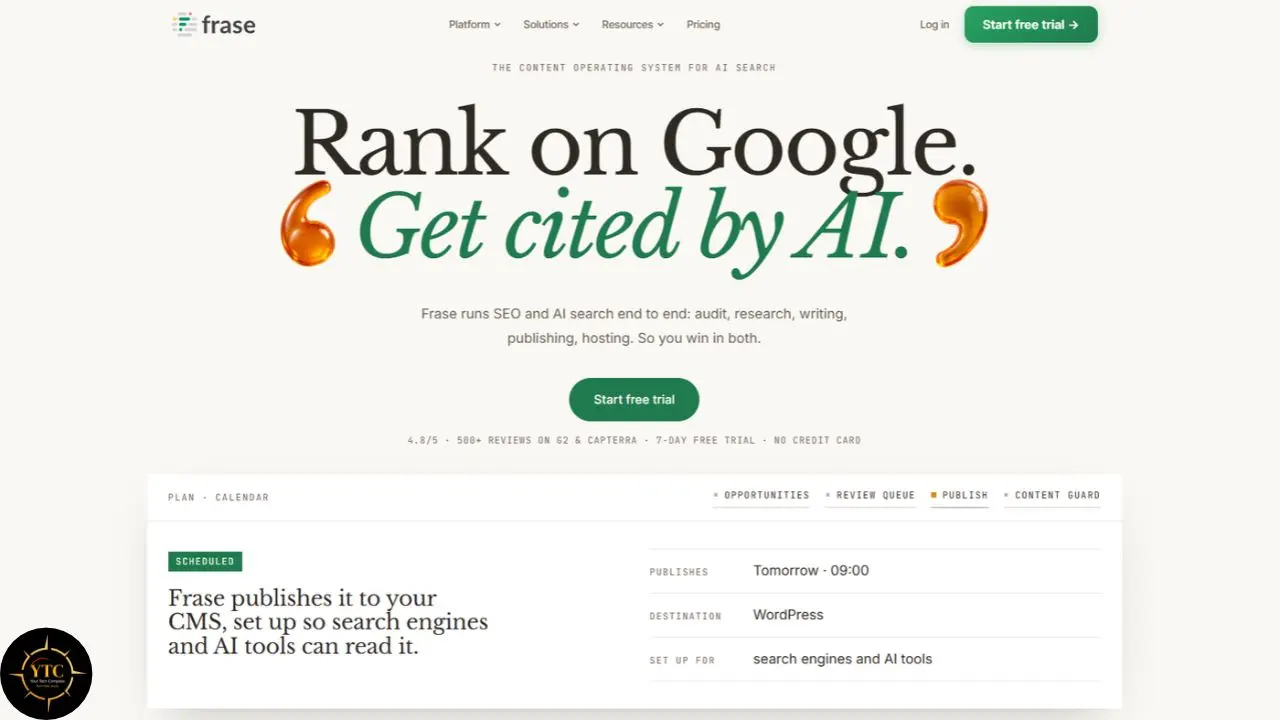
Frase (often written Frase.io) is an AI-powered SEO and content platform that researches a topic, drafts an article, optimizes it, can publish it through supported CMS integrations, and then monitors how it performs. Frase was co-founded by Tomas Ratia and Cody Jacques. The company launched publicly in 2017 and was known for most of its life as a content-brief and optimization tool for writers.
The pitch changed in 2026. Frase now calls itself “the content operating system for AI search,” which means it wants to help you rank on Google and get cited by AI search tools at the same time.
That second goal has a name: generative engine optimization, or GEO. It means shaping your content so tools like ChatGPT, Perplexity, Claude, and Gemini cite and reference it. If you want to see how the newest ChatGPT model changes that picture, our ChatGPT 5.4 explainer is a good companion read, and our AI Unboxed category covers how these tools retrieve and cite sources.
How Frase Works, and What Changed in 2026
Frase runs what it calls a loop, and each stage feeds the next. Understanding that loop explains why the product feels like a workflow rather than a single writing tool.
- Listen: Frase Answers, a widget on your site, captures the questions your visitors actually ask.
- Research: SEO research and content-gap signals can be turned into a content brief.
- Write: The AI agent drafts the piece with your brand voice in context.
- Optimize: Real-time SEO and GEO scores guide your edits.
- Publish: Posts can go to WordPress, Webflow, Sanity, or Wix, or to Frase’s own hosting.
- Monitor and fix: Content Guard watches for ranking or traffic declines and drafts fixes; AI Visibility tracks AI-search citations.
In practice, picture a SaaS blog. Visitors ask the same pricing question three times in the widget; Frase builds a brief around it, the agent drafts an answer, and you approve and publish. A month later, Content Guard flags a page that slipped in Google, and you review the suggested fix.
Frase’s 2026 Timeline
Frase’s current product and pricing cannot be judged fairly against reviews written before its 2026 rebuild. The timeline below separates company statements from third-party reporting.
When | What Changed | Source |
|---|---|---|
January 2026 | Frase says it rebuilt the product from the ground up. | Frase’s Trustpilot replies; Frase’s April 2026 blog post |
February 2026 | Frase announced its rebuilt platform and agent-based workflows. | Frase’s product announcement |
June 2026 | Packaging shifted to new usage meters, with optional pay-as-you-go overage. | Third-party pricing tracker |
Late October 2026 | Frase’s pricing page lists Starter, Professional, Scale, and Enterprise, with agent publishing and FraseCMS tiers. | Frase’s pricing page |
Three of those entries come from Frase itself. Treat them as company statements rather than independent confirmation.
Standout Features
The Frase AI Agent
Frase’s agent drafts articles with your brand in context, and an autonomy setting lets you decide whether it publishes on its own, keeps every page in review, or lands somewhere in between. Frase says every content type starts in review by default, and a type must earn automatic publishing through a record of approved drafts. The payoff is a faster first draft without surrendering the final call.
There’s a trade-off, though. Frase doesn’t prominently disclose the model that writes your drafts on the pages reviewed, so output can shift when that model changes. Our piece on the model churn tax shows how to price that risk, and I’d ask Frase’s support which model powers drafts before building a workflow around it.
SEO and GEO Scoring
Inside the editor, you see scores for how well a page fits Google’s expectations and how likely AI tools are to cite it. That gives you a target while you write instead of a report after you publish. The catch is that any score is a proxy, and no score guarantees a ranking.
AI Visibility Tracking

AI Visibility monitors where AI search engines cite you, and the platforms covered widen by plan. Starter covers ChatGPT and Google AI, Professional adds Perplexity and AI crawler monitoring, and Scale adds Claude and Gemini. Frase says this feature only alerts you and never edits your content, so the fix is up to you or the agent.
Content Guard
Content Guard watches your published pages for Google ranking decay and writes a revision when one slips. It watches 10 pages on Starter, 75 on Professional, and 300 on Scale, and approval is the default before anything republishes. Why does that matter? Old pages quietly lose traffic, and a monitored fix beats discovering the drop six months later.
Publishing, FraseCMS, and Frase Answers
Beyond the four supported CMS platforms, Frase offers FraseCMS, its own hosting, free for up to 100,000 page views a month with a small “Powered by Frase” badge. Paid FraseCMS tiers cost $19 and $99 a month as add-ons. Frase Answers includes a free per-site widget on every plan, with paid tiers for higher usage.
MCP Server, CLI, and API
Frase says you can run it from tools like Claude, Cursor, and ChatGPT through an MCP server and command-line interface on every plan. If MCP is new to you, our Model Context Protocol explainer covers the idea. For developers, this turns Frase from a dashboard into a building block.
Multilingual Writing
Frase says it writes natively in 70+ languages rather than translating. For readers across Africa, that could matter a lot. Check whether your target languages are on the list before you rely on it.
Where the Flagship Feature Falls Short
The agent and its autonomy setting are the headline features, so they deserve the hardest look. Like any SERP-informed brief generator, Frase’s outlines should be treated as a starting point, so you still curate the outline for search intent and relevance. And because the agent can publish on any content type once autonomy is enabled, a sloppy setting could push thin content live at scale.
My Opinion: Keep every content type in review until you’ve read a few dozen outputs. No trial can guarantee rankings, and I’d treat Frase’s emphasis on human review as a good sign.
Compared to Ahrefs right now: Frase’s own comparison page says Ahrefs treats AI visibility as a paid add-on without an integrated editor or fix loop. That’s Frase’s framing, and Ahrefs remains far deeper on backlinks and keyword data. In my view, the two answer different questions.
Frase Pricing in 2026
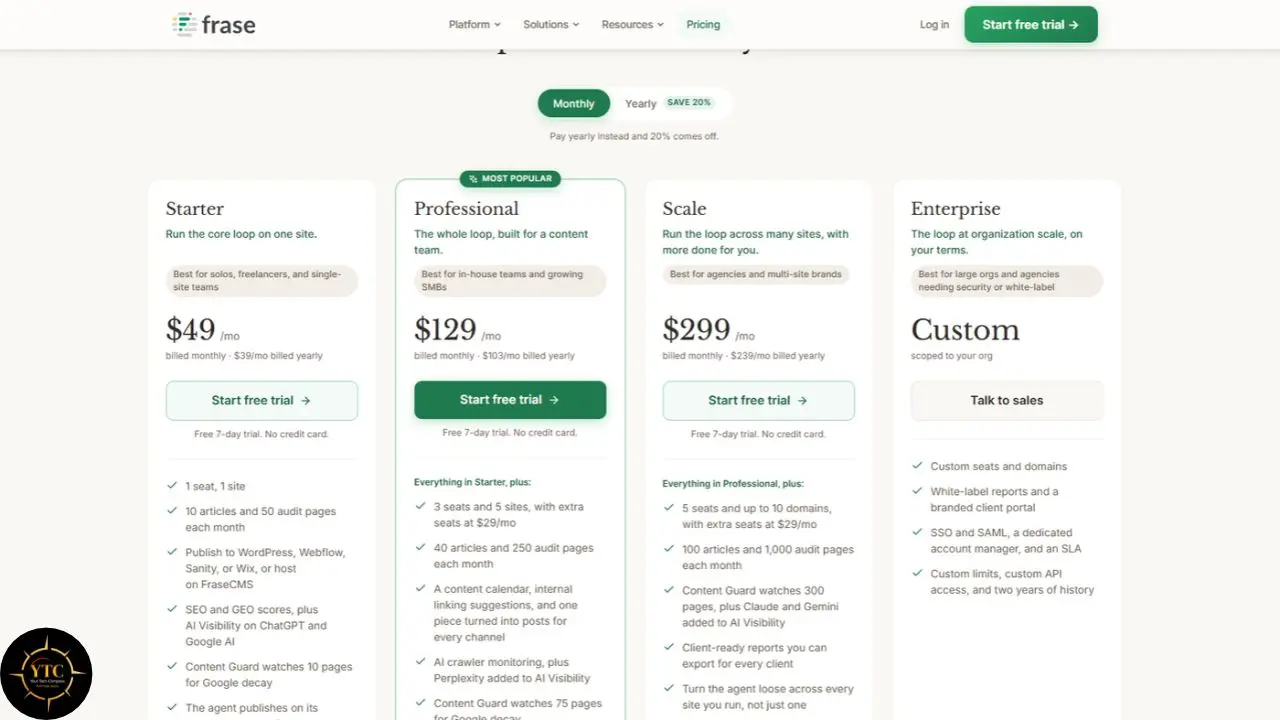
Frase price ranges by plan, with caps on articles, audit pages, and monitored pages. There’s no free plan, only a 7-day trial that needs no credit card. Here’s what the official pricing page listed in late October 2026.
Plan | Monthly | Annual (per month) | Seats / Sites | Articles / Audit Pages | Content Guard Pages |
|---|---|---|---|---|---|
Starter | $49 | $39 | 1 / 1 | 10 / 50 | 10 |
Professional | $129 | $103 | 3 / 5 | 40 / 250 | 75 |
Scale | $299 | $239 | 5 / 10 | 100 / 1,000 | 300 |
Enterprise | Custom | Custom | Custom | Custom | Custom |
Now for the math. Annual billing saves 20%, which comes to $120 a year on Starter, $312 on Professional, and $720 on Scale.
Cost per article tells a clearer story. On annual billing, you pay about $3.90 per article on Starter, $2.58 on Professional, and $2.39 on Scale, so volume buys real savings.
Overage costs more than included volume, but only if you switch on pay-as-you-go; Frase bills it at the end of the cycle. On Professional, extra articles run $5 each, and on Scale they run $4. Using Professional monthly pricing, Scale becomes cheaper once you need more than 74 articles in a month: Professional costs $129 plus 34 extras at $5 each, or $299; the same as Scale.
Seats work differently than you might expect. Starter includes one seat, while extra seats at $29 a month apply on Professional and Scale. A four-person team on Professional pays about $158 a month, while Scale includes five seats for $299.
The trial gives you Professional’s features with caps of 5 articles, 50 audit pages, 25 AI prompts, and 3 seats. On the paid Starter plan, Frase simply holds you at your monthly limits, so surprise bills are off the table.
Compared to Surfer SEO right now: Reviewers report Surfer’s entry plans near $49 to $59 a month, with its Standard plan around $99 to $119, after it moved to document-metered plans in 2026. Prices on both sides have moved this year, so check each vendor’s page before you decide.
Legal, Privacy, and Risk Considerations
Google’s Scaled Content Abuse Policy
Google doesn’t ban AI content, but it can take action against publishing many pages mainly to manipulate rankings. Google’s March 2024 announcement introduced the scaled content abuse policy and made clear it applies regardless of how the content is produced. Google’s enforcement has continued to target low-value publishing at scale, so I’d treat any plan to publish AI content in bulk as a risk, not a shortcut.
Data, Access, and Compliance
Connecting Google Search Console means granting Frase access to your site’s performance data, so review those permissions. Frase’s site states SOC 2 Type II and GDPR compliance, which is encouraging, but I’d verify the details in its security documentation. Copyright treatment of AI-generated output also varies by jurisdiction, so it’s wise to treat ownership and protectability as unsettled.
Usable Today vs. Settled
Frase’s features work today, and review-first defaults reduce risk. Search policy and AI-content rules are still moving, though, so a workflow that’s safe now may need adjusting later.
Frase vs. the Alternatives
Prices below are approximate and have shifted in 2026, so treat them as starting points.
Tool | Approx. Entry Price | Focus | Best Fit |
|---|---|---|---|
Frase | $39 to $49/month | Full loop: research, writing, optimization, AI visibility | Small teams wanting one workflow |
Surfer SEO | About $49 to $59/month | Page optimization and AI writing | Writers optimizing at volume |
Clearscope | $129/month (Essentials) | Content grading and team collaboration | Teams that prioritize grading accuracy |
MarketMuse | About $99/month (Optimize) | Topic modeling and content planning | Strategy-heavy content teams |
Ahrefs | Varies by plan | Full SEO suite with backlinks and keywords | SEO professionals needing deep data |
Frase vs. Surfer SEO
Both give you SERP-based briefs and optimization scores, but Frase bundles more of the workflow, including auditing, monitoring, and AI visibility tracking. Surfer remains best known for page-level content optimization.
My Opinion: Pick Frase if you want a single loop and Surfer if you already have a process and only need scoring.
Frase vs. Clearscope and MarketMuse
Clearscope prices from $129 a month for Essentials and offers a 14-day free trial. MarketMuse’s Optimize tier has historically been listed around $99 a month, though current pricing appears to require a sales conversation; its entry limits are tight, with one user and five briefs a month. Frase’s lower entry price and trial make it easier to test. If you run a large, strategy-heavy program, those two may still fit better.
Frase vs. Jasper and ChatGPT
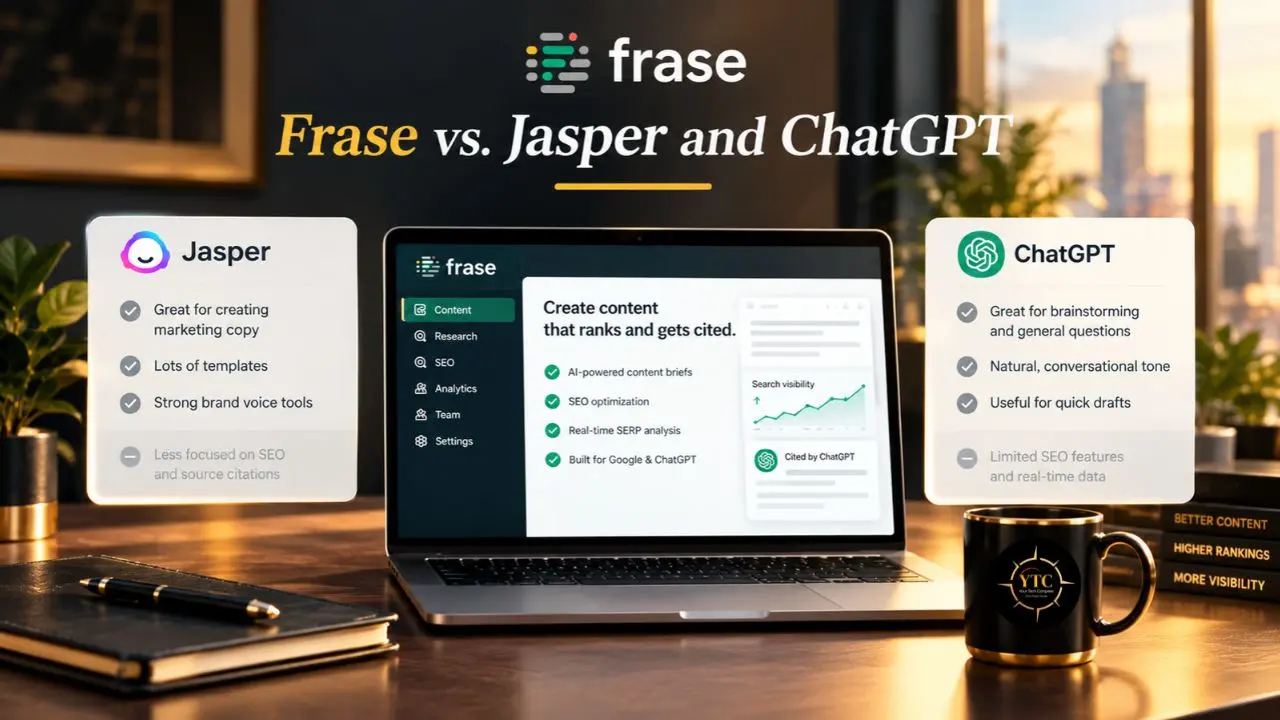
Jasper is a general marketing-writing platform, and our Jasper AI review explains where it fits. If you only need drafts, a do-it-yourself setup in ChatGPT works too, and our guide to ChatGPT Projects shows how to organize it. Frase’s edge is the SEO and GEO scoring around the draft, not the drafting alone.
For a wider tour of tools in this space, our Apps and Tools category covers the landscape.
Real-World Use Cases
- The Solo Blogger: You use Starter to research and draft a handful of posts a month, and the single site fits one blog. The 10-article monthly cap is plenty for a blogger publishing a few posts a month.
- The Small Agency: Scale’s 10 domains and client-ready reports suit someone juggling several clients. Enterprise adds white-label reports if you need them.
- The SaaS Content Team: Professional’s three seats, calendar, and repurposing tools fit an in-house team shipping weekly. Content Guard’s 75 pages help protect older winners.
- The Affiliate Publisher: Frase’s audit and decay monitoring help you keep a large archive fresh. Just keep Google’s scaled content policy in mind before you publish in bulk.
- The African Freelancer Serving Global Clients: A Nairobi or Lagos writer can use the no-card trial to test the workflow on a client project. Billing in U.S. dollars is the main thing to plan around, especially if your bank or card charges foreign-transaction fees.
Honest Limitations
- No Free Plan: You get a 7-day trial and then a paid subscription.
- Volume Caps on Every Tier: Starter stops at its limits, and overage on higher plans costs more per article.
- A Feature-Heavy Interface: With research, briefs, drafting, scoring, monitoring, and publishing in one place, beginners may need time to learn the workflow.
- Briefs Need Editing: Frase’s outlines are a starting point, so you still curate the outline before drafting.
- A Recently Rebuilt Product: Frase says it rebuilt in January 2026, so older reviews may describe a different tool.
- Billing Complaints: Some Trustpilot reviewers describe disappointing value for money.
The Review Landscape: High Ratings, Mixed Billing Feedback
Frase has a 4.8 out of 5 rating on G2, and Capterra lists 4.8 across 335 reviews. Both fit a pattern of power users praising the workflow. Remember that a vendor’s own page shows only the rating it chooses to highlight.
Trustpilot paints a harsher picture, with billing and value complaints, and Frase replied to at least one by pointing to its January 2026 rebuild. That context cuts both ways, because it may explain older complaints, but it doesn’t erase them. My read is that satisfaction tracks how well you fit the caps and how closely you watch your billing.
Who Should and Shouldn’t Use Frase
Use Frase if you are:
- A freelancer or small team that wants research, drafting, and optimization in one place.
- An agency managing up to 10 client sites on Scale.
- A publisher who needs to track citations in AI answers.
- Someone who wants a no-card trial before committing.
Skip Frase if you are:
- Looking for a free plan or a one-time purchase.
- Publishing hundreds of articles a month on a small budget.
- Needing deep backlink and keyword databases first.
- Planning to auto-publish AI content in bulk with little human oversight.
Frase for African Creators and Publishers: Accessibility and Cost

The trial is the best entry point. Frase offers a seven-day free trial and says no credit card is required. The company also provides free GEO and AI visibility checkers on its site; the AI Visibility Checker’s ChatGPT result is available without signup, while the full multi-engine report requires an email address. Try those before paying.
After the trial, the cost question is about dollars. Starter costs $468 per year on annual billing or $588 per month. Because Frase prices its plans in USD, exchange-rate movements against the naira, cedi, shilling, or rand will affect the amount you ultimately pay. Frase’s pricing page does not display accepted payment methods, so confirm with your bank or card provider that international USD billing will work before subscribing.
Language support could be a real advantage. Frase says it writes natively in more than 70 languages and locale variants, including Swahili, Hausa, Igbo, and Afrikaans. However, it does not appear to list Yoruba, Zulu, or Amharic, so verify support for your specific language before committing.
There is also an opportunity for brands that appear in AI answers. As AI-assisted search expands, African publishers that monitor and earn citations early could gain a competitive advantage. Our African Tech category follows how that shift is playing out.
FAQs
Frase is used to research, write, optimize, publish, and monitor SEO content. It also provides SEO and GEO scoring and tracks AI citations through its AI Visibility feature.
No. Frase offers a seven-day free trial with no credit card required. Paid plans start at $49 per month billed yearly or $39 annually.
Starter costs $49 monthly or $39 annually. Professional costs $129 monthly or $103 annually, while Scale costs $299 monthly or $239 annually. Enterprise pricing is custom, and extra seats cost $29 per month on Professional and Scale.
GEO (generative engine optimization) is the practice of structuring content so AI systems can understand, extract, and cite it. Frase provides a GEO Score in its editor and tracks AI citations through AI Visibility; the engines covered depend on your plan.
It depends on your workflow. Frase bundles research, drafting, optimization, publishing, GEO scoring, and AI-visibility tracking in one platform, while Surfer is a long-standing content-optimization specialist. Choose based on whether you want a broader workflow or a focused optimization tool.
Frase’s trial requires no card. For a paid subscription, check Frase’s payment-methods help article and confirm with your bank or card provider that international USD billing will work before subscribing.
Navigating the AI Search Shift: Where Frase Fits on Your Content Map

Frase makes a clear bet: ranking on Google and getting cited by AI tools are now one job, and one platform should handle both. Its all-in-one workflow, tiered article allowances with optional overage on higher plans, and review-first defaults make that bet credible. Starter’s hard 10-article monthly cap, a recently rebuilt product, and billing-related complaints reported in some third-party reviews are reasons to stay careful. My overall read is that Frase rewards teams that use the full research-to-publish loop and is less economical for teams that mainly need high-volume, hands-off content production.
If you are a freelancer, agency, or publisher, use the free trial on a real project, start on the tier that matches your volume, and keep every content type in review. If you build tools or shape policy in Africa, notice how much of this stack assumes dollar billing and English-first search. That gap is an opening for local products. Whoever closes it will help African brands show up where readers are increasingly looking.
Before you commit to your next content tool, browse the full lineup in our Apps and Tools library at YourTechCompass.com and let your compass do the sorting.