
You hand an AI agent a task that should fill an afternoon, check back two hours later, and discover it has forgotten the one rule you gave it in the first message. Or the job finishes, and the invoice makes you wish it hadn’t. Long-running agent work exposes both weaknesses at once, because models can lose coherence over thousands of steps while token bills compound with every one of them. That tension is exactly what Xiaomi targeted when it released MiMo-V2.5-Pro in April 2026: an open-weight, 1.02-trillion-parameter Mixture-of-Experts model with 42 billion active parameters, positioned by Xiaomi for long-horizon agent and software-engineering work.
This guide covers what MiMo-V2.5-Pro is, how its architecture works, what the benchmarks do and don’t prove, and what it costs in real dollars. It also covers a detail much earlier coverage predates: Xiaomi launched MiMo-V2.6-Pro in September 2026, began auto-routing V2.5-Pro API requests to it on October 14, and will invalidate the old model ID on October 21. I wrote this from official documentation, the model card, and third-party tracking rather than from my own testing, so I label opinions as opinions and flag every vendor claim. By the end, you will know whether the open weights, the hosted API, or the newer sibling fits your situation.
A note before we begin: every YTC score is earned, never negotiated. If you want to understand exactly how we evaluate apps & tools and how we handle affiliate relationships, our Review Methodology lays it all out.
Quick Verdict
- Best For: Developers and startups running long agentic coding or document workflows who want open weights and low per-token prices.
- Skip It If: You need image, video, or audio input, or you plan to keep calling Xiaomi’s hosted mimo-v2.5-pro ID after October 21, 2026. Requests to that ID began auto-routing to V2.6 on October 14 and will stop working on October 21.
- Bottom Line: A genuinely capable, cheap, and open agent model, but it is now the previous generation, so most new projects should start with MiMo-V2.6-Pro.
What MiMo-V2.5-Pro Is, and Where It Came From

MiMo-V2.5-Pro is the flagship text model in Xiaomi’s MiMo family, an open-weight Mixture-of-Experts system with about 1.02 trillion total parameters. Only 42 billion of them activate for any single token. Picture a huge team of specialists where just a handful answer each question: you get the knowledge of a giant model at the running cost of a far smaller one.
Xiaomi announced MiMo-V2.5-Pro on April 22, 2026, and released it through its platform on April 23 under the MIT license, which lets you use, modify, and commercialize the weights. The weights, tokenizer, and model card sit on Hugging Face, while the hosted version runs through Xiaomi’s API platform and AI Studio under the ID mimo-v2.5-pro. In practice, that dual availability means you can start with the API and move to your own hardware later without changing models.
A Short Version History
The lineage matters because it explains both the strengths and the current awkward timing. Xiaomi’s own changelog and the MiMo family’s public record show a fast cadence:
Date | Release | What Changed |
December 2025 | MiMo-V2-Flash | Open-weight release that introduced the hybrid-attention and multi-token-prediction design |
March 18, 2026 | MiMo-V2-Pro | Proprietary, about 1T parameters, 1M-token context |
April 22–23, 2026 | MiMo-V2.5-Pro and MiMo-V2.5 | MIT-licensed open weights; V2.5-Pro at 1.02T total and 42B active |
September 21–22, 2026 | MiMo-V2.6-Pro and Flash | Omnimodal inputs, same 1.02T/42B size, API pricing unchanged |
October 14, 2026 | V2.5 API auto-routing | Requests to mimo-v2.5-pro start routing to V2.6 |
October 21, 2026 | Old IDs invalid | Cutoff at 10:00 UTC+8 |
One curious footnote: a mystery model called Hunter Alpha, which some users mistook for a DeepSeek system, was later confirmed by Xiaomi as an early V2-Pro test build, according to Reuters-based accounts. It shows how quickly this family went from unknown to a name developers watch.
Architecture in Plain English
The first design choice is hybrid attention. According to the model card, the network interleaves local sliding-window layers with global attention layers at a 6:1 ratio, using a 128-token window. Xiaomi says this cuts key-value cache storage by nearly seven times at long context, which is why a 1M-token window is affordable to serve at all.
The second choice is multi-token prediction. Three lightweight modules let the model draft several tokens at once, and Xiaomi says this roughly triples output speed while also speeding up reinforcement-learning rollouts. For you, the payoff is lower latency on long, tool-heavy runs.
Under the hood, the model spans 70 layers with 384 routed experts and eight active per token. Xiaomi pre-trained it on 27 trillion tokens in FP8 mixed precision, then extended the context to 1M. Post-training followed three stages: supervised fine-tuning, agentic reinforcement learning, and multi-teacher on-policy distillation that merges the specialists into one student model.
Standout Features
Long-Horizon Agent Work
The headline feature is endurance. Xiaomi says that, paired with a proper harness, V2.5-Pro can sustain tasks involving more than 1,000 tool calls while still following subtle instructions. That matters because most agents fail late in a run, not early.
Xiaomi’s showcase makes the idea concrete. The model wrote a complete SysY compiler in Rust, covering the lexer, parser, Koopa IR, and a RISC-V backend, in 4.3 hours across 672 tool calls and passed all 233 hidden course tests. Its first compile already passed 137 of 233, and when a refactor at turn 512 broke two tests, the model diagnosed and fixed them.
Two more demos followed: an 8,192-line desktop video editor built over 1,868 tool calls and 11.5 hours, and an analog regulator design tuned inside a circuit-simulation loop in about an hour. These are vendor-picked examples, so I read them as a ceiling for the best harness, not a typical outcome. In my opinion, the recovery at turn 512 says more than the perfect score, because self-correction is what long runs actually need.
Xiaomi calls this skill “harness awareness”: the model uses its tools, memory, and context scaffolding well. If you build agents yourself, the surrounding framework matters, whether you wire it up with LangChain, run an open agent runtime such as OpenClaw, or work through a coding-agent platform like Factory AI. Xiaomi also encourages plugging the MiMo-V2.5 series into scaffolds such as Claude Code, OpenCode, and Kilo.
Token Efficiency
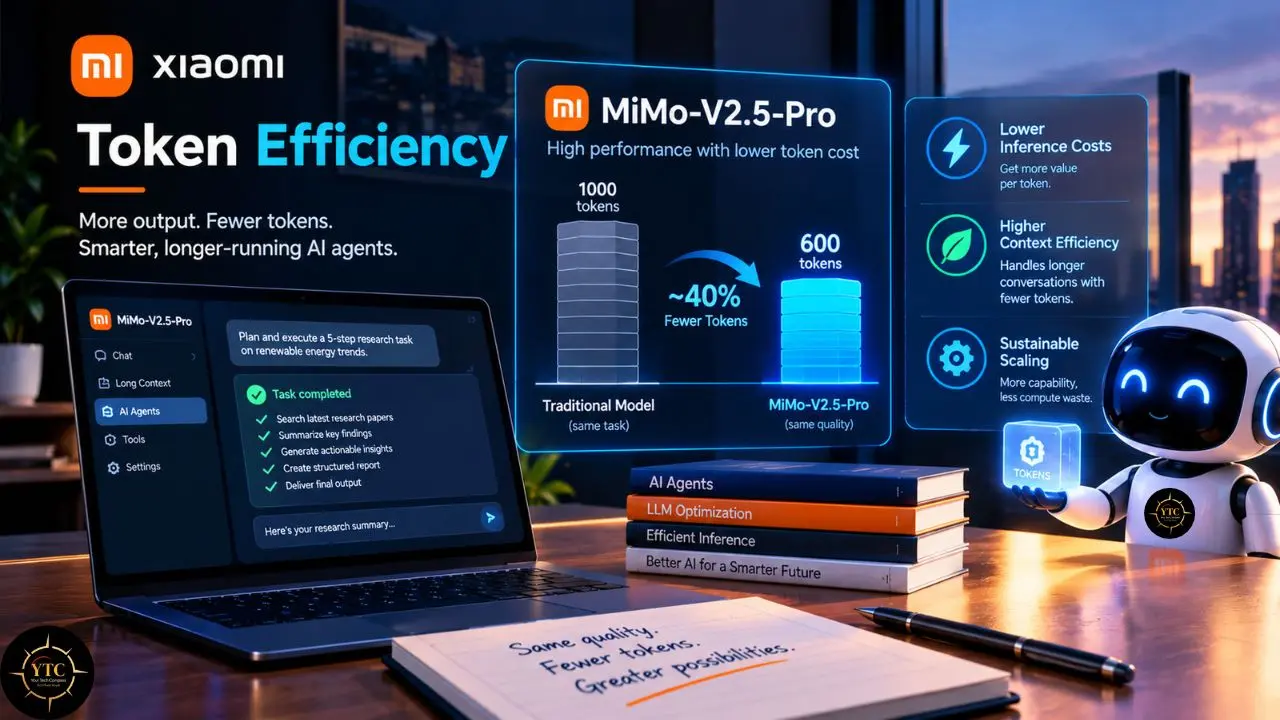
Xiaomi’s second selling point is doing more with fewer tokens. On ClawEval, it reports a 64% Pass^3 using about 70,000 tokens per trajectory, which it says is roughly 40–60% fewer tokens than Claude Opus 4.6, Gemini 3.1 Pro, and GPT-5.4 at comparable capability. Fewer tokens means a lower bill and faster completion, so efficiency compounds with the low per-token price.
There’s a catch, though: Xiaomi ran that chart itself. Independent tracking by Artificial Analysis is more modest but supportive, putting the weighted cost per Intelligence Index task at about $0.05. I would treat Xiaomi’s 40–60% figure as a promising claim, not a settled fact.
Long-Context Memory
A 1M-token window is only useful if the model can still find things inside it. On the GraphWalks long-context test, Xiaomi reports that its predecessor V2-Pro collapsed to 0.00 at 1M tokens. V2.5-Pro, by contrast, scores 0.56 on breadth-first search and 0.92 on parent lookups at 512K, and 0.37 and 0.62 at 1M.
The improvement is large, and the remaining decay is just as telling. Retrieval stays strong at half a million tokens, then thins out near the limit.
Where the Flagship Feature Falls Short
Long-run endurance comes with conditions. Xiaomi’s own wording ties it to a proper harness, so a thin wrapper may not reproduce the demos. Nor does Xiaomi publish a failure rate for long runs, which leaves you guessing how often a thousand-call task derails.
The 1M window also degrades near its limit, as the GraphWalks numbers show. My practical read: treat 1M as a ceiling, keep critical instructions near the end of the prompt, and test your own workload before trusting it. Finally, V2.5-Pro accepts text only, while the smaller MiMo-V2.5 and the V2.6 family take images, video, and audio.
Benchmarks and What They Actually Tell You
Start with who ran the test. Most agentic numbers below come from Xiaomi or from results Xiaomi published on its Hugging Face model card, so they show a ceiling, not an audit.
Measure | Result | Source Type |
SWE-bench Pro | 57.2 | Published on the model’s Hugging Face card (vendor-reported) |
SWE-bench Verified | 78.9 | Same listing |
Terminal-Bench 2.0 | 68.4 | Same listing |
ClawEval Pass^3 | 64% at about 70K tokens per trajectory | Xiaomi’s own chart |
GraphWalks at 512K | 0.56 BFS / 0.92 Parents | Xiaomi model card |
GraphWalks at 1M | 0.37 BFS / 0.62 Parents | Xiaomi model card |
Independent scoring complicates the picture. One third-party write-up lists V2.5-Pro at 26.0 on the Artificial Analysis Intelligence Index, against 46.3 for V2.6-Pro, though index versions change, so verify both figures before you quote them. Either way, the direction is clear: V2.5-Pro is capable but no longer Xiaomi’s best.
Pricing With Real Cost Math
On Xiaomi’s platform, MiMo-V2.5-Pro costs $0.435 per million fresh input tokens and $0.87 per million output tokens. Cache hits cost just $0.0036 per million. Early launch coverage reported tiered rates of about $1 input and $3 output for prompts up to 256K, with higher long-context tiers, but Xiaomi’s current price page shows the lower figures.
Price lists hide the real story, so here is what typical jobs cost at those rates:
Scenario | Token Mix | Estimated Cost |
Blended agent workload (Artificial Analysis’s 7:2:1 mix) | 1M tokens: 700K cached, 200K fresh input, 100K output | About $0.18 |
One long-document read | 200K fresh input, 3K output | About $0.09 |
50-step coding loop, no caching | 5M input, 100K output | About $2.26 |
Same loop, 90% cache hits | 4.5M cached, 0.5M fresh, 100K output | About $0.32 |
The last two rows carry the lesson. Caching cuts that loop’s cost by roughly 86%, which makes prompt structure a bigger lever than any discount. Put stable instructions and files at the start of every request so the cache can hit.
By comparison, Artificial Analysis lists a $1.68 median output price among comparable models, so $0.87 sits at about half. Third-party hosts vary: Artificial Analysis names GMI as the cheapest provider on listed per-token rates, at about $0.35 input and $0.70 output, and OpenRouter has shown promotional discounts. Prices move quickly, so check the live pages before you budget.
Open Weights, the MIT License and Self-Hosting Reality
MIT licensing is the real strategic advantage. You can download the weights, fine-tune them, deploy them privately, and ship products on top without negotiating terms. For regulated industries or anyone nervous about sending data to a third-party API, that freedom is the point.
The hardware tells a harsher story. The official vLLM recipe calls for eight H200 GPUs (141 GB each) on one node, plus a pre-built Docker image, while multi-node deployments are also documented for larger setups. Multiple GGUF quantizations exist for tools like llama.cpp and Ollama, but even those will not make a trillion-parameter model a laptop project: a recommended Q4_K_M quant is still roughly 623 GB.
In my view, most readers should treat the weights as a safety valve, not a starting point. Use the API now, and self-host only if volume or compliance demands it. If you want to try open models on your own machine, our guide to running open-source LLMs locally and safely covers the realistic route, and hosted-inference platforms such as Together AI show how open-weight models are usually served at scale.
The Deadline Every API User Should Know About
Here is the detail that changes the buying decision. Xiaomi’s update log says requests to MiMo-V2.5-Pro and MiMo-V2.5 began auto-routing to V2.6 on October 14, 2026, and the old model IDs become invalid on October 21 at 10:00 UTC+8. If you hard-coded mimo-v2.5-pro, you are already talking to a different model.
The open weights are a separate matter. The MIT-licensed V2.5-Pro files remain on Hugging Face, so self-hosters can keep a frozen, reproducible version. API users, however, should migrate and re-test their prompts.
Model | Params (Total / Active) | Inputs | API Price per 1M (In / Out) | Status |
MiMo-V2.5-Pro | 1.02T / 42B | Text | $0.435 / $0.87 | Hosted ID retires October 21, 2026; weights stay on Hugging Face |
MiMo-V2.5 | 310B / 15B | Text, image, video, audio | $0.14 / $0.28 | Also auto-routed to V2.6 |
MiMo-V2.6-Pro | 1.02T / 42B | Text, image, video, audio | $0.435 / $0.87 | Current flagship, 1M context |
MiMo-V2.6-Flash | 310B / 15B | Omnimodal | Unchanged from V2.5, per Xiaomi | Current low-cost tier |
Compared with MiMo-V2.6-Pro right now: the price is the same, the context is the same, and the newer model adds image, video, and audio input. Xiaomi reports a 46.32 score on the Artificial Analysis Intelligence Index version 4.3.2 for V2.6-Pro. Unless you need frozen weights, I see little reason to start a new project on V2.5-Pro.
MiMo-V2.5-Pro vs. the Alternatives
Among open-weight models in this size class, the closest peers are DeepSeek-V4-Pro and Kimi-K2. Xiaomi’s own base-model table shows a mixed picture, not a clean sweep:
Benchmark (Base Models) | MiMo-V2.5-Pro Base | DeepSeek-V4-Pro Base | Kimi-K2 Base |
Active / Total Params | 42B / 1.02T | 49B / 1.6T | 32B / 1.04T |
MMLU-Pro | 68.5 | 73.5 | 69.2 |
MATH | 86.2 | 64.5 | 70.2 |
TriviaQA | 81.3 | 85.6 | 85.1 |
LiveCodeBench v6 | 39.6 | – | 26.3 |
The pattern is clear. MiMo leads on math and code here, while DeepSeek-V4-Pro Base wins on knowledge-heavy tests such as MMLU-Pro and TriviaQA. These are pretrained checkpoints, not the chat models you would deploy, so they indicate underlying capability more than finished behavior.
Compared with other open-weight families: our reviews of GLM-4.7, Qwen 3, and Llama 4 show how each approaches size, licensing, and strengths differently. MiMo’s distinctive bet is long-run agent endurance at a comparatively low token cost.
Against closed models, Xiaomi benchmarks itself against Claude Opus 4.6, Gemini 3.1 Pro, and GPT-5.4. If you want the paid-model side of that decision, our explainers on ChatGPT 5.4 and Claude Opus 4.7 cover what you would be weighing it against. Browse more model deep-dives in AI Unboxed.
Real-World Use Cases

- Autonomous coding agents. Long refactors, test-fix loops, and repo-wide migrations suit a model that Xiaomi says can sustain tasks spanning more than a thousand tool calls. The practical takeaway: pair it with a harness that checkpoints progress, so a late failure doesn’t erase hours of work.
- Long-document pipelines. A 200K-token contract set or codebase costs about nine cents per read at list prices, so a hundred such reads run roughly $9. That makes bulk review and extraction affordable for small teams.
- Research and automation. Multi-step research that browses, summarizes, and writes benefits from the same endurance. The trade-off is that you must verify outputs yourself, because Xiaomi does not publish an independently verified hallucination rate for this model.
- Batch workloads with shared prefixes. Anything that reuses the same instructions or files across many calls can exploit cached input pricing of $0.0036 per 1 million tokens. In my view, this is the most underrated way to cut costs here.
Honest Limitations
Four limits stand out. Xiaomi is retiring the hosted V2.5-Pro model IDs (requests began auto-routing to V2.6 on October 14, 2026, and the old IDs become invalid on October 21, 2026); input is text-only, self-hosting needs serious GPU capacity, and most headline results come from the vendor. I would add a fifth: I have not verified Xiaomi’s API data-handling terms, so read them before you send customer records.
Who Should and Shouldn’t Use MiMo-V2.5-Pro
It suits you if you:
- Need an MIT-licensed model whose weights you can download, fine-tune, and host privately.
- Run long text-and-code agent jobs where per-token price dominates.
- Want to benchmark an open alternative against paid frontier models.
Skip it if you:
- Are starting a new project that depends on the hosted mimo-v2.5-pro ID after October 21, 2026.
- Need image, video, or audio input.
- Lack GPU capacity and don’t want to rely on a third-party host.
The Review Landscape
Two stories circulate about this model. Promotional roundups crown it the best open-source LLM using Xiaomi’s own charts, while independent trackers place it lower on a standardized index: Artificial Analysis scores V2.5-Pro at 26, while V2.6-Pro scores 46.32. Both can be true: the model is strong at its target job, and the target is narrow.
Community signals look healthy. At the time of my research, its Hugging Face page showed 764 likes, 19 community discussions, and about 19,500 downloads in the prior month. For a sense of how head-to-head chatbot hype plays out, see our Grok vs ChatGPT breakdown.
MiMo-V2.5-Pro for African Developers and Startups
Price is the clearest advantage for African developers and startups. At $0.435 and $0.87 per million tokens, a team in Lagos, Nairobi, or Accra can run serious agent experiments for a few dollars, and Artificial Analysis’s roughly $0.05 per benchmark task shows how small each job can be. For startups watching dollar-denominated bills against local currencies, that predictability matters.
There are gaps, though. Practical self-hosting guides point to an eight-GPU node, which is out of reach for most local teams, and Hugging Face tags the model for English and Chinese only. I found no independent evaluation of Swahili, Yoruba, Hausa, or Amharic performance, so test your language before you commit.
For policymakers and investors, the lesson is infrastructure: open weights only democratize AI if regional compute and data-protection rules keep pace. Explore more in our African Tech coverage and AI in Africa section.
FAQs
MiMo-V2.5-Pro is Xiaomi’s open-weight Mixture-of-Experts language model with 1.02 trillion total and 42 billion active parameters. It targets agentic coding, long-horizon tasks, and 1M-token context work. Xiaomi released it on April 22, 2026, and published the Hugging Face weights and model card on April 27, 2026.
The weights are open under the MIT license and free to download from Hugging Face. Running them yourself requires heavy GPU hardware, though. The hosted API charges per token.
Xiaomi lists $0.435 per million fresh input tokens, $0.87 per million output tokens, and $0.0036 per million cached input tokens. Third-party hosts may charge differently. Verify current rates before budgeting.
The post-trained model supports about 1 million tokens (1,048,576), with up to 131,072 output tokens on listed providers. The base model supports 256K. As with any long-context model, test retrieval and reasoning at the context lengths you actually plan to use.
You can keep using the open weights indefinitely. The hosted MiMo-V2.5-Pro ID, however, auto-routes to V2.6 from 14 October and becomes invalid on October 21 at 10:00 (UTC+8). Migrate API calls and re-test your prompts.
For new projects, V2.6-Pro looks stronger: same size and price, plus omnimodal input and a higher Intelligence Index score. Choose V2.5-Pro only if you need to preserve its original checkpoint for reproducibility. That is my opinion, based on Xiaomi’s and third parties’ published figures.
Reading the Compass: What MiMo-V2.5-Pro Teaches Us About Open AI Giants

MiMo-V2.5-Pro shows how quickly the gap between open and closed models is narrowing, and how quickly any single model can age. Within roughly six months, Xiaomi shipped a 1.02-trillion-parameter open-weight model, introduced a stronger successor, and scheduled the old API ID for shutdown. The useful lesson is not “pick this model” but “build so you can swap models without a rewrite.”
If you are a developer, wrap your model calls behind a thin, model-agnostic interface, structure prompts for caching, and re-test whenever a provider reroutes an ID. Investors can read this as evidence that price-performance, not parameter count alone, increasingly drives adoption, though they should demand independent benchmarks before believing any vendor chart. Policymakers across Africa, meanwhile, should treat open weights as an opportunity only if they pair them with regional compute, clear data-protection rules, and local-language evaluation.
Models will keep changing faster than roadmaps can track them, so keep your bearings at YourTechCompass.com, where we re-check the map so you don’t have to.