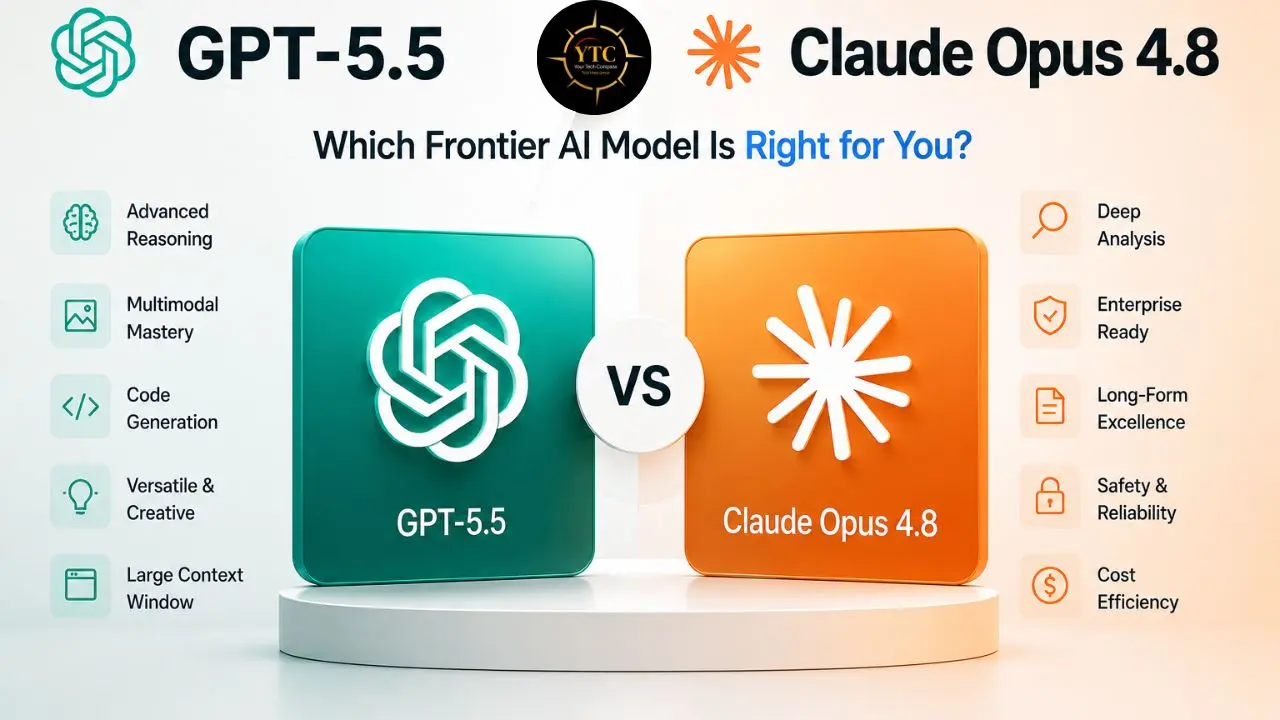
I want to frame this comparison with the exact timeline that makes it so interesting, because the context matters. OpenAI launched GPT-5.5 on April 23, 2026, and held the number-one position on the Artificial Intelligence Index for over a month. Then, on May 28, 2026 (just 35 days later, the fastest turnaround between Opus releases Anthropic has ever shipped), Claude Opus 4.8 arrived and displaced GPT-5.5 from the top spot, scoring 61.4 on the composite Intelligence Index versus GPT-5.5’s 60.2. Two flagship models from the two leading closed-source AI labs, both supporting 1-million-token context windows, both built for agentic multi-step workflows, both targeting the same enterprise and developer market, separated by just 5 weeks and less than two percentage points on the headline aggregate score.
The headline aggregate hides the real story, though, which is what this guide is actually about. These two models are close on composite intelligence but diverge sharply by task type, and the decision about which one belongs in your workflow is far more specific than any aggregate score can tell you. Opus 4.8 leads on SWE-bench Pro for real-world software engineering (69.2% vs 58.6%), knowledge work, legal reasoning, and agentic reliability. GPT-5.5 leads on Terminal-Bench 2.1 for terminal-driven agentic coding, runs leaner with fewer output tokens, and comes with the broader ChatGPT ecosystem: Advanced Voice Mode, native image generation, and the GPT Store. I’ve gone through every major benchmark, verified pricing from official sources, cross-referenced third-party evaluators, and built this comparison around the specific workflows where each model actually earns its subscription cost. By the end, you’ll have a direct, clear answer, not “both are great, it depends.”
A note before we begin: every YTC score is earned, never negotiated. If you want to understand exactly how we evaluate apps & tools, our Review Methodology lays it all out.
Quick Comparison: The Verified Numbers at a Glance
Before diving into the details, here’s the full current picture as of late June 2026, with every figure independently verifiable:
Dimension | GPT-5.5 | Claude Opus 4.8 |
Developer | OpenAI | Anthropic |
Release Date | April 23, 2026 | May 28, 2026 |
Context Window | 1,050,000 tokens | 1,000,000 tokens |
Max Output | 32K tokens | 128K tokens |
API Input Cost (per Mtok) | $5.00 | $5.00 |
API Output Cost (per Mtok) | $30.00 | $25.00 |
Fast Mode (Opus 4.8) | N/A | $10/$50 per Mtok (~2.5× speed) |
Consumer Subscription | ChatGPT Plus $20/month | Claude Pro $20/month |
Heavy User Tier | ChatGPT Pro $200/month | Claude Max $100–$200/month |
Intelligence Index (AA) | 60.2 | 61.4 (current #1) |
SWE-bench Pro (Coding) | 58.6% | 69.2% |
SWE-bench Verified | Strong | 88.6% |
Terminal-Bench 2.1 | 85.3% | 74.6% |
HLE (with Tools) | ~50% | 57.9% |
OSWorld-Verified | 78.7% | 83.4% |
MCP-Atlas (Agentic) | N/A | 82.2% |
Image Generation | ✅ DALL-E 4 native | ❌ No native generation |
Voice Mode | ✅ Advanced Voice Mode | ⚠️ Limited |
Persistent Memory | ✅ Yes | ✅ Yes (new in 4.8) |
Parallel Subagents | ⚠️ Limited | ✅ Hundreds (Dynamic Workflows) |
Open Weights | ❌ No | ❌ No |
What Is GPT-5.5: The Model and What It Brings

GPT-5.5, codenamed “Spud” internally at OpenAI, launched on April 23, 2026, as OpenAI’s first fully retrained base model since GPT-4.5. OpenAI describes it as its strongest agentic coding model to date, natively omnimodal, token-efficient, and designed for multi-tool orchestration at scale.
The clearest architectural advance over GPT-5.4 is token efficiency: OpenAI reports that GPT-5.5 uses fewer tokens to complete the same Codex tasks at the same per-token latency. This matters in practice because in agentic coding workflows, where a model makes dozens of sequential calls, lower per-call token counts compound into meaningfully lower latency and cost across the full workflow, even at the same headline price. OpenAI’s GPT-5.5 system card reports that individual claims in GPT-5.5 outputs are 23% more likely to be factually correct, and that responses contain a factual error 3% less often.
GPT-5.5 is available across ChatGPT Plus ($20/month), ChatGPT Pro ($200/month), Team, and Enterprise tiers. A GPT-5.5 Pro variant is available at the API level, priced at $30 per million input tokens and $180 per million output tokens, and targets the highest-accuracy, highest-stakes professional deployments. Standard API pricing is $5/$30. The ecosystem surrounding GPT-5.5 is genuinely broad: Advanced Voice Mode, native DALL-E 4 image generation, real-time web search, Canvas collaborative editor, and the full GPT store of third-party integrations.
For an understanding of how GPT-5.5 compares to its immediate predecessor, our ChatGPT 5.4 guide covers that generational progression in detail.
What Is Claude Opus 4.8: The Model and What It Brings
Claude Opus 4.8 arrived May 28, 2026, 35 days after GPT-5.5, Anthropic’s fastest Opus turnaround ever. Rather than positioning it as a dramatic generational leap, Anthropic is explicit that Opus 4.8 is a point release over Opus 4.7: the same $5/$25 API pricing, the same 1M context window, and the same architecture. The improvements are targeted and specific, which, as it turns out, is exactly what the benchmarks validate.
The headline qualitative shift in Opus 4.8 is honesty. Anthropic reports that the model is four times less likely than Opus 4.7 to let flawed code pass without flagging it, a change that sounds minor until you’re running hundreds of unattended agentic tasks and the difference between a model that says “this approach has a potential issue” versus one that silently continues matters enormously. The improvement in hallucination rate is concrete: Opus 4.8 shows a 35.9% hallucination rate on AA-Omniscience under the tested conditions, which is materially better than several peer models and earlier Claude releases on that benchmark. That suggests it may be safer for unattended production runs, though the exact risk reduction will depend on the workload and failure mode.
The feature additions are substantial. Dynamic Workflows in Claude Code can now spawn hundreds of parallel subagents in a single session, a capability targeted directly at codebase-scale refactoring and large-project agentic workflows that previously required orchestration layers external to the model.
Persistent memory is new in 4.8, finally matching the session-continuity capability that ChatGPT has offered for some time, allowing Opus to retain organizational context, workflow preferences, and learned patterns across separate conversations. Effort controls allow you to explicitly dial in reasoning depth per request, and Fast Mode, at $10/$50 per million tokens (approximately 2.5x output speed for a 3x price reduction), directly targets latency-sensitive production workloads.
For a complete breakdown of the predecessor model Opus 4.8 builds on, our Claude Opus 4.7 guide and Claude AI Explained both cover the architectural lineage in detail. If you’re specifically evaluating Claude for software engineering use, our guide on using Claude AI for coding is the most directly applicable resource on that site.
Benchmark Performance: The Honest Data, Benchmark by Benchmark
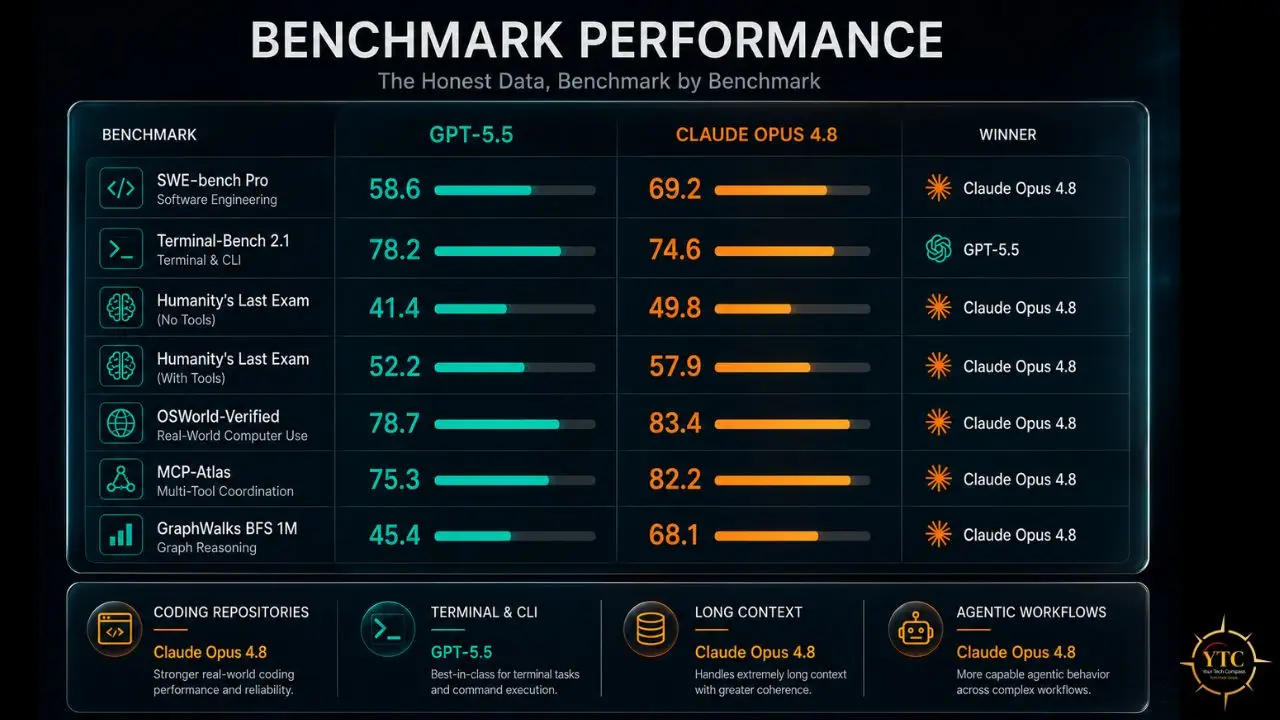
This is the section where precision matters most and where most comparison articles fall short, because reporting benchmark scores without explaining what each benchmark actually tests produces numbers that look informative but don’t help you make a decision.
Artificial Analysis Intelligence Index: The Composite Picture
The Intelligence Index from Artificial Analysis aggregates performance across a wide range of benchmarks into a single composite score and applies it consistently across models using the same evaluation harness. As of May 28, 2026, Claude Opus 4.8 leads with 61.4, ahead of GPT-5.5 at 60.2, the first time a Claude model has taken the top position since OpenAI’s April launch.
A composite score compresses dozens of very different skills into one number, and it should inform your decision, not make it. The more useful picture is the breakdown: Claude Opus 4.8 has a clear advantage in coding benchmarks, while GPT-5.5 leads some terminal-style agentic tasks. Which model is better at multimodal or grounded work depends on the specific benchmark and task type.
SWE-bench Pro: The Most Important Coding Benchmark
The SWE-bench tests models on resolving actual GitHub issues from real open-source repositories, not algorithm puzzles or syntax generation, but understanding an existing codebase and implementing a correct, working change. SWE-bench Pro is a harder variant that reduces the risk of inflated scores due to test data leakage.
On SWE-bench Pro, Opus 4.8 scores 69.2%, compared to 64.3% for Opus 4.7 and 58.6% for GPT-5.5, a substantial lead on the harder benchmark. For reference, SWE-bench Verified (the established version of the benchmark) shows Opus 4.8 at 88.6%, a benchmark that has become increasingly saturated at the frontier, which is exactly why the Pro variant is more informative at this performance tier.
Terminal-Bench 2.1: Where GPT-5.5 Wins
Terminal-Bench 2.1 measures agentic coding performance specifically in terminal-driven, multi-step environments, where the model must navigate file systems, run commands, parse output, and iterate. This is the benchmark category where GPT-5.5 leads on Terminal-Bench 2.1, with Opus 4.8 trailing by several points. Specifically, Terminal-Bench 2.1 reports GPT-5.5 at approximately 83.4%, compared to Opus 4.8 at 74.6%.
This gap is real and important for a specific developer workflow: if you’re running coding agents that primarily operate through CLI tools, shell scripts, and direct terminal interaction rather than IDE-integrated development, GPT-5.5’s Terminal-Bench advantage translates to a genuinely better real-world experience.
Humanity’s Last Exam (HLE): Cross-Domain Expert Reasoning
HLE tests graduate-level problems across mathematics, science, law, medicine, economics, and humanities, designed to require genuine reasoning rather than test data recall. This benchmark is meaningful precisely because it tests capabilities that don’t degrade gracefully with test-set memorization.
On Humanity’s Last Exam, Opus 4.8 scores 49.8% without tools and 57.9% with tools. The GPT-5.5 score is approximately 50% without tools, meaning both models are in the same performance tier on this benchmark, with Opus 4.8 pulling slightly ahead when tools are available and GPT-5.5 comparable in the pure text-only condition.
OSWorld-Verified: Computer Use and Autonomous GUI Navigation
OSWorld measures how well models can autonomously navigate and complete tasks on real computer interfaces (clicking through applications, filling forms, managing files) without scripted shortcuts. This is the benchmark most directly relevant to agentic applications of “computer use”.
Claude Opus 4.8 leads GPT-5.5 on OSWorld-Verified at 83.4% versus GPT-5.5 at 78.7%, while GPT-5.5 still leads on Terminal-Bench. MCP-Atlas measures multi-step tool coordination across MCP-connected services and external tools, and Opus 4.8 scores 82.2% on the benchmark. GPT-5.5 also has a published MCP-Atlas score in at least one leaderboard snapshot, at 75.3%.
Knowledge Work and Legal Reasoning
On GDPval-AA, Anthropic reports Opus 4.8 at 1,890 Elo, up from 1,753 for Opus 4.7, with agentic financial analysis rising from 51.5% to 53.9%. Anthropic also reports that Opus 4.8 scored 10.4% on Harvey’s Legal Agent Benchmark, making it the first model to exceed 10% on LAB’s strict all-pass scoring system.
The Full Benchmark Summary

Benchmark | GPT-5.5 | Claude Opus 4.8 | Leader |
Intelligence Index (AA) | 60.2 | 61.4 | Opus 4.8 |
SWE-bench Pro (Real Coding) | 58.6% | 69.2% | Opus 4.8 by 10.6 pts |
SWE-bench Verified | Competitive | 88.6% | Opus 4.8 |
Terminal-Bench 2.1 | 83.4% | 74.6% | GPT-5.5 |
HLE with Tools | ~50% | 57.9% | Opus 4.8 |
OSWorld-Verified | 78.7% | 83.4% | Opus 4.8 |
MCP-Atlas (Agentic) | N/A | 82.2% | Opus 4.8 |
GDPval-AA (Knowledge Work) | 84.9% | 1,890 Elo (leading) | Opus 4.8 |
Terminal / CLI-Driven Agents | Leads | Trails | GPT-5.5 |
LiveBench | Leads | Trails | GPT-5.5 |
OfficeQA Pro | 54.1% | 66.2% | Opus 4.8 |
GPQA Diamond (Science) | 93.6% | 93.6% | Tied |
The Honest Overall Picture
Opus 4.8 leads across more benchmarks and by wider margins in most categories. GPT-5.5 is the better choice if agentic, terminal-driven workflows are the priority. Claude Opus 4.8 is clearly ahead on the provisional aggregate, and the gap in coding benchmarks, specifically, is large enough that it doesn’t require careful examination to see.
Coding Performance: The Use Case That Decides It for Most Developers
Let me give you the specific picture here, because “which is better for coding” is actually three different questions depending on what kind of coding you do.
Multi-File Codebase Work and Correctness-Critical Refactoring
When tasks involve changes across five or more files (updating interfaces, propagating type changes, maintaining consistency across a module), Claude Opus 4.8 handles them with noticeably fewer errors. It tends to be more conservative about introducing changes it can’t trace back to an explicit requirement, which reduces drift during multi-step refactors.
GPT-5.5 can produce refactored code that looks clean but introduces subtle inconsistencies between files, particularly around naming conventions and return types. For bug-fixing tasks, Claude Opus 4.8 scores higher in root-cause accuracy, meaning it identifies the actual source of a bug rather than patching its symptoms.
This is the precise scenario where SWE-bench Pro’s 10.6-point gap in Opus 4.8’s favor is visible in practice, not just in spreadsheets.
Terminal-Driven and CLI-Heavy Workflows
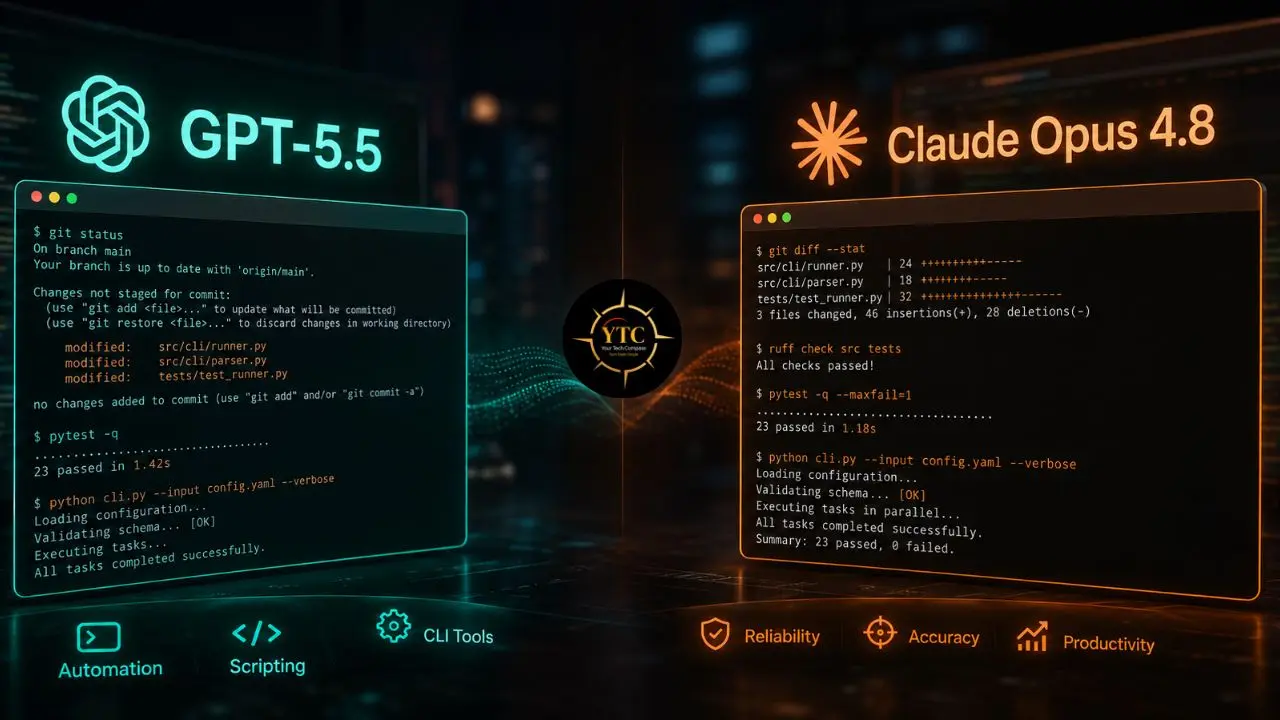
GPT-5.5’s Terminal-Bench 2.1 lead (83.4% vs 74.6%) is real and reflects a genuine qualitative difference: GPT-5.5 is faster, more token-efficient, and handles most hard terminal tasks without freezing during the kind of real developer testing documented in the Composio benchmark run. GPT-5.5 used much lower output token volume compared to Opus 4.8 in equivalent agentic coding runs, meaning even at the higher output price, it ended up cheaper in certain workflows because it generated far fewer output tokens.
This is the use case where routing to GPT-5.5 specifically pays off, particularly if your coding agent workflow is primarily CLI-based rather than IDE-integrated.
The Dynamic Workflows Advantage
Opus 4.8’s Dynamic Workflows feature in Claude Code (the ability to spawn hundreds of parallel subagents in a single session) is the agentic coding capability with no direct equivalent in GPT-5.5. For codebase-scale tasks where parallelism dramatically accelerates completion (reviewing hundreds of files simultaneously, running parallel test scenarios, orchestrating multiple concurrent refactor streams), this is a genuine architectural differentiator rather than a marketing feature. Our Claude Cowork review covers how this agentic architecture extends into Microsoft’s AI ecosystem, where Opus powers collaborative features.
The Honesty Factor for Unattended Runs
The “4x less likely to let flawed code pass without flagging it” improvement in Opus 4.8 deserves specific attention for agentic use cases, because this safety property matters most when you’re not watching the model work. A model that generates plausible-looking but subtly wrong code with confidence is actively worse than a model that generates the same wrong code but flags uncertainty, because the confident model silently introduces bugs you’ll discover in production rather than in review.
Reasoning, Writing, and Analysis: Where the Qualitative Differences Show
Both models are strong enough at general writing and analysis that the differences only become consistently visible with specific workflow types. Here’s where I’ve found each model’s qualitative character most clearly differentiated:
- GPT-5.5’s writing style handles casual, conversational prompts with high consistency; the model degrades less noticeably when prompts are loosely structured, which matters for teams whose prompt engineering quality varies. The factual accuracy improvements documented in the system card (23% more likely to be correct per claim) translate to a lower downstream editing burden for research-heavy content. GPT-5.5 handles more casual, conversational prompts with less degradation than Opus 4.8.
- Opus 4.8’s writing style shows consistent advantages in three specific scenarios: preserving voice when given a reference style, maintaining internal consistency and argument structure across very long documents, and acknowledging uncertainty with calibrated precision rather than projecting false confidence. Claude Opus 4.8 generally responds better to detailed, structured prompts. For high-stakes analytical writing (legal briefs, technical research synthesis, executive reports), Opus 4.8’s advantage in qualitative output is consistently reported in independent user evaluations.
The knowledge work benchmark supports this qualitatively: Opus 4.8’s GDPval-AA Elo of 1,890 implies roughly a 67% win rate over GPT-5.5 on knowledge-work tasks, a statistically robust advantage across the range of tasks that the benchmark covers. The broader landscape of frontier model comparisons in YourTechCompass’s AI Unboxed section covers how both models compare against third-party competitors such as Grok 4, DeepSeek V4, and Gemini.
Our Grok 4 review is specifically worth reading if you’re evaluating the full frontier tier rather than just this two-way comparison. For context on how other frontier models from different labs have approached similar benchmarks, our Qwen 3 review and GLM-4.7 Zhipu AI review cover the open-weight alternatives that are increasingly competitive at this tier.
Multimodal Capabilities: The Clearest Difference Between These Models
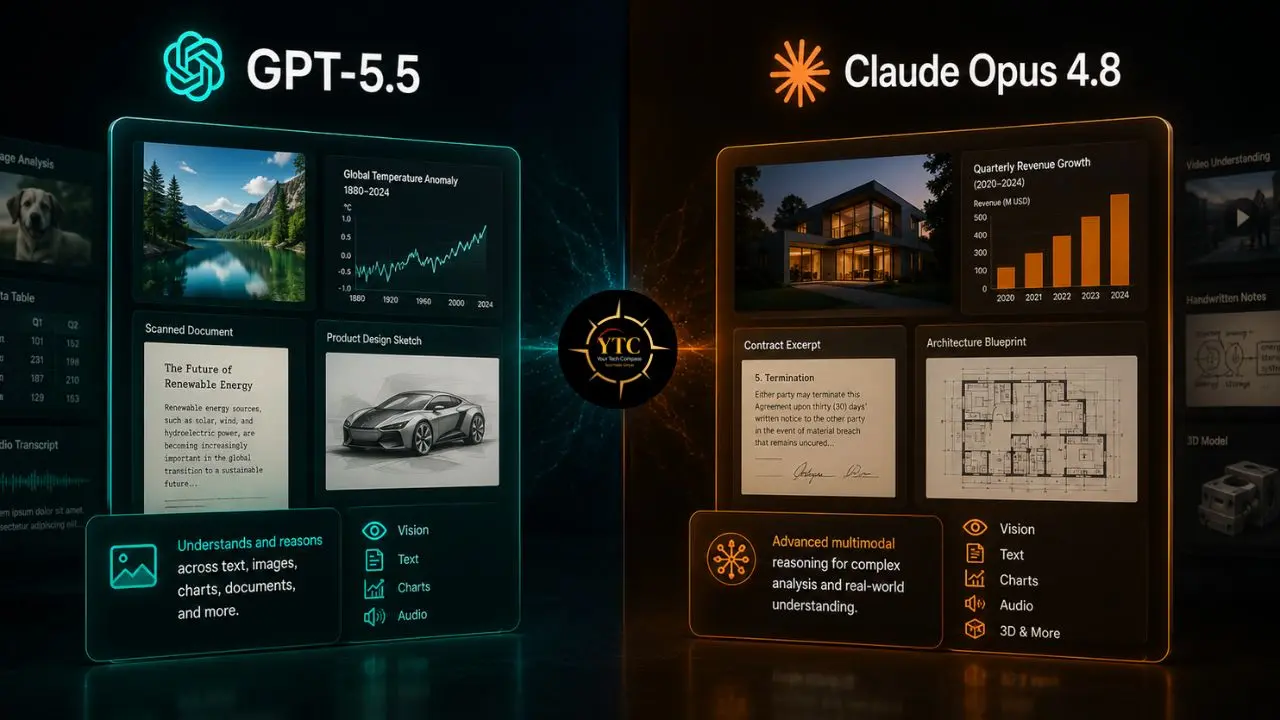
This is where the comparison is most one-sided, and it’s worth naming plainly rather than softening the gap.
GPT-5.5 Multimodal Capabilities:
- Native image generation via DALL-E 4 (directly in ChatGPT)
- Advanced Voice Mode (natural, low-latency voice conversation with emotional range)
- Vision: image analysis, chart interpretation, document reading
- Audio: transcription, voice input/output
- Video: frame analysis and description
Claude Opus 4.8 Multimodal Capabilities:
- Vision: genuinely strong for document and image analysis
- No native image generation (requires third-party integration)
- Limited voice mode (primarily text-based)
- No native video analysis at comparable depth
If multimodal capability is a meaningful part of your daily workflow (image generation, voice interaction, video analysis), GPT-5.5 leads by a significant margin. This isn’t a close call, and the gap doesn’t narrow in specific contexts. For text-and-code-only workflows, this difference is irrelevant. But it’s a real, practical consideration for content creators, product designers, educators, and anyone whose AI workflow spans media types.
Our ChatGPT vs Grok comparison covers how GPT-5.5’s multimodal suite compares against Grok’s equivalent capabilities, which is useful context if multimodal performance is a primary criterion. And if you’re comparing to older ChatGPT generations to understand the trajectory, our ChatGPT 4 guide illustrates how far the multimodal capabilities have progressed.
Pricing: The Complete 2026 Picture
The pricing situation is more nuanced than most headlines suggest, and the specific tier you’re evaluating changes the conclusion about the tier.
Standard API Pricing (Corrected)
The most important clarification for anyone coming from older comparison articles: Opus 4.8 is NOT the more expensive model at standard API rates. The actual current pricing:
Tier | GPT-5.5 | Claude Opus 4.8 |
Input (per Mtok) | $5.00 | $5.00 |
Output (per Mtok) | $30.00 | $25.00 |
Fast Mode Output | N/A | $50.00 (2.5× speed) |
Pro / High-Accuracy API | $180.00 output | N/A equivalent |
Prompt Caching Savings | ~90% on cached | ~90% on cached |
Batch Processing Savings | 50% | 50% |
At standard API rates, Opus 4.8 is cheaper per million output tokens than GPT-5.5, so for a 100-million-token monthly workload, it would save about $500 on output costs alone. For output-heavy agentic workflows, that difference can still compound at scale. In addition, for AI inference at scale, our AI inference cost optimization guide covers broader strategies (caching, batching, model routing) applicable to production deployments of either model.
However, the real-world cost picture is complicated by token efficiency. GPT-5.5 uses a much lower output token volume than Opus 4.8 in equivalent agentic coding runs, meaning that even at the higher output price, it ended up cheaper in certain workflows because it generated far fewer output tokens. This means the cost comparison is genuinely workflow-dependent: for the same task, GPT-5.5 sometimes uses fewer tokens and thus costs less despite the higher per-token rate. The right approach is testing both models on your specific workload rather than projecting from headline prices.
Consumer Subscription Tier
- ChatGPT Plus ($20/month): Access to GPT-5.5 with usage limits, DALL-E 4, Advanced Voice Mode, web search, and Canvas. The access limits at this tier are meaningful for heavy daily use.
- Claude Pro ($20/month): Access to Opus 4.8 with usage limits, and heavy Claude users report hitting those limits sooner than ChatGPT Plus’s equivalent, particularly given Opus’s output verbosity.
- Claude Max ($100 or $200/month): For consistent, heavy daily Opus 4.8 access. The $200 tier unlocks 5× the usage of Claude Pro.
- ChatGPT Pro ($200/month): For the heaviest ChatGPT users, including access to extended reasoning and priority compute.
The practical consumer-tier reality: both apps charge $20/month as an entry point, but heavy professional users of Opus 4.8 frequently find they need the $100–$200/month Claude Max tier to maintain meaningful daily access to the flagship model.
Agentic and Autonomous Task Performance
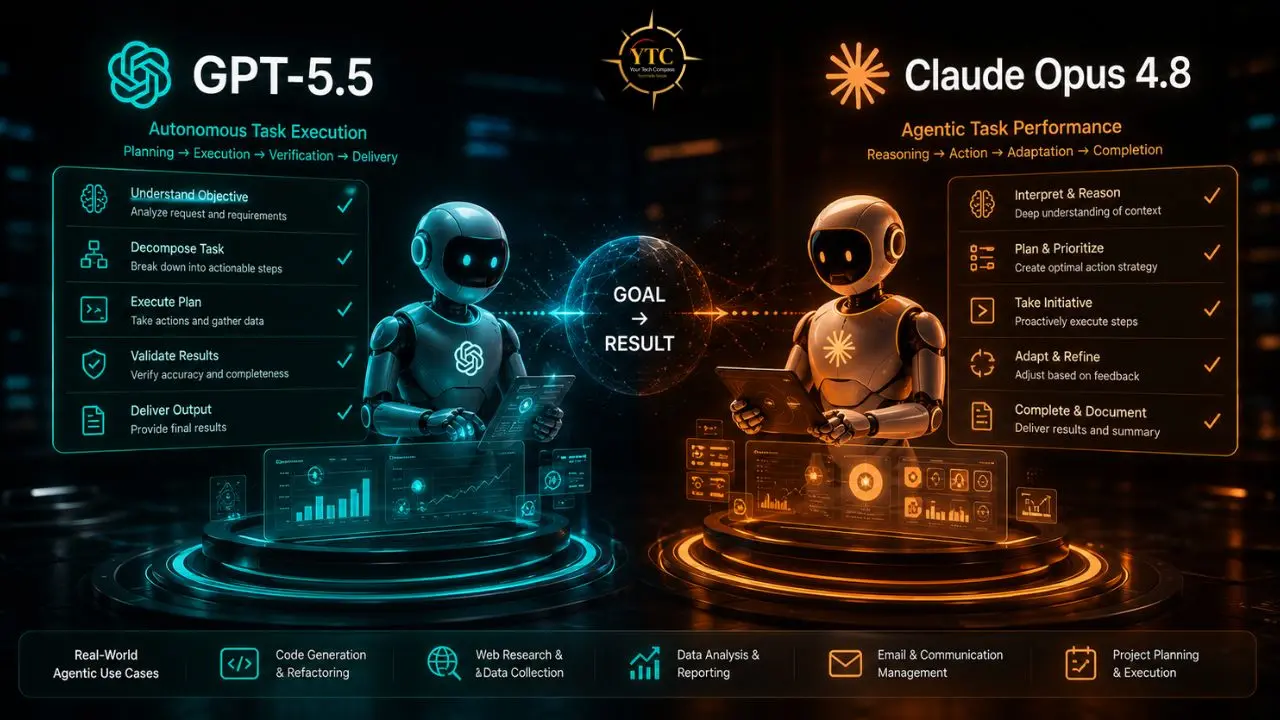
The most consequential shift in frontier AI is the move from conversational assistance to autonomous multi-step task execution, and this is the dimension in which the Anthropic vs. OpenAI architectural philosophies diverge most visibly.
Opus 4.8’s approach to agentic reliability is the “honesty first” philosophy: the model is specifically trained to flag uncertainty, refuse to proceed when something seems wrong, and surface issues rather than silently continue. Its honesty gains make unattended runs safer. For reliability-critical agents, Opus 4.8; for cost and latency, GPT-5.5.
The MCP (Model Context Protocol) integration is part of Opus 4.8’s agentic tooling story: MCP-Atlas measures how well models coordinate tools across real MCP-connected workflows, and Opus 4.8 scores 82.2% on that benchmark. Anthropic’s ecosystem also supports MCP-style connections for accessing external tools and documentation, though the exact number of connected services should be cited carefully.
GPT-5.5’s agentic architecture offers advantages in throughput and terminal performance: faster token generation, lower per-task latency, and leadership on the Terminal-Bench 2.1 for the CLI-driven autonomous coding workflow. For volume-sensitive production environments where the agent runs many tasks per hour, GPT-5.5’s efficiency characteristics can translate into better real-world economics despite benchmark scores that trail Opus on some dimensions.
The recommended production pattern is not binary: multi-model routing. Route complex coding, code review, and reliability-critical agents to Opus 4.8, terminal-heavy and token-sensitive workflows to GPT-5.5, and high-volume simple tasks to a cheaper model. This typically cuts costs by 30 to 50% compared with using a single frontier model for everything.
Our DeepSeek vs ChatGPT comparison covers how cost-optimized models fit into exactly this kind of multi-tier routing architecture. For African developers and organizations evaluating which frontier models are most accessible and cost-effective at the infrastructure level, our AI in Africa category documents how API cost structures affect adoption across different market contexts.
Which Model Is Right for You: The Decision Framework
Let me be direct here rather than hedging, because the benchmark data actually supports specific recommendations for specific workflows.
Choose GPT-5.5 If:
- You run terminal-driven, CLI-heavy, agentic coding workflows in which Terminal-Bench 2.1 performance directly predicts your real-world experience.
- You need native multimodal capability (image generation, Advanced Voice Mode, video analysis) as a core part of your workflow, not an edge case.
- You’re building high-volume production applications where GPT-5.5’s token efficiency could reduce total cost despite the higher per-token output rate.
- You want the most complete chatbot ecosystem (DALL-E 4, Canvas, GPT store integrations, Microsoft 365 Copilot integration) in a single interface.
- You want the slightly larger 1,050,000-token context window specifically.
Choose Claude Opus 4.8 If:
- Real-world software engineering performance is your primary criterion. SWE-bench Pro’s 10.6-point lead over GPT-5.5 is the clearest performance differential in this entire comparison, and it’s on the benchmark most directly relevant to professional coding work.
- You’re building reliability-critical agents that run unattended, where honesty improvements (4x less likely to let flawed code pass silently) matter more than throughput.
- You need Dynamic Workflows’ parallel subagent capabilities for codebase-scale work.
- You process complex, multi-file codebases, where Opus 4.8’s superior long-context consistency reduces the downstream review burden.
- You work in knowledge-intensive domains (legal analysis, financial modeling, research synthesis), where the GDPval-AA and OfficeQA Pro advantages reflect genuinely better professional output quality.
For a longer look at how Anthropic is extending Opus’s capabilities through partnerships and enterprise features, our Claude Mythos guide covers Anthropic’s frontier research models alongside the production lineup.
Run Both If:
- Your organization spans multiple use cases (some terminal-heavy, some correctness-critical; some multimodal, some pure text), and the API compatibility between systems makes multi-model routing operationally feasible. The 30–50% cost reduction from intelligently routing tasks to the right model is a real, documented benefit, and both models are available through overlapping infrastructure providers (AWS Bedrock, OpenRouter), making dual-model setups straightforward to implement.
FAQs

On the Artificial Analysis Intelligence Index composite, Opus 4.8 leads slightly overall (61.4 vs 60.2). GPT-5.5 leads on Terminal-Bench 2.1, LiveBench, and CyberGym, while Opus 4.8 leads on SWE-bench Pro, OSWorld-Verified, MCP-Atlas, and several knowledge-work benchmarks. Neither model is universally better; the better choice depends primarily on the workflow you are optimizing for, as well as cost and latency constraints.
Both cost $5.00 per million input tokens. GPT-5.5 costs $30.00 per million output tokens; Opus 4.8 costs $25.00 per million output tokens. At standard API rates, Opus 4.8 is actually the cheaper model. However, GPT-5.5 is more token-efficient in some workflows, generating fewer output tokens to complete the same task, which can make the total cost comparable to or occasionally lower than the alternative despite the higher per-token rate. Test both models on your specific workload before projecting costs from headline numbers.
It depends on the type of coding. For multi-file codebase work, root-cause debugging, correctness-critical refactoring, and real-world GitHub issue resolution (SWE-bench Pro: 69.2% vs. 58.6%), Opus 4.8 has a clear, documented advantage. For terminal-driven, CLI-heavy agentic coding where speed and token efficiency matter (Terminal-Bench 2.1: ~85% vs ~75%), GPT-5.5 leads. Identify the category that best describes your primary workflow, and use it as the deciding factor.
No. Opus 4.8 does not have native image generation capability. GPT-5.5 includes DALL-E 4 image generation natively within the ChatGPT interface. For Opus 4.8, image generation requires third-party integration. If visual content creation is a meaningful part of your AI workflow, this is a genuine practical consideration that pushes toward GPT-5.5 for that specific task type.
Both offer free tiers with restrictions. ChatGPT’s free tier provides limited access to GPT-5.5. Claude.ai’s free tier provides limited access to Opus 4.8 (often defaulting to Sonnet rather than Opus). Meaningful professional access to either model’s flagship requires a paid subscription. $20/month for both at the entry level, with heavy usage requiring $100–$200/month tiers on each platform.
For reliability-critical agents that run unattended, Opus 4.8’s OSWorld-Verified score (83.4% vs 78.7%), MCP-Atlas leadership (82.2%), and honesty improvements make it safer for long autonomous runs. However, for terminal-driven, throughput-critical agentic workflows, GPT-5.5, with its Terminal-Bench 2.1 lead and token efficiency, better serves high-speed CLI automation. For production deployments spanning multiple task types, multi-model routing (using Opus 4.8 for correctness-critical work and GPT-5.5 for speed-critical work) typically reduces costs by 30–50% compared with using a single frontier model.
Final Thoughts
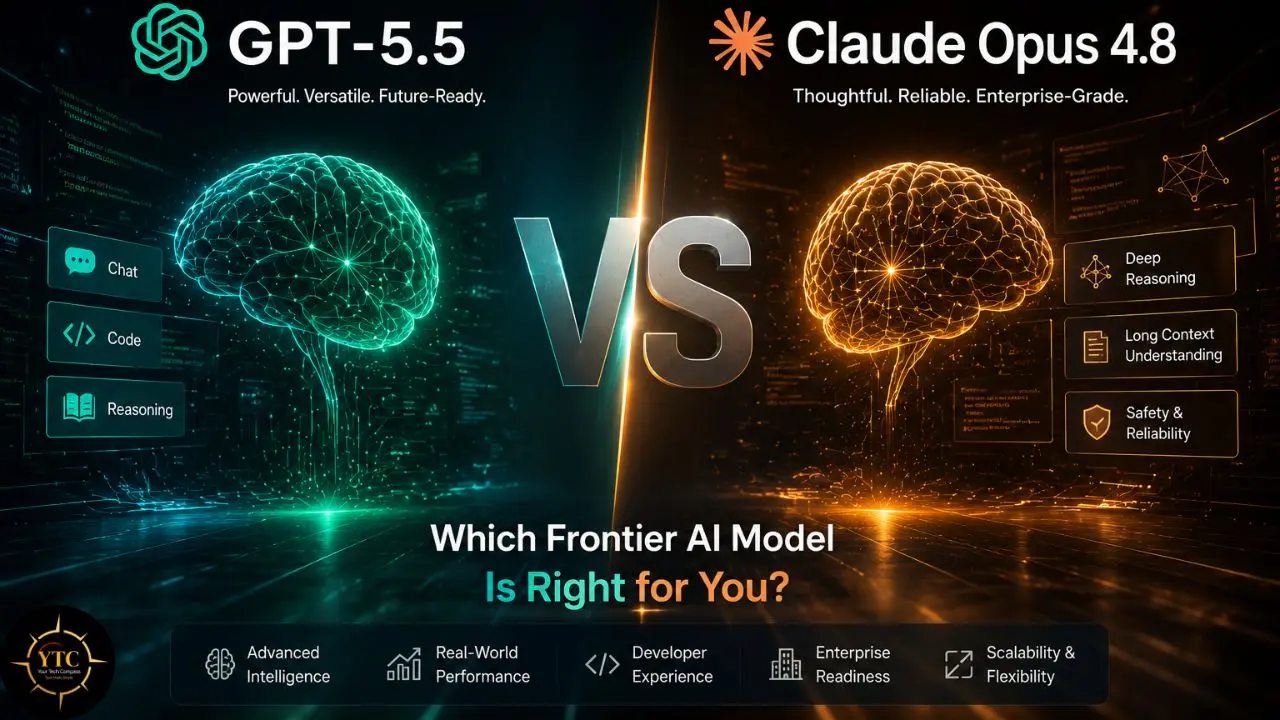
Here’s the clearest summary I can give you, based on every benchmark, pricing figure, and independent evaluation I’ve gone through: Opus 4.8 is the better model across more dimensions and by wider margins in most categories. It took the top spot on the Intelligence Index for a reason: 10.6 percentage points ahead on SWE-bench Pro, leading on OSWorld computer use, leading on knowledge work and legal reasoning, and doing all of this at a slightly lower output token price than GPT-5.5. The trajectory is also notable: Anthropic shipped 4.8 in 35 days, improved on the specific areas where production agentic deployments were failing (honesty, multi-file consistency, parallel execution), and positioned it as a reliability-first model for unattended AI work. That’s a coherent and well-executed product philosophy.
What that doesn’t mean is that GPT-5.5 isn’t the right choice for specific situations, because it absolutely is. Terminal-Bench 2.1, token efficiency, multimodal breadth, the ChatGPT ecosystem, and Microsoft 365 Copilot integration are real advantages that align directly with real workflows. The most sophisticated production teams don’t choose one model and apply it to every task; they route each task to the model that fits, and the 30–50% cost reduction that comes from doing this well is documented and achievable. The future of working with frontier AI isn’t a single tool subscription; it’s an intelligent stack where different models handle different jobs, each doing what it’s actually best at.
The frontier AI landscape is moving faster than any single comparison article can keep pace with; both Anthropic and OpenAI are now shipping on roughly six-week release cadences. For ongoing coverage of every significant model release, benchmark update, and pricing change, head to YourTechCompass.com, where the AI Unboxed section tracks every development worth knowing about.