You’ve got a great idea for your app: point the camera at a shelf, a crop leaf, or a street sign, and have the app understand what it sees. Then you price it out. Every cloud vision call adds lag, a per-token bill, and an awkward question about where those photos end up, so the feature sits on the roadmap forever.
Reka Edge is built for exactly that bottleneck, and in this guide I’ll walk you through what it is and how its design keeps image-input token costs low. We’ll cover the ways to access it and what each costs, how its custom license works, and how it compares with Qwen, Gemma, and Gemini. I’ll also show you what it means if you’re building from Lagos, Nairobi, Accra, or Johannesburg. Everything below comes from Reka’s own pages, official documentation, and independent third-party coverage rather than my own testing, so read my opinions as informed judgment, not lab results.
A note before we begin: every YTC score is earned, never negotiated. If you want to understand exactly how we evaluate apps & tools and how we handle affiliate relationships, our Review Methodology lays it all out.
Quick Verdict
- Best For: Developers and small companies building camera, video, or on-device vision features who want a compact model they can self-host.
- Skip It If: You need a proven long-context chat model, a general-purpose text model, or an unrestricted commercial license at scale.
- Bottom Line: Reka Edge pairs strong efficiency and very low prices with a revenue-capped license and benchmarks that Reka itself published. Prototype it, check the license against your revenue, and verify the claims on your own images.
What Is Reka Edge?
Reka Edge is a roughly 7-billion-parameter vision-language model from Reka AI. It takes images or video plus text and returns text. Reka pitches it for what it calls physical AI, meaning camera-equipped systems, robots, drones, and wearables, and says you can run it on-device, on-premises, or in the cloud.
Reka AI isn’t a newcomer. A directory lists the company in Sunnyvale, California, with a team of around 60, so treat that as approximate. It open-sourced Reka Flash 3, a 21B reasoning model under Apache 2.0, in March 2025, and it announced Reka Speech in September 2025.
The naming deserves a quick note. Reka’s March 11, 2026 announcement describes the “latest version” of Reka Edge, so earlier versions exist, and the current one carries the tag “2603.” If you read older coverage, check the date before you trust the specs.
How Reka Edge Works
Think of Reka Edge as two parts working together. A 657-million-parameter ConvNeXt V2 vision encoder reads the pixels, and a 6.4-billion-parameter transformer, which Reka says it trained from scratch, handles reasoning and generation. Reka says the encoder suits streaming video.
The clever part is how little the encoder asks of the language model. Reka Edge produces only 64 tokens per image tile, so a picture takes up far less of the context window. Fewer tokens mean faster responses and a smaller bill, because many vision APIs charge by the token.
Here’s how that looks on Reka’s model card for one 1024×1024 image.
Model | Input Tokens for a 1024×1024 Image |
|---|---|
Reka Edge | 331 |
Qwen 3.5 9B | 1,041 |
Cosmos Reason2 8B | 1,063 |
Gemini 3 Pro | 1,094 |
These are Reka’s own model card figures. Independent confirmation is still pending.
For detection, you prompt the model in a fixed format, Detect: {expression}, and it returns bounding boxes with labels. In practice, you could ask a warehouse camera frame to “Detect: pallets, forklift” and get coordinates back. If you want the broader picture of how vision-language models connect images to words, our AI Unboxed category explains it.
Reka Edge’s timeline has moved quickly, so here is how it unfolded.
When | What Happened | Source |
|---|---|---|
March 11, 2026 | Reka announces the new Reka Edge. | |
March 20, 2026 | Listed on OpenRouter. | |
April 14, 2026 | Reka publishes its OpenRouter integration post. | |
September 22, 2026 | EdgeQ, a Snapdragon-optimized build, is announced. | |
Mid-October 2026 | Reka’s developer site describes a “Gateway” that serves Reka models alongside open models, billed per token. |
Standout Features
Image and Video Understanding
Reka says Reka Edge outperforms the smaller open-weight models it lists on the MLVU and MMVU video benchmarks, though Gemini 3 Pro scores higher on MLVU in Reka’s table. The model card lists 74.30 on MLVU and 88.40 on Mobile Actions for tool use. That matters if you process footage, such as media libraries or camera archives, where temporal reasoning counts.
Object Detection and Grounding
On RefCOCO-A, a benchmark for resolving text references to objects in an image, the model card reports 93.13. Grounding means pointing at the right object, which robotics, automotive, and visual-search apps all need. The trade-off is that real-world camera angles, lighting, occlusion, and domain shift may produce different results from a benchmark.
Agentic Tool Use
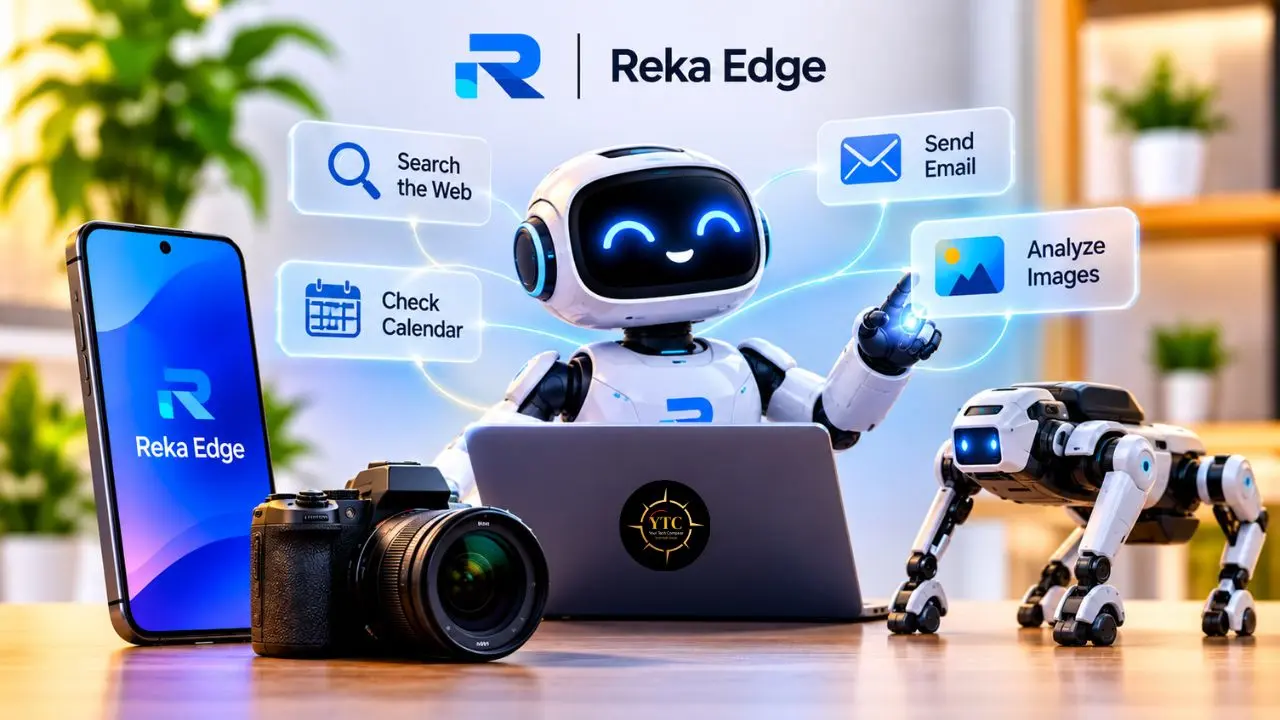
Reka describes Edge as reaching frontier-level tool calling on its Mobile Actions benchmark, where the model card reports 88.40. In plain terms, it can reason about what it sees and select or invoke defined tools, such as reading a label and then looking up a product. Our Model Context Protocol explainer covers how that tool-calling pattern is becoming standard.
Speed and Token Efficiency
Reka reports 5.46 images per second, a 0.522-second time to first token, and a 4.69-second end-to-end latency against 16.67 seconds for Gemini 3 Pro. These come from Reka’s own setup, which hosts the open models on its cluster with vLLM. So the direction is encouraging, but I’d rerun any comparison on your hardware.
Quantization That Fits Small Hardware
Reka says 4-bit quantization cuts memory from 13GB to 5GB, a 62% reduction, while retaining over 98% of performance and delivering up to 2.3 times higher throughput. A 3.5-bit option called Reka Quant squeezes memory further, though you have to contact Reka for access. For anyone with a modest GPU or edge board, that 5GB number is the headline.
EdgeQ on Snapdragon Phones
EdgeQ is Reka’s implementation for the Snapdragon 8 Elite chip, and it runs the vision and language work on the phone’s Hexagon NPU. In Reka’s Samsung S25 test, it was compared with Google’s Gemma 4 E4B, which ran through LiteRT-LM on the Adreno GPU.
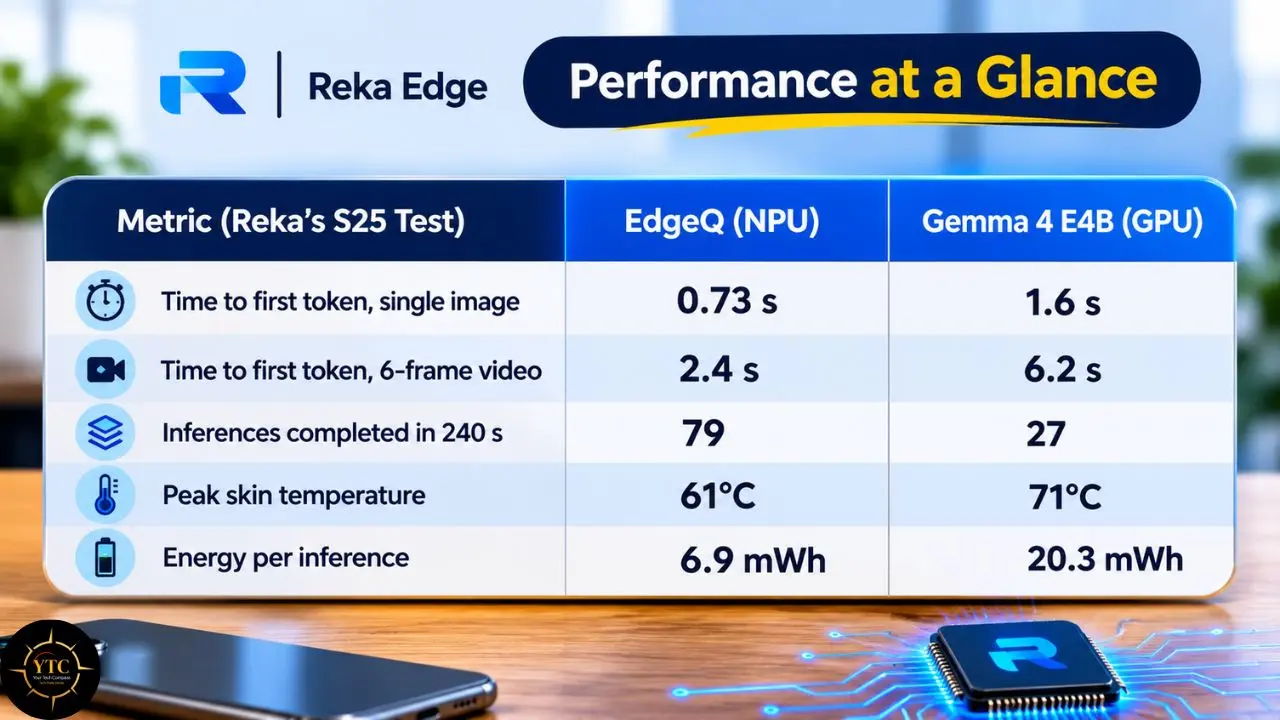
Accuracy declines with the quantized build. Reka lists RefCOCO-A at 88.65 for EdgeQ, compared with 93.01 for the full-precision Reka Edge configuration used in its EdgeQ comparison; MLVU falls from 72.31 to 66.93. That may be a fair trade for real-time speed, but it is not cost-free, and note that EdgeQ isn’t a public download.
Where the Efficiency Claims Need Scrutiny
Reka Edge’s headline is efficiency, so that’s the claim to pressure-test. Every benchmark comes from Reka, and Reka picked the rivals. Treat the numbers as strong evidence of intent, not independent proof.
There are practical limits too. The context window is 16,384 tokens on Reka’s API and OpenRouter, so long conversations will hit a wall. Running it yourself requires custom code and a specific vLLM setup, and EdgeQ and the quantized builds come through Reka’s team rather than a download button.
Compared to Qwen 3.5 9B and Gemma 4 E4B right now: Reka says Edge processes images faster and with fewer tokens than Qwen 3.5 9B and Cosmos Reason2 8B, and that EdgeQ performs at or better than Gemma 4 E4B on video understanding. These are Reka’s own comparisons. I’d wait for independent tests or run your own before you switch, and our Qwen3 review is a good primer on that rival family.
Reka Edge Pricing and License Breakdown
You have several ways to reach Reka Edge, and each has a different cost.
Access Route | Cost | Notes |
|---|---|---|
Reka Playground | Free to try, subject to Reka’s stated limits | Hosted demo |
Reka API ( reka-edge-2603) | $0.10 input / $0.10 output per million tokens | OpenAI-compatible; 16K context |
OpenRouter | $0.10 input / $0.10 output per million tokens | 16,384-token context; confirm final billing and any routing or platform charges in your account |
Self-host from Hugging Face | Free for eligible research and small commercial use | BSL 1.1; commercial production use requires under $1 million annual gross revenue, including affiliates. Governments, public-sector bodies, and academic institutions need a commercial license for production. |
EdgeQ and quantized builds | Contact Reka | Not a public download |
Now for the math. At 331 tokens per image, a million input tokens covers about 3,021 images, so encoding alone costs roughly $0.000033 per image. Add a 50-token prompt and a 100-token answer, and the cost comes to about $0.000048 per image, or roughly $4.81 per 100,000 images. That’s my arithmetic, based on Reka’s 331-token image encoding and OpenRouter’s listed token prices.
For comparison, a model that spends about 1,063 tokens per image would cost around 3.2 times more to encode the same pictures at the same input-token rate. Earlier Reka pricing pages listed separate per-image fees, so check whether any media-specific charges apply to your account.
The license is the other half of the price. Reka’s model card says you can use the weights commercially if your company makes less than $1 million a year in annual gross revenue, including affiliates and commonly controlled entities, and larger companies need a separate agreement. Governments, public-sector organizations, and academic institutions also need a commercial license for production deployments. Our GPT-5.5 vs. Claude Opus 4.8 comparison covers the cloud alternative if you’d rather pay per call than manage a license.
Legal, Privacy, and Risk Considerations
Understanding the License
Reka calls its release “open weights,” but the license is custom, not a standard open-source one. That’s an important distinction, because standard open-source licenses generally do not impose a revenue-based production-use limit.
Reka Edge uses BSL 1.1, and the license says it will automatically convert to Apache 2.0 two years after the model’s public release date, at which point those usage limitations no longer apply. Read the license text and confirm the applicable date before relying on either regime.
Custom Code and Security
The Hugging Face examples load the model with trust_remote_code, which runs code from the repository. That’s common, but it deserves review before you deploy anywhere sensitive. Pin a specific model revision and dependency versions, read the code that will run, and avoid blindly trusting a moving main branch.
Cameras, People, and the Law
Analyzing video of identifiable people can involve processing personal data, and sometimes sensitive personal data. Nigeria’s Data Protection Act 2023, Kenya’s Data Protection Act 2019, and South Africa’s POPIA can all apply, depending on where the people and processing are located, your role, and your lawful basis. Our coverage of AI policy in Africa tracks how those rules are evolving.
Usable Today vs. Settled
Running Reka Edge locally is available today through Hugging Face, subject to the license, and the API is live. EdgeQ’s wider availability and the practical timing and effect of the license’s move to Apache 2.0 are still worth tracking, so avoid building a business on assumptions about either.
Reka Edge vs. the Alternatives
Model | Type | Where It Runs | Reka’s Published Comparison | Caveat |
|---|---|---|---|---|
Reka Edge | 7B vision-language | Device, server, or API | Baseline | BSL 1.1 now; converts to Apache 2.0 two years after public release |
Qwen 3.5 9B | Open-weight vision-language | Self-hosted | Reka says Edge is over 2x faster in its end-to-end latency test | Reka-run test |
Cosmos Reason2 8B | Open-weight physical-AI model | Self-hosted | Reka says Edge is over 2x faster in its end-to-end latency test | Reka-run test |
Gemma 4 E4B | Google on-device model | Phone (GPU path) | EdgeQ leads on video in Reka’s S25 test | Reka-run test |
Gemini 3 Pro | Cloud frontier model | API only | Reka says Edge “approaches” it | Closed model with stronger general benchmarks in Reka’s table; accessed via API |
Reka Edge vs. Open-Weight Rivals
Qwen and Gemma come with their own licenses and ecosystems, and plenty of developers already know them. Reka’s pitch is token efficiency and edge speed, which matters most when you process many images or run on a battery. If you’re weighing the wider 2026 open-model field, our MiMo V2.5 Pro review covers a text-only agent model worth knowing, though it is not a direct vision-language alternative.
Reka Edge vs. Cloud Vision APIs
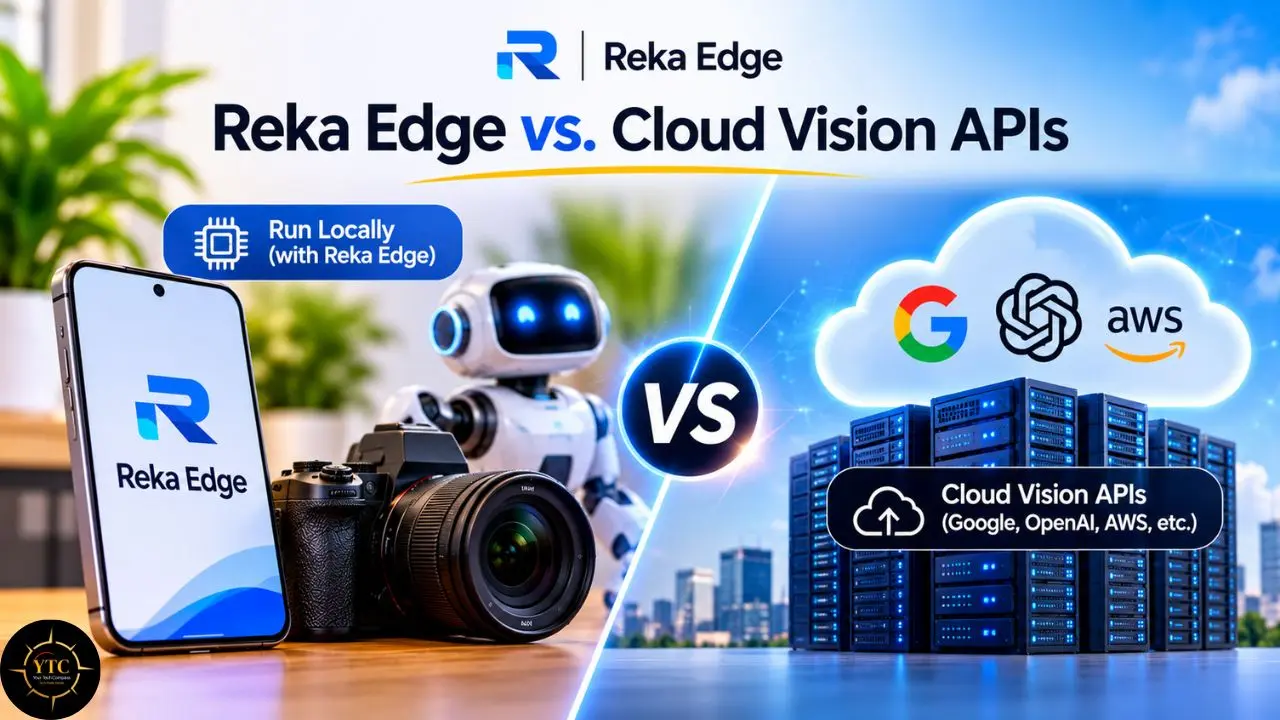
A cloud model like Gemini 3 Pro offers broader reasoning, but you pay per call, send your images to a third-party service, and accept network lag. Reka Edge flips that trade for high-volume workloads: potentially lower cost and local processing, with narrower general ability. For a wider tour of tools in this space, browse our Apps and Tools category.
Compared to a cloud vision API right now: A cloud model wins when you need open-ended reasoning over a few images, while Reka Edge wins when you process thousands of frames or need on-device processing and care about latency or privacy. My opinion: many teams will end up using both.
Real-World Use Cases
- Retail shelf and inventory cameras: You point cameras at shelves and ask the model to count or locate products. The low token cost can help keep a large camera fleet affordable, though you still need to budget for edge hardware, connectivity, storage, and accuracy testing.
- Media tagging and video captioning: A media team can generate captions, spot logos, and tag archives. Video understanding is one of Reka’s central claims, and Edge scores strongly against the smaller open-weight models in Reka’s comparisons, though Gemini 3 Pro remains ahead in Reka’s table.
- Smart glasses and AR assistance: Real-time scene description needs low latency, low power, and low heat. EdgeQ’s phone-based Snapdragon demonstration suggests the efficiency profile could suit wearables, but Reka has not published a glasses-specific benchmark.
- Robots and drones: Perception, grounding, and tool calls can run locally, which matters when connectivity is unreliable. The exact architecture still depends on whether the tools and downstream systems are on-device or remote.
- Agritech photo triage: An agritech startup in Nairobi or Lagos could let farmers photograph a leaf and get a first-pass diagnosis on a phone. You’d need to test accuracy on local crops before you promise anything, and it isn’t a substitute for expert agronomic advice.
- Retail counting in busy markets: A shop owner could photograph a shelf at closing time and get a stock count. Lighting and clutter will test any vision model.
Honest Limitations
- A revenue-capped license; for now: Companies above $1 million in annual gross revenue need a separate deal today, though the license converts to Apache 2.0 two years after public release.
- A short context window: 16,384 tokens limit long conversations and large multi-image prompts.
- Vendor-reported benchmarks: Independent tests are still limited.
- A hardware floor: The full model needs about 14GB in float16, and Reka lists 24GB as the minimum for Macs or Linux/WSL GPUs, while recommending an Apple Silicon Mac with 32GB or more.
- Setup friction: You need Python 3.12+, custom code, and Reka’s vLLM plugin for high-throughput serving.
- Gated builds: EdgeQ and Reka Quant require contacting Reka.
- A young ecosystem: Reka Edge has fewer tutorials, integrations, and community answers than the much larger Qwen or Gemma ecosystems.
The Review Landscape: Strong Claims, Few Independent Tests
Reka Edge is a developer-facing model and API, not a consumer app, so there is no app-store rating to consult. The available signals are therefore Reka’s own benchmarks, its documentation, and early community reaction.
The license has drawn mixed reactions. In a Reddit thread on the Hugging Face release, one commenter characterized the model as “largely non-commercial,” but that description is too broad: Reka Edge uses a Business Source License 1.1 that permits commercial production use by for-profit organizations and their affiliates with less than $1 million in annual gross revenue. Organizations at or above that threshold, as well as government, public-sector, and academic organizations, need a commercial license for production deployment.
Dates can mislead here. Reka published the model weights and license on Hugging Face on March 11, 2026, while some gateway listings show October 9, 2026, an apparent platform-availability date rather than the model’s original release date.
Who Should and Shouldn’t Use Reka Edge
Those who should use Reka Edge:
- Developers building camera, video, or on-device vision features.
- Startups or small organizations, including affiliates, with less than $1 million in combined annual gross revenue that want to self-host.
- Teams needing low-latency image or video understanding at the edge.
- Robotics, camera, drone, or wearables builders with tight compute, memory, or power constraints.
Who should skip it:
- Teams building a general chatbot or long-document assistant; Reka Edge is vision-first, accepts a 16K context, and is positioned for image/video understanding, detection, and tool use rather than broad text reasoning.
- Larger companies, or organizations with affiliated entities, at or above $1 million in annual gross revenue that do not want to obtain a commercial license.
- Government, public-sector, and academic organizations planning production deployments without a commercial license.
- Teams expecting frontier-level general reasoning from a 7B model.
Reka Edge for African Builders
The Most Encouraging Detail Is Memory
A 7B model in a 4-bit quantized build can require roughly 4–5GB of memory, depending on the quantization format and runtime, compared with roughly 14GB for a full-precision 7B model. That difference can make local experimentation feasible on hardware that could not accommodate the full model.
On-device inference also avoids per-image API charges and data transfer, though Reka’s hosted API does bill separately for multimodal inputs. If you are shopping for a machine to experiment with, our guide to the best laptops for running AI tools locally explains what to look for.
The license may also fit many African builders better than it fits large technology companies. Reka permits commercial production use without a separate license for for-profit organizations and affiliated entities with less than $1 million in annual gross revenue. Many African startups and small businesses are likely to fall below that threshold, though founders should check combined group and affiliate revenue before relying on the grant.
API billing is denominated in U.S. dollars, so currency movements against the naira, cedi, shilling, or rand will affect the real cost. Reka’s published pricing documentation describes prepaid credits and dollar-based token pricing but does not list local payment methods; confirm the available checkout options before building a payment workflow around them.
Phones Are the Harder Question
Reka’s EdgeQ implementation targets Qualcomm’s Snapdragon 8 Elite, a flagship Android processor that many users in African markets will not own. Ask Reka about mid-range and older-device support before planning a consumer deployment around it. Reka’s efficiency and latency figures could matter in power-constrained settings, but they are vendor-reported rather than independently verified.
Language Coverage Is the Other Gap
Reka’s broader multimodal-model materials list languages including Swahili, Arabic, French, Portuguese, Hindi, and others, but that does not establish how well Reka Edge performs in a particular African language. Test your target languages, dialects, names, addresses, and document types before making product promises.
Vision features also sit inside many payments, KYC, and onboarding flows, where privacy and compliance obligations can be significant. Our African FinTech coverage examines where those duties bite. For the wider context, see our African Tech categories.
FAQs
Reka Edge is a 7-billion-parameter vision-language model from Reka AI. It accepts images or video plus text and returns text, and it is designed for edge devices, on-premises servers, and cloud deployment.
Reka publishes the weights openly, but under a custom Business Source License 1.1 rather than a standard open-source license. For-profit organizations and affiliated entities with less than $1 million in annual gross revenue may use it commercially without a separate agreement; larger companies, as well as government, public-sector, and academic organizations, need a commercial license for production deployment.
Reka’s API lists $0.10 per million input tokens and $0.10 per million output tokens. At 331 tokens per 1024×1024 image, 100,000 images would cost about $3.31 in image-input charges; prompt and output tokens are billed separately at the same rate.
Reka says its EdgeQ implementation runs on Snapdragon 8 Elite phones, including the Samsung Galaxy S25, using the Hexagon NPU. EdgeQ is not presented as a public download, so confirm device support and access directly with Reka before planning a mobile rollout.
Reka’s own model card reports that Edge encodes a 1024×1024 image in 331 tokens, versus 1,063 for Cosmos-Reason2 8B, 1,041 for Qwen 3.5 9B, and 1,094 for Gemini 3 Pro. It also reports benchmark results against those models, with Edge approaching but not consistently matching Gemini 3 Pro. These are vendor-reported comparisons, so validate them on your own images, videos, prompts, and hardware.
Yes, if your organization and its affiliates have less than $1 million in annual gross revenue, according to Reka’s license. Read the full license before deployment, and contact Reka for a commercial license if you exceed the threshold or fall into a restricted organization category.
What Reka Edge Means for Builders Who Can’t Wait on the Cloud
Reka Edge makes a compelling case that many vision workloads need not be expensive, slow, or cloud-bound when the model represents visual input efficiently. Its 331-token encoding for a 1024×1024 image, $0.10-per-million-token API pricing, and potential to run in a roughly 4–5GB 4-bit quantized build are genuine reasons to take it seriously. Its revenue-capped license and Reka-reported benchmarks are equally genuine reasons to test it before trusting it.
If you are a developer or startup, prototype through Reka’s API or OpenRouter, evaluate the model on your own images, videos, prompts, and hardware, and read the license against your organization’s revenue and affiliates before building around it. OpenRouter provides an OpenAI-compatible path to Reka Edge at the same listed token pricing, which makes early experimentation straightforward.
If you invest in or shape policy for African technology, pay attention to how small, efficient models could shift where AI runs: from distant data centers toward local devices, including phones where supported. That shift creates opportunity for lower-cost, lower-latency services, but it also raises privacy, consent, and data-governance stakes. The builders who plan for both will be best placed.
If you’re building for places where connectivity is a luxury, keep your compass pointed at AI in Africa on YourTechCompass.com for more research-first coverage.