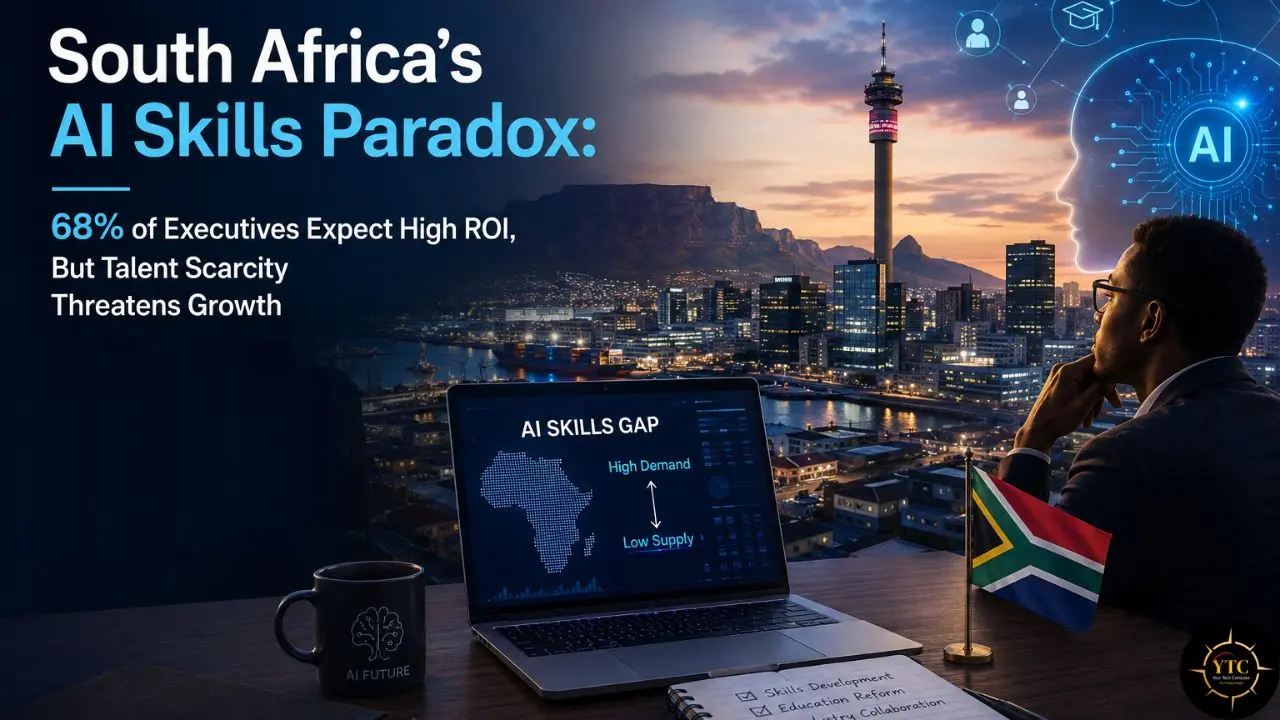
Sixty-eight percent of South African executives expect a high return on investment from AI-driven work redesign in 2026. That figure comes from Mercer’s Global Talent Trends 2026 report, which surveyed nearly 12,000 executives, HR leaders, investors, and employees across 16 geographies, including South Africa. Yet the same study reveals that only 41% of South African employees report they are “thriving” in their current roles, below the global average of 44%. Fifty-two percent of executives cite talent scarcity as the single biggest force shaping their workforce strategy. The gap between boardroom optimism and shop-floor readiness is not a minor disconnect. It is a structural fault line.
This paradox is not simply about recruitment difficulty or salary inflation. It is about an education system that produces computer science graduates without production-ready machine learning skills, an immigration regime that cannot attract foreign talent fast enough to replace the outflow, and a corporate culture that treats AI as an automation tool first and a capability-building opportunity second. South Africa leads Africa in AI research output, digital infrastructure maturity, and enterprise adoption intent. But intent without talent is a strategy built on sand. This article examines the hard numbers behind the gap, the institutional failures that created it, and what South African companies and policymakers must do differently before the competitive window narrows.
The Numbers Behind the Paradox
Executive Optimism vs. Workforce Reality
Mercer’s data paints a picture of a workforce at a critical inflection point. While 68% of executives expect high ROI from AI work redesign this year, 53% of employees worry their current skills will not remain relevant. 78% of workers trust their employers to teach them the skills they need if their jobs change due to AI. That trust is fragile and being tested.
Eighty-three percent of South African employees report improved efficiency when using AI tools. Nearly three-quarters (75%) are concerned about AI being used for workplace surveillance. While 88% of South African executives believe their organizations foster trust, only 68% of employees agree that people trust one another within their organization. This is not a technology problem. It is a relationship problem. Employees are being asked to embrace tools they suspect will be used to monitor, evaluate, and eventually replace them.
The financial pressure is equally stark. Among employees considering leaving their jobs, 50% cite higher pay elsewhere as the primary reason. Yet 65% of South African workers say they would trade a 10% salary increase for opportunities to upskill in AI and digital competencies. That is a remarkable statistic. It means the workforce is not simply demanding more money. It is demanding future relevance. A majority of executives identify the move toward skills-powered talent practices as a critical area for leadership focus. The alignment between what employees want and what executives claim to prioritize is real. The execution gap is where everything breaks down.
How South Africa Stacks Up Against the Continent
South Africa is not alone in suffering this paradox. SAP’s Africa’s AI Skills Readiness Revealed report, released in May 2025 and drawing on mid-size and enterprise companies across South Africa, Kenya, and Nigeria, found that 99% of organizations consider AI skills essential to business success. Every single company surveyed expects demand for AI skills to increase in 2025. Every single company also expects an AI-related skills gap.
The business impact is already material. 90% of surveyed organizations cite negative impacts from the shortage, including failed innovation initiatives, project delays, increased pressure on existing teams, and an inability to take on new client work. 85% prioritize AI development skills. 83% prioritize generative AI skills. Cybersecurity sits at 86%. The demand is universal. The supply is not.
South Africa’s position within this continental picture is unique. It has the most mature digital infrastructure, the deepest financial markets, and the strongest research base. But that maturity creates a different kind of pressure. Kenyan and Nigerian companies are building AI capability from a lower baseline; their expectations are calibrated differently. South African enterprises are expected to compete globally. The broader AI landscape across Africa provides essential context, but South Africa’s specific challenge is that its ambition has outpaced its pipeline.
How South Africa, Kenya, and Nigeria Compare on AI Skills
Metric | South Africa | Kenya | Nigeria |
Executive AI ROI Confidence | 68% (Mercer GTT 2026, SA-specific) | Not surveyed | Not surveyed |
AI Skills Considered Essential (Enterprise) | 99% (SAP 2025, combined 3-country sample) | 99% (SAP 2025, combined 3-country sample) | 99% (SAP 2025, combined 3-country sample) |
Companies Citing Negative Impact from Skills Gap | 90% (SAP 2025, combined 3-country sample) | 90% (SAP 2025, combined 3-country sample) | 90% (SAP 2025, combined 3-country sample) |
Employees “thriving” in Roles | 41% (Mercer GTT 2026, SA-specific) | Not surveyed | Not surveyed |
Employees Worried About Skill Obsolescence | 53% (Mercer GTT 2026, global) | Not surveyed | Not surveyed |
Primary Skills Gap Impact | Project delays, failed innovation, team burnout (SAP 2025) | Project delays, failed innovation, team burnout (SAP 2025) | Project delays, failed innovation, team burnout (SAP 2025) |
Footnotes:
- Mercer GTT 2026 South Africa data is country-specific; Kenya and Nigeria were not included in the SA-specific Mercer dataset.
- SAP 2025 data is from a combined sample of mid-size and enterprise companies across South Africa, Kenya, and Nigeria; figures are not broken out by individual country.
- The 53% “skill obsolescence worry” figure is a global GTT 2026 statistic, not specific to SA.
Why the University Pipeline Is Broken
The Curriculum Lag
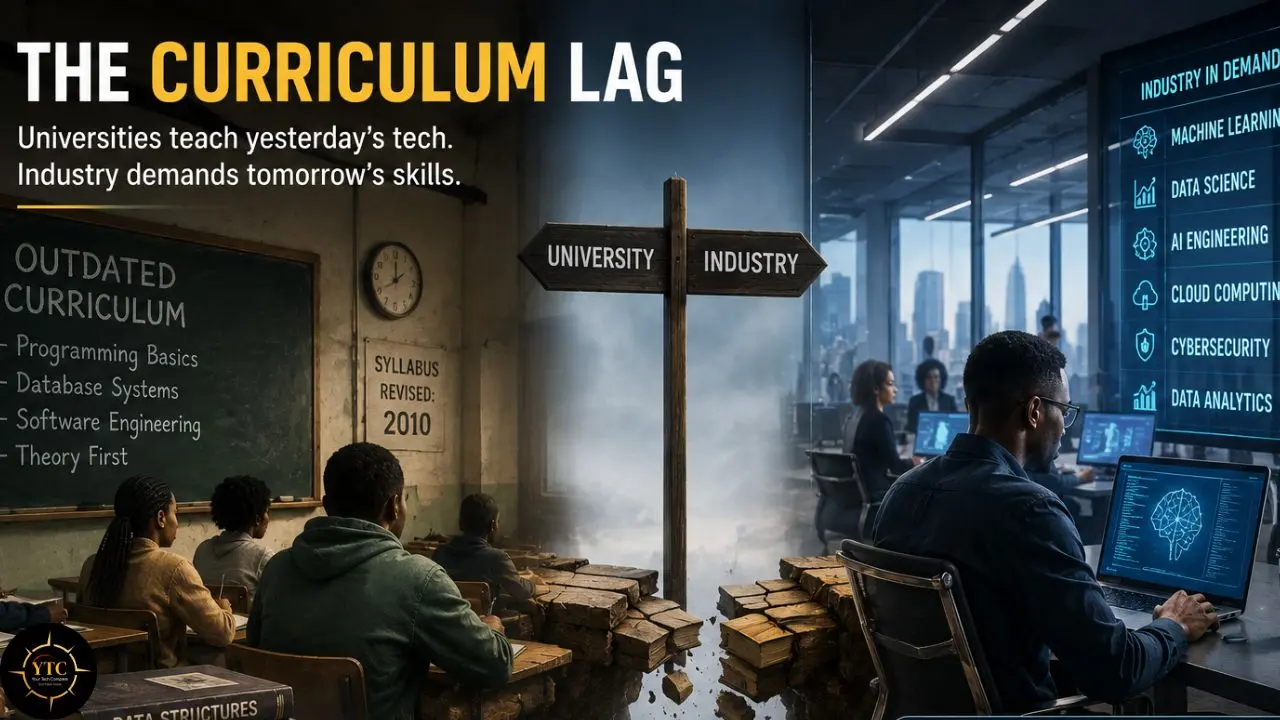
South African computer science programs at institutions like Wits, Stellenbosch, and UCT produce graduates who understand algorithms, statistical theory, and research methodology. What they often lack is production engineering capability: MLOps, data pipeline architecture, model deployment, monitoring, and bias auditing. The time required to update accredited university curricula cannot keep pace with the rapid evolution of AI tooling. A student who begins a three-year degree in 2023 is learning frameworks that may be obsolete by the time they enter the workforce in 2026.
The gap between what a Stellenbosch graduate knows and what a Johannesburg fintech needs is measured in years, not months. Companies are not complaining about a shortage of theoretical knowledge. They are complaining about a shortage of people who can take a model from Jupyter Notebook to production, handle drift, manage A/B testing, and explain failure modes to a non-technical regulator. That is not a problem a single curriculum update can fix. It is a structural misalignment between academic incentive structures and commercial reality.
The Mathematics Crisis Filtering Into AI
The pipeline problem starts earlier than university. South Africa’s matric mathematics outcomes have declined in real terms, and the proportion of learners qualifying for rigorous STEM degree pathways is shrinking. Machine learning at its core is applied mathematics: linear algebra, calculus, probability, and optimization. Without a strong foundational mathematics pipeline in secondary schools, the pool of students capable of advanced AI work shrinks before admissions officers even open their files.
UNESCO’s 2025 Artificial Intelligence Readiness Assessment for South Africa explicitly identifies knowledge and skills gaps as a barrier to meeting labor market needs. The report notes that while South Africa has made significant strides in technology infrastructure, with 78.6% internet access as of 2023, capabilities are unevenly distributed and economic strains exacerbate existing challenges. The assessment found that South Africa has yet to publish a national AI strategy, relying instead on ICT-focused policies and the National Digital and Future Skills Strategy to prepare citizens for digital work. That absence of a dedicated AI skills framework means the coordination between basic education, higher education, and industry is happening ad hoc, if at all.
Research Excellence vs. Industry Readiness
South Africa leads Africa in AI research output and PhD production. The country produces world-class papers, contributes to international conferences, and hosts respected research groups. But industry does not need more researchers writing papers. It needs practitioners who can deploy, monitor, and maintain models in production environments.
The academic incentive structure rewards publication, not deployment. A researcher who publishes five papers on fairness in machine learning receives more institutional support than a researcher who builds and maintains a fair lending model for a credit union. Until universities create career tracks and funding models that value industry collaboration as highly as they value citation counts, research excellence will continue to exist in parallel to, rather than in service of, the skills shortage.
The Brain Drain and the Remote Work Siphon
Where South African AI Talent Actually Goes
The remote work revolution has created a global market for South African engineering talent, and the pricing is brutal. A machine learning engineer in Cape Town or Johannesburg can now earn a dollar-denominated salary from a US or European firm that local companies cannot match. The arbitrage is rational on both sides. For the engineer, it is a 3x or 4x increase in effective income. For the foreign employer, it is still cheaper than hiring in San Francisco or London.
Emigration pathways compound the problem. Canada’s Express Entry program for tech workers, the UK’s Global Talent Visa, and Australia’s skilled migration program all actively recruit South African STEM graduates. The salary and quality-of-life differential makes leaving a sound personal decision, even if it hollows out the local ecosystem.
The gendered dimension is particularly acute. Women in AI roles face additional pressure points, from workplace culture to caregiving responsibilities to the global demand for diverse technical teams. The experience of women building AI across Africa shows that retention strategies must be intersectional. Losing women engineers to foreign markets does not just reduce the talent pool. It reduces the diversity of the talent pool, which in turn damages the quality of the AI systems being built.
Why Foreign Talent Cannot Replace the Outflow

South Africa’s Critical Skills Visa includes IT and engineering categories, but processing delays, documentation requirements, and bureaucratic inconsistency make it an unreliable pipeline. A Nigerian or Kenyan machine learning engineer with world-class credentials faces months of uncertainty trying to work legally in South Africa, precisely when that same engineer is being recruited remotely by firms in London, Toronto, or Berlin.
The result is a double loss. South Africa bleeds talent to the Global North and cannot efficiently import talent from the rest of Africa to replace it. The comparison with India’s AI adoption trajectory is instructive. India treated regional talent mobility and diaspora return as strategic priorities. South Africa has not. The visa regime is not just an administrative inconvenience. It is a competitive disadvantage.
What South African Companies Are Getting Wrong
The Automation-First, People-Second Mindset
Mercer found that 83% of employees report improved efficiency when using AI tools. But 74% fear workplace surveillance. The message from the workforce is clear: we will use these tools, but we do not trust the motives behind their deployment. Many organizations are prioritizing AI for productivity and ROI, but workforce strategy and upskilling are not keeping pace, leading employees to perceive AI as more about control and replacement than augmentation.
This mindset destroys the trust required for successful AI adoption. Employees who fear obsolescence may collaborate less openly, do the minimum required to stay employable, and leave when better opportunities arise. The corporate AI strategy conversation often focuses on model selection and cloud architecture. It should first focus on workforce psychology and trust architecture.
The Buy-vs.-Build Trap
The SAP survey found that two‑thirds (~66%) of African organizations are introducing career development initiatives with AI specialization. That sounds promising. But in practice, many South African companies also lean heavily on recruiting experienced AI talent from other firms and on external consultants, in a market where most enterprises report difficulty finding qualified AI professionals and where salary premiums for experienced AI talent are extreme.
Poaching inflates salaries and mostly redistributes existing capacity rather than expanding the national talent pool. Consultant‑led projects can deliver working models quickly, but where internal teams are under‑skilled, there is a real risk that, once the engagement ends, the organization lacks the depth to maintain, update, or debug what was built. Both strategies address immediate delivery needs; neither, on its own, solves the underlying capability gap.
The Diversity Dimension
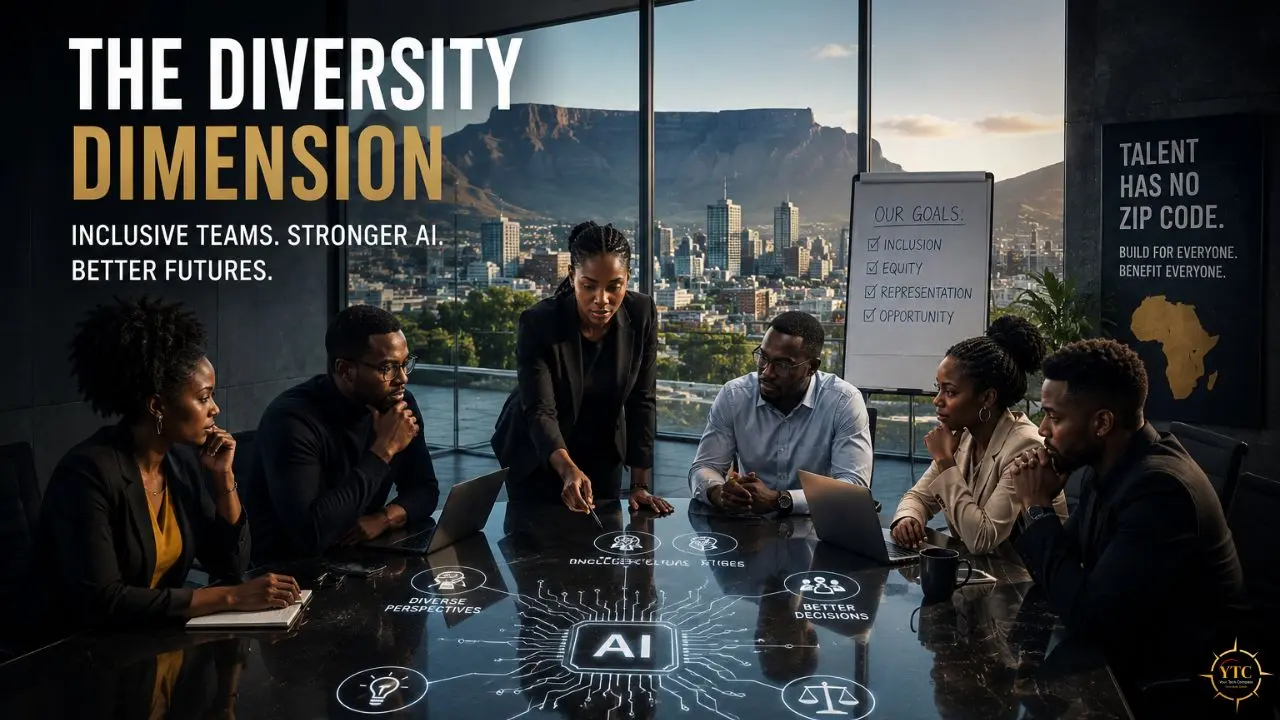
AI roles in South Africa remain concentrated in demographic segments with historical access to quality mathematics education and university pathways. The effective talent pool is artificially shrunk by exclusion. Companies that do not invest in expanding access through bursaries, internships, and targeted recruitment from previously disadvantaged communities are competing for the same narrow slice of talent while ignoring the majority of the population.
This is not a social justice argument alone. It is a business argument. A homogeneous team builds homogeneous models. A credit-scoring algorithm trained by engineers who have never lived in a township will fail to account for the financial behaviors of township residents. The diversity of the team directly affects the robustness of the product.
What Actually Works: Models Worth Scaling
Internal Academies and Apprenticeships
The most effective response to the skills shortage is not external recruitment. It is an internal creation. South African companies that have built internal AI training pipelines, hiring for aptitude and training for competence, are expanding their talent pool beyond the small cohort of “ready-made” engineers.
The apprenticeship model works because it sidesteps the curriculum lag. A mathematics graduate with strong problem-solving skills can be taught MLOps, deployment pipelines, and model monitoring in 6-12 months if the training is structured around real company data and problems. The key is retention: these programs must include clear career progression, accredited credentials at each stage, and salary increases that reflect growing capability. Otherwise, the company becomes a free training ground for competitors.
University-Industry Partnerships
Programs in which corporates co-design curricula, fund labs, and guarantee internships are beginning to show results. UCT and, increasingly, Wits have established industry partnership mechanisms: advisory boards, funded research, experiential training, and aligned curricula that aim to reduce the time lag between academic training and industry readiness. These partnerships work best when they are not philanthropic gestures but operational necessities. A bank that needs 50 data engineers per year should not wait for the university to guess what the market needs. It should fund the lab, place its practitioners as adjunct lecturers, and hire directly from the graduating class.
Pan-African Talent Strategies
South African companies should be recruiting machine learning engineers from Nigeria, Kenya, Ghana, and Egypt, not as a stopgap, but as a permanent strategy. The SAP survey confirms that all major African markets face the same skills shortage, while broader ecosystem data shows that talent distribution is uneven. A Nigerian engineer with production experience in Lagos fintech may bring capabilities that are scarce in Johannesburg: Nigeria has Africa’s highest workforce AI literacy, and Lagos is widely described as the continent’s deepest fintech talent pool, even as local enterprise AI adoption lags.
The primary barriers are visa and regulatory, not a lack of talent. Fixing the Critical Skills Visa processing stream, streamlining recognition of qualifications from accredited African universities, and pursuing deeper reciprocal mobility arrangements with regional blocs such as ECOWAS and EAC would help unlock a continental talent pool. South Africa’s advantage is not that it has more talent than its neighbors. It is that more employers can afford to pay for it. The companies that treat pan‑African recruitment as infrastructure rather than charity will compound that advantage.
A Three-Year Roadmap for Closing the Gap
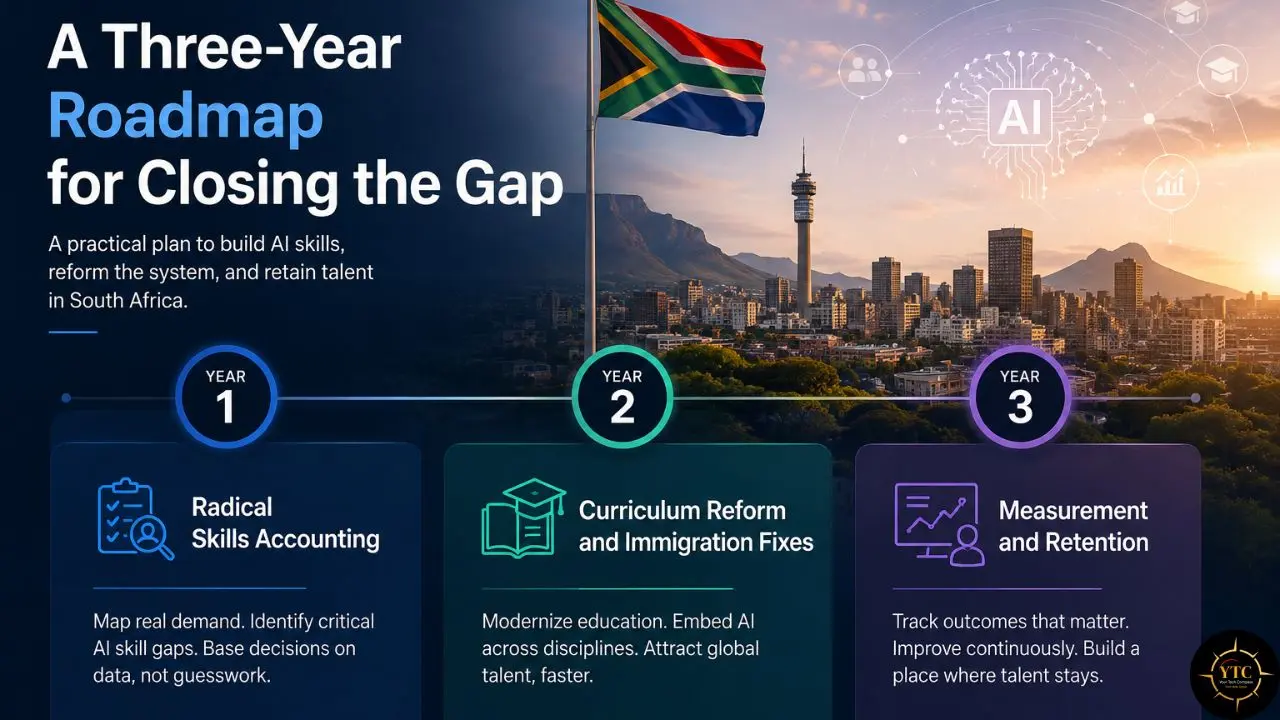
Year 1: Radical Skills Accounting
South African companies must stop inflating their AI capability. Audit the current workforce honestly: who can actually build and deploy models, and who merely uses ChatGPT? Stop calling Excel automation “AI strategy.” The Pnet Job Market Trends Report for March 2026, released in April 2026, found that AI literacy is rapidly emerging as an important skill, with companies increasingly seeking candidates who can apply AI tools across everyday functions, not only in technical environments. That distinction matters. A workforce that can prompt a large language model is not the same as one that can train, deploy, and maintain it.
Government alignment is equally urgent. The Department of Higher Education and Training must map the actual supply of AI skills against actual demand, sector by sector. The AI policy landscape across Africa is moving fast, with nearly 30 countries engaged in UNESCO readiness assessments and several publishing national frameworks. South Africa’s lack of a dedicated national AI strategy, as confirmed by UNESCO’s 2025 readiness assessment, means there is no single, AI‑specific coordinating body that systematically aligns education output with industry input.
Year 2: Curriculum Reform and Immigration Fixes
Partner with universities to create industry-aligned AI degree tracks and vocational certifications. Incentivize TVET colleges to offer practical ML engineering diplomas, not just theoretical computer science degrees. The curriculum must include ethics, bias auditing, and domain-specific applications, whether in financial services, healthcare, or agriculture.
Fix the Critical Skills Visa: dedicated processing streams for AI roles, recognized qualifications from African universities, and fast-track pathways for engineers from Nigeria, Kenya, and Egypt. The current system is too slow to compete with remote hiring from London or Toronto. Speed is the most important variable.
Year 3: Measurement and Retention
Tie executive compensation and promotion to workforce AI literacy metrics, not just AI deployment metrics. A company that deploys five models with a team of ten overworked engineers is not succeeding. It is burning out its only competitive advantage. Retention requires career architecture: clear progression from data analyst to ML engineer to AI product manager, with accredited credentials and salary bands at each step.
Retention also requires addressing the surveillance anxiety that Mercer identified. 74% of employees fear AI-powered monitoring. Companies that use AI to augment decision-making rather than monitor behavior will retain talent. Companies that use AI to replace judgment will lose it. The choice is that simple.
Frequently Asked Questions

South Africa’s AI skills paradox is the tension between high executive confidence in AI‑driven returns and a workforce that lacks the skills, trust, and readiness to deliver those returns. Around seven in ten South African executives place AI at the top of their ROI agenda for 2026, yet about half cite talent scarcity as a top workforce challenge, and only 41% of employees report thriving in their roles.
According to Mercer’s 2026 Global Talent Trends report, around seven in ten South African executives (about 71%) place AI at the top of their ROI agenda for 2026. The report, released in May 2026, included a South African sample of 50 C‑suite executives and 500 employees.
The shortage stems from three structural failures: university curricula that lag behind production engineering needs, a shrinking secondary school mathematics pipeline that reduces the pool of STEM-capable students, and a brain drain to foreign markets where remote work and emigration pathways offer salaries local companies cannot match. Corporate over-reliance on poaching and consulting rather than internal training compounds the problem.
All three markets face the same fundamental shortage. SAP’s 2025 survey of companies across South Africa, Kenya, and Nigeria found that 99% consider AI skills essential and 100% expect a skills gap. South Africa’s gap feels more acute because its enterprise expectations are calibrated to global competition, while its talent pipeline remains relatively small and tightly contested.
Two-thirds of African organizations are introducing AI-focused career development initiatives, and 94% offer training at least once a month. But many South African companies still over-rely on poaching competitors’ staff and hiring external consultants rather than building internal academies. The most effective responses combine apprenticeship programs, university partnerships, and pan-African recruitment.
The government should publish a dedicated national AI strategy, something UNESCO’s 2025 assessment confirmed does not yet exist. It should align basic and higher education curricula with industry needs, fix Critical Skills Visa processing for AI roles, and create public-private partnerships that fund independent AI audit and training capacity through universities and civil society organizations.
Conclusion
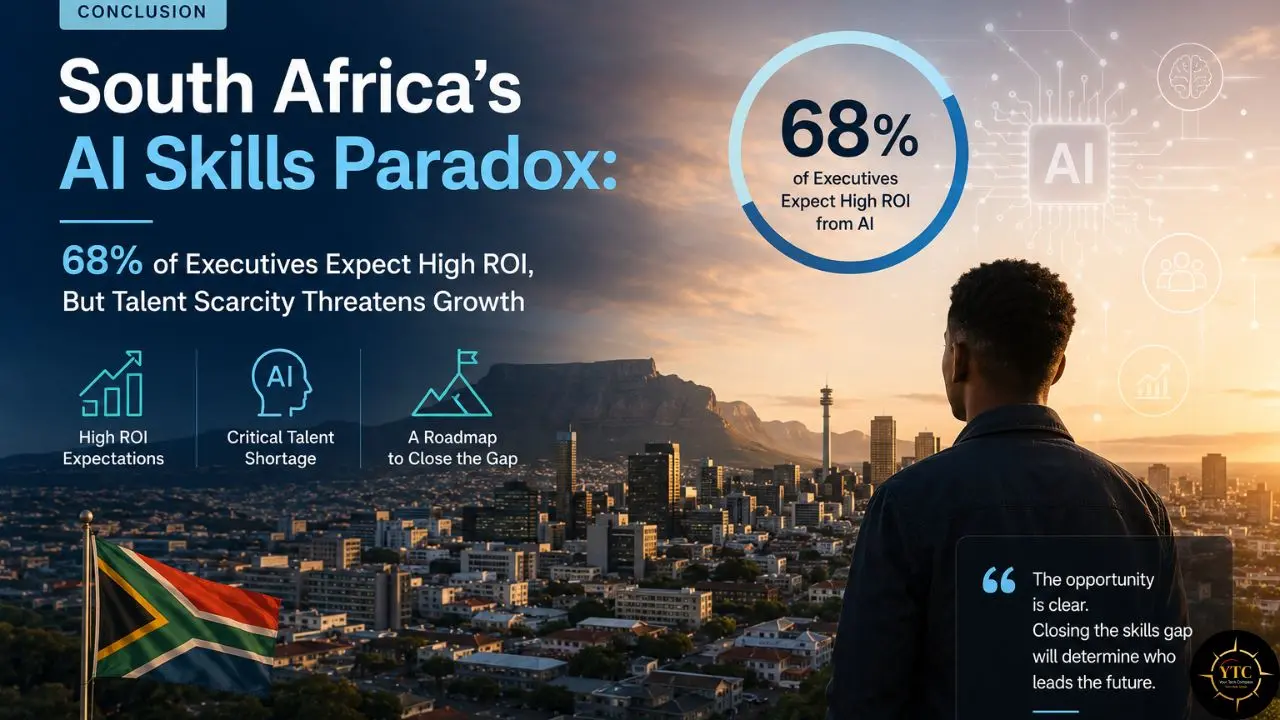
South Africa’s AI opportunity is real, but it is being undermined by a talent pipeline that leaks at every joint, from matric mathematics classrooms to emigration queues to corporate boardrooms that measure AI success by software deployment rather than human capability. The 68% executive confidence figure is not wrong. It is premature. Confidence without capability is a liability, not a strategy.
The next three years will determine whether South Africa becomes Africa’s undisputed AI hub or loses its lead to markets that invested in people while Pretoria and Johannesburg debated policy. Companies that treat skills as a cost will pay for it in failed projects, burned-out teams, and models that no one knows how to maintain. Companies that treat skills as infrastructure (building rather than buying, training rather than poaching, trusting rather than surveilling) will compound their advantage. The talent is willing. Sixty-five percent of employees would trade a 10% raise for upskilling. The question is whether employers and policymakers are willing to meet them.
If you’re building AI teams in Johannesburg, hiring across borders, or trying to understand where South Africa’s competitive edge is heading, start at YourTechCompass.com, where we track the talent, the policy, and the infrastructure that decide who wins.