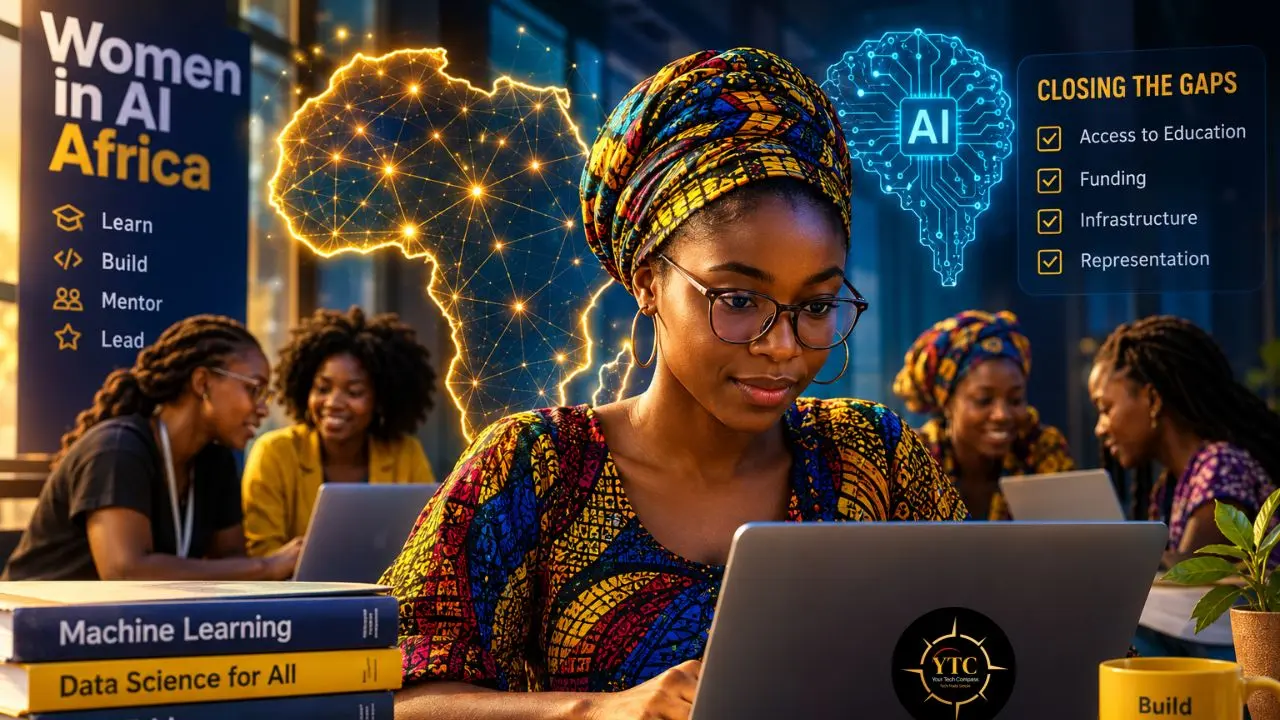
Let’s start with a moment without a statistic attached. You’re in a technical meeting. You’ve just proposed an architecture for a language model that would perform better on low-resource African-language data. Someone across the table responds to the man sitting next to you, asking him to clarify what you said. You clarify it again, directly. The conversation moves forward with the idea, implicitly attributed to the room rather than to you. You file it away. You have work to do. This isn’t a story from twenty years ago. It’s the routine experience of women building AI across African markets right now: the small, compounding, invisible tax that sits beneath every more discussable barrier; the interrupted funding round, the university without computing resources, the internet connection that fails during an online course. The cognitive and emotional cost of navigating a field that constantly questions your right to be in it doesn’t appear in gender gap statistics, but it shapes what’s possible in ways that go well beyond the counted variables.
I’m writing this because the coverage of women in AI in Africa tends to do one of two unhelpful things: it either leads with numbers that flatten individual experience into percentages and institutional reports, or it leads with “inspiring women who overcame” stories that inadvertently place the burden of structural change on individual excellence. This article tries to do something different. It centers what the women building AI in Africa are actually experiencing: the specific, intersectional barriers that compound in ways individual effort alone can’t undo, and the specific support structures and communities that have genuinely changed trajectories for women who’ve come through them. The breakthroughs covered here are real. So are the barriers. Both deserve their full space.
The Landscape: What the Numbers Tell You and What They Miss
Before we engage with the statistics, I want to flag something about how this data is typically used. Numbers aggregate across realities that are structurally very different from each other, and using them without that context produces recommendations that help some women while leaving others completely unaddressed.
What the Data Shows
Women represent approximately 22% of AI professionals globally, a gap that is larger than the gender gap in the overall workforce and at least as large as, and in many contexts larger than, the gap in STEM fields more broadly. The gap is structural and persistent, showing up across every layer of the AI pipeline: education, research publication, senior leadership, and founding teams.
In Africa, specifically, multiple compounding gaps intersect. Women are underrepresented in STEM education across Sub-Saharan Africa, though the figures vary significantly by country and institution. Women AI researchers from African institutions are a thin slice of authorship at major machine learning venues (NeurIPS, ICML, ACL, EMNLP), reflecting both who gets into the research pipeline and who gets credited when they do. Women-founded AI ventures receive a disproportionately small share of the already-constrained pool of African tech venture capital. The Deep Learning Indaba has tracked gender representation among its participants and presenters since its founding in 2017, and the longitudinal picture shows gradual but real progress from a very low base.
What the Numbers Don’t Capture
The single most important thing those statistics can’t tell you is that “women building AI in Africa” encompasses a range of structural realities so wide that a single intervention cannot meaningfully address them all simultaneously.
A woman with a computer science degree from the University of Cape Town, a reliable internet connection, and access to cloud GPU credits is operating in a structurally different environment from a woman with equivalent intellectual capacity but no access to university education, unreliable electricity, and expensive mobile data in a rural area in the Sahel. Both are real.
Furthermore, both experiences deserve acknowledgment. And an intervention designed for the first (a professional program, a research fellowship, a corporate sponsorship) may be entirely irrelevant to the second.
What the numbers also don’t capture is the mental bandwidth cost of operating in spaces where your presence is routinely questioned. The accumulation of meetings where you’re talked over, research ideas credited to colleagues who didn’t generate them, network events where your technical credentials are assumed to be lesser until you prove otherwise; none of this appears in a gender gap statistic, but it represents a real and ongoing drain on the energy available for actual work. That tax is paid differentially by women in AI across Africa, and any honest account of the barriers has to include it.
The Structural Barriers: Specific and Honest
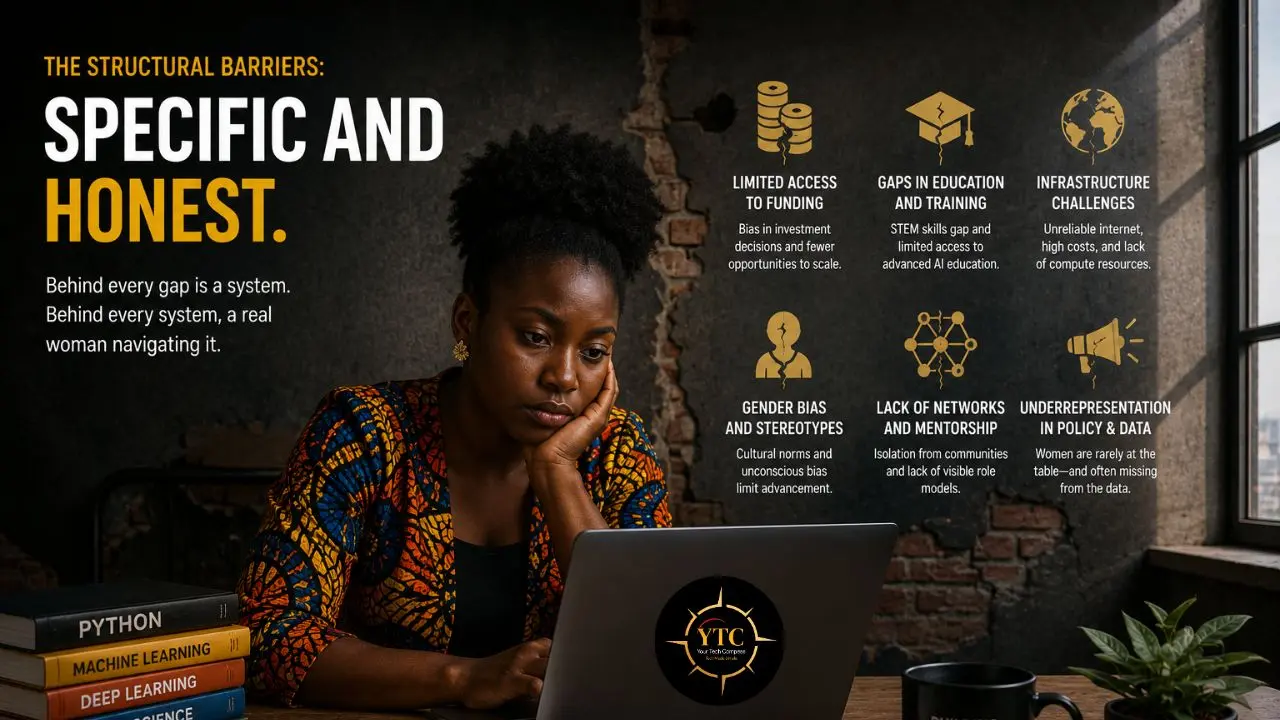
The barriers facing women who build AI in Africa don’t operate in isolation. They compound. Understanding how they compound and where they intersect with class, geography, and family context is the prerequisite for designing interventions that actually work rather than those that look good in a program report.
The Education Pipeline Gap
AI capability requires a mathematical foundation. That foundation is shaped years before university, in the quality of secondary school mathematics and science education available to a given student. The gap in educational quality between schools serving different socioeconomic populations, between urban and rural contexts, between schools with adequate science resources and those without, that upstream gap is the first filter, and it eliminates candidates from the AI pipeline before any university outreach program can reach them.
Girls who demonstrate mathematical aptitude in under-resourced environments are statistically less likely to be encouraged to pursue STEM pathways than boys with equivalent ability. This isn’t always malicious.
It’s often the internalized occupational sorting of families and teachers who have absorbed the ambient message that certain fields are for certain people. The first adult who says “you could study mathematics seriously” to a girl who might not otherwise believe it is doing infrastructure work: invisible, uncompensated, and essential.
Early marriage expectations and domestic labor obligations create a different but related filtering effect. These pressures are not equally distributed across class, geography, or family culture, but where they’re present, they interrupt educational trajectories in ways that nothing downstream can compensate for.
The University Environment Problem
Where women do access computer science education, the environment they find often presents a second set of barriers that compound the access problem with a retention problem. Male-dominated faculty compositions, curricula that don’t reflect applications relevant to women’s lives, mentorship structures that operate along gender-homophilous networks (senior researchers recommending junior researchers who remind them of themselves), and campus cultures where women’s technical competence is routinely questioned; these are documented patterns, not allegations.
“At the beginning of my career, I was deeply invested in issues around gender and racial inequality, particularly within the AI space,” Pelonomi Moiloa, CEO of Lelapa AI, has shared publicly. That investment came from navigating an environment where the structural disadvantages were not theoretical. The AI and machine learning subfield within computer science tends toward lower female participation, even in programs where the overall gender distribution is more balanced, a second-order filtering that occurs after women have already navigated the first set of barriers to enter the department.
The Infrastructure and Access Gap
AI development requires reliable, affordable internet access and access to computing resources, such as GPUs, cloud compute, or, at minimum, consistent device access for model training and coursework. These resources are not equally distributed across geography, household income, or, critically, gender within households where computing resources are shared.
Free GPU resources from Google Colab, Kaggle, and cloud providers have partially addressed the compute access problem for women with reliable internet access. But reliable internet creates a circular dependency: it requires consistent electricity, affordable data plans, and a stable physical environment in which sustained technical work is possible.
In 2024, only 31% of women in Africa were using the internet, compared with 43% of men, the widest gender gap in internet use globally. In low- and middle-income countries, women are 15% less likely than men to use mobile internet. In households where those resources are shared, access is frequently structured by implicit hierarchies that disadvantage women.
There’s a specific safety dimension that connectivity and access barriers create for women that men navigating equivalent barriers don’t face in the same way. In communities where internet access requires traveling to an urban center, women face specific safety constraints on that travel. Furthermore, in communities where the nearest computing resource is a university campus or a tech hub in a different district, the question of whether it’s safe to travel there alone, and at what hours, constrains learning and professional development in ways that men in the same economic context aren’t navigating.
The Funding Gap for Female-Led AI Ventures
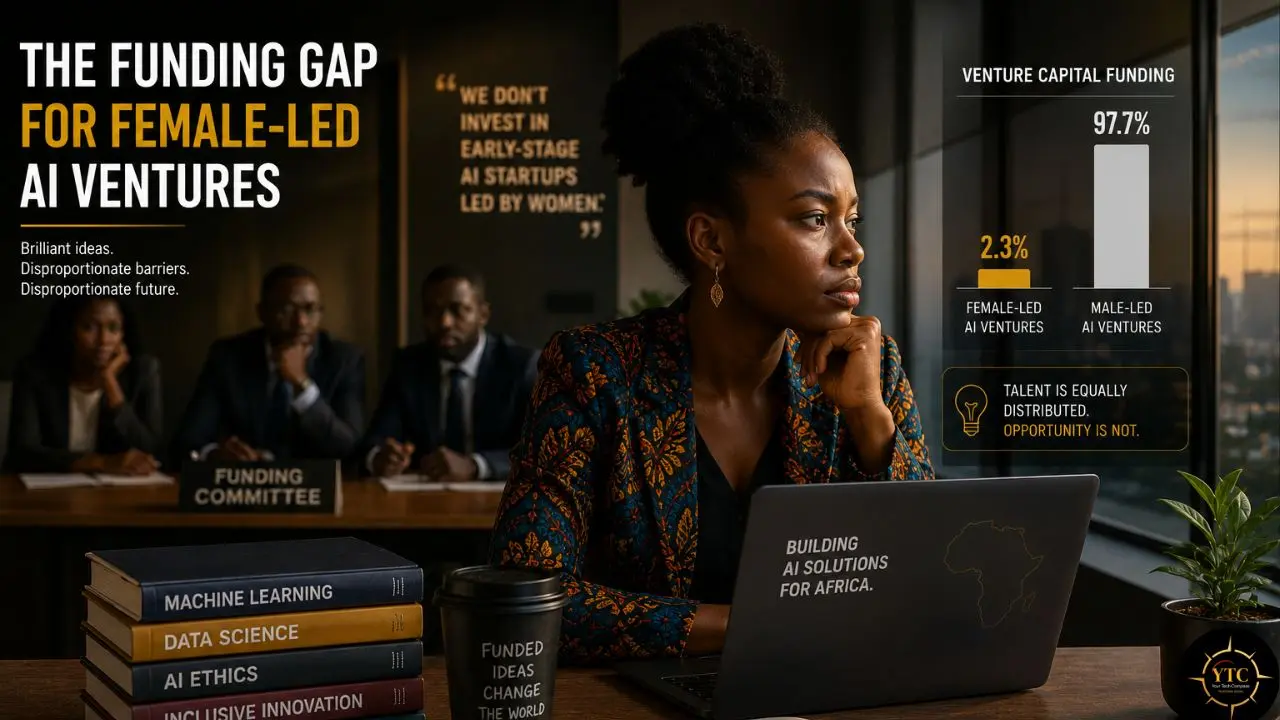
Female AI founders in Africa face what amounts to a compounding disadvantage: the global pattern of venture funding bias against women (approximately 2% of global VC funding went to all-female founding teams in recent years, a figure that has barely shifted) intersects with Africa’s smaller total capital pool and earlier-stage funding desert. In 2025, female-founded startups in Africa received just 0.9% of total venture capital, $28.8 million out of $3.2 billion, the lowest share recorded since tracking began in 2021.
The pattern isn’t primarily overt bias in pitch rooms, though that exists and is documented. More pervasively, it’s the network effect of who knows whom, of pitch events designed to be welcoming, of accelerators with gender-inclusive evaluation criteria, and of investors with established relationships with female founders that create referral pipelines.
Venture funding is a relationship business, and the relationships were built in spaces where African women were substantially underrepresented. Closing the funding gap requires addressing the network gap, not just adding a diversity criterion to an otherwise unchanged process.
The Visibility and Recognition Gap
Research credit is determined by citation patterns, conference invitations, and recommendation networks that systematically underrepresent women who produce equivalent work. The “cite the men” pattern in technical writing is documented across academic disciplines, and it compounds over time: being cited less means less visibility, which means fewer speaking invitations, which means fewer networking opportunities, which means narrower co-author pipelines for the next paper.
In commercial contexts, the technical competence of female AI founders is questioned at pitch meetings in ways their male counterparts with equivalent qualifications don’t experience, sometimes explicitly, often through the difference between “how does this work?” directed at the male co-founder of a mixed team and the same question being directed to the woman who built it when she’s the only one in the room.
The Intersectionality That Statistics Flatten
These barriers don’t affect all women equally. The compounding of gender disadvantage with class disadvantage, geographic disadvantage, and family structure creates a spectrum of structural reality that no single intervention addresses.
A woman from a middle-class urban family with a CS education primarily faces barriers in professional culture and funding. A woman from a low-income rural family faces the education pipeline gap, the infrastructure gap, and the funding gap simultaneously, as well as social-pressure barriers that operate most intensely in community contexts where women’s professional ambitions can conflict with powerful expectations about appropriate roles.
Programs that intervene only at the professional level, e.g., fellowships, accelerators, corporate sponsorship programs, help women already in the professional pipeline. They don’t reach the women who never made it to that stage, who represent the deeper gap.
The Support Systems That Actually Worked
The distinction between programs that look good and programs that actually change trajectories is where the most honest and most useful analysis lives. The support structures that have demonstrably worked share specific characteristics that are worth naming precisely because they’re replicable.
Deep Learning Indaba: The Community That Built the Research Pipeline
The Deep Learning Indaba describes itself as “a collective promise that African talent will not stand at the periphery of global AI, but at the center of its creation.” Founded in 2017, it has been the most consistently documented positive intervention in the African AI talent pipeline, for women and for the broader community, and understanding why it worked is more useful than simply noting that it did.
It didn’t work by being a women’s program. It worked by being a community program that actively invested in inclusion as a founding value, not an afterthought. Active scholarship programs for participants who otherwise couldn’t afford to attend, gender-balanced organizing committees, mentorship structures that connected junior researchers with senior researchers across gender lines, and a physical gathering designed to be the kind of place where introductions and collaborations could form across institutional boundaries; these are specific design choices with specific effects.
A core Indaba value is Masakhane — “We Build Together” — reflected in the organizing committees that sustain year-round efforts to strengthen African machine learning. The Indaba alumni network has become a self-reinforcing support structure that enables research collaborations, job placements, and co-founder relationships in ways that otherwise wouldn’t have occurred across the continent’s fragmented institutional landscape.
The 2026 Indaba is coming to Lagos, Nigeria, starting from 2nd to 7th August, with the theme of “Sovereign Intelligence: the ability for Africa to build, steward, and understand its own systems, its own data, and its own scientific direction,” a theme that carries the specific weight of who gets to define what African AI means. That question is not incidentally related to gender equity. It is centrally related to it.
Masakhane: The Research Community That Removed Gatekeeping
Jade Abbott co-founded Masakhane, a grassroots, community-first NLP research collective that has published over 200 research contributions in African language processing. The community’s founding ethos, “we are researchers,” applied to people the mainstream ML research world had explicitly excluded; it created space for women who were doubly marginalized: by their geography and by their gender.
The model that made Masakhane effective is worth examining specifically. The open-source, community-driven approach reduced the gatekeeping mechanisms that most disadvantage women: you didn’t need a university affiliation, a GPU cluster, a senior researcher’s endorsement, or institutional prestige to contribute.
You needed internet access, time, and willingness to work. The contributions of women in the Masakhane community have been documented, attributed, and cited; in a research culture where women’s contributions are systematically undercited, this was not a small thing.
The overlap between the Masakhane community and Indaba alumni is high and deliberate. The same people built both structures, understanding that you need both: the annual gathering for connection and the ongoing community for sustained work.
Jade Abbott’s work at Masakhane specifically has a mission: “to strengthen and spur NLP research in African languages, for Africans, by Africans,” a framing that is explicitly about who gets to author the technical future of AI on the continent, not just who gets to use it.
Alternative Education Pathways
For women who didn’t access traditional CS education, coding bootcamps and self-directed online learning have created pipelines into AI-adjacent work that didn’t exist a decade ago. Programs like Moringa School in Kenya, newer AI-specific programs that have prioritized female enrollment, and the proliferation of structured online AI curricula through platforms like Coursera, fast.ai, and Google’s machine learning crash course have expanded access in meaningful ways.
The honest assessment of these pathways is twofold: they have created real access for women who would otherwise have had none, and they typically lead to data annotation, AI operations, and entry-level ML engineering roles rather than to research leadership and senior technical positions, where representation gaps are deepest. Alternative pathways can open doors into the profession; they don’t automatically break through the ceiling inside it.
Corporate Technical Programs: Real but Limited
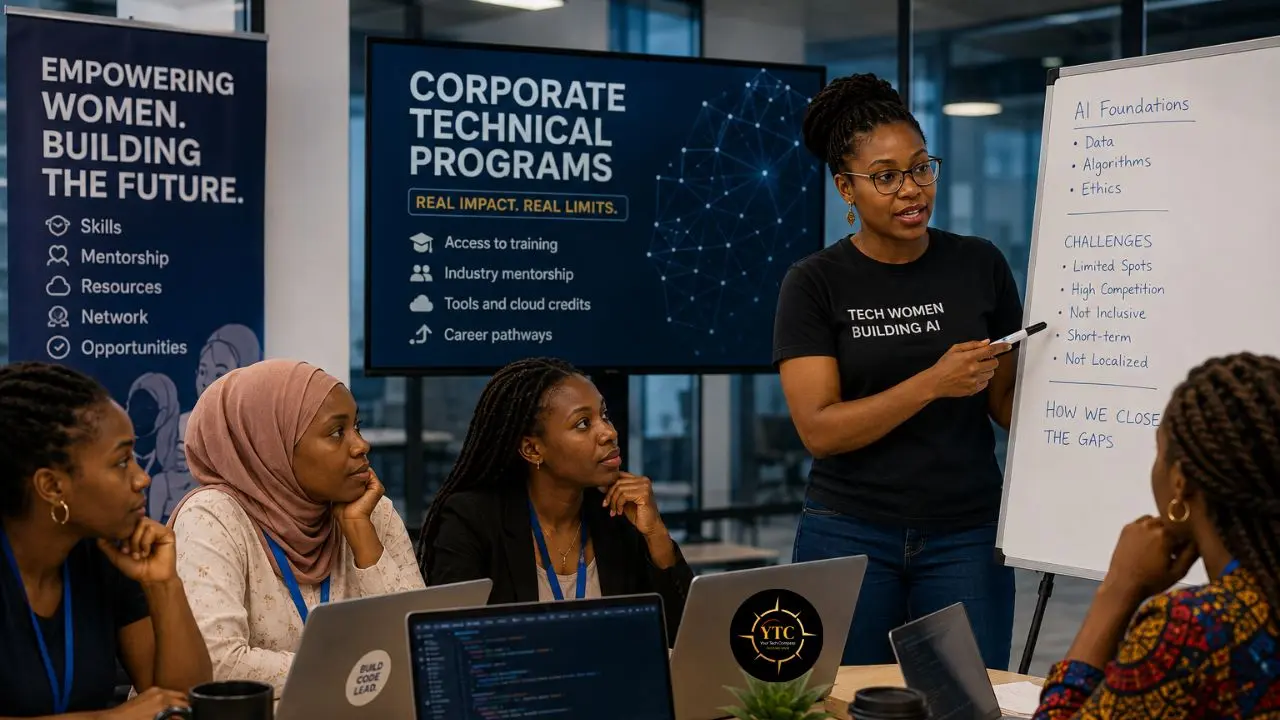
Google’s Women Techmakers, Microsoft’s Africa Development Center initiatives (and Microsoft’s public citation of Lelapa AI and the Masakhane Research Foundation as partners), and Meta’s AI research presence in Africa have all included specific programs for women in AI. These have been meaningful for the women they reach.
The honest limitation is that they reach a small, already-advantaged subset of the population: women who are already connected enough to know the programs exist and meet their eligibility criteria. And their sustainability is tied to corporate priorities that can shift with business cycles in ways that community-built structures don’t.
The Support Structure No Program Replaces
Across the public accounts of African women who have successfully built AI careers, one factor appears with striking consistency and is almost never designed for by formal programs: the specific adult (a parent, an aunt, a teacher) who recognized a girl’s technical capability and actively supported the path at a moment when community pressure pointed elsewhere.
This isn’t a universal experience. It’s not evenly distributed by geography or class. But it appears consistently enough to warrant acknowledgment as a structural factor rather than individual luck, because it points to an intervention opportunity that most programs ignore.
Programs that engage families and communities, rather than only individual women, address a real structural variable. The adult who says “you can do this” and materially supports the path is doing infrastructure work. Infrastructure work can be intentionally designed.
The Women Making It Happen
Rather than profiling individuals as exceptional outliers, I want to connect the work of specific women to the structural dynamics this article has been tracing, because their stories are evidence of what becomes possible when specific barriers are addressed, not evidence that barriers don’t matter.
Pelonomi Moiloa: Building the Infrastructure of Language

Pelonomi Moiloa has taken an unconventional path to becoming one of Africa’s most recognized figures in artificial intelligence: from biomedical engineering in Johannesburg to a master’s degree in Japan, through data science at one of South Africa’s largest banks, to co-founding Lelapa AI in December 2022 alongside Jade Abbott.
The question that Pelonomi Moiloa has dedicated her career to answering is deceptively simple: what does it look like when AI actually works for African people, in African languages, on African terms? Not adapted from somewhere else. Not retrofitted. Built here, for here, from the beginning.
Lelapa AI has launched InkubaLM, described as Africa’s first multilingual large language model, and Vulavula, meaning “speak” or “speak up,” a natural language processing service capable of transcribing, translating, and analyzing text in local languages, including isiZulu and Sesotho. In March 2025, Microsoft President Brad Smith publicly cited Lelapa AI as one of the startups Microsoft had partnered with.
What Moiloa’s trajectory illustrates isn’t primarily the story of an individual who overcame. It’s the story of a specific combination of support structures: the Masakhane community, the Deep Learning Indaba network, a professional foundation in formal data science, and co-founders who shared a clear mission that made a specific kind of company possible. Remove any one element, and the outcome is different.
Moiloa also founded The Ungovernable NPC, an experimental community space whose initiatives include the Code Kamoso coding academy for teenage girls; in other words, she is simultaneously building the AI infrastructure layer and the upstream pipeline that builds the next generation of people who can work on it.
Jade Abbott: Research Made Accessible

Jade Abbott, CTO and co-founder of Lelapa AI, is also the co-founder of Masakhane, which is dedicated to strengthening and advancing NLP research in African languages, for Africans, by Africans.
What Abbott’s work illustrates is the specific value of building research infrastructure that removes institutional gatekeeping. Masakhane’s model (open, community-driven, explicitly inclusive) has produced hundreds of research contributions from people the formal ML research world hadn’t made space for. That’s a structural intervention, not an individual story.
Dina Machuve: Agricultural AI from Tanzania
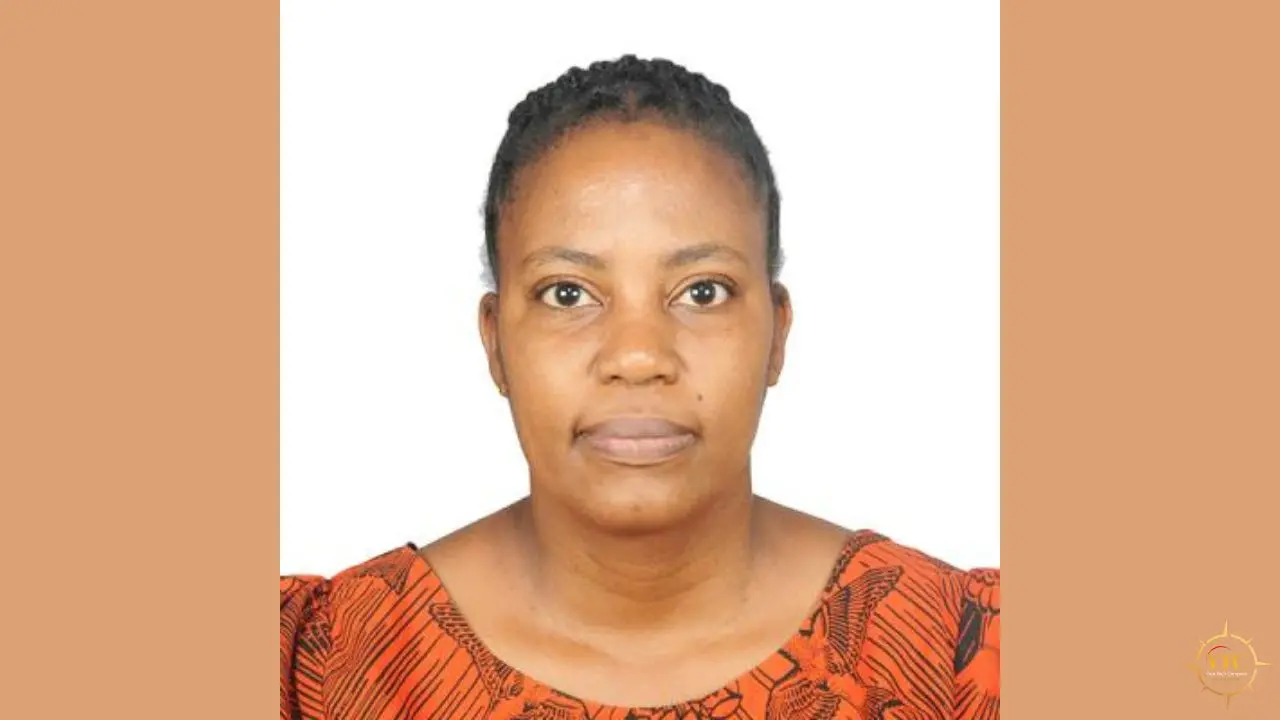
Dina Machuve is co-founder and CTO of DevData Analytics and has worked as a lecturer and researcher at the Nelson Mandela African Institution of Science and Technology in Tanzania. Her work focuses on applying machine learning and computer vision to agriculture, disease detection, and food processing.
Machuve’s work sits at the intersection of AI and agricultural development, precisely the application context where African AI can serve the majority of the continent’s population rather than its urban minority. Our guide on how AI is revolutionizing agriculture in Africa and our AI cocoa farming West Africa guide cover the applications she and researchers like her are building, tools that depend on women researchers building them if they’re going to serve women farmers.
Ethel Cofie and Nyalleng Moorosi
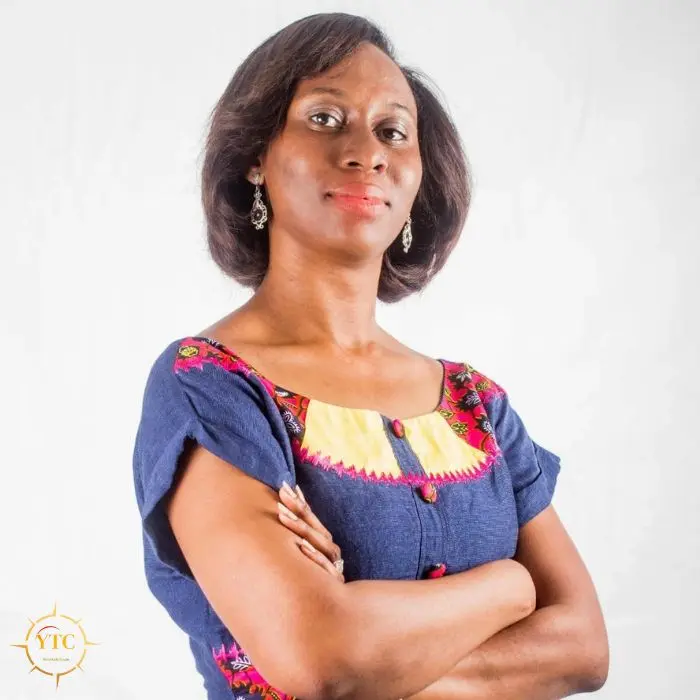
Ethel Cofie founded Women in Tech Africa to train women and girls in tech and to host convenings that propel women to the forefront of the African and global tech ecosystem.
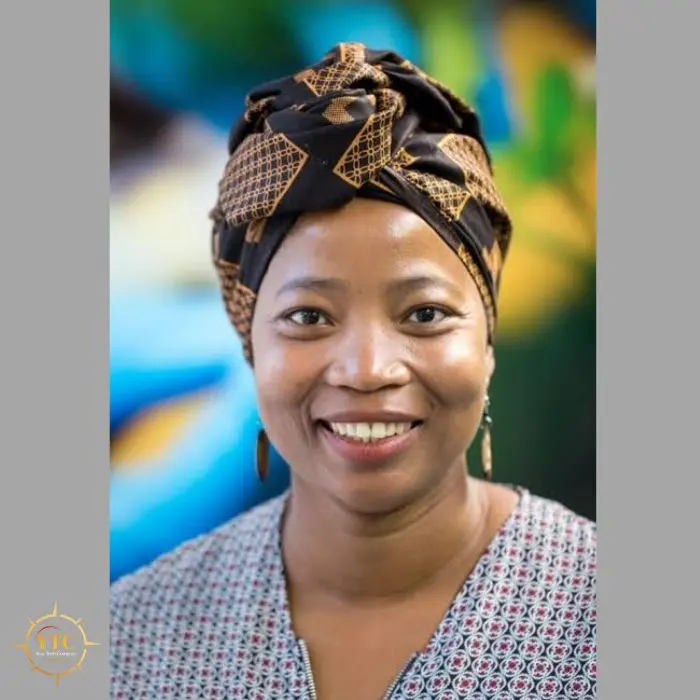
Nyalleng Moorosi, from Lesotho, is a Senior Researcher at the Distributed AI Research Institute (DAIR), an organization whose explicit mandate is AI research conducted in the public interest rather than in the service of commercial AI development, and which has been one of the most visible homes for African AI researchers working on equity and inclusion.
The common thread across these women’s work is not exceptional individual talent alone, though that is clearly present. It is the specific combination of community infrastructure that didn’t exist and they helped build; research frameworks that center African contexts rather than adapting external ones; and a refusal to treat the absence of African-language, African-demographic AI systems as a technical inconvenience rather than a structural equity issue.
Barriers vs Breakthroughs: Where We Actually Stand
Dimension | What Is Changing | What Hasn’t Changed Enough |
Research Representation | Women from Africa are now present at NeurIPS, ACL, EMNLP, ICLR (near zero a decade ago) | Senior authorship and cited leadership remain male-dominated |
Community Infrastructure | Masakhane, Deep Learning Indaba, WiMLDS chapters, AI4D programs exist and work | Geographic reach remains concentrated in urban, well-connected areas |
Commercial AI Ventures | Lelapa AI is a real company with real customers and enterprise partnerships | Funding gap for female-led AI ventures remains structurally significant |
AI Systems Serving Women | Some progress in health AI and agricultural AI with female researcher involvement | Most deployed AI systems are still built on datasets that don’t reflect African women’s voices and use cases |
Corporate Programs | More programs exist, and more are funded than a decade ago | Reach is limited to women already in the pipeline; upstream access gap is not addressed |
Policy Representation | Women are increasingly present in African AI governance discussions | Senior policy leadership in AI governance remains male-dominated in most markets |
The education pipeline problem is the slowest-moving of all these dimensions, because it’s structural, upstream, and multi-generational. The improvements in Nairobi’s and Lagos’s tech communities are not yet occurring in rural regions at the same rate or on the same scale. And the senior leadership pipeline (at the CTO and CEO level, at the senior researcher level) remains a gap that will take more than the current pace of change to close.
What Would Actually Help: Beyond Good Intentions
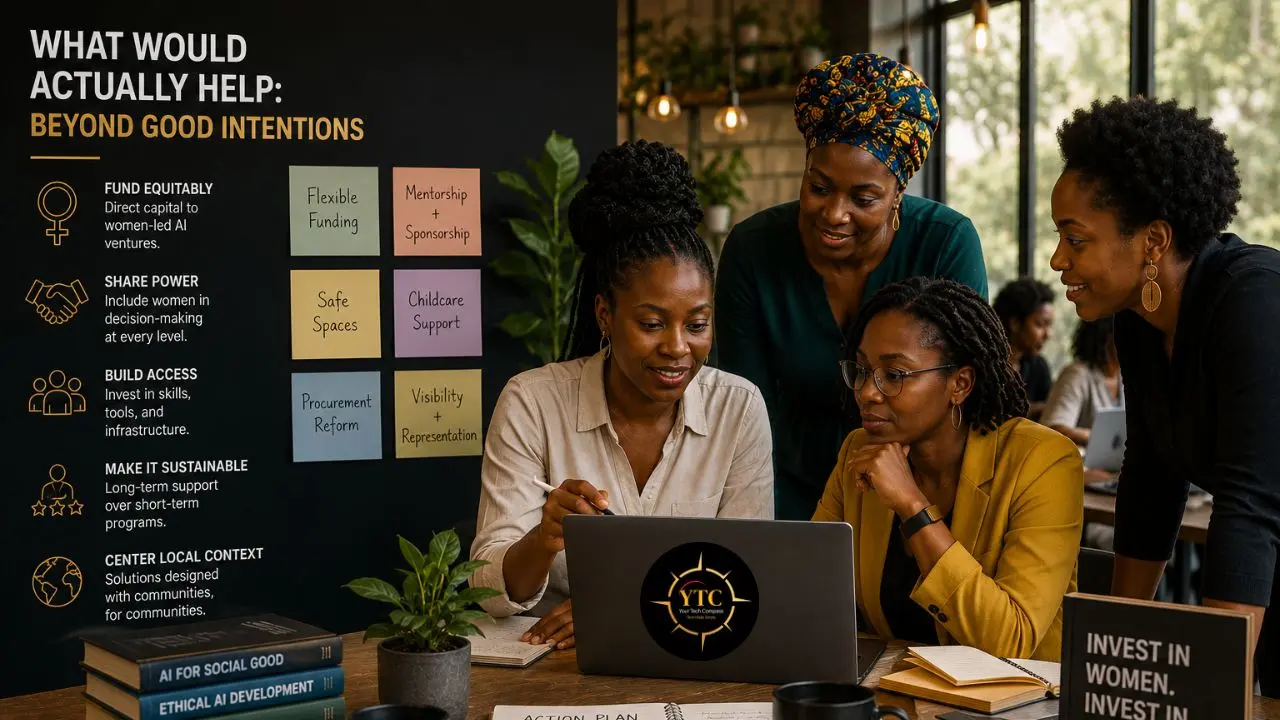
Different readers of this article are positioned to do different things with it. Here’s specific guidance for each.
For Programs and Organizations
Fund what’s already working before creating new parallel structures. Masakhane, Deep Learning Indaba, WiMLDS chapters across African cities, and AI4D Africa programs have demonstrated impact with limited resources. They don’t need more organizations creating separate women-in-AI initiatives that fragment attention and resources away from proven infrastructure.
Address the infrastructure layer, not only the professional layer. Programs that intervene at the professional level (fellowships, competitions, corporate mentorship) help women already in the pipeline.
Device access subsidies, internet connectivity programs in underserved areas, and electricity reliability are the infrastructure variables that determine whether a woman can learn AI in the first place. These are harder to deliver, and they’re the more important investment for the women who aren’t yet in the room.
Engage families and communities, not just individuals. The women who’ve successfully navigated into AI careers in Africa overwhelmingly report that the specific adult who encouraged them early on is a critical factor. Programs that only equip individual women for environments that haven’t changed set them up for isolation. While programs that shift the community and family context around aspiring women in AI address a structural root cause.
The broader ecosystem context (how AI is being built, funded, and governed across the continent) matters for understanding where to plug in. Our AI in Africa category tracks all significant developments across this ecosystem, and our AI in Africa guide covers the full landscape in which women builders operate.
For Tech Companies
Publish meaningful, auditable inclusion data rather than voluntary program descriptions. A diversity statement without data is a goodwill exercise. In addition, data without trend lines and accountability structures is a goodwill exercise with numbers. Meaningful inclusion means tracking pipeline representation, retention, promotion rates, and compensation parity by gender and publishing the results.
Source African language and demographic training data from African women researchers and communities. The data gap and the representation gap are the same problem viewed from different angles.
AI systems trained on data that doesn’t reflect African women’s voices and use cases will perform poorly for African women; that’s a product-quality problem, not just an equity problem. For the technical background on African language AI development, our African NLP and local LLMs guide covers the infrastructure being built and the specific gaps that remain.
Build hiring practices that actively address the network effect problem. If you exclusively hire from the networks you already know, you’ll hire people who look like the people your peers already hired. Deliberately expanding recruitment networks (to Masakhane, Indaba, and African university CS departments beyond the most prominent ones) changes the pipeline before you need to address it further up the chain.
For the Women Building AI Right Now
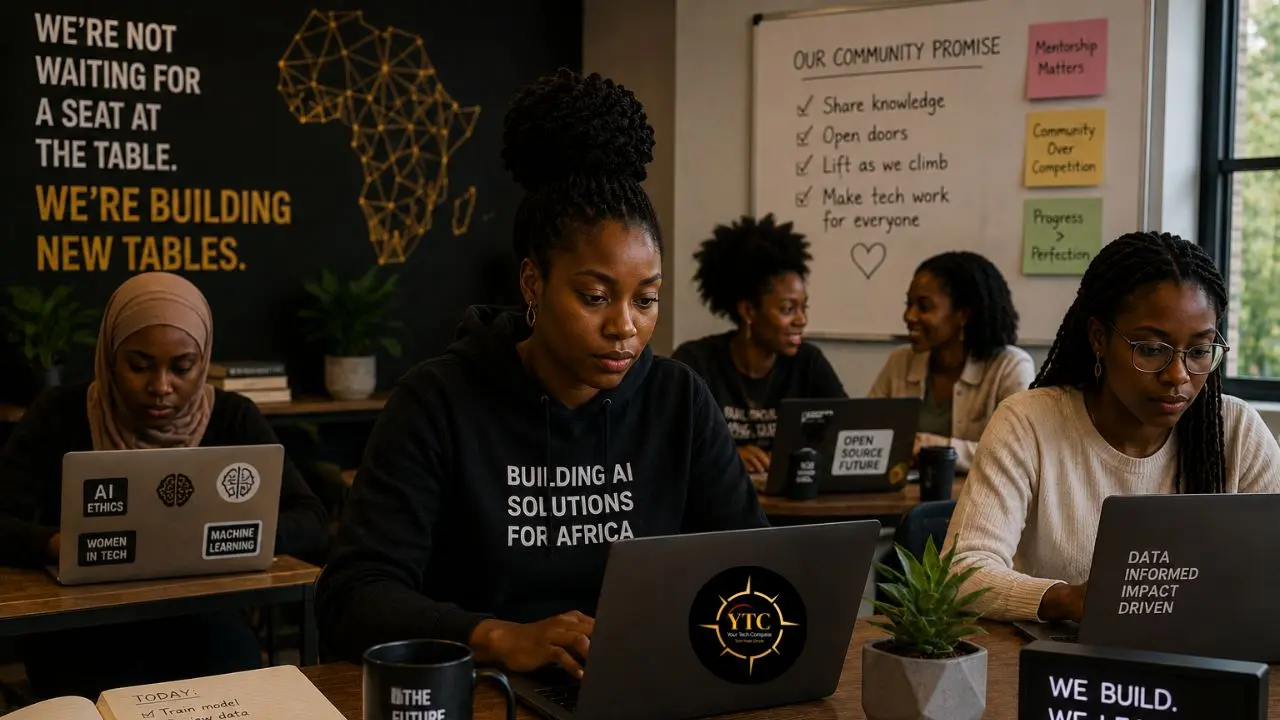
The support networks that worked did so because people used them. Masakhane, the Indaba community, WiMLDS chapters, and online communities don’t automatically deliver their value; they deliver it through participation. The access structures exist in a way they didn’t a decade ago.
You are not the problem you need to solve. The barriers are structural, and you are navigating them, which is different from failing to remove them yourself. Individual resilience is necessary and real; it is also not sufficient, and confusing the two puts the wrong burden in the wrong place.
For Policy
The AU Continental AI Strategy includes inclusivity as a guiding principle. Member states implementing national AI strategies should specify what “inclusive AI” means in gender terms, not as an aspirational statement but as a concrete commitment with measurable indicators.
Our AI policy in Africa guide covers the policy landscape within which these commitments are being shaped. The intersection of gender equity and AI governance is where policy and practice can reinforce each other, but only if the policy language is specific enough to require action.
AI systems being deployed in African health, agriculture, and financial contexts (the sectors with the most potential impact on women’s lives) should be required to demonstrate performance across gender and demographic groups, not only aggregate performance. Our AI healthtech startups Africa guide and the agricultural AI coverage on YourTechCompass show what’s being built and what’s being left out.
For broader context on how Africa’s AI development compares internationally, our Africa vs India AI adoption guide provides a useful structural comparison. In addition, our African fintech category tracks the sector in which AI applications most directly affect women’s financial access across the continent. And our AI Unboxed section tracks frontier model developments that set the technical context in which African women builders work.
FAQs
Precise pan-continental data doesn’t exist in a consistent form, which is itself diagnostic. Women represent approximately 22% of AI professionals globally, a gender gap that is wider than the gap in STEM fields more broadly. In Africa, this gap is compounded by geographic, educational, and infrastructure access gaps that vary significantly across countries and contexts. The Deep Learning Indaba and Masakhane communities have produced the most reliable longitudinal data on the gender composition of African AI researchers, showing gradual improvement from a very low base since 2017.
They compound in layers rather than operating independently: the quality of mathematics and science education available at the secondary level, which sets the pipeline before any professional program can intervene; university environments that create retention problems after initial access; infrastructure gaps in device, internet, and electricity access that are differentially distributed by gender within households; venture funding gaps that are both global (women receive approximately 2% of VC globally) and Africa-specific; and professional culture patterns that create ongoing cognitive overhead for women already in the field. The intersectionality of these barriers with class and geography means that women from lower-income rural contexts face them in a much heavier combination than women already in professional urban tech environments.
The most consistently effective support has come from community infrastructure rather than individual programs: Deep Learning Indaba (a research community and annual gathering), Masakhane (an open-source NLP research community), WiMLDS chapters across African cities, and AI4D Africa programs. Corporate programs from Google, Microsoft, and Meta have provided meaningful access for women who reach them, but their reach is limited geographically and socioeconomically. Ethel Cofie’s Women in Tech Africa provides training and convening focused specifically on women in African tech contexts.
Pelonomi Moiloa (CEO of Lelapa AI, Masakhane contributor, Time’s Most Influential People in AI) and Jade Abbott (co-founder of Masakhane and Lelapa AI) are building both commercial AI infrastructure and research community infrastructure simultaneously. Dina Machuve in Tanzania is applying computer vision and machine learning to agricultural problems. Nyalleng Moorosi at the Distributed AI Research Institute is doing AI ethics and equity research. Ethel Cofie is building capacity-development infrastructure. These are not exceptional outliers; they are evidence of what becomes possible when specific support structures are in place.
The gap is compounded in Africa by factors that don’t exist in the same form in high-income markets: weaker upstream STEM education for girls in many contexts, higher infrastructure access costs, smaller domestic AI job markets, and thinner research funding. But the community infrastructure that has developed (Masakhane, Deep Learning Indaba) has produced women who now present at the most competitive global AI venues, suggesting that with appropriate support structures, African women can compete and lead globally. The gap is contextual and addressable rather than inherent and fixed.
Masakhane is the clearest answer: the community’s open-source model requires no institutional affiliation, no GPU cluster, and no endorsement from a senior researcher to contribute. Starting with accessible online curriculum (fast.ai’s practical deep learning, Coursera’s machine learning specializations, Google’s crash courses) alongside community engagement in Masakhane or local WiMLDS and Indaba chapters is the documented pathway through which women without formal CS backgrounds have entered the field. The pathway first leads into AI-adjacent roles; research leadership and senior technical roles for those from non-traditional backgrounds require more deliberate community investment over time.
Conclusion
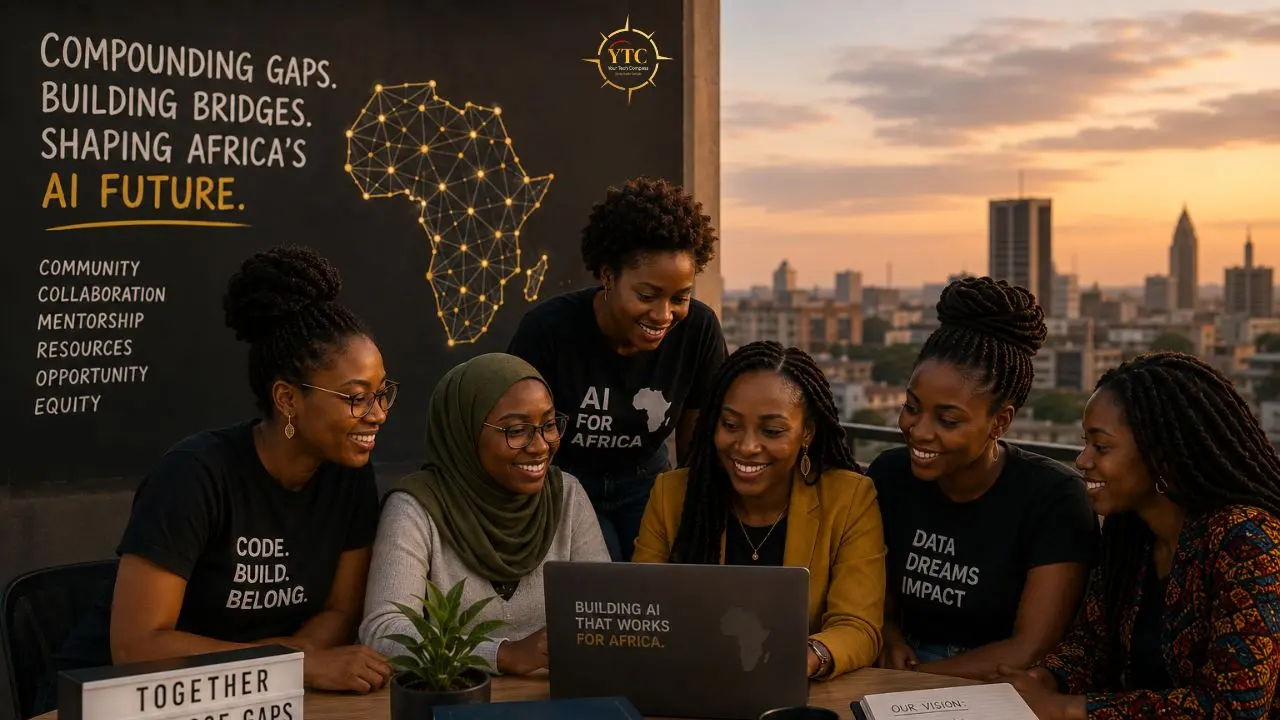
The barriers facing women who build AI in Africa are structural, compounding, and unevenly distributed by geography, class, and family context. They begin upstream of any professional program in the quality of mathematics education a girl has access to at fourteen, and they persist through every subsequent stage in subtler, harder-to-cite forms than the first. Individual excellence (and there is extraordinary individual excellence happening) navigates these barriers. It does not remove them. The women profiled in this article didn’t succeed despite a field that was indifferent to their presence. They succeeded despite the skepticism of someone who was often actively skeptical, with the specific help of communities and collaborators who decided to build the infrastructure that should already have existed. That’s not inspiration. That’s a documentation of how structural change actually happens, and what it costs when it has to be done from the outside rather than from the beginning.
The women building AI in Africa right now are not doing it despite Africa. They are doing it for Africa, building language infrastructure, agricultural tools, healthcare diagnostics, and financial systems that don’t work without them. That’s not an inspiring coda to an article about barriers. It’s a strategic imperative. AI systems built without the participation of the communities they’re meant to serve perform measurably worse for those communities than systems built with that participation, a fact with direct implications for every technology company, research institution, and policy body interested in AI systems that actually function in African contexts. The field needs them. The appropriate response to that fact is to structure the field like it.
For more detailed coverage of AI development, African fintech, and technology shaping the continent’s future, head to YourTechCompass.com.