

You’ve felt this gap before, even if you’ve never called it that. You have a genuinely good story: a product launch, a milestone, or a local business worth writing about, and no clear way to put it in front of the journalist most likely to care. Hiring a PR agency can be beyond the budget of many founders, family businesses, and nonprofits, while a mass email blast to a purchased media list can damage deliverability and make a pitch easier to ignore or mark as spam.
TAIPR says it can close that gap with AI: you describe your story, it identifies a newsworthy angle and a journalist already covering that beat, and you review and send the drafted pitch yourself. We ran three real tests to see how well that workflow held up: two using a Chicago-based hospitality business and one using Atlas, a Kenya-based mobile-money platform, selected specifically to assess journalist matching outside the US. This review is based on what those tests found, rather than secondhand reporting; at the time of testing, we found little independent coverage of a product that appears to be newly launched.
- Story-to-angle matching
- Journalist matching
- Pitch drafting
- Review-and-send workflow
- Checkout and payment localization
- African journalist coverage
- Tested
- September 2026
- Testing period
- 7 days1 bar = 1 day
- Plan
- Spark (~$24/mo annual)
- Tester
- YTC editorial team
- Devices
- Chrome on desktop
What we actually tested: Three real businesses, three full pitch cycles. We ran TAIPR’s three-step flow (story to angle, angle to journalist match, match to drafted pitch) using a Chicago-based hospitality business (tested twice) and Atlas, a Kenya-based mobile money platform chosen specifically to probe African journalist coverage. Every draft was edited and fact-checked before we considered it send-ready. Checkout was tested end-to-end, including Stripe’s automatic currency and country detection.
A note before we begin: every YTC score is earned, never negotiated. If you want to understand exactly how we evaluate apps & tools and how we handle affiliate relationships, our Review Methodology lays it all out.
Quick Verdict
- Best For: Founders, nonprofits, and local businesses with a genuinely newsworthy story, no agency budget, and the discipline to fact-check before sending.
- Skip It If: You expect fully send-ready drafts, guaranteed coverage, or cannot justify $24–29 per month without a free tier.
- Bottom Line: TAIPR’s three-step process worked largely as advertised in our testing, and its journalist matching in our Kenya-based test was a genuine positive. But two of three test pitches contained factual errors the tool did not identify, so treat every draft as a targeted starting point, not a finished one.
What Is TAIPR, and How Does It Work?
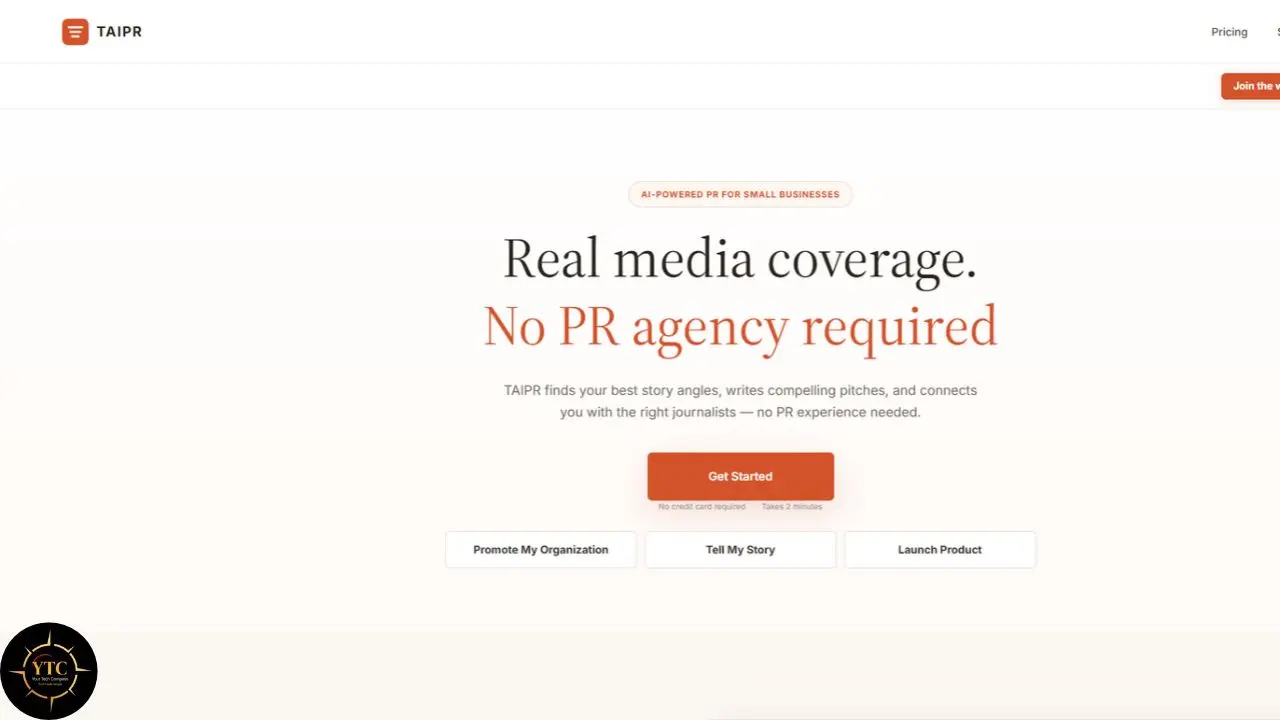
TAIPR positions itself as an AI PR strategist for people who’d never otherwise get PR help: founders, family businesses, nonprofits, and local businesses without a retainer. Tell it your story, and it finds a newsworthy angle plus a journalist “matched to current reporting” for you to review and send yourself, rather than the tool sending it on your behalf. That distinction matters: it keeps a human decision point between an AI-generated claim and a real journalist’s inbox.
Onboarding took a few minutes: name, business, website, a few story details. As our AI Unboxed coverage continues to show, “AI strategist” can mean a genuine research pipeline or a prompt template wearing a strategist’s jacket, so we checked which one this actually is. TAIPR’s privacy policy confirms it uses Amazon Bedrock, including OpenAI models, to generate angles and drafts; and Tavily, a live web-search service, to research journalists and stories — a meaningfully different architecture than a static database, and the same pattern behind a wave of AI tools chaining live search to a language model rather than relying purely on training data. Our Model Context Protocol explainer breaks down that broader architecture if you want the plumbing underneath.
Standout Features (and Where They Fall Short)
Story-to-Angle Matching: The Flagship
Angle quality ranged from genuinely newsworthy to loosely connected in our three tests. The strongest, “Beyond the Wallet: Atlas Builds a Broader Financial Platform for Everyday African Life,” tied a mobile-money platform to a timely industry development: payments companies expanding their operations in Africa. It did more than reword the company description.
“2,448 Miles or a Chicago Prelude” worked for the same reason. It drew on a clear, dated news hook: Route 66’s 2026 centennial. AFAR editorial director Billie Cohen wrote about the anniversary in a December 16, 2025 story on the route’s centennial year.
The weakest, “Chicago’s Halloween Tours Reveal the Ghosts, Gangsters and Dark History Behind Its Architectural Icons,” felt more like a seasonal tie-in than a genuine news hook. Before considering it for outreach, we replaced the peg with Open House Chicago, the Chicago Architecture Center’s annual architecture festival, scheduled for October 17–18, 2026.
In our tests, TAIPR did not distinguish between an angle built around a specific, dated news event and one built around a generic seasonal theme. That left us to judge the strength of the hook ourselves.
Compared with JustReachOut: JustReachOut focuses on finding journalists and tailoring pitches to their existing coverage. TAIPR begins earlier in the process by proposing a story angle before pairing it with a journalist and drafting outreach. That can make TAIPR more useful for users who do not arrive with a fully formed pitch idea, but it also creates more room for the tool to make an unconvincing leap.
Journalist Matching
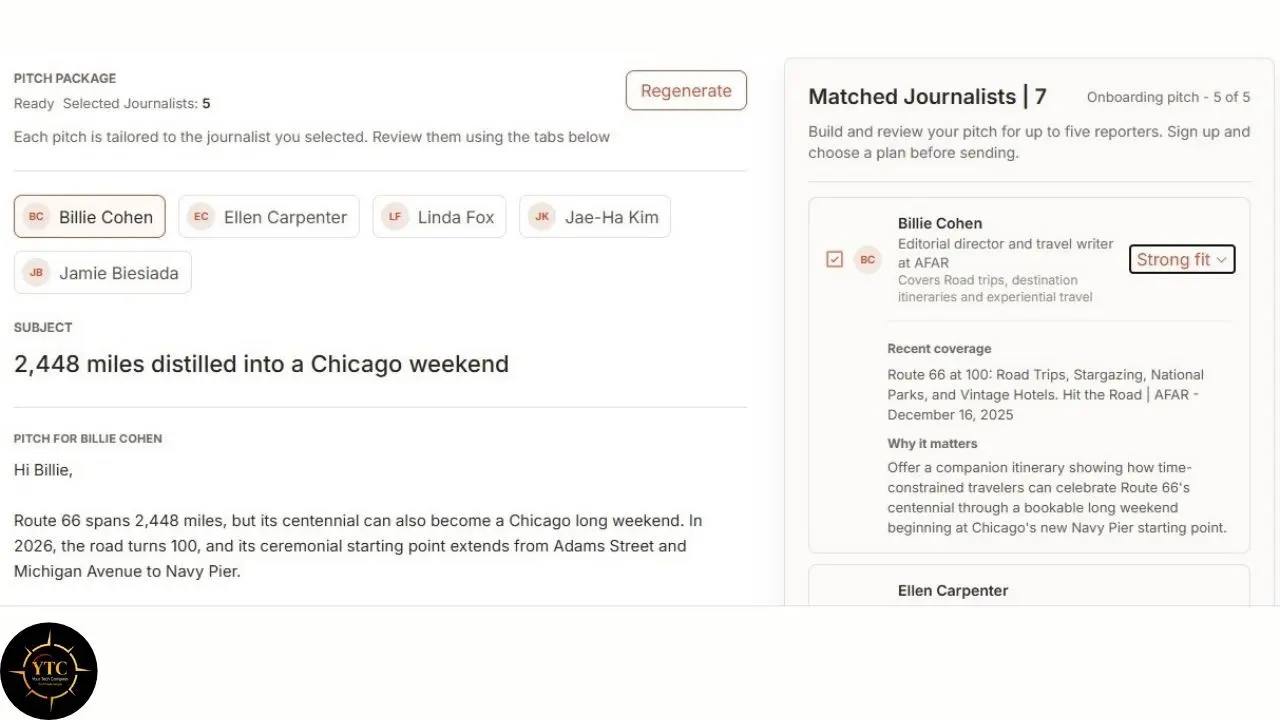
Two of the three matches were current and closely targeted in our tests. Billie Cohen, AFAR’s editorial director, was matched to her December 16, 2025 article on Route 66’s 2026 centennial, published about nine months before our test.
Alexis Akwagyiram, managing editor of Semafor Africa, was matched to his December 5, 2025 report on Latin American payments company dLocal’s planned expansion in Africa. It was the newest source across our three tests and the strongest overall match.
The third match was weaker. Bailey Berg was paired with an April 11, 2025 AFAR article about Frank Lloyd Wright’s final residential commission, a loose fit for a Chicago ghost-tour pitch built around architecture. At the time of our test, the article was roughly 17 months old, yet TAIPR labeled it “Recent.” Unless that label refers to something other than publication date, it is misleading.
That was the more important finding: TAIPR’s “current reporting” approach worked in two of our three tests, but users should still open the source article, check its date, and assess the journalist’s actual beat before trusting the match.
Pitch Drafting
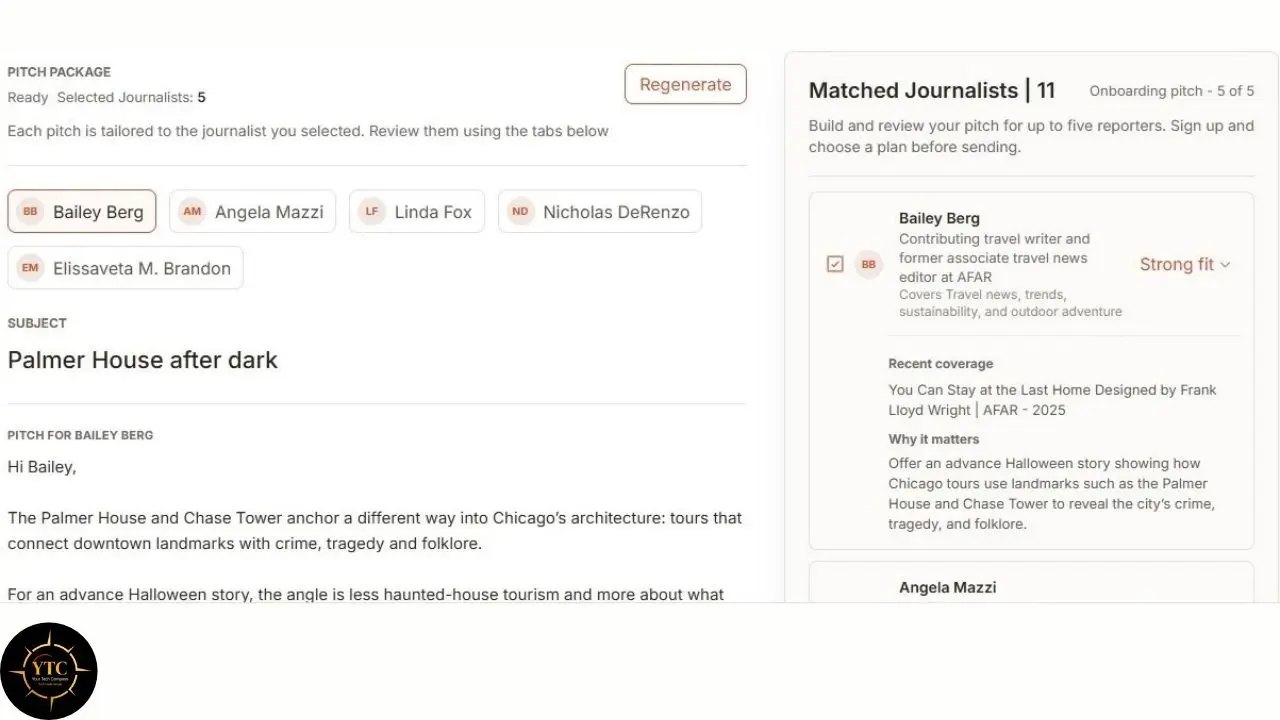
All three drafts were coherent, specific to their angles, and structured like something a journalist might actually open; none read as generic template copy. That is a genuine strength, and the part of TAIPR that most clearly outperforms a form letter.
Here is the most important finding in this review, though: two of three drafts contained errors serious enough that a journalist could reasonably hold them against the sender. The Berg draft’s subject line imposed a dark, Halloween-specific frame on Open House Chicago that was not supported by the event we independently selected as the replacement news peg. Open House Chicago describes itself as a free festival focused on Chicago’s architectural and cultural sites, with access to locations ranging from iconic landmarks to lesser-known architectural spaces.
The Atlas draft contained a separate sourcing problem: it attributed a mobile-money statistic to a GSMA report while citing a Semafor article that did not establish that attribution. Even if the underlying figure was correct, the mismatch left the pitch with an unsupported source claim. The cited Semafor article was written by Alexis Akwagyiram and covered Uruguayan fintech company dLocal’s expansion in Africa, but it does not by itself validate the separate GSMA attribution.
Neither issue was flagged by the tool, and both appeared in the claims intended to hook the reporter, the worst possible place for an unverified error to live. TAIPR’s own guidance tells users to check every claim, link, name, and statistic before sending, which supports treating the drafts as assisted first versions rather than fully verified outreach.
The Berg draft’s subject line read: “Chicago’s Halloween Tours Reveal the Ghosts, Gangsters and Dark History Behind Its Architectural Icons.” That wording framed Open House Chicago as a sinister or Halloween-oriented event, although the festival’s official materials present it as a free architecture and culture festival scheduled for October 17–18, 2026.
The Atlas draft contained a source-attribution error: it tied a mobile-money statistic to the Semafor article even though the figure came from a GSMA report. That required a sourcing correction before the pitch could be considered ready to send.
Review-and-Send Step
Here, the tool fully delivers on its promise. We edited all three pitches before deciding whether to send them: wording-level tightening for Cohen’s, a full peg replacement and subject-line rewrite for Berg’s, and one sourcing correction for Akwagyiram’s. The revisions were moderate overall: never a full rebuild, but never nothing.
TAIPR left me in complete control of the final wording in every case. That matches its stated human-review workflow: users are expected to verify claims, make editorial decisions, and approve the pitch before sending.
A Note on Outcomes
This review evaluates draft quality and the editing workflow up to the point of sending. Whether these specific pitches were ultimately sent, and what response they drew, is not something I’m reporting on here; that is a separate question from whether the tool does what it claims before that point.
The limitation worth flagging instead is that, in our tests, TAIPR did not identify which claims required verification or show the source behind each claim inside the draft. Catching the two errors depended entirely on our own fact-checking, not on anything the product flagged. TAIPR’s own guidance makes clear that human review remains necessary, but our testing suggests that users should treat every draft as a targeted starting point, not a finished one.
Pricing: The Real Cost Math
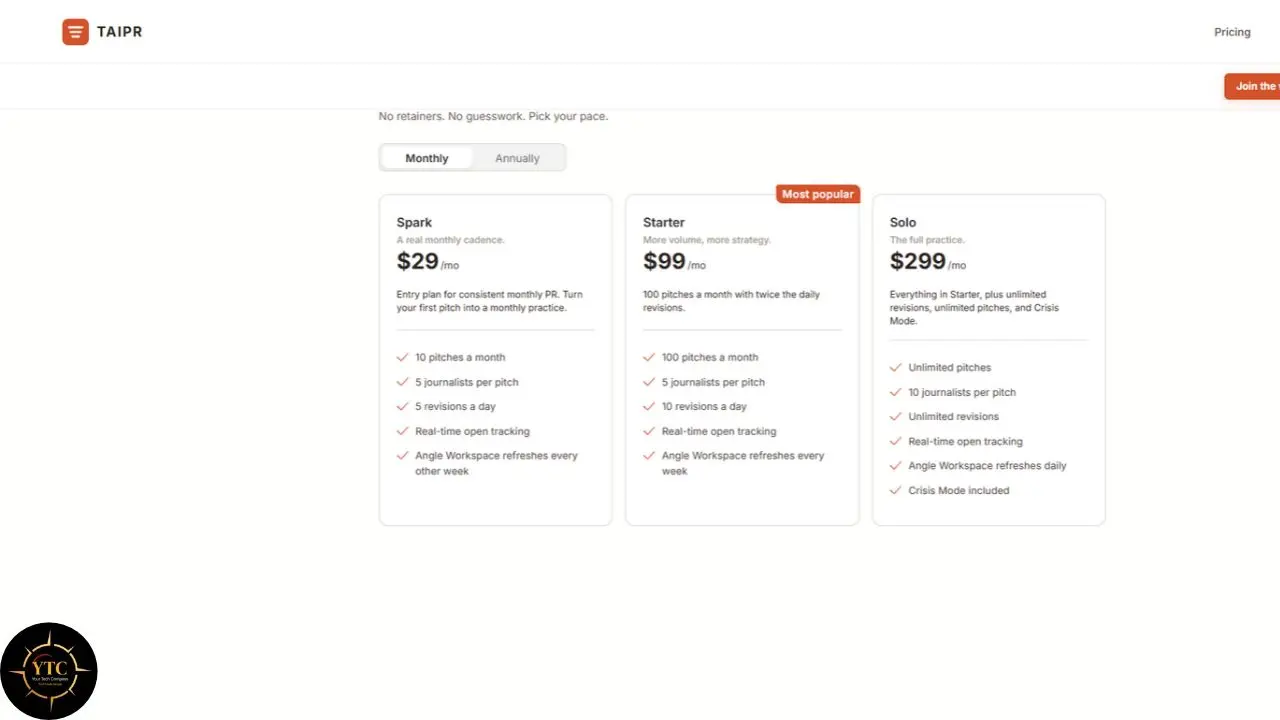
At the time of testing, pricing was not linked from TAIPR’s main navigation, but it was not gated either: taipr.com/pricing was public once you knew to look. TAIPR offered three tiers, billed monthly or annually, with annual billing reducing the effective monthly price by roughly 16–17% across the board.
Tier | Monthly Price | Effective Monthly Price, Billed Annually | Pitches/Month | Journalists/Pitch | Revisions/Day | Angle Refresh |
Spark | $29 | $24 | 10 | 5 | 5 | Every other week |
Starter (Most Popular) | $99 | $83 | 100 | 5 | 10 | Weekly |
Solo | $299 | $249 | Unlimited | 10 | Unlimited | Daily |
Legal, Privacy, and Risk: Who Owns a Bad Pitch?
TAIPR prepares outreach that is sent under your name to real journalists, with the user reviewing and approving the final pitch before it goes out. Accountability here is not abstract. TAIPR’s Terms of Service say you retain ownership of submitted content while granting the company a license to use it to provide, secure, support, and improve the service. Its Privacy Policy itemizes what it collects: account details, campaign information, pitch drafts, journalist lists, and standard technical data such as IP addresses and usage logs.
On data use, TAIPR is more transparent than many early-stage AI tools, though not perfectly so. Its Privacy Policy states that Google and Gmail user data is never used to train or fine-tune an AI model and is never sent to AI or search providers. That is an explicit, narrowly scoped guarantee. The same wording is not repeated verbatim for other campaign content, such as business details and pitch drafts, although the policy indicates that AI requests are generally not retained for provider-side application history. It reads more like a drafting gap than evidence of a hidden practice, but “appears” is doing real work in that sentence.
Retention periods are specific in several important cases: OAuth state records are retained for 30 minutes, outbound email-job records for seven days, and email-open tracking for 180 days. Other data is retained under broader “as long as needed to provide the Services” language. Journalists can opt out of future TAIPR-assisted outreach through a “Do Not Pitch” suppression list that TAIPR says it will honor.
Risk allocation is where TAIPR is most candid. Section 4 of its Terms, covering AI outputs, states that outputs “may be inaccurate, incomplete, outdated, or unsuitable” and puts responsibility for reviewing, fact-checking, and approving them on the user before sending. That matched our testing: two of three drafts contained errors serious enough to matter, and the tool flagged neither. TAIPR discloses the risk in writing and retains a human review step, but in our tests it did not provide claim-level fact checks, source validation, or warnings for the errors we found.
TAIPR vs. the Alternatives
TAIPR sits in genuine white space: cheaper and more self-serve than established PR software, with less human oversight than a boutique agency or a hybrid AI-plus-strategist service.
Platform | Starting Cost | What It Automates | Human Review Step | Best For | Weakest At |
TAIPR | ~$24/mo (billed annually; $29 monthly) | Angle generation, journalist matching, pitch drafting | Yes (you review and send it to yourself) | Story-rich founders without PR experience | Fact accuracy, recency labeling, no free entry |
JustReachOut | $98–165/mo billed annually (plus higher tiers) | Journalist research, pitch personalization, outreach tools; human strategist support on higher-touch tiers | Yes, with added human coaching on selected plans | Marketers wanting AI plus real guidance | You still bring your angle |
Boutique PR Agency | Typically $2,000–10,000+/month retainer | Full strategy, writing, relationship-building | The agency is the review step | Funded companies wanting hands-off PR | Cost, opacity, retainer risk |
Compared to JustReachOut: JRO starts higher but adds human-verified addresses and strategist coaching. Know your angle already? JRO. Need one invented for you? TAIPR.
None of these tools does ongoing media monitoring or social listening, a different category, covered in our Sprout Social review and wider apps and tools coverage.
Real-World Use Cases
Our hospitality test is the clearest real-world example here: a Chicago-based hospitality business with a Route 66 centennial angle, matched to AFAR’s editorial director, needed only light wording edits before it was ready to consider sending. It was about as close to the ideal outcome as TAIPR produced in the hospitality tests.
A nonprofit with a timely but under-resourced story fits a similar profile: no PR budget, no in-house comms person, and a real news hook if someone can find the right journalist to pitch it to. TAIPR explicitly lists nonprofits among its intended users. Based on what we saw, that nonprofit should expect a workable starting draft, not a finished one. The same fact-checking discipline we applied matters just as much for a mission-driven story as it does for a commercial one.
A local business owner trying to land regional press sits somewhere in between. TAIPR’s angle quality clearly depends on how strong the underlying news hook actually is, so a business with a genuinely timely story will get more out of this tool than one hoping the AI invents newsworthiness that is not there yet.
Honest Limitations

Does “matched to current reporting” hold up? Inconsistently. In our three tests, the source articles were about three, nine, and seventeen months old; TAIPR labelled the oldest “Recent.” TAIPR’s use of live web search via Tavily explains the research mechanism, but it does not guarantee recency on its own. Its cheaper plans also refresh the Angle Workspace less often, so angle freshness may vary by what you pay, not just by topic.
How much fact-checking does a draft need before it is safe to send? More than “review and send” implies, though TAIPR’s own terms are honest about the gap. In our three tests, two drafts contained claims serious enough to damage credibility with a journalist. TAIPR discloses that AI outputs may be inaccurate, incomplete, outdated, or unsuitable and puts the responsibility for reviewing and fact-checking them on the user. The tool provides a review step, but in these tests it did not flag the unsupported claims or identify the sources behind them.
Are there real gaps in journalist coverage outside major US media? Fewer than expected. TAIPR returned at least five relevant African journalists in one Kenya-based fintech test, with geography implied rather than declared. That is a genuinely positive signal, though one well-covered beat in one country does not establish how a thinner sector or a different market would fare.
Who Should Use TAIPR (and Who Shouldn’t)
Use it if you:
- Have a genuinely newsworthy story but no angle-finding skill or agency budget.
- Can commit real verification time to each pitch before sending, not just a skim.
- Need journalist matches beyond major US media. In our Kenya-based fintech test, TAIPR returned at least five relevant African journalists, though that one result does not establish coverage quality across every market or beat.
- Are based in Kenya and value local-currency checkout: Stripe offered Kenyan shillings alongside US dollars in our test. Local-currency availability elsewhere remains untested.
- Treat every pitch as the start of a relationship, not a one-shot transaction.
Skip it if you:
- Expect accurate, send-ready drafts with no human verification.
- Need guaranteed placements; no PR tool can promise coverage, and TAIPR says editorial decisions remain with journalists and publications.
- Cannot justify $24–29/month without a trial.
- Work in a niche or thinly covered beat; calibrate expectations first with our tech guides.
The Review Landscape: An Honest Note

TAIPR is a newer product, and publicly available independent coverage appears limited. The company was still referring to alpha users in May 2026, and its founder lists TAIPR AI as beginning in February 2026.
I found no detailed independent hands-on testing that confirms or contradicts these specific findings. That cuts both ways: this review documents a three-test sample, not a universal verdict. Treat it as one evidence-led data point, and weigh its conclusions against your own story, industry, geography, and willingness to verify every pitch before sending.
TAIPR in Africa: The Accessibility Check
TAIPR’s homepage says nothing about geographic coverage, and neither do its Terms; eligibility is defined by age and legal capacity to contract, with no country or regional restriction stated. Testing with Atlas, a Kenya-based mobile-money platform, returned at least five relevant African journalists, led by Alexis Akwagyiram, Managing Editor of Semafor Africa. Semafor says Akwagyiram has covered African news and current affairs for more than a decade at the BBC, Reuters, and the Financial Times. He was the strongest and most current match across all three of our tests.
The press-coverage scope selector (local, regional, and national) never asked for a declared country. In this test, TAIPR appeared to infer geography from the business description and return relevant regional journalists, a useful design choice when it works. Payment localization reinforced that result: in the Kenya checkout test, Stripe auto-detected the business’s country and offered KES alongside USD with no manual input. That is a genuine, unadvertised accessibility win. This is the same quiet, default-level accessibility our AI in Africa coverage keeps tracking: tools that work well for African users not because they were built specifically for the continent, but because they did not build in barriers to begin with.
Fair limits apply. African fintech is a well-covered beat, so this may have been an easier test than most African sectors, and currency localization was confirmed for one country, not the continent broadly. For the wider payments landscape this sits inside, our African FinTech coverage tracks how crowded and how well served this particular beat has become.
Finding True North When the Pitch Machine Talks Back

TAIPR’s real achievement is not automation; it is translation. It turns a business description into the question every journalist asks: why should anyone care today? In two of our three tests, the answers it produced were genuinely good. That is one of the core jobs a PR retainer can cover, and one many founders lack the time, training, or repeatable process to do consistently.
The practical takeaway is calibration, not rejection. Use TAIPR when you have a real story, a verification habit, and realistic expectations. It can provide a useful, research-led starting point for developing an angle, finding relevant journalists, and drafting outreach, but it is not a finished PR service or a substitute for editorial judgement. TAIPR’s terms explicitly warn that AI outputs can be inaccurate, incomplete, outdated, or unsuitable. Whatever ends up in the pitch, the fact-check is yours to do, because the signature at the bottom is yours too.
Let Your Tech Compass be the last review you read before your next pitch. Find your bearings at YourTechCompass.com.