The EU’s Artificial Intelligence Act entered into force on 1 August 2024 and is being applied in stages; the United States still has no single, comprehensive federal AI statute comparable in scope. Across African capitals, the pressure is on to govern AI before adoption outpaces oversight. Yet one tension gets too little airtime: Africa’s governments, businesses, and consumers will keep building, buying, and deploying artificial intelligence whether or not comprehensive AI-specific laws arrive, and the real question is whether those rules will match the realities we live with.
The continent does not need the most elaborate AI governance framework on earth. It needs one that can function. Risk-based regulation is not a diluted version of European ambition, nor is it a complete solution on its own. In the African context, it directs scarce regulatory resources toward the applications capable of the greatest harm while leaving room for experimentation everywhere else. The African Union’s Continental AI Strategy makes the same call: agile, forward-looking and risk-based regulation paired with investment in infrastructure, computing, datasets, skills, research, institutions and innovation. This article maps what that could look like, country by country and tier by tier, because treating Africa as a single market is how well-intentioned policy loses touch with reality.
What “Risk-Based” Actually Means and Why Africa Can’t Copy Europe
The EU AI Act uses a risk-based framework rather than a single, exhaustive four-tier system. It prohibits certain AI practices, including social scoring that produces unjustified or disproportionate detrimental treatment and some biometric uses. In addition, it subjects defined high-risk systems, including certain medical devices, creditworthiness or credit-scoring systems, and systems used in education, employment, law enforcement, border management, and essential services, to stringent requirements.
It also imposes targeted transparency obligations on systems such as chatbots and tools that generate or manipulate synthetic content, while many other AI applications, including spam filters, generally face no mandatory AI Act obligations. Violations of prohibited AI practices can draw fines of up to €35 million or 7% of worldwide annual turnover, whichever is higher, with other breaches carrying lower but still substantial penalties.
Now set that against enforcement reality. Nigeria published its National Artificial Intelligence Strategy in September 2025, setting out pillars for AI infrastructure, responsible and ethical AI, and a robust AI-governance framework. Kenya’s Office of the Data Protection Commissioner has demonstrated practical enforcement capacity through penalty notices, enforcement notices, determinations, and digital-credit-provider compliance action. South Africa’s Information Regulator, which administers POPIA, already touches AI systems that process personal information while facing skills shortages and workload pressures, a mismatch our South Africa AI skills paradox piece unpacks in more detail.
The point, made plainly: copying Brussels wholesale would risk importing institutional and compliance machinery that many governments would struggle to fund, staff, coordinate, and enforce consistently. The EU framework depends not only on risk categories, but also on specialist authorities, market surveillance, conformity assessment, technical standards, documentation, post-market monitoring, remedies, and enforcement powers. That is not a case for lower African standards, but for adapted ones.
What Africa should take from Europe is the foundational idea: the greater the potential harm to rights, safety, or livelihoods, the stronger the safeguards. The African adaptation is proportionality: simpler baseline obligations for low-risk uses, targeted documentation and human oversight for high-impact systems, and heavier reliance on sectoral regulators that already oversee relevant risks in credit, health, communications, consumer protection, and financial services.
Governments do not necessarily need a new AI super-regulator. They can identify the highest-risk applications, assign clear responsibility to existing bodies, and establish a modest coordination function for cross-sector issues. Most lower-risk systems should face baseline transparency, recordkeeping, and complaint-handling requirements rather than case-by-case approval. Registration should be reserved for clearly defined high-impact systems, particularly those used by public authorities or in credit, employment, education, health, policing, border administration, and essential services. High-impact applications should receive closer scrutiny, meaningful human oversight, and appropriate technical and decision records.
For the fuller regulatory and market picture, our Artificial Intelligence in Africa guide is a useful starting point.
The Regulatory Landscape Across Africa: A Patchwork, Not a Plan
Africa has no continent-wide, binding AI regulatory framework. The African Union’s Continental AI Strategy offers a common policy direction, but it is not a harmonized statute or supervisory regime, and national approaches still differ in scope, legal force, and institutional design. Zimbabwe, for instance, is shaping its own approach, detailed in our coverage of Zimbabwe’s national AI strategy.
South Africa: POPIA, the IRBA, and the Ghost of an AI Framework

South Africa is one of the continent’s most legally developed digital markets, but maturity is not clarity. POPIA’s substantive provisions commenced on July 1, 2020, and its one-year compliance grace period ended on June 30, 2021. Section 71 restricts decisions based solely on automated processing that produce legal consequences or substantially affect a person, particularly where profiling is involved. Its protections are qualified, however: contract-related and legally authorized decisions may fall within statutory exceptions, provided the required safeguards are in place. Even the Independent Regulatory Board for Auditors is examining how AI affects audit quality.
That Act does not yet exist. A draft national AI policy, published for public comment in April 2026, continues the process, but a draft policy is not an enacted statute. It proposes a much more ambitious governance architecture, including AI-specific coordinating, regulatory, ethics, and redress bodies, but those proposals do not yet carry the force of law. Governance therefore still runs through existing instruments: POPIA, the Constitution, consumer law, financial-sector rules, and other sectoral requirements. The flexibility suits a founder in Cape Town; a loan applicant subject to a solely automated decision may have Section 71 protections, but the scope of those protections depends on whether an exception applies and whether the lender has provided the safeguards POPIA requires.
Nigeria: NITDA’s Strategy and the Sandbox Gap
Nigeria moved early. NCAIR published a draft National Artificial Intelligence Strategy in August 2024; a September 2025 National AI Strategy followed under the Federal Ministry of Communications, Innovation and Digital Economy, and the two should not be conflated. The latter sets out pillars for infrastructure, ecosystem building, sectoral adoption, responsible AI, and AI governance, but it remains a policy strategy rather than an AI-specific statute. We’ve weighed that pace of institution-building against other emerging markets in our piece on AI adoption in Africa versus India.
The gap is execution. Nigeria’s financial authorities have built substantial licensing and supervisory machinery, and the Central Bank of Nigeria and Securities and Exchange Commission have each developed sandbox or innovation-testing mechanisms within their respective mandates. Those mechanisms support controlled testing of financial innovation, but they are not general AI-governance regimes and do not, on their face, establish AI-wide requirements for bias testing, explainability, or model-safety evaluation. Outside financial services, AI governance rests largely on general data-protection and sectoral rules.
The Nigeria Data Protection Act 2023 gives data subjects a qualified right not to be subject to solely automated decisions that produce legal or similarly significant effects, and requires safeguards that include human intervention, the ability to express a view, and the ability to contest a decision where an exception applies. The NDPC’s powers therefore reach AI-related personal-data processing, but public AI-specific enforcement practice remains limited. Financial services are likely to be Nigeria’s first serious testing ground for AI oversight.
Kenya: A Strong Data Protection Act With a Nascent AI Layer
Kenya’s Data Protection Act of 2019 is one of the continent’s more developed privacy statutes, and the ODPC has shown teeth with enforcement notices, determinations, audits, and administrative penalties. It grants every data subject the right not to be subject to a decision based solely on automated processing, including profiling, that significantly affects them, and to request human reconsideration.
The catch: as of August 2026, Kenya has no dedicated AI statute. A Nairobi mobile lender can comply with the DPA’s core principles while operating a credit-scoring model that produces discriminatory outcomes, because the regime relies on general data-protection principles rather than a comprehensive, AI-specific system for bias auditing, risk classification, technical standards, and post-market model oversight.
ODPC guidance issued in July 2026 requires human review for significant automated decisions and sets out expectations for fairness, explainability, DPIAs, and governance for high-risk AI, but enforcement will depend on how consistently those expectations are applied in practice. Kenya’s 2025–2030 National AI Strategy, initially published in draft for public validation, and the Artificial Intelligence Bill, 2026 point toward a dedicated AI-governance layer; neither was an enacted AI statute as of August 2026. Kenya’s healthtech founders need that clarity. We’ve profiled several of those healthtech startups navigating that uncertainty.
Rwanda: The Continent’s Most Deliberate Tech Laboratory
Rwanda does not wait for perfection before acting. The Smart Rwanda Master Plan and the Irembo platform’s digitization of government services have made Kigali one of Africa’s most deliberate tech-governance laboratories. The Rwanda Food and Drugs Authority has issued guidelines for the review and approval of Software as a Medical Device, including AI- and machine-learning-based software, and runs AI-in-health pilots across clinics with WEF and Gates Foundation partners.
The 2023 National AI Policy includes a detailed, multiyear implementation plan and proposes a Responsible AI Office within the Ministry of ICT and Innovation to coordinate delivery. The lesson is methodological, not mechanical: Rwanda’s small, centralized state iterates fast; Nigeria’s far larger population and federal structure make the same speed impossible. Our AI Policy in Africa piece compares how these national policies stack up against one another.
Egypt and Morocco: Giving North Africa Its Due

North Africa is too often an afterthought in pan-African tech discourse; this analysis will not repeat that mistake. Egypt’s National Council for Artificial Intelligence, Quantum Computing and Emerging Technologies anchors a 2025–2030 national AI strategy and, in March 2026, published a Guide to Egypt’s National AI Governance Framework that sets out a risk-based, hybrid model with central policy direction, technical evaluation, sectoral oversight, and post-market monitoring.
The national Arabic LLM, Karnak, plus dedicated research centers and significant public investment, puts Egypt in the same conversation as South Africa and Nigeria, even as R&D funding and ecosystem maturity keep developing. That effort mirrors a broader continental push toward homegrown language models, a trend our African NLP and local LLMs piece explores.
Morocco’s digital-transformation agenda has increasingly foregrounded AI, including in public-service modernization, industrial competitiveness, and smart-city ambitions, leveraging its multilingual context. These markets matter doubly: they interface with both African Union frameworks and Middle Eastern standards. Any serious account of Africa’s AI position belongs to North Africa as much as the sub-Saharan powerhouses.
A Three-Tier Framework That Matches African Capacity
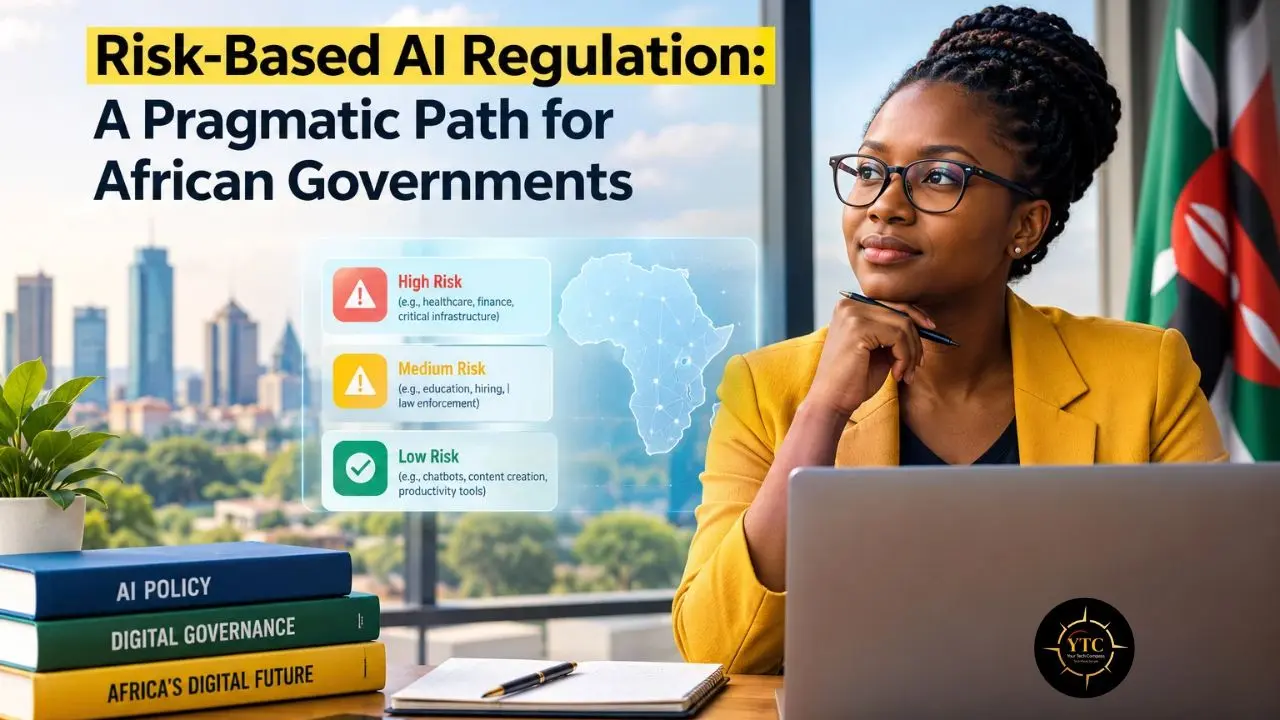
Keep the EU’s risk-based logic, but collapse it into three tiers: every added tier is ambiguity, and ambiguity is the enemy of enforcement where regulators are stretched thin. The aim is not to weaken protections. It is to concentrate oversight where AI can most seriously affect rights, safety, livelihoods, and access to essential services.
Tier 1: High-Risk and Prohibited
This tier covers applications that can ruin lives before a regulator finishes reading the complaint. Indiscriminate or generalized real-time biometric identification in publicly accessible spaces should be prohibited. Any narrowly defined law-enforcement exception should rest on a clear legal basis and be necessary, proportionate, limited in purpose, geography, and duration, and subject to independent or judicial authorization and oversight.
Automated credit decisions that materially determine access to finance should be classified as high risk, with mandatory impact assessments, documented validation and performance testing, meaningful human review, and a route to challenge adverse outcomes. Independent assurance should apply where the scale, complexity, or risk of discriminatory harm justifies it.
Clinical diagnostic and decision-support systems should operate under meaningful qualified clinical oversight. Where that oversight cannot be guaranteed, the system should not autonomously determine diagnosis or treatment. The error cost is measured in liberty, economic exclusion, and human health, so that is where scarce resources should concentrate. These rules can use existing institutions and clear thresholds: a central bank can set assurance and appeals requirements for consequential credit decisions; a health regulator can require clinical evaluation, human oversight, documentation, and post-market monitoring for AI-enabled medical software.
Tier 2: Limited-Risk
Customer-service chatbots, nonconsequential recommendation systems, and internal workflow tools sit here. The harm can still be real: a biased chatbot can mislead a customer or reproduce personal data; a recommendation system can amplify harmful or discriminatory outcomes. The response is disclosure, proportionate documentation, risk assessment where personal data or vulnerable users are involved, complaint handling, and fallback to existing regulators. Recruitment screening, insurance eligibility or pricing, and any system that substantially affects a person’s job, credit, benefits, housing, health care, education, or access to services should move into Tier 1.
A Lagos platform using AI to screen CVs should therefore be treated as high risk. It should notify applicants of automated screening, conduct a pre-deployment impact assessment, test for discriminatory outcomes across relevant groups, keep decision records, provide meaningful human review, and maintain an accessible appeal mechanism.
Tier 3: Minimal-Risk
Spam filters, routine inventory forecasting, weather APIs, and internal analytics should face no mandatory AI-specific pre-market approval. Voluntary standards can promote good practice while existing privacy, consumer-protection, cybersecurity, and sectoral law continue to apply. This tier protects experimentation: a small farm should not need regulatory approval to call a rainfall-prediction API.
Classification must follow actual function, though. A tool that controls irrigation, recommends pesticides, determines access to subsidies, or triggers insurance payouts needs stronger safeguards. A simple rule enforced beats a perfect rule ignored.
The Infrastructure Reality No Regulator Can Ignore
Data Sovereignty vs. Data Availability

The push for domestic and regional data capacity is justified: Kigali Innovation City, Nigeria’s Galaxy Backbone, Kenya’s Konza Technopolis, and South Africa’s Teraco all reflect a real sovereignty and resilience logic. But data sovereignty is not the same as forcing every dataset or workload to stay within national borders. Training modern AI requires computing power that remains scarce and expensive across much of the continent.
A Lagos startup processing Nigerian personal data may face higher compliance costs when it uses offshore cloud infrastructure, because cross-border transfers require a lawful transfer basis and appropriate safeguards. Where sector-specific rules or government contracts require local hosting, the cost and availability of domestic cloud capacity become even more consequential. Regulators should not turn affordable cloud access into a privilege of large incumbents by imposing localization obligations without adequate local or regional capacity.
The Talent Gap: Who Audits These Systems?
African regulators and public institutions do not yet have enough specialists in machine learning, data governance, cybersecurity, human rights, and sector regulation to evaluate high-impact AI systems at scale. Competition from better-funded global employers can make it harder for African governments, universities, startups, and regulators to retain specialized AI talent; retention strategies should also explicitly address gender equity.
The pragmatic response is to fund independent audit capacity through universities, professional bodies, accredited laboratories, civil-society watchdogs, and public-private partnerships. Data Science Africa and the Deep Learning Indaba can help build the talent pipeline, develop local evaluation methods, convene peer-review networks, and train regulators and prospective auditors. That is a workforce question we tackle directly in our Africa’s AI factories guide.
Internet Fragmentation and Cross-Border Enforcement
A Kenyan startup can deploy a model hosted on AWS Mumbai, train it on Nigerian data, serve Ghanaian users, and face questions from a Tanzanian regulator after a citizen in Dar es Salaam is denied a loan. That is increasingly the operating reality for cross-border digital services. Without workable interoperability, African AI companies may need to navigate overlapping data-protection, consumer, financial-services, cybersecurity, and emerging AI-governance requirements, each with different transfer rules, documentation duties, regulators, and remedies.
Regional Economic Communities, including ECOWAS, the EAC, and SADC, are essential venues for developing shared standards, supervisory cooperation, mutual recognition, and compatible sandbox rules. But they are not the only ones. The AU Data Policy Framework, the AfCFTA Protocol on Digital Trade, the Malabo Convention, and practical transfer mechanisms such as adequacy decisions, reciprocal agreements, binding corporate rules, and standard contractual clauses all have a role in making lawful cross-border AI deployment possible.
Sector-Specific Risks African Regulators Must Prioritize
Financial Services: Algorithmic Bias in Mobile Lending
Mobile lending is a fast-growing and often opaque part of African fintech, a space our African Fintech category discusses in more depth. Some digital lenders use automated models and alternative data (mobile money history, airtime and phone activity, e-commerce data, and other digital signals) to make or inform rapid credit decisions. The efficiency can be genuine, but so are the risks: the World Bank notes that digital financial services may rely on data that is incomplete or unrepresentative, and that algorithmic decisions can preserve or amplify bias in data collection, model design, or market practices.
The exclusion risk deserves particular attention. Women, rural borrowers, and informal-sector workers may have thinner digital footprints, irregular or seasonal incomes, limited smartphone access, or weaker access to formal identification. Models trained on data that does not adequately represent these groups may disadvantage them in approval rates, loan limits, pricing, or collections.
This is Tier 1: central banks and consumer-protection regulators should require disclosure of automated decision-making and data sources, test outcomes across relevant borrower groups, provide human review and redress, and mandate independent fairness audits for lenders above proportionate portfolio thresholds. Similar bias questions extend beyond lending to AI-driven routing in African e-commerce and logistics, a sector we’ve examined separately.
Healthcare: Diagnostic AI in Under-Resourced Clinics

The promise is enormous: a clinic in northern Nigeria with no radiologist can use computer vision to flag suspected tuberculosis on a chest X-ray, and an AI triage tool can help a Ugandan community health worker prioritize children for malaria testing. The danger is equally large: where qualified clinical review is unavailable or weak, an erroneous AI output may directly shape diagnosis, triage, or treatment. AI systems trained primarily on high-income-country data may perform poorly in low- and middle-income settings and can encode biases that disadvantage marginalized groups.
Liability is just as murky: if a clinic in Tanzania uses a model developed in India, hosted in Ireland, and deployed by a local NGO, who answers for a misdiagnosis? Health regulators need clear answers before deployment scale makes the question moot. Diagnostic and triage systems should undergo local validation, disclose their intended use and limitations, maintain human clinical oversight, and provide accessible mechanisms for questioning decisions and seeking redress when harm occurs.
Agriculture: Localization Before Scale
Agritech AI is already reshaping farming in Ethiopia, Senegal, and Uganda, from satellite drought prediction to automated insurance payouts triggered by weather data, a shift we’ve covered in how AI is revolutionizing agriculture in Africa. The risk is localization: models developed or validated outside the target setting may not generalize across different soils, crops, rainfall patterns, pest pressures, farming practices, and agroecological zones. AI in agrifood systems requires reliable, locally relevant data and adaptation to local conditions if it is to support effective agricultural decisions.
A model built on Iowa cornfields should not be assumed to perform reliably in the Ethiopian highlands without independent local validation. When it fails, a farmer may receive unsuitable planting advice or face an incorrect insurance or eligibility decision. Any system making high-impact agronomic recommendations for African farmers should disclose the geographic and agronomic coverage of its training and validation data, validate performance in relevant local environments, communicate uncertainty clearly, and provide human agronomic support. This is especially important for weather-index insurance, where automated payouts may be triggered by predefined thresholds rather than AI itself.
Governance: Biometric ID and the Power of the State
Government AI is a special case: the state holds the most power to harm. Nigeria’s BVN and NIN, Kenya’s Huduma Namba, and Ghana’s SIM re-registration all illustrate how identity-linked data can become central to financial access, telecommunications, and public services. Biometric data cannot be reset like a password, and centralized databases create single points of failure for surveillance, exclusion, and data breaches.
Huduma Namba drew constitutional challenges; Kenya’s High Court held that collecting DNA and GPS coordinates for identification without specific statutory authorization and safeguards was intrusive, unnecessary, and unconstitutional, while also recognizing the exclusion risk for people without identity documents or usable biometrics. The NIN-SIM linkage has also raised data-security and exclusion concerns. Any government system collecting biometrics, deciding eligibility, or gating public services belongs in Tier 1, with data-protection impact assessments, independent security audits, purpose limitation, access logging, and judicial or independent oversight of law-enforcement access.
What Pragmatic Enforcement Looks Like on the Ground
Rules on paper mean little without enforcement capacity. African governments need three practical mechanisms to make risk-based AI regulation real: functional regulatory sandboxes, independent technical expertise, and regional coordination through the African Union and Regional Economic Communities.
Regulatory Sandboxes That Actually Work
A regulatory sandbox gives innovators a controlled testing environment under regulatory supervision without facing immediate full compliance burdens. Mauritius operates a statutory Regulatory Sandbox License framework that allows eligible innovators to test activities where the law is absent or inadequate, subject to safeguards, monitoring, and exit planning.
Nigeria has financial-sector sandbox mechanisms led by the Central Bank of Nigeria and the Securities and Exchange Commission; NITDA is also developing a cross-sector National Regulatory Sandbox with other regulators. The difference between a sandbox that works and one that is merely a press release comes down to three things: a clear legal basis for tailored conditions, clear exit criteria that tell founders exactly when they must graduate to full compliance, and regulator staff who understand the technology well enough to ask intelligent questions.
Many African regulators face technical-capacity constraints. A sandbox supervised by officials who cannot evaluate technical documentation, training data, or performance evidence is theater, not policy. The fix is to hire technical talent into regulatory bodies at competitive salaries, or to contract technical advisory capacity from the private sector and academia, with conflict-of-interest and procurement safeguards. There is no shortcut.
Public-Private Partnerships for AI Auditing

African governments should not try to build all AI audit capacity in-house. The better model is to fund independent audit ecosystems. Universities with strong computer science departments can conduct bias audits. Civil society organizations with data literacy capacity can serve as public interest monitors. Industry associations can develop self-regulatory standards that complement (not replace) binding rules and independent public enforcement, especially for high-risk systems.
This approach has precedent. Financial regulation commonly relies on external assurance, audit, and specialist forensic expertise. Kenya’s ODPC has proposed a framework that would allow it to outsource data-protection compliance audits or engage external auditors when specialized expertise or resource constraints justify it.
The same model scales to AI. Government sets the standards and enforces them; civil society and academia provide the technical muscle. It is faster to build, harder to capture by industry, and more resilient against the brain drain that empties government agencies of their best technical staff, if independence, transparent procurement, and conflict-of-interest safeguards are built into the system.
Regional Harmonization Through the AU and RECs
The African Union’s Digital Transformation Strategy for Africa (2020–2030) provides a continental vision, and more recent AU digital policy work explicitly supports agile, forward-looking, risk-based AI regulation at national and regional levels, but the real work of AI governance harmonization will happen at the Regional Economic Community level, the kind of ground-level shift our AI in Africa category tracks as it unfolds. ECOWAS can harmonize financial AI rules for West Africa. The EAC can create a common framework for health AI and cross-border data flows. SADC can align on digital ID and biometric governance.
This is not idealism; it is necessity. Fragmented national rules can raise compliance costs, delay cross-border expansion, and make smaller firms less able to serve multiple African markets. Regional harmonization lowers compliance costs, increases market size, and creates the scale that attracts serious investment. The AU’s role should be to set broad principles and facilitate REC-level coordination, not to attempt a one-size-fits-all continental statute that ignores the economic and legal diversity of its fifty-five member states.
The Opposition: What Getting This Wrong Looks Like
The startup case against over-regulation is hard to dismiss. Cumulative licensing, procurement, data-protection, health, and sectoral approvals can create substantial delays for founders deploying regulated AI products. Over-regulation does not just slow innovation; it exports it. Compliance costs that mean little to a Series B fintech are fatal to a three-person startup in Accra, so the calibration answer is to regulate risk rather than size.
The case against under-regulation has been pressed for years by African digital-rights advocates, including groups such as Paradigm Initiative. They have emphasized the risks of data extractivism, weak accountability for private AI providers, and the unequal distribution of AI’s benefits and harms. A light-touch framework quietly trades away the long-term value of citizens’ data.
Regulatory arbitrage completes the trap. A race to the bottom could allow firms to target users from the least demanding jurisdiction while undermining protections elsewhere. Prevention requires REC-level minimum standards, regulatory cooperation, and clear obligations for foreign providers that target or materially affect people in their jurisdictions. Both are legally complex, and both are necessary, which is why the AU’s own strategy insists on harmonization.
A Five-Year Roadmap for African Governments
Risk-based AI regulation is not a single bill or a conference declaration. It is a process that unfolds over years. Here is what that process should look like in practice.
Years 1–2: Baseline Mapping and Stakeholder Engagement

Before adopting broad new AI statutes, governments need to know what AI is already deployed in their jurisdictions and where existing law already applies. This means auditing government systems already using or procuring algorithmic tools: biometric databases, welfare-administration systems, public-safety tools, and automated decision-support systems, while surveying regulated industries. It means convening stakeholders who are rarely invited to policy tables: informal-sector workers whose data may fuel fintech models, rural patients who will encounter diagnostic AI, farmers whose livelihoods depend on algorithmic recommendations.
This phase should also build regulator capacity and establish interim safeguards for genuinely high-risk uses. Send officials to technical training. Hire ML engineers, data-protection specialists, and sectoral experts into regulatory bodies, even if only on contract. Create feedback loops between regulators and the startups they will eventually govern. No rushed omnibus AI law yet. Start with understanding, procurement controls, and targeted safeguards.
Years 3–4: Pilot Sectoral Frameworks
With baseline data in hand, launch risk-based rules in two high-impact sectors. Finance and health are often strong starting points because the harms can be concrete and sectoral regulators may already exist, though each country should choose priorities based on local deployment, risk, and enforcement capacity.
Use regulatory sandboxes selectively for genuinely novel, lower-risk applications, while applying stronger safeguards to high-risk systems. Iterate based on what breaks. If the bias-audit requirement for algorithmic lenders proves unenforceable because no accredited local auditors, data-access protocols, or accepted testing methods exist, fund those foundations rather than abandoning the requirement. If meaningful human oversight for health AI cannot be met because qualified professionals lack the authority, training, or time to challenge model outputs, pair deployment with staffing and accountability measures, or delay deployment.
This is the phase where theory meets friction. The policymakers who succeed will be the ones who treat the first two years as iterative learning rather than failure, while preserving redress, incident reporting, independent review, and the ability to suspend systems that cause harm.
Year 5: Continental and Regional Harmonization
By year five, the goal should be to move from national experiments toward REC-level coordination. ECOWAS could develop a model AI framework or sector-specific guidance for West Africa. The EAC could advance interoperable cross-border data and AI rules. SADC could prioritize shared safeguards for biometric and digital-ID governance. The AU’s role is to facilitate this convergence, share tested approaches from member states, and prepare for the inevitable: AI providers, cloud infrastructure, data flows, and downstream effects that cross national borders and require coordinated continental responses.
The Compass Points Toward Rules That Work

Africa does not need the world’s most advanced AI regulation. It needs regulation that matches its capacity, respects its innovation ecosystem, and protects citizens from the highest-stakes harms; the kind of ground-level view our African Tech category exists to provide. The three-tier framework sketched here is not the easier path, but it is a practical way to match scarce enforcement resources to real harm.
The next five years will strongly shape whether African AI governance becomes a Global South model or another cautionary tale of imported frameworks and ignored realities. Startups are building, data is flowing, and risks are already visible in lending, health care, and biometric systems, where biased data, privacy failures, weak oversight, or unreviewable automated decisions can cause real harm. Regulation that waits for perfection will arrive too late; regulation matched to the continent’s reality can better protect citizens without needlessly choking innovation. The choice is not between rules and freedom. It is between rules that work and rules that pretend.
When the rules are still being written, reliable bearings matter more than ever. Find yours at YourTechCompass.com.