
On Sunday night, a Johannesburg trader writes a plan: risk one percent per trade, stop after two losses, stay out of the market for the first fifteen minutes of the session. By Tuesday afternoon, none of it survives. A stop-out triggers a rushed re-entry, the re-entry gets a wider stop, and a small planned loss becomes the biggest of the week. The charts were sharp, and the execution was instant, yet the decision still failed.
South African wealthtech has put most of its energy into the action itself: the payment, the order, the account opening. It has paid far less attention to the decision that comes before and after. This article looks at why that gap exists, what the regulatory and usage data say about it, and how behaviour-first products try to close it, including Market Reflex, the platform I founded. It ends with practical rules for local founders building in this space.
Disclosure: I’m the founder of Market Reflex, which appears in this article as a case study. This is founder and operator analysis, not trading or investment advice.
South Africa Gives Fintech Founders a Rare Foundation
Few markets pair a mature financial system with a population this comfortable using digital products. That combination invites an obvious but shallow conclusion: build another broker, wallet, or market-data app.
The institutional backdrop deserves more attention than it usually gets. The South African Reserve Bank’s Fintech Unit, established in August 2017, tracks areas such as artificial intelligence, open finance and crypto assets. The Intergovernmental Fintech Working Group (IFWG), formed in 2016, coordinates regulators on the same topics. Since 2020, its Innovation Hub has given founders three doors to knock on: a Regulatory Guidance Unit for specific rule questions, a Regulatory Sandbox for supervised product testing, and an Innovation Accelerator where regulators and industry explore new ideas together. The Reserve Bank and the Financial Sector Conduct Authority (FSCA) co-lead the hub.
For founders, the message is practical. South Africa welcomes innovation, but it expects you to know where technology ends and regulated activity begins. I would argue early-stage teams should treat the Regulatory Guidance Unit as a first call rather than a last resort.
Access Is Strong, but Usage Is the Real Test
The World Bank’s Global Findex data puts South African account ownership at 81% of adults in 2024. Even so, its digital finance snapshot shows roughly 8.8 million of the country’s 46.7 million adults aged 15 and older still have no account. Those numbers frame the access story well. They say much less about what the other 81% do with their accounts.
Owning an account differs from using it with confidence, consistency, and a plan. A person can hold a banking app, a brokerage login, and a crypto exchange profile, then still trade on impulse every Friday. Onboarding is largely a solved problem for the connected market. Competence is not. For founders, the valuable question therefore shifts from “Can this person get in?” to “Does this person get better?”
Trading Tools Answer Market Questions, Not Behavioural Ones
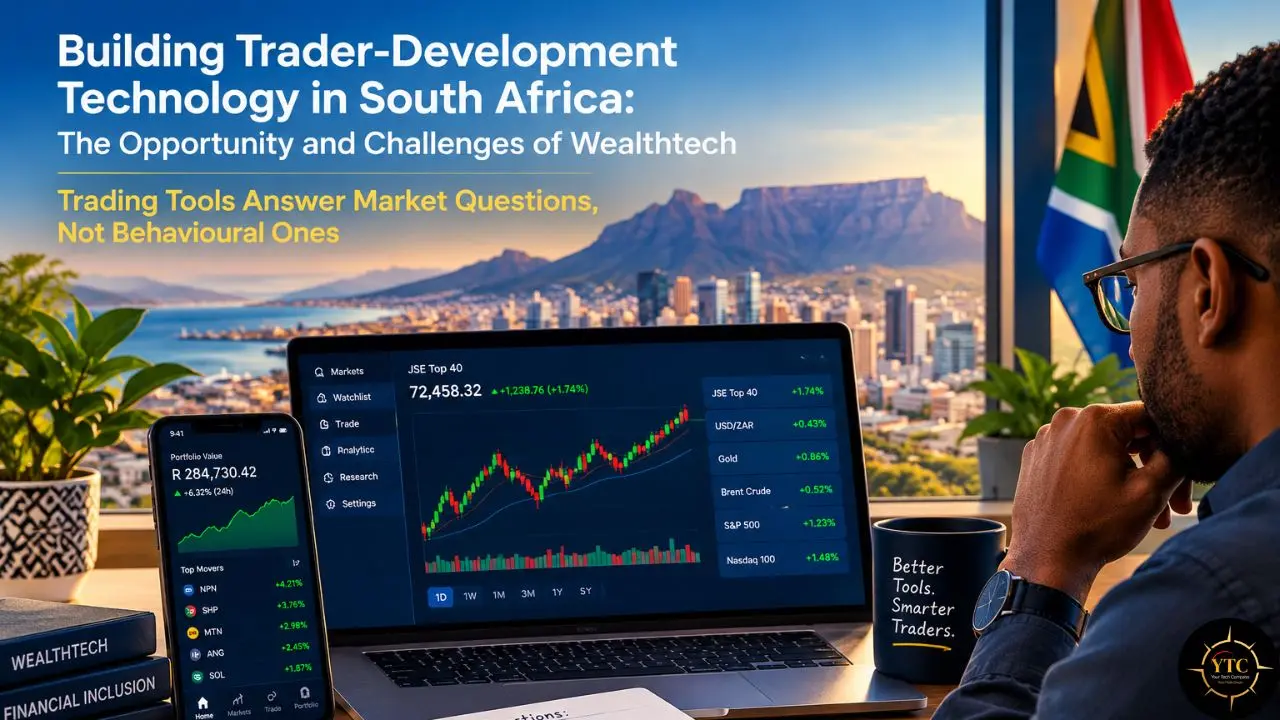
Modern trading technology handles market questions superbly: price, support levels, volatility, execution speed, position size. It stays silent on another set. Why did the trader ignore the plan? Why did a loss trigger a rushed second trade? And why did two wins breed overconfidence? Why did a boundary set before entry move after it? Why does a mistake the trader already understands keep repeating?
Better charts do not answer these, because they are behavioural questions. A trader can have fast execution, deep educational material, and a clean interface and still lack discipline, since the technology stack improves while the human decision process stays erratic.
That gap pushed me to build Market Reflex around trader development instead of signals or execution. The product treats planning, journaling, reflection, and behavioural review as core features, rather than homework users must do in a spreadsheet somewhere else. Market Reflex does not execute trades or issue signals.
Reflective AI Is the Safer and More Useful Bet
Artificial intelligence makes this category more interesting and more dangerous. The tempting product is an assistant that tells traders what to do. It invites trouble on three fronts: accuracy, over-reliance, and the boundary between coaching and advice. In South Africa, that boundary carries legal weight, because the Financial Advisory and Intermediary Services (FAIS) Act governs who may give financial advice and the FSCA supervises market conduct. Founders should get proper legal counsel on where their product sits.
A reflective design sidesteps most of the trap. Instead of saying “buy this asset,” a reflective tool compares a decision with the user’s own written plan, flags repeated language across journal entries, and asks a pointed question after a rule deviation. The user’s judgment stays in charge, and the tool simply makes their process visible. Teams exploring this approach should also follow how regulators are handling AI in African financial services, because the rules are still moving.
Guardrails belong in the product design, not buried in the terms of service. AI feedback should never promise returns, present itself as a licensed adviser, or convert a behavioural observation into a trade recommendation. Users also deserve a plain explanation of what data the system analyses and what it cannot conclude from it. A predictive system gets one chance to be wrong with real money on the line. A reflective system fails more gently, which is a strong argument for building it first.
Trust Is an Architecture Decision
A journal that records trades, emotional states, mistakes, and confidence levels collects information that feels more personal than ordinary app activity. That creates design obligations from day one.
South Africa’s Protection of Personal Information Act (POPIA), enforced by the Information Regulator, sets conditions for lawful processing, including limits on what you collect, clear purposes, security safeguards, and retention. Legal advice should settle exactly how those conditions apply to your product, but the design habit is simple. Before adding a data field, ask whether the feature breaks without it. If it does not, leave the field out. Then add clear consent, real deletion and strong account security, and treat retention as a deliberate decision rather than a default.
Community features raise a second problem. Trading communities turn harmful quickly when incentives reward exaggerated profit claims, unqualified advice, or reckless risk-taking, and regulators have turned their attention to social-media financial influencers. Founders who add creator tools therefore need moderation in the first release, not the third. The business model and the safety model must be designed together, because an engagement loop that rewards screenshots of winning trades will undermine whatever the product teaches about discipline.
Innovation Alone Does Not Guarantee Good Outcomes
A 2025 Reserve Bank working paper, Fintech and financial system stability in South Africa, offers a useful reality check. Its authors found that fintech startup formation is associated with lower bankruptcy risk, credit risk, and stock return volatility among incumbent financial institutions, with the effect stronger for smaller banks. They also found the relationship is nonlinear: early collaboration can harden into competition as more startups enter, and the authors urge regulators to watch for systemic risk.
The paper studies incumbents, not retail users, so it cannot tell us whether a journaling tool improves discipline. It does reinforce a principle every founder should absorb. Technology earns its value from what it improves and how responsibly it is deployed, not from being new.
The Hard Part Is Product Judgment, Not Features
From an operator’s seat, the obvious technical work has not been the difficult part. A journal can be built. So can a reflection form and an AI interface.
The harder questions sit in product judgment. How do you make reflection useful enough that people come back to it? How do you measure progress without pretending a behavioural score is scientifically precise? And how do you hold attention without building another dopamine-driven trading feed? How do you keep AI feedback helpful without letting it drift into advice? And how do you tell a feature that dazzles in a demo from one that improves a user’s process?
Working through these questions has pushed us to think less like a trading-software company and more like a behaviour and learning company operating inside financial technology. The shift changes what we build, what we measure, and what we refuse to ship.
Beyond Trading: Where African Fintech Goes Next

Kenya’s M-Pesa proved that African builders could reinvent payments and access from the ground up, and fintech teams in Nigeria and South Africa have extended that playbook. The next wave can move from access to effective use: decision-support tools, financial-health products, behavioural savings, risk-awareness tools, AI-assisted financial education and accountability systems for small businesses.
South Africa already holds a useful clue in the stokvel. These savings groups work because members hold each other accountable, and software can extend that discipline to people who lack a group. The guiding question changes from “Can this person reach a financial service?” to “Does this technology help them use it well?” That is harder to build and harder to measure, but it may create more durable value than another interface to the same markets.
Six Rules for South African Wealthtech Founders
- Define what you are and what you are not. Financial products become dangerous when the marketing language is broader than the actual product.
- Treat regulation as a design input. Use the IFWG’s Regulatory Guidance Unit early, before architecture hardens around assumptions.
- Do not mistake AI capability for product value. A model can write impressive text without solving the user’s underlying problem.
- Build evidence into the product. If you claim to improve behaviour, you need a responsible method for measuring whether behaviour actually changes.
- Protect trust aggressively. One misleading claim, weak privacy practice or poorly moderated feature can erase a large amount of product work.
- Build for a problem that outlives one market. Market Reflex began with a trading-behaviour problem visible in South Africa, but impulsivity, inconsistency, overconfidence and poor reflection are human problems, not local ones.
FAQs
Trader-development technology helps traders improve their process rather than execute trades or follow signals. Typical features include planning tools, journaling, reflection prompts, and behavioural review, so users can compare what they planned with what they did.
It depends on what the product does. A tool that only records and reflects on a user’s own decisions sits differently from one that recommends specific financial products, which can fall under the FAIS Act. Founders should confirm their position with a lawyer or the IFWG’s Regulatory Guidance Unit.
It can, if the design stays reflective. The AI compares decisions with the user’s own plan, surfaces patterns in their journal, and asks questions, while avoiding buy or sell recommendations, return promises, and any claim to be a licensed adviser.
No. Market Reflex focuses on journaling, discipline, reflection, behavioural awareness, and AI-assisted coaching. It does not execute trades or provide signals or investment recommendations.
POPIA sets conditions for processing personal information, including purpose, collection limits, security safeguards, and retention. Journals that capture emotional states and mistakes make data minimisation and deletion especially important, so founders should seek legal advice on their specific data flows.
The IFWG Innovation Hub, co-led by the Reserve Bank’s Fintech Unit and the FSCA, offers a Regulatory Guidance Unit for rule questions, a Regulatory Sandbox for supervised testing and an Innovation Accelerator for exploring emerging ideas.
Where Your Tech Compass Should Point Next: The Decision Behind the Trade

South African wealthtech has built a fast fleet of instruments for moving money, and a compass is a different kind of tool. It does not make the journey quicker. It keeps you pointed in the right direction. A trader with perfect execution and no process is simply moving fast with no bearing, and the same applies to a product team that ships features without asking whether users decide better afterward. The strongest opportunity in this market sits at the decision, where planning, reflection, and accountability turn access into competence.
The practical lessons differ by reader. Local developers should build reflection into the core product, set honest limits on what their AI says, and collect only the data a feature requires. Investors should ask for evidence of behaviour change instead of counting downloads or trade volume. Policymakers can help most by keeping the IFWG’s guidance channels easy to reach and by clarifying where coaching ends and advice begins.
Chart your own course through South Africa’s fintech terrain with sharper analysis at YourTechCompass.com.
About the Author: Mlungisi Mdletshe is the founder of Market Reflex, a South African trader-development technology platform focused on journaling, discipline, reflection, behavioural awareness and AI-assisted coaching. Market Reflex does not execute trades or provide trading signals or investment recommendations.