Consider the final semester of a computer science degree in Nairobi. Your grades are strong, your thesis tackles image classification, and you have a shortlist of employers. Then you open the first junior machine learning posting. It asks for model deployment, cloud platforms, and two years of production experience. Your degree taught you the theory; nobody taught you the rest. Graduates across African tech hubs often encounter a similar gap, while employers struggle to find candidates with production-ready skills.
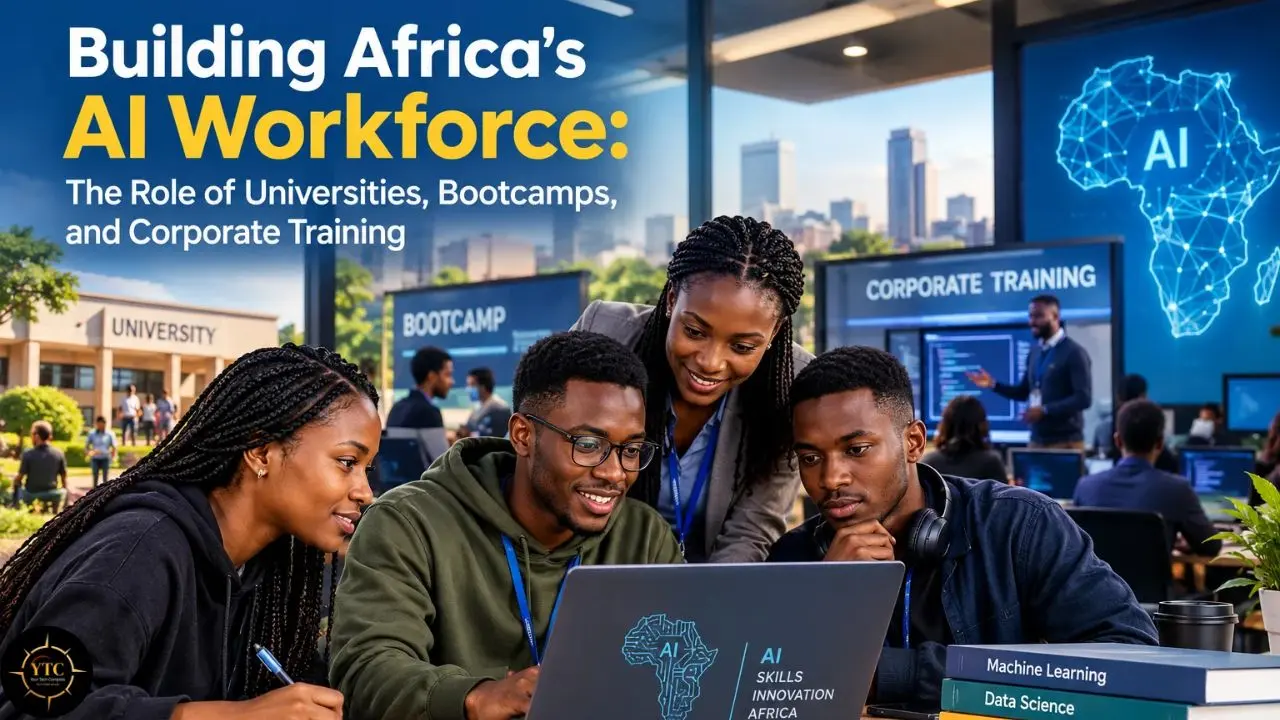
This article examines how Africa’s AI workforce is actually built. I compare three engines of AI skills training: universities, bootcamps, and corporate and government programs, on what each produces, whom it reaches, and where it breaks down. My argument is that no single pillar builds a workforce, and the biggest losses occur in the handoffs between them. Along the way, you will see which countries make the mix work, which headline numbers deserve skepticism, and what local developers, investors, and policymakers should do with the evidence.
What “AI Workforce” Actually Means
The phrase hides three different jobs. Builders research, train, and adapt models. Practitioners, such as data engineers, MLOps specialists, and product managers, turn those models into reliable, usable products. The largest group is likely the AI-literate worker: the nurse, accountant, or agricultural extension officer who uses AI tools well without writing code. Each group needs a different training route, and blurring them leads governments to celebrate course completions that change no one’s job. If you belong to that third group, the hands-on and research-based explainers in our AI Unboxed section are a practical place to start.
Next, consider the size of the gap. Reliable estimates of Africa’s share of the global AI workforce are scarce. ODI estimates that Africa has roughly 43,500 to 61,700 AI developers (about 7% of its 716,000 software developers) and may account for only about 5% of the global AI workforce even at the upper end of that range. The talent that does exist is concentrated.
ODI research found that over half of the continent’s professional developers sit in South Africa, Nigeria, Egypt, and Kenya, which also draw more than 83% of AI-startup funding. Demand, however, keeps climbing. The World Bank estimates that more than 230 million jobs in Sub-Saharan Africa could require digital skills by 2030, and SAP’s 2025 survey of companies in South Africa, Kenya, and Nigeria found that 99% consider AI skills critical to business success. For the wider picture, our guide to artificial intelligence in Africa maps where each market stands.
The supply side looks thin. ODI’s reading of a World Bank survey of 174 African universities found that only 31% offer a dedicated AI program and 34% offer a data science degree, while AI courses account for just 1.5% of enrollments in specialized digital fields. I treat “registered learners” as a vanity metric. The number that matters is how many people hold jobs that use what they learned.
Universities: Deep But Slow
Universities build the system’s deepest skills, and they build them slowly. The strongest African examples are small, postgraduate, and deliberately continental.
The Elite Postgraduate Nodes
Carnegie Mellon University Africa in Kigali shows what the model produces at its best. Its Class of 2026 graduated on 15 May and brought the campus to 1,000 alumni, with degrees that include a master’s in engineering artificial intelligence. Shortly afterwards, two of its students won a best paper award at the Deep Learning Indaba, which ran in Lagos from 2 to 7 August 2026 and drew more than 1,000 participants.
The Indaba began in 2017 and has become one of the continent’s largest gatherings for AI and machine-learning researchers and practitioners. So what does this mean for the workforce? These institutions train the people who build and govern AI systems, but they graduate hundreds, not hundreds of thousands. One door is open right now, though: CMU-Africa’s six-course online Certificate in AI for Africa is free for qualified applicants; check their site for the exact dates of the late-2026 application window.
The Mass Undergraduate System
Scale lives elsewhere. According to the Africa AI Governance Index Report 2026, Algeria offers 74 AI master’s programs across 52 universities and produces roughly 30,000 engineering graduates a year, although low salaries push many abroad. By comparison, Egypt targets 30,000 AI specialists by 2030 through its Digital Egypt Pioneers Initiative. The trade-off becomes obvious quickly: a large pipeline means little if graduates leave or arrive without applied skills.
The Curriculum Lag
Speed is the weak point. Salesforce’s Ursula Fear told TechCabal in June 2026 that South Africa’s qualification frameworks run on five-year cycles while AI skills change within months. Kenya shows the same pattern. A 2026 study in Discover Education analyzed more than 46,000 Nairobi job postings, found a persistent mismatch between academic preparation and employer demand, and called for mechanisms that update curricula continuously.
I unpacked the South African version of this problem in our analysis of South Africa’s AI skills paradox. My view is that universities are irreplaceable for research and governance talent and the wrong tool for fast reskilling. Treat them as the foundation, not the whole building.
Bootcamps: Fast, Uneven, and Under Pressure
Bootcamps exist because degrees move slowly and cost more than many people can afford. Their promise is employable skills in months.
What Bootcamps Do Well
ALX, Moringa School, Zindi, and Andela each attack a different gap. ALX aims for continental reach at low cost. Moringa, based in Nairobi, advertises employer partnerships. Zindi turns real company datasets into competitions that double as portfolios, and Andela connects vetted engineers to global employers. Career switchers and self-taught developers tend to benefit most, because they need proof of work rather than another certificate. In practice, a bootcamp pays off when an employer will accept a portfolio in place of a degree.
The Quality Problem
The trade-off is trust. Placement claims of roughly 70% to 85% circulate on bootcamp sites and comparison pages, but they are self-reported or repeated across comparison pages rather than independently audited, so I would not rely on them.
ODI’s analysis offers a sharper warning: secondary reporting of its findings says Nigerian learners on global online platforms scored just 12% proficiency in data analysis and 5% in software engineering assessments. Finishing a course and mastering the material are different outcomes. A bootcamp that won’t publish cohort-level results at six and twelve months asks for your trust without earning it.
The Entry-Level Squeeze
Here’s the catch. Andela’s 2026 AI Engineering Bootcamp was free and ran for ten weeks from 16 February, yet it required eight or more years of software engineering experience and 40 hours a week. Put differently, the money has moved up-market, toward upskilling seniors rather than launching beginners.
The bootcamps that survive will pair applied AI engineering with domain knowledge in fintech, agritech, or health. African fintech employers, which our African fintech coverage tracks closely, are the obvious first buyers of that blend.
Corporate and Government Training: Scale With Strings
Corporate and state programs reach the largest numbers, and they carry the most strings.
The Big Pledges
Microsoft announced plans to train 3 million Africans in AI skills in 2026 under its Elevate program, delivered through schools, universities, and public institutions in South Africa, Kenya, Nigeria, and Morocco. It pairs that with a partnership to distribute Microsoft 365 and Copilot to about 300 million MTN subscribers and a planned R5.4 billion (roughly $330 million) investment in South African cloud and AI capacity.
In Kenya, a UNDP-Microsoft center of competence aims to train more than 1,000 AI specialists and bring AI literacy into schools, according to CSIS. Why do companies fund this? Skilled users buy cloud services. That motive is not cynical, but it explains why corporate programs lean toward literacy.
Government-Anchored Programs
Nigeria’s 3 Million Technical Talent (3MTT) program is one of Africa’s largest public AI-skilling experiments. NITDA’s two-year review of the National AI Strategy reports more than 135,000 participants trained, over 3,000 paid internships with UNDP, and 15,000 graduates linked to jobs.
Look closely at those figures: they measure training, internships, and job linkages, not necessarily durable employment in roles that use the training. Against a target of 3 million by 2027, 135,000 is roughly 4.5%. For its part, Kenya published its National AI Strategy 2025–2030 in March 2025, and our tracker of AI policy across Africa shows how many other countries are following.
The Catch
Pledges are not trained people, trained people are not employed people, and employed people are not retained. Vendor programs also teach the vendor’s stack. That works for AI literacy and carries risk for any country that wants engineers who can build and own local systems. I would call corporate programs the best tool for AI literacy at scale and the weakest tool for producing builders.
The Three Pillars at a Glance
The table below condenses the trade-offs.
Pillar | Best at Producing | Speed | Scale | Main Risk |
|---|---|---|---|---|
Universities | Builders, researchers, governance talent | Slow (years) | Small at the top; large but uneven below | Curriculum lag; graduate emigration |
Bootcamps | Practitioners and career switchers | Fast (weeks to months) | Moderate | Unverified outcomes; entry-level squeeze |
Corporate and Government Programs | AI-literate workers at volume | Fast | Largest | Pledges outrun outcomes; vendor lock-in |
Where the Pipeline Breaks
The pillars are not the problem. The handoffs are.
Start with the jump from training to hiring. SAP’s survey found near-universal demand for AI skills, yet 94% of African organizations still offer training at least monthly, which tells you graduates often arrive unfinished. Then retention fails. One estimate cited in reporting on Africa’s developer market finds that 38% of African developers work for at least one foreign firm, while Algeria’s low salaries push engineers abroad. Local employers therefore train talent that others hire.
Access breaks along three lines. Geography is the first, as the four-country cluster shows. Gender is the second, and the retention lessons in our piece on women building AI in Africa apply to training as much as hiring. Compute is the third: UNDP’s analysis of about 11,000 African data scientists on Zindi found that only 5% had the computing resources they needed, a gap we examine in who fills Africa’s AI factories. A bootcamp without GPUs teaches theory.
Language and context add another layer. Building models for Swahili, Yoruba, or isiZulu requires trainers, datasets, and evaluation resources that remain scarce and unevenly distributed, which is why the African NLP and local LLM movement depends on a few research communities. Governance needs people too: regulators cannot enforce risk-based AI regulation without staff who understand the systems they oversee. The binding constraints, in short, are not seat count alone; they include employer demand, retention, compute access, and distribution.
Three Tests for a Pipeline That Works
Before you trust any programme, run it through three tests.
Does It Connect to Employers?
Programs that co-design curricula with hiring managers and guarantee interviews beat programs that issue certificates and hope. Nigeria’s Talent Registry and Kenya’s emerging university-industry partnerships are early attempts; neither yet has independently verified results at scale.
Does It Measure Outcomes, Not Enrolment?
Demand cohort-level employment data at six and twelve months, including pay and whether the job uses AI skills. Without that, “trained” simply means “registered.”
Does It Teach Fundamentals Plus Local Context?
Tool-specific training expires in months, whereas mathematics, data handling, and model evaluation last. Local context, such as mobile-money data, crop conditions, and African languages, makes graduates valuable at home. India offers a useful contrast, as our comparison of Africa and India’s AI adoption shows: it paired compute investment with large-scale talent programs.
The table below applies these tests loosely to six market groupings. Read it as a snapshot, not a ranking.
Country | Strongest Pillar | Flagship Example | Biggest Gap |
|---|---|---|---|
Nigeria | Government plus corporate | 3MTT: 135,000+ trained | Outcome data remain limited and largely government-reported |
Kenya | University and corporate partnerships | UNDP–Microsoft AI skilling center; Moringa School | Limited public data on AI-graduate employment outcomes |
South Africa | Research universities | Leading research output; Microsoft capacity investment | Five-year curriculum cycles; emigration |
Rwanda | Elite postgraduate training | CMU-Africa: 1,000 alumni | Small scale |
Algeria | State-led degree pipeline | 74 AI master’s programs | Talent retention |
Egypt | State-led degree pipeline | 30,000-specialist target | Delivery against target |
FAQs
No reliable continental ranking exists, so I would judge programs by graduate outcomes rather than prestige. Carnegie Mellon University Africa in Kigali, with its master’s in engineering AI, is the clearest example of a specialized AI program. Algeria and Egypt run larger state-led pipelines. Check job-placement data before you apply.
Sometimes. They suit career switchers who need a portfolio, provided the bootcamp publishes six- and twelve-month outcomes and teaches applied AI work, not syntax alone. Treat self-reported placement rates cautiously, and compare free or subsidized options first.
Yes, with limits. CMU-Africa’s online Certificate in AI for Africa is free for qualified applicants, with applications open from October 15 to November 15, 2026. Nigeria’s 3MTT offers state-backed training for selected fellows, though participants may still need to cover transportation and other personal costs. Confirm current terms on each official page.
Nobody has a reliable census. ODI estimates that Africa has roughly 43,500 to 61,700 AI developers (about 7% of its 716,000 software developers) and may account for only about 5% of the global AI workforce even at the upper end of that range. ODI also notes that more than half of the continent’s professional developers sit in four countries. Treat any single headcount as an estimate.
It depends on the metric. Nigeria leads on program scale through 3MTT, South Africa on research and enterprise demand, Rwanda on elite postgraduate training through CMU-Africa, and Algeria and Egypt on state-led degree pipelines. Kenya combines university, corporate, and public partnerships.
What the Compass Says About Africa’s AI Workforce
Each pillar does one job well. Universities build depth, bootcamps build speed, and corporate and government programs build reach. A workforce emerges only when the three connect to real employers, and when talent has reasons to stay. Across Nigeria, Kenya, South Africa, and Rwanda, I see the same pattern: the pledges are loud, the comparable outcome data is limited, and the distance between them will decide who wins.
If you are a developer, pair a fundamentals program, such as CMU-Africa’s cost-free Certificate in Artificial Intelligence for Africa, with applications open until November 15, 2026, with a portfolio project built on an African problem. If you invest, fund employer-linked training and make cohort-level employment and retention outcomes a condition of capital. And if you shape policy, publish placement data, write retention incentives into every corporate pledge, and fund compute access alongside coursework. Our wider African tech coverage will keep tracking which of these moves actually works.
Ready to find your bearings in African tech? Chart your next move at YourTechCompass.com, where every route runs through evidence, not hype.