I’ll tell you what struck me most when I first started paying serious attention to Mistral AI. It wasn’t a benchmark number or a funding announcement. It was September 2023, when a three-person-founded French startup, barely five months old, dropped a 7-billion-parameter model on Hugging Face with no fanfare, and the AI community spent the next week unable to stop talking about it. Mistral 7B outperformed Meta’s Llama 2 13B on most benchmarks despite having nearly half the number of parameters. No press conference. No livestream. Just a magnet link and a technical blog post. That moment told you everything about what Mistral AI was: a lab built by people who had done the science at DeepMind and Meta, who knew that raw parameter count was not the only game in town, and who were determined to prove that efficient architecture could beat brute-force scale.
Two and a half years later, Mistral AI is a $6 billion company, has released over 42 models, landed enterprise clients including ASML and ESA through its new Forge platform, and is routinely cited as Europe’s most strategically important AI company. This review is for you, whether you’re a developer evaluating open-source alternatives to GPT and Claude, a European enterprise evaluating GDPR-compliant AI with genuine data residency, a researcher trying to understand where Mistral fits in the frontier model landscape, or simply someone who wants to understand what this Paris-based lab has actually built and why the global AI community continues to watch it so closely.
A note before we begin: every YTC score is earned, never negotiated. If you want to understand exactly how we evaluate apps & tools, our Review Methodology lays it all out.
What Is Mistral AI: The Company, the Mission, and the Context
Mistral AI was founded in April 2023 by Arthur Mensch, Guillaume Lample, and Timothée Lacroix, three researchers with direct experience at DeepMind and Meta AI who left those institutions with a specific thesis: AI models should be efficient, open, and European. That founding philosophy has shaped every product decision the company has made since.
The funding trajectory validates the conviction behind that thesis. Mistral raised €105 million in its seed round in June 2023, the largest European AI seed round in history at the time. A $415 million Series A followed in December 2023. A $1.1 billion Series B in June 2024 brought the company’s valuation to approximately $6 billion. Additionally, a strategic $16 million investment from Microsoft came alongside an Azure distribution agreement, a partnership that created some tension with European AI sovereignty advocates but gave Mistral global enterprise distribution reach that a Paris-based startup couldn’t build independently.
The European context is inseparable from Mistral’s identity. Headquartered in Paris and with a significant presence across Europe, Mistral is explicitly positioned as Europe’s answer to OpenAI, backed by European investors and governments seeking strategic AI sovereignty rather than complete dependence on US or Chinese models. Furthermore, Mistral’s relationship with the EU AI Act is substantively different from that of US labs: its open-weight models fall into a specific regulatory category that offers developers more flexibility while giving European regulators greater visibility into the model than proprietary black-box alternatives provide.
Mistral operates a dual model strategy that defines its entire product architecture. Open-weight models are released freely (downloadable, self-hostable, and commercially usable under Apache 2.0), helping build the developer community and ecosystem.
Proprietary frontier models are available via API on La Plateforme, Mistral’s developer API platform, at pricing that consistently undercuts comparable US frontier models. Consequently, you can interact with Mistral AI at every level, from running Mistral 7B locally on your laptop to deploying Mistral Large 3 via API for enterprise-scale production inference, without a single conversation with a sales team.
The Mistral Model Family: Every Model and What Each Is For

Mistral has released 42 models, a pace that reflects both technical ambition and a deliberate strategy to cover every deployment scenario in the market. Let me map the models that actually matter for your decision-making.
Open-Weight Models
Mistral 7B (September 2023)
This is the model that changed the conversation about what a small, efficiently designed model could do. It outperformed Llama 2 13B on most benchmarks while being nearly half its size, prompting every AI lab to revisit its assumptions about the relationship between parameter count and capability.
Released under Apache-2.0, it runs on consumer hardware and remains among the most downloaded models on Hugging Face. Furthermore, it established Mistral’s core design principles: sliding-window attention, grouped-query attention, and a training process optimized for quality per parameter rather than scale for its own sake.
Mixtral 8x7B (December 2023)
This model introduced the Mixture-of-Experts architecture to the open-weight world at a meaningful scale. With 46.7 billion total parameters and only 12.9 billion active per token, it matched GPT-3.5’s performance at a dramatically lower compute cost.
This was the model that established the MoE efficiency story as Mistral’s primary technical identity. Apache 2.0 license, fully open for commercial deployment.
Mixtral 8x22B (April 2024)
This model scaled the MoE approach to 141 billion total parameters with 39 billion active. At launch, it was competitive with GPT-4-class models on several benchmarks while remaining freely downloadable. Apache 2.0 license.
Mistral Small 3.1 (March 2025)
This model marked Mistral’s entry into the multimodal open-weight model space, a 24-billion-parameter model with vision understanding and a 128K context window. It is one of the most capable models in its size class available under a genuinely open license.
Mistral Small 4 (March 2026)
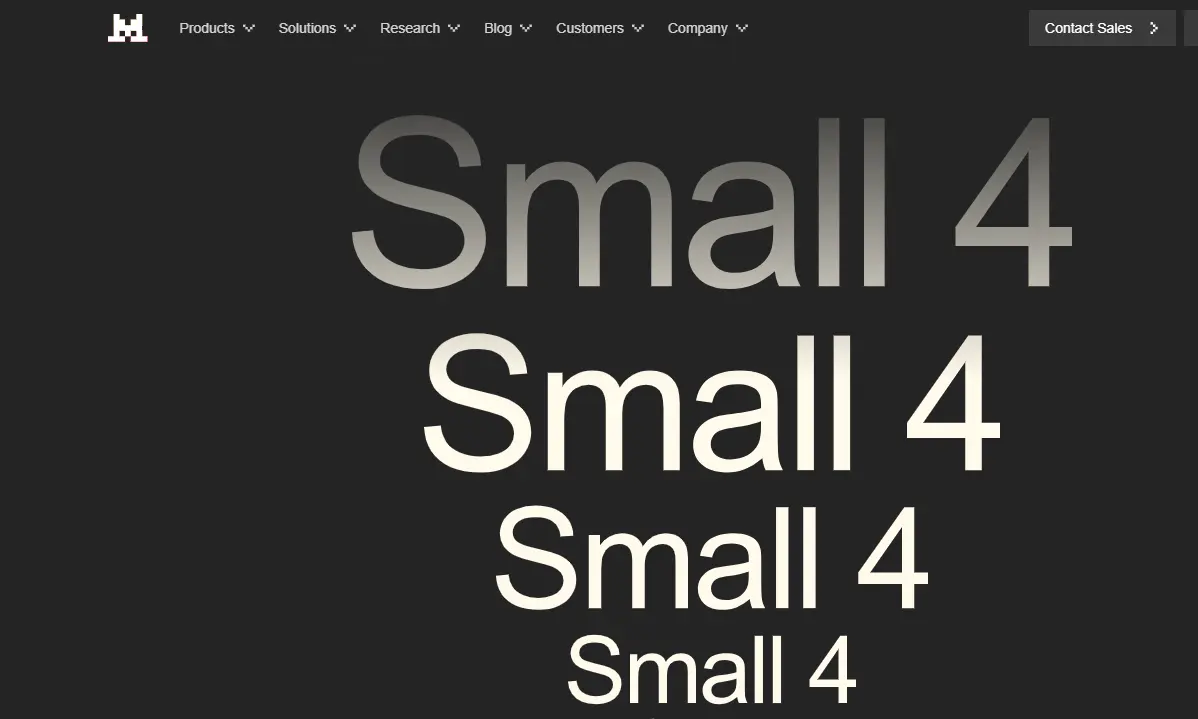
This is the most architecturally significant release in Mistral’s history since Mixtral 8x7B. Released on March 16, 2026, it unifies three previously separate Mistral products — Magistral (reasoning), Pixtral (multimodal vision), and Devstral (agentic coding) — into a single, versatile model.
At 119 billion total parameters with only 6 billion active per token (MoE with 128 experts, 4 active per token), it delivers configurable reasoning depth via a reasoning_effort parameter: set to “none” for fast conversational responses, set to “high” for deep chain-of-thought reasoning that matches the dedicated Magistral model. Additionally, Mistral claims a 40% reduction in end-to-end completion time and 3x more requests per second than Small 3. At $0.15 per million input tokens, it is 5x cheaper than GPT-5.4 Mini on input and 7.5x cheaper on output.
Devstral (May 2025) and Devstral 2 (December 2025)
These are coding-specialist models built for agentic software engineering: repository-level reasoning, multi-file refactoring, and autonomous execution of coding pipelines.
Voxtral TTS (2025)
This is Mistral’s open-source text-to-speech model, which supports nine languages and competes directly with ElevenLabs at approximately 73% lower cost. Built on Ministral 3B with 8GB of BF16 weights, it’s runnable locally for voice-agent applications.
Proprietary API Models
Mistral Large 3 (December 2025)
This is Mistral’s current flagship proprietary model; the largest open-weight MoE model from any major lab, trained on 3,000 NVIDIA H200 GPUs, and debuting at #2 in the open-source non-reasoning model category on the LMArena leaderboard at launch. On MMLU-Pro, it scores 73.11%, and on MATH-500, it scores 93.60%, per LayerLens/Atlas independent evaluation (strong numbers for a model priced at $2.00 per million input tokens and $6.00 per million output tokens). That output price is 60% below GPT-5.4’s $15 per million output tokens, the most common bottleneck in production chat workloads.
Mistral Large 3 2512 (December 2025)
This is the snapshot version of Mistral Large 3, available via API for deterministic production deployments.
Mistral Medium 3.1 (August 2025)

This model is the mid-tier proprietary option, priced at $0.40 per million input tokens and $2.00 per million output tokens, offering meaningful capabilities at a cost well below the Large tier.
Pixtral Large (November 2024)
This is Mistral’s multimodal flagship at 124 billion parameters, handling both image and text understanding, priced at $2.00/$6.00 per million tokens, matching the Large 2 flagship tier.
Codestral (updated August 2025)
This is Mistral’s code-specialist proprietary model, priced at $0.30 per million input tokens and $0.90 per million output tokens, with a 256K context window and fill-in-the-middle support for IDE integration. It has a separate free-access tier for individual developers using IDE coding-assistant workflows.
Mistral Saba (February 2025)
This model focuses on Arabic and South Asian languages, extending Mistral’s multilingual coverage into markets its European-focused training data doesn’t naturally serve as deeply.
Ministral family (December 2025 — 3B, 8B, 14B)
This is Mistral’s edge-and-on-device model series. The standout is the Ministral 14B reasoning variant, which achieves 85% on AIME 2025, beating Qwen-14B’s 73.7%, making it one of the best small reasoning models available at any price.
Mistral Model Family at a Glance

Model | Type | Parameters | Context | License | Price (API) | Best For |
Mistral 7B | Open-weight | 7B | 32K | Apache 2.0 | Free (self-host) | Edge, local AI, fine-tuning foundation |
Mixtral 8x7B | Open-weight | 46.7B / 12.9B active | 32K | Apache 2.0 | Free (self-host) | GPT-3.5 parity at lower compute |
Mixtral 8x22B | Open-weight | 141B / 39B active | 64K | Apache 2.0 | Free (self-host) | Near-GPT-4 open deployment |
Mistral Small 3.1 | Open-weight | 24B | 128K | Apache 2.0 | $0.20/$0.60 | Multimodal open; efficient general use |
Mistral Small 4 | Open-weight | 119B / 6B active | 128K | Apache 2.0 | $0.15/$0.60 | Unified reasoning + vision + coding |
Devstral / Devstral 2 | Open-weight | Based on Small | 128K | Apache 2.0 | $0.40/$0.90 | Agentic coding; repo-level engineering |
Mistral Large 3 | Proprietary | MoE (large) | 128K | API only | $2.00/$6.00 | Flagship enterprise; multilingual |
Pixtral Large | Proprietary | 124B | 128K | API only | $2.00/$6.00 | Multimodal flagship |
Codestral | Proprietary | 22B | 256K | API (free tier) | $0.30/$0.90 | Code completion; IDE integration |
Mistral Medium 3.1 | Proprietary | Medium MoE | 128K | API only | $0.40/$2.00 | Mid-tier cost/capability balance |
Ministral 14B | Proprietary | 14B | 128K | API only | $0.20/$0.20 | Small reasoning; mobile/embedded |
Voxtral TTS | Open-weight | 3B | N/A | Open | $0.016/1K chars | Voice agents; TTS in 9 languages |
Key Features: What Makes Mistral AI Distinctive

Let me walk you through the features that define Mistral’s competitive position, not just what the models do, but what the overall platform does that matters for your actual use case.
Efficiency-First Architecture Philosophy
This is Mistral’s founding differentiator and the one from which all other advantages flow. Sliding-window attention, grouped-query attention, and MoE sparse activation were not features Mistral bolted onto existing architectures; they are foundational to how every Mistral model is designed. The result is that you get meaningfully more capability per parameter than comparable dense transformer models of the same size.
The Mistral Small 4 numbers make this concrete. 119 billion total parameters. 6 billion active per token. That’s a model with the knowledge capacity of an 119B-parameter architecture, running at the compute cost of a 6B dense model.
Furthermore, configurable reasoning_effort lets you tune the compute expenditure per request, not per model deployment. Consequently, you get maximum flexibility without the operational overhead of managing multiple model endpoints.
Apache 2.0 Open-Weight Releases: Genuinely Open
The distinction between licenses matters more than most coverage acknowledges. Meta’s Llama Community License has a 700M monthly active user threshold and EU deployment restrictions.
Mistral’s Apache 2.0 releases, covering Mistral 7B, Mixtral 8x7B, Mixtral 8x22B, Mistral Small 3.1, Mistral Small 4, and Devstral, impose no usage restrictions for commercial deployment. You can build a commercial product, modify the model architecture, fine-tune on proprietary data, and redistribute derivative models without royalties, approvals, or legal overhead. Moreover, Apache 2.0 is the license that enterprise legal teams already know and have cleared, which matters significantly for regulated industries.
European Multilingual Leadership

Mistral models were trained with particular depth on European language data (French, German, Spanish, Italian, Portuguese) in ways that reflect both the founding team’s European background and the company’s explicit commercial focus on European enterprises. Mistral Large 2 and Large 3 are consistently rated as the strongest API-accessible models for European language tasks. Furthermore, Mistral Saba extends this multilingual commitment to Arabic and South Asian languages, reflecting an ambition to go beyond the European market into underserved multilingual regions globally.
Mistral Small 4’s Unified Architecture
Released March 16, 2026, Mistral Small 4 represents the most architecturally interesting development in Mistral’s history since Mixtral. Instead of maintaining separate APIs for reasoning (Magistral), vision (Pixtral), and coding (Devstral), three separate integrations, three billing accounts, and three sets of model behavior to manage, Mistral Small 4 unifies all three into one deployment. For a developer building a product that needs to handle code reviews, analyze uploaded diagrams, and reason through multi-step business problems in the same session, this consolidation is genuinely valuable.
La Plateforme: Competitive API with European Data Residency
La Plateforme is Mistral’s developer API, available at docs.mistral.ai. It uses an OpenAI-compatible SDK format, meaning existing integrations can switch to Mistral models with minimal code changes.
European data residency options allow European enterprises using La Plateforme to route data through Mistral’s European infrastructure, satisfying GDPR data residency requirements that US-hosted APIs cannot meet. Additionally, Forge (Mistral’s enterprise deployment platform) has already onboarded ASML and ESA as enterprise customers, demonstrating that Mistral’s enterprise offering is production-grade, not just a developer API with a premium label.
Voxtral TTS: The Unexpected Audio Play
Voxtral TTS positions Mistral in the voice interface market in a way that most people don’t associate with the company. At $0.016 per 1,000 characters, compared to ElevenLabs pricing that can run 10–20x higher, and with support for 9 languages, Voxtral makes high-quality voice AI economically viable for applications that previously couldn’t afford commercial TTS services. Its open-weight availability means you can self-host it for zero marginal cost.
Benchmark Performance: How Does Mistral Stack Up?

Here’s the honest benchmark picture, including where Mistral leads, where it’s competitive, and where it trails the frontier.
Mistral’s benchmark story has always been about efficiency rather than absolute dominance, and the latest numbers continue that pattern. Mistral Large 3 scores 73.11% on MMLU-Pro and 93.60% on MATH-500 per independent LayerLens/Atlas evaluation, strong numbers for a model at its price point.
The Ministral 14B reasoning variant achieves 85% on AIME 2025, beating Qwen-14B’s 73.7% and making it one of the best small reasoning models available. Additionally, Mistral Large 3 debuted at #2 on the LMArena open-source non-reasoning leaderboard, a community-voted benchmark that reflects actual user preference rather than lab-curated test sets.
The per-parameter efficiency story is where Mistral’s numbers are genuinely exceptional. Mistral Small 4 at 6 billion active parameters delivers multimodal reasoning, vision understanding, and agentic coding capability that would have required a 30–70B dense model just two years ago. Consequently, if your question is “what’s the most capable model I can run on X budget of hardware,” Mistral’s answer is consistently better than most alternatives.
The Honest Limitation
Mistral does not lead the frontier on the hardest reasoning benchmarks. Independent evaluations show Mistral Large 3 scoring approximately 40% on AIME 2025 and 43.9% on GPQA Diamond in non-reasoning mode, significantly below Gemini 3.1 Pro’s 94.3% on GPQA Diamond and Grok 4’s 44.4% on HLE.
The 85% AIME score belongs to the Ministral 14B reasoning variant, a smaller specialist model, not the flagship. Proprietary models like Gemini 3.1 Pro, GPT-5.4, and Claude Opus 4.6 hold clear leads on the hardest reasoning benchmarks. Mistral’s value proposition is capability per dollar and capability per parameter, not raw capability maximalism.
Benchmark Comparison Table
Benchmark | Mistral Large 3 | GPT-4o | Claude Opus 4.6 | Gemini 3.1 Pro | Llama 4 Maverick |
MMLU-Pro | 73.11% | ~88.7% | Leading | Leading | 80.5% |
MATH-500 | 93.60% | Strong | Strong | Leading | N/A |
AIME 2025 (Non-Reasoning) | ~40% | Competitive | Strong | Strong | Competitive |
GPQA Diamond | ~44% | 92.8% | N/A | 94.3% | Competitive |
LMArena (User Pref.) | #2 open-source | Top tier | Top tier | Top tier | Top tier |
European Multilingual | Leading | Good | Good | Good | Limited |
API Output Cost | $6/Mtok | ~$15/Mtok | $75/Mtok | $12/Mtok | ~$0.19/Mtok |
Open-Weight Available | ✅ Yes (Apache 2.0) | ❌ No | ❌ No | ❌ No | ✅ Yes |
Self-Hosting | ✅ Full | ❌ No | ❌ No | ❌ No | ✅ Full |
Note: Mistral Large 3 AIME and GPQA scores from LayerLens/Atlas independent evaluation. Mistral did not publish official scores for these benchmarks. The 85% AIME score belongs to the Ministral 14B reasoning variant, not Large 3.
Pricing and Access: What You’ll Actually Pay

Mistral’s pricing is one of its clearest competitive advantages, particularly for output-heavy production workloads where per-token output cost is the primary driver of total AI infrastructure spend.
Open-Weight Models (free)
Mistral 7B, Mixtral 8x7B, Mixtral 8x22B, Mistral Small 3.1, Mistral Small 4, and Devstral 2 are all available for download from Hugging Face under Apache 2.0. Running them locally or on your own cloud infrastructure incurs no licensing costs; only your hardware or cloud compute costs apply.
La Plateforme API pricing (As of April 2026)
- Mistral Small 4: $0.15 per million input tokens / $0.60 per million output tokens
- Mistral Medium 3.1: $0.40 per million input / $2.00 per million output
- Mistral Large 3: $2.00 per million input / $6.00 per million output
- Pixtral Large: $2.00 per million input / $6.00 per million output
- Codestral: $0.30 per million input / $0.90 per million output (free tier for individual developers)
- Ministral 8B: $0.10 per million input / $0.10 per million output
- Ministral 3B: $0.04 per million input / $0.04 per million output
The cost comparison against major competitors is stark. Mistral Large 3’s output at $6.00 per million tokens is 60% cheaper than GPT-5.4’s $15.00 and 92% cheaper than Claude Opus 4.6’s $75.00. For an output-heavy content-generation workflow producing 10,000 articles per month, each with 8,000 output tokens, Mistral Large 3 saves approximately $73 per month compared to GPT-5.4, purely due to the output pricing differential. Furthermore, Mistral Small 4 at $0.15 input / $0.60 output is 5x cheaper than GPT-5.4 Mini on input and 7.5x cheaper on output.
The honest limitation: Mistral’s context window is 128K across most models, with only Codestral reaching 256K. If your workloads require 1M+ token context, GPT, Claude, Gemini, and DeepSeek all offer substantially longer context windows. Consequently, if your application fits within 128K, Mistral is an underpriced option that more teams should be evaluating.
Enterprise Access
Microsoft Azure and Google Cloud Vertex AI both offer Mistral models through their marketplaces, providing enterprise teams with managed billing, support, and infrastructure that La Plateforme’s direct API doesn’t offer. Mistral Forge handles the most sophisticated enterprise deployments, with dedicated infrastructure and contractual data-residency guarantees.
Mistral AI vs The Competition: Honest Head-to-Head
Let me give you the direct comparisons that drive most purchasing decisions.
Mistral vs ChatGPT (GPT-4o / GPT-5.x)

On benchmark performance, Mistral Large 3 competes meaningfully with GPT-4o on general knowledge, multilingual, and coding tasks, but trails meaningfully on the hardest reasoning benchmarks (GPQA Diamond, AIME in reasoning mode) where GPT-5.x variants lead. The decisive structural advantages sit elsewhere.
Mistral Large 3’s output at $6.00 per million tokens is 60% cheaper than GPT-5.4’s $15.00 per million, a difference that becomes substantial at production scale. European data residency on La Plateforme gives Mistral a GDPR compliance story that a US-hosted ChatGPT API cannot match. Furthermore, Mistral’s open-weight models offer a self-hosting option that GPT has never provided.
ChatGPT leads in consumer UX maturity, the broadest plugin and tool ecosystem, and the deepest brand recognition among non-technical users. Our ChatGPT 5.4 breakdown provides a full breakdown of GPT’s current capabilities for comparison.
Honest Verdict: Mistral for cost efficiency at production scale, European data residency, and open-weight self-hosting; ChatGPT for consumer UX polish and ecosystem breadth.
Mistral vs Claude Opus 4.6 (Anthropic)
Claude leads in structured enterprise writing quality, nuanced instruction following, and output consistency for complex planning documents, advantages explored in our Claude Opus 4.6 review. The cost comparison is extraordinary: Mistral Large 3 at $6.00 per million output tokens versus Claude Opus 4.6 at $75.00 per million output tokens, a 92% cost reduction for broadly comparable general-purpose performance.
Additionally, Claude has no open-weight version at any parameter count; you cannot self-host it, fine-tune it, or audit its weights. For organizations where data sovereignty requires on-premise deployment, this limitation ends the comparison before it begins.
Honest Verdict: Claude for premium writing quality and complex planning output, where API pricing is acceptable; Mistral for cost efficiency at volume and self-hosted deployment, where data sovereignty is non-negotiable.
Mistral vs Llama 4 (Meta)

Both are genuinely open-weight models with commercial-use licenses, which is their most important shared characteristic. Llama 4 Scout’s 10-million-token context window is dramatically larger than Mistral’s 128K maximum, a decisive advantage for tasks requiring processing of extremely long documents. In addition, Llama 4 has Meta’s institutional backing, the largest open-source developer community on Hugging Face, and more accumulated community tooling. Our Llama 4 explained guide covers Meta’s full model in detail.
Mistral leads in European multilingual performance; its models were specifically trained for French, German, Spanish, Italian, and Portuguese in ways that Llama 4’s 12 fine-tuned languages don’t fully replicate. Mistral’s EU data residency story is cleaner.
Meta’s license currently excludes EU-based organizations, whereas Mistral’s Apache-2.0 models are fully available for deployment in the EU. Additionally, Mistral Small 4’s unified reasoning-vision-coding architecture is more integrated than anything Llama 4 currently offers in a single model.
Honest Verdict: Llama 4 for long-context tasks and the broadest Western open-source community; Mistral for European markets, EU-compliant self-hosting, unified reasoning, and multimodal coding capabilities.
Mistral vs DeepSeek V4-Pro
Both are strong open-weight models with commercial licenses, and they serve overlapping but distinct audiences. DeepSeek V4-Pro leads in pure coding benchmarks (LiveCodeBench: 93.5%) and offers a 1-million-token context window at $3.48 per million output tokens, which is cheaper than Mistral Large 3.
As covered in our DeepSeek V4 review, the primary concern with DeepSeek’s hosted API is data residency; it routes through Chinese servers. Self-hosted DeepSeek resolves this, but Mistral’s self-hosted Apache 2.0 models eliminate this concern entirely without requiring users to navigate Chinese-origin model trust decisions.
Mistral benefits from the European cultural and linguistic context, EU regulatory alignment, and the brand trust of a French-founded company operating under EU jurisdiction.
Honest Verdict: DeepSeek for maximum coding performance and lowest API cost where data residency is resolved; Mistral for European regulated environments and GDPR-native deployment.
Mistral vs Qwen 3 (Alibaba)

Both are strong open-weight models under permissive licenses, but with different multilingual profiles. Qwen 3 covers 119 languages, the broadest open-weight multilingual coverage available.
Mistral’s multilingual depth is concentrated in European languages, with genuinely strong performance in French, German, Spanish, Italian, and Portuguese, which Qwen 3 achieves less consistently. Additionally, Mistral’s EU jurisdiction offers cleaner regulatory alignment for European organizations than Alibaba Cloud’s infrastructure, even when both are self-hosted.
As detailed in our Qwen 3 review, Qwen 3 also has documented content filtering for Chinese government-sensitive topics that Mistral doesn’t have.
Honest Verdict: Qwen 3 for global multilingual breadth and deployment in the Asian market; Mistral for European regulated environments and EU-native multilingual depth.
Mistral vs Grok 4 (xAI)
Grok 4’s real-time X data integration is a capability Mistral simply doesn’t have, as covered in our Grok 4 review. For applications requiring live social media intelligence, Grok 4’s moat is real and defensible. However, Grok 4 is entirely proprietary; no self-hosting, no open weights, no fine-tuning.
Mistral’s open-weight models under Apache 2.0 offer deployment flexibility that Grok 4 cannot match, at any price. Furthermore, Grok 4’s standard API at $21.25 per million output tokens is more than three times that of Mistral Large 3 at $6.00 per million output tokens.
Honest Verdict: Grok 4 for real-time X-native intelligence; Mistral for self-hosted deployment, GDPR compliance, and significantly lower API cost.
Full Head-to-Head Summary

Criteria | Mistral Large 3 | GPT-4o | Claude Opus 4.6 | Llama 4 Maverick | Qwen3-235B |
API Output Cost | $6/Mtok | $15/Mtok | $75/Mtok | ~$0.19/Mtok | Free (self-host) |
Open-Weight (Apache 2.0) | ✅ Small 4, 7B, etc. | ❌ No | ❌ No | ✅ Meta License | ✅ Apache 2.0 |
EU Data Residency | ✅ Native | ❌ US-hosted | ❌ US-hosted | ✅ Self-host | ✅ Self-host |
European Multilingual | Leading | Good | Good | Limited | Good |
Context Window | 128K (256K Codestral) | 128K | 200K | 10M (Scout) | 128K–256K |
Real-Time Data Access | ❌ No | ⚠️ Web search | ❌ No | ❌ No | ❌ No |
Coding Specialist | ✅ Codestral / Devstral 2 | Strong | Strong | Good | Strong |
Consumer Chat UX | Le Chat (developing) | Best in class | Very polished | Limited | Limited |
Fine-Tuning on Own Data | ✅ Yes (open models) | ❌ No | ❌ No | ✅ Yes | ✅ Yes |
Geopolitical Trust (EU) | EU-native | US | US | US | Chinese |
Real-World Use Cases: Where Mistral Shines
Here’s where Mistral’s positioning translates into a genuine practical advantage.
European Enterprise AI with GDPR Compliance
This is Mistral’s most defensible commercial position, and it is a use case for which it has no direct equivalent. For a European financial institution, healthcare provider, or law firm that needs AI with data processed on European infrastructure, under EU jurisdiction, and with an Apache-2.0 open-weight license for on-premises deployment, Mistral is the only lab that delivers all of these properties simultaneously.
Forge’s enterprise contracts with ASML and ESA confirm that this value proposition is converting at the highest enterprise levels. Furthermore, the reasoning_effort parameter in Mistral Small 4 provides European enterprises with fine-grained cost control, which is critical for organizations that need to demonstrate appropriate AI cost governance.
Cost-Efficient High-Volume Production API
The output pricing comparison is the practical starting point. At $6.00 per million output tokens for Mistral Large 3 versus $75.00 for Claude Opus 4.6 and $15.00 for GPT-5.4, the cost reduction for output-heavy workloads is transformative.
For content generation, document summarization, customer support automation, or any application that generates thousands of responses per hour, Mistral Large 3 delivers frontier-adjacent quality at a price point that changes the economics of AI-native product development. Consequently, products that couldn’t afford frontier-class AI at Claude or GPT pricing become viable on Mistral.
Self-Hosted Privacy-First Deployment
Mistral Small 4 and the earlier Mixtral family give you genuinely capable AI that runs entirely within your own infrastructure. Medical records, legal documents, proprietary financial models, and data that should never leave your network can now be processed by an AI that genuinely doesn’t leave your network. Additionally, the Apache 2.0 license means your legal team doesn’t need to negotiate any terms: commercial use of the open-weight models is unconditionally permitted.
Coding and Developer Tooling
Codestral’s 256K context window (the largest among Mistral models and unusual for a coding-specialist model) is specifically designed for repository-scale code understanding. IDE integration via the free Codestral API endpoint means individual developers can use it at zero cost.
Devstral 2 extends this to agentic workflows: multi-file refactoring, frontend development pipelines, and CI/CD automation. For the full picture of how our AI Unboxed model landscape has evolved in developer tooling, YourTechCompass provides the most up-to-date comparative analysis.
Multilingual European Content Applications
If you’re building for French-, German-, Spanish-, Italian-, or Portuguese-speaking users, Mistral Large 3’s European multilingual depth is the strongest API option available at any price point. For French in particular, the depth of Mistral’s training data reflects the founding team’s home market in ways that US labs simply haven’t prioritized. Voxtral TTS extends this to voice interfaces in nine languages, enabling voice-first product experiences for European markets at a cost that makes localization economically viable.
Limitations and Honest Weaknesses

Mistral has real limitations, and naming them is how you make a good decision rather than an enthusiastic one.
Not the Frontier Leader in Raw Reasoning Capability
Mistral Large 3 trails Gemini 3.1 Pro (94.3% GPQA Diamond), GPT-5.4, and Claude Opus 4.6 on the hardest reasoning benchmarks. The Ministral 14B reasoning variant’s 85% AIME score is impressive for a 14B model, but it’s a small specialist model, not the flagship. Therefore, if your primary use case is graduate-level scientific reasoning or multi-step expert problem solving at the frontier, GPT-5.x or Gemini 3.1 Pro provides more reliable performance.
The Context Window Is the Most Significant Practical Limitation
128K tokens (256K for Codestral) is generous for most applications but falls well short of Llama 4 Scout’s 10M tokens, Gemini 3.1 Pro’s 1M tokens, and DeepSeek V4’s 1 M tokens. Consequently, for applications involving extremely long documents, large codebase analysis, or extended multi-session memory, Mistral’s context ceiling is a real constraint.
No Native Real-Time Data Access in Base Models
Like Qwen 3 and Llama 4, base Mistral models don’t have web search. The Mistral Agents framework on La Plateforme adds web search as a tool, but this requires agent configuration rather than being native to the base model. Consequently, for applications requiring current information without custom RAG, Grok 4 and Gemini 3.1 Pro provide more seamless solutions.
Le Chat Consumer Interface Is Behind the Leaders
Mistral’s consumer chat interface (Le Chat) exists and is functional, but it doesn’t compete with ChatGPT or Claude.ai in UX polish, feature depth, or consumer adoption. For users who primarily interact with AI through a consumer interface rather than an API, Mistral is not the right choice.
Microsoft Investment Tension
Mistral’s strategic investment from Microsoft, alongside EU government backing and an explicit positioning around European sovereignty, creates a philosophical tension that some European advocates have publicly noted. Mistral is simultaneously Europe’s independent AI champion and a Microsoft portfolio investment, a position that requires careful navigation as European AI policy continues to develop.
Smaller Hugging Face Community Than Llama
Despite Mistral 7B’s breakthrough impact in 2023, the cumulative community fine-tune library around Llama models is substantially larger. More specialized community fine-tunes, tooling integrations, and support exist for Llama than for Mistral, which is a practical disadvantage for teams that depend on community-developed extensions.
Who Should Use Mistral AI

Use Mistral AI if you’re a European enterprise that needs GDPR-compliant AI with genuine data residency; Mistral’s La Plateforme is the only major AI API platform operating natively under EU jurisdiction. Also, use it if cost efficiency at production scale is a primary constraint; Mistral Large 3’s $6.00 per million output tokens is the cheapest premium-quality model output available from a major lab.
You can use Mistral AI if your application serves French-, German-, Spanish-, Italian-, or Portuguese-speaking users. This is because Mistral’s European multilingual depth is unmatched among API-accessible models.
Additionally, use it if you need powerful open-weight models under Apache 2.0 for commercial self-hosting, particularly for legal, healthcare, or financial applications where data cannot leave your infrastructure. If you’re building coding tools or agentic software engineering workflows, Codestral and Devstral 2 are among the strongest specialized options at any price.
Who Shouldn’t Use Mistral AI
Consider alternatives if you need the absolute frontier on reasoning benchmarks: GPT-5.x, Gemini 3.1 Pro, or Grok 4 lead on GPQA Diamond, HLE, and ARC-AGI-2. Also consider Llama 4 Scout if your application requires a 10M+ token context window. This is because Mistral’s 128K is a genuine ceiling for long-document applications.
In addition, consider Qwen 3 if your multilingual needs extend well beyond European languages, as it supports 119 languages. Also, consider Grok 4 if real-time X/Twitter data integration is a core requirement of the application. And if a polished consumer chat experience is your primary product interface, ChatGPT’s ecosystem remains more mature than Le Chat’s.
FAQs
For open-weight models, yes, completely. Mistral 7B, Mixtral 8x7B, Mixtral 8x22B, Mistral Small 3.1, Mistral Small 4, and Devstral 2 are all freely downloadable from Hugging Face under Apache 2.0. You can run them locally, deploy them on your own cloud infrastructure, fine-tune them on proprietary data, and build commercial products on them without any licensing fee.
Start with the use case. For European enterprise deployment with GDPR compliance at production scale: Mistral Large 3 via La Plateforme. And for a unified self-hosted model that handles reasoning, vision, and coding in a single deployment: Mistral Small 4. For coding assistance and IDE integration at zero cost: Codestral’s free tier. And for agentic software engineering: Devstral 2. For edge and mobile deployment: Ministral 3B or 8B. However, for voice interfaces: Voxtral TTS. And for self-hosted general-purpose AI on consumer hardware: Mistral 7B or Mixtral 8x7B.
Yes. This is arguably Mistral’s strongest competitive position. La Plateforme processes data in European data centers under EU jurisdiction. Open-weight models under the Apache 2.0 license enable fully on-premises deployment for organizations with strict data sovereignty requirements. Mistral Large 3’s European multilingual depth makes it the strongest API-accessible option for French-, German-, Spanish-, Italian-, and Portuguese-language applications.
Yes, and more easily than most open-weight alternatives. Mistral 7B runs on any modern laptop with 8GB+ RAM via Ollama (ollama run mistral), no GPU required. Mixtral 8x7B runs comfortably on a system with a dedicated consumer GPU (24GB+ VRAM). Mistral Small 4’s MoE design, with 6B active parameters despite a total of 119B, makes it significantly more hardware-accessible than an 119B dense model would be.
Conclusion

Mistral AI is the most important proof point that the global AI race is not a binary contest between US and Chinese labs. A Paris-founded company with three researchers, a founding thesis about efficiency and openness, and a first release that shocked the community with a 7-billion-parameter model, has built, in two and a half years, a $6 billion company, a 42-model portfolio, a full-stack enterprise platform, and what is arguably the strongest cost-performance story of any AI lab that isn’t subsidized by a cloud computing giant. Furthermore, Mistral Large 3’s output at $6.00 per million tokens, 60% cheaper than GPT-5.4 and 92% cheaper than Claude Opus 4.6, is not a discount tier with discounted capability. It’s genuinely competitive performance at a genuinely competitive cost, from a lab operating under EU jurisdiction, with Apache-2.0 open-weight releases available for every scenario where self-hosting matters.
The honest picture includes the limitations: the 128K context ceiling, the trailing position on frontier reasoning benchmarks, the less-polished consumer interface, and the tension between Microsoft’s investment and its positioning on European sovereignty. None of those are fatal flaws; they’re trade-offs that a thoughtful purchaser needs to understand before choosing Mistral over a competitor. What Mistral has consistently demonstrated since September 2023 is that efficient architecture beats brute-force scale; that you can do more with less; that European AI doesn’t need to wait for American permission; and that open-weight models under permissive licenses can build ecosystems faster than proprietary black boxes. The trajectory from Mistral 7B to Mistral Small 4 in two and a half years tells you that the next release will be worth watching very closely.
The European AI story is one of the most important chapters being written in the global AI race right now, and Mistral is at its center. Visit YourTechCompass.com for ongoing coverage of the AI models, tools, and platforms shaping what you can build and deploy in 2026 and beyond.