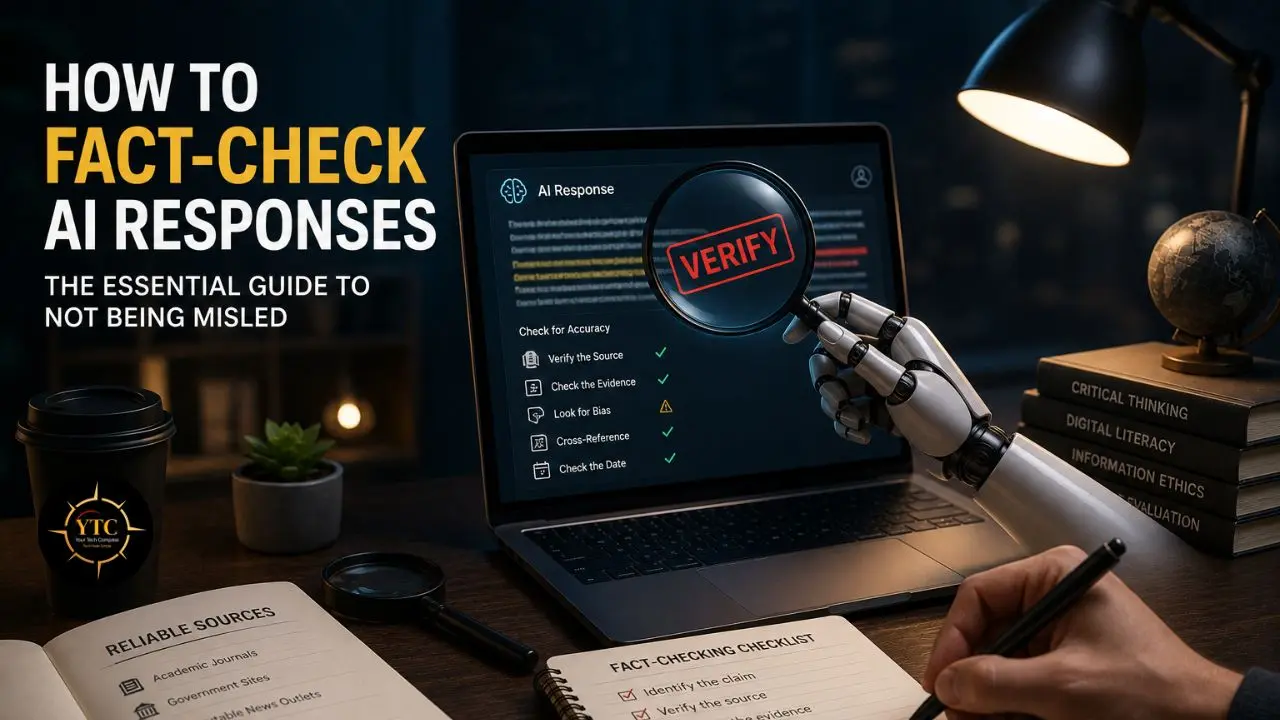
Let me start with a pattern documented in research from 2025, because it captures exactly why this guide exists. Multiple studies have found that large language models are systematically overconfident: they overestimate the probability that their answers are correct by 20–60%, and their stated confidence can remain high even when they’re less sure. Read that slowly: the less certain the model actually is, the less its outward confidence reliably signals correctness. There’s no typographical tell, no hesitation in the sentence structure, no visible seam between what the AI knows and what it’s inventing. A fabricated academic citation reads exactly like a real one. A wrong statistic is wrapped in the same authoritative prose as a correct one. A misattributed quote arrives with the same confidence as a genuine one. That’s what makes AI errors genuinely dangerous rather than merely inconvenient; the signal of wrongness is absent precisely when you most need it to be present.
The 2026 Stanford HAI AI Index found hallucination rates across 26 top models ranging from 22% to 94%, depending on the benchmark and use case. Studies of AI use in research contexts have documented hallucinated citations in a substantial share of chatbot-generated answers, and surveys show that many enterprise users have made decisions based on AI output they later discovered was incorrect. Those numbers aren’t an argument against using AI; they’re an argument for using it with the right habits. This guide gives you those habits: a practical, tiered framework for deciding what actually needs verification, a step-by-step process for checking AI responses efficiently, a toolkit of specific resources for different claim types, and the red flag signals that should trigger scrutiny regardless of how authoritative an AI’s output sounds. The goal isn’t permanent skepticism of everything an AI says. It’s calibrated trust; knowing which claims need checking, how to check them quickly, and when you can reasonably proceed.
Why AI Gets Things Wrong: Understanding the Problem Before Fixing It
Before you can fact-check effectively, you need to understand why AI hallucinates; because the specific mechanism behind the errors tells you exactly which types of claims are highest risk.
What Hallucination Actually Is
AI models aren’t databases of facts. They don’t retrieve stored information the way search engines index web pages.
Instead, they are prediction engines; trained to generate text by predicting the most statistically likely next token based on patterns in training data. They don’t understand truth. They predict plausibility.
When an AI fills a knowledge gap, it doesn’t recognize it as such. It simply generates the most statistically plausible next word, sentence, or paragraph. And because plausible-sounding text often resembles accurate text, especially when the model has been trained on vast quantities of well-written, authoritative content, the result is output that sounds correct yet is wrong.
A 2025 mathematical proof confirmed that hallucinations cannot be fully eliminated under current LLM architectures. This isn’t a bug that will be patched in the next update. It’s an inherent structural characteristic of how large language models work, and it applies to every AI tool you’re currently using: GPT-5.5, Claude Opus, Gemini, DeepSeek; all of them. The rates vary; the presence doesn’t.
Theoretical work in 2024–2025 showed that hallucinations are inevitable for language models in general, and that perfect hallucination control is mathematically impossible under current LLM inference mechanisms. This isn’t a bug that will be patched in the next update.
It’s an inherent structural characteristic of how large language models work, and it applies to every AI tool you’re currently using: GPT-5.5, Claude Opus, Gemini, DeepSeek, all of them. The rates vary; the presence doesn’t.
The More Reasoning, The More Hallucination: The Counterintuitive Finding
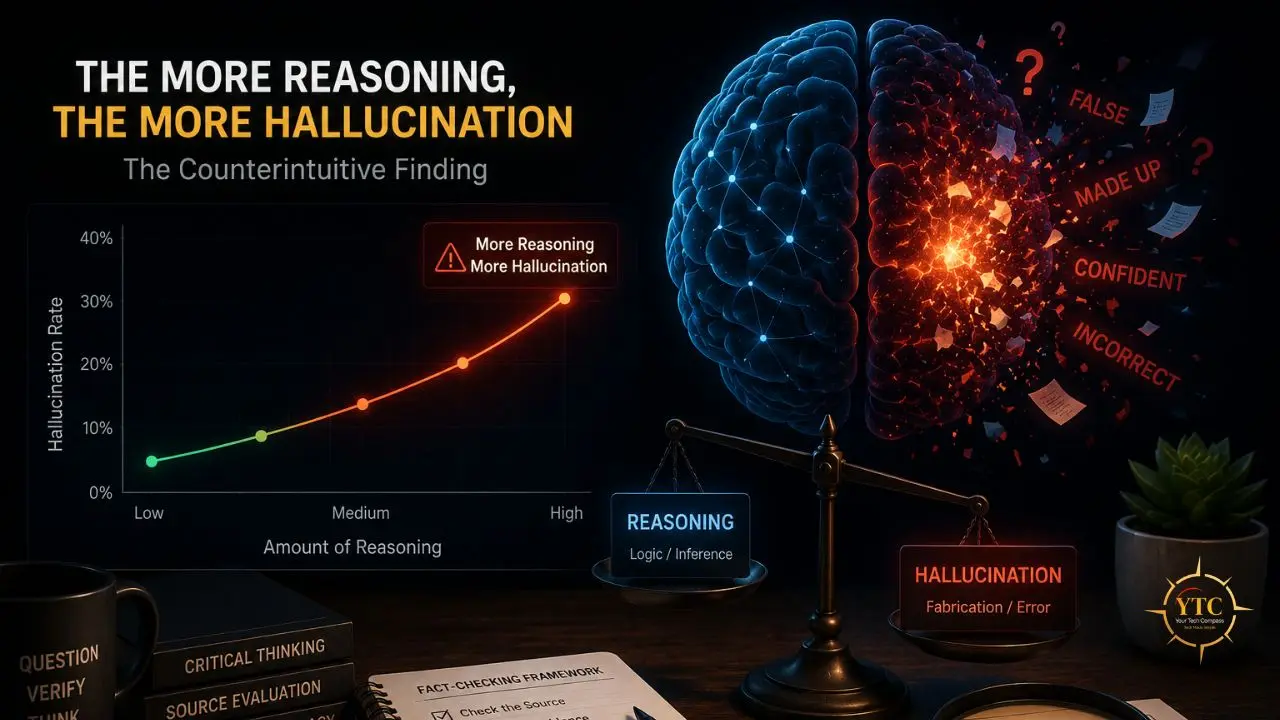
One of the most practically important findings from 2025 AI research runs directly counter to what you’d expect. Models built for deeper reasoning actually hallucinated more on factual benchmarks. According to OpenAI’s internal evaluations reported in 2025, OpenAI’s o3 model hallucinated 33% of the time on the PersonQA benchmark, more than double the 16% rate of its predecessor o1. The smaller o4-mini performed even worse at 48%.
The implication: a model’s benchmark intelligence doesn’t protect you from hallucination. Don’t assume that because you’re using a more capable or more expensive model, you can relax your verification standards. If anything, the confident fluency of the most capable models can make their errors harder to detect, not easier.
The Specific Claim Types That Hallucinate Most
Understanding which claim categories are highest-risk is the most actionable piece of technical context in this section. Across all the research on AI accuracy, certain patterns are consistent:
- Specific Statistics and Numbers: Percentages, figures, data points. AI often generates plausible-sounding numbers with false specificity (“87.3% of users reported…”) that have no verified source. The specificity is itself a red flag.
- Citations and References: Academic papers, journal articles, books. Hallucinated citations appear in a substantial share of chatbot-generated answers in research contexts, with studies documenting fake but structurally convincing references (with correct author name format, journal name, year, volume and page numbers) that simply don’t exist.
- Recent Events Post-Training-Cutoff: Anything that happened after the model’s knowledge cutoff is either absent, incomplete, or confabulated from similar older events. Models trained on static datasets exhibit notably higher hallucination rates when asked about recent events than when asked about well-covered historical topics.
- Specific Attributions and Quotes: “X said: ‘…'” statements where the quote is fabricated or subtly misrepresented. This is common with historical figures and current public personalities alike.
- Niche and Specialized Domains: The less a topic appeared in training data, the more the model fills gaps with statistically plausible but incorrect content.
- Africa-Specific Information: AI training data is heavily skewed toward English-language, Western-sourced content. Claims about African markets, regulations, events, or statistics are particularly prone to inaccuracies, outdated information, or cross-country conflation. A statistic about Kenya may have been pulled from a Nigerian context. A regulation described as current may have been superseded. Regional specificity is where AI confidence diverges most sharply from AI accuracy for African readers. Our AI in Africa category and the AI policy in Africa guide both cover the governance and accuracy dimensions of AI deployment in African contexts, which is directly relevant to understanding why regional verification matters more, not less, for African readers using these tools.
The Verification Hierarchy: Not Everything Needs the Same Level of Checking
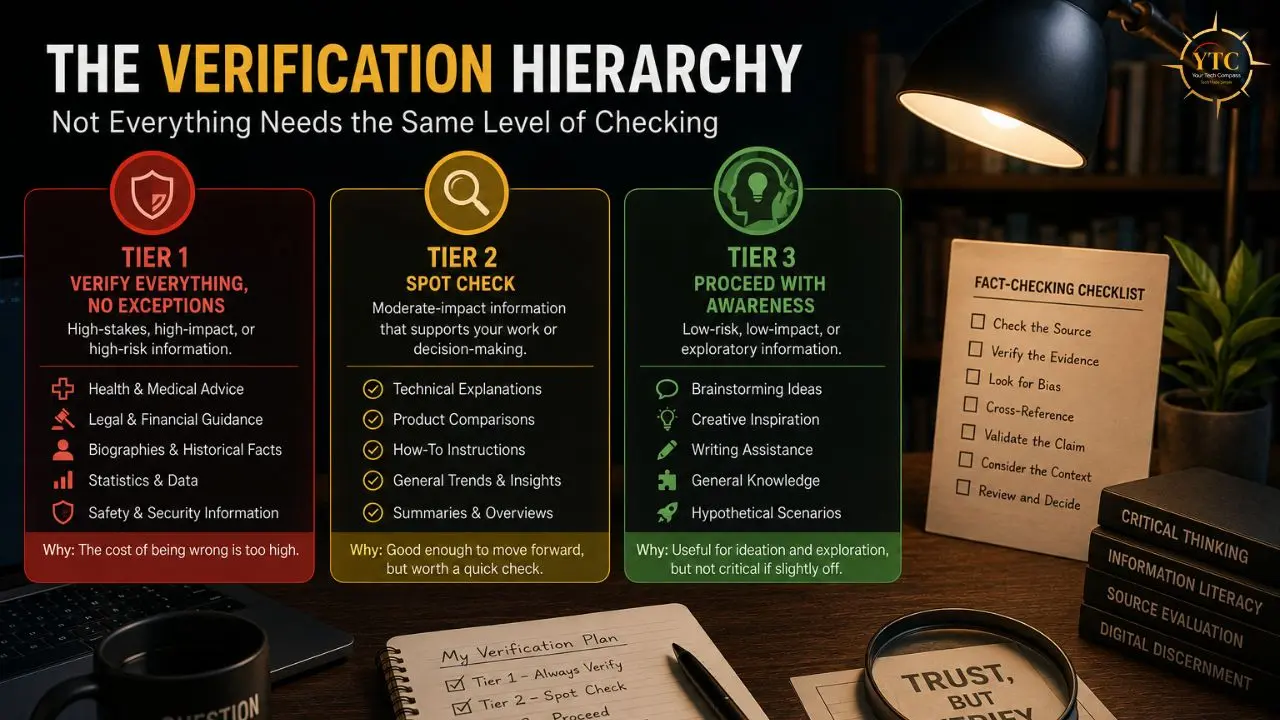
Treating every AI output as equally suspect is as unproductive as treating every AI output as authoritative. The practical solution is a tiered approach that allocates your verification effort proportionally to the stakes of being wrong.
Tier 1: Verify Everything, No Exceptions
These claim types should never proceed to use without independent verification, regardless of how authoritative they sound:
- Any specific statistic, percentage, or figure you plan to publish, present, or use to make a decision.
- Any citation, paper title, or source reference the AI provides.
- Any direct quote attributed to a named person.
- Any legal, medical, or financial claim you might act on.
- Any claim about a specific named person: biographical details, statements, records, dates.
Tier 2: Spot Check
These warrant verification, particularly if you’re using the output in any professional or published context:
- Factual claims about historical events, especially dates, specific outcomes, and named participants.
- Descriptions of how products, systems, or processes work; these change with software updates and policy changes.
- Pricing, availability, or regulatory information; accurate at training time, may be outdated now.
- Statistical claims you’re referencing rather than building an argument on.
Tier 3: Proceed with Awareness
These categories carry lower hallucination risk and don’t typically require systematic fact-checking:
- Explanations of broadly documented concepts where you can sense-check against your existing knowledge.
- Creative content, brainstorming, and ideation where factual accuracy isn’t the primary output.
- Structural assistance (outlines, rewrites, format changes) where the AI isn’t generating new facts.
The calibration principle: the goal is proportional skepticism. A creative writing brainstorm doesn’t need Google Scholar. A medical claim you’re planning to act on does.
Step-by-Step: How to Fact Check AI Responses
This is the core of the guide: six specific, sequential steps you can apply to any AI response that lands in Tier 1 or Tier 2 of the hierarchy above.
Step 1: Scan for Red Flag Signals Before You Start Verifying
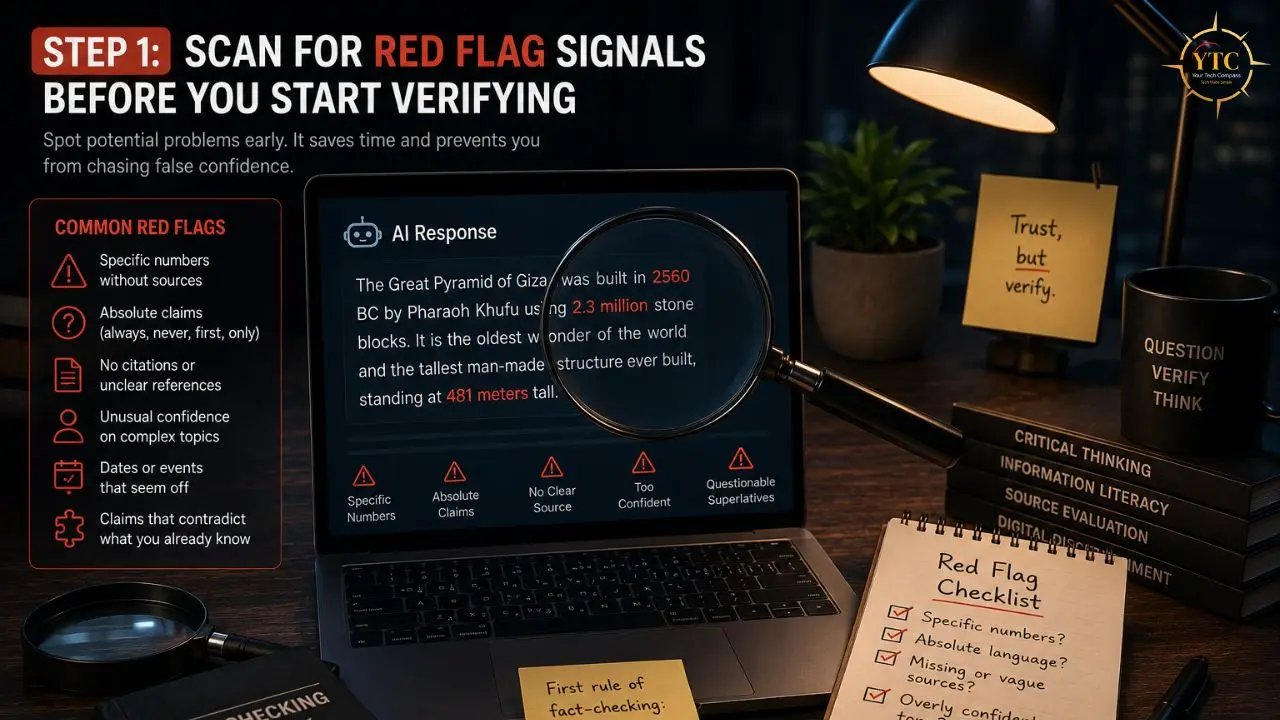
Before spending time on external research, train yourself to read AI responses looking for specific hallucination patterns:
- Very Specific Numbers Without a Stated Source: Any statistic of the form “X% of people…” or “in [year], there were [specific number]…” should immediately raise a flag. The specificity is precisely what AI fabricates most convincingly. Ask: where does this number come from?
- Citations Included In-Line or at the End: Do not assume a citation is real. This deserves its own step below, but as a red flag signal: any time an AI produces a formal citation (author, journal, year, volume, pages), treat it as unverified until you’ve confirmed it in a database.
- Superlatives and Records: “The first,” “the largest,” “the only,” “the highest ever,” specific claims of primacy or scale are frequent hallucination sites. These are exactly the kind of emphatic, authoritative-sounding claims that AI confabulates confidently.
- Named Direct Quotes: Any “X said: ‘…'” format where the quote is specific and not a widely-reproduced famous saying should be treated as potentially fabricated or misattributed.
- Confident Claims About Recent Events: Anything that could plausibly have changed since the model’s training cutoff (e.g., AI model names, pricing, company leadership, regulatory status, election outcomes) should be treated as potentially outdated or incorrect.
Step 2: Check Citations First, Because They’re the Most Commonly Fabricated
Hallucinated citations appear in a substantial share of chatbot-generated answers in research contexts, with multiple studies in 2025–2026 documenting fake but structurally convincing references. This is the step that surprises most people who haven’t encountered it before.
The citation looks real. The author name looks right. The journal is a real journal. The year is plausible. The paper simply doesn’t exist.
How To Verify a Citation
Search Google Scholar (scholar.google.com) for the exact paper title in quotation marks. Search PubMed for medical or health research. If the paper doesn’t appear in any database search, treat it as fabricated and remove it from whatever you’re producing. If it does appear, take the additional step of confirming the paper actually argues what the AI claims it argues; AI sometimes correctly identifies a real paper and then misrepresents its conclusions.
A Practical Workflow
When an AI response contains a citation, open scholar.google.com in a new tab immediately and search for it before you write anything about that citation. Catching a fake reference before you’ve built a paragraph around it costs one minute. Catching it after costs five.
Step 3: Trace Statistics Back to Primary Sources
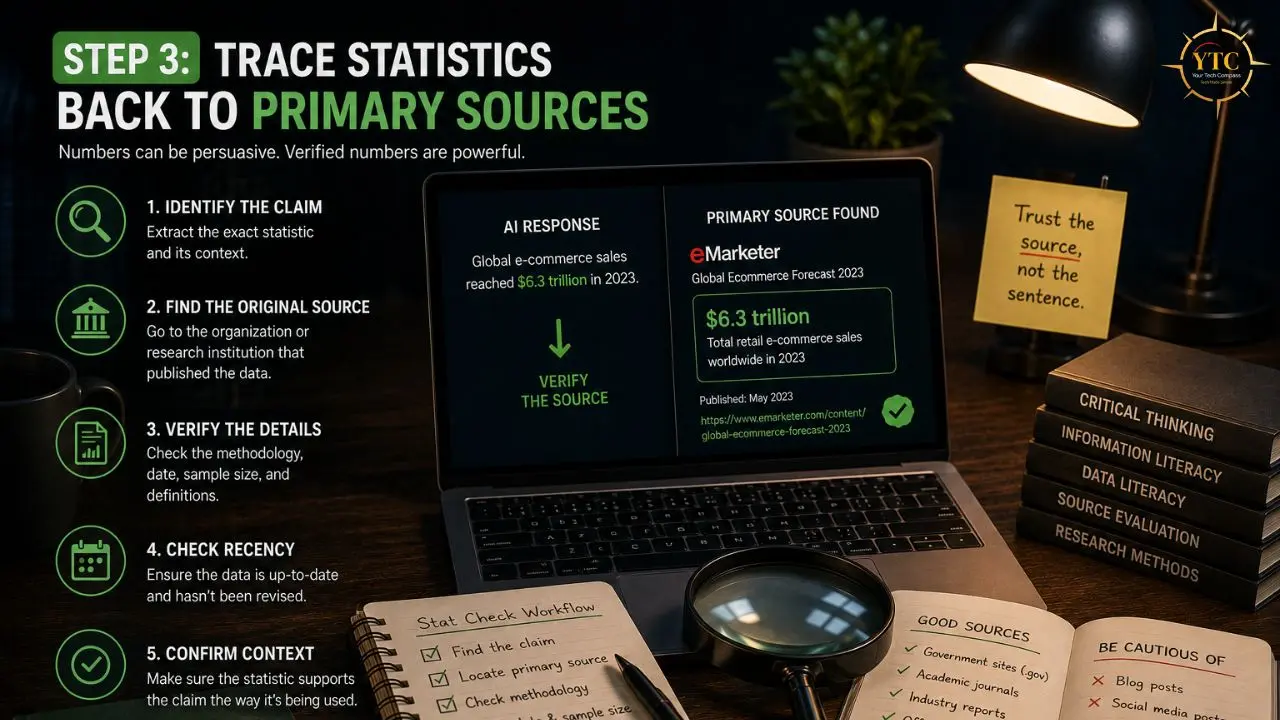
When AI gives you a statistic, your only question is: what is the original source of this number? Not another article that cites it. Not another AI tool that repeats it. The actual primary source where it was first measured and published.
The Verification Path
Search the statistic (in quotation marks if it’s specific) plus likely source domains. For global health statistics, that’s WHO and UNICEF. For economic data, that’s the World Bank and IMF. For African-specific data, that’s the Mo Ibrahim Foundation, African Development Bank, or individual national statistics offices. For research findings, that’s Google Scholar and the original journal.
Some estimates of error rates for AI-generated complex professional queries fall in the 20%-40% range, depending on the task and model. If you cannot find the primary source of a statistic in three or four targeted searches, treat the statistic as unverified and don’t use it. Alternatively, use it only if you characterize it appropriately: “AI-generated research suggests…” with an explicit note that verification was inconclusive.
The Rule That Protects You
Do not verify an AI statistic by asking a different AI model. One AI tool repeating another AI tool’s fabricated statistic is not verification; it’s amplification of the original error, delivered with additional confidence.
Step 4: Use Multiple Independent Sources for Factual Claims
A factual claim that is correct should appear across multiple independent, credible sources. The reverse is a useful diagnostic: if a specific claim only appears on one website, or predominantly on content-farm or AI-generated sites, treat it as unconfirmed.
The Search Strategy
Google the specific claim with date filtering to control for recency. Wikipedia is useful as an orientation layer; it often signals the mainstream understanding and provides primary-source citations at the bottom that you can follow up on. Then follow those citations to official, primary sources rather than using Wikipedia itself as the endpoint.
A Structural Tip for African Readers
For region-specific claims, Africa Check (africacheck.org) is the most authoritative Africa-focused fact-checking resource and actively debunks AI-generated misinformation shared about African news, health, economics, and politics. Make it a standard stop when verifying claims about any African country or context.
Step 5: Ask the AI to Show Its Work Before You Verify Externally
Before investing time in external research, try a quick triage step: ask the AI directly for the source of a specific claim.
Type: “What is your source for that specific statistic?” or “What paper is that citation from?” or “How confident are you in that claim?”
OpenAI published research in 2025 explaining this clearly: hallucinations persist because standard training and evaluation procedures reward guessing over acknowledging uncertainty. When models are trained and evaluated on accuracy metrics, guessing and occasionally being right look better than consistently admitting uncertainty.
A well-calibrated model will acknowledge uncertainty when pressed: “I’m not certain of the exact source; I’d recommend verifying this independently.” That acknowledgment is useful information. A poorly calibrated model may generate a fake source in response to your question, which is also useful diagnostic information; it tells you the model is filling gaps rather than retrieving knowledge.
This step doesn’t replace external verification. It functions as a fast triage that surfaces the most uncertain claims before you spend research time on ones the AI is genuinely confident about.
Step 6: Use Perplexity AI or Search-Backed Tools for Real-Time Verification
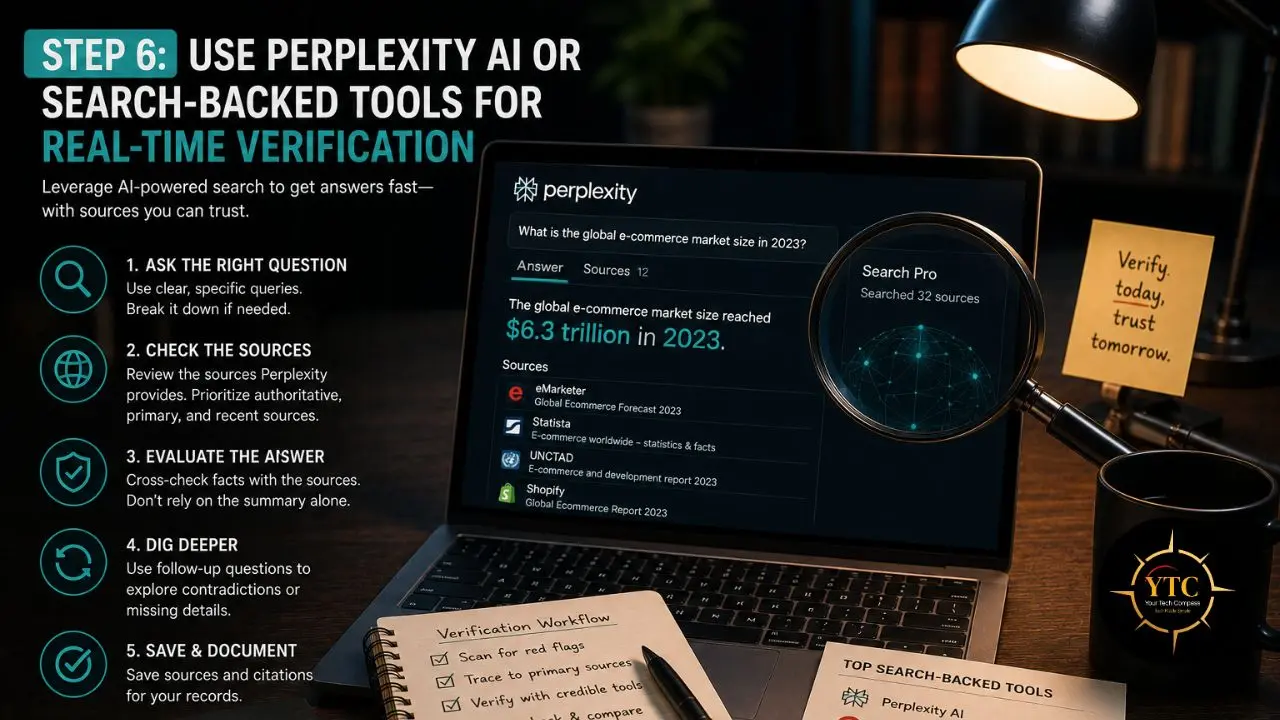
For checking current facts, recent events, or any claim that might have changed since the generating model’s training cutoff, search-grounded AI tools provide an efficient verification layer. A 2025–2026 study found that AI search hallucinations appear in at least 1 out of 5 queries on some benchmarks, and often higher on difficult, multi-turn tasks, but search-grounded tools that cite specific sources give you the means to check those sources directly, which pure chat AI tools don’t provide.
Our Perplexity AI guide covers how Perplexity’s real-time, citation-backed responses work in practice. For fact-checking purposes, the key workflow is: rephrase the specific claim as a question, run it in Perplexity, check which sources it surfaces, then follow those sources to verify the underlying claim directly. The sources are the point: Perplexity’s source links give you primary materials to evaluate rather than another AI opinion to add to the pile.
Limitation To Understand
Perplexity is excellent for recent, well-documented facts from mainstream sources. For niche, local, or non-English-language topics, particularly African regional information, it has the same data availability gaps as other AI tools. The DeepSeek V4’s open-weight approach and multilingual coverage mean it’s occasionally better for regional information. Our DeepSeek V4 review covers how its approach to non-English sources differs from that of Western-centric models.
Fact Checking Tools and Resources: Your Verification Toolkit
Use Case | Tool | Best For |
General Claims and Viral Misinformation | Widely shared false statements, social media claims | |
Africa-Specific Fact-Checking | Politics, health, economics across African countries | |
International Fact-Checking | Global news and regional misinformation | |
Academic Citations | Verifying whether papers exist and what they say | |
Medical/Health Research | Health and medical citation verification | |
Global Statistics | Data verification with source citations per data point | |
Economic and Development Data | Economic, demographic, and development statistics | |
Recent News and Current Events | Wire service primary source verification | |
Real-Time AI Verification | Current facts with cited sources | |
African Governance Data | African governance, infrastructure, economics |
The Africa Check Recommendation Deserves Emphasis
Africa Check is not just one option among many for African readers; it’s a genuinely essential resource that has no direct equivalent in Western fact-checking ecosystems. It actively investigates claims specific to African political, economic, and health contexts, publishes its methodology alongside findings, and covers the type of AI-generated misinformation about Africa that neither Snopes nor PolitiFact addresses. Bookmark it alongside any other verification resource you use regularly.
Building Better Verification Habits: The Long Game
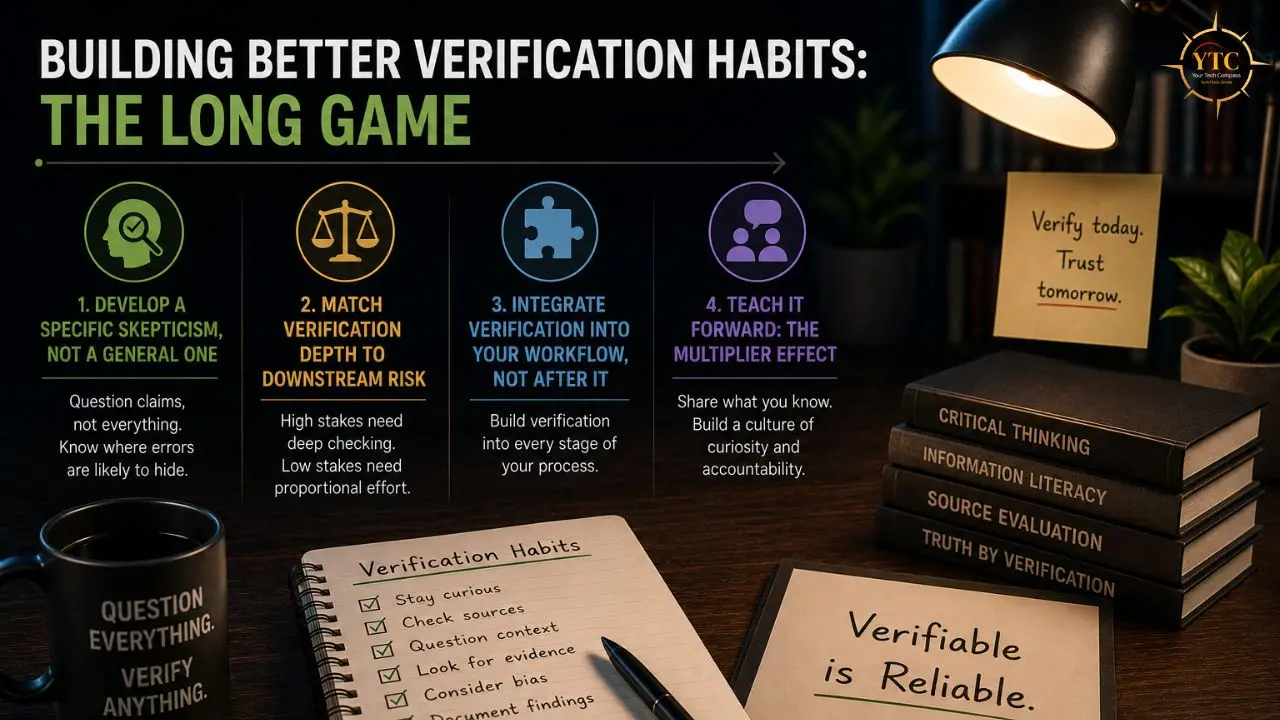
Tools are only as useful as the habits that put them to work. The step-by-step process above is most valuable when it becomes instinct rather than something you consciously remember to apply.
Develop a Specific Skepticism, Not a General One
Hallucination risk isn’t uniformly distributed across an AI response. Long explanatory content about how a concept works is generally more reliable than a specific statistic embedded in that explanation.
Train yourself to mentally flag specific, checkable claims as you read (numbers, dates, citations, attributions, records) as distinct from explanatory prose. You’re not re-reading every sentence with suspicion. You’re scanning for specific claim types known to be high risk.
The “Would I Bet Money On This?” Test
This is the personal calibration test I find most practically useful. For any specific fact you’re about to use or share, ask yourself: would I bet something I actually care about on this being accurate without checking?
If the honest answer is no, you need to verify it before using it. If yes, proceed, and note that your answer will be calibrated to your existing knowledge of the domain, which is exactly where it should come from.
Match Verification Depth to Downstream Risk
The appropriate verification standard scales with what happens if you’re wrong:
- Casual question for yourself → low verification effort; sense-check against what you already know.
- Social media post or article you’ll publish → every specific fact needs a traceable source.
- Business or professional decision → primary source verification, not just search results.
- Medical or health decision you’ll act on → peer-reviewed sources and qualified professionals, not AI at any verification tier.
Integrate Verification Into Your Workflow, Not After It
The most time-efficient fact-checking habit is verification at point of contact, not at the end. When AI gives you a key statistic, paste it into a search window immediately, before writing the paragraph around it.
Before including a citation, check it in Scholar before writing the sentence that cites it. Catching a false statistic before you’ve built an argument around it costs a minute. Catching it after you’ve written three paragraphs and scheduled the post costs considerably more.
Teach It Forward: The Multiplier Effect
A large majority of enterprises now include human-in-the-loop processes to catch hallucinations before deployment. At the individual level, the equivalent is making verification habits visible to the people around you.
The colleagues, students, or family members who are least skeptical of AI output are the highest-risk nodes in any collective information system. Sharing one specific, concrete habit (“always search the specific number before using it”) with non-technical colleagues has outsized impact on the collective accuracy of the information environment around you.
How AI Tools Handle Uncertainty and What to Look For
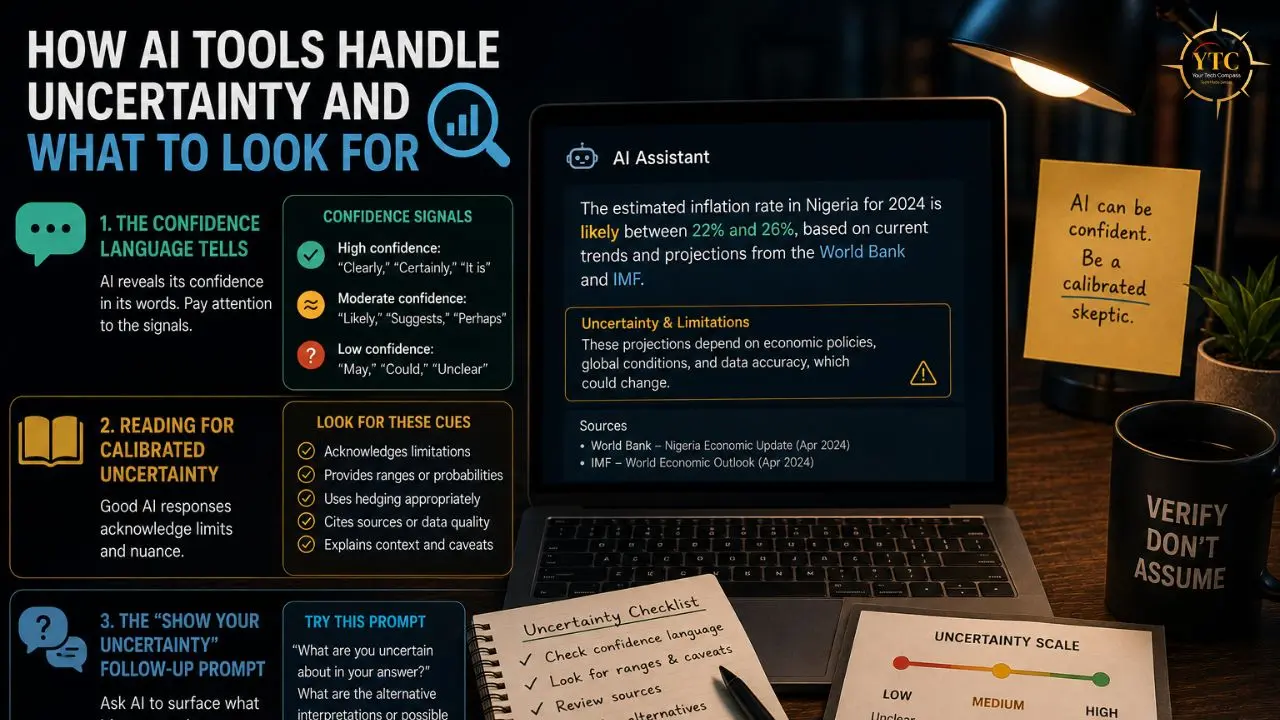
One final dimension of AI literacy that most guides skip: how to read the AI’s own response for built-in signals of reliability.
The Confidence Language Tells
Research in 2024–2025 shows that large language models are systematically overconfident: they often state incorrect answers with the same fluent certainty as correct ones, and they can be swayed by overly confident user prompts into doubling down on false claims. This means the most confident-sounding claim in an AI response is not automatically trustworthy; on specific factual points, it’s often the one deserving the most scrutiny. When you encounter an AI statement that includes strong certainty markers (“definitely,” “certainly,” “without a doubt”) on a concrete claim, treat that as a verification flag, not as reassurance.
Reading for Calibrated Uncertainty
Well-calibrated AI models communicate their own uncertainty: “I believe this is accurate, but I’d recommend verifying,” “my training data has a cutoff, and I may not have current information on this,” “I’m not certain of the source for this specific figure.” These markers are features, not weaknesses. A model that acknowledges what it doesn’t know is more reliable than one that claims to know everything with equal confidence.
When an AI response contains no uncertainty markers on specific empirical claims, treat the absence of hedging as a reason to verify, not as confirmation of accuracy.
The “Show Your Uncertainty” Follow-Up Prompt
After receiving an AI response on a factual topic, a useful follow-up is: “For the specific statistics and citations in your response, which are you most and least confident in, and where would you recommend I verify?” Well-calibrated models respond to this with useful guidance. It doesn’t replace verification, but it’s a faster triage than checking everything equally.
Understanding which models are most and least prone to confident hallucination is part of our AI Unboxed category coverage, which tracks model accuracy developments as they evolve. For a direct comparison of how GPT-5.5 and Claude Opus 4.8 handle uncertainty and accuracy differently at the current frontier, our GPT-5.5 vs Claude Opus 4.8 comparison is directly relevant context.
In addition, our Claude AI Explained guide covers Anthropic’s Constitutional AI approach to reducing confident confabulation, which differs meaningfully from how other leading models handle this. Furthermore, our Tech Guides section covers the broader digital literacy context in which fact-checking AI sits, including the Safe Public WiFi Precautions guide, which addresses the parallel challenge of calibrating appropriate trust in digital systems.
FAQs
Hallucination rates vary significantly across models and benchmarks. Google’s Gemini-2.0-Flash-001 recorded a hallucination rate of just 0.7% on summarization benchmarks as of April 2025, while Falcon-7B-Instruct hallucinated in nearly 1 out of every 3 responses (29.9%). The range is genuinely wide, and the counterintuitive finding from 2025 is that advanced reasoning models sometimes hallucinate more on factual tasks than simpler predecessors. No model is immune, and the appropriate response is to calibrate verification habits rather than switch models.
No, and theoretical work in 2024–2025 showed that hallucinations are inevitable for language models in general, and that perfect hallucination control is mathematically impossible under current LLM inference mechanisms. Even the most reliable models hallucinate at some rate. The more achievable goal is calibrated trust: knowing which claim types need verification, having efficient habits to check them, and developing domain familiarity that helps you recognize plausible-but-wrong outputs faster over time.
Search Google Scholar (scholar.google.com) for the exact paper title in quotation marks. If the paper doesn’t appear, it’s fabricated; AI routinely produces structurally convincing fake citations. If the paper does appear, read the abstract to confirm it actually argues what the AI claims it argues. For medical research, search PubMed. The step takes under two minutes and should be non-negotiable before using any AI-provided citation in published or professional work.
For research purposes, search-grounded tools that provide explicit source citations, particularly Perplexity AI, are currently the most verification-friendly AI tools because they show you their sources rather than embedding claims without attribution. That said, even search-grounded tools make errors, and their sources should still be followed and evaluated, not just noted as present.
The honest answer: you often can’t tell from the statistic itself, which is precisely the problem. The red flags are false specificity (oddly precise numbers like “87.3%”), the absence of a stated source, and topics where you know the primary data would be specialized or scarce. The verification method: search for the statistic’s primary source. If you can’t find where it was originally measured and published within a few targeted searches, treat it as unverified.
Reports in 2025–2026 suggest that knowledge workers spend, on average, several hours per week verifying AI outputs, with some estimates as high as 4+ hours. That number sounds significant until you weigh it against the cost of acting on wrong information: correcting published errors, retracting business decisions, rebuilding credibility, or losing access to accounts and services. The time investment in verification is proportional and front-loaded; as you develop domain familiarity and efficient verification habits, the process gets faster. More practically, calibrated verification means you check Tier 1 claims carefully and let Tier 3 content flow without systematic checking, which keeps the total time investment manageable for most workflows.
Conclusion

The core literacy shift this guide asks you to make isn’t distrust of AI; it’s distrust of AI’s confidence specifically. The fluency, the authority, the specificity; none of those signal accuracy. AI models generate statistically probable responses based on pattern matching rather than retrieving verified facts. That’s not a flaw in any one tool. It’s the category’s architecture. The appropriate response is calibrated verification habits: knowing which claim types are highest risk, having the tools to check them efficiently, building the check into your workflow at point of contact rather than after the fact, and reading AI responses themselves for the uncertainty signals that well-designed models do provide when you know to look for them.
What I want you to take from this guide isn’t a comprehensive checklist that you apply to every AI interaction for the rest of your life. It’s one starting habit that you build into your current highest-stakes use of AI, and then extend from there. If you write professional content using AI, start with citations: check every one before you use it. If you make business decisions with AI research, start with statistics; trace every number to its primary source. If you use AI for health information, stop at Tier 1; regardless, that category always needs a professional. The AI literacy gap that makes people vulnerable to confident-sounding wrong answers isn’t closed by knowing that AI hallucinates. It’s closed by having a specific, practiced, efficient habit that intercepts errors before they compound into decisions, publications, or conversations built on foundations that aren’t there.
Developing better habits around AI is one of the highest-leverage investments you can make in your professional life right now. Head to YourTechCompass.com for more practical, E-E-A-T-friendly guides on using AI tools effectively, safely, and with appropriate skepticism.