I’ll tell you the honest version of the Siri story before the excited version. For most of 2023 and 2024, the criticism was accurate: while OpenAI was shipping GPT-4, Anthropic was refining Claude, and Google was rebuilding Gemini from the ground up, Siri was still misunderstanding calendar requests, confusing contacts with similar names, and responding to complex questions with a link to a web search. Apple had built the world’s first mainstream AI assistant in 2011, and then, for a long stretch, seemed to watch the field evolve without urgently joining it. The result was an assistant that worked fine for setting timers and playing music, but couldn’t hold a candle to its competitors in reasoning, writing, or anything requiring sustained intelligence.
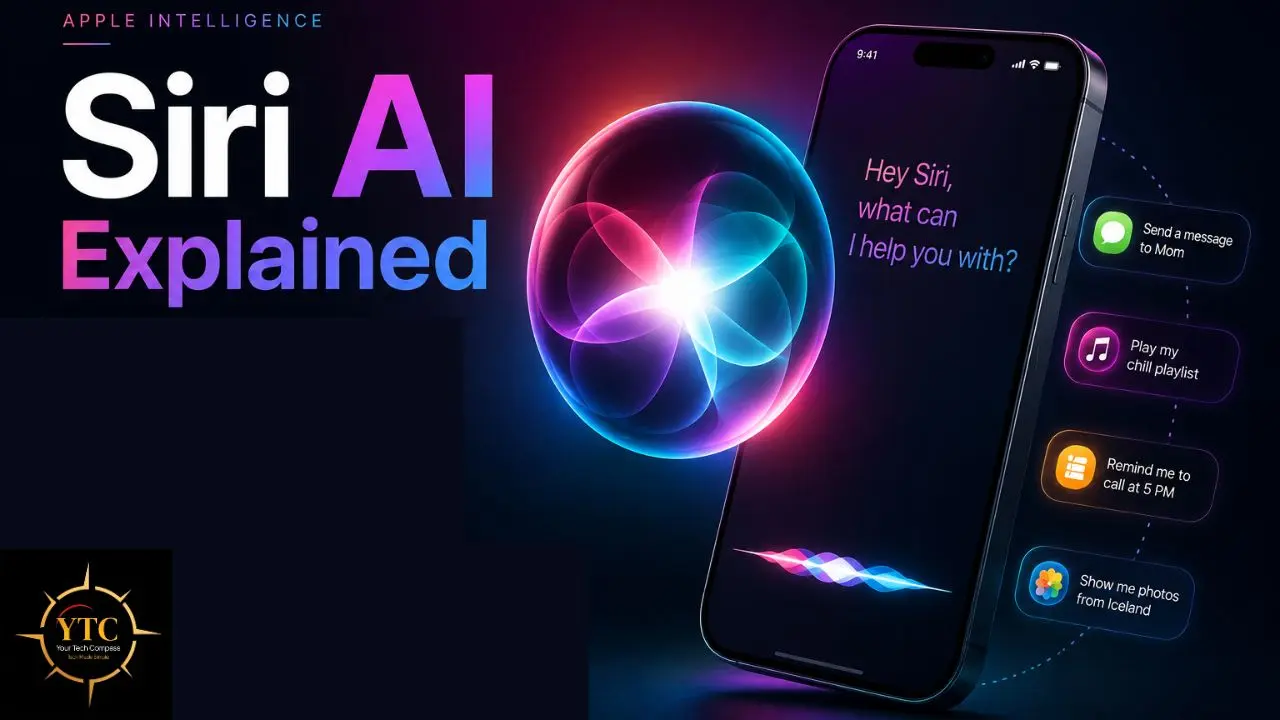
That story changed significantly at WWDC 2026. On June 8, 2026, framed as Tim Cook’s farewell keynote at Apple Park, Apple unveiled what it calls Siri AI: a fully rebuilt assistant powered by a new Apple Intelligence architecture co-developed with Google’s Gemini models, as part of a multi-year deal confirmed in January 2026. Apple introduced Siri AI, powered by Gemini-based Apple Intelligence, alongside iOS 27, macOS 27 Golden Gate, and system-wide AI features focused on performance, privacy, and deeper app integration. This article walks you through exactly what changed, how the architecture works, what Siri can do right now across different devices, how it compares to ChatGPT and Gemini, and what the roadmap beyond iOS 27 looks like. If you’ve been dismissing Siri because of what it was in 2022, it’s time to take another look.
A note before we begin: every YTC score is earned, never negotiated. If you want to understand exactly how we evaluate apps & tools and how we handle affiliate relationships, our Review Methodology lays it all out.
What Is Siri AI: History, Architecture, and the Apple Intelligence Shift
Siri launched in October 2011 as the first mainstream AI voice assistant, shipped with the iPhone 4S. It was originally developed by SRI International, acquired by Apple in 2010, and built on a pipeline architecture rather than a language model. Speech recognition → intent classification → action execution. That architecture was functional but rigid: it couldn’t handle ambiguity, maintain conversational context across turns, or adapt to how people naturally speak when they want something done.
For years, Alexa, Google Assistant, and eventually ChatGPT evolved their architectures in ways that Siri didn’t. Key milestones in Apple’s AI evolution include the 2018 hiring of John Giannandrea from Google to lead machine learning and AI strategy, the 2020 introduction of the Neural Engine in Apple Silicon, the 2024 launch of Apple Intelligence with ChatGPT integration at WWDC, and the 2025 announcement of the Apple Foundation Models framework. Each of those was an attempt to close a gap that kept widening.
Apple Intelligence: The Architectural Foundation
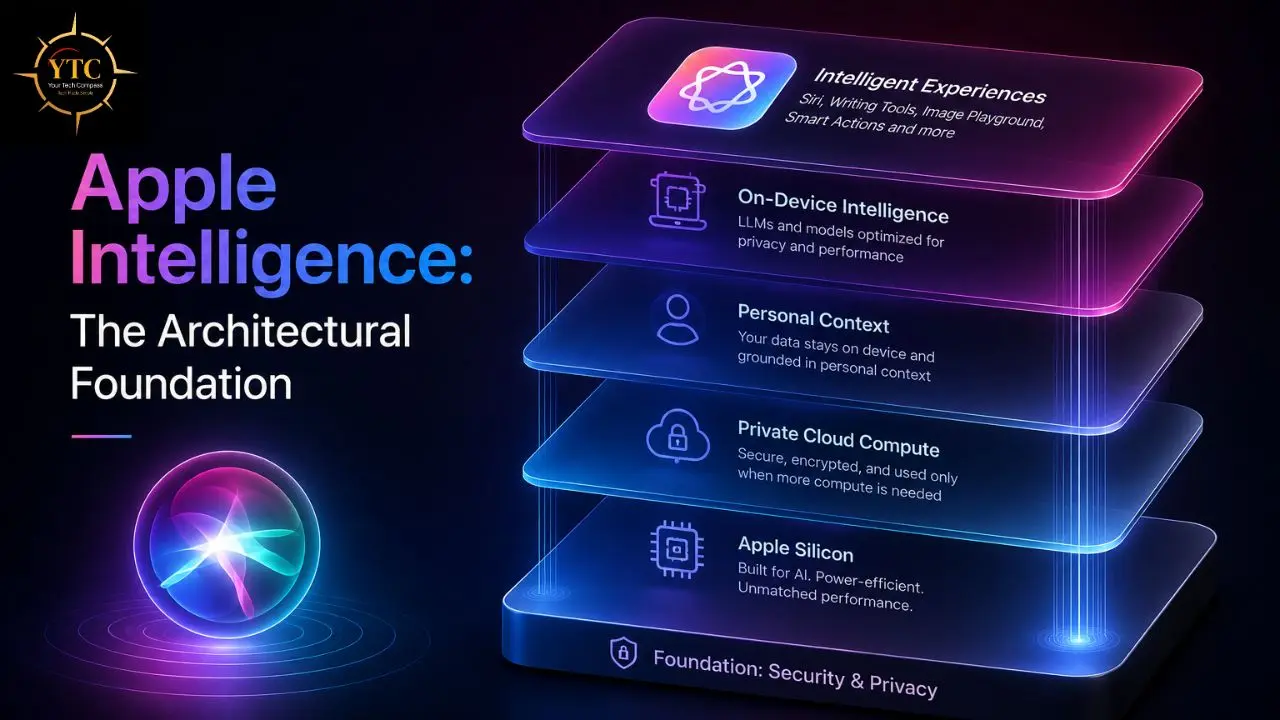
Apple Intelligence, introduced with iOS 18.1 in October 2024, is the AI system that Siri now runs on. Understanding Apple Intelligence is essential for understanding what Siri can do, because the two are architecturally inseparable. Apple Intelligence is Apple’s built-in AI system that runs across its devices, handling simple tasks on-device and routing more complex work to private cloud servers and, when needed, to a custom Gemini model. It is best understood as a privacy-first router, not a single chatbot you open and talk to.
The original Apple Intelligence stack (iOS 18.1 through iOS 26.3) had three layers. First, on-device language models, approximately 3-billion-parameter models running entirely on Apple Silicon’s Neural Engine, handling personal context tasks without any data leaving your device.
Second, Private Cloud Compute: Apple’s privacy-preserving server infrastructure for tasks that exceed on-device capacity, with code publicly verifiable and data not retained or used for training. Third, ChatGPT integration: with explicit user permission, Siri could route specific, complex queries to OpenAI’s model, while keeping the user’s identity undisclosed to OpenAI.
The WWDC 2026 Siri AI Overhaul: What Actually Changed
What changed in 2026 is the engine room. Apple Intelligence now runs on a hybrid stack of co-developed Apple Foundation Models and a licensed Gemini model, coordinated by a new system orchestrator. According to Apple, the goal is to give you the capability of a frontier model without handing your life to an advertising company.
Apple plans to use Google’s Gemini AI model to power an updated version of Siri. “After careful evaluation, Apple determined that Google’s AI technology provides the most capable foundation for Apple Foundation Models,” Apple and Google said in a statement. The two companies have entered into a multi-year contract in which Apple will use Google’s Gemini model and cloud computing technology to power its AI features.
Consequently, what you’re getting with Siri AI in iOS 27 is not an incremental upgrade to the 2024 Apple Intelligence system. It’s a rebuilt assistant that coordinates Apple’s own on-device models with Gemini’s frontier reasoning capabilities; all routed through a privacy-first architecture that, at least by Apple’s account, doesn’t hand your personal data to an advertising company in exchange for better answers.
Apple reshuffled its AI executive ranks in 2025 amid delays to Siri’s revamp, replacing AI head John Giannandrea with Mike Rockwell, who had led the team that developed Apple’s Vision Pro. Giannandrea’s forthcoming retirement was then confirmed in December, with former Google and Microsoft AI researcher Amar Subramanya announced as Apple’s new vice president of AI. The leadership change reflects the urgency of the rebuild; this wasn’t a routine product iteration.
What Siri AI Can Actually Do in 2026: Current Capabilities
Let me walk you through the capability picture clearly, not the marketing claims, but what the features actually enable in daily use.
Siri AI: The New Interface
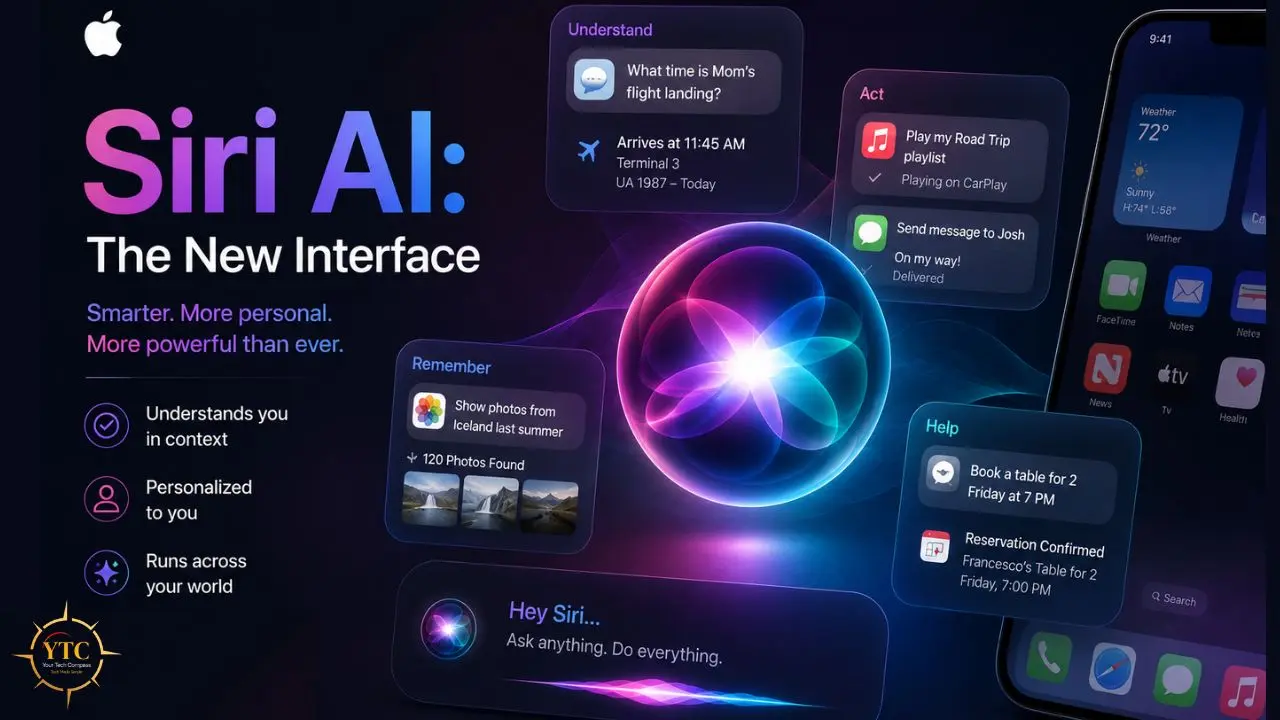
Siri AI introduces a new “Ask Siri” interface that allows users to interact via both voice and text, offering a more detailed, full-screen conversational experience. One of the more notable additions is a dedicated Siri app that allows users to revisit past conversations and continue ongoing interactions across devices. The app provides an overview of the conversation history, enabling users to jump back to previous queries or start new ones, and syncs conversations across devices via iCloud.
This is the shift from Siri as a one-off assistant to Siri as a persistent AI interface. When you ask Siri something today, that conversation exists in your history tomorrow. You can return to it, continue it, and reference it across your iPhone, iPad, and Mac simultaneously. That’s categorically different from how Siri operated before, where every session started fresh, and nothing persisted.
Personal Context: What “On-Device AI” Actually Enables
The most practically significant Siri capability in 2026 is personal context awareness: Siri’s ability to read and act on the content of your personal data across all your Apple apps simultaneously, without that data leaving your device. This capability was delayed until iOS 18.4 and finally arrived with the Gemini-powered overhaul. Siri gains personal context awareness, on-screen awareness, and cross-app action execution.
In practice, this means that a search for “Siri, when did my flight confirmation arrive?” searches your Mail and returns the booking details. “What address did Marcus send me last week?” searches your Messages. “What was the budget number from the spreadsheet I worked on Tuesday?” searches your Files. These are queries that previously sent Siri to a generic web search because it had no access to your personal information. Now the answer comes from your actual data, processed on your device.
Cross-App Actions
Cross-app action execution is where Siri starts behaving like a genuine AI agent rather than a voice shortcut. Apple demonstrated use cases such as drafting emails, planning events, retrieving information from messages and photos, and executing app-based tasks without requiring users to manually switch between apps.
“Add the address from this email to the contact,” reads Mail, updates Contacts. “Create a calendar event from this message,” reads the conversation, and creates the event. “Share this photo with the person I was texting,” connects Photos and Messages.
The operational difference from the previous Siri is significant. Previous Siri required you to describe the destination: “Open Contacts, find Marcus, edit the address field, type this.” New Siri understands the intent and figures out the navigation itself; it’s task-oriented rather than command-oriented.
Writing Tools
Writing Tools (accessible via Siri or directly in any text field across iOS, iPadOS, and macOS) provide system-wide capabilities for rewriting, proofreading, summarizing, and drafting. The Gemini foundation means writing quality is meaningfully better than the 2024 Apple Intelligence version.
In addition, long email threads get summarized accurately. Draft responses are specific, not generic. The “friendly,” “professional,” and “concise” rewrite options actually differ in output quality rather than producing cosmetically different versions of the same text.
Notification Intelligence
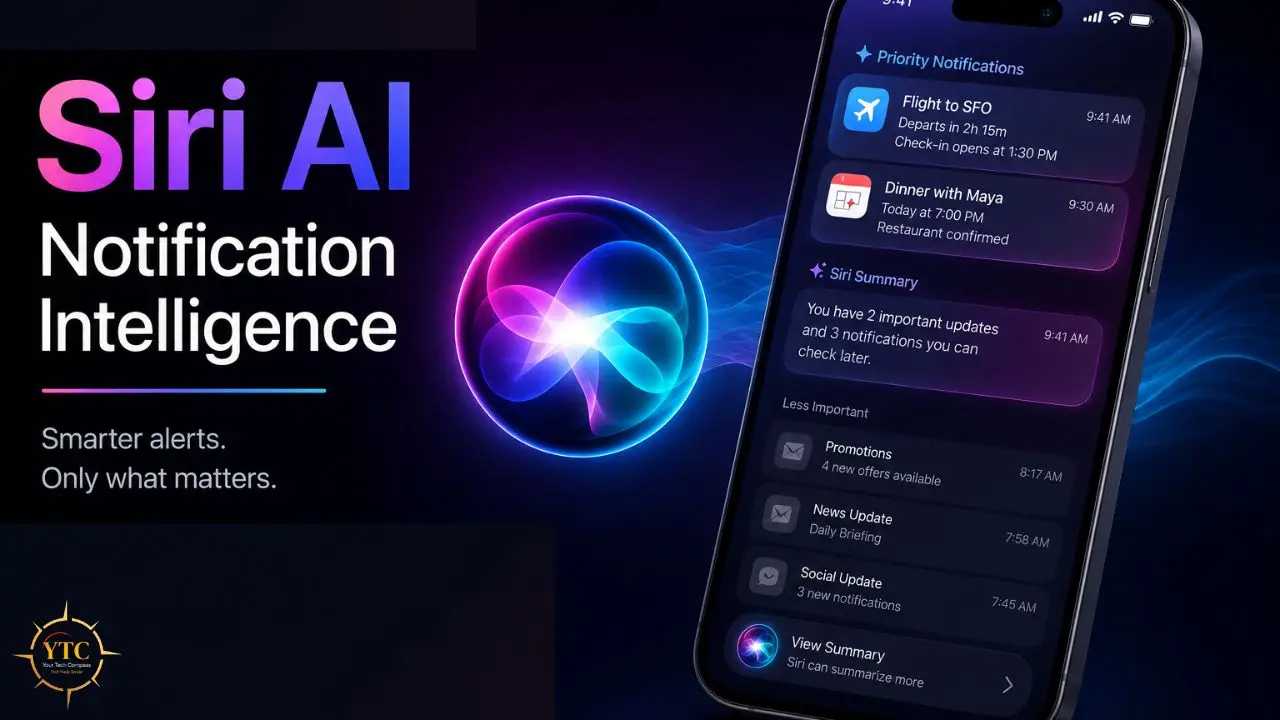
Notification summaries have existed since iOS 18.1; Siri groups and summarizes notification clusters to surface what’s important. The accuracy of these summaries has improved with the Gemini upgrade, which matters practically: a notification summary that misrepresents a message is worse than no summary because it creates false confidence. The 2026 version is meaningfully more reliable on this specific feature.
Where Siri AI Still Has Limitations
Honest assessment requires naming what the rebuild hasn’t yet fixed. Siri’s third-party app integration depth is uneven. The App Intents framework enables some deep third-party integration, but coverage depends entirely on whether app developers have implemented it. Additionally, while Gemini’s reasoning is significantly better than the 2024 Apple Intelligence models, you’re not getting the full Gemini Pro experience.
You’re getting a version routed through Apple’s privacy architecture, which involves trade-offs in what context passes through. Consequently, for tasks requiring sustained, complex, multi-turn reasoning on novel problems, dedicated tools like ChatGPT or Gemini will often still produce better results.
Apple Intelligence: The Architecture Behind Siri AI
Understanding the engine room helps you use the product more intelligently and evaluate the privacy claims honestly.
The System Orchestrator
The new Apple Intelligence architecture adds a system orchestrator layer that coordinates between Apple’s on-device models, Private Cloud Compute, and the Gemini model. When you make a request, the orchestrator routes it based on complexity and sensitivity: simple requests to on-device models (fast, private, no internet required); complex requests requiring reasoning or world knowledge to Private Cloud Compute with the Gemini foundation; and requests specifically requiring current web information to the Gemini model’s search capabilities.
This routing is invisible to you; you interact with Siri as a single interface. But the orchestration matters because it determines what leaves your device (which matters for privacy) and which model generates your response (which matters for quality).
Apple Foundation Models: The On-Device Layer
Apple’s on-device models are approximately 3-billion-parameter models running on Apple Silicon’s Neural Engine, optimized for the specific tasks that dominate daily Siri use: setting context, cross-app actions, notification summaries, and personal information queries. These models are small enough to run entirely on-device without impacting battery life, but large enough to handle the contextual complexity of real-world personal data queries.
The on-device models don’t require an internet connection and are significantly faster than cloud-routed requests. For the most sensitive personal context queries (messages, emails, health data), on-device processing is where Apple’s privacy claim is strongest.
Private Cloud Compute: How It Actually Works
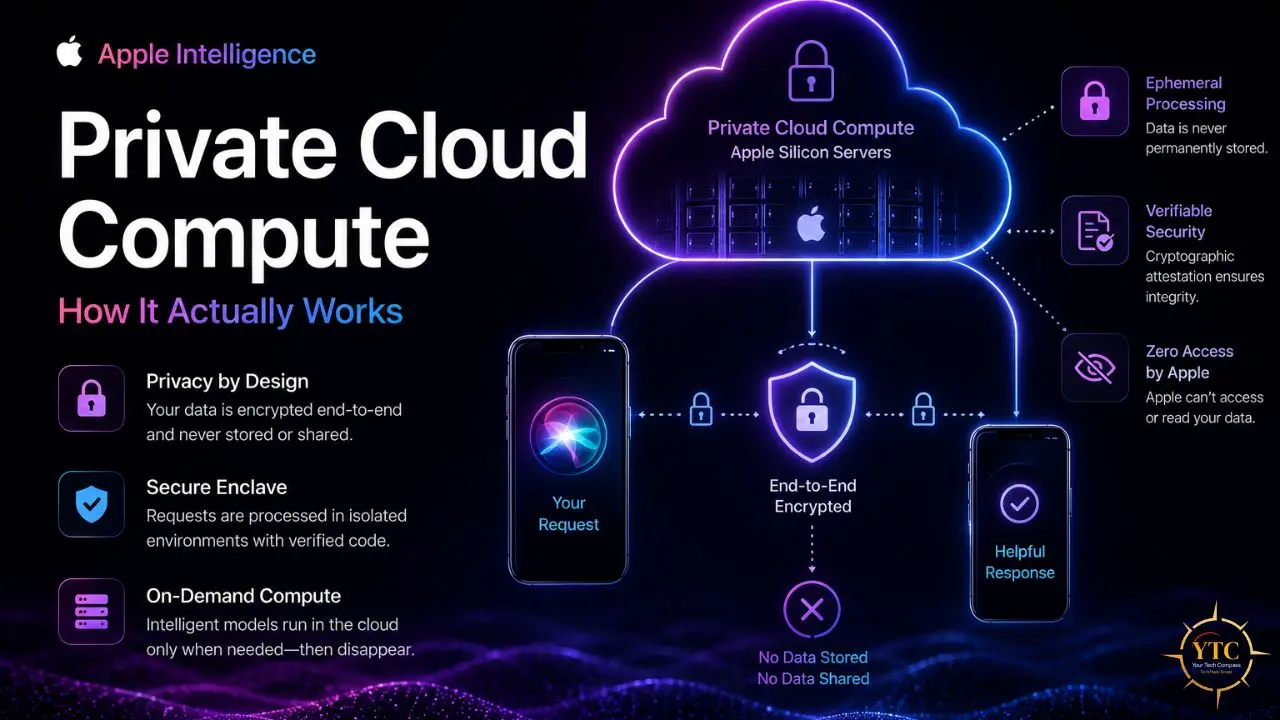
Private Cloud Compute is Apple’s secure server-side infrastructure for requests that exceed the capacity of on-device models. Apple’s security claims are more verifiable than typical cloud AI privacy statements: Apple said that under the new agreement, its Apple Intelligence AI features will continue to run either on users’ devices or in a secure cloud to protect privacy. The code running on Private Cloud Compute nodes is publicly verifiable by independent security researchers, a transparency commitment that OpenAI and Google don’t match for their equivalent infrastructure.
The Gemini Foundation
The Gemini integration is the capability upgrade that justifies calling the 2026 system a genuine overhaul rather than an incremental update. Apple isn’t using Gemini Pro out of the box.
The partnership involves a custom Gemini model co-developed with Apple’s specific privacy and on-device coordination requirements. This distinction matters: the Gemini powering Siri AI has been adapted for Apple’s hybrid on-device/cloud architecture, rather than simply being placed behind the Siri interface as a wrapper.
For readers who want to understand Gemini’s full capabilities in its standard form, our Gemini 3.1 Pro review covers the complete benchmark picture, including the 94.3% GPQA Diamond score and 1M-token context window that make Gemini the strongest scientific reasoning model currently available.
Siri vs. ChatGPT vs. Google Gemini: Honest Comparison
Here is the comparison you actually need: not which assistant is technically “best,” but which one is right for which jobs.
The Fundamental Positioning Difference
The most important thing to understand before comparing Siri to ChatGPT or Gemini is that they’re solving different problems. ChatGPT and Gemini are general-purpose AI reasoning tools: optimized for thinking, writing, research, coding, and complex analysis.
Siri AI is a device-integrated personal assistant: optimized for acting on your personal data, controlling your device, and connecting the digital services you already use. These tools serve different workflow moments, and the question “Is Siri better than ChatGPT?” is roughly like asking whether a GPS is better than a map; it depends entirely on whether you’re navigating or planning.
Siri AI vs ChatGPT
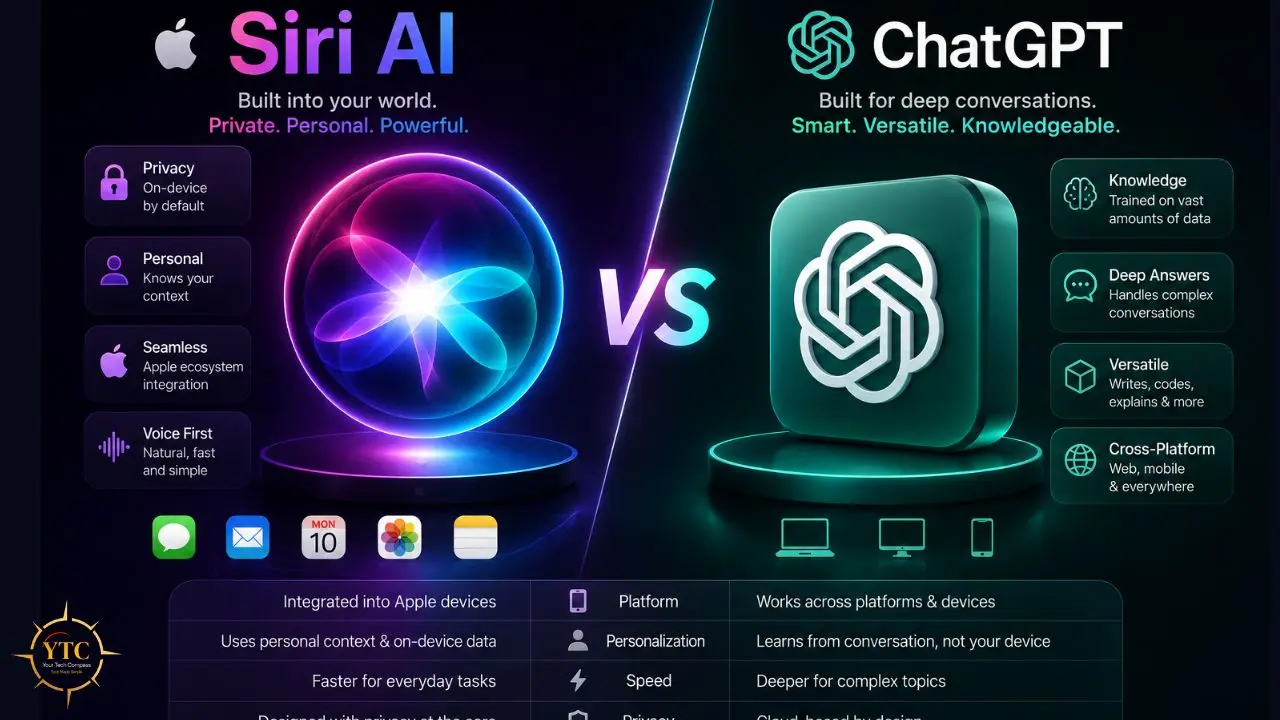
ChatGPT leads in complex reasoning, sustained multi-turn analysis, creative writing quality, and coding capability. Its conversation memory, plugin ecosystem, and general-purpose breadth make it the right tool for thinking-intensive tasks. Siri AI leads in on-device integration, personal context (your actual emails, messages, photos, calendar), privacy architecture, and zero setup for iPhone users. Siri’s hands-free voice interaction while driving, exercising, or working without a screen available is a practical workflow advantage that ChatGPT’s app doesn’t match.
The Honest Bottom Line: These tools complement each other more than they compete. Siri for “do this on my device with my data.” ChatGPT for “help me think through, write, or analyze something.”
For users tracking the broader ChatGPT landscape and its evolution, our AI Unboxed section covers the latest developments in frontier models.
Siri AI vs. Google Gemini
This comparison has become genuinely interesting, given that Gemini now powers the foundation model behind Siri AI. Apple currently partners with OpenAI to integrate ChatGPT into Siri and Apple Intelligence for complex queries, and it’s unclear what the Google partnership means for the future integration of ChatGPT. The relationship among Siri, Gemini, and ChatGPT is actively evolving. Apple has confirmed it isn’t immediately changing the ChatGPT arrangement, but has not outlined the long-term model.
Gemini, accessible directly via the Gemini app or API, offers the full set of Gemini Pro capabilities, including a 94.3% GPQA Diamond score, a 1M-token context window, and native Google ecosystem integration. Siri AI uses a customized Gemini model routed through Apple’s privacy architecture, giving you frontier reasoning with Apple’s privacy guarantees, but not necessarily the full Gemini Pro experience.
Additionally, Siri leads in Apple device integration, on-device privacy, and access to personal data. On the other hand, Gemini leads in raw reasoning capability, integration with the Google ecosystem, and real-time search grounding.
Siri AI vs. Open-Source Alternatives
For developers and technically sophisticated users, open-source models like those covered in our Qwen 3 review, DeepSeek V4 review, and GLM-4.7 Zhipu AI review represent the self-hosted, zero-cost-at-inference alternative to cloud AI. These models don’t provide Siri’s device integration or personal context capabilities, but they offer full data sovereignty, zero per-token cost, and complete architectural control that no Apple or Google product can match.
For African developers and professionals in markets where API cost efficiency is a primary constraint, as documented in the AI in Africa coverage, open-source models and Siri’s on-device processing represent two paths to frontier-adjacent AI capability without ongoing per-query cloud costs.
Full Head-to-Head Comparison

Feature | Siri AI (iOS 27) | ChatGPT (GPT-5.x) | Gemini (Direct) | Open-Source (e.g., Qwen3) |
Device Integration | ✅ Native Apple | ❌ App only | ⚠️ Android-native | ❌ No native integration |
Personal Data Access | ✅ Email, Messages, Photos, Calendar | ❌ No | ⚠️ Google services only | ❌ No |
On-Device Processing | ✅ Full on-device option | ❌ Cloud only | ❌ Cloud only | ✅ Full self-host |
Privacy Architecture | ✅ On-device + Private Cloud Compute | ⚠️ OpenAI cloud | ⚠️ Google Cloud | ✅ Full data sovereignty |
Complex Reasoning | ⚠️ Gemini-powered (good) | ✅ GPT-5.x | ✅ Gemini Pro | ✅ Frontier class |
Conversation History | ✅ Persistent across devices | ✅ Yes | ✅ Yes | ❌ Session-only |
Voice Interaction | ✅ Best-in-class | ⚠️ App-based | ⚠️ App-based | ❌ Requires setup |
API Cost | Zero (bundled with Apple) | $20+/month | $19.99/month | Free (self-hosted) |
Real-Time Search | ✅ Via Gemini | ✅ Web search | ✅ Native Google | ❌ RAG required |
Best For | Device tasks + personal context | Reasoning + writing | Research + Google ecosystem | Developers + self-hosting |
Privacy: Apple’s Strongest and Least-Marketed Differentiator
The question of AI assistant privacy matters more than most users consciously consider. An AI assistant that reads your emails, messages, and calendar is accessing the most sensitive data on any device you own. Every request sent to a cloud AI assistant is transmitted to the provider’s servers, where it is processed in accordance with that provider’s data-handling policies.
Apple’s on-device processing architecture means that for personal context queries like “what did my doctor’s office email me?” or “what is Sarah’s phone number?” nothing leaves your iPhone. The on-device model processes your sensitive personal data without contacting a server. No Apple employee has access to what’s processed locally.
For more complex tasks routed to Private Cloud Compute, Apple’s security commitments are more verifiable than typical cloud AI privacy policies. The architecture is genuinely different from a plain ChatGPT app.
The code running on Private Cloud Compute nodes is publicly verifiable by independent security researchers, a transparency commitment that neither OpenAI nor Google matches for equivalent infrastructure. Furthermore, Apple has stated that data processed in Private Cloud Compute is not used to train Apple’s AI models, a meaningful commitment given that both OpenAI and Google’s default policies allow the use of interactions for training unless explicitly opted out.
When Siri routes a request to the custom Gemini model, you’re told. The routing is transparent, not hidden. You can understand what’s leaving your device and where it’s going, which is the starting point for any honest evaluation of AI privacy claims.
Siri AI on Different Apple Devices: What Changes by Platform
Siri’s capabilities vary meaningfully by device. The full Siri AI experience requires specific hardware, and knowing which features are available on which devices prevents frustration.
iPhone (iOS 27)
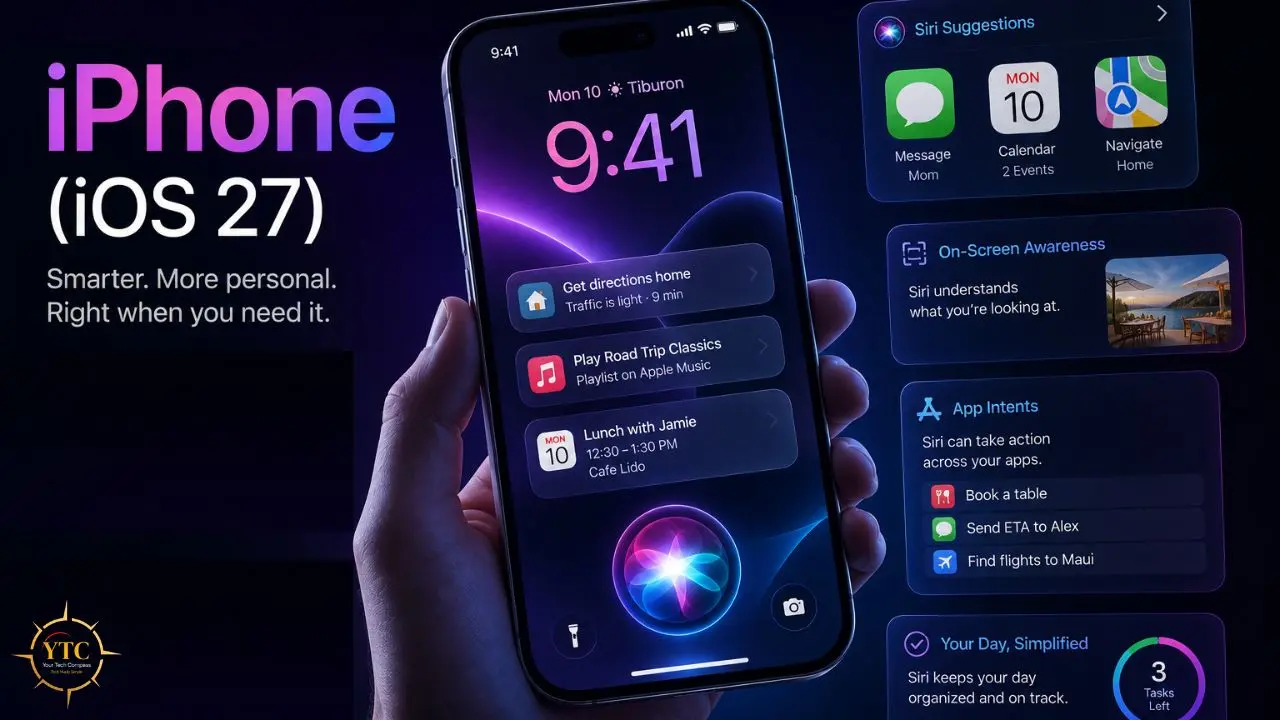
Full Siri AI feature set. Requires iPhone 15 Pro or later for on-device processing; iPhone 16 and 17 series have the strongest on-device performance due to A18 and A19 chip Neural Engine improvements. Cross-app personal context, full writing tools, notification summaries, ChatGPT and Gemini routing, and the new persistent Siri conversation history are all available on compatible hardware.
For performance context on current iPhone hardware, our MacBook Pro M4 review details Apple Silicon’s neural processing capabilities.
iPad (iPadOS 27)
Full Apple Intelligence features on M1-chip iPads and later. Same Siri AI capabilities as iPhone, with the larger screen providing additional context for writing tools and the full-screen conversational Siri interface.
Mac (macOS 27 Golden Gate)
Full Apple Intelligence on M-series Macs. Siri is accessible via keyboard shortcut and voice, with integration across all macOS productivity apps: Mail, Calendar, Notes, Finder, and Safari.
Writing Tools available system-wide across every text field. For Mac users experiencing performance issues that affect the AI experience, our Time Machine backup issue guide covers a related Mac performance issue that Siri’s background processes can interact with.
Apple Watch (watchOS)
More limited: basic queries, timers, calls, and messages. Apple Watch chips don’t yet support on-device Apple Intelligence models. Routes to iPhone for processing mean Watch Siri depends on iPhone proximity and connection quality.
AirPods
Announce Notifications and Eyes Free mode. Increasingly useful for heads-up contextual awareness, particularly notification summaries while commuting, but doesn’t access the full Siri AI feature set.
CarPlay
Hands-free voice interaction for safe-to-use commands (navigation, music, messaging). Apple intentionally limits the full AI feature set in CarPlay for safety reasons. The goal is minimal cognitive demand while driving, not maximum AI capability.
What’s Coming Next: Apple’s Siri Roadmap
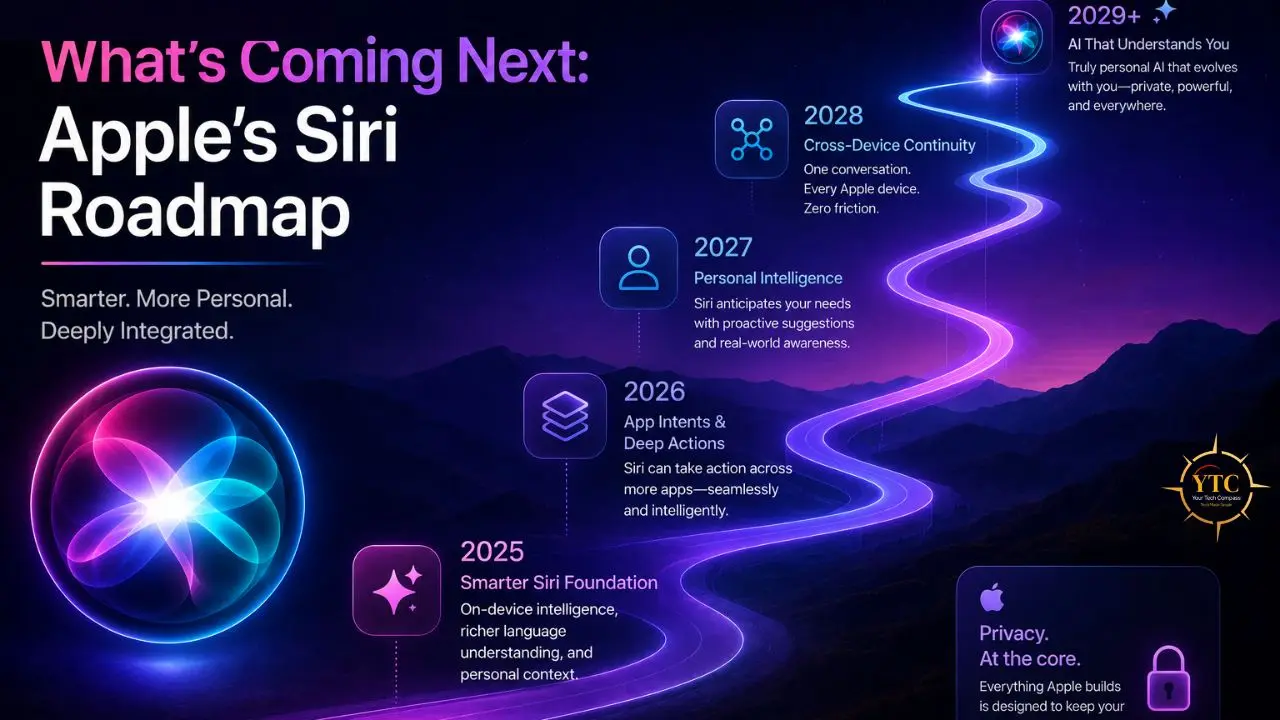
WWDC 2026, held on June 8, unveiled the fully redesigned Siri for iOS 27, which functions as a complete chatbot with web search, image generation, content summarization, coding assistance, file analysis, and multi-step command execution. Apple is also reportedly planning an Extensions marketplace for third-party AI integrations in iOS 27, creating a platform for developers to build on top of the Gemini-powered Siri infrastructure.
The Extensions marketplace is the development that could most significantly change Siri’s competitive position. If Apple opens the Siri AI infrastructure to third-party developers, allowing them to build specialized AI integrations that surface through Siri’s interface.
The assistant’s capability set expands at a pace no single company’s development team can match on its own. This mirrors the App Store model: Apple provides the platform and privacy infrastructure; developers provide the specialized capabilities.
The “Personal Siri” Vision
Apple has described a future Siri that understands your complete personal context, not just your current messages and calendar, but your history, preferences, relationships, and habits, maintained across years of interaction. This shift reflects Apple’s move toward positioning Siri as a persistent AI interface rather than a one-off assistant.
The persistent conversation history in iOS 27 forms the foundation of this vision. You can’t have a Siri that knows your history if no history is preserved.
The engineering challenge is doing this at scale while maintaining the on-device privacy commitment. The more personal context Siri retains, the more valuable it becomes, and the higher the privacy stakes. Apple’s bet is that the combination of on-device processing and Private Cloud Compute can deliver cloud-like AI personalization without exposing data.
Agentic Siri: The Multi-Step Horizon
Current Siri handles individual cross-app actions. The roadmap points toward multi-step autonomous workflows: “Plan my trip, book the hotel, add it to my calendar, and draft the out-of-office email” as a single autonomous chain of actions rather than four separate requests. This requires deeper App Intents coverage across third-party apps, significantly more capable on-device reasoning models, and reliable error handling when steps in the chain fail. Consequently, the agentic capability announced at WWDC 2026 is the beginning of this roadmap rather than its completion.
The Competitive Reckoning
The irony is that Siri’s original creator, Apple, is now licensing the core intelligence for its assistant from Google, which launched Google Assistant in 2016, in part as a competitive response to Siri. The Apple-Google partnership is a fascinating reversal and an honest acknowledgment by Apple that building frontier reasoning models from scratch, while competitors had years of head start and multiples of Apple’s AI research investment, was not a viable short-term path to a competitive assistant.
Apple has reportedly considered integrating AI models from Anthropic and Perplexity into its software and indicated it will likely add AI search providers to Safari, including Perplexity. This multi-model strategy (using the best available model for each task rather than building a single model that does everything) may be Apple’s most pragmatic and differentiated AI approach.
Rather than competing on which company has the best single AI model, Apple is competing on which company builds the best AI coordination layer atop the world’s best models, with the best privacy architecture. For those tracking how AI tools like the Oasis browser are building on similar multi-model principles for browser-level AI integration, the strategic parallels are instructive.
FAQs
Siri AI is Apple’s fully rebuilt AI assistant unveiled at WWDC 2026, powered by a new Apple Intelligence architecture that combines Apple’s on-device Foundation Models with a custom Google Gemini model coordinated by a system orchestrator. Simple, personal tasks are handled entirely on your device; nothing leaves your iPhone. More complex reasoning tasks route through Apple’s Private Cloud Compute or the Gemini model.
Apple Intelligence is the AI system; Siri AI is the interface you interact with. Apple Intelligence handles the routing, processing, and privacy architecture, deciding whether a request goes to the on-device model, Private Cloud Compute, or the Gemini foundation model. Siri AI is the conversational layer that receives your requests, presents responses, and maintains your conversation history. You interact with Siri; Apple Intelligence is what makes Siri capable.
Full Apple Intelligence and Siri AI require an iPhone 15 Pro or later, specifically devices with the A17 Pro chip or newer. The standard iPhone 15 and earlier models cannot run the on-device models. The iPhone 16 and 17 series support the full feature set and deliver the best performance.
Siri without Apple Intelligence is the 2023 version, a pipeline-based assistant capable of system commands, timers, calls, music, and simple factual queries, with limited ability to understand nuanced requests or access your personal data. In addition, Siri with Apple Intelligence (iOS 18.1 onward) adds personal context awareness, cross-app actions, writing tools, notification summaries, and routing to ChatGPT and Gemini. Siri AI in iOS 27 adds persistent conversation history, a full-screen conversational interface, significantly improved reasoning powered by Gemini, and a new Extensions marketplace for third-party integrations. The gap between 2023 Siri and 2026 Siri AI is the largest capability jump in the assistant’s fifteen-year history.
Conclusion
Siri AI in 2026 is not the best AI assistant by every benchmark, and it shouldn’t be evaluated that way. What it is, specifically and defensibly, is the best AI interface for acting on your personal Apple device data with a privacy architecture no cloud-native competitor can honestly claim to match. The persistent conversation history, on-device access to personal context that reads your emails and messages, cross-app action execution, and Gemini-powered reasoning that now handles the complex queries Siri previously passed to web search collectively represent the largest single capability improvement in Siri’s fifteen-year history. The writing tools were useful, the notification summaries were hit-or-miss, and the genuinely smart Siri Apple teased in 2024 never quite arrived. At WWDC 2026, that changed.
The honest caveats remain. The depth of third-party app integration depends entirely on developers’ adoption of App Intents, meaning the feature’s actual utility in your specific workflow depends on whether your most-used apps have implemented it. The Gemini partnership is a multi-year arrangement whose evolution, particularly regarding the future of the ChatGPT integration, hasn’t been fully disclosed. And the agentic multi-step workflows Apple demonstrated at WWDC are early-stage roadmap capabilities, not production-ready features ready for daily use. Furthermore, the multi-model strategy Apple is pursuing, coordinating the world’s best AI models through a privacy-first architecture rather than competing head-to-head on model quality, may be the most sustainable differentiation a hardware company can build in the AI era. Whether it fully delivers is the question this product’s next two years will answer.
Apple’s AI story is moving faster than any single article can capture, and the devices you use every day are becoming a genuinely different kind of computing platform. Visit YourTechCompass.com for ongoing coverage of Apple Intelligence, Siri AI updates, and the AI tools shaping how we work and communicate.