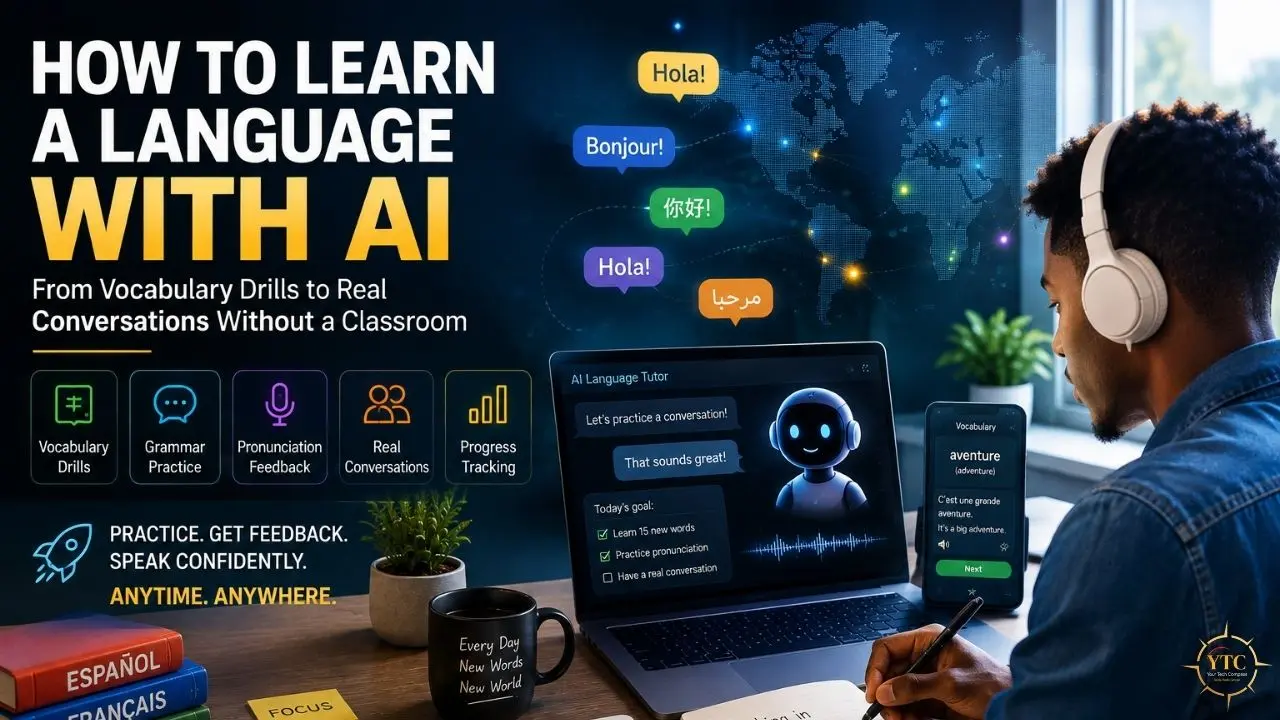
Every time you sit down to choose a language learning method, you face the same exhausting trade-off. You spent three years in high school Spanish and cannot order coffee. You bought a $500 Rosetta Stone package and abandoned it by week four. Or you hired a tutor, but scheduling conflicts killed the momentum. AI promised to fix this, and in 2026, it mostly delivers, but only if you know which tools build actual fluency and which ones just gamify procrastination.
This guide will show you exactly how to learn a language with AI. You will get the apps that structure daily practice, the conversational models that replace expensive tutors, and the immersive tools that turn Netflix into a language classroom. You will also get honest limitations: AI still hallucinates translations, most apps ignore African languages entirely, and no chatbot will correct your accent like a human will. By the end, you will know which tools match your budget, your target language, and the way your brain actually learns.
Quick Verdict
- Best For: Self-motivated learners who need flexible, affordable practice and are comfortable blending structured apps with conversational AI.
- Skip It If: You need formal certification, you are learning a low-resource African language with tonal complexity, or you require face-to-face cultural immersion.
- Bottom Line: AI can get you to conversational fluency faster and cheaper than traditional methods, but it works best as a supplement (not a replacement) for structured grammar study and human interaction.
What Is AI-Powered Language Learning?
AI-powered language learning is the shift from static flashcards and pre-recorded audio to adaptive algorithms, generative conversation, and real-time pronunciation feedback. Instead of repeating the same dialogue track fifty times, you now have tools that adjust difficulty based on your mistakes, generate infinite conversation scenarios, and score your pronunciation at the phoneme level.
The landscape breaks into three layers. Structured apps like Duolingo Max and Speak use AI to personalize lesson paths and simulate conversation. General conversational models like ChatGPT and Claude act as 24/7 language partners that never tire of your mistakes. Immersive tools like Language Reactor overlay AI-generated translations and vocabulary highlights onto Netflix, YouTube, and any webpage. Together, these layers create a learning stack that was impossible five years ago.
This sits in the broader ed-tech and AI landscape we track across our Tech Guides and AI Unboxed categories. If you are curious about how the underlying AI models compare, our reviews of ChatGPT 5.4 and Claude Opus 4.7 break down the engines powering these tutoring features.
How AI Language Learning Works: The Four Methods
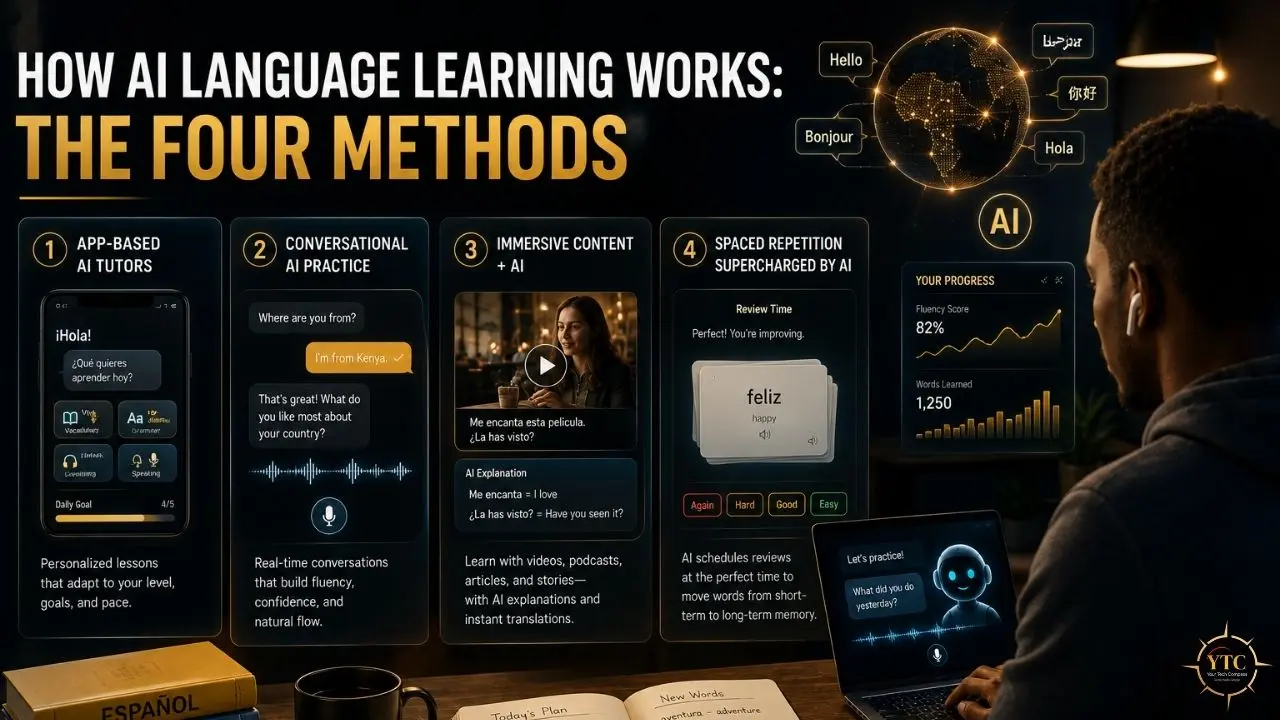
App-Based AI Tutors
Duolingo Max uses GPT-4 to power “Explain My Answer” and “Video Call” features. The app explains grammar mistakes in natural language and lets you hold video conversations with AI characters like Lily and Falstaff. As of January 2026, Explain My Answer became free for most major courses, leaving Video Call and Roleplay as the primary paid differentiators.
Speak takes a different approach. It is built around conversation-first learning: you watch a short video, immediately repeat phrases aloud, and then practice in AI role-play scenarios. The app analyzes your speech for pronunciation, grammar, and fluency issues in real time. ELSA Speak narrows the focus even further to pronunciation, using neural networks to identify which phonemes you are mispronouncing and drilling them until they stick.
Conversational AI Practice
ChatGPT, Claude, and Gemini are among the most accessible language tutors on the planet. They are free or cheap, available at 2 a.m., and collectively support well over 80 languages. You can prompt them to correct your mistakes, role-play a job interview, explain grammar rules like you are ten, or generate custom vocabulary lists for your profession.
The zero-cost advantage is real. ChatGPT’s basic voice mode is free for all users, and even Advanced Voice is available in limited daily amounts on the free tier. Advanced Voice Mode, which offers more natural turn-taking and interruption handling, is included in much larger quotas with ChatGPT Plus at $20 per month. For text-based practice, the free tier of any major model is sufficient for most learners, though heavy daily use may hit rate limits.
But here is the catch: these models are generalists, not teachers. They do not track your progress. They do not maintain a curriculum. In addition, they rarely correct your pronunciation because they cannot hear you in text mode, and even in voice mode, their feedback is polite encouragement rather than surgical correction. As our guide on fact-checking AI responses explains, AI confidently generates incorrect information, including translations, idioms, and grammar explanations in less common languages.
Immersive Content + AI
Language Reactor is a browser extension that overlays dual subtitles, vocabulary highlighting, and instant translations onto Netflix and YouTube. You watch content in your target language, click any word for a definition, and save words to a personal list. It turns passive entertainment into active study.
AI-generated podcasts and graded readers are also emerging. Tools like ElevenLabs and NotebookLM can generate audio content at your exact proficiency level, narrated by synthetic voices, on topics you actually care about. The quality is not yet indistinguishable from that of native speakers, but for intermediate learners needing comprehensible input, it is genuinely useful.
Spaced Repetition Supercharged by AI
Memrise uses AI to generate mnemonic images and contextual sentences for vocabulary. Anki, the open-source spaced repetition standard, can be supercharged by having ChatGPT generate custom decks for niche vocabulary (medical terminology, legal phrases, or regional slang that no commercial app covers).
Spaced repetition still works because the science is sound. AI simply removes the friction of content creation. Instead of manually typing flashcards, you paste a word list into ChatGPT and get a formatted Anki deck in thirty seconds.
Standout Tools (and the Honest Limitations Behind Them)
Duolingo Max: Structured but Shallow
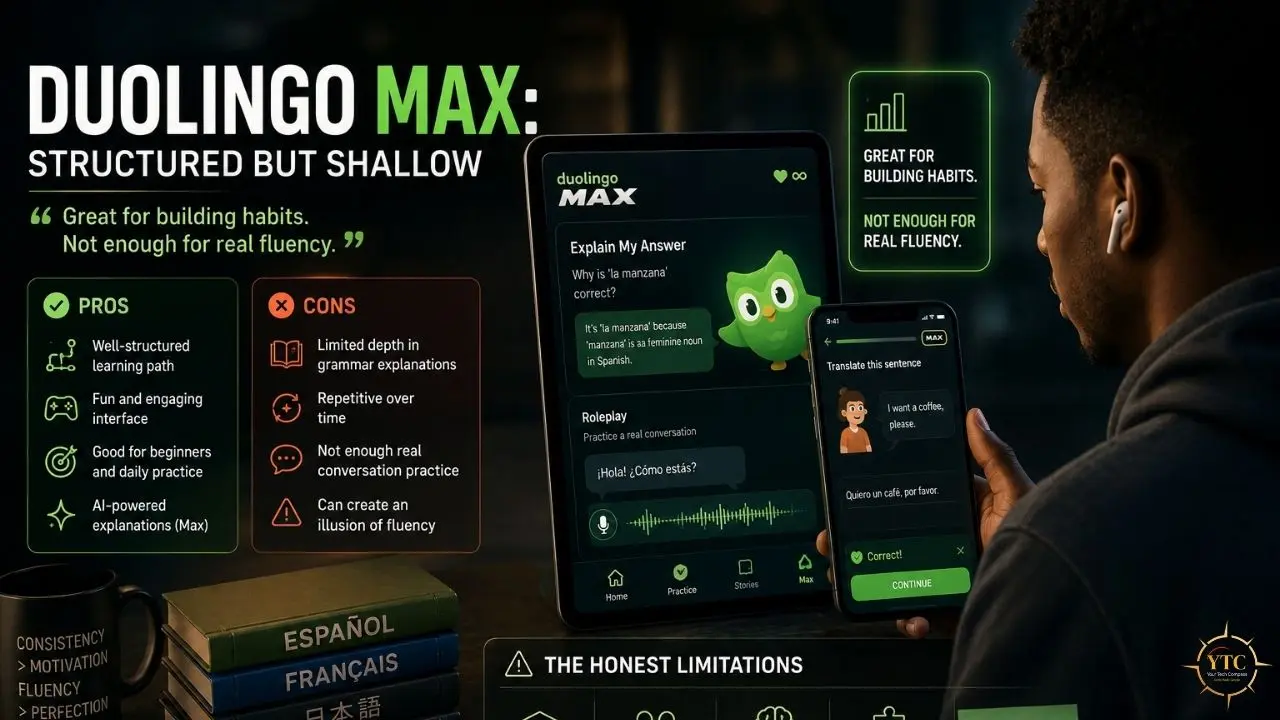
Duolingo Max adds AI conversation features to the familiar gamified path. Video Call lets you talk with Lily in simulated scenarios. Roleplay drops you into situations like ordering coffee or buying train tickets. The polish is undeniable. Duolingo has over 500 million registered users for a reason.
But the limitation is structural. Duolingo teaches you to pass levels, not to hold a conversation. The AI features are premium-priced add-ons on top of an already freemium model. At $168 per year or $29.99 per month, Max is expensive for what is essentially guided small talk wrapped in a game. In my opinion, if you already love Duolingo’s streak mechanics, Max is a logical upgrade. If you are serious about fluency, you will outgrow it within months.
Speak: Conversation-First, Language-Limited
Speak is the most polished conversation trainer in the category. Its lesson loop (watch, repeat, roleplay) forces more spoken sentences per session than any competitor. The speech feedback is real, not simulated, and the curriculum has genuine progression.
The limitation is scope. Speak is heavily optimized for English learners and a handful of Asian languages (primarily Korean and Japanese, with some support for Chinese). African language support is minimal to nonexistent. At around $17.99 per month or $84–$99 per year for Premium (plus a higher Premium Plus tier), it is also priced for Western markets. For a learner in Lagos or Nairobi, that subscription represents a meaningful expense.
ELSA Speak: Pronunciation Precision
ELSA Speak drills pronunciation at the phoneme level. It tells you exactly which sounds you are missing, whether it is the difference between /iː/ and /ɪ/, or why your “th” sounds like a “d.” For learners who can hold a conversation but are repeatedly asked to repeat themselves, this precision is unmatched.
The limitation is narrowness. ELSA focuses on accent reduction, not general fluency. It requires consistent broadband for audio processing, and its pricing varies by region; published rates range from roughly $74.99 to $159.99 annually, depending on your market and the timing of promotions.
ChatGPT / Claude / Gemini: The Infinite Tutor
These models are the most flexible language practice tools available. You can practice at 2 a.m., switch languages mid-conversation, and generate an infinite number of custom exercises. ChatGPT’s Advanced Voice Mode, available on the $20-per-month Plus plan, handles spoken dialogue with natural turn-taking.
The limitations are significant. There is no structured curriculum. You must know what to ask. The models cannot reliably correct pronunciation. They hallucinate translations for low-resource languages. And they have no memory of your long-term progress unless you manually manage con
text windows. In my experience, these tools work best as conversation partners for intermediate learners who already know what to practice, not as primary teachers for beginners.
Compared to a human tutor right now: AI tutors are available at 2 a.m., cost a fraction of the price, and never judge your mistakes. However, they cannot read your frustration, intuitively adapt to your learning pace, or teach cultural nuance. For structured grammar and accountability, a human still wins. For practice volume, AI wins decisively.
What AI Language Learning Actually Costs
The Free Tier Reality
Duolingo’s free tier gives you full course access but limits daily practice through an energy system, approximately 15 to 20 minutes before you hit the wall. ChatGPT and Claude offer free text-based conversation practice with reasonable daily limits. Language Reactor’s basic dual-subtitle and lookup features are free, though machine translation and unlimited vocabulary tools require Pro. YouTube with AI-generated transcripts is free.
For a committed beginner, this free stack is genuinely sufficient for the first three to six months. You do not need to spend money to start.
Paid Tiers
Duolingo Max runs approximately $168 per year or $29.99 per month. Speak Premium costs around $17.99 per month or $84–$99 per year, depending on region and promotions. ELSA Premium pricing varies by region but typically ranges from $75 to $160 annually. ChatGPT Plus, which unlocks much higher Advanced Voice quotas and higher usage limits, costs $20 per month.
💳 AI Language Learning Costs at a Glance
Tool | Monthly Cost | Annual Cost | What You Get | Best For |
Duolingo (Free) | $0 | $0 | Basic lessons, energy limits, ads | Casual beginners |
Duolingo Max | ~$30/mo | ~$168/yr | AI Video Call, Roleplay, Explain My Answer, no ads, unlimited hearts | Gamified learners |
Speak Premium | ~$18/mo | ~$84–99/yr | Conversation curriculum, speech feedback | Speaking-focused learners |
ELSA Premium | ~$11–13/mo | ~$75–160/yr | Phoneme-level pronunciation drilling | Accent reduction |
ChatGPT Plus | ~$20/mo | ~$240/yr | Much higher Advanced Voice quotas, higher message limits, and advanced features | Self-directed practice |
Human Tutor (iTalki) | ~$5–40/hr | Variable | Live conversation, cultural context, accountability | Serious learners |
Prices verified as of mid-2026; regional variations apply. Always check current in-app pricing before subscribing.
The Real Cost Math
One hour of tutoring per week typically costs $40–$100 per month, depending on tutor level and language. One AI app subscription costs $12–$30 per month. The break-even point is simple: if you practice daily for twenty minutes, AI delivers more total practice hours per dollar than tutoring.
But the hidden cost is app stacking. Subscribing to Duolingo Max, Speak Premium, and ChatGPT Plus simultaneously costs roughly $65–$80 per month, approaching the cost of light tutoring without the human accountability. In my opinion, the smartest approach is to pick one structured app and one conversational tool, not five.
Honest Limitations of the AI Language Learning Approach
- Hallucination risk is real. AI models confidently generate incorrect translations, especially for idioms, proverbs, and low-resource languages. I have seen ChatGPT translate a Yoruba proverb into grammatically correct but culturally meaningless English. If you are learning a language for professional or legal purposes, verify every critical translation with a native speaker.
- No pronunciation feedback from text models is a hard ceiling. ChatGPT and Claude cannot hear you. You can practice output, but you won’t receive correction on tone, pitch, or accent. Even voice mode offers only surface-level feedback. For tonal languages like Mandarin, Yoruba, or Thai, this gap is disqualifying without a supplementary tool.
- Cultural blindness is another friction point. AI teaches textbook grammar, not street slang, social registers, or the unspoken rules of politeness. It will not tell you when a phrase is technically correct but socially awkward. That nuance comes from human interaction.
- Motivation decay persists despite gamification. Apps track streaks, but without a human teacher or exam deadline, dropout rates remain high. The tools are only as good as the consistency you bring to them.
- Low-resource language gaps are the most significant limitation for African learners. Swahili, Yoruba, Zulu, Amharic, and Hausa receive minimal support in most AI language apps. Duolingo offers Swahili and Zulu but without Max AI features. ChatGPT handles Swahili reasonably well but struggles with tonal languages, proverbs, and regional dialects. For African language preservation and learning, the infrastructure gap is real.
Compared to traditional classroom learning: AI is faster for vocabulary acquisition and repetitive practice. Classrooms are better for structured grammar progression, peer pressure, and certified assessment. Most effective learners combine both.
How to Learn a Language With AI: A Practical Weekly Framework
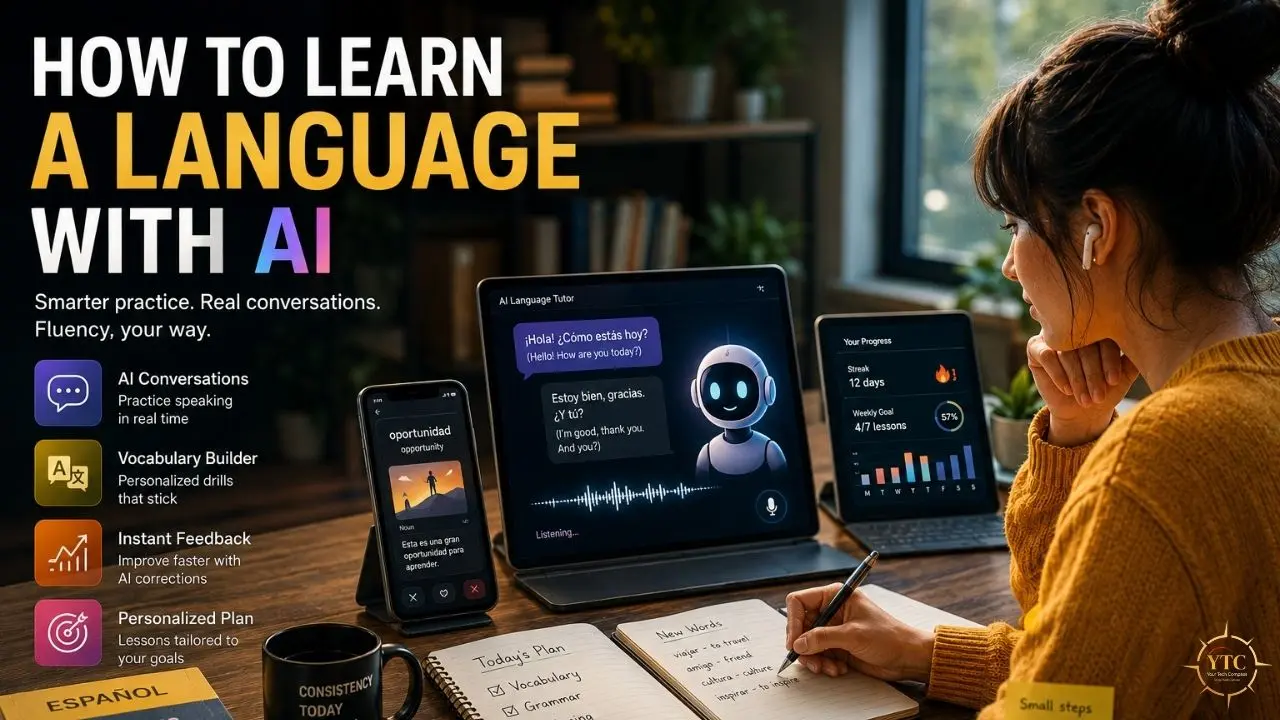
- Monday, Wednesday, Friday: Structured app practice for twenty minutes. Use Duolingo Max or Busuu to build a foundation in grammar and vocabulary.
- Tuesday, Thursday: Conversational AI practice for fifteen minutes. Use ChatGPT Advanced Voice Mode or Speak for spoken output. Focus on one scenario per session: ordering food, asking directions, discussing work.
- Saturday: Immersive content for thirty minutes. Watch Netflix with Language Reactor overlays, or listen to an AI-generated podcast at your level. Note ten new words and add them to Anki.
- Sunday: Review and custom deck generation. Export your week’s mistakes from your structured app, feed them to ChatGPT, and generate targeted flashcards. Review for fifteen minutes.
- Monthly: One human tutor session via iTalki or a local teacher. Use this for accountability, pronunciation correction, and cultural questions that AI cannot answer.
Real-World Use Cases
- Remote workers relocating abroad use daily AI conversation practice to reach workplace fluency before the move. ChatGPT roleplay simulates meetings, client calls, and casual office small talk.
- Students preparing for exams use AI-generated practice tests and grammar drills tailored to weak areas. ChatGPT can create DELE, JLPT, or DELF-style questions on demand.
- Diaspora reconnecting with heritage languages uses ChatGPT to learn Yoruba, Igbo, or Swahili phrases for family communication. The model handles basic phrases well, though proverbs and deep cultural references remain a challenge.
- Business travelers use Speak or ELSA to rapidly improve pronunciation before client meetings. Fifteen minutes daily for two weeks yields noticeable gains in clarity.
- Polyglots maintaining multiple languages rotate daily practice across languages using a single ChatGPT Plus subscription. One day Spanish, the next French, the next Japanese, no separate app purchases required.
Who Should Use AI for Language Learning
- Self-motivated learners with inconsistent schedules who cannot commit to fixed class times.
- Budget-conscious students who cannot afford hourly tutoring.
- Professionals needing targeted business vocabulary quickly.
- Introverts who freeze in live conversation and need low-stakes practice.
- Travelers preparing for short-term trips who need survival phrases fast.
Who Shouldn’t Use AI for Language Learning
- Learners pursuing formal certification where exam-specific preparation is non-negotiable.
- Students of low-resource African languages are poorly supported by current AI tools.
- People who need external accountability to maintain consistency.
- Learners requiring deep cultural immersion and regional dialect training.
- Anyone with unreliable internet access, since most AI language tools are cloud-dependent.
An Honest Note on the Review Landscape
App Store ratings for Duolingo Max praise the AI explanations but criticize aggressive monetization and the 2025 energy system overhaul, which limits free practice. Reddit language-learning communities consistently recommend “ChatGPT plus Anki” over premium app subscriptions for serious learners. The gap between “completed Duolingo tree” and “can hold a conversation” remains wide, and most users underestimate it.
Speak and ELSA receive strong reviews for their specific niches, but are not general-purpose solutions. The most common sentiment among advanced learners is that AI tools accelerate the middle phase of language learning (between beginner and intermediate) but do not replace the final push to fluency, which requires human interaction.
AI Language Learning in Africa: Accessibility and Practical Realities
Language Support Gaps
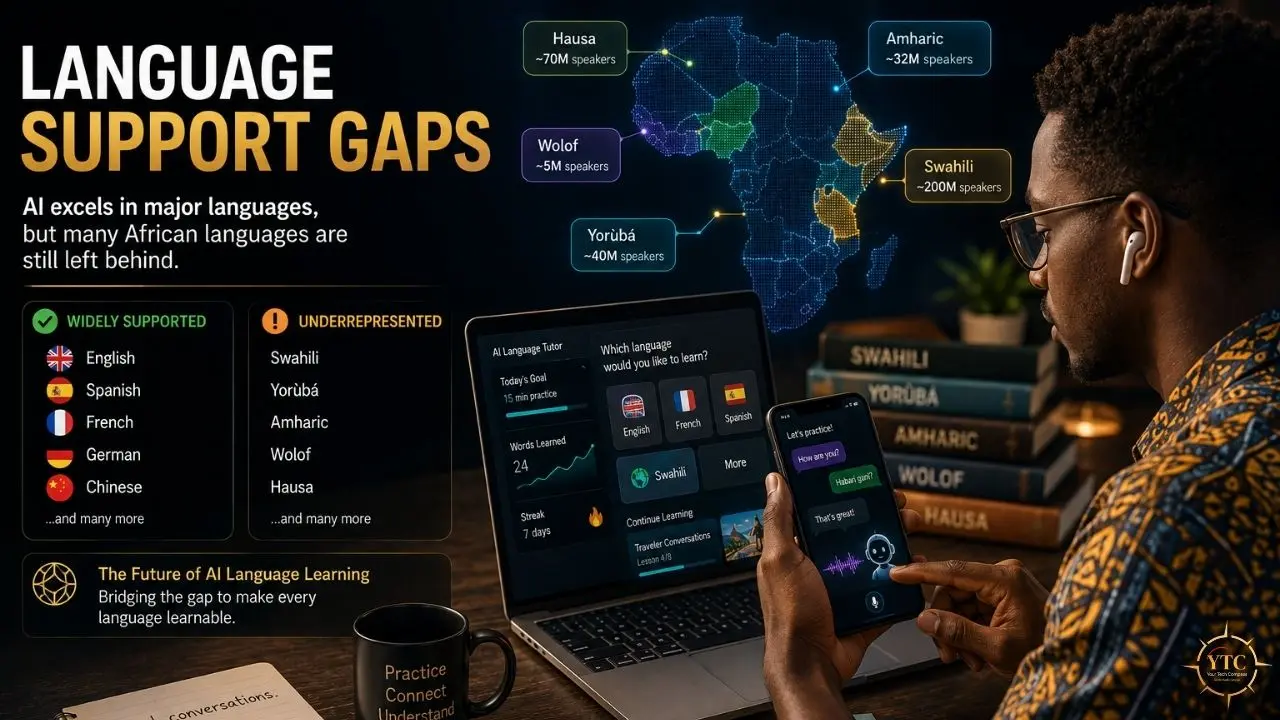
Duolingo offers Swahili and Zulu but without Max AI features. ChatGPT handles Swahili reasonably well but struggles with tonal languages, proverbs, and regional dialects. Yoruba, Igbo, Amharic, and Hausa are effectively unsupported by most commercial AI language apps.
The broader context of African language technology is something we track across our AI in Africa coverage. Local NLP initiatives are building models for African languages, but consumer-grade apps lag by years in supporting European and Asian languages.
Connectivity and Data Costs
Audio-heavy apps like Speak and ELSA require a stable broadband connection and consume significant amounts of data. A thirty-minute speaking session can use 100 to 200 megabytes. On metered data plans, that adds up quickly. ChatGPT’s text-based practice is lighter but still requires a stable connection. Offline functionality is minimal across the board; most AI features require cloud processing.
Pricing in African Market Context
Duolingo Max at $168 per year converts to roughly 250,000 Nigerian naira or 22,000 Kenyan shillings. Speaking at $84 per year is roughly 125,000 naira or 11,000 shillings. ChatGPT Plus at $20 per month is roughly 30,000 naira or 2,600 shillings monthly. For students and young professionals, these are meaningful expenses.
The free tiers of Duolingo and ChatGPT are genuinely viable entry points for budget learners. I believe most African learners should start there and only upgrade when consistent daily practice justifies the cost.
Diaspora and Practical Workarounds
African diaspora learners in Europe and North America benefit from full app availability and stronger internet. For learners on the continent, practical workarounds include using the free tier to generate vocabulary lists and practice dialogues, then reviewing offline with handwritten notes or downloaded Anki decks. Community-driven AI models for African languages are emerging but not yet consumer-ready.
FAQs
No. AI can get you to a conversational intermediate level efficiently. True fluency (nuanced expression, cultural appropriateness, and spontaneous production in high-stakes situations) requires human interaction, immersion, and time that no app can compress.
They serve different purposes. Duolingo is structured and gamified, excellent for beginners building vocabulary and habits. ChatGPT excels at conversational practice and personalized feedback for intermediate learners. Most effective learners use both.
Speak is the strongest for a structured conversation curriculum with real speech feedback. ELSA Speak is best for pronunciation drilling. ChatGPT Advanced Voice Mode is best for free-form, open-ended dialogue. Choose based on whether your bottleneck is conversation stamina, accent clarity, or the volume of unstructured practice.
Between $0 and $30 per month for most learners. The free tiers of Duolingo and ChatGPT handle beginner needs. Paid tiers range from $11 per month for ELSA to $30 per month for Duolingo Max. Human tutoring costs $10 to $25 per hour.
Partially. ChatGPT handles basic Swahili phrases and grammar. Duolingo offers Swahili and Zulu without AI features. Yoruba, Igbo, Amharic, and Hausa are poorly supported by most commercial apps. For these languages, human tutors and community resources remain essential.
Use AI for daily practice volume (vocabulary, conversation drills, and comprehension). However, use human teachers for weekly accountability, pronunciation correction, and cultural nuance. Use formal classes or textbooks for a structured progression in grammar. The combination is stronger than any single method alone.
Final Thoughts
AI has democratized language practice in ways that were impossible five years ago. A free Duolingo account and a ChatGPT subscription can provide more hours of conversation than a $500 traditional course. The personalization is real. The convenience is real. The cost savings are real. But AI is a force multiplier for motivated learners, not a substitute for discipline. The tools are only as good as the consistency you bring to them.
If you are learning Spanish for a vacation in Barcelona, AI is sufficient. If you are preparing for the JLPT N1 or trying to reconnect with Igbo heritage, you will need human teachers, community immersion, and patience that no algorithm can compress. Use AI for volume. Use humans for depth. And never trust a single AI translation with your job interview or your marriage proposal.
If this guide helped you build a language learning plan that actually fits your life, bookmark YourTechCompass.com before your next study session, because the best AI tutor in the world cannot replace a learner who shows up every day.