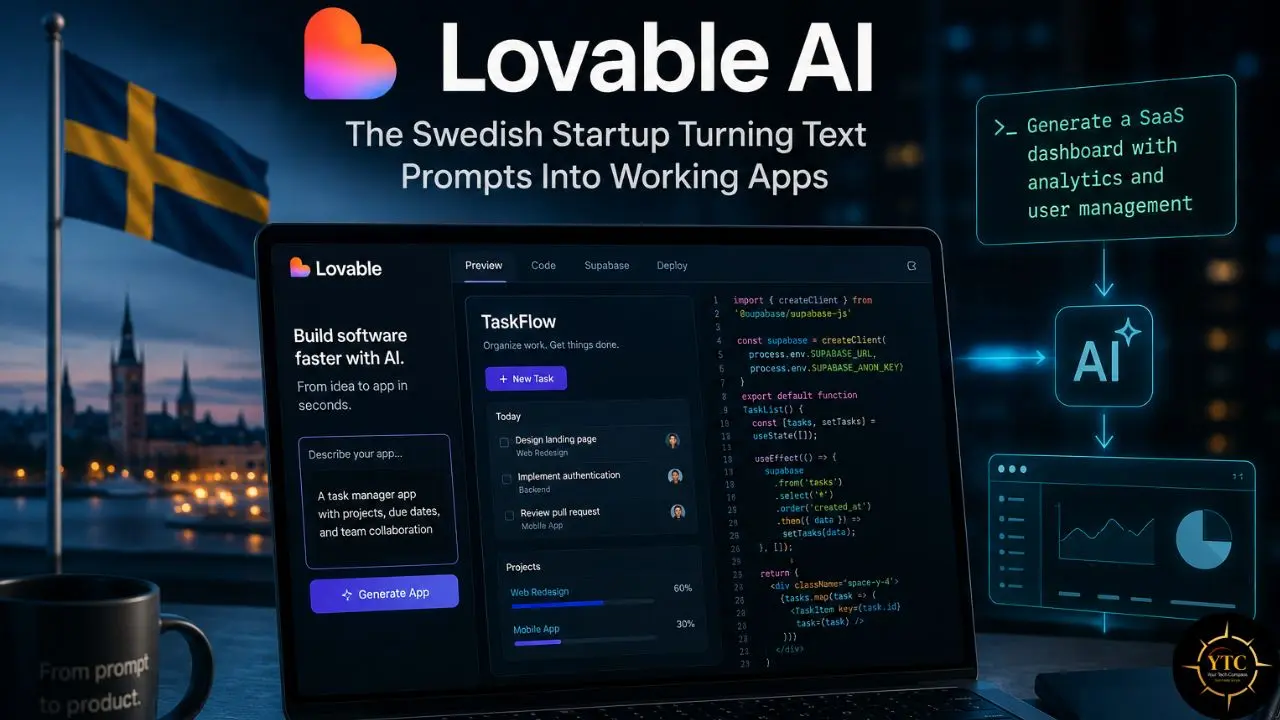
I want to start with a specific test I ran because it’s the kind of concrete demonstration that either makes this category of tool credible or exposes it as demo-ware. I typed this into Lovable’s prompt box: “Build me a loyalty points tracker for a coffee shop. Customers earn points per purchase, can see their balance, and redeem rewards. Include a login system and admin dashboard.” Within 90 seconds, Lovable generated a strong first version of an application with a customer-facing interface showing point balances, a reward redemption system, an admin panel for managing customers, and a Supabase-powered login system. The design looked polished with clean typography, a responsive layout, and a cohesive color scheme that would pass for a professional product. That’s the pitch, and it’s real. The more important question (the one that determines whether Lovable is a serious business tool or a very impressive demo) is what happens at minute 91, when you need to customize the logic, hit an edge case, or start thinking about what this app costs you at scale.
That’s the question this review answers. Lovable raised $330 million at a $6.6 billion valuation in December 2025 and later reported more than $200 million in ARR. With claims of 25 million projects created and 100,000 new projects launching daily, this is clearly resonating with people. However, a $6.6 billion valuation and real usefulness are two different things, and the gap between them is exactly where most tool reviews fail you. This guide covers what Lovable actually is, how the technical architecture works under the hood, what each tier realistically costs, the “80% problem” that every serious builder eventually hits, and which specific use cases the tool genuinely earns its subscription price for, versus where you should reach for something more capable.
A note before we begin: every YTC score is earned, never negotiated. If you want to understand exactly how we evaluate tools, our Review Methodology lays it all out.
What Is Lovable?
Lovable is an AI app builder. You describe an app in plain language (no writing code, no local environment setup), and it generates a full-stack web app using React, TypeScript, Tailwind CSS, and Supabase on the backend. That description is accurate as far as it goes, but it undersells the architectural completeness: the generated application includes working navigation, authentication flows, database connections, and deployment, not just a frontend UI that looks like an app but isn’t one.
The Company Behind the Product
Founded in 2023 by Anton Osika (a physics-trained engineer who worked at CERN) and Fabian Hedin, Lovable started as an open-source project called GPT Engineer that went viral on GitHub. GPT Engineer was a command-line tool that let developers describe a program and have the AI scaffold the initial codebase. What Lovable recognized was that the real market wasn’t developers who wanted to skip the first 30 minutes of setup; it was the enormous population of people with a clear product idea and no way to build it.
The rebranding to Lovable in late 2024 reflected that strategic pivot: away from developer tooling, toward a general “anyone can build an app” audience. The growth that followed is among the fastest in software history. As of mid-2026, it’s one of the leading browser-based AI app builders, competing with Bolt.new and Vercel’s v0 in the same market. Enterprise customers, including Zendesk, Deutsche Telekom, Klarna, and Uber, are now using the platform, a meaningful signal that the tool has moved beyond founder prototypes into production workflows.
The Vibe Coding Context

The term “vibe coding” was coined by AI researcher Andrej Karpathy in early 2025 to describe this new approach: instead of writing code line by line, you describe the vibe of what you want and let AI figure out the implementation. In November 2025, Collins Dictionary named it the word of the year. Lovable sits at the center of that cultural and technical shift, not as an AI assistant helping developers code faster, but as a tool designed for people who aren’t writing code at all.
AI app builders like Lovable, Bolt.new, Replit, and v0 create complete applications from conversation alone. AI code editors like Cursor, GitHub Copilot, and Windsurf require programming knowledge and provide code completion assistance as you work. This categorical distinction is important.
If you’re evaluating Lovable against tools like Cursor or GitHub Copilot, you’re comparing different categories. The right comparison is against Bolt.new and v0, which this review covers in detail below.
How Lovable Works: The Technical Architecture
Understanding what Lovable actually generates, and how, is the difference between using it effectively and running into avoidable walls.
The Generation Pipeline
Users can describe an app idea in plain language, and Lovable turns that into a working first-pass application. In common setups, it generates a React app scaffolded with Vite and styled with Tailwind CSS, while backend services such as authentication and data storage are often handled by Supabase or similar integrations.
The specific tech stack matters because it determines what you own after generation. Lovable isn’t producing a proprietary internal format that only runs on Lovable’s servers. It generates real React and TypeScript code (the same stack experienced developers use to build production web applications), meaning that a developer who later inherits the project will see familiar, standard code rather than an AI-specific format they’d need to learn.
Lovable recently added a Draw-to-Build interface that lets users sketch UI elements on the canvas and have the system generate app code from those inputs. It also offers an MCP-based Claude integration that allows users to build, iterate, deploy, and manage Lovable apps from Claude or Claude Code, which is useful for technically comfortable users who want to stay in their existing AI workflow while using Lovable’s deployment stack
The Supabase Integration: The Backend Layer
Lovable’s native Supabase integration gives you a production-ready backend without boilerplate code. Natural language prompts automatically configure user authentication, PostgreSQL database storage, file uploads, and server-side functions. The system generates database tables, storage configurations, and frontend components automatically when you ask to “Add user profiles where users can set a name, bio, and upload a profile picture.”
Lovable’s Supabase integration is a key difference from tools that only generate frontend UI. When a feature requires data persistence, Lovable can scaffold the database schema, connect it to the frontend, and set up authentication in a single workflow, reducing the need to configure these components separately. If your project is exported to your own GitHub repository and backend services are externalized through Supabase, you keep the code and can continue working even if Lovable changes direction, though you would lose the convenience of Lovable’s prompt-driven iteration.
Users who bring their own Supabase account (recommended for any production application) retain full control of their database independently of their Lovable subscription. Users who rely on Lovable’s managed backend option gain convenience at the cost of that independence.
Plan Mode vs. Build Mode
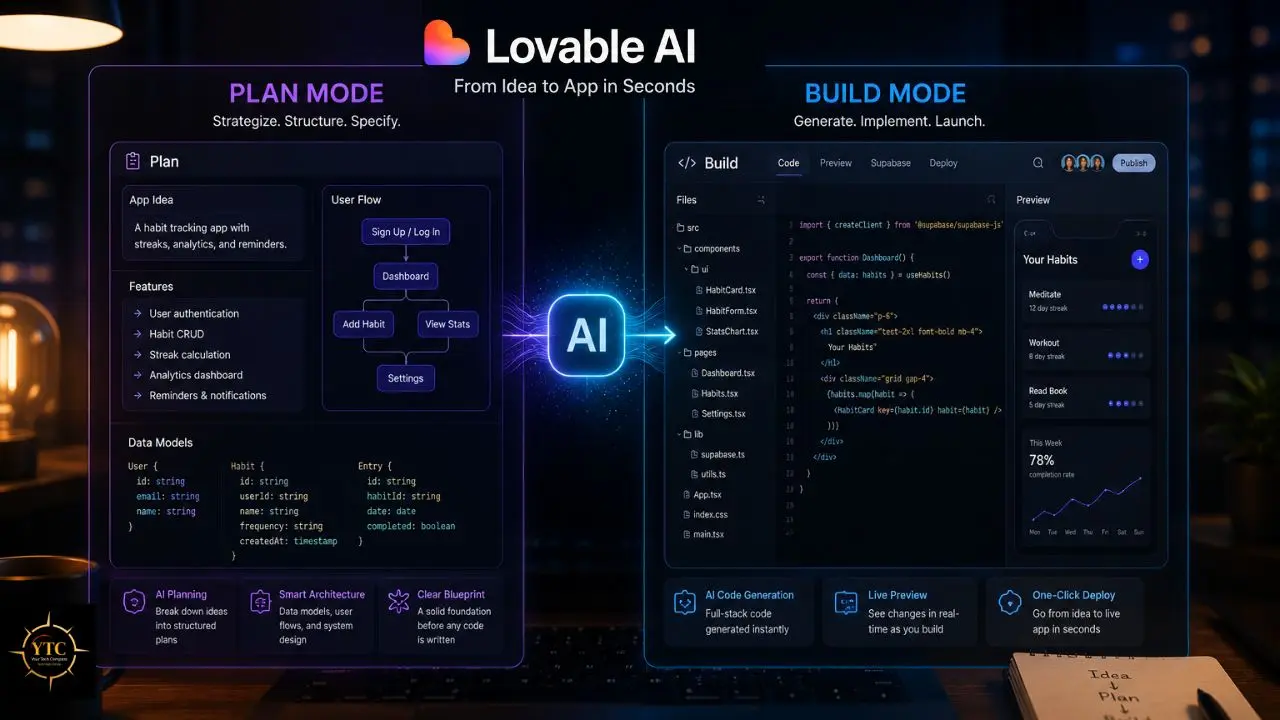
The reality has nuances worth understanding before you rely on it: how the Plan and Build modes differ, what the tool actually generates under the hood, and how its credit-based pricing really behaves.
Plan mode is a conversational scoping step: you describe your application, Lovable asks clarifying questions and proposes an architecture, and you approve the plan before any generation happens. This is genuinely useful for complex applications where jumping directly into code generation would likely require extensive re-generation as the scope becomes clearer. Build mode is the active generation phase: Lovable writes code, and you review diffs before they’re applied.
The Iterative Edit Loop
After the initial generation, the actual workflow has three layers. Default mode is pure AI prompts: describe a feature, and the AI writes it. The visual editor lets you make CSS-level design changes by clicking on elements directly, without writing a prompt or touching the underlying code.
The visual editor is the feature that reduces the most friction in daily use. Describing a small visual change in words, for instance, “move the button 8 pixels to the right and make it slightly more rounded,” is genuinely awkward through a text prompt.
The visual editor lets you click directly on the element and adjust it without cycling through the chat interface. However, for cosmetic changes, this compression of the iteration loop is more valuable than it sounds.
GitHub Sync and Code Ownership
One-click deployment, custom domains, and GitHub sync mean a Lovable project can be connected to a real repository early in the workflow. Engineers who want to skip boilerplate can then take over the code through GitHub, while Lovable handles the first-pass generation and ongoing sync. This substantially reduces lock-in, though the exact handoff still depends on how the project was configured.
This is the fundamental architectural difference from no-code platforms like Bubble or Webflow, where the application exists only within the platform’s proprietary runtime. With Lovable, GitHub sync gives you genuine, permanent code ownership regardless of what happens to your Lovable subscription.
Lovable Key Features
Full-Stack App Generation From Text
The core capability is to describe an application in plain English and quickly get a working full-stack web app back up and running, often including deployment and backend integration. The generated apps typically include navigation, responsive layouts, interactive elements, database connections, and authentication rather than static mockups. Lovable is often described as much faster than traditional coding, with some sources claiming speedups of up to 20x.
The range of application types that Lovable handles well includes landing pages, SaaS dashboards, internal admin tools, booking systems, content platforms, customer-facing portals, and e-commerce storefronts. Any application that follows reasonably standard UI patterns and data flows is a strong candidate for Lovable generation.
Lovable Cloud vs. Bring-Your-Own Supabase
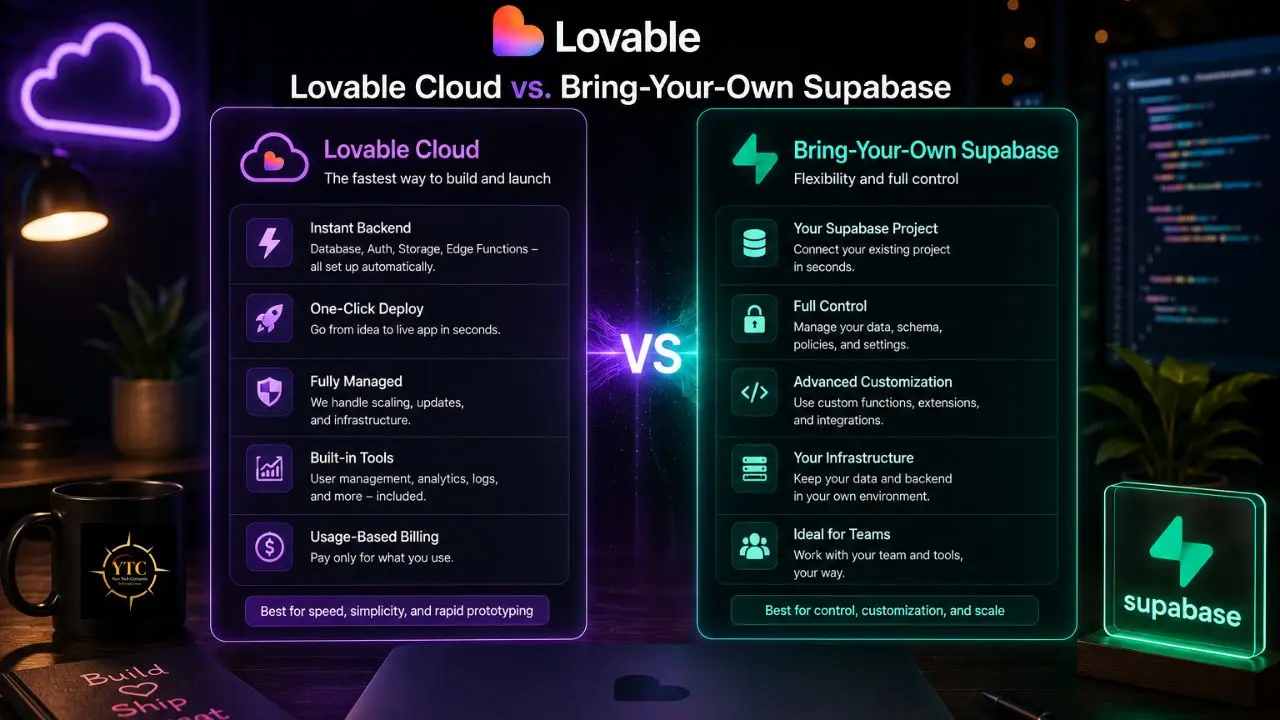
Lovable offers a managed backend option (Lovable Cloud) that handles database and auth without requiring users to configure an external Supabase account. This is the right choice for pure prototyping and evaluation. For any application with real users, real data, or a need to persist beyond a Lovable subscription, connecting your own Supabase project is strongly recommended; it gives you backend independence that Lovable Cloud doesn’t provide.
AI Chat-Based Editing
The daily workflow is a chat-based edit loop: describe the change, review the proposed diff, then accept it or ask for refinements. Pricing is credit-based, so each message incurs a usage charge based on complexity; the practical takeaway is that small edits are cheaper than larger feature changes.
Visual Editor and Draw Mode
The visual editor provides direct manipulation of layout, typography, colors, and copy without going through the prompt cycle. The newer Draw mode (sketch UI elements directly on the canvas, and AI converts them into production code) extends this to freehand UI design, which is particularly useful for designers who think visually rather than through text.
Stripe, Supabase, and Third-Party Integrations
Built-in Supabase database integration with authentication, payments (Stripe), and file storage. Beyond the core integrations, Lovable’s integration marketplace has expanded significantly since the 2024 launch, covering common SaaS requirements (email, analytics, payments) without requiring custom backend code. The Stripe integration enables payment-enabled applications without the need for separate payment backend development, a meaningful capability for founders building revenue-generating products.
Multiplayer Collaboration and Business Features
Real-time collaborative editing is available for teams working on the same project. Business and Enterprise add the governance layer for building at scale: team workspaces, role-based access, internal publishing, SSO, and a security center, plus SCIM and audit logs at the top end. These features extend Lovable from a solo-founder tool to an organizational platform, as reflected in enterprise customer traction with companies such as Zendesk and Klarna.
Google Cloud Partnership
Lovable’s expanded Google Cloud partnership adds Gemini model integration and enterprise-scale infrastructure support, reinforcing its position as a platform built for large-scale application development. Lovable also supports Gemini Enterprise connectors, which suggests a broader multi-model and multi-integration strategy.
Lovable Pricing: The Complete 2026 Picture
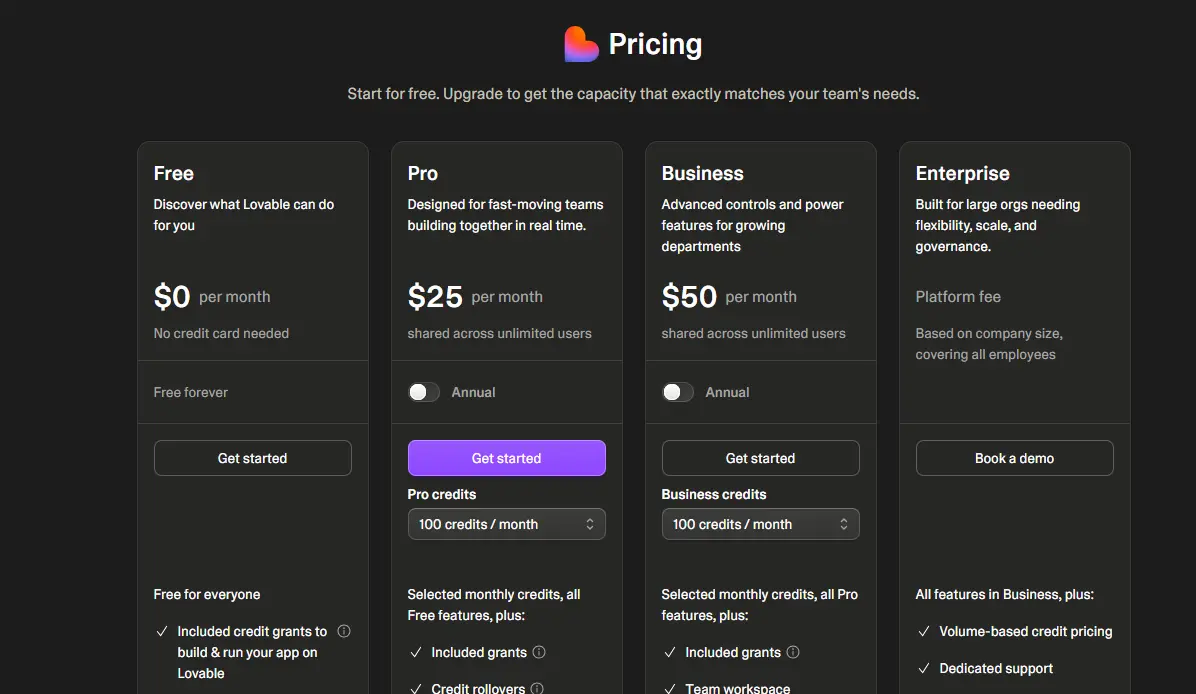
The headline pricing is straightforward. Credit consumption behavior is where real-world costs become more complex and where most first-time users encounter their first surprise.
Current Plan Tiers
Lovable has a free tier with 5 credits per day (up to 150 per month) for testing and prototypes. Paid plans start at $25/month for the Pro tier, which includes 100 credits.
Plan | Price | Credits | Key features |
Free | $0 | Limited monthly/daily credits | Public projects, basic generation, evaluation use |
Starter / Pro | ~$25/month | ~100/month | Private projects, custom domains, GitHub sync |
Business | ~$50/month | ~100/month | Higher usage limits, collaboration features |
Scale | Higher tier | 500+ credits/month | Team features, priority support |
Enterprise | Custom | High-volume / negotiated | SSO, SCIM, audit logs, enterprise security |
Always verify current pricing at lovable.dev/pricing before committing, as plans evolve.
The Credit System: The Most Important Thing to Understand
Credits are usage-based, and the cost of a request generally depends on the amount of code touched, the complexity of the task, the amount of context the agent needs to inspect, and which workflows or modes are used. Light edits may cost very little, while broader agentic tasks cost more. For billing-sensitive details, always check the current pricing documentation.
Monthly credits roll over on paid plans; daily credits reset and don’t carry forward. This is the distinction between the free tier and paid tiers that matters most for evaluation: if you’re actively building a project over multiple days, the free tier’s daily reset cap is genuinely limiting. The monthly rollover on paid plans better reflects how real building sessions work: intensive for a few days, then lighter review and refinement.
Heavy real-world use can quickly burn through lower-tier limits, especially when debugging loops trigger multiple rounds of revision. For that reason, users building beyond a simple prototype should budget for a higher tier than they first expect. Iterative fix-and-retry workflows often cost more than a single successful generation, so the practical advice is to plan conservatively.
The Hidden Cost: Supabase Usage
Supabase has its own pricing that applies separately from your Lovable subscription once you exceed its free tier limits. For production applications with real users and real data, budget for Supabase costs independently. The free Supabase tier is genuinely useful for prototypes; production scale requires their paid plans starting at $25/month.
Lovable vs. The Competition
Lovable vs. Bolt.new
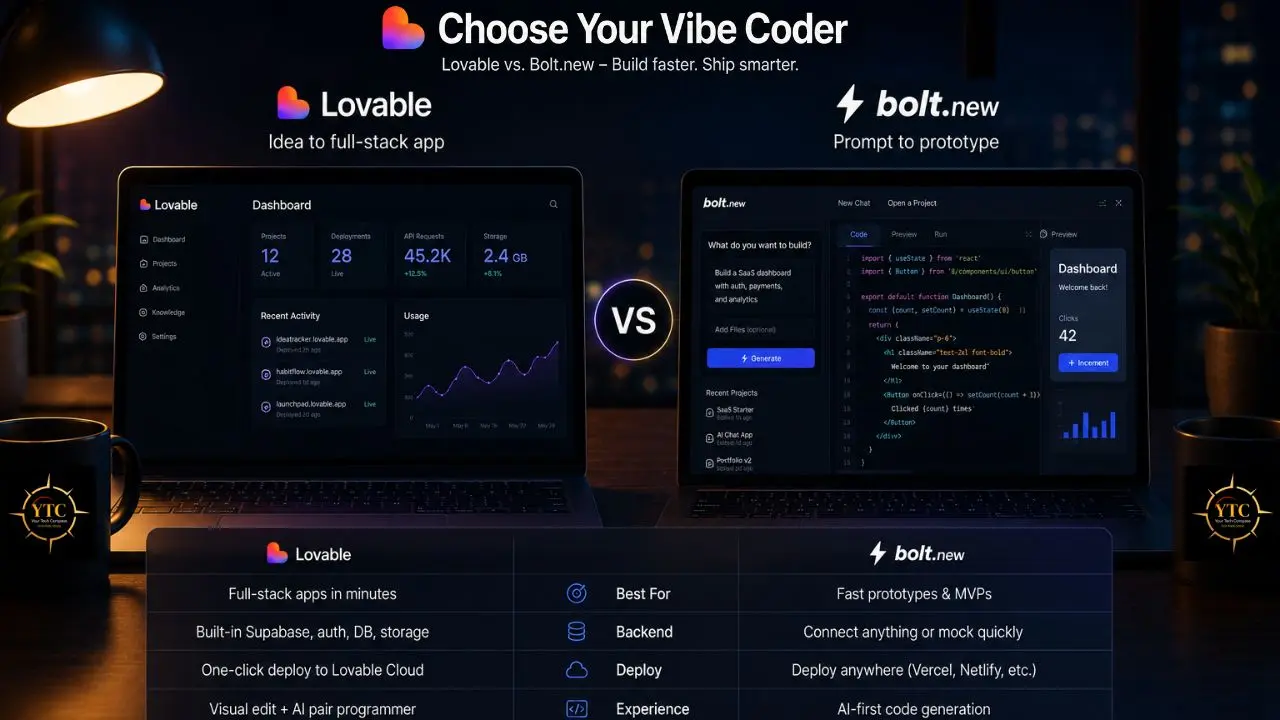
The Lovable vs Bolt comparison reveals fundamental differences in development philosophy. Bolt provides a browser-based IDE with direct code access and WebContainer technology, allowing developers to maintain full control while leveraging AI assistance. It excels at rapid prototyping with its “diffs” feature, enabling faster iterations. Lovable emphasizes conversational development, in which complex applications emerge from simple descriptions.
The practical differentiation I’ve consistently observed across independent reviews is that Lovable ships with a more polished default visual design out of the box and stronger Supabase-native backend integration. Bolt gives developers more direct access to code and greater flexibility with frameworks; it’s not limited to the React/Supabase stack that Lovable defaults to.
For a complete breakdown of what Bolt specifically offers, our Bolt AI review covers it in detail.
Lovable vs. v0 by Vercel
v0 is more narrowly focused on UI component generation within the Next.js/Vercel ecosystem, so it works especially well when you mainly need polished interfaces. The key difference is that v0 generally assumes a developer will integrate the generated components into an existing codebase, while Lovable is designed to support users who may not be developers at all.
For a comprehensive assessment of v0’s capabilities, our Vercel review provides an in-depth comparison.
Lovable vs. Replit Agent
Replit provides a broader cloud development environment, with Agent operating inside the Replit IDE and supporting more autonomous testing, longer sessions, and a wider range of project types. Lovable is more focused on prompt-to-web-app generation and tends to feel more streamlined for building browser-based apps. The trade-off is platform dependency: Replit offers a more complete environment, while Lovable offers a more specialized app-building flow.
Our Replit-explained guide covers Replit’s full environment and use cases in detail.
Lovable vs. Cursor
In the Cursor vs. Lovable comparison, Cursor enhances traditional coding workflows by providing intelligent AI assistance within a familiar IDE. It’s perfect for professional developers who want to maintain their existing practices while gaining AI superpowers.
But the comparison is only partly direct, because Lovable and Cursor serve different categories of work: Lovable is better suited to fast prototype generation, while Cursor is better suited to precision engineering inside an existing codebase. A practical workflow is to use Lovable for the first 80% of an app and Cursor for production hardening and refinement.
Our Cursor AI review covers what that “export to Cursor” step actually involves in practice.
Lovable vs. Traditional No-Code (Bubble, Webflow)
The fundamental difference between categories is code ownership and portability. Bubble and Webflow are proprietary platforms where applications run only within their runtime; your “app” doesn’t exist outside their systems. Lovable generates real, exportable code that lives in your GitHub repository regardless of your subscription status.
Bubble has more mature visual builders for highly complex business logic; Lovable is dramatically faster for initial generation. The right choice depends on whether you prioritize visual building depth, generation speed, or code portability.
Comparison Table

Tool | Output | Best Fit | Backend Style | Code Ownership | Typical Entry Price |
Lovable | Full-stack web app | Non-developers, MVP founders | Supabase-native, full-stack oriented | ✅ GitHub export | ~$25/month |
Bolt.new | Full-stack web app | Developers who want code control | Flexible stack | ✅ Export | Similar paid tier |
v0 (Vercel) | UI components | UI components and front-end generation | Next.js/Vercel-centric | ✅ Export | Usage-based |
Replit Agent | Broad (web + scripts) | Cloud IDE, broader project types | Replit-native workspace | ✅ Export | Usage-based |
Cursor | Code assistance | Professional developers | Works with existing codebases | ✅ Local files | ~$20/month |
Bubble | No-code app | No-code business apps | Proprietary platform | ❌ Platform-locked | ~$32/month |
Real-World Use Cases: Where Lovable Actually Delivers
MVP and Startup Prototyping
For an MVP meant to validate a business idea, Lovable can be a very fast path from concept to a working product because it combines full-stack generation with GitHub sync, making it easier to hand the code off to developers later. If your app needs payments, that can shorten the path to testing monetization, but the timeline still depends on scope and product complexity. In practice, Lovable is strongest as the first-pass builder for a lean MVP, with GitHub sync bridging to a more custom production build.
Lovable is especially compelling for non-technical founders who want to validate an idea quickly with a working product that includes auth and payments. Its strongest case is as a fast MVP builder that can get a deployable first version in front of users, then hand that codebase to a developer for production hardening and scale-up. That makes it a practical alternative to expensive agency builds or starting from scratch with coding.
Internal Tools and Business Dashboards
Teams building internal admin panels, reporting dashboards, and workflow tools that don’t need to scale to thousands of users but do need to exist quickly find Lovable’s speed advantage most valuable here. A tool that would take a developer two days to build from scratch can be prototyped and iterated on within hours, without requiring the engineering resources typically allocated to higher-priority product work.
Agency Client Work and Prototyping
Designers and consultants use Lovable to deliver functional prototypes to clients faster than traditional development timelines allow. A working interactive demo is more persuasive than static mockups in client presentations, and the gap between “pitch prototype” and “initial deliverable” collapses significantly with Lovable as the generation layer.
Healthcare, EdTech, and Specialized Verticals
One developer documented building 30 apps in 30 days using AI-driven workflows, an extreme but useful example of how quickly ideas can be tested before committing to a single path. The real lesson is not that this is normal, but that AI app builders can make rapid concept validation far more practical than traditional development timelines allow.
For African healthcare innovators and startups exploring digital health tools, this matters directly; our AI healthtech startups Africa guide profiles teams building exactly this kind of rapid-iteration product approach in the African healthcare context, where validation speed and resource efficiency are critical constraints. The best Lovable use cases in specialized verticals typically start with a product validated through Lovable and then transition to more robust engineering once product-market fit is confirmed.
Honest Limitations: The 80% Problem

Short answer: Lovable AI is the fastest tool in 2026 for non-technical founders to ship the first 80% of an MVP. For the final 20% and any serious production work, you graduate to Cursor or Claude Code.
Let me make the “80% problem” specific rather than abstract, because understanding exactly where the wall is helps you plan around it rather than discover it mid-project.
Complex Business Logic Hits the Wall Fastest
Lovable excels at standard CRUD patterns (create, read, update, delete) and common SaaS interaction flows. Custom business logic that doesn’t follow standard patterns (complex state machines, multi-step approval workflows, sophisticated pricing logic) requires increasingly granular prompting to get right, and the AI occasionally interprets intent differently than the user meant. Therefore, complex tasks, where debugging and persistent errors start requiring judgment that the platform assumes you have, are where even non-technical users hit a genuine ceiling
Security Configuration Requires Some Technical Literacy
AI-generated code can be subtly wrong, insecure, or inefficient. The output is a starting point, not a finished product.
Read the diffs, test the behavior, and have a developer audit anything that handles real user data before you ship it. Supabase row-level security configuration, authentication edge cases, and proper data access controls benefit from developer review before any production deployment with real users.
Credit Costs Escalate During Debugging Loops
The catch? Those credits disappear faster than you expect, especially when the AI gets stuck in debugging loops. When Lovable encounters a complex error, the repair cycle (generate fix → test → find new issue → generate next fix) can consume credits at a rate that’s difficult to predict from the subscription’s headline credit count.
Generated Code Quality Varies with Iteration Depth
Developers who export Lovable projects to GitHub report that the AI-generated code output is clean and well-structured on initial generation. Technical debt accumulates with extensive iterative prompting; a project that’s been heavily iterated on with dozens of patches may need refactoring by a developer before it’s maintainable in the long term.
Mobile Apps Aren’t Available
Web-only (no native iOS/Android apps). Lovable generates web applications; native mobile app generation is outside the current scope.
The Claude model powering much of Lovable’s generation, specifically in the analytical reasoning and code planning layers, is covered in depth in our Claude Opus 4.7 explained guide, which is useful background for understanding the underlying generation capabilities and their limits. In addition, our GitHub Copilot guide covers the developer-side tools that typically complement Lovable in a production pipeline once the prototype phase is complete. Our broader AI Unboxed section tracks ongoing developments across this AI tooling category as the vibe coding ecosystem continues to evolve rapidly.
Who Should Use Lovable?
Use Lovable if:
- You’re a non-technical founder who needs a working MVP to validate an idea or demonstrate to investors, and you need it in days, not months.
- You’re a designer, product manager, or consultant who wants to build functional prototypes faster than briefing and waiting on a development team.
- You want real, ownable, exportable code rather than proprietary no-code platform lock-in.
- Your application follows reasonably standard patterns: dashboards, SaaS tools, booking systems, content platforms, customer portals.
- You’re exploring multiple product ideas quickly before committing resources to one direction.
For teams specifically evaluating AI feedback and survey tools as part of their product development toolkit, our best AI feedback survey tools guide covers tools that complement the rapid MVP approach Lovable enables; gathering user feedback on prototypes built quickly through Lovable is a natural pairing. Our best AI productivity apps guide and our Apps and Tools category cover the broader tool ecosystem that Lovable-built products typically integrate with.
Who Shouldn’t Use Lovable?

Consider alternatives if:
- You’re a professional developer seeking code-level AI assistance within your existing workflow; Cursor or GitHub Copilot is a better fit.
- Your project requires native mobile apps; Lovable doesn’t yet support iOS or Android.
- You need highly specific, complex business logic with unusual workflows; the iteration cost in credits may make a developer-first approach more economical.
- You’re budget-sensitive and need fully predictable monthly costs; the credit consumption model requires monitoring regardless of which AI app builder you choose.
FAQs
Lovable has a free tier with 5 credits per day (up to 150 per month) for testing and prototypes. No credit card is required for the free tier. The daily reset means it’s genuinely useful for evaluation but limiting for serious daily building. Paid plans start at $25/month with 100 monthly credits that roll over, a meaningful difference in usability for real projects.
Yes, fully. One-click deployment with custom domains and GitHub sync means your code lives in a real GitHub repository from the moment of generation. If Lovable as a service shuts down or pivots, your code keeps working (it’s on your GitHub); you permanently own the output regardless of your subscription status.
No. Lovable is built for people who do not write code, and non-technical users can create working applications with simple prompts. However, some technical understanding is helpful for security configuration, debugging, and production hardening. The first 80% of app creation is accessible to non-coders, while the final 20% often benefits from developer involvement.
Both can generate full-stack web apps from text prompts, but they serve slightly different users. Lovable is generally the better choice for non-technical users because it offers a more complete out-of-the-box experience, polished default visuals, and strong backend integration for getting to a working product quickly. Bolt.new is often a better fit for developers who want more direct control over the code and greater flexibility in how the app is structured from the start.
Yes, for many non-critical use cases. Lovable can generate production-ready web applications, but anything that handles real user data, payments, or sensitive information should be reviewed by a developer before launch. A security and reliability check is strongly recommended before production deployment.
Vibe coding is a way of building software by describing the product you want in natural language and letting AI handle much of the implementation, rather than writing code line by line. Lovable is one of the best tools for this style of building when the goal is to quickly create a deployable full-stack web app, especially for non-technical founders and rapid MVPs. It offers the lowest barrier to entry for turning an idea into a working product, while tools like v0 can be stronger for UI components, and Replit Agent offers broader flexibility across project types.
Final Thoughts
Lovable has earned its growth by solving a genuine, expensive problem: the gap between having a product idea and having something real enough to test, show investors, or charge customers for. The key innovation: end-to-end app generation. You don’t just get a UI (v0) or a single-page demo (Bolt); you get a working full-stack app with auth, a database, and deployment in a single flow. The exportable GitHub-synced codebase is what separates Lovable from a passing no-code trend; it’s a genuine on-ramp into working software, not a platform that owns your product.
What Lovable is not, and the honest acknowledgment of this is the mark of whether a tool review is actually useful, is a replacement for engineering at scale. The 80% problem is real. For the final 20% and any serious production work, you graduate to Cursor or Claude Code. The credit system requires real budget discipline, and production security demands developer review before real users interact with real data. Used for what it’s actually built for, the fastest possible route from idea to testable, ownable, deployable product, Lovable delivers on its premise more consistently than any comparable tool in this category right now. That’s the honest verdict: impressive and genuinely useful for the right user, with real limitations for the wrong one.
The AI app builder category is evolving faster than any other segment of the developer tools market. Visit YourTechCompass.com for honest, tested reviews of every significant tool as the vibe coding landscape develops.