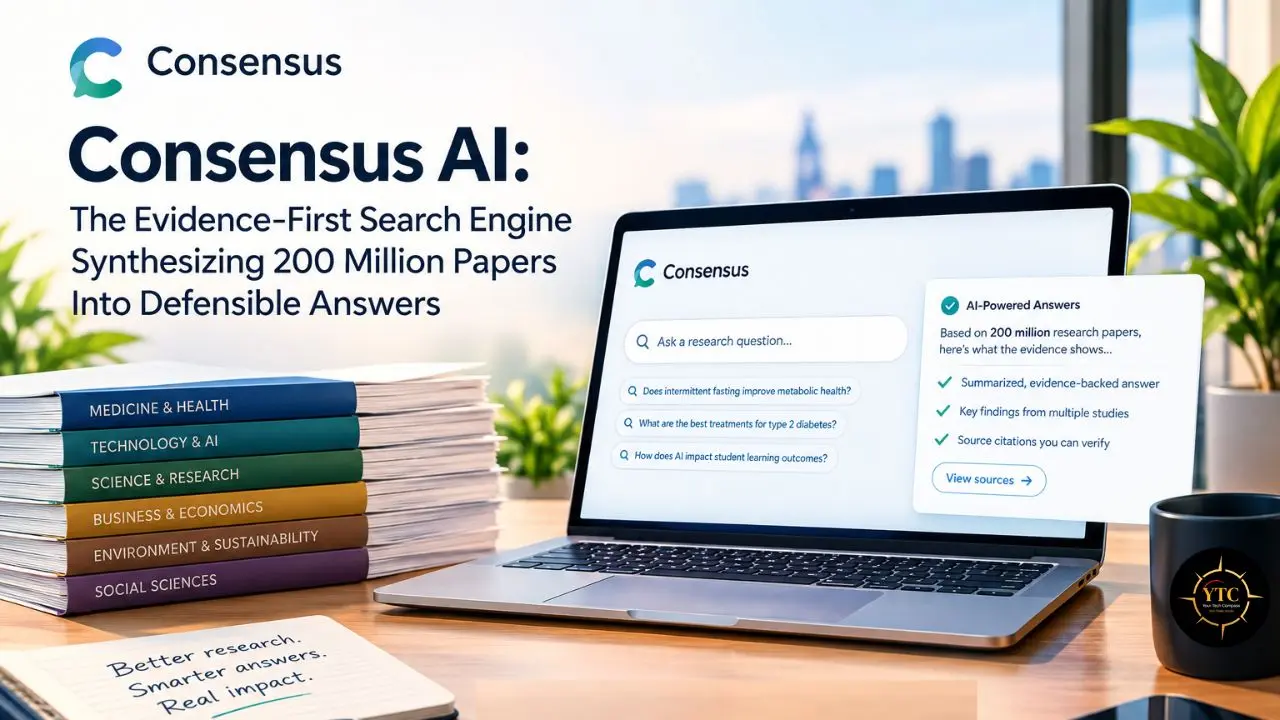
Every researcher knows this particular flavor of exhaustion. You type a question into Google Scholar, and ten thousand results come back: a wall of abstracts you’d need a week to sort through, with no sense of which five papers actually answer your question or whether the literature even agrees on anything. You need a defensible answer, not another list of citations to triage, and many general-purpose AI tools either hallucinate sources outright or may train on your queries unless you opt out.
Consensus AI was built specifically for that gap: an AI-powered search engine that reads across more than 200 million peer-reviewed papers and gives you a synthesized, cited answer grounded in retrieved studies instead of a reading list. In this review, I’ll walk through what Consensus AI actually is, how its Papers, Pro, and Deep Review workflows operate, the complete 2026 pricing picture with real cost math against named alternatives, the honest limitations documented by Consensus and independent reviewers, and whether this tool holds up if you’re researching from Lagos, Nairobi, or Accra rather than Boston or London.
A note before we begin: every YTC score is earned, never negotiated. If you want to understand exactly how we evaluate apps & tools and how we handle affiliate relationships, our Review Methodology lays it all out.
Quick Verdict
- Best For: Students, journalists, clinicians, and researchers who need fast, evidence‑backed answers to a focused question without running a full systematic review.
- Skip It If: You need custom, exportable data extraction across hundreds of papers, PRISMA‑aligned systematic‑review screening, or journal‑quality metrics like SJR or SNIP surfaced directly in your results (Consensus offers Q1–Q4 filtering instead).
- Bottom Line: Consensus AI is the most accessible entry point into evidence‑backed academic search in 2026. Its $120 annual Pro plan delivers genuine value, but the lack of structured extraction and a Consensus Meter that doesn’t weigh study quality mean it complements serious review workflows rather than replacing them.
What Is Consensus AI?
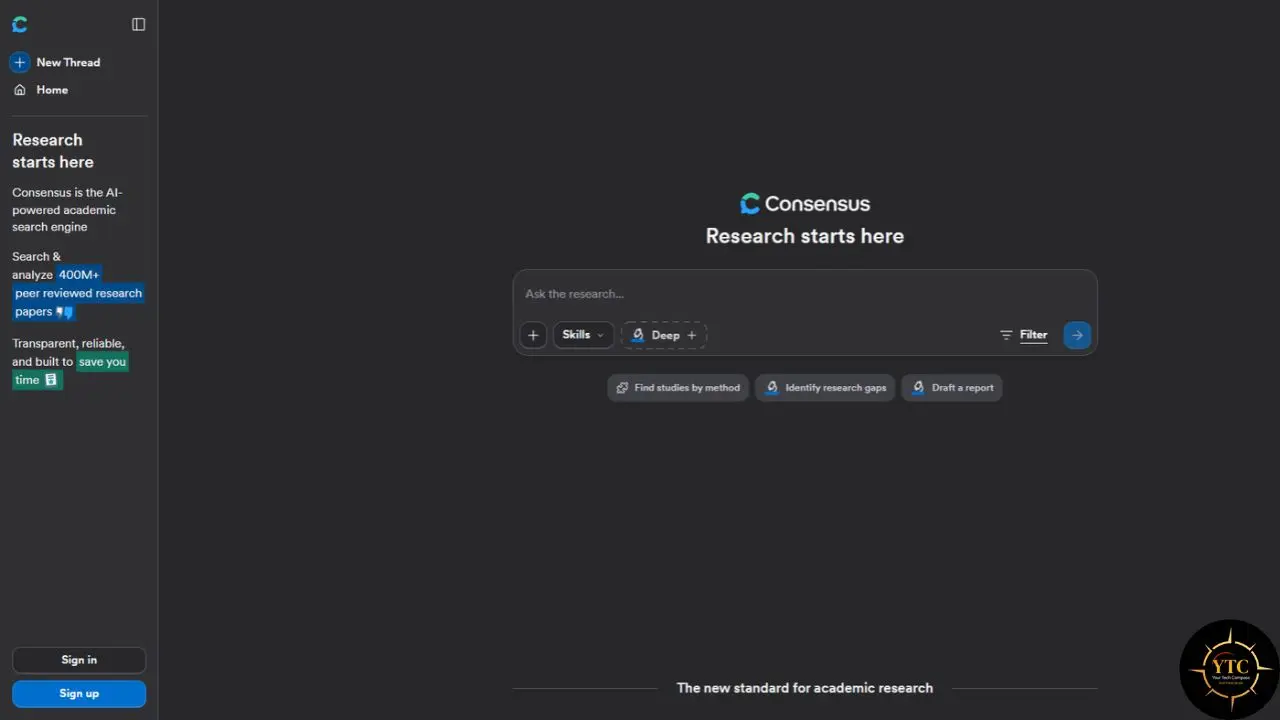
Consensus AI was founded in 2021 by Eric Olson and Christian Salem, two former Northwestern University football teammates who built the company around a simple mission: make scientific knowledge easier to access and actually interpret, not just find. What started as a search engine for peer‑reviewed literature has grown into a platform searching more than 200 million papers spanning medicine, psychology, biology, economics, engineering, and the social sciences, drawing on sources that include Semantic Scholar, OpenAlex, and Consensus’s own crawl of the scholarly web.
Here’s the distinction worth understanding before anything else: Consensus AI is not a general‑purpose chatbot wearing an academic skin. The company states plainly that it doesn’t train its AI models on user data and that search activity is anonymized, a meaningfully different privacy posture than the consumer AI assistants most people default to, and one I’ll unpack further in the legal section below.
Positioned between Google Scholar’s raw discovery and Elicit’s heavier systematic‑review machinery, Consensus AI sits in a genuinely useful middle lane: faster than the former, lighter than the latter. If you’re trying to understand where tools like this fit in the broader AI landscape, our AI Unboxed category tracks that wider terrain, and our Ask AI Tools guide is worth a look if you’re comparing several “ask an AI” products side by side.
How Consensus AI Works: The Three Search Modes
Quick Search
Quick Search returns a short, AI‑synthesized summary based on the top 10 most relevant papers, essentially a faster, citation‑backed overview rather than a raw result list. Use this when you need a quick orientation to a topic or fast fact‑checking rather than a deep synthesis.
Pro Search
This is where Consensus AI’s actual differentiation lives. You ask a natural‑language question, the AI analyzes up to 20 papers, and it returns a synthesized narrative answer with numbered citations you can trace back to the source. Pro Search also includes the Consensus Meter (a visual read of whether the literature supports, opposes, or is mixed on a yes/no question) alongside filters for publication year, methodology (RCT, meta‑analysis, systematic review, observational), journal quartile, citation threshold, and preprint exclusion.
Deep Search
Deep Search runs up to 20 targeted internal searches across the corpus, reviews 1,000+ papers, and synthesizes the top ~50 into a longer, structured report complete with tables, visual summaries, and its own Consensus Meter reading. It’s rate‑limited by monthly quota (e.g., 3/month on Free, higher on paid plans) and is the deepest synthesis tier the platform offers.
Standout Features (and the Honest Limitations Behind Them)
The Consensus Meter
The Meter gives you a fast directional read (supporting, opposing, or mixed) on a yes/no research question, which is genuinely useful for a journalist fact-checking a claim or a clinician who needs quick orientation before rounds. That speed is the whole point, and it delivers on it.
The honest limitation matters more than the speed, though: the Meter counts papers into categories without weighing study design, sample size, or journal quality. A small, underpowered observational study counts identically to a large randomized controlled trial in that tally, so you still need to open the underlying papers yourself to judge actual strength of evidence; the Meter tells you direction, not confidence.
Citation Graph
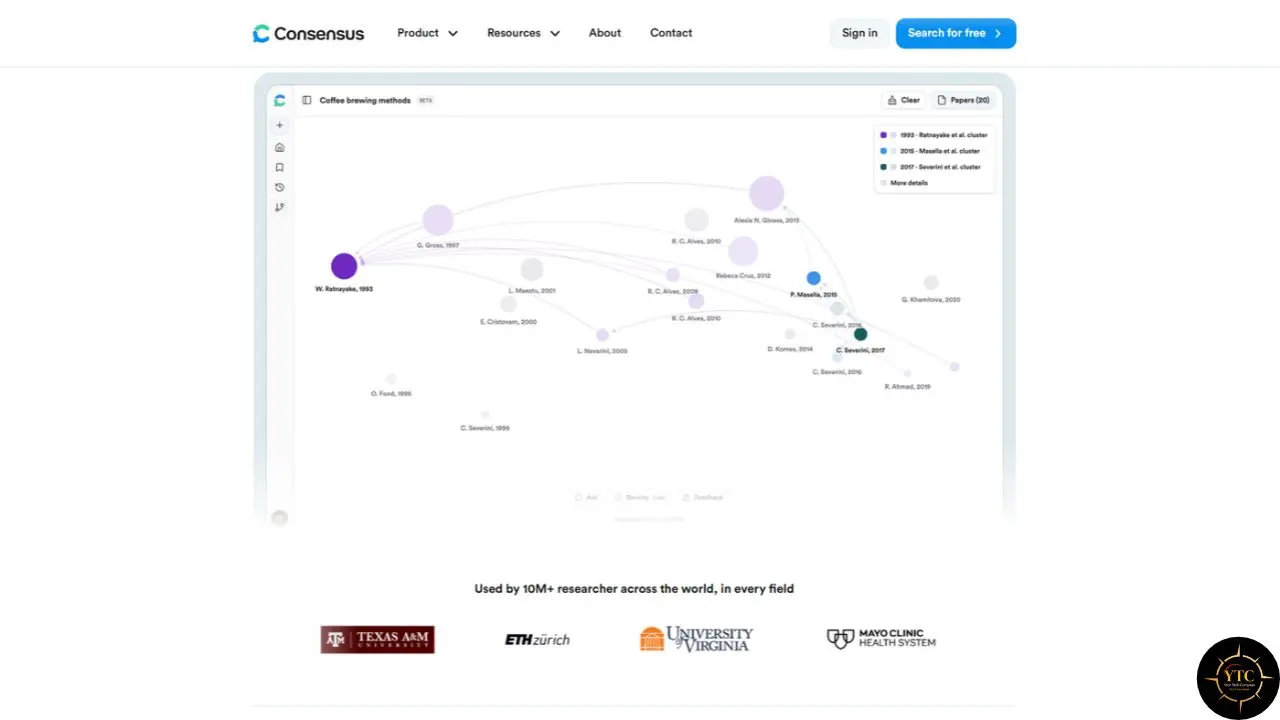
The Citation Graph is a visual network map showing which papers cite which, letting you trace influence and discover related work without leaving the platform. ResearchRabbit built its entire product around exactly this capability, and Consensus AI includes a comparable version natively, which is a real convenience.
Where it falls short: the graph shows that two papers are connected, but not the nature of that connection: whether a later paper supports, contradicts, or merely mentions the one it cites. For that distinction, Scite remains the sharper, more specialized tool.
Study Snapshot
One click gets you a summary of a paper’s key details: publication year, study type, sample size, key findings, citation count, which saves real time when you’re screening a long result list. It’s a small feature that compounds into meaningful time savings across dozens of papers.
The limitation is baked into how it works: Snapshots are AI-generated summaries of abstracts, not full-text extractions. If a paper’s abstract omits a critical limitation the authors buried in their discussion section, the Snapshot will miss it too.
Ask Paper (Chat With Papers)
Select multiple papers (or upload full‑text PDFs) and ask questions across them, and Consensus AI generates key learnings with support for follow‑up questions, turning a static reading list into something closer to an interactive research session. This behavior is documented in Consensus AI’s own product materials; follow‑ups stay constrained to the papers you initially selected or uploaded (up to five at a time), so Ask Paper is a deeper read of what you’ve already chosen, not an open‑ended research assistant.
My Library and Integrations
You can save papers, threads, and searches, import by DOI, organize work into Collections (folders/sub‑folders), and sync with Zotero and EndNote: solid, basic reference management without leaving the platform.
The gap: no native annotation layer, no citation‑style management. My Library saves and organizes your work; it doesn’t manage citations the way a dedicated reference tool does.
Consensus AI Pricing: The Complete 2026 Picture
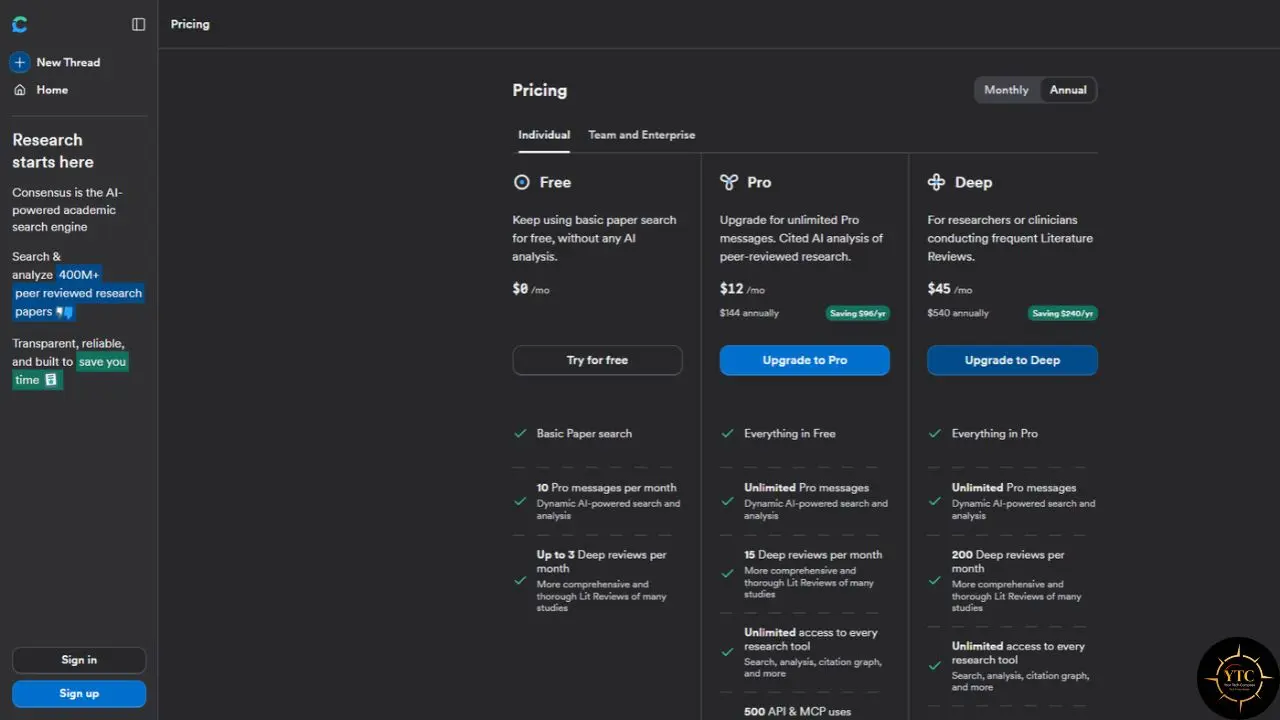
The Free Tier
Unlimited Quick Searches, 15 Pro messages per month, 3 Deep reviews per month, and 10 Study Snapshots per month, with no credit card required. The catch: 15 Pro messages are comfortable for occasional use, but throttle anyone doing daily research, and those 3 free Deep reviews are genuinely more generous than most competitors offer, several of whom lock deep synthesis entirely behind a paywall.
Pro: $20/month or $144/year
Unlimited Pro messages, 15 Deep reviews a month, and unlimited Study Snapshots. Annual billing saves $96 against paying monthly. At $144 a year (roughly $12/month), Pro undercuts Perplexity Pro (~$200/year) and Scite’s Basic tier (~$240/year), and Elicit Pro (~$588/year), making it the category’s clearest value entry point for a researcher who needs evidence-backed answers weekly without running deep reviews daily.
Deep: $65/month or $540/year
200 Deep reviews a month, with annual billing saving $240 over the monthly rate. The real math here: 200 Deep reviews a month works out to roughly 10 per working day to actually use the full allowance, which is overkill for most solo researchers; this tier earns its cost only if you’re generating long-form literature reviews on a near-daily basis.
Teams: Custom
50 Deep reviews per user monthly, centralized billing, and volume discounts scaling up to 200 seats.
Enterprise: Custom
Built for 200-plus users, with library-system integrations and organization-wide account management. Teams and Enterprise specifics are drawn from Consensus AI’s published materials rather than direct testing; treat exact seat pricing as claimed, not independently verified, and confirm current terms directly before committing a team budget.
Student Discount
A verified school email unlocks up to 40% off, dropping Pro to roughly $86/year and Deep to roughly $324/year.
Plan Breakdown (2026)
Plan | Monthly | Annual | What You Get | Best For |
Free | $0 | $0 | Unlimited Quick Search, 15 Pro msgs, 3 Deep reviews, 10 Snapshots/mo | Occasional, light research |
Pro | $20/mo | $144/yr (save $96) | Unlimited Pro messages, 15 Deep reviews/mo, unlimited Snapshots | Weekly researchers, students, journalists |
Deep | $65/mo | $540/yr (save $240) | 200 Deep reviews/mo | Near-daily literature review work |
Teams | Custom | Custom | 50 Deep reviews/user/mo, centralized billing | Research groups, labs |
Enterprise | Custom | Custom | 200+ users, library integrations | Institutions |
The real cost math worth sitting with: if you’re running Pro Search more than 15 times a month, the free tier is genuinely insufficient and Pro pays for itself quickly. If you’re hitting Deep Search more than 15 times a month, that’s your signal to upgrade past Pro entirely. One hidden cost worth budgeting for regardless of tier: Consensus AI doesn’t replace your institutional library access, so paywalled full-text papers still route through your library’s DOI resolution or interlibrary loan, and that takes real time the subscription price doesn’t cover.
Is Consensus AI Safe? Data Privacy and the Trust Picture

Where Your Data Goes
Consensus states it does not train its AI models on user data, and that search activity is anonymized and not sold or shared with third parties for model training. For anyone handling sensitive pre‑publication research or working with data related to patients, that’s a meaningful, stated differentiator from general‑purpose LLMs that may train on conversation history by default.
The “Not a Library Database” Caveat
Consensus is explicit that it isn’t a substitute for your institution’s library databases. Its search and ranking operate over metadata and publicly indexable content, and full‑text access to paywalled sources still depends on your library or interlibrary loan; synthesis happens on what Consensus can actually retrieve, not on content it cannot see.
Synthesis Accuracy and Hallucination Risk
Because every answer is grounded in real papers with hyperlinked DOIs, hallucination risk runs lower here than with a general‑purpose chatbot pulling from memory, when the tool is used as intended, and claims are checked against the cited sources. That said, the AI can still overinterpret genuinely mixed findings or flatten real nuance into a single directional reading on the Consensus Meter. Remember that “usable for orientation today” and “fully resolved for your literature review” are two different standards, and only you can verify which one your specific use case actually needs.
Consensus AI vs. Elicit vs. Scite vs. Perplexity vs. ResearchRabbit
Dimension | Consensus AI | Elicit | Scite | Perplexity | ResearchRabbit |
Entry Paid Price | $144/yr | $588/yr | $144/yr | $200/yr | $120/yr |
Corpus | 200M+ scholarly documents (primarily peer‑reviewed, with some conference papers and preprints) | Peer‑reviewed + preprints (~138M papers) | 1.6B+ classified citation statements across 317M+ indexed articles | Live web + some scholarly | Citation network, no synthesis |
Core Strength | Fast synthesized answers | Structured extraction, screening | Citation context (support/contradict) | Live, current‑events search | Visual discovery, free |
Synthesis Depth | Narrative answer, Consensus Meter | Tables, custom columns | None (citation analysis only) | Narrative, general web | None |
Weakest At | Structured extraction, quality weighting | Price, learning curve | No narrative synthesis | Not peer‑review‑specific | No AI synthesis |
ResearchRabbit is included for completeness as a free discovery alternative, though it operates in a different category from the synthesis tools above.
Where Consensus AI Genuinely Earns Its Users
It’s among the fastest time‑to‑answer options in this group for an evidence‑backed question: plain English in, a synthesized response in seconds. It also pairs one of the best free tiers for actual deep synthesis (3 Deep reviews monthly, where most competitors gate that entirely) with one of the most affordable paid entry points at $120 a year (Pro), plus two features (the Consensus Meter and the native Citation Graph) that neither Elicit nor a free Google Scholar search offers at all.
Where It Doesn’t
Elicit dominates once you need systematic reviews, structured extraction, or screening at real scale. Scite remains the only tool here that tells you whether a later paper actually supports, contradicts, or just mentions a given claim. Perplexity reaches live web sources, vendor pages, and this morning’s reporting that a peer‑review‑only corpus simply can’t touch; our Perplexity AI review covers that territory in depth. And ResearchRabbit offers comparable citation‑mapping depth with a fully free core tier, while Consensus AI gates its advanced AI synthesis and higher‑volume usage behind paid plans.
Compared to Elicit right now: Elicit offers structured data extraction with custom columns (two on its free plan, up to 40 on Enterprise) plus systematic-review screening across as many as 40,000 papers. Consensus AI has none of that: no extraction tables, no inclusion/exclusion scoring, no CSV export of variables. If your workflow means comparing sample sizes, interventions, and outcomes across a hundred studies side by side, Elicit is the only one of the two that can actually do it.
Compared to Perplexity right now: Perplexity searches the live web (vendor pages, government sites, this morning’s reporting) while Consensus AI searches primarily peer‑reviewed literature, plus some conference papers and preprints. Need yesterday’s FDA guidance or a company’s latest earnings call? Perplexity is the only one of the two that can answer that. Need what published science actually says about a clinical intervention? Consensus AI is the sharper tool for that specific job.
Compared to Semantic Scholar right now: Semantic Scholar is free, indexes a comparable corpus, and includes alerts and research feeds. Consensus AI charges $120 a year (Pro) specifically for AI synthesis and the Consensus Meter on top of that same kind of corpus. If you’re comfortable reading abstracts and drawing your own conclusions, Semantic Scholar is free and sufficient; if you want synthesized answers with a directional read already done for you, Consensus AI justifies its cost.
If you’re weighing Consensus AI against other AI‑native research or writing tools more broadly, our Genspark AI and NotebookLM reviews cover two meaningfully different approaches to the same general problem, worth a read if you’re still narrowing down which category of tool actually fits your workflow.
Real-World Use Cases
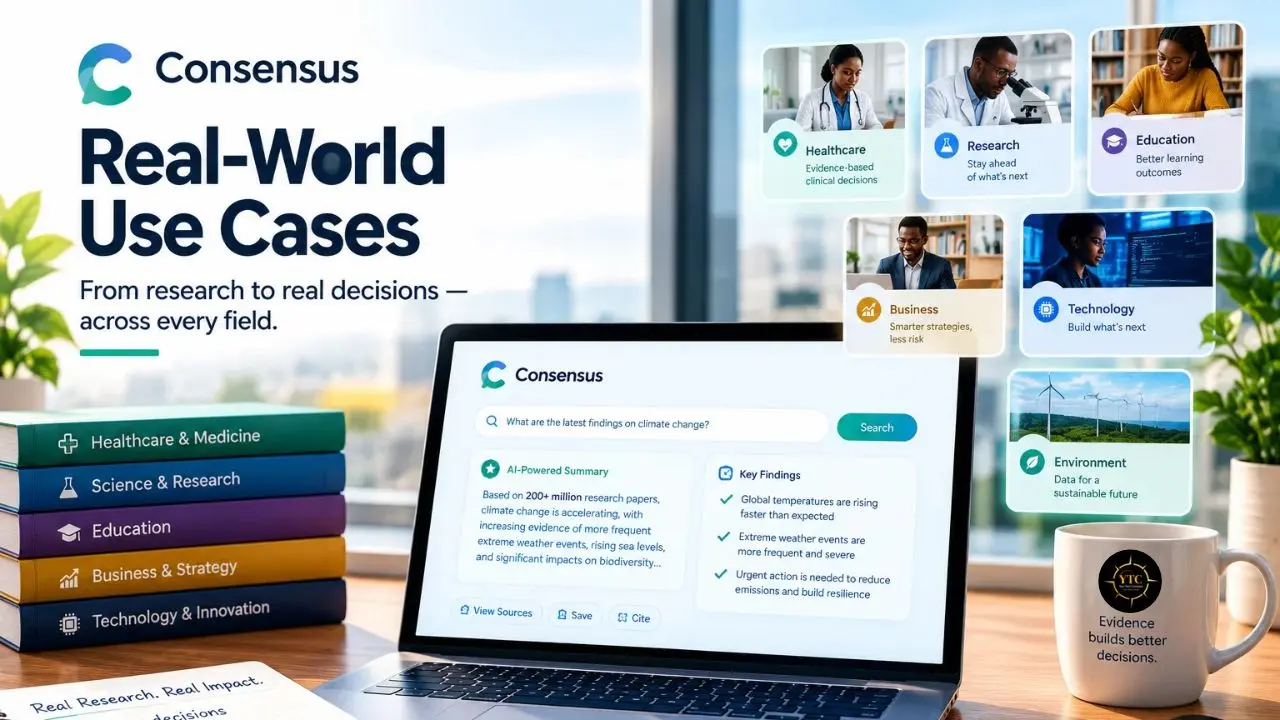
Picture a medical student prepping for rounds with a specific clinical question and no time to read six full papers before morning. Medical Mode’s narrowed, guideline‑aware medical corpus (top journals plus ~50,000 clinical guidelines) gets them oriented in minutes rather than hours. A journalist fact‑checking a health claim for a story leans on the Consensus Meter and its linked DOIs to get a defensible, citable directional read before publishing, rather than taking a press release’s framing at face value.
A PhD student in the early stages of a literature review uses Deep Search to map the shape of a field before committing real weeks to a full systematic review inside Elicit, using Consensus AI as reconnaissance, not the final product. A policy researcher needing a quick evidence brief on a social intervention, without months of formal review work, gets a workable starting point here that would otherwise require a research assistant’s time.
An Honest Note on the Review Landscape
Academic users consistently praise Consensus AI’s speed, clean interface, and genuinely generous free tier; that part of its reputation checks out. At the same time, criticism surfacing on Reddit and academic forums centers on the Consensus Meter’s lack of quality weighting, library and workflow features that stay fairly shallow for serious reviewers, and the absence of extraction features serious reviewers eventually need. The honest gap worth naming plainly: “gets me oriented in 30 seconds” and “replaces my actual review workflow” are two different claims, and the distance between them is wider than Consensus AI’s own marketing tends to suggest.
Who Should Use Consensus AI
- Students writing literature reviews who need fast orientation before committing to deep reading.
- Journalists fact‑checking scientific claims who need linked source papers, not just a confident‑sounding summary.
- Clinicians and medical students using Medical Mode for continuing education, not patient‑facing decisions.
- Researchers in early‑stage projects mapping a field before a formal systematic review.
- Knowledge workers who want evidence‑backed answers without learning Boolean search syntax.
- Budget‑conscious teams who need real AI synthesis at $120/year (Pro) rather than Elicit’s $588/year.
Who Shouldn’t Use Consensus AI
- Researchers running formal systematic reviews that require screening, inclusion/exclusion criteria, and structured extraction.
- Teams that need SJR, SNIP, or impact‑factor metrics surfaced directly in search results.
- Anyone wanting AI‑powered document drafting or citation‑grounded writing done inside the tool itself as a primary writing environment.
- Researchers managing large reference libraries who need in‑PDF annotations, fine‑grained tags, and full citation‑style management inside a dedicated reference manager.
- Anyone expecting Consensus to replace their library’s full‑text access; while Consensus analyzes full text (including many paywalled papers) for relevance, it does not provide special access to paywalled PDFs outside its publisher agreements and institutional licenses.
Consensus AI for African Researchers: Accessibility and Practical Realities
Pricing in African Market Context
The free tier is genuinely usable for light research needs; 15 Pro messages and 3 Deep reviews a month cover a real amount of ground. At current exchange rates, Pro’s $144/year works out to roughly ₦191,800 or KSh18,700, which is reasonably accessible for a funded researcher but a real stretch for an unfunded student, and there’s no regional pricing adjustment beyond the standard 40% academic discount available to anyone with a verified .edu or .ac school email.
Connectivity and Data Costs
Consensus AI’s interface is text-based with minimal heavy media, which makes it genuinely viable on metered mobile data; a typical Pro search consumes only a few kilobytes, and even Deep Search’s tables and visual summaries stay lightweight compared to anything video- or image-heavy. There’s no offline mode, though, so every search still depends on an active connection.
Payment Barriers
Paid tiers require a credit card, with no mobile money, M-Pesa, or local bank transfer option currently supported. In markets with lower card penetration, that structural gap means the free tier functions as the realistic ceiling for a meaningful share of potential users; a pattern our African fintech coverage, our mobile money evolution guide, and our mobile money in Africa guide all track in more depth across the broader payments landscape this sits inside.
Language and Localization
The interface is English-only, with no support yet for Swahili, Yoruba, Amharic, or other major African languages; while you can set a preferred output language for AI synthesis, African languages are not among the supported options and coverage remains heavily English-dominant. Medical Mode draws on international journals without prioritizing African medical research or local clinical guidelines specifically, so researchers studying African contexts directly may find the underlying corpus skews noticeably Western.
The Practical Path
For unfunded African researchers, the sensible approach is treating the free tier as your primary tool and Pro as a genuine luxury rather than a given. Funded researchers and institutions are better served negotiating team or enterprise pricing than buying individual Deep plans one at a time. For the wider landscape of AI tools actually built with (or at least usable within) African constraints, our AI in Africa category and our broader African tech coverage track that terrain as it develops.
FAQs
Consensus AI is an AI-powered academic search engine that reads across more than 200 million scholarly documents (primarily peer-reviewed papers, with some conference papers and preprints) and returns synthesized, cited answers to natural-language research questions, rather than a raw list of abstracts to sort through yourself.
Yes, with real functionality, not just a locked demo. The free tier includes unlimited basic paper searches, around 15 Pro messages, 3 Deep reviews, and 10 Study Snapshots every month, with no credit card required to start.
Google Scholar returns a ranked list of papers for you to read and synthesize yourself; Consensus AI adds an AI synthesis layer on top of a comparable corpus, returning a direct answer with citations and a directional Consensus Meter reading.
No, it’s explicitly a search and synthesis tool, not a drafting tool. There’s no AI writing or document-generation feature inside Consensus AI itself; you’ll still need to write the review yourself using what it surfaces.
Based on its stated privacy policy, yes, Consensus AI says it doesn’t train models on user data and anonymizes search activity. That said, every synthesized answer still needs verification against the source papers before you cite it in your own work; treat it as a strong starting point, not a final authority.
Reasonably well on the technical side, the lightweight, text-based interface works fine on metered mobile data, and the free tier is genuinely usable. The real friction is the payment layer: no mobile money support and no regional pricing mean paid tiers remain a real stretch for many unfunded researchers.
Your Tech Compass on Evidence-Backed Search
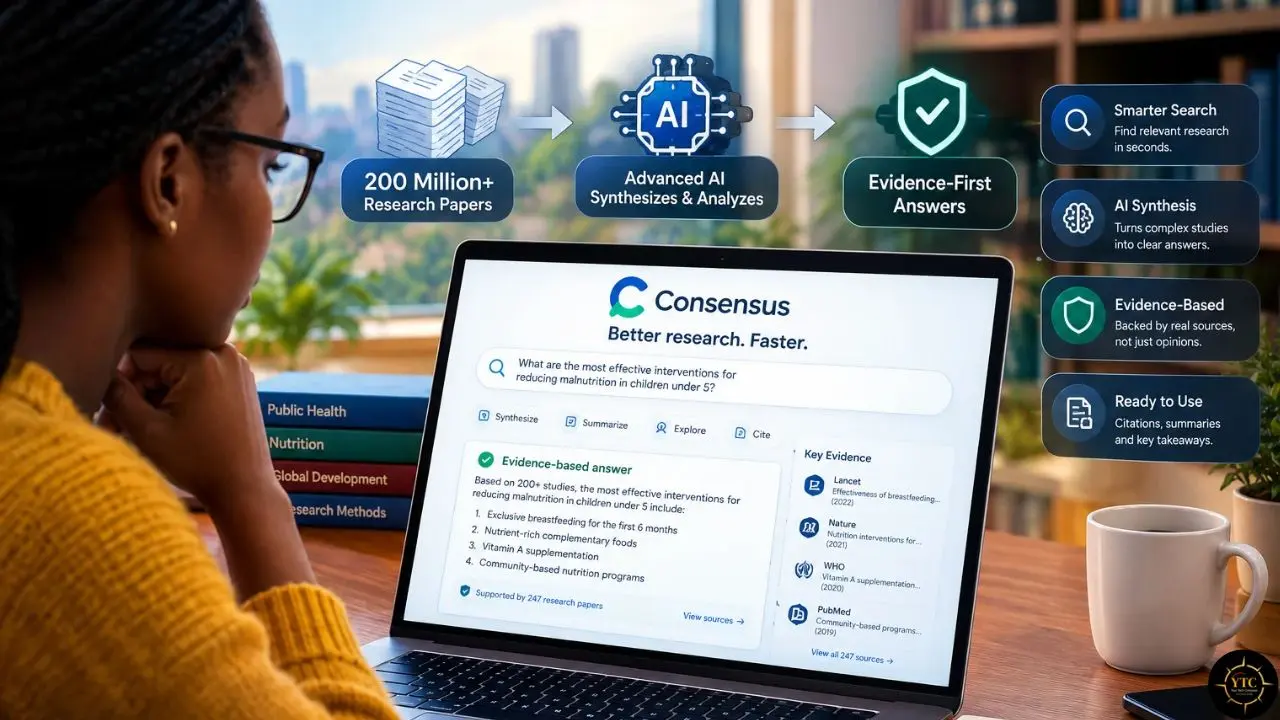
Consensus AI has carved out a genuinely useful niche sitting between raw search and full systematic-review software. At $120 a year (Pro), it’s one of the most accessible paid, evidence-backed search tools with AI synthesis available to researchers who need defensible answers, not an entire new workflow to learn, and the Consensus Meter, Citation Graph, and Deep Search together give it real differentiation from both the free alternatives nipping at its heels and the considerably pricier competitors above it.
The trade-offs are just as real, though, and worth repeating plainly: a meter that doesn’t weigh study quality, no structured data extraction, and a My Library that stays relatively shallow for serious reference management mean Consensus AI is an orientation tool, not a review tool. For policymakers, journalists, and early-stage researchers, that’s exactly the right fit for the job at hand. For systematic reviewers and anyone doing serious data extraction across dozens of studies, treat it as a sharp first stop on the way somewhere else, not the destination itself.
If this guide helped you tell the research tools that orient you from the ones that overwhelm you further, head back to YourTechCompass.com because the best search engine in the world is still useless if it hands you ten thousand abstracts when all you needed was one defensible answer.