You have been there. Your OpenAI bill just crossed $400 this month, and your product has not even found product‑market fit yet. Every user conversation burns cash, and the math gets worse with each new sign‑up. You start eyeing open‑source models (Llama, DeepSeek, Qwen), knowing they could cut your inference bill by 50–80% or more on many workloads if you can tolerate slightly lower capability on some tasks. But then you picture the alternative: managing CUDA/toolchain dependencies, running vLLM or similar serving stacks, and handling GPU cluster incidents outside business hours. That gap between “too expensive” and “too complicated” is exactly where Together AI has planted its flag.
In this review, I’m tearing down Together AI’s entire stack: the serverless inference tier, the dedicated endpoints, the GPU clusters, and the fine‑tuning pipeline that looks cheap on a per‑token basis until you factor in the ongoing cost of hosting the resulting model on dedicated or provisioned endpoints for production SLAs. You will get real pricing math, head‑to‑head comparisons against Fireworks AI and Groq, an honest look at the review landscape, and a dedicated Africa accessibility section that does not pretend latency to EU/Middle East edges or USD‑only, card‑based billing are non‑issues. By the end, you will know whether Together AI deserves your API key.
A note before we begin: every YTC score is earned, never negotiated. If you want to understand exactly how we evaluate apps & tools and how we handle affiliate relationships, our Review Methodology lays it all out.
Quick Verdict
- Best For: Teams that need a deep catalog of open‑source models with built‑in fine‑tuning and want an OpenAI‑compatible API without managing GPU infrastructure.
- Skip It If: Your workload is latency‑critical and narrow (Groq’s LPU hardware can be significantly faster for the specific models it supports) or if you need self‑serve custom fine‑tune hosting and cannot tolerate the possibility of ongoing dedicated GPU costs in the ~$4k–$5k‑per‑month range per GPU when running continuously for production.
- Bottom Line: Together AI is one of the broadest open‑model hosts on the market, with 200+ models across chat, vision, audio, and video. Serverless is genuinely cheap for prototyping, but the real cost story only becomes clear once you factor in dedicated endpoints, fine‑tuned hosting, and the variant system that, on certain models and tasks, trades some precision for speed (e.g., throughput‑optimized or quantized variants).
What Is Together AI?
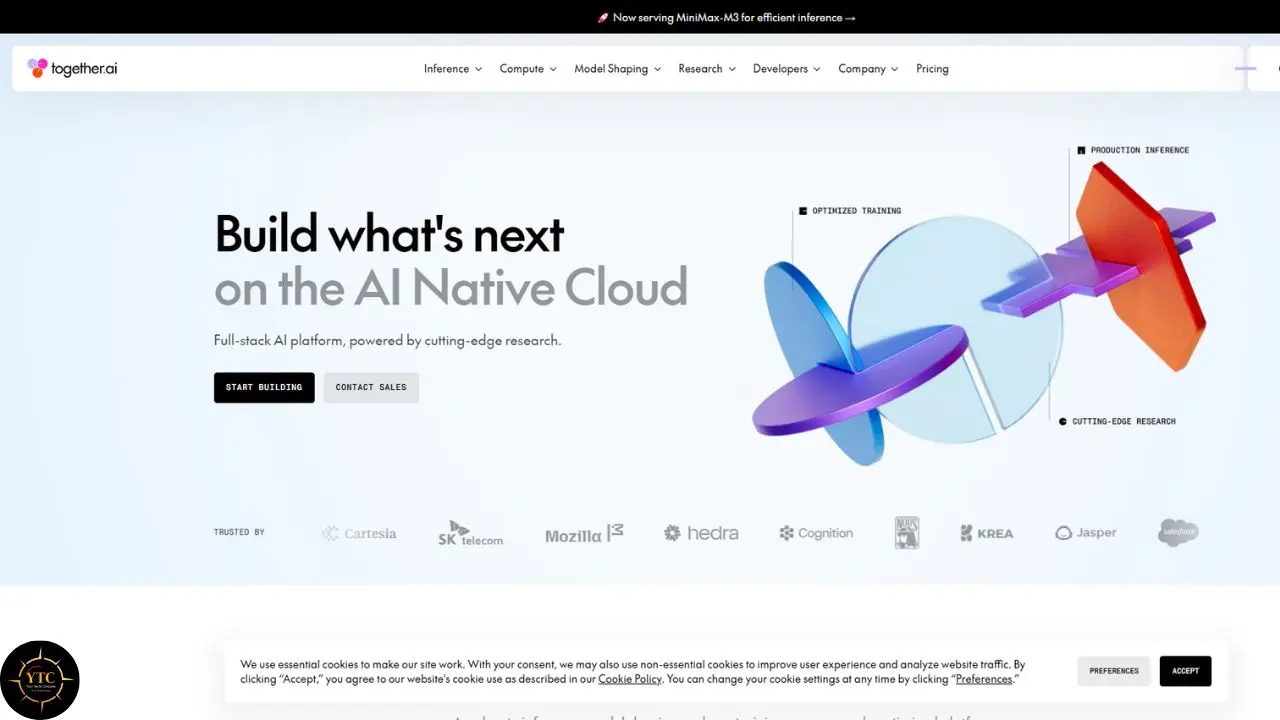
Together AI emerged in 2022, when Vipul Ved Prakash (who previously co‑founded Topsy, which was acquired by Apple for a reported $200 million) teamed up with Stanford‑affiliated researchers to solve a specific problem. GPU access was expensive and limited, and the cloud was built for CPUs, not the hunger of large language models. Their mission: democratize GPU computing so developers can train, fine‑tune, and run AI models without building their own data centers.
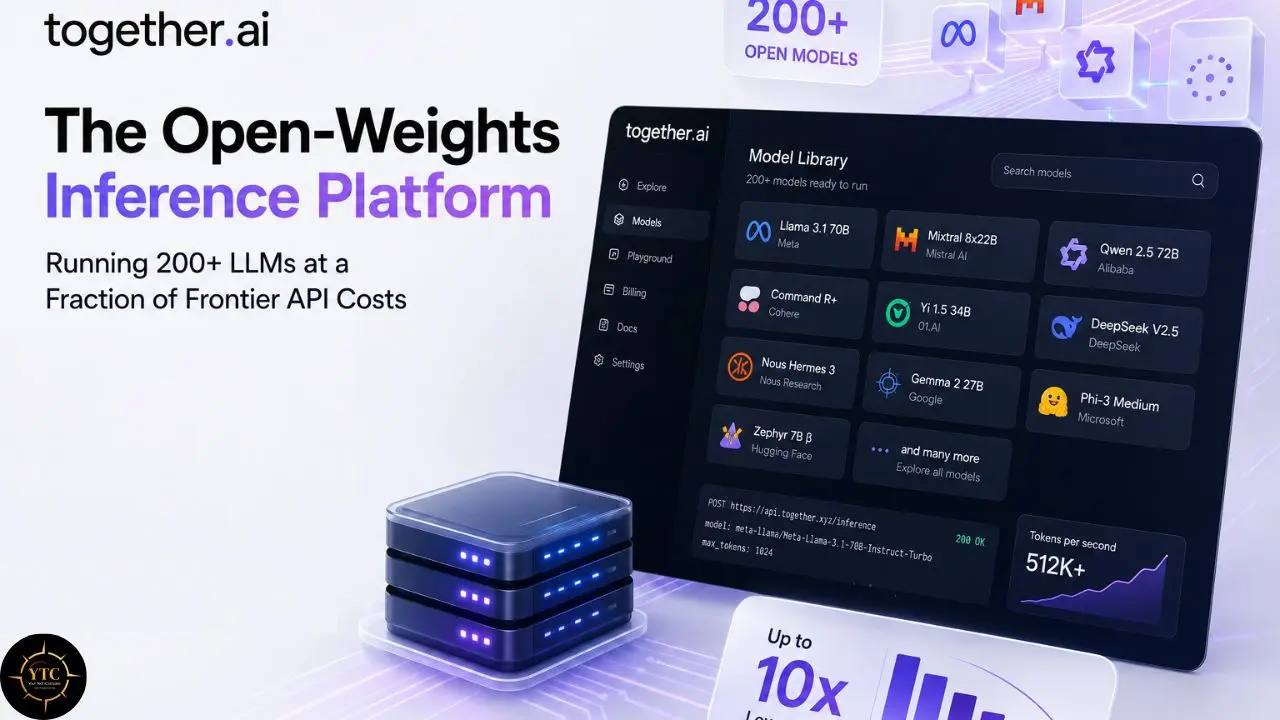
Today, Together AI operates as a neutral, model‑agnostic inference platform. It does not build proprietary frontier models; it hosts them. The catalog spans 200+ open‑source and open‑access models from Meta’s Llama family, DeepSeek, Alibaba’s Qwen, Zhipu AI’s GLM, Moonshot AI’s Kimi, Mistral, and dozens more.
One API key and a unified SDK, with a single bill for serverless inference, fine‑tuning, and dedicated GPU usage, whether you are calling Llama 3.3 70B for support chat or DeepSeek V4 Pro for reasoning. The OpenAI‑compatible API surface means switching from GPT‑4o is often a base‑URL swap, removing the migration friction that keeps teams locked into proprietary APIs.
How It Works and What Is New in 2026
The Three Compute Products
Together AI offers three main compute products. Understanding the boundary between them is the difference between a $50 bill and a $5,000 surprise.
- Serverless inference is the shared GPU pool that most users start with. You call an OpenAI‑compatible endpoint, pay per token, and never touch a server. No provisioning latency, no replicas to size, no minimum cost. The trade‑off is rate limiting: serverless enforces rate limits (and, in some cases, token caps) that vary by model and account tier, and bursty, high‑volume agent workflows can hit these limits, requiring dedicated capacity.
- Dedicated Model Inference provisions single‑tenant GPU instances billed per GPU‑hour. An H100 runs $5.49/hour on‑demand for Dedicated Inference; reserved commitments and GPU Clusters can bring effective hourly costs down into the ~$3–$4/hour range, depending on term and plan. Much higher effective rate limits than serverless (bound mainly by your provisioned GPU capacity), identical API surface to serverless, prototype on shared hardware, move to reserved capacity without rewriting code.
- GPU Clusters are the raw layer: from small multi‑GPU sets to very large NVIDIA GPU clusters with high‑speed interconnects, available on demand or reserved for extended terms (publicly listed up to 180+ days, with longer via sales). For teams running custom training loops or distributed fine‑tuning that outgrows the managed pipeline. On‑demand H100 clusters start at ~$3.99 per GPU per hour, with higher tiers up to ~$5.99/hour, depending on plan and commitment.
Inference Engine 2.0 and the Variant System
In 2024, Together AI rolled out Inference Engine 2.0, alongside a growing set of model variants optimized for different throughput and cost points. The same base model can appear in multiple forms (for example, -Reference, -Turbo, -Lite, or “FP8 Throughput”), each with different performance characteristics and prices.
In practice:
- -Reference variants are typically the highest‑quality, full‑precision configurations for that model.
- -Turbo and “FP8 Throughput” variants are optimized for speed and cost, often using lower‑precision or other optimizations; quality is close to -Reference on many tasks but can degrade on some reasoning or math benchmarks.
- -Lite variants are further optimized for cost/latency and may use stronger compression; expect a more noticeable quality trade‑off on complex tasks.
The catch: these are different model IDs that you explicitly select (e.g., …-Reference vs …-Turbo), not hidden tiers behind a single endpoint. It is easy to benchmark on a -Turbo variant, assuming it represents the base model, only to discover quality degradation in production. Always pin -Reference (or the highest‑quality variant) for initial benchmarks, then move to -Turbo/-Lite only after validating the trade‑off on your own workloads.
The Fine-Tuning Pipeline
Together supports LoRA and full fine‑tuning on Llama, Mistral, Qwen, DeepSeek, and other open models, billed per million tokens. A 16B‑class model costs about $0.48 per million tokens for LoRA SFT, scaling to roughly $2.90 per million for 70B–100B models, with intermediate tiers (e.g., 17B–69B) in between. DPO is priced at roughly 2–3× the corresponding LoRA SFT rate, depending on model size.
Here is the gotcha: once training finishes, you must budget for hosting the fine‑tuned model; for production SLAs, this often means a dedicated or provisioned endpoint. That can mean ~$4,000–$4,700 per month per H100 if you keep the endpoint running 24/7, regardless of traffic volume. Startups routinely estimate that “fine‑tuning will cost us $30,” only to discover that the ongoing hosting bill can be 10–100× higher if they run a dedicated GPU continuously. Plan the lifecycle, not just the training step.
Standout Features
The Broadest Open-Model Catalog
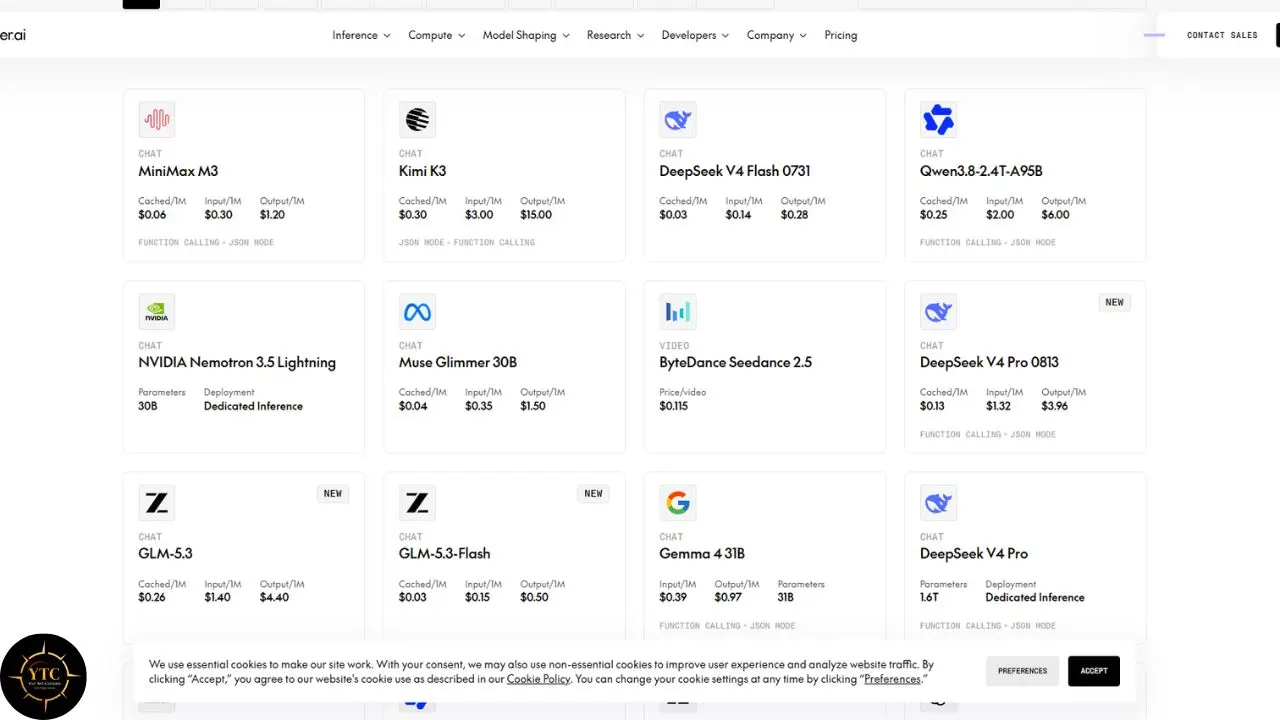
With 200+ models across text, vision, image, audio, video, transcription, embeddings, and moderation, Together’s catalog is among the largest of open‑model hosts. Flagship text models as of September 2026 include DeepSeek V4‑class models around $1.3/$4.0 per million tokens, Kimi‑class models at $3.00/$15.00, GLM‑class models around $1.40/$4.40, and GPT‑OSS 20B at $0.05/$0.20. For production workhorses, Llama 3.3 70B Instruct Turbo is priced at around $1 per million tokens, making it multiple times cheaper than GPT‑4o‑class APIs.
The real value is experimentation. Test five models in an afternoon, compare outputs, and commit without rewriting integrations. For teams still searching for the right model‑task fit, that flexibility is worth more than any single per‑token rate.
Cached-Input Discounts
Select models bill cached input at steep discounts when the same prompt prefix repeats. For example, some DeepSeek V4‑class models drop from around $1.3/M to ~$0.13/M (a ~10× reduction), GLM‑class models from ~$1.40 to ~$0.26, and MiniMax‑class models from ~$0.30 to ~$0.06. The mechanism is automatic and prefix‑based.
For agentic workflows that reuse a large system prompt every turn, this quietly changes economics. A coding agent firing 10,000 daily requests with a 2,000‑token system prompt could see its input bill drop by ~50–70% in a typical scenario, without changing application code.
Batch API: Up to 50% Off
For non‑real‑time workloads, the Batch API processes asynchronous jobs at up to 50% lower cost on many models. Offline dataset generation, nightly log enrichment, bulk classification: $200 on serverless can become ~$100 via Batch. Just a flag in your API call. Minimal friction, immediate savings.
Honest Limitations: The Flagship Feature Gaps
The Variant Confusion
The variant system is powerful but poorly signposted. The same base model can appear as multiple explicit variants (e.g., -Reference, -Turbo, -Lite, “FP8 Throughput”), each with different performance characteristics and prices.
The pricing page lists these in a dense table that is easy to scan past. Teams have shipped on -Turbo, thinking it represented the highest‑quality configuration, only to discover quality degradation in production evals weeks later. Always check the full model string and variant notes (e.g., “FP8 Throughput”) before committing traffic. Together AI does not make these trade‑offs obvious during onboarding.
Serverless Rate Limits Push You to Dedicated Earlier Than Expected
Free tier: on the order of ~60 RPM. Paid: often ~600 RPM with around 1M tokens per minute, varying by model and account tier. An agent firing parallel tool calls or a chatbot hitting a traffic spike can slam into the serverless ceiling before the budget is nearly spent.
Together’s own docs recommend dedicated endpoints for steady, high‑volume traffic. The mistake is switching too early: an H100 at $5.49/hour is ~$3,950 per month, and that only pays off at sustained high utilization. Bursty traffic means paying for idle GPU time.
The Fine-Tune Hosting Surprise
Fine‑tuned models must be deployed separately, and for production SLAs, they often end up on dedicated or provisioned endpoints. There is no universal “pause button” for idle GPUs; if you keep the endpoint running 24/7, you pay continuously, even with no traffic. A legal‑tech startup might spend ~$50 training a 70B model, then face a ~$4,000–$4,700 monthly hosting bill if they keep a dedicated GPU running 24/7 before serving a single request.
For many teams, this is the single biggest pricing gotcha on the platform. LoRA adapters on serverless would be ideal, but in practice, many teams end up deploying fine‑tuned/LoRA models on dedicated or provisioned endpoints for production SLAs. If you need self‑serve custom hosting with Multi‑LoRA on serverless and want to avoid fixed GPU costs, Fireworks AI’s Multi‑LoRA serverless approach is worth comparing.
Pricing Breakdown: The Real Cost Math

Serverless Per-Token Rates (September 2026, Listed/approx.)
Model | Input ($/1M) | Output ($/1M) | Cached Input ($/1M) |
GPT‑OSS 20B | $0.05 | $0.20 | — |
MiniMax M3 | $0.30 | $1.20 | $0.06 |
Qwen3.5 9B | $0.17 | $0.25 | — |
Llama 3.3 70B Instruct Turbo | ~$1.00 | ~$1.00 | — |
DeepSeek V4 Flash | $0.14 | $0.28 | $0.03 |
DeepSeek V4 Pro | $1.32 | $3.96 | $0.13 |
Kimi K3 | $3.00 | $15.00 | $0.30 |
GLM 5.2 | $1.40 | $4.40 | $0.26 |
Prices are listed as serverless rates as of September 2026 and may vary by route, plan, and updates; cached input is available only on select models.
Dedicated Endpoints and GPU Clusters (September 2026, Listed/approx.)
Hardware | Dedicated Inference (per hr) | Cluster On-Demand (per GPU/hr) | Cluster Reserved 181+ Days |
NVIDIA HGX H100 | $5.49 | $3.99 | Contact sales |
NVIDIA HGX H200 | Contact sales | $5.99 | Contact sales |
NVIDIA HGX B200 | $8.99 | $8.19 | Contact sales |
Dedicated and cluster pricing depends on plan, region, and commitment; reserved 181+ day terms are quoted via sales.
The Break-Even Math
Scenario A: 1 billion tokens per month on Llama 3.3 70B serverless = ~$1,040 (at $1.04/M tokens). Dedicated H100 = ~$3,950–$4,000/month (at $5.49/hour). Serverless wins.
Scenario B: 5 billion tokens per month on the same model. Serverless = ~$5,200. Dedicated H100 = ~$3,950–$4,000. Dedicated wins, plus consistent latency. Break-even sits around 3.5–4B tokens/month.
Scenario C: Fine-tune Llama 3.3 70B on 500M tokens. Training at $2.90 per million = ~$1,450. Hosting on a dedicated H100 = ~$4,000 per month (base rate), or higher with redundancy/managed services. The ongoing hosting bill is ~2.5–3× the one-off training cost in month one.
Free Tier and Startup Programs
As of August 2026, Together AI requires a minimum $5 credit purchase to access the platform and offers no advertised free trial. However, a subset of models (including select open‑source LLMs such as Ternary Bonsai 27B) are available at $0 per million tokens for prototyping, though the exact list and count of free models are not fixed on the pricing page. The Startup Accelerator offers up to $15,000–$50,000 in platform credits based on a company’s funding stage, with eligibility tied to how much the startup has raised, which can be a barrier for solo developers and early‑stage African startups.
Together AI vs. the Competition
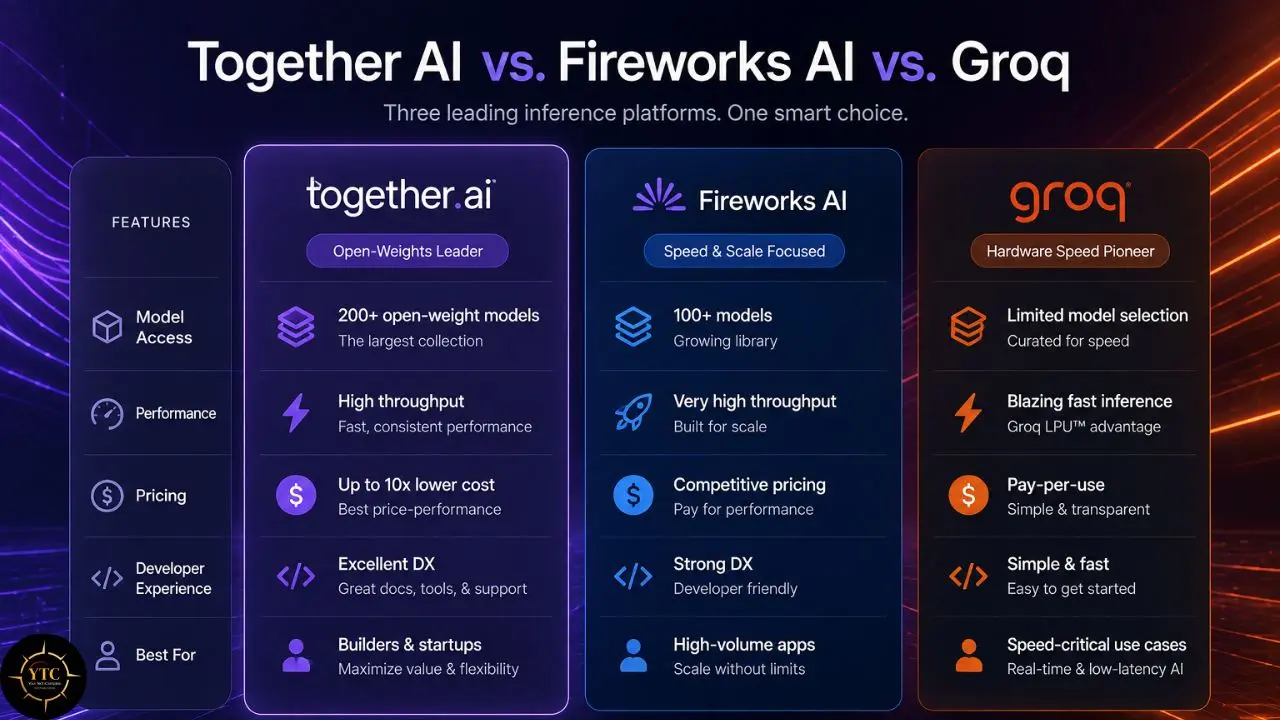
Head-to-Head: Together AI vs. Fireworks AI vs. Groq
Dimension | Together AI | Fireworks AI | Groq |
Model Catalog | 200+ open models (text, image, audio, video) | Very large catalog (400+ reported), strong multimodal support | Curated, narrower set of production/preview models |
Llama 3.3 70B ($/1M in/out) | $1.04 / $1.04 | ~$0.60–$0.90 depending on tier | $0.59 / $0.79 (Enterprise) |
Fine-tuning | Full LoRA + full FT (SFT/DPO) via managed fine-tuning | LoRA SFT/DPO; Multi‑LoRA; serve fine-tuned adapters at base-model cost | Enterprise-only, gated; no self-serve fine-tuning |
Custom Model Hosting | Dedicated endpoints (single-tenant GPUs, PTUs) | Dedicated + Multi‑LoRA serverless deployments | Not available self-serve |
Raw Speed (tokens/sec) | ~150–400 on Llama 3.3 70B (serverless, varies by endpoint) | Similar band to Together; varies by tier and model | ~280–750+ depending on model; ~280 tok/s on Llama 3.3 70B Enterprise |
Function Calling | Supported; not typically highlighted as best-in-class | Strong tool use / function calling reliability | Basic tool use; more limited than Fireworks |
Batch Discount | Up to 50%+ via Batch API pricing | Up to ~50% via batch/cached discounts | No batch API |
Free Credits | $5 minimum prepaid; some models at $0/M tokens (e.g., Ternary Bonsai 27B) | $1 free credit at signup | Free console signup with rate-limited developer plan |
Compared to Groq right now: Groq’s custom LPU silicon delivers up to 700+ tokens per second on some models, with around 280 tokens per second on Llama 3.3 70B Enterprise, typically 2–3× faster than Together on comparable workloads. The trade-off is model selection: Groq only carries a curated set. If you need a specific Qwen or DeepSeek variant that Groq does not host, Together is often your best option among the fast-inference providers.
Compared to Fireworks right now: Fireworks matches Together within cents on many models and tends to edge ahead in function-calling reliability. Where Together competes is in catalog breadth and breadth of open-weight variants. More importantly, Fireworks’ Multi‑LoRA lets you serve fine-tuned adapters at base-model cost on serverless, while Together typically routes fine-tuned deployments to dedicated endpoints or reserved capacity. For teams iterating on custom behavior, that is a genuine cost advantage.
Real-World Use Cases
Startup Prototyping on a Budget
A two-person startup uses Together’s prepaid credits to test several open models for a support chatbot. After selecting Llama 3.3 70B Instruct Turbo, it estimates serverless costs from the actual input/output token mix.
At current listed rates, 10 million combined input and output tokens would cost about $10.40 if split evenly. As usage grows, the team compares token-priced serverless inference with the hourly cost and capacity requirements of a dedicated endpoint. Together’s OpenAI-compatible API can reduce migration work when switching models, although model-specific features still require testing.
Agentic Workflows With Cached Input
A coding agent places its stable system prompt and repository structure at the beginning of each request. On GLM-5.2, Together lists standard input at $1.40 per million tokens and cached input at $0.26 per million, so eligible repeated input is about 5.4 times cheaper. The savings apply only to the portion that is actually cached; output tokens and changing or uncached input remain billed separately.
Batch Data Processing
A data team submits a nightly summarization job for 50,000 support tickets through Together’s Batch API. Because the workload does not require synchronous responses, it may qualify for serverless rates up to 50% lower, provided the selected model is batch-eligible and the request meets the API’s requirements.
The Review Landscape: Power Users vs. Marketing
Practitioner discussions about Together AI are mixed. Positive comments commonly mention broad open-model access, OpenAI-compatible APIs, speed, and price; negative comments include concerns about rate limiting, product complexity, and deployment details.
The rate-limit concern is well grounded, but it is more nuanced than a fixed “serverless cap.” Together uses dynamic limits that vary by organization and model, responds to recent successful usage and live capacity, and is particularly sensitive to sudden bursts. Requests can receive 429 responses when they exceed the dynamic rate limit, while capacity-related overload can result in 503 responses. Together recommends steady traffic, exponential backoff, and dedicated inference for workloads that require predictable throughput.
Fine-tuning also requires a careful review of costs and deployment. Together’s fine-tuning workflow covers training and hosted inference, but serving a tuned model through a dedicated endpoint introduces a separate hosting decision and cost. Teams can also download a fine-tuned model for local deployment, so hosting is not unavoidable; the important point is to read the deployment and pricing documentation before comparing only the training fee with a serverless API price.
A raw API is not automatically a plug-and-play production system. Even with OpenAI-compatible request patterns, a team normally needs to implement or operate authentication, retries, rate-limit handling, observability, evaluation, prompt versioning, and fallback behavior. Consequently, a price comparison, such as Together’s listed price of $1.04 per million tokens for Llama 3.3 70B Instruct Turbo versus a competing provider’s price, should identify the exact model, token direction, and pricing date, and be supplemented with integration and operational costs.
Together AI For African Developers: Accessibility and Practical Realities
Africa Accessibility
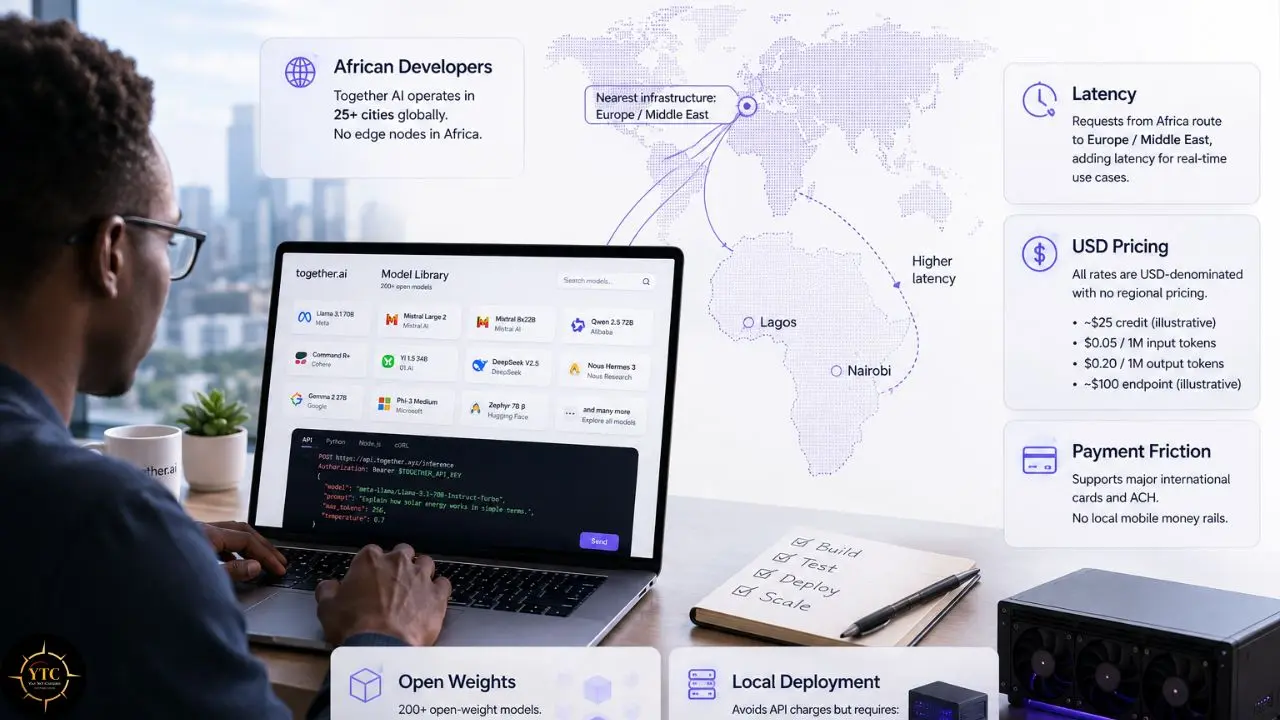
As of September 2026, Together AI operates in 25+ cities globally, but none in Africa. Nearest edge nodes are in Europe and the Middle East, so latency to Lagos or Nairobi is fine for async work but rough for real-time voice agents or interactive coding tools. A low-latency chatbot for the Nigerian market will feel the round-trip to Europe.
Pricing in African Market Context
Some Together AI promotions have offered $25 in introductory credits, but availability should be confirmed at sign-up; it is not necessarily a permanent free tier. At the quoted GPT-OSS 20B rates of $0.05 per million input tokens and $0.20 per million output tokens, $25 would cover 500 million input tokens or 125 million output tokens. Actual usage depends on the input/output mix.
Together AI’s rates are all USD-denominated with no regional pricing. At approximately August 2026 exchange rates, $25 equals roughly ₦37,500 Nigerian naira or KSh3,250 Kenyan shillings. A dedicated H100 endpoint at $4,673 per month converts to roughly ₦7.0 million or KSh607,000, prohibitive for most African startups without external funding. Serverless remains more accessible for low-volume use, while production scale may require dedicated capacity, funding, or both.
Payment Barriers
Together accepts major credit and debit cards, while ACH bank transfers are available for U.S. accounts. Its published payment methods do not include M-Pesa, mobile money payments, or local African bank transfers. This may make paid access difficult for developers without internationally enabled cards, although the availability of free credit varies by promotion and should not be treated as guaranteed.
The broader payment infrastructure context is something we track across our African fintech coverage, our mobile money evolution guide, and our mobile money Africa guide. For teams in markets where card penetration is under 20%, this friction is a structural barrier, not a minor inconvenience.
The Open-Source Advantage
Together hosts open-weight models, but licensing varies by model; not all are MIT-, Apache-, or Llama-licensed. Fine-tuned models can be downloaded for local inference or served through Together’s dedicated endpoints. Local deployment avoids API charges but still requires suitable GPUs, electricity, maintenance, and technical expertise.
Diaspora and Practical Workarounds
Developers in Europe and North America may have easier access to supported payment methods and regional infrastructure, although this varies by country. African teams can prototype locally, use eligible downloadable models, and move to Together when they need scalable inference.
I believe most African developers should treat Together as either a starting point or a scaling layer, depending on payment access, local GPU capacity, latency requirements, licensing, and production volume. For teams building on the continent, our AI in Africa category covers the broader landscape of accessible AI tools and infrastructure.
Conclusion
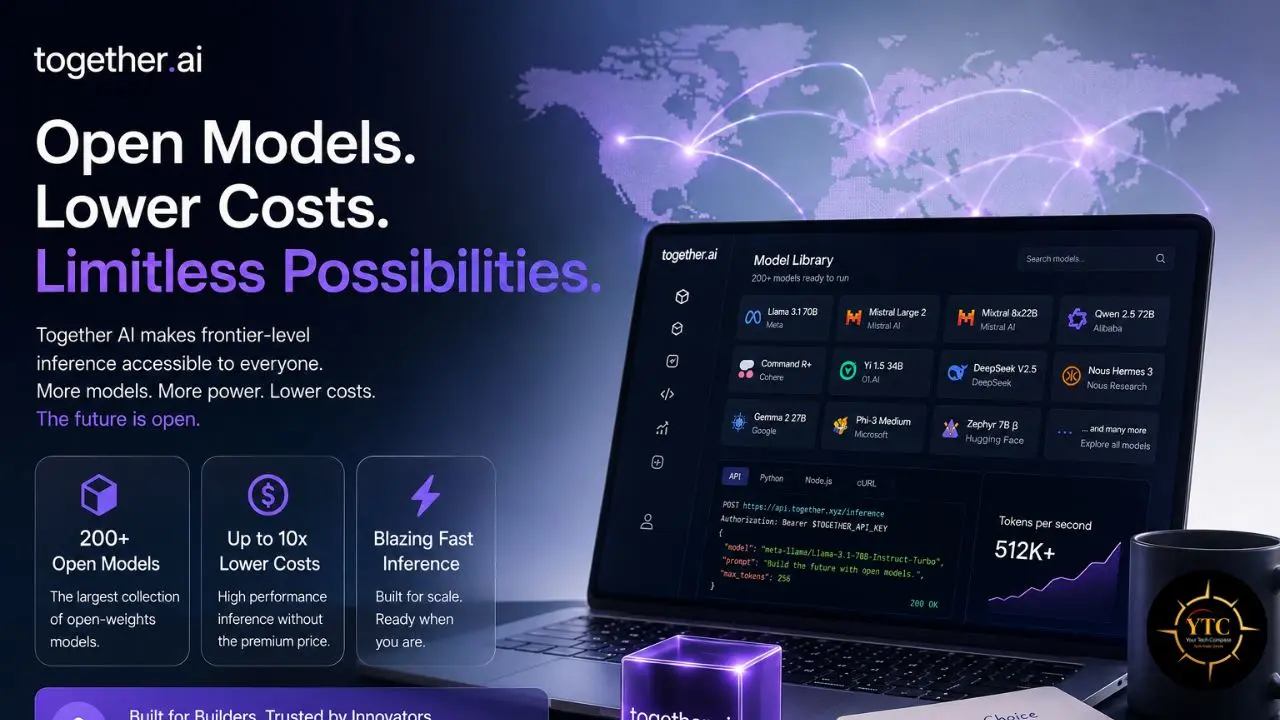
Together AI is one of the broader open-model inference platforms available in 2026. Its catalog includes more than 200 models across text, vision, image, audio, video, and embeddings, allowing teams to experiment before committing to a narrower stack. Cached-input pricing and the Batch API can reduce costs for suitable workloads, while OpenAI-compatible APIs may simplify migration from other providers.
The platform rewards careful cost and deployment analysis. Model variants require attention, serverless limits are dynamic, and dedicated inference may be necessary for predictable throughput or latency. Fine-tuning can add hosting costs, although eligible models may be downloaded for local inference. For African developers, access to payment methods, regional latency, and local infrastructure remain practical concerns, while promotional credits may support initial testing. Together is strongest when model breadth and open-weight access matter; providers such as Groq may be preferable when low latency is the priority. The choice should reflect pricing, token volume, latency, licensing, and engineering costs, not breadth alone.
If this breakdown helped you cut through the inference-provider noise, there is more where that came from; head to YourTechCompass.com for deep dives on the tools and platforms shaping how you build with AI.