

You ask an AI assistant to fix a bug in one function, and it does so confidently, cleanly, and wrongly. It couldn’t see the three other services that call that function, so its tidy patch breaks production on Friday afternoon. Plenty of developers have lived some version of that story, and it explains why a growing category of tools now competes on context rather than autocomplete.
Augment Code is one of the sharpest examples of that bet, and its 2026 has been eventful. In this guide, I’ll walk you through what Augment Code is, how its Context Engine works, and how its pricing has been restructured several times over the past year. I’ll also explain what Harness’s October 8, 2026 acquisition of select Augment assets, including Cosmos, the Auggie CLI, and the Code Context Engine, means for you, compare it with Cursor, GitHub Copilot, and Claude Code, and show what it means for teams building in Africa. Everything below comes from official pages, press coverage, and published reviews rather than my own testing, so read my opinions as informed judgment, not lab results.
A note before we begin: every YTC score is earned, never negotiated. If you want to understand exactly how we evaluate apps & tools and how we handle affiliate relationships, our Review Methodology lays it all out.
Quick Verdict
- Best For: Teams with large or multi-repo codebases that value deep codebase context and can tolerate vendor and product-roadmap change.
- Skip It If: You need inline autocomplete on a non-Enterprise plan, want a permanent free tier, or need certainty about the product’s long-term ownership, packaging, and support.
- Bottom Line: Augment Code pairs strong context technology with flat pricing that looks cheap on paper but can become unpredictable under heavy agent use. With key products now owned by Harness, I’d pilot it before making a long-term commitment.
What Is Augment Code?
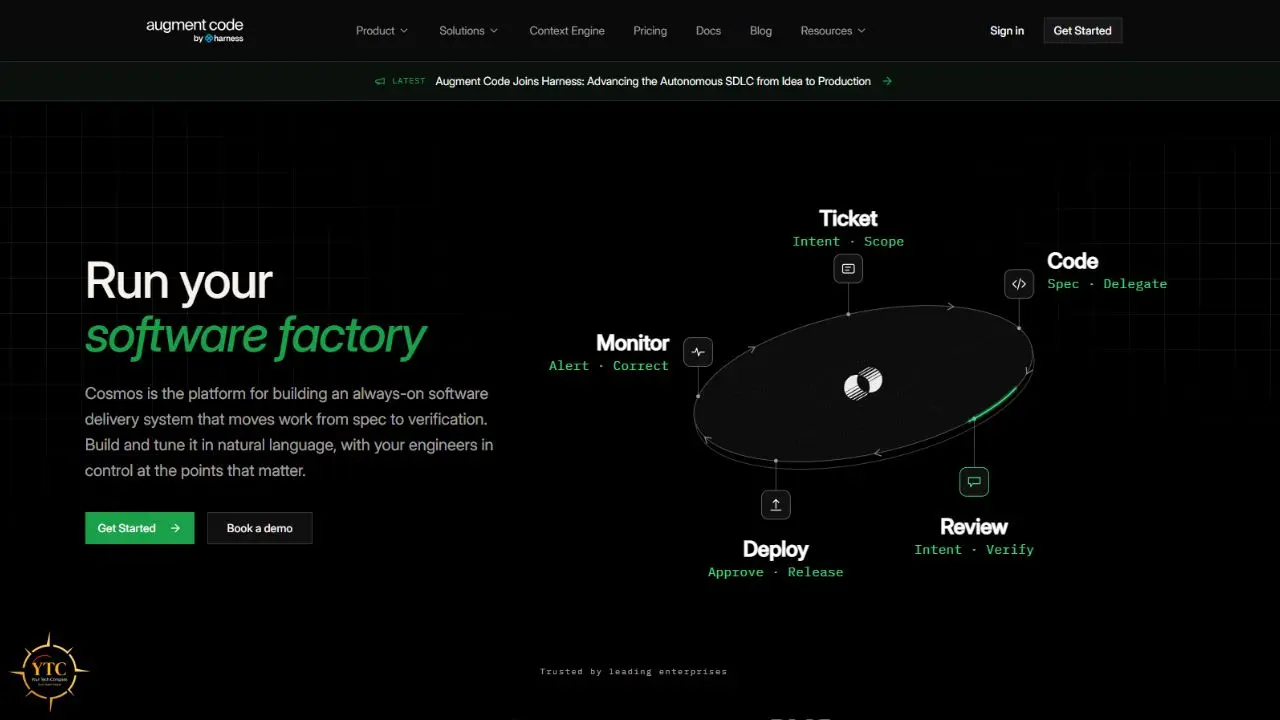
Augment Code is an AI coding platform built around a Context Engine, which indexes your codebase so agents can reason over real project context instead of one open file. The product family has several parts. It includes extensions for VS Code and JetBrains, the Auggie command-line agent, GitHub code review, and Cosmos, which Harness describes as a programmable software factory that runs a fleet of AI agents from idea to merge-ready code.
Augment raised $252 million in total funding, including a $227 million Series B announced in April 2024, and built its reputation on deep context for large codebases. What matters for you is the positioning: Augment sells understanding of your whole stack, not a faster way to type.
The Harness Deal: What Changed on October 8, 2026
On October 8, 2026, Harness announced that it had acquired select assets from Augment Code. According to Harness’s announcement, those assets include Cosmos, the Auggie CLI, the Code Context Engine, and related technology, and the team behind them joins Harness. Terms weren’t disclosed.
Notice the wording, because it matters. Coverage stresses that Harness bought select assets rather than the entire company, and Cosmos is becoming the Harness Cosmos Software Factory Agent. Augment’s pricing page now carries a Harness copyright notice, an early visible sign of the transition, though it does not answer how existing accounts, usage balances, or code indexes will be handled.
So what happens to your account? As of early November 2026, I couldn’t find a published answer on existing contracts, usage balances, or code indexes. Press analysis noted that neither side had addressed those points, so treat renewal as an open negotiation and ask for continuity terms in writing. Our piece on the model churn tax explains how to price this kind of vendor change before it lands on your budget.
The deal also sits at the end of a bumpy year for Augment’s plans, which the timeline below traces.
When | What Changed | Source |
|---|---|---|
October 20, 2025 | Credit-based plans introduced: $20 Indie, $60 Standard, $200 Max | Pricing tracker |
March 5, 2026 | Augment announces a March 31 sunset of inline completions and Next Edit for non-Enterprise plans | Augment’s changelog |
June–July 2026 | Augment moves from credit-based billing to a flat $100 Business plan, with usage billed across LLM tokens, compute, and a 40% service fee on LLM usage | Pricing tracker |
September 2026 | A flat $20 Standard plan added below Business | Pricing tracker, matching Augment’s pricing page |
October 8, 2026 | Harness acquires select Augment Code assets | Harness announcement |
How Augment Code Works
Think of Augment as a loop with four stages. It indexes your repositories, retrieves the relevant context for each task, runs an agent or a review against that context, and then hands you a pull request or an answer. The retrieval step is the product’s whole argument.
Here’s a practical example. Say you change an API response and need every downstream consumer. A file-level assistant sees the file you edited, while a context-first tool searches the wider codebase for callers, contracts, and conventions before it suggests anything.
Augment has also unbundled that retrieval layer. Its Context Engine MCP, which launched in February 2026, exposes the engine to other agents through the Model Context Protocol, and the docs list quickstarts for Claude Code, Codex, Cursor, and Gemini CLI. If MCP is new to you, our Model Context Protocol explainer covers the basics, and our AI Unboxed category explains how these coding agents reason.
Standout Features
The Context Engine

This is the engine behind everything else. It maintains a semantic index of your code, dependencies, commit history, and other project context so retrieval returns relevant snippets rather than keyword matches. It helps most on large, multi-repo systems where no single developer holds the whole picture.
The trade-off is that your code can be indexed in Augment’s cloud, although Context Engine MCP also offers a local mode through the Auggie CLI. Retrieval quality still depends on repository hygiene: stale dependencies, inconsistent structure, and poor commit history can reduce the value of semantic retrieval.
Auggie CLI and the IDE Agents
Auggie brings the same agent and context to your terminal, while the extensions cover VS Code and JetBrains. That matters because developers rarely work in one place. A terminal-first engineer and an IDE-first engineer can share the same context layer.
Cosmos, Now Harness Cosmos Software Factory Agent
Cosmos coordinates multiple agents from idea through implementation, review, and verification. Harness’s acquisition announcement names four prebuilt Experts: Project Builder, PR Author, Deep Reviewer, and PR Fixer, while later Harness material describes a broader set of workflow-specific Experts. I’d call this the most ambitious part of the stack and also the one most affected by the acquisition.
Code Review
Augment’s code review is available as an add-on for individuals and teams and reviews GitHub pull requests with AI. Enterprise adds analytics, user allowlists, MCP configuration, and multi-organization support. For a small team, that review layer can act as a tireless first reader before a human steps in.
The Context Engine MCP
Augment says adding the Context Engine MCP improved agent quality by 30% to 80% across leading agents in its own benchmarks. That figure is vendor-reported, so I’d treat it as a promising claim, not an independent result. Its docs describe a local mode that runs Auggie as an MCP server and a remote mode that connects through a GitHub App.
Where the Flagship Feature Falls Short
The Context Engine is the headline, so it deserves the hardest look. Augment’s own agent is deeply integrated with the Context Engine, while third-party agents access it through MCP; the depth of integration and available context may differ. That means the “use it with anything” story has a ceiling. Benchmarks are vendor-reported, and reviewers say retrieval misses can still produce generic or irrelevant output.
The bigger frustration for many individual developers is what Augment removed. Its March 5, 2026 changelog says it would sunset inline completions and Next Edit on March 31 for non-Enterprise plans, citing a shift toward agent workflows. My opinion: that’s a coherent product bet, but it means Augment is no longer a drop-in autocomplete.
Compared with Cursor right now: Cursor is an AI-native editor that keeps completions front and center, while Augment is context-first and agent-first inside the editor you already use. Our Cursor AI review covers that side in depth. In my view, the choice comes down to whether you value a new editor or deeper context.
Augment Code Pricing in 2026
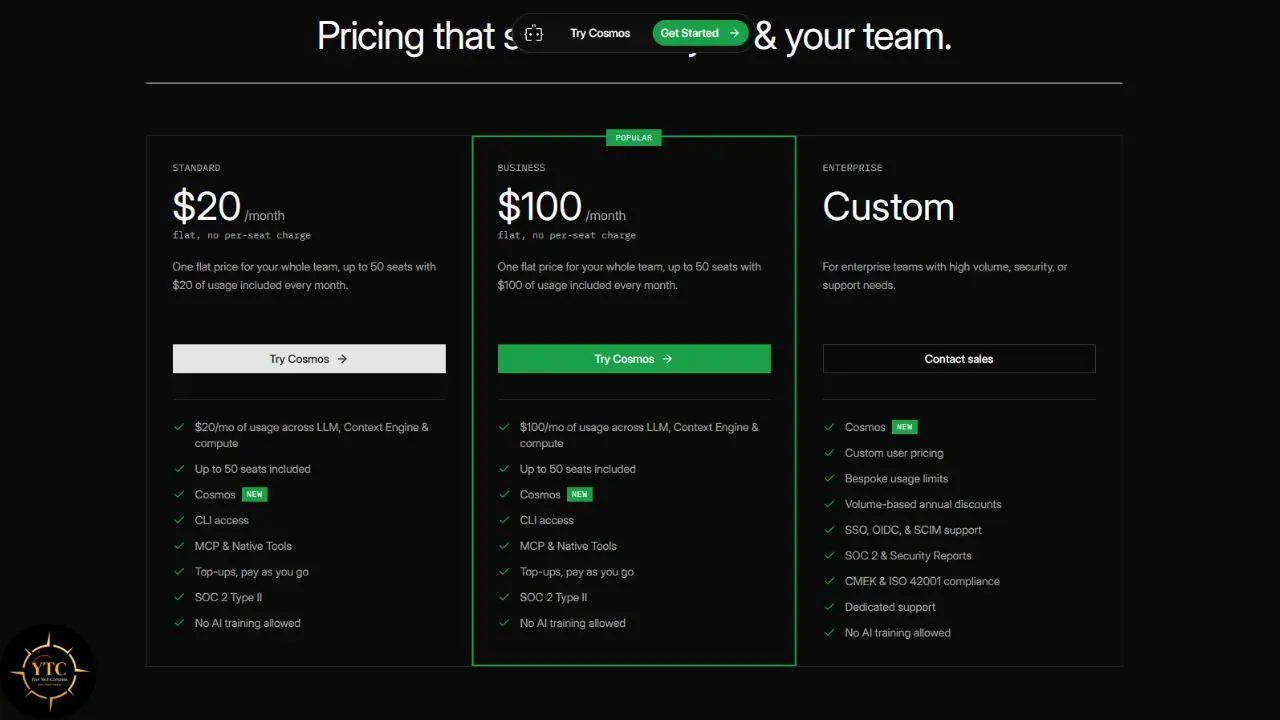
Augment’s official pricing page lists three plans as of November 1, 2026. Both self-serve plans are flat, with no per-seat charge.
Augment’s Plans at a Glance
Plan | Price | Included Usage | Seats | Notable Inclusions |
|---|---|---|---|---|
Standard | $20/month flat | $20/month across LLMs, Context Engine, and compute | Up to 50 | Context Engine, agents, CLI, MCP, Cosmos, SOC 2 Type II |
Business | $100/month flat | $100/month across LLMs, Context Engine, and compute | Up to 50 | Same core features, more included usage |
Enterprise | Custom | Custom usage and custom top-ups | Unlimited users | Custom compute, multi-region compute, unlimited concurrent sessions, dedicated support |
Augment also lists SOC 2 Type II, CMEK and ISO 42001 compliance, SIEM integration, data-residency options, granular access controls, audit trails, and Enterprise SSO in its plan comparison. For procurement purposes, treat Enterprise as the tier for custom limits, larger teams, multi-region compute, and dedicated support rather than assuming every security control is exclusive to it.
Usage works like a prepaid dollar balance. Model calls bill at the provider’s public API list price plus a flat 40% service fee, while compute carries no fee. Your team shares one pool, and when it runs dry, you top up pay-as-you-go; purchased top-ups are valid for 12 months.
Now for the math. Spread across five developers, Standard works out to $4 each, and Business across 25 developers is also $4 each. Because of the 40% fee, a task that costs $2 at the provider’s list price costs $2.80 through Augment, so if your $20 goes entirely to model calls, it buys about $14 of list-price usage. The caveat is that Augment’s balance also covers Context Engine and compute, so your effective model budget may be lower if those services consume part of the pool.
The catch is the word “pooled.” A team of 10 sharing $100 gets about $10 each, and heavy agent work can burn credits quickly. So the flat price is cheap on paper, but your real bill depends on top-ups.
What a 10-Developer Team Pays
Option for a 10-Developer Team | Monthly Cost | What’s Included | Billing Model |
|---|---|---|---|
Augment Standard | $20 flat | $20 pooled usage | Model usage at provider list price plus 40% fee; Context Engine and compute also draw from the pool |
Augment Business | $100 flat | $100 pooled usage | Same |
GitHub Copilot Business | $190 ($19 × 10) | 1,900 AI Credits per user, worth about $19 | Usage-based AI Credits since June 1, 2026; credits are pooled at the billing-entity level |
Cursor Teams Standard | $300 ($30 × 10) | Included usage for Cursor’s first-party models; third-party models are not included | Third-party model usage is billed at public API list prices plus Cursor’s Token Rate, paid from a team prepaid balance |
Compared to GitHub Copilot right now: Copilot Business is per-seat and predictable at $19 per user, and GitHub says inline completions remain unlimited on paid plans. Our GitHub Copilot explainer covers the details. Augment’s pooled dollars can stretch further for a big team, but they’re harder to forecast.
Which model you route to also changes the bill, since frontier models cost very different amounts per token. If that choice matters to you, our GPT-5.5 vs. Claude Opus 4.8 comparison shows how two leading models differ.
Legal, Privacy, and Risk Considerations
Data and Training

Augment says all paid plans exclude AI training on your data under its Commercial Terms, and it holds SOC 2 Type II. The stronger controls (customer-managed encryption keys, ISO 42001, SIEM integration, and data residency options) are positioned around the Enterprise plan. If your client contracts demand those controls, budget for Enterprise and confirm the exact contractual commitments in writing.
That distinction matters: Augment’s Community Terms permit training on customer code, output, and usage data, while its paid Commercial Terms exclude AI training on customer data. Do not assume the no-training commitment applies to a free or community-tier workflow.
Where Your Code Goes
Cloud indexing means your source code leaves your machine, and you control scope with ignore files. For teams in Nigeria, Kenya, or South Africa handling client data, that raises data-protection questions. Our coverage of AI policy in Africa tracks how rules are evolving.
Ownership and Contract Risk
The Harness deal leaves continuity unanswered, so ask whether your contract is being assigned and get the answer in writing. It’s worth separating what works today from what’s settled. Harness acquired select Augment assets, including Cosmos, the Auggie CLI, and the Code Context Engine; Cosmos remains accessible through Augment’s existing site for now, but the integration roadmap has no published release date.
Verifying AI-Written Code
Context doesn’t remove the need to review. In Stack Overflow’s 2025 Developer Survey, 46% of developers said they distrust AI accuracy against 33% who trust it, and 66% named “almost right, but not quite” as their top frustration. Keep a human review step on anything an agent writes.
Augment Code vs. the Alternatives
Tool | Approach | Free Tier | Team Entry Price | Best Fit |
|---|---|---|---|---|
Augment Code | Context Engine plus agents, CLI, and IDE extensions | No free plan listed | $20 or $100 flat (up to 50 seats) | Large or multi-repo teams |
Cursor | AI-native editor with agents | Hobby (free, limited) | From $30 per user/month (Teams) | Editor-first developers |
GitHub Copilot | Assistant inside GitHub and IDEs | Free plan | $19 per seat (Business) | GitHub-centered organizations |
Claude Code | Terminal agent | Not included on Claude Free | Included with paid Claude plans; also available through API usage | Terminal-first developers |
Prices changed during 2026, and usage models differ sharply, so confirm each figure on the vendor’s page before buying.
Augment Code vs. Cursor
Cursor replaces your editor, while Augment adds a context layer to the one you have. If your team lives in JetBrains, that difference is practical rather than philosophical. I’d pick Cursor for editor-centered workflows and Augment for sprawling repositories.
Augment Code vs. Claude Code
Claude Code is a terminal agent, and its context comes primarily from runtime search and agent tools rather than a persistent, pre-built index. The two aren’t strict rivals, because Augment’s Context Engine MCP can plug into Claude Code. In my opinion, that combination is the most interesting use of Augment’s technology right now.
Augment Code vs. GitHub Copilot
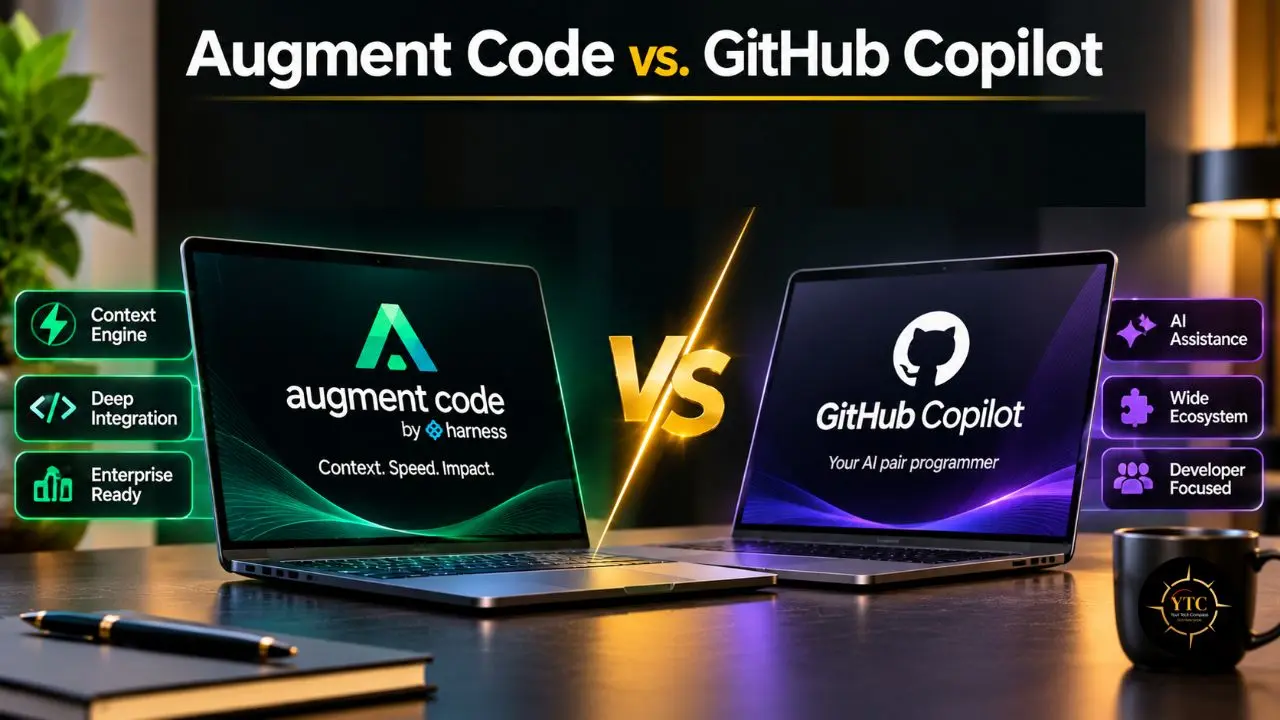
Copilot is broader, cheaper per seat, and native to GitHub. Augment’s edge is depth on large systems, not breadth. If you’re weighing agent harnesses more generally, our OpenClaw explainer covers another approach, and our Apps and Tools category covers the wider landscape.
Real-World Use Cases
- Onboarding Engineers to a Large Codebase: You ask the agent how a payment flow works across five services instead of interrupting a senior colleague. Context retrieval turns that question into minutes of reading.
- Multi-Repo Refactors: You change a shared contract and let the agent surface likely consumers and cross-repository impacts. This is where context-first tools justify their cost.
- Automated Pull Request Review: Code review gives every PR a first pass before a human looks. It won’t replace reviewers, but it can catch the obvious issues early.
- Ticket-to-PR Workflows: Cosmos aims to take a ticket through implementation and review. Given the acquisition, I’d pilot this on low-risk work first.
- The Outsourcing Shop in Nairobi or Lagos: A team maintaining several client repositories can share one flat plan across up to 50 seats. Watch the pooled usage, and confirm your clients allow cloud indexing of their code.
Honest Limitations
- No Published Free Tier: You can’t explore it casually, so confirm whether a trial exists before committing.
- Pooled Usage Drains Fast: Heavy agent runs can burn through a small balance, and additional LLM usage on top-ups carries the 40% service fee; compute is billed separately.
- Repeated Pricing Changes: Augment changed its pricing model more than once in about a year, moving from per-message pricing to credits and then to dollar-based usage. That makes budgeting harder.
- Ownership Transition: Contract, balance, and index continuity remain unaddressed in public coverage of the Harness acquisition.
- No Inline Completions: Non-Enterprise plans lost them in March 2026.
- Security Controls Concentrated in Enterprise: CMEK, SIEM integration, and data residency are positioned with Enterprise rather than the flat self-serve plans.
- Community-Level Support: Standard and Business get community support plus tickets, while dedicated support is Enterprise-only.
The Review Landscape: Thin Volume, Mixed Signals
Public review volume is limited and mixed. G2 shows 35 reviews with a 4.0/5 average, Trustpilot shows only five reviews at 3.0/5, and Gartner Peer Insights shows about 42 reviews with a much stronger 4.8/5 score. One aggregator puts its overall confidence near 50%, so treat every figure as provisional.
The themes repeat. Reviewers praise deep codebase context, while critics point to cost predictability and abrupt pricing changes. Many reviews also describe the older credit-based plans, so they may not match what you’d buy today.
Who Should and Shouldn’t Use Augment Code
Use Augment Code if you are:
- A team with several repositories and shared service contracts.
- An engineering org that wants agent-driven reviews and refactors.
- A shop that can pilot cheaply on the $20 plan, while watching its $20 pooled-usage limit.
- A team comfortable negotiating terms during a vendor transition.
Skip Augment Code if you are:
- A solo developer who wants inline autocomplete.
- Working in a small single repository where context is simple.
- Unable to meet Augment’s data-handling, security, or compliance requirements for your code.
- Looking for a stable, long-term vendor relationship right now.
Augment Code for African Teams

The best news is the entry price. A flat $20 plan covering up to 50 seats could suit a small African dev shop, provided your usage stays within the pool. Augment prices its plans in U.S. dollars, so currency swings against the naira, cedi, shilling, or rand and card or foreign-exchange fees will shape the real cost.
The pricing page does not clearly list accepted payment methods, so confirm that your card works before you plan around it. Our African FinTech coverage tracks how payment rails are evolving for exactly this kind of problem. Teams building payments or mobile-money software also handle sensitive code, which makes Augment’s Enterprise-positioned data-residency options worth asking about.
Connectivity matters too. Cloud indexing and agent runs need a stable connection, although Context Engine MCP’s local mode can reduce reliance on cloud indexing during active development. I couldn’t confirm latency from African regions. Our AI in Africa and wider African Tech categories follow how developers across the continent are adopting these tools.
FAQs
Augment Code is an AI coding platform built around a Context Engine that indexes your codebase. It offers IDE extensions, the Auggie CLI, code review, and Cosmos for coordinating agents.
Augment’s pricing page lists a $20 monthly Standard plan and a $100 monthly Business plan, each flat for up to 50 seats with matching included usage. Enterprise is custom, and usage beyond the included balance is billed pay-as-you-go.
I couldn’t find a published free plan on its pricing page. Confirm whether a trial exists before you plan around one.
Harness acquired select Augment Code assets on October 8, 2026, including Cosmos, the Auggie CLI, and the Code Context Engine. Coverage notes it wasn’t a purchase of the entire company.
It depends on your workflow. Augment’s strength is deep context across large codebases, while Cursor is editor-first and Claude Code is terminal-first. You can also pair Augment’s Context Engine with other agents through MCP.
Augment says paid plans exclude AI training on your data under its Commercial Terms. Read those terms yourself before you index client code.
Reading the Terrain Before You Commit

Augment Code made a clear bet that context beats autocomplete, and its Context Engine is the reason to take it seriously. Over the past year, it changed its pricing model more than once, dropped inline completions for non-Enterprise plans, and then saw its flagship products move to Harness. My read is that the technology is strong and the vendor picture is unsettled, so the smartest move is a small, reversible pilot.
If you lead a team, start on the $20 plan with one real repository, measure how fast the pooled usage drains, and get continuity terms in writing before you scale. If you build tools or invest in them, notice how quickly AI coding is moving from assistants to autonomous delivery pipelines, and ask where African developers fit in that stack. The teams that learn to verify agent output at the speed it arrives will benefit most.
Chart your next engineering decision with the same care: more research-first coverage of the tools shaping our world at YourTechCompass.com.